

Environmentally friendly comprehensive hydrometallurgical method development for neodymium recovery from mixed rare earth aqueous solutions using organo-phosphorus derivatives
Open accessThe DOI matches its Crossref record; 39 of the 39 references it cites were found in a registry or an index; 11 of the 27 sources its claims cite were checked for support.
Abstract
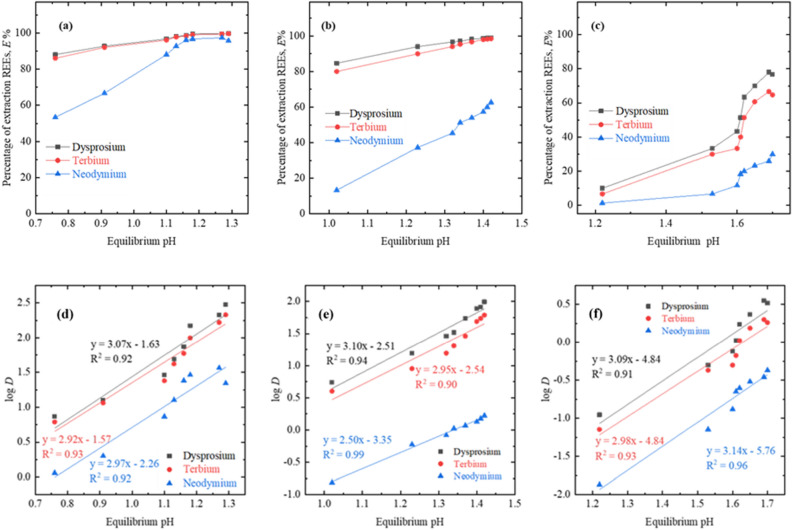
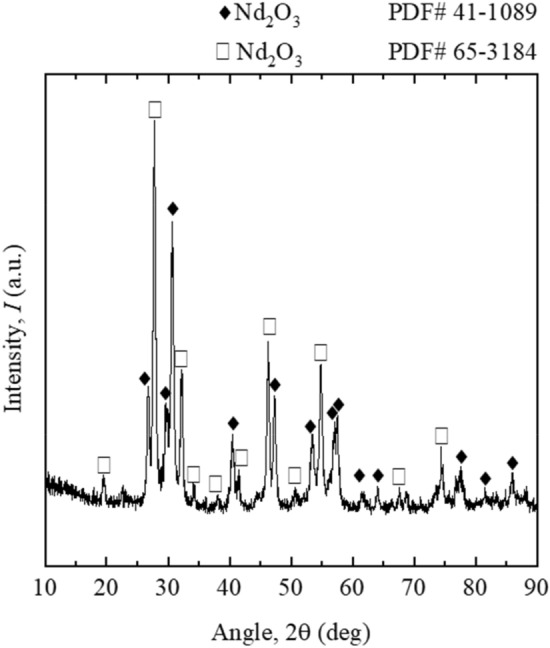
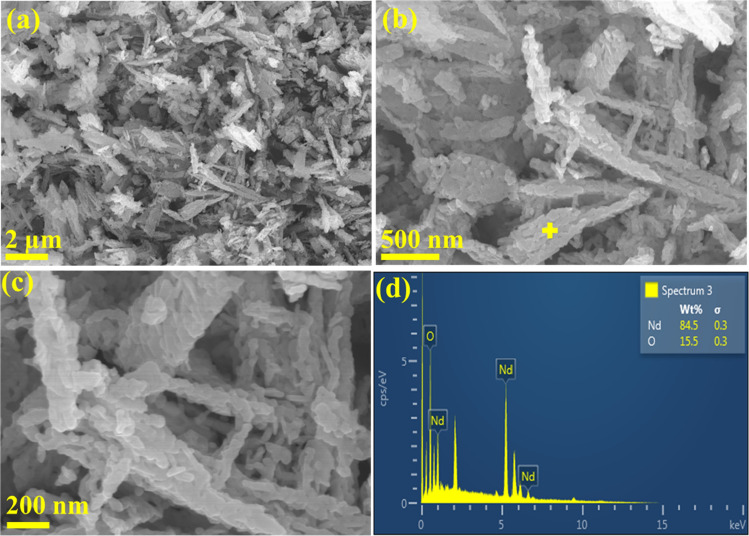
Rare earth elements (REEs) have obtained a greatest significant in human lives owing to their important roles in various high technology applications. The present method development was deal technology important REEs such as neodymium, terbium and dysprosium, selective extraction with possible separation and recovery studies, successfully. The chloride mediated mixed aqueous solution containing 1500 mg/L each of REEs such as Nd, Tb and Dy was subjected at selective separation of Nd from other associated REEs. Three organo-phosphorous based commercial extracting agents such as Cyanex 272, PC 88A and D2EHPA, were employed for the extraction, possible separation and recovery of rare earth elements. A comparative extraction behavior of all these three extractants as function of time, pH influence, extractant concentration, temperature and diluents were systematically investigated. The extraction tendency of organo-phosphorus reagents towards the extraction of either of the REEs follows of the sequence as: D2EHPA > PC 88A > Cyanex 272. The thermodynamic behavior of either of the extractants on liquid-liquid extraction processing of REEs was investigated and thermodynamic calculations were calculated and presented. Substantial recovery of neodymium oxalate followed by its calcined product as neodymium oxide was ascertained from XRD study and SEM-EDS analysis.
Overview
CoChat Summary
TL;DR
This study develops a hydrometallurgical solvent-extraction route to selectively recover neodymium from a synthetic mixed rare-earth chloride solution containing Nd, Tb, and Dy using organo-phosphorus extractants. D2EHPA outperformed PC 88A and Cyanex 272, enabling Nd enrichment up to 11.7-fold and recovery of Nd₂O₃.
Key findings
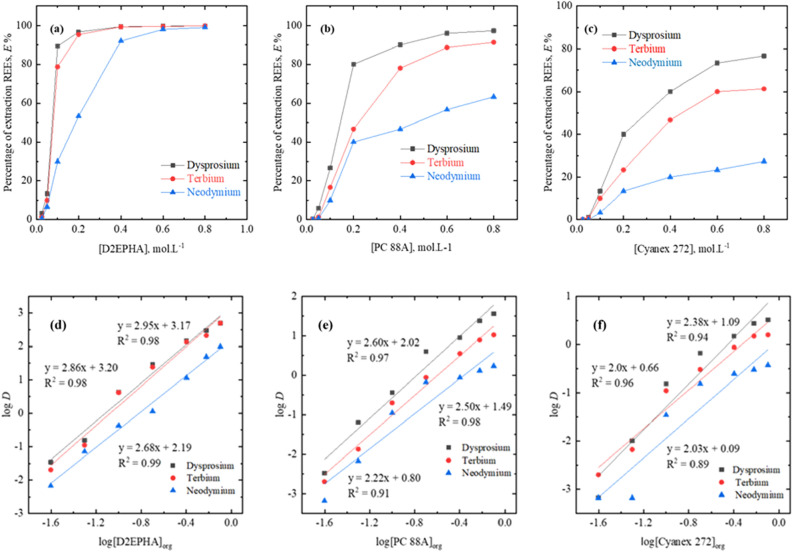
- Extraction efficiency followed D2EHPA > PC 88A > Cyanex 272. At 0.8 mol/L, D2EHPA extracted ~99% of Nd, Tb, and Dy; PC 88A extracted 97–98% Dy, 91% Tb, and 63–64% Nd; Cyanex 272 extracted ~76% Dy, 61% Tb, and 27% Nd.
- Slope analysis indicated release of 2–3 mol H⁺ and association of 2–3 mol extractant per mole of REE. For D2EHPA, log D vs log extractant slopes were ~2.68–2.95; for PC 88A, 2.60, 2.50, and 2.22 for Dy, Tb, and Nd; for Cyanex 272, 2.38 for Dy and 2.0 for Tb/Nd.
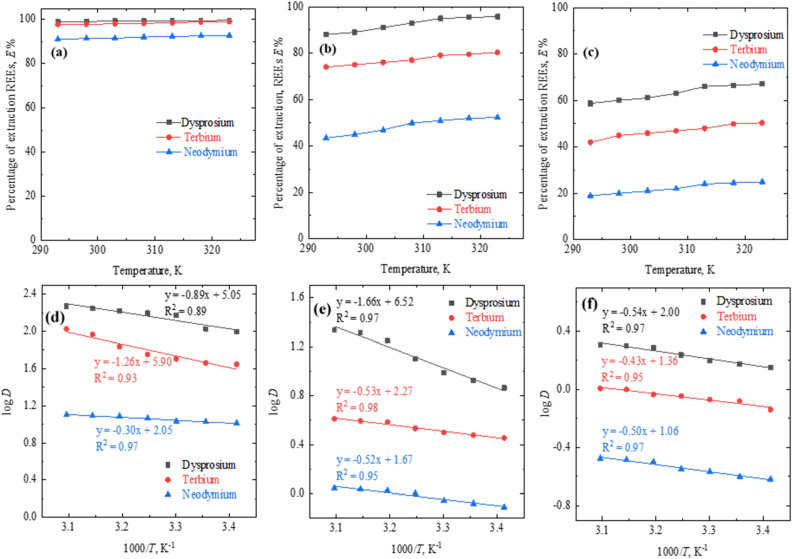
- Thermodynamics with D2EHPA gave positive ΔH values of 17.04, 24.13, and 5.74 kJ/mol for Dy, Tb, and Nd, indicating endothermic extraction; ΔG values were −11.77, −9.54, and −5.96 kJ/mol, and ΔS values were 96.69, 112.97, and 39.25 J/mol.
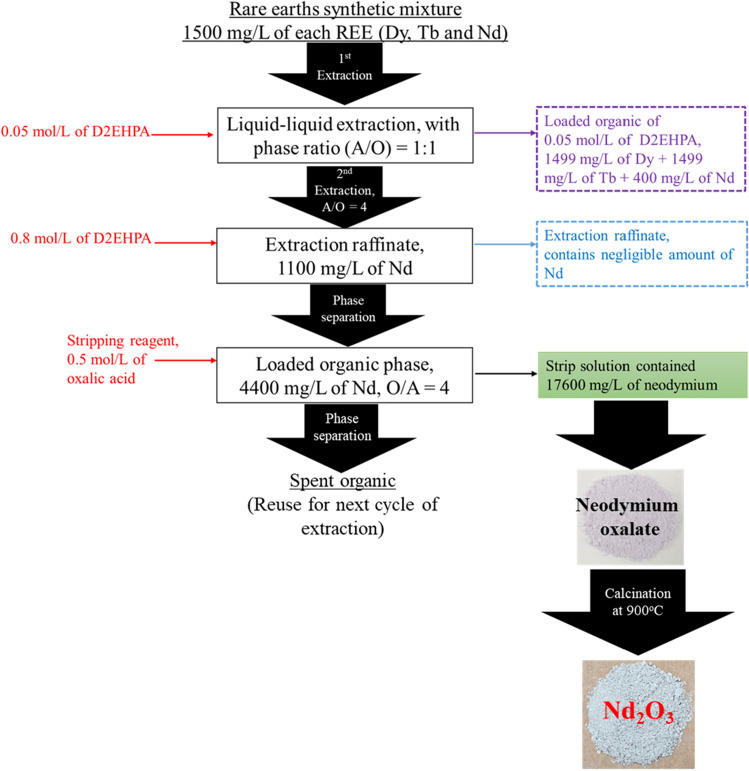
- McCabe–Thiele analysis predicted 3 and 4 stages for complete Dy and Tb extraction at A:O = 1; a 4-stage counter-current simulation gave raffinate with <1 mg/L Dy, <1 mg/L Tb, and 1100 mg/L Nd, with >99.9% Dy/Tb extraction and ~26.7% Nd co-extraction. For Nd, 0.8 mol/L D2EHPA at A:O = 4:1 required two stages for >99.9% extraction; stripping with 0.5 mol/L oxalic acid at SO:SS = 4:1 gave >99.9% Nd stripping and ~17,600 mg/L Nd, enabling 11.7-fold enrichment. Final Nd₂O₃ showed Nd and O at 84.5 and 15.5 wt%, with fused particles about 30–50 nm.
Methods
- Synthetic chloride leach liquor containing 1500 mg/L each of Nd, Tb, and Dy was prepared by dissolving rare-earth oxides in HCl and distilled water.
- Batch liquid–liquid extraction used D2EHPA, PC 88A, or Cyanex 272 in Exxsol D80, with shaking at 250 rpm, 60 min contact time, A/O = 1 unless varied; pH was adjusted with HCl or NaOH, and REE concentrations were analyzed by ICP.
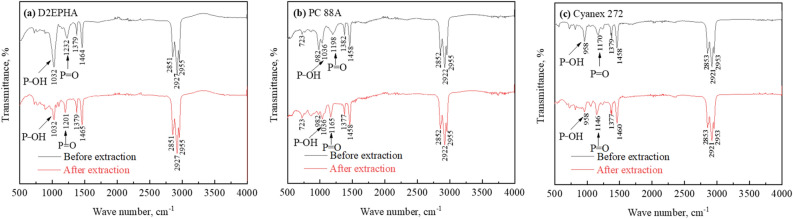
- The study compared time, equilibrium pH, extractant concentration, temperature, and diluents; characterized organic phases by FT-IR and the final product by XRD and FE-SEM/EDS; and used slope analysis, thermodynamic plots, McCabe–Thiele diagrams, and counter-current simulation.
Limitations
- Stated limitations: Not stated in the paper.
- Evident from the text: all extractions used a synthetic chloride solution prepared from rare-earth oxides, not an actual leach liquor or secondary waste; the work is laboratory-scale batch testing.
- Evident from the text: several key isotherm and simulation results are placed in Supplementary Data files rather than fully reported in the main text, and the provided text is fragmented/reordered, limiting independent verification of some details.
Model-written summary. Check it against the paper before relying on it.
Integrity signals
Registry
Cites
Statistics
Figures
Verification
Claims the paper makes
4 Valid · 1 Not valid · 3 Not checked · 55 Own results and interpretations
The sources with a verdict support this claim; the rest weren’t checked yet, have no full text we could read, or their verdicts aren’t rated yet.
In the paper
“Nonetheless, the SX process further enables on separation of target REEs up to greater extent in presence of other REEs and/or base metal impurities15,21.”
§ Environmentally friendly comprehensive hydrometallurgical method development for neodymium recovery from mixed rare earth aqueous solutions using organo-phosphorus derivatives > Introduction
What the sources say
- Supportedcites [15] Xie F Dreisinger D Doyle F A critical review on solvent extraction of rare earths from aqueous solutions Miner. Eng. 2014 56 10 28 10.1016/j.mineng.2013.10.021 source
Section 3.1 (Configurations) states that rare earth SX processes comprise primary separations, which separate REEs from other elements in the leach liquor, and secondary separations, which produce single or mixed REE products from the mixed REE stream; Section 3 repeats that D2EHPA is widely used for primary separation because the distribution coefficients of the REEs as a group differ markedly from those of typical impurities. Section 3.2 adds that the chemistry is controlled to make the distribution coefficient of the desired element(s) much higher than that of unwanted elements, with scrubbing to remove residual impurities, and Section 2 calls SX 'generally accepted as the most appropriate commercial technology for separating rare earths'. Together these support the paraphrase that SX enables separation of target REEs to a greater extent alongside other REEs and/or base-metal impurities (though Section 1.3 notes iron-rich impurities are often precipitated out before the SX circuit). (LLM, conf=0.80)
- Not checked — no full text of the sourcecites [21] Thakur NV Separation of rare earths by solvent extraction Miner. Process. Extract. 2000 21 1–5 277 306 10.1080/08827500008914171 source
states a cause- Asserted: passes — The authors put it forward as true.
- Checkable: passes — It can be checked against evidence.
- Load-bearing: passes — The paper’s conclusions depend on it.
- Based: passes — The paper gives a reason why it holds.
- Supported
The cited sources support only part of this claim — read each source’s verdict below.
In the paper
“It has been noticed that during the process development the key challenge is encountered at the downstream stage for separation of the Nd in presence of Dy, Pr and Tb since they possess similar characteristics separation behavior16–19.”
§ Environmentally friendly comprehensive hydrometallurgical method development for neodymium recovery from mixed rare earth aqueous solutions using organo-phosphorus derivatives > Introduction
What the sources say
- Not checked — no full text of the sourcecites [16] Jyothi RK Rare-Earth Metal Recovery for Green Technologies: Methods and Applications, ISBN: 978-3-030-38105-9 2020 Cham Springer source
- Partly supportedcites [17] Jha MK Kumari A Panda R Kumar JR Yoo K Lee JY Review on hydrometallurgical recovery of rare earth metals Hydrometallurgy 2016 165 2 26 10.1016/j.hydromet.2016.01.035 sourceExperimental — accuracy not yet measured
The Fluorescent tubes section (p. 13) says rare-earth separation can require many extraction stages because of low separation factors, and describes separating Nd from a fraction that also contains Pr. It also discusses difficult Dy separations, but does not identify downstream separation of Nd specifically from Dy, Pr, and Tb as a key challenge or say that all four have similar separation behavior. (LLM, conf=0.83)
- Not checked — no full text of the sourcecites [18] Yoon HS Kim CK Chung KW Kim SD Lee JY Kumar JR Solvent extraction, separation and recovery of the dysprosium (Dy) and neodymium (Nd) from aqueous solutions: waste recycling strategies for permanent magnet processing Hydrometallurgy 2016 165 27 43 10.1016/j.hydromet.2016.01.028 source
- Not checked — no full text of the sourcecites [19] Kumari A Panda R Jha MK Kumar JR Lee JY Process development to recover rare earth metals from monazite mineral: a review Miner. Eng. 2015 79 102 115 10.1016/j.mineng.2015.05.003 source
plainstates a cause- Asserted: passes — The authors put it forward as true.
- Checkable: passes — It can be checked against evidence.
- Load-bearing: passes — The paper’s conclusions depend on it.
- Based: passes — The paper gives a reason why it holds.
The sources with a verdict support this claim; the rest weren’t checked yet, have no full text we could read, or their verdicts aren’t rated yet.
In the paper
“The present study concluded that the cation exchange mechanism was strongly supported by the previous works15–17 while extracting these REEs from numerous aqueous media.”
§ Environmentally friendly comprehensive hydrometallurgical method development for neodymium recovery from mixed rare earth aqueous solutions using organo-phosphorus derivatives > Result and discussions > Effect extractant concentration
What the sources say
- Supportedcites [15] Xie F Dreisinger D Doyle F A critical review on solvent extraction of rare earths from aqueous solutions Miner. Eng. 2014 56 10 28 10.1016/j.mineng.2013.10.021 source
Section 2.1 'Cation exchangers' states that 'The overall extraction of rare earth elements from aqueous media by cation exchange extractants in their acidic form can generally be expressed as' the cation-exchange reaction of Peppard et al. (1958), refined by Mason et al. (1978) to account for dimeric acid — i.e. the mechanism is credited to earlier works. The Reagents class section adds further prior studies confirming it across media (Sato, 1989: 'The extraction of rare earths with HEHEHP follows Eq. (1)... from chloride and nitrate media'; Peppard et al. (1957a,b) on chloride; Zhang et al. (2007) on sulfate; Saleh et al. (2002) on nitrate-acetato), and Section 2.2 extends it to chelating extractants ('extract metals by a cation ion exchange mechanism'). The review's caveat that the real process is more complicated than the simple equation (aggregation, undissociated acid) does not contradict the cation-exchange mechanism itself. (LLM, conf=0.82)
- Not checked — no full text of the sourcecites [16] Jyothi RK Rare-Earth Metal Recovery for Green Technologies: Methods and Applications, ISBN: 978-3-030-38105-9 2020 Cham Springer source
- Supportedcites [17] Jha MK Kumari A Panda R Kumar JR Yoo K Lee JY Review on hydrometallurgical recovery of rare earth metals Hydrometallurgy 2016 165 2 26 10.1016/j.hydromet.2016.01.035 source
Section 4.2.1.1 (p. 11) describes extraction of rare earths from aqueous media by cationic extractants and gives a general expression for it. Section 4.2 (p. 10) reports rare-earth extraction from nitrate, sulfate, chloride, and perchlorate solutions, supporting the reference to multiple aqueous media. (LLM, conf=0.88)
boostedstates an association- Asserted: passes — The authors put it forward as true.
- Checkable: passes — It can be checked against evidence.
- Load-bearing: unclear — It is unclear whether the paper’s conclusions depend on it.
- Based: passes — The paper gives a reason why it holds.
- Supported
The cited sources that could be checked couldn’t confirm or dispute this claim.
In the paper
“In most case studies, separation is performed from the solution bearing binary or unitary REEs systems with limited reports of tertiary systems8–11.”
§ Environmentally friendly comprehensive hydrometallurgical method development for neodymium recovery from mixed rare earth aqueous solutions using organo-phosphorus derivatives > Introduction
What the sources say
- Could not verifycites [8] Case ME Fox R Fox V Baek BJ Mincher BJ Wai CM Extraction behavior of selected rare earth metals from acidic chloride media using tetrabutyl diglycolamide Solvent. Extr. Ion Extract. 2017 35 7 496 506 10.1080/07366299.2017.1373984 sourceExperimental — accuracy not yet measured
The Introduction discusses rare-earth recovery and hydrometallurgical separation, but does not compare how often studies use one-, two-, or three-element systems. Searches for binary, unitary, and ternary systems found no passage in our copy supporting the claimed pattern; the Materials and Methods section describes this paper’s experiments, not the prevalence of those study designs. (LLM, conf=0.74)
- Could not verifycites [9] Basulto C Study of the solvent extraction of the lighter lanthanide metal ions by means of organophosphorus extractants J. Chil. Chem. Soc. 2013 58 2 1785 1789 10.4067/S0717-97072013000200032 sourceExperimental — accuracy not yet measured
The Introduction (p. 1) says solvent extraction is used to separate rare earth elements, and the Experimental section (p. 1) describes this paper’s solutions. Neither addresses how often published studies use single-, binary-, or ternary-element systems; searches for those terms found no such comparison. (LLM, conf=0.75)
- Not checked — no full text of the sourcecites [10] Banda R Jeon H Lee M Solvent extraction separation of Pr and Nd from chloride solution containing La using Cyanex 272 and its mixture with other extractants Sep. Purif. Technol. 2012 98 481 487 10.1016/j.seppur.2012.08.015 source
- Could not verifycites [11] Gergoric M Barrier A Retegan T Recovery of rare-earth elements from neodymium magnet waste using glycolic, maleic, and ascorbic acids followed by solvent extraction J. Sustain. Met. 2018 5 1 85 96 10.1007/s40831-018-0200-6 sourceExperimental — accuracy not yet measured
The Introduction and Liquid-Liquid Extraction sections discuss this paper’s magnet leachates and separation of REEs from other metals. They do not compare how often published studies use single-REE, binary-REE, or ternary-REE solutions. Searches for those system types found no passage supporting the claimed prevalence. (LLM, conf=0.72)
plain- Asserted: passes — The authors put it forward as true.
- Checkable: passes — It can be checked against evidence.
- Load-bearing: passes — The paper’s conclusions depend on it.
- Based: passes — The paper gives a reason why it holds.
- Could not verify
A result the paper reports from its own data — it cites no other source for it, so there is none to check. The quote shows it is in the paper.
In the paper
“On the other hand, 76%, 61%, and 27% of Dy, Tb and Nd respectively using 0.8 mol/L of Cyanex 272 were extracted from the synthetic leach liquor in 60 min of contact time.”
§ Environmentally friendly comprehensive hydrometallurgical method development for neodymium recovery from mixed rare earth aqueous solutions using organo-phosphorus derivatives > Result and discussions > Effect of time on rare earths extraction
plainstates a cause- Asserted: passes — The authors put it forward as true.
- Checkable: passes — It can be checked against evidence.
- Load-bearing: unclear — It is unclear whether the paper’s conclusions depend on it.
- Based: passes — The paper gives a reason why it holds.
- Rests on an assumption not shown here.
33 more claims
Create a free account to see all 63 claims and to verify the 2 references still open.
- Probably not a substantial claim. 6
- It may state two separate claims as one. 20
Citations
Cites
A critical review on solvent extraction of rare earths from aqueous solutions
Xie, F., Zhang, T. A., Dreisinger, D., & Doyle, F. (2014) · Minerals Engineering · doi:10.1016/j.mineng.2013.10.021 · Cited by 1,444
Evaluating Rare Earth Element Availability: A Case with Revolutionary Demand from Clean Technologies
Alonso, E., Sherman, A. M., Wallington, T. J., Everson, M. P., Field, F. R., Roth, R., & Kirchain, R. E. (2012) · Environmental Science & Technology · doi:10.1021/es203518d · Cited by 1,033
Review on hydrometallurgical recovery of rare earth metals
Jha, M. K., Kumari, A., Panda, R., Rajesh Kumar, J., Yoo, K., & Lee, J. Y. (2016) · Hydrometallurgy · doi:10.1016/j.hydromet.2016.01.035 · Cited by 688
Self-citationSolvent extraction in hydrometallurgy: the role of organophosphorus extractants
Flett, D. S. (2005) · Journal of Organometallic Chemistry · doi:10.1016/j.jorganchem.2004.11.037 · Cited by 294
Process development to recover rare earth metals from monazite mineral: A review
Kumari, A., Panda, R., Jha, M. K., Kumar, J. R., & Lee, J. Y. (2015) · Minerals Engineering · doi:10.1016/j.mineng.2015.05.003 · Cited by 294
Self-citationRadhika, S., Batchu, N. K., Kantam, M. L., & Reddy, B. R. (2010) · Separation and Purification Technology · doi:10.1016/j.seppur.2010.08.018 · Cited by 169
Synergistic effect of Cyanex 272 and Cyanex 302 on separation of cobalt and nickel by D2EHPA
Darvishi, D., Haghshenas, D. F., Alamdari, E. K., Sadrnezhaad, S. K., & Halali, M. (2005) · Hydrometallurgy · doi:10.1016/j.hydromet.2005.02.002 · Cited by 159
Yoon, H.-S., Kim, C.-J., Chung, K.-W., Kim, S.-D., Lee, J.-Y., & Kumar, J. R. (2016) · Hydrometallurgy · doi:10.1016/j.hydromet.2016.01.028 · Cited by 159
Self-citationBattsengel, A., Altansukh, B., Narankhuu, A., Haga, K., Watanabe, Y., & Shibayama, A. (2018) · Hydrometallurgy · doi:10.1016/j.hydromet.2018.05.024 · Cited by 156
Solvent extraction of rare earth elements using phosphonic/phosphinic acid mixtures
Quinn, J. E., Soldenhoff, K., Stevens, G. W., & Lengkeek, N. A. (2015) · Hydrometallurgy · doi:10.1016/j.hydromet.2015.09.005 · Cited by 155
Research works printed but not linked: 2
- European commission final report on “Study on the review of the list of critical raw materials: criticality assessments”, ISBN: 978-92-79-47937-3, 10.2873/876644 (2017). · doi:10.2873/876644
- Gergoric M Ekberg C Steenari B-M Retegan T Separation of heavy rare-earth elements from light rare-earth elements via solvent extraction from a neodymium magnet leachate and the effects of diluents J. Sustain. Met. 2017 3 3 601 610 10.1007/s40831-017-0117-5 · DOI
Cited by
Neves, H. P., Ferreira, G. M. D., Ferreira, G. M. D., de Lemos, L. R., Rodrigues, G. D., Leão, V. A., & Mageste, A. B. (2021) · Separation and Purification Technology · doi:10.1016/j.seppur.2021.120064 · Cited by 122
Merroune, A., Brahim, J. A., Berrada, M., Essakhraoui, M., Achiou, B., Mazouz, H., & Beniazza, R. (2024) · Journal of Industrial and Engineering Chemistry · doi:10.1016/j.jiec.2024.04.042 · Cited by 105
Sharifian, S., & Wang, N. L. (2024) · Journal of environmental chemical engineering · doi:10.1016/j.jece.2024.112402 · Cited by 59
Efficient and Selective Adsorption of Neodymium on Expanded Vermiculite
Brião, G. D. V., da Silva, M. G. C., & Vieira, M. G. A. (2021) · Industrial & Engineering Chemistry Research · doi:10.1021/acs.iecr.0c05979 · Cited by 41
Metadata
- Authors
- Arellano Ruiz, V. C., Kuchi, R., Parhi, P. K., Lee, J.-Y., & Jyothi, R. K.
- Affiliations
- Korea Institute of Geoscience and Mineral Resources (KR)
- Fakir Mohan University (IN)
- Corresponding author
- Parhi, Pankaj Kumar
- Lee, Jin-Young
- Jyothi, Rajesh Kumar
- Venue
- Scientific Reports
- Published
- 2020-10-09
- Volume
- 10
- Issue
- 1
- Pages
- 16911-16911
- ISSN
- 2045-2322 (ISSN-L)
- PMC
- PMC7547677
- OpenAlex
- W3092076878
- Semantic Scholar
- ed138d0c3250c3c247e912bb16e82817b6fb7da0
- Cited by
- 55
- References
- 39
- Citations by year
- 2026: 14 · 2025: 18 · 2024: 9 · 2023: 6 · 2022: 6 · 2021: 2
- FWCI
- 1.72
- Type
- journal article
- Language
- en
- Open access
- gold
- doi.org
- Licence
- cc-by
- creativecommons.org/licenses/by/4.0 (tdm)
- creativecommons.org/licenses/by/4.0 (vor)
- Locations
- Scientific Reports (publishedVersion, cc-by)
- PubMed Central (publishedVersion, cc-by)
- PubMed (publishedVersion)
- DOAJ (DOAJ: Directory of Open Access Journals) (submittedVersion, cc-by-sa)
- Funders
- Korea Institute of Geoscience and Mineral Resources
- Ministry of Science and ICT, South Korea (CRC-15-06-KIGAM)
- Topics
- Physical Sciences › Materials Science › Metals and Alloys › Extraction and Separation Processes
- Physical Sciences › Chemistry › Inorganic Chemistry › Radioactive element chemistry and processing
- Physical Sciences › Chemical Engineering › Filtration and Separation › Chemical and Physical Properties in Aqueous Solutions
- Keywords
- neodymium recovery, rare earth elements, selective extraction, organophosphorus extractants, Cyanex 272, PC88A, D2EHPA, liquid-liquid extraction, extraction thermodynamics, neodymium oxide, terbium, dysprosium, chloride solutions, hydrometallurgy
About these checks
Registry, retraction, Cites and statistics results are computed, not judged, with one exception: a printed reference that no index lists is read once by a model before it counts as a citation error. Claims are extracted by a model and kept only when their quote appears verbatim in the text; each cited source is then checked, with a model’s help, for whether it says what the claim relies on. Those verdicts can be wrong — read the claim’s quote and the cited source before relying on one.
The claim verdicts this report counts are experimental: their accuracy is not yet measured.
A language model drew the claims from the paper on 2026-10-10, under version 3 of the claim definition (model deepseek-v4.1-flash, prompt extract-v3).
A second model labelled each claim on 2026-10-10 (model jev-1.13-20260917, definition revision gold-guideline-v0.2).
Cited sources are checked with a language model’s help (qwen3.8-omni-flash and gpt-6-sol).
Statistics and arithmetic are recomputed, not judged.
Confidence bands are shown only for fields calibrated on our annotated test set. None is calibrated yet, so no band is shown.
What counts as a claim ›How we measure confidence ›How we check this ›
Are you an author, or do you see a problem with this page? Request a review
Data sources
Bibliographic data: Semantic Scholar, OpenAlex, Crossref.
Contains information from the Semantic Scholar Academic Graph Datasets, made available under the ODC Attribution License (ODC-BY 1.0).
Semantic Scholar’s data is described in: Kinney, R., et al. (2023). The Semantic Scholar Open Data Platform. arXiv:2301.10140.
