

Physiological synchrony is associated with cooperative success in real-life interactions
Open accessPublished version of a preprint
The DOI matches its Crossref record; 63 of the 69 references it cites were found in a registry or an index; none of the 28 sources its claims cite is checked for support yet.
Abstract
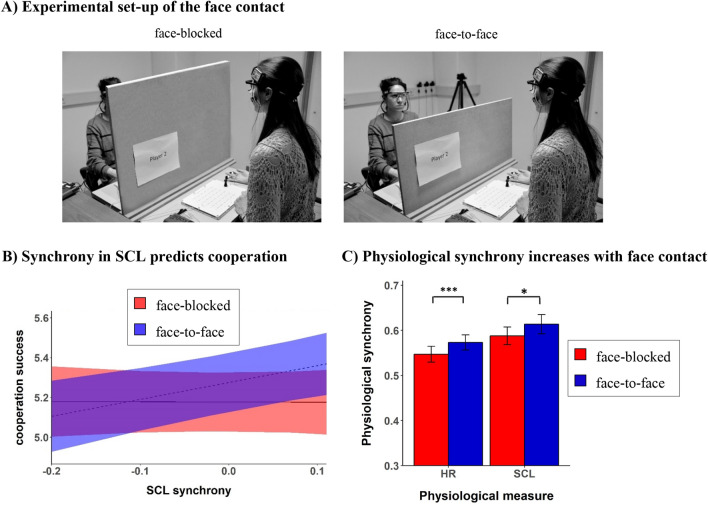
Cooperation is pivotal for society to flourish. To foster cooperation, humans express and read intentions via explicit signals and subtle reflections of arousal visible in the face. Evidence is accumulating that humans synchronize these nonverbal expressions and the physiological mechanisms underlying them, potentially influencing cooperation. The current study is designed to verify this putative linkage between synchrony and cooperation. To that end, 152 participants played the Prisoner’s Dilemma game in a dyadic interaction setting, sometimes facing each other and sometimes not. Results showed that synchrony in both heart rate and skin conductance level emerged during face-to-face contact. However, only synchrony in skin conductance levels predicted cooperative success of dyads. Crucially, this positive linkage was strengthened when participants could see each other. These findings show the strong relationship between our bodily responses and social behavior, and emphasize the importance of studying social processes between rather than within individuals in real-life interactions.
Overview
CoChat Summary
TL;DR
The paper reports that physiological synchrony—especially skin conductance level synchrony—is associated with greater cooperative success in a real-life iterated Prisoner’s Dilemma, and this link is strongest when partners can see each other. Heart rate synchrony was higher in face-to-face interaction, but it did not predict cooperative success.
Key findings
- In the main model, the interaction between skin conductance level (SCL) synchrony and Face condition significantly predicted cooperative success: t(2882.33) = 3.24, p = 0.001, f² = 0.013.
- The SCL synchrony–cooperation relation was positive in the face-to-face condition (beta = 0.86) and essentially flat in the face-blocked condition (beta = −0.01).
- Heart rate synchrony did not show a significant interaction with Face condition on cooperative success: t(2861.92) = 0.86, p = 0.389, f² < 0.001.
- Face-to-face interaction increased both cooperation and synchrony: cooperative success was higher with face contact (Mface = 0.65; Mface-blocked = 0.59; t(3629.74) = 7.59, p < 0.001, f² = 0.02), and synchrony was higher face-to-face for both HR: t(59) = 3.76, p < 0.001, f² = 0.24 and SCL: t(49) = 2.40, p = 0.020, f² = 0.12.
- Control analyses found that synchrony in original dyads exceeded randomly matched dyads for both HR: t(3622.7) = 8.06, p < 0.001, d = 0.27 and SCL: t(3015.5) = 4.38, p < 0.001, d = 0.15, and cooperative success was not explained by the two individuals’ independent arousal levels (ps > 0.10).
Methods
- Design: Mixed-design study with a within-dyad Face manipulation (face-to-face vs face-blocked) and a between-dyad Feedback manipulation; the paper focused on Face, while Feedback was included as a control.
- Sample/data: 152 naïve participants (76 dyads), same-sex dyads who did not know each other; after exclusions, the heart-rate analysis included 60 dyads and the skin-conductance analysis 50 dyads.
- Main analysis: Participants played a modified iterated Prisoner’s Dilemma for 30 trials per condition; cooperative success was analyzed with multilevel linear regression, and physiological synchrony was quantified using a lagged windowed cross-correlation analysis on 8 s windows with lags up to 4 s in 100 ms steps.
Limitations
- The authors state they could not run an additional control analysis to test whether synchrony depended on both partners choosing the same response option, because the data had twice as many mutual cooperation trials as mutual defection trials, so the analysis would not be valid.
- The authors explicitly note they do not make claims about causality or direction: the design is consistent with synchrony driving cooperation, but prior work also supports the opposite direction; they say future studies should manipulate both variables.
- Evident from the text: the study used same-sex dyads only, so the findings may not generalize to mixed-sex interactions (this was an inclusion choice, not a reported limitation, but it constrains generalizability).
Model-written summary. Check it against the paper before relying on it.
Integrity signals
Registry
Cites
Statistics
Figures
Verification
Claims the paper makes
0 Valid · 0 Not valid · 19 Not checked · 49 Own results and interpretations
A result the paper reports from its own data — it cites no other source for it, so there is none to check. The quote shows it is in the paper.
In the paper
“the results showed that the interaction effect between skin conductance level synchrony and Face condition significantly predicted cooperative success ( t (2882.33) = 3.24, p = 0.001, f 2 = 0.013).”
plainstates an association- Asserted: passes — The authors put it forward as true.
- Checkable: passes — It can be checked against evidence.
- Load-bearing: passes — The paper’s conclusions depend on it.
- Based: passes — The paper gives a reason why it holds.
A result the paper reports from its own data — it cites no other source for it, so there is none to check. The quote shows it is in the paper.
In the paper
“face-to-face contact amplified the level of synchrony in heart rate and skin conductance level (HR: t (59) = 3.76, p < 0.001, f 2 = 0.24; SCL: t (49) = 2.40, p = 0.020, f 2 = 0.12).”
plainstates a cause- Asserted: passes — The authors put it forward as true.
- Checkable: passes — It can be checked against evidence.
- Load-bearing: unclear — It is unclear whether the paper’s conclusions depend on it.
- Based: passes — The paper gives a reason why it holds.
A result the paper reports from its own data — it cites no other source for it, so there is none to check. The quote shows it is in the paper.
In the paper
“For both heart rate and skin conductance level, the original dyads showed significantly higher Fisher-Z transformed correlations than the newly generated dyads (HR: t (3622.7) = 8.06, p < 0.001, d = 0.27; SCL: t (3015.5) = 4.38, p < 0.001, d = 0.15).”
plainstates an association- Asserted: passes — The authors put it forward as true.
- Checkable: passes — It can be checked against evidence.
- Load-bearing: passes — The paper’s conclusions depend on it.
- Based: passes — The paper gives a reason why it holds.
A result the paper reports from its own data — it cites no other source for it, so there is none to check. The quote shows it is in the paper.
In the paper
“face-to-face contact amplified the level of synchrony in heart rate and skin conductance level (HR: t (59) = 3.76, p < 0.001, f 2 = 0.24; SCL: t (49) = 2.40, p = 0.020, f 2 = 0.12).”
plainstates a cause- Asserted: passes — The authors put it forward as true.
- Checkable: passes — It can be checked against evidence.
- Load-bearing: unclear — It is unclear whether the paper’s conclusions depend on it.
- Based: passes — The paper gives a reason why it holds.
14 more claims
Create a free account to see all 68 claims and to verify the 28 references still open.
- It may state two separate claims as one. 19
- Probably not a substantial claim. 38
Claims other papers make about this one
Each is checked against this paper’s own text: does it say what the citing paper says it does?
The source backs part of the claim, not all of it — or backs it for a different population, condition or comparison.
In the citing paper
“Cooperative success was positively associated with levels of synchrony but only when participants could see each other (face-to face interactions), not in the face-blocked conditions.”
From Physiological attunement and flourishing: understanding the influence of relationships on health (2025) · cites this paper as [78]
Experimental — accuracy not yet measuredThe source backs part of the claim, not all of it — or backs it for a different population, condition or comparison.
In the citing paper
“In Behrens et al. (78), participants playing a social dilemma game in pairs showed greater skin conductance synchrony during face-to-face interactions, which correlated with higher cooperation rates and mutual trust.”
From Physiological attunement and flourishing: understanding the influence of relationships on health (2025) · cites this paper as [78]
Experimental — accuracy not yet measuredThe cited source says what the claim attributes to it.
In the citing paper
“Visual access amplified attunement effects (78), and emotion regulation through stress reappraisal led to more adaptive cardiovascular responses at both individual and dyadic levels (79).”
From Physiological attunement and flourishing: understanding the influence of relationships on health (2025) · cites this paper as [78]
The cited source says what the claim attributes to it.
In the citing paper
“Yet, to date, much of the existing research on IPS has focused on contexts where individuals are explicitly instructed to perform a social task.”
From Interpersonal Synchronization of Autonomic Physiology via Mere Visual Contact (2026) · cites this paper as [26]
The cited source says what the claim attributes to it.
In the citing paper
“The interaction effect between skin conductance level synchrony and visual conditions significantly predicted cooperative success.”
From Physiological attunement and flourishing: understanding the influence of relationships on health (2025) · cites this paper as [78]
3 more claims about this paper
Create a free account to see every claim other papers make about this one.
Statistics recomputed
Every reported test result, recomputed from its test statistic and degrees of freedom. A result shows as not adding up only once an independent check has confirmed it.
- Consistentt(2882.33) = 3.24reported p = .001 · recomputed p = .001
“t (2882.33) = 3.24, p = .001”
- Consistentt(2861.92) = 0.86reported p = .389 · recomputed p = .390
“t (2861.92) = 0.86, p = .389”
- Consistentt(3629.74) = 7.59reported p < .001 · recomputed p < .001
“t (3629.74) = 7.59, p < .001”
- Consistentt(59) = 3.76reported p < .001 · recomputed p < .001
“t (59) = 3.76, p < .001”
- Consistentt(49) = 2.4reported p = .02 · recomputed p = .020
“t (49) = 2.40, p = .020”
3 more recomputed tests
Create a free account to see every test the Stats check recomputed.
Self-check
Percentages, sums and reported differences re-computed from the paper’s own numbers.
Each contradiction between two passages listed here was confirmed by an independent check.
Rated minor: it would not touch a result — a value no result rests on, a p-value that stays on the same side of the significance level, or a conflict that is clerical, resolved elsewhere in the paper, or outside its own findings.
In the paper
“three of the 152 participants (= 76 dyads) were excluded because they had missing data for 30 or more out of 60 trials.”
“Dyads with more than 50% missing data (more than 30 trials) were excluded.”
Citations
Cites
Development and validation of brief measures of positive and negative affect: The PANAS scales.
Watson, D., Clark, L. A., & Tellegen, A. (1988) · Journal of Personality and Social Psychology · doi:10.1037/0022-3514.54.6.1063 · Cited by 32,433
Cohen, J. (1992) · Psychological Bulletin · doi:10.1037//0033-2909.112.1.155 · Cited by 8,771
(1980) · Medical Entomology and Zoology · Cited by 4,712
(2001) · doi:10.1017/cbo9780511546396 · Cited by 4,482
The chameleon effect: the perception–behavior link and social interaction
Chartrand, T. L., & Bargh, J. A. (1999) · Journal of Personality and Social Psychology · doi:10.1037/0022-3514.76.6.893 · Cited by 3,674
The somatic marker hypothesis and the possible functions of the prefrontal cortex
Damasio, A. R. (1996) · Philosophical Transactions of the Royal Society of London. Series B: Biological Sciences · doi:10.1098/rstb.1996.0125 · Cited by 2,847
SIMR : an R package for power analysis of generalized linear mixed models by simulation
Green, P., & MacLeod, C. J. (2016) · Methods in Ecology and Evolution · doi:10.1111/2041-210x.12504 · Cited by 2,467
The pupil as a measure of emotional arousal and autonomic activation
Bradley, M. M., Miccoli, L., Escrig, M. A., & Lang, P. J. (2008) · Psychophysiology · doi:10.1111/j.1469-8986.2008.00654.x · Cited by 1,919
Intersubject synchronization of cortical activity during natural vision
Hasson, U., Nir, Y., Levy, I., Fuhrmann, G., & Malach, R. (2004) · Science · doi:10.1126/science.1089506 · Cited by 1,839
Dawson, M. E., Schell, A. M., Filion, D. L., & Berntson, G. G. (2009) · Handbook of Psychophysiology · doi:10.1017/cbo9780511546396.007 · Cited by 1,720
Research works printed but not linked: 1
- Lenth, R. V. Post Hoc Power: Tables and Commentary (Department of Statistics and Actuarial Science, University of Iowa, Iowa, 2007).
Cited by
Physiological synchrony is associated with attraction in a blind date setting
Prochazkova, E., Sjak-Shie, E., Behrens, F., Lindh, D., & Kret, M. E. (2021) · Nature Human Behaviour · doi:10.1038/s41562-021-01197-3 · Cited by 80
“The 100 ms was based on previous literature measuring synchrony in a variety of physiological measures 18,19,50 .”
Self-citationHow and why people synchronize: An integrated perspective
daSilva, E. B., & Wood, A. (2025) · Personality and Social Psychology Review · doi:10.1177/10888683241252036 · Cited by 56
“…and increasing connection by being an observable signal that partners are similar, although nonobservable measures of arousal such as heart rate and skin conductance are likewise associated with (but do not cause) feelings of connection (e.g., Behrens et al., 2020; Prochazkova et al., 2022).”
Gordon, I., Wallot, S., & Berson, Y. (2021) · Psychophysiology · doi:10.1111/psyp.13857 · Cited by 45
Trust Measurement in Human-Autonomy Teams: Development of a Conceptual Toolkit
Krausman, A., Neubauer, C. E., Forster, D. E., Lakhmani, S. G., Baker, A. L., Fitzhugh, S. M., Gremillion, G. M., Wright, J. L., Metcalfe, J. S., & Schaefer, K. E. (2022) · ACM Transactions on Human-Robot Interaction · doi:10.1145/3530874 · Cited by 57
Basic Emotions or Constructed Emotions: Insights From Taking an Evolutionary Perspective
van Heijst, K., Kret, M. E., & Ploeger, A. (2023) · Perspectives on Psychological Science · doi:10.1177/17456916231205186 · Cited by 62
“…mimicry occurred on a completely uncon-scious and uncontrollable level, such as with pupil mimicry (Kret et al., 2015) or physiological synchrony (e.g., Behrens et al., 2020; Galbusera et al., 2019; Levenson & Gottman, 1983; Prochazkova et al., 2022; for a review, see Prochazkova and Kret, 2017).”
Self-citationParviainen, T. M., Lyyra, P., & Nokia, M. S. (2022) · Neuroscience & Biobehavioral Reviews · doi:10.1016/j.neubiorev.2022.104908 · Cited by 48
Folz, J., Fiacchino, D., Nikolić, M., van Steenbergen, H., & Kret, M. E. (2022) · Affective Science · doi:10.1007/s42761-021-00083-5 · Cited by 38
“Synchrony in SCLs, as well as in heart rate, was further shown to be predictive of interpersonal attraction (Prochazkova et al., 2021).”
BackgroundInfluentialSelf-citationMimicry eases prediction and thereby smoothens social interactions
Kret, M. E., & Akyüz, R. (2022) · Cognition & Emotion · doi:10.1080/02699931.2022.2110452 · Cited by 30
“But this conflicts with the speed at which facial mimicry can occur, and also with alternative types of mimicry including physiological synchrony (Procházková & Kret, 2017; Behrens et al., 2020).”
BackgroundSelf-citationBoukarras, S., Placidi, V., Rossano, F., Era, V., Aglioti, S. M., & Candidi, M. (2025) · Psychophysiology · doi:10.1111/psyp.70031 · Cited by 23
“during psychotherapy (Messina et al. 2013; Palmieri et al. 2018; Tschacher and Meier 2020), cooperative problem-solving (Behrens et al. 2020; Danyluck and Page-Gould 2019), speed dates (Prochazkova et al. 2021; Zeevi et al. 2022), and mother– child interactions (Feldman et al. 2011; Feldman 2012).”
A comparative framework of inter-individual coordination and pair-bonding
Roth, T. S., Samara, I., Tan, J., Prochazkova, E., & Kret, M. E. (2021) · Current Opinion in Behavioral Sciences · doi:10.1016/j.cobeha.2021.03.005 · Cited by 27
Self-citationDiana, F., & Kret, M. E. (2024) · Neuroscience & Biobehavioral Reviews · doi:10.1016/j.neubiorev.2024.105950 · Cited by 28
Self-citationFlory, S., Guglielmini, S., Scholkmann, F., Marcar, V. L., & Wolf, M. (2023) · Scientific Reports · doi:10.1038/s41598-023-39083-9 · Cited by 18
Collective Emotion: A Framework for Experimental Research
Chung, V., Grèzes, J., & Pacherie, É. (2023) · Emotion Review · doi:10.1177/17540739231214533 · Cited by 23
Watanabe, K., Sathyanarayana, T. M. B., Dengel, A. R., & Ishimaru, S. (2023) · IEEE Access · doi:10.1109/access.2023.3279428 · Cited by 21
“Analysis of nonverbal information in online meetings was done by researchers [29], [30], [31].”
BackgroundSocial and nonsocial synchrony are interrelated and romantically attractive
Cohen, M., Abargil, M., Ahissar, M., & Atzil, S. (2024) · Communications Psychology · doi:10.1038/s44271-024-00109-1 · Cited by 23
“We ask you to prepare and upload code at this stage, to avoid delays later on in the process.”
Thorsson, M., Galazka, M. A., Johnels, J. Å., & Hadjikhani, N. K. (2024) · Scientific Reports · doi:10.1038/s41598-024-58701-8 · Cited by 21
“…using face-to-face eye-tracking setups reflect findings from previous two-dimensional presentations 30–32 , and conversely, whether experimental settings can be said to reflect face-to-face interactions of daily life 17,27,33 , which is not as straight-forwardly defined and may be discussed 34 .”
BackgroundHow video calls affect mimicry and trust during interactions
Diana, F., Juárez-Mora, O. E., Boekel, W., Hortensius, R., & Kret, M. E. (2023) · Philosophical Transactions of the Royal Society B Biological Sciences · doi:10.1098/rstb.2021.0484 · Cited by 23
Self-citationBringing social interaction at the core of organizational neuroscience
Boukarras, S., Ferri, D., Frisanco, A., Farnese, M. L., Consiglio, C., Alvino, I., Bianchi, F. P., D'Acunto, A., Боргогни, Л., & Aglioti, S. M. (2022) · Frontiers in Psychology · doi:10.3389/fpsyg.2022.1034454 · Cited by 16
“, 2020), cooperative success (Behrens et al., 2020) and team cohesion (Mønster et al.”
BackgroundGeiger, N., Swim, J. K., Mallett, R. K., & Mulvey, L. L. (2022) · Social Psychological and Personality Science · doi:10.1177/19485506221143593 · Cited by 17
“Conversations about such topics can increase concern and acceptance of key information, foster shared meaning, defuse misunderstandings, and facilitate cooperation toward solutions (Behrens et al., 2020; Goldberg et al., 2019; Myers et al., 2017; Swim et al., 2018).”
BackgroundMukeriia, Y., Treur, J., & Hendrikse, S. C. F. (2023) · Cognitive Systems Research · doi:10.1016/j.cogsys.2023.101187 · Cited by 14
Oakes, R. A., Peschel, L., & Barraclough, N. E. (2024) · iScience · doi:10.1016/j.isci.2024.109843 · Cited by 20
Chereskin, E., Allen, S. J., Connor, R. C., Krützen, M., & King, S. L. (2024) · Philosophical Transactions of the Royal Society B Biological Sciences · doi:10.1098/rstb.2023.0194 · Cited by 10
“In humans, the use of physical synchrony can promote the release of oxytocin and aid in reinforcing social bonds [69–72].”
BackgroundRees, L. L., & Friedman, R. (2024) · Academy of Management Annals · doi:10.5465/annals.2022.0160 · Cited by 12
Grasso‐Cladera, A., Costa‐Cordella, S., Mattoli-Sánchez, J., Vilina, E., Santander, V., Hiltner, S. E., & Parada, F. J. (2024) · Social Neuroscience · doi:10.1080/17470919.2024.2409758 · Cited by 16
“…during interaction has been associated with emotion regulation (Abney et al., 2021), therapeutic alliance (Koole & Tschacher, 2016), and cooperation (Behrens et al., 2020), among other relevant social components, these associations need further investigation in the context of hyperscanning.”
Brandl, H. B., & Farine, D. R. (2024) · Proceedings of the Royal Society B Biological Sciences · doi:10.1098/rspb.2024.1961 · Cited by 13
“Matching of physiological (and emotional) states might make it easier to predict the actions of others [16], and can promote social attraction [17] and cooperation [18] in humans.”
Kykyri, V., Nyman‐Salonen, P., Tschacher, W., Tourunen, A., Penttonen, M., & Seikkula, J. (2024) · Psychotherapy Research · doi:10.1080/10503307.2024.2361432 · Cited by 15
“Physiological synchrony in groups has been related to a better emotional climate (Gashi et al., 2018), and physiological synchrony predicts the cooperative success of dyads (Behrens et al., 2020).”
Artificial Empathy in Therapy and Healthcare: Advancements in Interpersonal Interaction Technologies
Jia, T., Pan, F., Yang, X., Ji, L., Farina, D., & Li, C. (2025) · Cyborg and Bionic Systems · doi:10.34133/cbsystems.0473 · Cited by 13
“Furthermore, it contributes to greater pleasurable emotional experiences [ 9 ], improved neurodevelopment [ 10 ], increased self-efficacy [ 11 ], more participation [ 12 ], successful cooperation, and better performance [ 13 ].”
Genetic and Environmental Influences on Playing Video Games
Hassan, T. (2023) · Media Psychology · doi:10.1080/15213269.2023.2165504 · Cited by 9
Group‐based flow: The influence of cardiovascular synchronization and identifiability
Snijdewint, J. A., & Scheepers, D. T. (2022) · Psychophysiology · doi:10.1111/psyp.14227 · Cited by 8
Self-citationNon‐verbal effecting – animal research sheds light on human emotion communication
Schirmer, A., Croy, I., Liebal, K., & Schweinberger, S. R. (2024) · Biological reviews/Biological reviews of the Cambridge Philosophical Society · doi:10.1111/brv.13140 · Cited by 9
Moulder, R. G., Jr., Duran, N. D., & D’Mello, S. K. (2022) · INTERNATIONAL CONFERENCE ON MULTIMODAL INTERACTION · doi:10.1145/3536221.3556595 · Cited by 7
“, heart rate and skin conductance) has been shown to be associated with increased success rates in collaborative problem solving paradigms [8].”
BackgroundSelf-citationStudent arousal, engagement, and emotion relative to Physical Education periods in school
Fogarty, J. S., Goodwill, A. M., Tan, A. L., & Tan, S. (2023) · Trends in Neuroscience and Education · doi:10.1016/j.tine.2023.100215 · Cited by 12
Physiological attunement and flourishing: understanding the influence of relationships on health
Bastos, M. A. V., Braz, D. F., Porto, A. L. M., Cordeiro, K. S. D. S., Portella, R. B., & Granger, D. A. (2025) · Frontiers in Psychiatry · doi:10.3389/fpsyt.2025.1614379 · Cited by 7
The Self and Its Intersubjective Synchrony in Psychotherapy: A Systematic Review
Angeletti, L. L., Ventura, B., Galassi, F., Castellini, G., Ricca, V., Scalabrini, A., & Northoff, G. (2025) · Clinical Psychology & Psychotherapy · doi:10.1002/cpp.70110 · Cited by 16
“…on therapeutic mechanisms of change. effects on engagement (Murata et al. 2021), affiliation (Hove and Risen 2009), attraction (Prochazkova et al. 2022), performance (Gordon et al. 2020), tendency to cooperate (Behrens et al. 2020) and prosocial behaviours and attitudes (Rennung and Göritz 2016).”
Orui, J., Shiraiwa, K., Tazaki, F., Inoue, T., Ueda, M., Ueno, K., Naito, Y., & Ishii, R. (2024) · Scientific Reports · doi:10.1038/s41598-024-68980-w · Cited by 7
“Despite these limitations, PS is thought to occur mainly during joint tasks 9 and face-to-face interactions 10 , but it has also been reported to occur between individuals who are simply present without direct interaction 46 .”
BackgroundPauly, T., Lüscher, J., Wilhelm, L. O., Amrein, M. A., Boateng, G., Kowatsch, T., Fleisch, E., Bodenmann, G., & Scholz, U. (2024) · JMIR mhealth and uhealth · doi:10.2196/49576 · Cited by 7
“Physiological linkage has been associated with central interpersonal outcomes such as trust, empathy, and effective cooperation [28,30-32], and could thus be important for social”
BackgroundDo we all synch alike? Brain–body-environment interactions in ASD
Beker, S., & Molholm, S. (2023) · Frontiers in Neural Circuits · doi:10.3389/fncir.2023.1275896 · Cited by 7
“…of the cortex and rhythmic pattern generators of peripheral body signals with the environment (Omer et al., 2019; Perl et al., 2019; Al et al., 2020; Behrens et al., 2020; Al et al., 2021; Grund et al., 2021; Madsen et al., 2021; Pérez et al., 2021; Prochazkova et al., 2021; Madsen et al., 2022).”
BackgroundHow and Why People Synchronize: An Integrated PerspectivePreprint
daSilva, E. B., & Wood, A. (2024) · doi:10.31234/osf.io/zwxgn · Cited by 6
Fogel‐Yaakobi, S., Golland, Y., Levit‐Binnun, N., Borelli, J. L., Mikulincer, M., & Shai, D. (2023) · Psychophysiology · doi:10.1111/psyp.14263 · Cited by 10
Qin, J., Zhang, Q., Wang, Y., et al. (2025) · Sustainable Cities and Society · doi:10.1016/j.scs.2025.106653 · Cited by 5
Yi, W., & Palmėr, C. (2026) · Psychophysiology · doi:10.1111/psyp.70254 · Cited by 9
“In addition to behavioral synchrony, physiological synchrony between individuals, such as alignments in their respiratory and cardiac patterns, can co-incide with group cohesion and shared intentions (Konvalinka et al. 2011; Prochazkova et al. 2022; Tomashin et al. 2022).”
Correlates of interpersonal physiological synchrony and sources of empirical heterogeneity
Gordon, I., & Bartsch, R. P. (2026) · Nature Reviews Psychology · doi:10.1038/s44159-026-00535-4 · Cited by 20
Somatovisceral Influences on Emotional Development
Faig, K. E., Smith, K. E., & Dimitroff, S. J. (2023) · Emotion Review · doi:10.1177/17540739231163180 · Cited by 5
“During emotional contagion, external stimuli such as others’ emotional expressions influence the observer’s internal environment by eliciting comparable physiological changes in their body (Behrens et al., 2020; Dimitroff et al., 2017), which may then facilitate a shared emotional state.”
BackgroundMelton, K. K., Hodge, C. J., Densley, K., & Sturdivant, R. X. (2024) · Journal of Leisure Research · doi:10.1080/00222216.2024.2315051 · Cited by 5
“Following best practices identified in Boker et al. (2002) and Behrens et al. (2020), we specified four parameters: window size, window increment, maximum lag, and lag increment.”
Clin, É., Miller, E., & Kissine, M. (2024) · Journal of Experimental Psychology General · doi:10.1037/xge0001553 · Cited by 5
THE EMERGENCE AND IMPACT OF SYNCHRONY IN DESIGN TEAMS: A COMPUTATIONAL STUDY
Perišić, M. M., Štorga, M., & Gero, J. S. (2023) · Proceedings of the Design Society · doi:10.1017/pds.2023.339 · Cited by 6
“This relationship appears reciprocal, as physiological and behavioural synchrony have been shown to be predictive of one's experience of group cohesion (Gordon et al. , 2020; Liu et al. , 2021) and cooperation (Behrens et al. , 2020; Wiltermuth and Heath, 2009).”
Backgrounddel Rosario, K., West, T. V., Mendes, W. B., Kunduzi, B., Mamode, N., & Gogălniceanu, P. (2023) · Annals of Surgery · doi:10.1097/sla.0000000000006007 · Cited by 5
“25,26”
Gong, D., Yan, H., Wu, M., Wang, Y., Lei, Y., Wang, X., & Xiao, R. (2025) · Electronics · doi:10.3390/electronics14061129 · Cited by 5
An Exploratory Study of Physiological Linkage Among Strangers
Boyd, S. M., Kuelz, A., Page‐Gould, E., Butler, E. A., & Danyluck, C. M. (2022) · Frontiers in Neuroergonomics · doi:10.3389/fnrgo.2021.751354 · Cited by 8
“, 2019) or working as teammates toward a shared goal (Henning et al., 2001; Elkins et al., 2009; Behrens et al., 2020).”
Backgroundvan Eijndhoven, K. H. J., Wiltshire, T. J., Hałgas, E. A., Gevers, J., & Louwerse, M. M. (2025) · Journal of Cognitive Engineering and Decision Making · doi:10.1177/15553434251328803 · Cited by 3
DialogLab: Authoring, Simulating, and Testing Dynamic Human-AI Group Conversations
Hu, E., Chen, Y., Li, M., Phadnis, V., Xu, P., Qian, X., Olwal, A., Kim, D., Heo, S., & Du, R. (2025) · ACM Symposium on User Interface Software and Technology (UIST) · doi:10.1145/3746059.3747696 · Cited by 18
Heart rate synchrony as a marker of real-world social engagement
He, H., Christensen, J. H., Sørensen, A. J. M., & Konvalinka, I. (2026) · PNAS Nexus · doi:10.1093/pnasnexus/pgag181 · Cited by 10
“While interpersonal physiological synchrony is a well-documented phenomenon that occurs when individuals engage in both direct and indirect interaction (5, 26, 41, 42), most studies remain confined to lab settings or high-arousal contexts (16, 23).”
Music as a social instrument: a brief historical and conceptual perspective
Bannan, N., & Harvey, A. R. (2025) · Frontiers in Cognition · doi:10.3389/fcogn.2025.1533913 · Cited by 8
Ludwig, V. U., Prieur, L., Rennie, S. M., Beswerchij, A., Weintraub, D., Berry, B., Wey, J., Candido, K., & Platt, M. L. (2025) · Mindfulness · doi:10.1007/s12671-025-02588-7 · Cited by 5
“HR synchrony, as well, may be a key correlate of connection, with studies in various settings revealing a role in interpersonal dynamics and co-regulation (Behrens et al., 2020; Coutinho et al., 2021; Flory et al., 2023).”
Grasso‐Cladera, A., Costa‐Cordella, S., Mattoli-Sánchez, J., Vilina, E., Santander, V., Hiltner, S. E., & Parada, F. J. (2024) · doi:10.31234/osf.io/6qzew · Cited by 3
Dyadic Interaction Platform: A novel tool to study transparent social interactionsPreprint
Isbaner, S., Báez-Mendoza, R., Bothe, R., Eiteljoerge, S. F. V., Fischer, A., Gail, A., Gläscher, J. P., Lüschen, H., Moeller, S., Penke, L., et al. (2025) · eLife · doi:10.7554/elife.106757.1 · Cited by 5
Yuan, D., Chan, J., Shoaib, Z., Chan, K., Kielman, A., & Wong, P. C. M. (2025) · NeuroImage · doi:10.1016/j.neuroimage.2025.121662 · Cited by 2
Integrating neural, physiological, and interoceptive measures in social interaction
Lettieri, G. (2026) · Frontiers in Neuroscience · doi:10.3389/fnins.2026.1771470 · Cited by 3
Moffat, R., Naudszus, L. A., & Cross, E. S. (2026) · Annals of the New York Academy of Sciences · doi:10.1111/nyas.70272 · Cited by 3
“Comparisons between groups showed a trending group difference, where the slope of change in interpersonal distance across sessions was more positive for same generation than intergenerational dyads.”
Micheli, L. R., Breil, C., & Böckler, A. (2024) · Journal of Personality and Social Psychology · doi:10.1037/pspi0000437 · Cited by 4
Acquiring musical knowledge increases music liking: Evidence from a neurophysiological study
Hou, Y., Song, B., Zhu, Y., Yu, L., & Hu, Y. (2024) · PsyCh Journal · doi:10.1002/pchj.791 · Cited by 5
Baets, G. A. D., & Praet, E. V. (2023) · Sport in Society · doi:10.1080/17430437.2023.2286018 · Cited by 4
“Depending on their research perspective, some call it endocrine synchrony, autonomous synchrony, empathic resonance or linkage (Palumbo et al. 2017; Behrens et al. 2020; Denk et al. 2021; Mayo, Lavidor, and Gordon 2021).”
BackgroundInfluentialLiu, C., González, V. A., Lee, G., Cabrera‐Guerrero, G., & Zou, Y. (2024) · Journal of Construction Engineering and Management · doi:10.1061/jcemd4.coeng-15064 · Cited by 4
Speer, S. P. H., Sened, H., Mwilambwe-Tshilobo, L., Falk, E. B., Tsoi, L., Burns, S. M., & Tamir, D. (2024) · bioRxiv (Cold Spring Harbor Laboratory) · doi:10.1101/2024.10.03.616501 · Cited by 2
Dyadic Interaction Platform: A novel tool to study transparent social interactionsPreprint
Isbaner, S., Báez-Mendoza, R., Bothe, R., Eiteljoerge, S. F. V., Fischer, A., Gail, A., Gläscher, J. P., Lüschen, H., Moeller, S., Penke, L., et al. (2025) · eLife · doi:10.7554/elife.106757 · Cited by 5
He, H., Christensen, J. H., Sørensen, A. J. M., & Konvalinka, I. (2025) · bioRxiv (Cold Spring Harbor Laboratory) · doi:10.64898/2025.12.01.691366 · Cited by 2
Team Synchrony Under Fire: Heart Rate Recurrence Reveals a Biosignature of Victory in Elite Esports
GU, X., Liang, X., ZHAO, S., AGUDAMU, & ZHANG, Y. (2025) · Medicine & Science in Sports & Exercise · doi:10.1249/mss.0000000000003867 · Cited by 2
Heart rate synchrony in minimal social interactions in relation to mimicry
Wicher, P., Murata, A., Kumano, S., & Hamilton, A. F. D. C. (2026) · Royal Society Open Science · doi:10.1098/rsos.251436 · Cited by 1
A novel end-to-end dual-camera system for eye gaze synchrony assessment in face-to-face interaction
Thorsson, M., Galazka, M. A., Johnels, J. Å., & Hadjikhani, N. K. (2023) · Attention Perception & Psychophysics · doi:10.3758/s13414-023-02679-4 · Cited by 2
Franz, K. S., Rezaei, S., & Chau, T. T. (2024) · IEEE Access · doi:10.1109/access.2024.3512353 · Cited by 1
“Phenomena such as collaboration [1], [2], [3], [4], shared emotional states [5], [6], mirrored behavior [2], and mutual attunement [7], manifest physiologically and are theorized to be evolutionary mechanisms that strengthen social bonds [8], [9].”
Mukeriia, Y., Treur, J., & Hendrikse, S. C. F. (2025) · Studies in systems, decision and control · doi:10.1007/978-3-031-99968-0_10 · Cited by 7
Heart rate synchrony as an objective biomarker for therapy outcome in affective disordersPreprint
Gernert, C. C., Falkai, P., & Falter, C. M. (2024) · medRxiv · doi:10.1101/2024.08.29.24312787 · Cited by 1
“IPS is supposed to be fundamental in fostering social relationships and cohesion by showing associations with rapport 31,32 , affiliation 33 , successful cooperation 25,34 , prosocial commitment 35 , and empathy 20,36 .”
BackgroundTwo-locus CRISPR toxin-antidote gene drive for confined population modificationPreprint
Feng, R., Tan, Y., Lu, Z., Chen, Y., & Champer, J. (2026) · bioRxiv (Cold Spring Harbor Laboratory) · doi:10.64898/2026.07.12.738060 · Cited by 1
Flory, S., Guglielmini, S., Scholkmann, F., et al. (2022) · Research Square · doi:10.21203/rs.3.rs-2057259/v1
Shelton, C. D., & Hon, S. (2023) · IntechOpen eBooks · doi:10.5772/intechopen.107500
How do circadian rhythms and neural synchrony shape networked cooperation?
Vasiliauskaitė, V., & Hausladen, C. I. (2023) · Frontiers in Physics · doi:10.3389/fphy.2023.1125270
Do we all synch alike? Brain-body-environment interactions in AutismPreprint
Beker, S., & Molholm, S. (2023) · doi:10.31234/osf.io/wjtpk
Examining Physiological Features Underlying Team Coordination BreakdownsPreprint
van Eijndhoven, K. H. J., Wiltshire, T. J., Hałgas, E. A., Gevers, J., & Louwerse, M. M. (2023) · Research Square · doi:10.21203/rs.3.rs-3777585/v1
Boukarras, S., Placidi, V., Rossano, F., Era, V., Aglioti, S. M., & Candidi, M. (2024) · doi:10.31219/osf.io/mr8j9
Enhancing affect communication during public speaking with sensing and social biofeedback
Murali, P. (2023) · Digital Repository Service (Northeastern University) · doi:10.17760/d20620609 · Cited by 1
The social structure of space and time: preliminary generalizations
McCaffree, K. J. (2025) · Theory and Society · doi:10.1007/s11186-025-09602-w
“…peoples’ ability to synchronize physiologically in encounters influences a range of outcomes—from liking another person to cooperating with them (Behrens et al., 2020; Prochazkova et al., 2022)— the embodied study of spatiotemporal perception constitutes a cutting edge of sociology and social…”
Burns, A., Tomashin, A., Atia, B., Gilboa, A., Cohen, S., & Gordon, I. (2025) · Research Square · doi:10.21203/rs.3.rs-6874510/v1
Physiological synchrony among human fishers during collective hunting with wild dolphins
Brandl, H. B., Valle‐Pereira, J. V. S., Pruessner, J. C., Machado, A. M. S., Daura-Jorge, F. G., Cantor, M., & Farine, D. R. (2025) · Biology Letters · doi:10.1098/rsbl.2025.0421 · Cited by 1
“Collective physiology and its alignment is increasingly recognized as fundamental to group behaviour [12,22,24], decision-making [24,64] and cooperative success across social species [14,17,21,40,65].”
Matsui, T., Yamaguchi, T., Dobashi, S., Takahashi, S., Tachibana, Y., Takamizawa, R., Kosugi, W., & Mizuno, S. (2026) · bioRxiv (Cold Spring Harbor Laboratory) · doi:10.64898/2026.01.05.697802
“Related work in other collective contexts has documented physiological synchrony among participants and linked synchrony to affiliative outcomes and cooperative success (Behrens et al., 2020; Konvalinka et al., 2011).”
Béres, L., Nagy, P., Pólya, T., Weiss, B., Boncz, A., & Winkler, I. (2026) · Frontiers in Psychology · doi:10.3389/fpsyg.2026.1655164 · Cited by 1
“Some studies also show evidence for physiological synchrony concerning pupil size (Wohltjen and Wheatley, 2021), heart rate, and skin conductance (electrodermal activity or EDA; Behrens et al., 2020).”
Shaw, T. J., Fok, M., Wang, M., Hornburg, C. B., Jeon, M., Scarpa, A., & Kim, S. (2026) · Interacting with Computers · doi:10.1093/iwc/iwag018
Heart rate synchrony as an objective biomarker in psychotherapy: a wearable-based pilot study
Gernert, C. C., & Falter, C. M. (2026) · European Archives of Psychiatry and Clinical Neuroscience · doi:10.1007/s00406-026-02248-4
“Research has found IPS to be fundamental in fostering social relationships and cohesion by showing associations with rapport [e.g. 39, 40 ], affiliation [ 41], successful cooperation [e.g. 34, 42], prosocial commitment [43], and empathy [44].”
A systematic analytical review of twin studies in communication and media
Hassan, T. (2026) · Global Perspectives in Communication · doi:10.1093/gpcomm/wpag005
Dynamic time warping of interpersonal physiologic synchrony predicts high stakes trust
Arai, L., Zeng, Y., & Zak, P. J. (2026) · Frontiers in Behavioral Economics · doi:10.3389/frbhe.2026.1826500
Yi, Z., Tongtong, Z., Jin, L., Wang, Y., Dai, Y., Wang, L., Shate, C., Hao, N., & Wang, Y. (2026) · NeuroImage · doi:10.1016/j.neuroimage.2026.122146 · Cited by 1
Shi, Q., Pushi, X., & Xu, Y. (2026) · Learning and Motivation · doi:10.1016/j.lmot.2026.102326
Firelight and the origins of spoken language
Hobaiter, C., & Dominy, N. J. (2026) · Proceedings of the Royal Society B Biological Sciences · doi:10.1098/rspb.2026.0602
Physiological synchrony predicts reduced reciprocity only in face-to-face interactions
Diana, F., Folz, J., Sjak-Shie, E., Hortensius, R., & Kret, M. E. (2026) · Proceedings of the Royal Society B Biological Sciences · doi:10.1098/rspb.2025.3224
Self-citationInterpersonal Synchronization of Autonomic Physiology via Mere Visual Contact
Koul, A., & Novembre, G. (2026) · Annals of the New York Academy of Sciences · doi:10.1111/nyas.70322 · Cited by 1
Metadata
- Authors
- Behrens, F., Snijdewint, J. A., Moulder, R. G., Prochazkova, E., Sjak-Shie, E. E., Boker, S. M., & Kret, M. E.
- Affiliations
- Leiden University (NL)
- University of Virginia (US)
- Corresponding author
- Kret, M. E.
- Venue
- Scientific Reports
- Published
- 2020-11-12
- Volume
- 10
- Issue
- 1
- Pages
- 19609-19609
- ISSN
- 2045-2322 (ISSN-L)
- PMC
- PMC7661712
- OpenAlex
- W3101282990
- Semantic Scholar
- 79f5afa40502a9d87be47bb342e8f0ca55456ff6
- Cited by
- 93
- References
- 69
- Citations by year
- 2026: 19 · 2025: 19 · 2024: 22 · 2023: 21 · 2022: 9 · 2021: 3
- FWCI
- 9.02
- Type
- journal article
- Language
- en
- Open access
- gold
- doi.org
- Licence
- cc-by
- creativecommons.org/licenses/by/4.0 (tdm)
- creativecommons.org/licenses/by/4.0 (vor)
- Locations
- Scientific Reports (publishedVersion, cc-by)
- PubMed Central (publishedVersion, cc-by)
- PubMed (publishedVersion)
- Leiden Repository (Leiden University) (submittedVersion, cc-by)
- Radboud Repository (Radboud University) (submittedVersion)
- Data Archiving and Networked Services (DANS) (submittedVersion, cc-by)
- Funders
- Leiden University Fund (W18205-5-95)
- Nederlandse Organisatie voor Wetenschappelijk Onderzoek (406-15-026)
- Netherlands Science Foundation (016.VIDI.185.036)
- Topics
- Social Sciences › Psychology › Social Psychology › Action Observation and Synchronization
- Social Sciences › Psychology › Experimental and Cognitive Psychology › Evolutionary Psychology and Human Behavior
- Social Sciences › Sociology and Political Science › Evolutionary Game Theory and Cooperation
- Keywords
- physiological synchrony, cooperation, heart rate synchrony, skin conductance level, prisoner's dilemma, dyadic interaction, face-to-face contact, nonverbal cues, arousal, interpersonal synchrony, social behavior
- MeSH terms
- Prisoner Dilemma, Adult, Cooperative Behavior, Female, Galvanic Skin Response, Game Theory, Heart Rate, Humans, Interpersonal Relations, Male, Skin Physiological Phenomena, Social Behavior, Young Adult
About these checks
Registry, retraction, Cites and statistics results are computed, not judged, with one exception: a printed reference that no index lists is read once by a model before it counts as a citation error. Claims are extracted by a model and kept only when their quote appears verbatim in the text; each cited source is then checked, with a model’s help, for whether it says what the claim relies on. Those verdicts can be wrong — read the claim’s quote and the cited source before relying on one.
A language model drew the claims from the paper on 2026-10-11, under version 3 of the claim definition (model deepseek-v4.1-flash, prompt extract-v3).
A second model labelled each claim on 2026-10-11 (model jev-1.13-20260917, definition revision gold-guideline-v0.2).
Statistics and arithmetic are recomputed, not judged.
Confidence bands are shown only for fields calibrated on our annotated test set. None is calibrated yet, so no band is shown.
What counts as a claim ›How we measure confidence ›How we check this ›
Are you an author, or do you see a problem with this page? Request a review
Data sources
Bibliographic data: Semantic Scholar, OpenAlex, Crossref.
Contains information from the Semantic Scholar Academic Graph Datasets, made available under the ODC Attribution License (ODC-BY 1.0).
Semantic Scholar’s data is described in: Kinney, R., et al. (2023). The Semantic Scholar Open Data Platform. arXiv:2301.10140.
