

Physiological synchrony is associated with cooperative success in real-life interactions
Open accessPublished version of a preprint
The DOI matches its Crossref record; 63 of the 69 references it cites were found in a registry or an index; none of the 28 sources its claims cite is checked for support yet.
Abstract
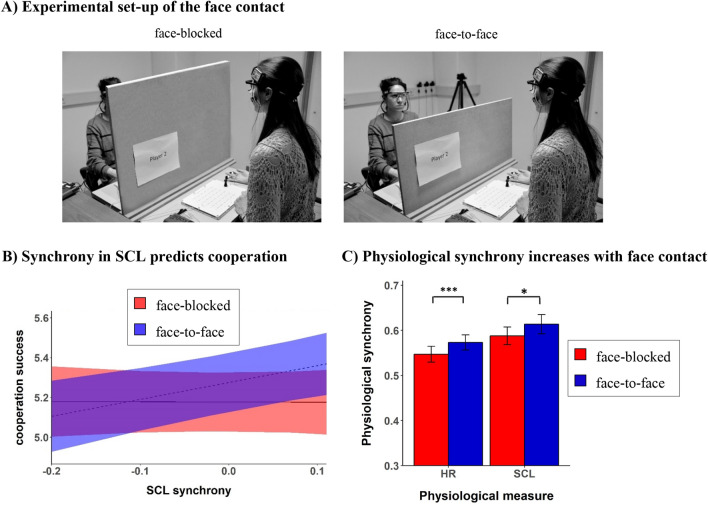
Cooperation is pivotal for society to flourish. To foster cooperation, humans express and read intentions via explicit signals and subtle reflections of arousal visible in the face. Evidence is accumulating that humans synchronize these nonverbal expressions and the physiological mechanisms underlying them, potentially influencing cooperation. The current study is designed to verify this putative linkage between synchrony and cooperation. To that end, 152 participants played the Prisoner’s Dilemma game in a dyadic interaction setting, sometimes facing each other and sometimes not. Results showed that synchrony in both heart rate and skin conductance level emerged during face-to-face contact. However, only synchrony in skin conductance levels predicted cooperative success of dyads. Crucially, this positive linkage was strengthened when participants could see each other. These findings show the strong relationship between our bodily responses and social behavior, and emphasize the importance of studying social processes between rather than within individuals in real-life interactions.
Overview
CoChat Summary
TL;DR
The paper reports that physiological synchrony—especially skin conductance level synchrony—is associated with greater cooperative success in a real-life iterated Prisoner’s Dilemma, and this link is strongest when partners can see each other. Heart rate synchrony was higher in face-to-face interaction, but it did not predict cooperative success.
Key findings
- In the main model, the interaction between skin conductance level (SCL) synchrony and Face condition significantly predicted cooperative success: t(2882.33) = 3.24, p = 0.001, f² = 0.013.
- The SCL synchrony–cooperation relation was positive in the face-to-face condition (beta = 0.86) and essentially flat in the face-blocked condition (beta = −0.01).
- Heart rate synchrony did not show a significant interaction with Face condition on cooperative success: t(2861.92) = 0.86, p = 0.389, f² < 0.001.
- Face-to-face interaction increased both cooperation and synchrony: cooperative success was higher with face contact (Mface = 0.65; Mface-blocked = 0.59; t(3629.74) = 7.59, p < 0.001, f² = 0.02), and synchrony was higher face-to-face for both HR: t(59) = 3.76, p < 0.001, f² = 0.24 and SCL: t(49) = 2.40, p = 0.020, f² = 0.12.
- Control analyses found that synchrony in original dyads exceeded randomly matched dyads for both HR: t(3622.7) = 8.06, p < 0.001, d = 0.27 and SCL: t(3015.5) = 4.38, p < 0.001, d = 0.15, and cooperative success was not explained by the two individuals’ independent arousal levels (ps > 0.10).
Methods
- Design: Mixed-design study with a within-dyad Face manipulation (face-to-face vs face-blocked) and a between-dyad Feedback manipulation; the paper focused on Face, while Feedback was included as a control.
- Sample/data: 152 naïve participants (76 dyads), same-sex dyads who did not know each other; after exclusions, the heart-rate analysis included 60 dyads and the skin-conductance analysis 50 dyads.
- Main analysis: Participants played a modified iterated Prisoner’s Dilemma for 30 trials per condition; cooperative success was analyzed with multilevel linear regression, and physiological synchrony was quantified using a lagged windowed cross-correlation analysis on 8 s windows with lags up to 4 s in 100 ms steps.
Limitations
- The authors state they could not run an additional control analysis to test whether synchrony depended on both partners choosing the same response option, because the data had twice as many mutual cooperation trials as mutual defection trials, so the analysis would not be valid.
- The authors explicitly note they do not make claims about causality or direction: the design is consistent with synchrony driving cooperation, but prior work also supports the opposite direction; they say future studies should manipulate both variables.
- Evident from the text: the study used same-sex dyads only, so the findings may not generalize to mixed-sex interactions (this was an inclusion choice, not a reported limitation, but it constrains generalizability).
Model-written summary. Check it against the paper before relying on it.
Integrity signals
Registry
Cites
Statistics
Figures
Verification
Claims the paper makes
0 Valid · 0 Not valid · 19 Not checked · 49 Own results and interpretations
A result the paper reports from its own data — it cites no other source for it, so there is none to check. The quote shows it is in the paper.
In the paper
“the results showed that the interaction effect between skin conductance level synchrony and Face condition significantly predicted cooperative success ( t (2882.33) = 3.24, p = 0.001, f 2 = 0.013).”
plainstates an association- Asserted: passes — The authors put it forward as true.
- Checkable: passes — It can be checked against evidence.
- Load-bearing: passes — The paper’s conclusions depend on it.
- Based: passes — The paper gives a reason why it holds.
A result the paper reports from its own data — it cites no other source for it, so there is none to check. The quote shows it is in the paper.
In the paper
“face-to-face contact amplified the level of synchrony in heart rate and skin conductance level (HR: t (59) = 3.76, p < 0.001, f 2 = 0.24; SCL: t (49) = 2.40, p = 0.020, f 2 = 0.12).”
plainstates a cause- Asserted: passes — The authors put it forward as true.
- Checkable: passes — It can be checked against evidence.
- Load-bearing: unclear — It is unclear whether the paper’s conclusions depend on it.
- Based: passes — The paper gives a reason why it holds.
A result the paper reports from its own data — it cites no other source for it, so there is none to check. The quote shows it is in the paper.
In the paper
“For both heart rate and skin conductance level, the original dyads showed significantly higher Fisher-Z transformed correlations than the newly generated dyads (HR: t (3622.7) = 8.06, p < 0.001, d = 0.27; SCL: t (3015.5) = 4.38, p < 0.001, d = 0.15).”
plainstates an association- Asserted: passes — The authors put it forward as true.
- Checkable: passes — It can be checked against evidence.
- Load-bearing: passes — The paper’s conclusions depend on it.
- Based: passes — The paper gives a reason why it holds.
A result the paper reports from its own data — it cites no other source for it, so there is none to check. The quote shows it is in the paper.
In the paper
“face-to-face contact amplified the level of synchrony in heart rate and skin conductance level (HR: t (59) = 3.76, p < 0.001, f 2 = 0.24; SCL: t (49) = 2.40, p = 0.020, f 2 = 0.12).”
plainstates a cause- Asserted: passes — The authors put it forward as true.
- Checkable: passes — It can be checked against evidence.
- Load-bearing: unclear — It is unclear whether the paper’s conclusions depend on it.
- Based: passes — The paper gives a reason why it holds.
14 more claims
Create a free account to see all 68 claims and to verify the 28 references still open.
- It may state two separate claims as one. 19
- Probably not a substantial claim. 38
Claims other papers make about this one
Each is checked against this paper’s own text: does it say what the citing paper says it does?
The source backs part of the claim, not all of it — or backs it for a different population, condition or comparison.
In the citing paper
“Cooperative success was positively associated with levels of synchrony but only when participants could see each other (face-to face interactions), not in the face-blocked conditions.”
From Physiological attunement and flourishing: understanding the influence of relationships on health (2025) · cites this paper as [78]
Experimental — accuracy not yet measuredThe source backs part of the claim, not all of it — or backs it for a different population, condition or comparison.
In the citing paper
“In Behrens et al. (78), participants playing a social dilemma game in pairs showed greater skin conductance synchrony during face-to-face interactions, which correlated with higher cooperation rates and mutual trust.”
From Physiological attunement and flourishing: understanding the influence of relationships on health (2025) · cites this paper as [78]
Experimental — accuracy not yet measuredThe cited source says what the claim attributes to it.
In the citing paper
“Visual access amplified attunement effects (78), and emotion regulation through stress reappraisal led to more adaptive cardiovascular responses at both individual and dyadic levels (79).”
From Physiological attunement and flourishing: understanding the influence of relationships on health (2025) · cites this paper as [78]
The cited source says what the claim attributes to it.
In the citing paper
“Yet, to date, much of the existing research on IPS has focused on contexts where individuals are explicitly instructed to perform a social task.”
From Interpersonal Synchronization of Autonomic Physiology via Mere Visual Contact (2026) · cites this paper as [26]
The cited source says what the claim attributes to it.
In the citing paper
“The interaction effect between skin conductance level synchrony and visual conditions significantly predicted cooperative success.”
From Physiological attunement and flourishing: understanding the influence of relationships on health (2025) · cites this paper as [78]
3 more claims about this paper
Create a free account to see every claim other papers make about this one.
Statistics recomputed
Every reported test result, recomputed from its test statistic and degrees of freedom. A result shows as not adding up only once an independent check has confirmed it.
- Consistentt(2882.33) = 3.24reported p = .001 · recomputed p = .001
“t (2882.33) = 3.24, p = .001”
- Consistentt(2861.92) = 0.86reported p = .389 · recomputed p = .390
“t (2861.92) = 0.86, p = .389”
- Consistentt(3629.74) = 7.59reported p < .001 · recomputed p < .001
“t (3629.74) = 7.59, p < .001”
- Consistentt(59) = 3.76reported p < .001 · recomputed p < .001
“t (59) = 3.76, p < .001”
- Consistentt(49) = 2.4reported p = .02 · recomputed p = .020
“t (49) = 2.40, p = .020”
3 more recomputed tests
Create a free account to see every test the Stats check recomputed.
Self-check
Percentages, sums and reported differences re-computed from the paper’s own numbers.
Each contradiction between two passages listed here was confirmed by an independent check.
Rated minor: it would not touch a result — a value no result rests on, a p-value that stays on the same side of the significance level, or a conflict that is clerical, resolved elsewhere in the paper, or outside its own findings.
In the paper
“three of the 152 participants (= 76 dyads) were excluded because they had missing data for 30 or more out of 60 trials.”
“Dyads with more than 50% missing data (more than 30 trials) were excluded.”
Citations
Cites
Development and validation of brief measures of positive and negative affect: The PANAS scales.
Watson, D., Clark, L. A., & Tellegen, A. (1988) · Journal of Personality and Social Psychology · doi:10.1037/0022-3514.54.6.1063 · Cited by 32,433
Cohen, J. (1992) · Psychological Bulletin · doi:10.1037//0033-2909.112.1.155 · Cited by 8,771
(1980) · Medical Entomology and Zoology · Cited by 4,712
(2001) · doi:10.1017/cbo9780511546396 · Cited by 4,482
The chameleon effect: the perception–behavior link and social interaction
Chartrand, T. L., & Bargh, J. A. (1999) · Journal of Personality and Social Psychology · doi:10.1037/0022-3514.76.6.893 · Cited by 3,674
The somatic marker hypothesis and the possible functions of the prefrontal cortex
Damasio, A. R. (1996) · Philosophical Transactions of the Royal Society of London. Series B: Biological Sciences · doi:10.1098/rstb.1996.0125 · Cited by 2,847
SIMR : an R package for power analysis of generalized linear mixed models by simulation
Green, P., & MacLeod, C. J. (2016) · Methods in Ecology and Evolution · doi:10.1111/2041-210x.12504 · Cited by 2,467
The pupil as a measure of emotional arousal and autonomic activation
Bradley, M. M., Miccoli, L., Escrig, M. A., & Lang, P. J. (2008) · Psychophysiology · doi:10.1111/j.1469-8986.2008.00654.x · Cited by 1,919
Intersubject synchronization of cortical activity during natural vision
Hasson, U., Nir, Y., Levy, I., Fuhrmann, G., & Malach, R. (2004) · Science · doi:10.1126/science.1089506 · Cited by 1,839
Dawson, M. E., Schell, A. M., Filion, D. L., & Berntson, G. G. (2009) · Handbook of Psychophysiology · doi:10.1017/cbo9780511546396.007 · Cited by 1,720
Depression and the response of others.
Coyne, J. C. (1976) · Journal of Abnormal Psychology · doi:10.1037/0021-843x.85.2.186 · Cited by 1,464
Van Lange, P. A. M., De Bruin, E. M. N., Otten, W., & Joireman, J. A. (1997) · Journal of Personality and Social Psychology · doi:10.1037/0022-3514.73.4.733 · Cited by 1,209
Visceral influences on brain and behavior
Critchley, H. D., & Harrison, N. A. (2013) · Neuron · doi:10.1016/j.neuron.2013.02.008 · Cited by 1,177
Mammalian empathy: behavioural manifestations and neural basis
de Waal, F. B. M., & Preston, S. D. (2017) · Nature Reviews Neuroscience · doi:10.1038/nrn.2017.72 · Cited by 957
Marital interaction: Physiological linkage and affective exchange.
Levenson, R. W., & Gottman, J. M. (1983) · Journal of Personality and Social Psychology · doi:10.1037/0022-3514.45.3.587 · Cited by 855
A Modern Approach to Regression with R
Sheather, S. (2009) · Springer Texts in Statistics · doi:10.1007/978-0-387-09608-7 · Cited by 692
Effect size measures for multilevel models: definition, interpretation, and TIMSS example
Lorah, J. (2018) · Large-scale Assessments in Education · doi:10.1186/s40536-018-0061-2 · Cited by 650
Amini, A., & Cheng, C. (2013) · Scientific Reports · doi:10.1038/srep03316 · Cited by 594
Interpersonal autonomic physiology: a systematic review of the literature
Palumbo, R. V., Marraccini, M. E., Weyandt, L. L., Wilder-Smith, O., McGee, H. A., Liu, S., & Goodwin, M. S. (2017) · Personality and Social Psychology Review · doi:10.1177/1088868316628405 · Cited by 566
Connecting minds and sharing emotions through mimicry: A neurocognitive model of emotional contagion
Prochazkova, E., & Kret, M. E. (2017) · Neuroscience & Biobehavioral Reviews · doi:10.1016/j.neubiorev.2017.05.013 · Cited by 433
Self-citationBoker, S. M., Rotondo, J. L., Xu, M., & King, K. (2002) · Psychological Methods · doi:10.1037//1082-989x.7.3.338 · Cited by 360
Self-citationFashioning the face: sensorimotor simulation contributes to facial expression recognition
Wood, A., Rychlowska, M., Korb, S., & Niedenthal, P. (2016) · Trends in Cognitive Sciences · doi:10.1016/j.tics.2015.12.010 · Cited by 353
Sex differences in cooperation: A meta-analytic review of social dilemmas.
Balliet, D., Li, N. P., Macfarlan, S. J., & Van Vugt, M. (2011) · Psychological Bulletin · doi:10.1037/a0025354 · Cited by 349
Silent disco: dancing in synchrony leads to elevated pain thresholds and social closeness
Tarr, B., Launay, J., & Dunbar, R. I. M. (2016) · Evolution and Human Behavior · doi:10.1016/j.evolhumbehav.2016.02.004 · Cited by 341
A different vision of dyslexia: Local precedence on global perception
Franceschini, S., Bertoni, S., Gianesini, T., Gori, S., & Facoetti, A. (2017) · Scientific Reports · doi:10.1038/s41598-017-17626-1 · Cited by 317
Two routes to actorhood: lexicalized potency to act and identification of the actor role
Frenzel, S., Schlesewsky, M., & Bornkessel-Schlesewsky, I. (2015) · Frontiers in Psychology · doi:10.3389/fpsyg.2015.00001 · Cited by 240
Heart rate and skin conductance analysis of antecendents and consequences of decision making
Crone, E. A., Somsen, R. J. M., Beek, B. V., & Van Der Molen, M. W. (2004) · Psychophysiology · doi:10.1111/j.1469-8986.2004.00197.x · Cited by 231
A prisoner's dilemma experiment on cooperation with people and human-like computers.
Kiesler, S., Sproull, L., & Waters, K. (1996) · Journal of Personality and Social Psychology · doi:10.1037//0022-3514.70.1.47 · Cited by 201
Oberman, L. M., Winkielman, P., & Ramachandran, V. S. (2009) · Developmental Science · doi:10.1111/j.1467-7687.2008.00796.x · Cited by 200
Building trust: Heart rate synchrony and arousal during joint action increased by public goods game
Mitkidis, P., McGraw, J. J., Roepstorff, A., & Wallot, S. (2015) · Physiology & Behavior · doi:10.1016/j.physbeh.2015.05.033 · Cited by 174
A COOPERATIVE SPECIES: HUMAN RECIPROCITY AND ITS EVOLUTION
Rosas, A. (2013) · Revista de Filosofia Aurora · doi:10.7213/revistadefilosofiaaurora.7778 · Cited by 168 · cited 2×
“That response incorporated two choices: (1) the level of willingness to cooperate; moving from the left (option A) to the right (option F) on the x-axis, the willingness to cooperate increased with option A reflecting full defection and option F reflecting full cooperation; (2) what the participant thought the other p…”
BackgroundPassion Within Reason: The Strategic Role of Emotions
Waller, W. (1989) · Journal of Economic Issues · doi:10.1080/00213624.1989.11504995 · Cited by 160
Pupil Mimicry Correlates With Trust in In-Group Partners With Dilating Pupils
Kret, M. E., Fischer, A. H., & De Dreu, C. K. W. (2015) · Psychological Science · doi:10.1177/0956797615588306 · Cited by 139
Self-citationKret, M. E. (2015) · Frontiers in Psychology · doi:10.3389/fpsyg.2015.00711 · Cited by 116
Self-citationPhysiological compliance for social gaming analysis: Cooperative versus competitive play
Chanel, G., Kivikangas, J. M., & Ravaja, N. (2012) · Interacting with Computers · doi:10.1016/j.intcom.2012.04.012 · Cited by 110
Rapid Facial Mimicry In Geladas
Mancini, G., Ferrari, P. F., & Palagi, E. (2013) · Scientific Reports · doi:10.1038/srep01527 · Cited by 109
Moulder, R. G., Boker, S. M., Ramseyer, F., & Tschacher, W. (2018) · Psychological Methods · doi:10.1037/met0000172 · Cited by 108
Self-citationKret (2014) · doi:10.1371/journal.pone.0104886 · Cited by 98
Relationships between affective states and decision-making
Werner, N. S., Duschek, S., & Schandry, R. (2009) · International Journal of Psychophysiology · doi:10.1016/j.ijpsycho.2009.09.010 · Cited by 97
Pupil mimicry promotes trust through the theory-of-mind network
Prochazkova, E., Prochazkova, L., Giffin, M. R., Scholte, H. S., De Dreu, C. K. W., & Kret, M. E. (2018) · Proceedings of the National Academy of Sciences · doi:10.1073/pnas.1803916115 · Cited by 95
Self-citationEye contact modulates facial mimicry in 4-month-old infants: An EMG and fNIRS study
de Klerk, C. C. J. M., Hamilton, A. F. D. C., & Southgate, V. (2018) · Cortex · doi:10.1016/j.cortex.2018.05.002 · Cited by 95
Physiological Linkage of Dyadic Gaming Experience
Järvelä, S., Kivikangas, J. M., Kätsyri, J., & Ravaja, N. (2014) · Simulation & Gaming · doi:10.1177/1046878113513080 · Cited by 86
Physiological synchrony is associated with attraction in a blind date setting
Prochazkova, E., Sjak-Shie, E., Behrens, F., Lindh, D., & Kret, M. E. (2021) · Nature Human Behaviour · doi:10.1038/s41562-021-01197-3 · Cited by 80
Self-citationPupil-mimicry conditions trust in partners: moderation by oxytocin and group membership
Kret, M. E., & De Dreu, C. K. W. (2017) · Proceedings of the Royal Society B: Biological Sciences · doi:10.1098/rspb.2016.2554 · Cited by 75
Self-citationAffective Synchrony and Autonomic Coupling during Cooperation: A Hyperscanning Study
Vanutelli, M. E., Gatti, L., Angioletti, L., & Balconi, M. (2017) · BioMed Research International · doi:10.1155/2017/3104564 · Cited by 69
Pupillary Contagion in Infancy: Evidence for Spontaneous Transfer of Arousal
Fawcett, C., Wesevich, V., & Gredebäck, G. (2016) · Psychological Science · doi:10.1177/0956797616643924 · Cited by 64
Beard, C., Rodriguez, B. F., Moitra, E., Sibrava, N. J., Bjornsson, A., Weisberg, R. B., & Keller, M. B. (2011) · Journal of Anxiety Disorders · doi:10.1016/j.janxdis.2011.03.009 · Cited by 59
Voncken, M. J., & Bögels, S. M. (2009) · Biological Psychology · doi:10.1016/j.biopsycho.2009.02.004 · Cited by 56
Social and Physiological Context can Affect the Meaning of Physiological Synchrony
Danyluck, C., & Page-Gould, E. (2019) · Scientific Reports · doi:10.1038/s41598-019-44667-5 · Cited by 56
Methodological Advances for Detecting Physiological Synchrony During Dyadic Interactions
McAssey, M. P., Helm, J., Hsieh, F., Sbarra, D. A., & Ferrer, E. (2013) · Methodology · doi:10.1027/1614-2241/a000053 · Cited by 51
Methods for Quantifying Patterns of Dynamic Interactions in Dyads
Gates, K. M., & Liu, S. (2016) · Assessment · doi:10.1177/1073191116641508 · Cited by 50
The Interplay Between Face-to-Face Contact and Feedback on Cooperation During Real-Life Interactions
Behrens, F., & Kret, M. E. (2019) · Journal of Nonverbal Behavior · doi:10.1007/s10919-019-00314-1 · Cited by 47
Self-citationSaved by the blush: being trusted despite defecting
Dijk, C., Koenig, B., Ketelaar, T., & de Jong, P. J. (2011) · Emotion · doi:10.1037/a0022774 · Cited by 46
Human eyes with dilated pupils induce pupillary contagion in infants
Fawcett, C., Arslan, M., Falck-Ytter, T., Roeyers, H., & Gredebäck, G. (2017) · Scientific Reports · doi:10.1038/s41598-017-08223-3 · Cited by 39
Laméris, D. W., van Berlo, E., Sterck, E. H. M., Bionda, T., & Kret, M. E. (2020) · American Journal of Primatology · doi:10.1002/ajp.23138 · Cited by 36
Self-citationSimilarity and cooperation received as determinants of cooperation rendered
Kaufmann, H. (1967) · Psychonomic Science · doi:10.3758/bf03330765 · Cited by 29
Peer-Review Guidelines Promoting Replicability and Transparency in Psychological Science
Davis, W. E., Giner‐Sorolla, R., Lindsay, D. S., Lougheed, J. P., Makel, M. C., Meier, M. E., Sun, J., Vaughn, L. A., & Zelenski, J. M. (2018) · Advances in Methods and Practices in Psychological Science · doi:10.1177/2515245918806489 · Cited by 24
Galazka, M. A., Johnels, J. Å., Zürcher, N. R., Hippolyte, L., Lemonnier, É., Billstedt, E., Gillberg, C., & Hadjikhani, N. K. (2018) · Psychological Science · doi:10.1177/0956797618809382 · Cited by 24
Behrens, F., Moulder, R. G., Boker, S. M., & Kret, M. E. (2020) · bioRxiv (Cold Spring Harbor Laboratory) · doi:10.1101/2020.08.27.269746 · Cited by 21
Self-citationPost Hoc Power Calculation: Observing the Expected
Plate, J. D. J., Borggreve, A. S., van Hillegersberg, R., & Peelen, L. M. (2018) · Annals of Surgery · doi:10.1097/sla.0000000000002910 · Cited by 20
Pupils say more than a thousand words: Pupil size reflects how observed actions are interpreted
Quesque, F., Behrens, F., & Kret, M. E. (2019) · Cognition · doi:10.1016/j.cognition.2019.04.016 · Cited by 14
Self-citationThe choreography of human attraction: physiological synchrony in a blind date settingPreprint
Prochazkova, E., Sjak-Shie, E., Behrens, F., Lindh, D., & Kret, M. (2019) · bioRxiv · doi:10.1101/748707 · Cited by 13
Self-citationUnder the Umbrella of Prosocial Behavior – A Critical Comparison of ParadigmsPreprint
Behrens, F., & Kret, M. E. (2020) · PsyArXiv (OSF Preprints) · doi:10.31234/osf.io/9uebc · Cited by 3
Self-citation
Research works printed but not linked: 1
- Lenth, R. V. Post Hoc Power: Tables and Commentary (Department of Statistics and Actuarial Science, University of Iowa, Iowa, 2007).
Cited by
Physiological synchrony is associated with attraction in a blind date setting
Prochazkova, E., Sjak-Shie, E., Behrens, F., Lindh, D., & Kret, M. E. (2021) · Nature Human Behaviour · doi:10.1038/s41562-021-01197-3 · Cited by 80
“The 100 ms was based on previous literature measuring synchrony in a variety of physiological measures 18,19,50 .”
Self-citationHow and why people synchronize: An integrated perspective
daSilva, E. B., & Wood, A. (2025) · Personality and Social Psychology Review · doi:10.1177/10888683241252036 · Cited by 56
“…and increasing connection by being an observable signal that partners are similar, although nonobservable measures of arousal such as heart rate and skin conductance are likewise associated with (but do not cause) feelings of connection (e.g., Behrens et al., 2020; Prochazkova et al., 2022).”
Gordon, I., Wallot, S., & Berson, Y. (2021) · Psychophysiology · doi:10.1111/psyp.13857 · Cited by 45
Trust Measurement in Human-Autonomy Teams: Development of a Conceptual Toolkit
Krausman, A., Neubauer, C. E., Forster, D. E., Lakhmani, S. G., Baker, A. L., Fitzhugh, S. M., Gremillion, G. M., Wright, J. L., Metcalfe, J. S., & Schaefer, K. E. (2022) · ACM Transactions on Human-Robot Interaction · doi:10.1145/3530874 · Cited by 57
Basic Emotions or Constructed Emotions: Insights From Taking an Evolutionary Perspective
van Heijst, K., Kret, M. E., & Ploeger, A. (2023) · Perspectives on Psychological Science · doi:10.1177/17456916231205186 · Cited by 62
“…mimicry occurred on a completely uncon-scious and uncontrollable level, such as with pupil mimicry (Kret et al., 2015) or physiological synchrony (e.g., Behrens et al., 2020; Galbusera et al., 2019; Levenson & Gottman, 1983; Prochazkova et al., 2022; for a review, see Prochazkova and Kret, 2017).”
Self-citation
Metadata
- Authors
- Behrens, F., Snijdewint, J. A., Moulder, R. G., Prochazkova, E., Sjak-Shie, E. E., Boker, S. M., & Kret, M. E.
- Affiliations
- Leiden University (NL)
- University of Virginia (US)
- Corresponding author
- Kret, M. E.
- Venue
- Scientific Reports
- Published
- 2020-11-12
- Volume
- 10
- Issue
- 1
- Pages
- 19609-19609
- ISSN
- 2045-2322 (ISSN-L)
- PMC
- PMC7661712
- OpenAlex
- W3101282990
- Semantic Scholar
- 79f5afa40502a9d87be47bb342e8f0ca55456ff6
- Cited by
- 93
- References
- 69
- Citations by year
- 2026: 19 · 2025: 19 · 2024: 22 · 2023: 21 · 2022: 9 · 2021: 3
- FWCI
- 9.02
- Type
- journal article
- Language
- en
- Open access
- gold
- doi.org
- Licence
- cc-by
- creativecommons.org/licenses/by/4.0 (tdm)
- creativecommons.org/licenses/by/4.0 (vor)
- Locations
- Scientific Reports (publishedVersion, cc-by)
- PubMed Central (publishedVersion, cc-by)
- PubMed (publishedVersion)
- Leiden Repository (Leiden University) (submittedVersion, cc-by)
- Radboud Repository (Radboud University) (submittedVersion)
- Data Archiving and Networked Services (DANS) (submittedVersion, cc-by)
- Funders
- Leiden University Fund (W18205-5-95)
- Nederlandse Organisatie voor Wetenschappelijk Onderzoek (406-15-026)
- Netherlands Science Foundation (016.VIDI.185.036)
- Topics
- Social Sciences › Psychology › Social Psychology › Action Observation and Synchronization
- Social Sciences › Psychology › Experimental and Cognitive Psychology › Evolutionary Psychology and Human Behavior
- Social Sciences › Sociology and Political Science › Evolutionary Game Theory and Cooperation
- Keywords
- physiological synchrony, cooperation, heart rate synchrony, skin conductance level, prisoner's dilemma, dyadic interaction, face-to-face contact, nonverbal cues, arousal, interpersonal synchrony, social behavior
- MeSH terms
- Prisoner Dilemma, Adult, Cooperative Behavior, Female, Galvanic Skin Response, Game Theory, Heart Rate, Humans, Interpersonal Relations, Male, Skin Physiological Phenomena, Social Behavior, Young Adult
About these checks
Registry, retraction, Cites and statistics results are computed, not judged, with one exception: a printed reference that no index lists is read once by a model before it counts as a citation error. Claims are extracted by a model and kept only when their quote appears verbatim in the text; each cited source is then checked, with a model’s help, for whether it says what the claim relies on. Those verdicts can be wrong — read the claim’s quote and the cited source before relying on one.
A language model drew the claims from the paper on 2026-10-11, under version 3 of the claim definition (model deepseek-v4.1-flash, prompt extract-v3).
A second model labelled each claim on 2026-10-11 (model jev-1.13-20260917, definition revision gold-guideline-v0.2).
Statistics and arithmetic are recomputed, not judged.
Confidence bands are shown only for fields calibrated on our annotated test set. None is calibrated yet, so no band is shown.
What counts as a claim ›How we measure confidence ›How we check this ›
Are you an author, or do you see a problem with this page? Request a review
Data sources
Bibliographic data: Semantic Scholar, OpenAlex, Crossref.
Contains information from the Semantic Scholar Academic Graph Datasets, made available under the ODC Attribution License (ODC-BY 1.0).
Semantic Scholar’s data is described in: Kinney, R., et al. (2023). The Semantic Scholar Open Data Platform. arXiv:2301.10140.
