

Comparative transcriptome analysis implied a ZEP paralog was a key gene involved in carotenoid accumulation in yellow-fleshed sweetpotato
Open accessThe DOI matches its Crossref record; 57 of the 57 references it cites were found in a registry or an index.
Abstract
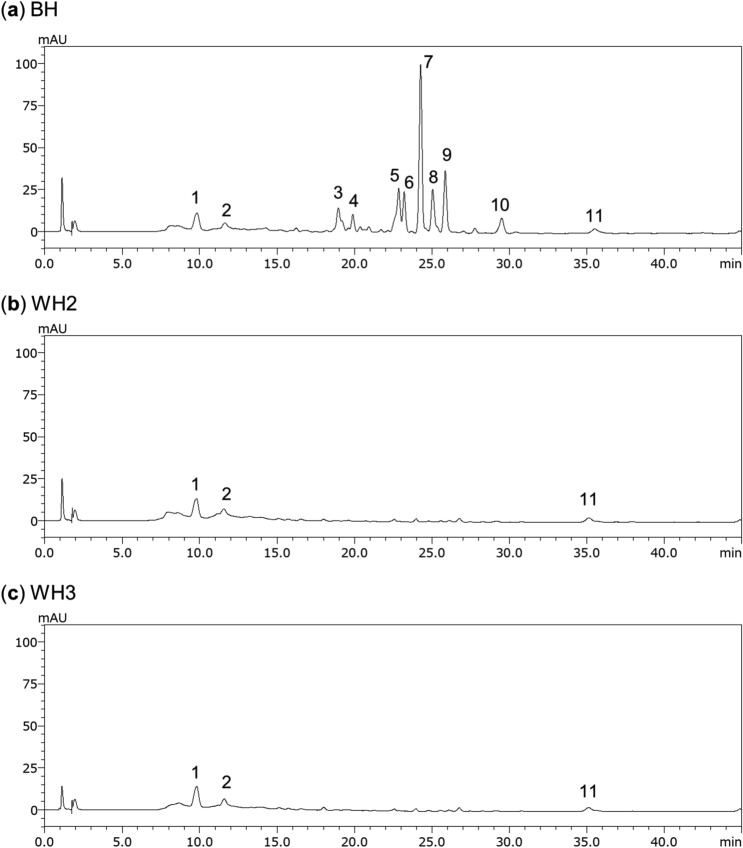
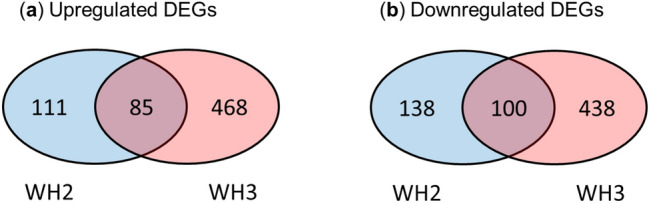
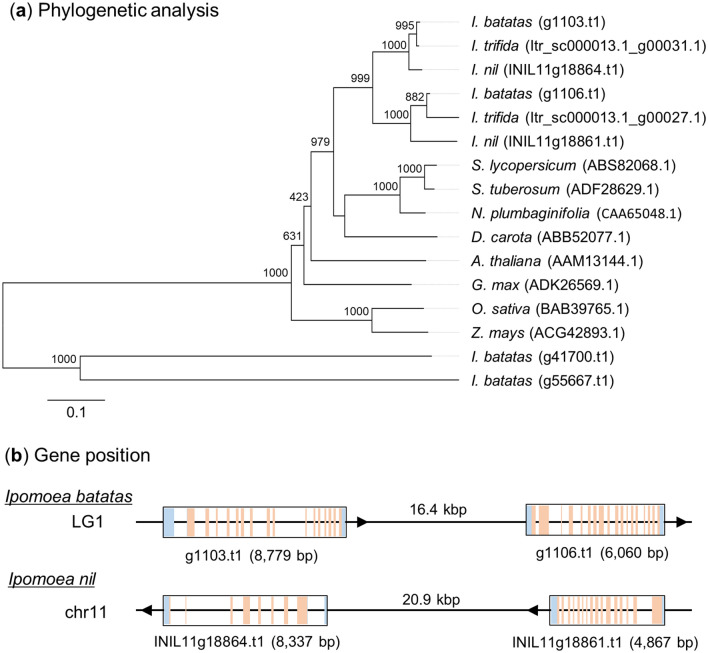
The mechanisms of carotenoid accumulation in yellow-fleshed sweetpotato cultivars are unclear. In this study, we compared the transcriptome profiles of a yellow-fleshed cultivar, Beniharuka (BH) and two of its spontaneous white-fleshed mutants (WH2 and WH3) to reveal the genes involved in yellow flesh. As a result of RNA sequencing, a total of 185 differentially expressed genes (DEGs) were commonly detected in WH2 and WH3 compared to BH. Of these genes, 85 DEGs and 100 DEGs were commonly upregulated and downregulated in WH2 and WH3 compared to BH, respectively. g1103.t1, a paralog of zeaxanthin epoxidase (ZEP), was only DEG common to WH2 and WH3 among 38 genes considered to be involved in carotenoid biosynthesis in storage roots. The expression level of g1103.t1 was also considerably lower in five white-fleshed cultivars than in five yellow-fleshed cultivars. Analysis of carotenoid composition in the storage roots showed that the epoxidised carotenoids were drastically reduced in both WH2 and WH3. Therefore, we propose that the ZEP paralog, g1103.t1, may be involved in carotenoid accumulation through the epoxidation of β-carotene and β-cryptoxanthin in sweetpotato.
Overview
The claims and statistics of this paper haven’t been checked yet.
Free: it reads the open-access text and checks the first 5 claims that cite a source we can check. Create a free account to check every claim.
Integrity signals
Registry
Cites
Statistics
Figures



Verification
Claims the paper makes
The claims and statistics of this paper haven’t been checked yet.
Free: it reads the open-access text and checks the first 5 claims that cite a source we can check. Create a free account to check every claim.
Claims other papers make about this one
Each is checked against this paper’s own text: does it say what the citing paper says it does?
The source backs part of the claim, not all of it — or backs it for a different population, condition or comparison.
In the citing paper
“Suematsu et al. (Suematsu et al., 2020) identified ZEP paralog (g1103.t1) as a key gene involves in carotenoid accumulation by regulating epoxidation of β-carotene and β-cryptoxanthin in yellow-fleshed sweetpotato.”
From Integrated analysis of carotenoid metabolites and transcriptome identifies key genes controlling carotenoid compositions and content in sweetpotato tuberous roots (Ipomoea batatas L.) (2022) · cites this paper as Suematsu et al., 2020
Experimental — accuracy not yet measured
Self-check
Percentages, sums and reported differences re-computed from the paper’s own numbers.
The self-check needs the paper’s full text.
Citations
Cites
1 retracted
Ghelfi, A., Shirasawa, K., Hirakawa, H., & Isobe, S. (2019) · Bioinformatics · doi:10.1093/bioinformatics/btz380 · Cited by 21
RetractedAnalysis of Relative Gene Expression Data Using Real-Time Quantitative PCR and the 2−ΔΔCT Method
Livak, K. J., & Schmittgen, T. D. (2001) · Methods · doi:10.1006/meth.2001.1262 · Cited by 180,860
Trimmomatic: a flexible trimmer for Illumina sequence data
Bolger, A. M., Lohse, M., & Usadel, B. (2014) · Bioinformatics · doi:10.1093/bioinformatics/btu170 · Cited by 65,548
Thompson, J. D., Higgins, D. G., & Gibson, T. J. (1994) · Nucleic Acids Research · doi:10.1093/nar/22.22.4673 · Cited by 64,617
The neighbor-joining method: a new method for reconstructing phylogenetic trees.
(1987) · Molecular Biology and Evolution · doi:10.1093/oxfordjournals.molbev.a040454 · Cited by 59,715
Robinson, M. D., McCarthy, D. J., & Smyth, G. K. (2010) · Bioinformatics · doi:10.1093/bioinformatics/btp616 · Cited by 41,364
featureCounts: an efficient general purpose program for assigning sequence reads to genomic features
Liao, Y., Smyth, G. K., & Shi, W. (2014) · Bioinformatics · doi:10.1093/bioinformatics/btt656 · Cited by 27,219
HISAT: a fast spliced aligner with low memory requirements
Kim, D., Langmead, B., & Salzberg, S. L. (2015) · Nature Methods · doi:10.1038/nmeth.3317 · Cited by 24,112
Mutation of the mouse klotho gene leads to a syndrome resembling ageing
Kuro-o, M., Matsumura, Y., Aizawa, H., Kawaguchi, H., Suga, T., Utsugi, T., Ohyama, Y., Kurabayashi, M., Kaname, T., Kume, E., et al. (1997) · Nature · doi:10.1038/36285 · Cited by 3,837
Carotenoid actions and their relation to health and disease
Krinsky, N. I., & Johnson, E. J. (2005) · Molecular Aspects of Medicine · doi:10.1016/j.mam.2005.10.001 · Cited by 1,420
Cited by
Resistant starch from sweet potatoes: Recent advancements and applications in the food sector
Bodjrenou, D. M., Li, X., Lu, X., Lei, S., Zheng, B., & Zeng, H. (2022) · International Journal of Biological Macromolecules · doi:10.1016/j.ijbiomac.2022.12.002 · Cited by 54
Xiao, S., Dai, X., Zhao, L., Zhou, Z., Zhao, L., Xu, P., Gao, B., Zhang, A., Zhao, D., Yuan, R., et al. (2022) · Horticulture Research · doi:10.1093/hr/uhac234 · Cited by 40
“Transcriptome analysis demonstrated that the ZEP paralog was a key gene involved in carotenoid accumulation in yellow-fleshed sweetpotato, which was consistent with our results [39].”
ResultZhang, J., He, L., Dong, J., Zhao, C., Wang, Y., Tang, R., Wang, W., Ji, Z., Cao, Q., Xie, H., et al. (2023) · Biotechnology for Biofuels and Bioproducts · doi:10.1186/s13068-023-02299-y · Cited by 28
“To explore the differences in expression levels of carotenoid pathway genes in the tuberous roots of the three cultivars, 10 carotenoid biosynthetic genes (IbGGPS, IbPSY, IbPDS, IbZDS, IbCRTSIO, IbLCYB, IbLCYE, IbCHYB, IbCHYE, and IbZEP) and three carotenoid catabolic genes (IbCCD1, IbCCD4, and IbNCED3) were analyzed…”
BackgroundInfluentialHu, J., Wang, J., Muhammad, T., Yang, T., Li, N., Yang, H., Yu, Q., & Wang, B. (2024) · International Journal of Molecular Sciences · doi:10.3390/ijms25126493 · Cited by 23
“Similarly, the four oxidation reactions regulated by CHYB, zeaxanthin epoxidase (ZEP), violaxanthin de-epoxidase (VDE) and neoxanthin synthase (NXS) lead to the conversion of β -carotene to zeaxanthin, antheraxanthin, vio-laxanthin and neoxanthin [12].”
BackgroundJia, R., Zhang, R., Gangurde, S. S., Tang, C., Jiang, B., Li, G., & Wang, Z. (2022) · Frontiers in Plant Science · doi:10.3389/fpls.2022.993682 · Cited by 20
“GGPP, geranylgeranyl diphosphate; PSY, 15-cis-phytoene synthase; PDS, 15-cis-phytoene desaturase; Z-ISO, 15-cis-z-carotene isomerase; ZDS, z-carotene desaturase; CRTISO, prolycopene isomerase; LCYB, lycopene b-cyclase; LCYE, lycopene ϵ-cyclase; DWARF27, b-carotene isomerase D27; CCD1, carotenoid cleavage dioxygenase 1…”
BackgroundInfluential
Metadata
- Authors
- Suematsu, K., Tanaka, M., Kurata, R., & Kai, Y.
- Affiliations
- National Agriculture and Food Research Organization (JP)
- Corresponding author
- Suematsu, Keisuke
- Venue
- Scientific Reports
- Published
- 2020-11-26
- Volume
- 10
- Issue
- 1
- Pages
- 20607-20607
- ISSN
- 2045-2322 (ISSN-L)
- PMC
- PMC7693279
- OpenAlex
- W3108531761
- Cited by
- 27
- References
- 57
- Citations by year
- 2025: 5 · 2024: 8 · 2023: 7 · 2022: 6 · 2021: 1
- FWCI
- 1.14
- Type
- journal article
- Language
- en
- Update notices
- correction (2021-09-20)
- Open access
- gold
- doi.org
- Licence
- cc-by
- creativecommons.org/licenses/by/4.0 (tdm)
- creativecommons.org/licenses/by/4.0 (vor)
- Locations
- Scientific Reports (publishedVersion, cc-by)
- PubMed Central (publishedVersion, cc-by)
- PubMed (publishedVersion)
- Topics
- Life Sciences › Biochemistry, Genetics and Molecular Biology › Molecular Biology › Plant biochemistry and biosynthesis
- Life Sciences › Biochemistry, Genetics and Molecular Biology › Molecular Biology › Plant Gene Expression Analysis
- Life Sciences › Agricultural and Biological Sciences › Plant Science › Postharvest Quality and Shelf Life Management
- Keywords
- Ipomoea batatas, carotenoid accumulation, zeaxanthin epoxidase, carotenoid biosynthesis, beta-cryptoxanthin, tuberous roots, differentially expressed genes, transcriptome
- MeSH terms
- Plant Breeding, Carotenoids, Mutation, Oxidoreductases, Plant Proteins, Gene Expression Regulation, Plant, Ipomoea batatas, Transcriptome
About these checks
Registry, retraction, Cites and statistics results are computed, not judged, with one exception: a printed reference that no index lists is read once by a model before it counts as a citation error. Claims are extracted by a model and kept only when their quote appears verbatim in the text; each cited source is then checked, with a model’s help, for whether it says what the claim relies on. Those verdicts can be wrong — read the claim’s quote and the cited source before relying on one.
Statistics and arithmetic are recomputed, not judged.
Confidence bands are shown only for fields calibrated on our annotated test set. None is calibrated yet, so no band is shown.
What counts as a claim ›How we measure confidence ›How we check this ›
Are you an author, or do you see a problem with this page? Request a review
How to cite
Cite CoChat for the checks on this page, and the paper for its own findings.
- This page
- CoChat. (2026). Citation check: Comparative transcriptome analysis implied a ZEP paralog was a key gene involved in carotenoid accumulation in yellow-fleshed sweetpotato. https://app.cochat.ai/papers/10.1038/s41598-020-77293-7
- The paper
- Suematsu, K., Tanaka, M., Kurata, R., & Kai, Y. (2020). Comparative transcriptome analysis implied a ZEP paralog was a key gene involved in carotenoid accumulation in yellow-fleshed sweetpotato. Scientific Reports. https://doi.org/10.1038/s41598-020-77293-7
Data sources
Bibliographic data: Semantic Scholar, OpenAlex, Crossref.
Contains information from the Semantic Scholar Academic Graph Datasets, made available under the ODC Attribution License (ODC-BY 1.0).
Semantic Scholar’s data is described in: Kinney, R., et al. (2023). The Semantic Scholar Open Data Platform. arXiv:2301.10140.
