

The DOI matches its Crossref record; 31 of the 31 references it cites were found in a registry or an index.
Feasibility of continuous fever monitoring using wearable devices
Open accessPublished version of a preprint
Abstract
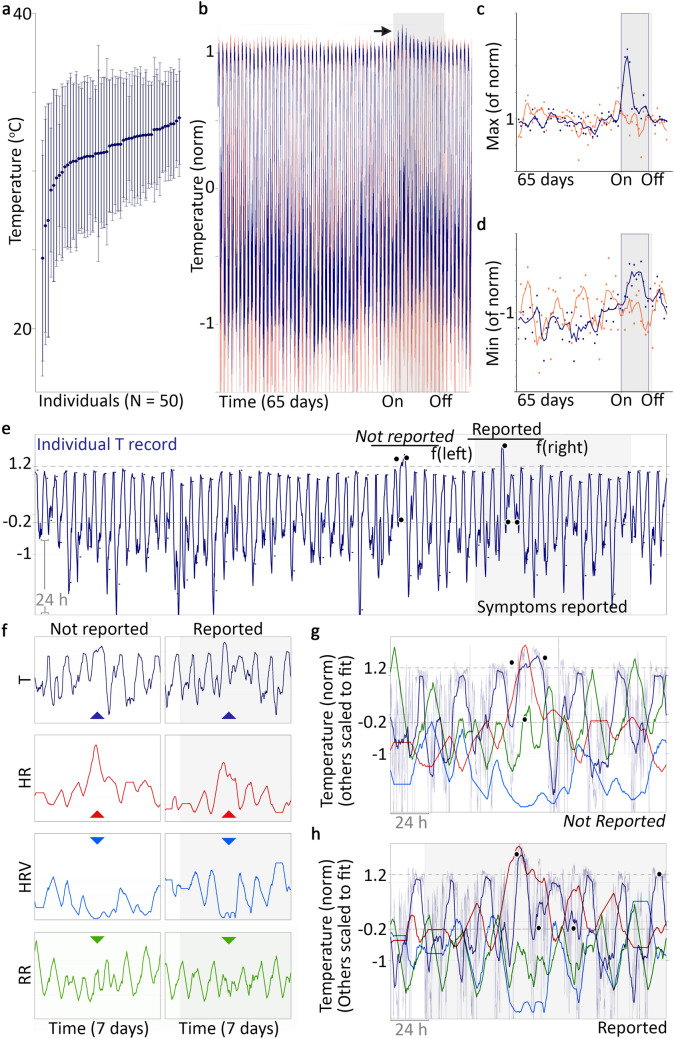
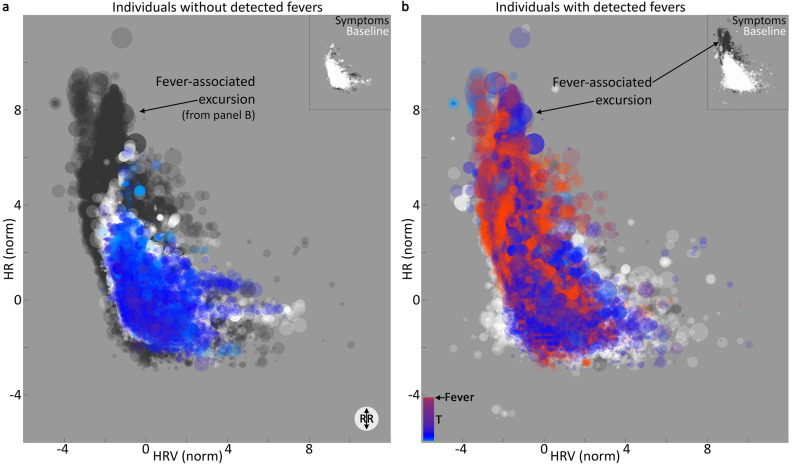
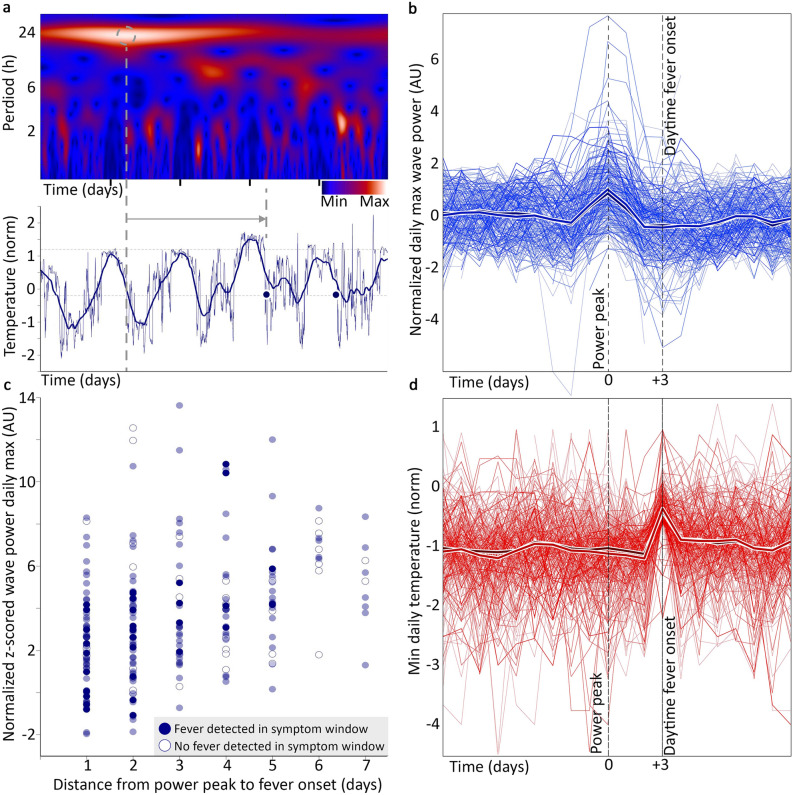
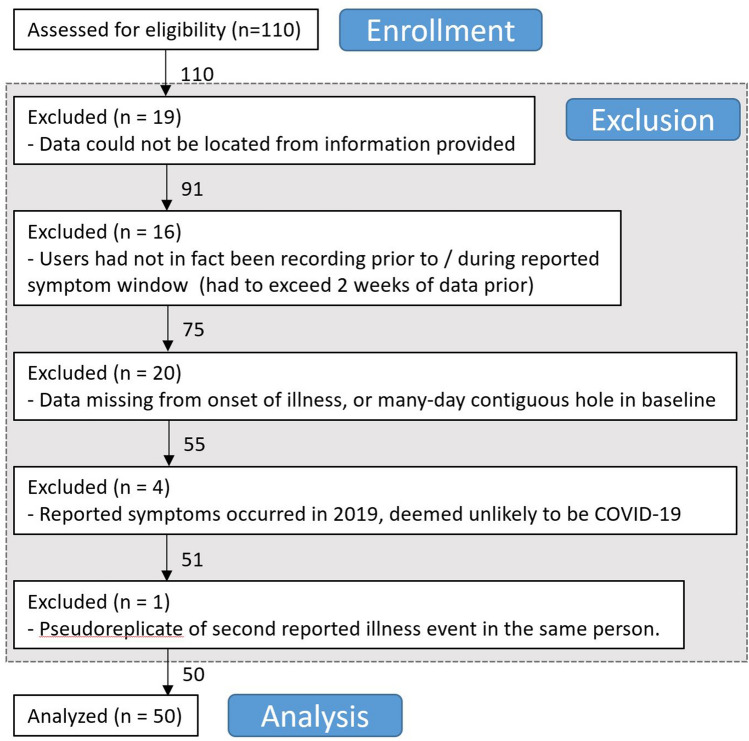
Elevated core temperature constitutes an important biomarker for COVID-19 infection; however, no standards currently exist to monitor fever using wearable peripheral temperature sensors. Evidence that sensors could be used to develop fever monitoring capabilities would enable large-scale health-monitoring research and provide high-temporal resolution data on fever responses across heterogeneous populations. We launched the TemPredict study in March of 2020 to capture continuous physiological data, including peripheral temperature, from a commercially available wearable device during the novel coronavirus pandemic. We coupled these data with symptom reports and COVID-19 diagnosis data. Here we report findings from the first 50 subjects who reported COVID-19 infections. These cases provide the first evidence that illness-associated elevations in peripheral temperature are observable using wearable devices and correlate with self-reported fever. Our analyses support the hypothesis that wearable sensors can detect illnesses in the absence of symptom recognition. Finally, these data support the hypothesis that prediction of illness onset is possible using continuously generated physiological data collected by wearable sensors. Our findings should encourage further research into the role of wearable sensors in public health efforts aimed at illness detection, and underscore the importance of integrating temperature sensors into commercially available wearables.
Overview
The claims and statistics of this paper haven’t been checked yet.
Run the check — free, no account needed. It reads the open-access text and checks the sources it cites.
Integrity signals
Registry
Cites
Statistics
Figures
Verification
Claims the paper makes
The claims and statistics of this paper haven’t been checked yet.
Run the check — free, no account needed. It reads the open-access text and checks the sources it cites.
Claims other papers make about this one
Each is checked against this paper’s own text: does it say what the citing paper says it does?
The source backs part of the claim, not all of it — or backs it for a different population, condition or comparison.
In the citing paper
“For each 24-h period, we discarded wearable sensor-assessed distal body temperature values below the 5th percentile value and above the 95th percentile. This served to exclude periods of non-wear and periods of clinical fever and to minimize influence from non-representative extreme values (e.g., outliers), as done in prior research with wearable sensor-assessed metrics51,52.”
From Sleep and temperature data from wearable devices support noninvasive detection of diabetes mellitus in a large-scale, retrospective analysis (2026) · cites this paper as [52]
Experimental — accuracy not yet measured
Self-check
Percentages, sums and reported differences re-computed from the paper’s own numbers.
The self-check needs the paper’s full text.
Citations
Cites
Zhou, F., Yu, T., Du, R., Fan, G., Liu, Y., Liu, Z., Xiang, J., Wang, Y., Song, B., Gu, X., et al. (2020) · The Lancet · doi:10.1016/s0140-6736(20)30566-3 · Cited by 27,263
Dissecting racial bias in an algorithm used to manage the health of populations
Obermeyer, Z., Powers, B., Vogeli, C., & Mullainathan, S. (2019) · Science · doi:10.1126/science.aax2342 · Cited by 7,137
Heart rate variability: A review
Rajendra Acharya, U., Paul Joseph, K., Kannathal, N., Lim, C. M., & Suri, J. S. (2006) · Medical & Biological Engineering & Computing · doi:10.1007/s11517-006-0119-0 · Cited by 2,820
Potential Biases in Machine Learning Algorithms Using Electronic Health Record Data
Gianfrancesco, M. A., Tamang, S., Yazdany, J., & Schmajuk, G. (2018) · JAMA Internal Medicine · doi:10.1001/jamainternmed.2018.3763 · Cited by 1,395
Circadian rhythms, sleep, and the menstrual cycle
Baker, F. C., & Driver, H. S. (2007) · Sleep Medicine · doi:10.1016/j.sleep.2006.09.011 · Cited by 529
Generalized Morse Wavelets as a Superfamily of Analytic Wavelets
Lilly, J. M., & Olhede, S. C. (2012) · IEEE Transactions on Signal Processing · doi:10.1109/tsp.2012.2210890 · Cited by 510
Estimated effectiveness of symptom and risk screening to prevent the spread of COVID-19
Gostic, K., Gomez, A. C., Mummah, R. O., Kucharski, A. J., & Lloyd-Smith, J. O. (2020) · eLife · doi:10.7554/elife.55570 · Cited by 417
The pathophysiological basis and consequences of fever
Walter, E. J., Hanna-Jumma, S., Carraretto, M., & Forni, L. G. (2016) · Critical Care · doi:10.1186/s13054-016-1375-5 · Cited by 340
Sleep, circadian rhythms and health
Foster, R. G. (2020) · Interface Focus · doi:10.1098/rsfs.2019.0098 · Cited by 286
Kleinberg, J., Ludwig, J., Mullainathan, S., & Rambachan, A. (2018) · AEA Papers and Proceedings · doi:10.1257/pandp.20181018 · Cited by 278
Cited by
Sorted by citations
Items 101–133 of 133
Maschewski, F., & Nosthoff, A.-V. (2022) · Digital Culture & Society · doi:10.14361/dcs-2022-080104 · Cited by 2
The datafied hand in our health
Vora, K. (2024) · Anthropology of Consciousness · doi:10.1111/anoc.12237 · Cited by 1
Sanches, C. A., Librantz, A. F. H., Sampaio, L. M. M., & Belan, P. A. (2025) · Journal of Medical Internet Research · doi:10.2196/76613 · Cited by 1
Classroom Automation & Protection
Sengupta, P., Tripathy, S., & Bhowmick, S. (2024) · International Conference on Control, Instrumentation, Energy & Communication · doi:10.1109/ciec59440.2024.10468077 · Cited by 1
Physiological and Inertial Features based Dataset for Falls and Activities: PIF v2
Kaur, R., Sharma, R., & Dhaliwal, M. K. (2024) · Procedia Computer Science · doi:10.1016/j.procs.2024.04.120 · Cited by 1
Energy-Efficient Monitoring of Potential Side Effects from COVID-19 Vaccines
Deng, W., Ngai, E. C. ‐., & van Zoest, V. (2022) · IEEE International Conference on Internet of Things (iThings) and IEEE Green Computing and Communications (GreenCom) and IEEE Cyber, Physical and Social Computing (CPSCom) and IEEE Smart Data (SmartData) · doi:10.1109/ithings-greencom-cpscom-smartdata-cybermatics55523.2022.00066 · Cited by 1
Slepian, M. J. (2023) · Elsevier eBooks · doi:10.1016/b978-0-12-824010-6.00081-2 · Cited by 1
Conroy, B., Silva, I., Mehraei, G., Damiano, R. F., Gross, B. D., Salvati, E., Feng, T., Schneider, J., Olson, N. H., Rizzo, A. G., et al. (2021) · Research Square · doi:10.21203/rs.3.rs-802605/v1 · Cited by 1
Usability of A Low Fidelity Wearable Device and App to Monitor Covid-19 Out-Patients
AlJurbua, N. (2021) · doi:10.22215/etd/2021-14661 · Cited by 1
Pandemic Solutionism: The Power of Big Tech during the COVID-19 CrisisPreprint
Maschewski, F., & Nosthoff, A.-V. (2023) · SSRN Electronic Journal · doi:10.2139/ssrn.4454582 · Cited by 1
Low-Power Biopotential Signal Acquisition System for Biomedical Applications
Tasneem, N. T. (2022) · University of North Texas Digital Library (University of North Texas) · doi:10.12794/metadc1944354 · Cited by 1
Viswanath, V. K., Navaneethan, S., Burks, J. H., Soltani, S., Kasl, P., Hartogensis, W., Dilchert, S., Hecht, F. M., Mason, A. E., Wang, E. J., et al. (2026) · Communications Medicine · doi:10.1038/s43856-026-01501-0
Self-citationPandemics, Preprints, and Praxis
Schwartz, M. R., & Oppold, P. J. (2021) · Advances in human and social aspects of technology book series · doi:10.4018/978-1-7998-6453-0.ch001
Grant, A. D., Wilbrecht, L., & Kriegsfeld, L. J. (2021) · bioRxiv (Cold Spring Harbor Laboratory) · doi:10.1101/2021.10.15.464452
Enabling Factor Theory For Human Well-being
Nakazawa, H., Kodaka, A., Nishii, S., & Takebe, T. (2021) · Health Evaluation and Promotion · doi:10.7143/jhep.48.501
Framst, I., D’Andrea, C., Baquero, M., & Maboni, G. (2022) · bioRxiv (Cold Spring Harbor Laboratory) · doi:10.1101/2022.03.31.486658
Moore, A. K., Doležalová, N., Morelli, D., Gkrania‐Klotsas, E., Cunningham, A. C., Booth, A., Plans, D., Reed, A. B., Aral, M., Rennie, K. L., et al. (2022) · Research Square · doi:10.21203/rs.3.rs-1885504/v1
Füzéry, A. K., Kost, G. J., & Tran, N. K. (2022) · Encyclopedia of Analytical Chemistry · doi:10.1002/9780470027318.a9797
Wearable Analytics and Early Diagnostic of COVID-19 Based on Two Cohorts
Skibińska, J., Hošek, J., & Channa, A. (2022) · International Congress on Ultra Modern Telecommunications and Control Systems and Workshops (ICUMT) · doi:10.1109/icumt57764.2022.9943460
Evaluation of Early Diagnosis of COVID-19 Algorithms
Modaresi, S. M. R., Osmani, A., Razzazi, M., & Chibani, A. (2022) · IEEE International Conference on Tools with Artificial Intelligence (ICTAI) · doi:10.1109/ictai56018.2022.00193
Fusion-Based Activity Recognition
Sandhu, M. M., Khalifa, S., Portmann, M., & Jurdak, R. (2023) · Green energy and technology · doi:10.1007/978-3-031-27685-9_7
Classification of COVID-19 associated symptomatology using machine learning
Ramirez-Bautista, J. A., Chaparro-Cárdenas, S. L., Contreras, W. G., Guerrero-Salazar, W., & Huerta-Ruelas, J. A. (2023) · DYNA · doi:10.15446/dyna.v90n226.105616
Technology Approaches for Cruise Ship Disease Propagation Monitoring
Almeida, B., Mateus, M., Pacheco, M., Maló, P., & Teixeira, T. (2023) · Springer eBooks · doi:10.1007/978-3-031-48831-3_10
Optimizing COVID-19 testing resources use with wearable sensors
Quer, G., Kolbeinsson, A., Radin, J. M., Foschini, L., & Pandit, J. A. (2024) · PLOS Digital Health · doi:10.1371/journal.pdig.0000584 · Cited by 1
Zargaran, A., Sousi, S., Colville, G., Radcliffe, G., Malek, R., Douiri, A., El‐Boghdadly, K., Nebbia, G., Martínez-Nuñez, R. T., & Greenough, A. (2025) · BMJ Open · doi:10.1136/bmjopen-2024-089598
Practical Applications of Wearable Devices for Diagnosis and Monitoring
Kim, H. (2024) · MechEcology · doi:10.23104/me.2024.10.3.2.23
3 medical innovations fueled by COVID-19 that will outlast the pandemic
FULLER, D. H., Krogan, N. J., & Titus, A. H. (2021) · doi:10.64628/aai.ffsyg5aa4
Mustajoki, I., Karhinoja, K., & Kaisti, M. (2025) · Proceedings of IEEE Sensors/Proceedings of IEEE Sensors ... · doi:10.1109/sensors59705.2025.11330340
Perez, J. R. C., Arreola, A. R., Verykios, T. D., Cortes, E. G., & Tellez, A. (2026) · Lecture notes in computer science · doi:10.1007/978-3-032-17933-3_21
Wearable systems for real-time disease diagnosis and predictive analytics
Huynh, P. K., Nguyen, D. H., Liu, H., Marahatta, S., Olaniran, O., Nguyen, D., Truong, T. T., Huynh, P., Keshwani, A., Prioli, J. P. J., et al. (2026) · Elsevier eBooks · doi:10.1016/b978-0-44-331426-1.00018-8
Predictive artificial intelligence to increase the success of heart transplantation
Olawade, D. B., Odetayo, A., Weerasinghe, K., Marinze, S., Egbon, E., & Teke, J. (2026) · Elsevier eBooks · doi:10.1016/b978-0-443-43934-6.00001-8
Innovative digital twin framework for early risk detection and personalized perinatal healthcare
Sanz, M., Yuste, V. A., Rivera, D., Moreno, J. I., & Novo, X. A. L. (2026) · Frontiers in Digital Health · doi:10.3389/fdgth.2026.1724029
Soltani, S., Hartogensis, W., Dilchert, S., Flores, K., Lowry, C. A., Raison, C. L., Hecht, F. M., Smarr, B. L., & Mason, A. E. (2026) · Frontiers in Psychiatry · doi:10.3389/fpsyt.2026.1846398
Self-citation
Metadata
- Authors
- Smarr, B. L., Aschbacher, K., Fisher, S. M., Chowdhary, A., Dilchert, S., Puldon, K., Rao, A., Hecht, F. M., & Mason, A. E.
- Affiliations
- University of California San Diego (US)
- University of California, San Francisco (US)
- Baruch College (US)
- Corresponding author
- Smarr, Benjamin L.
- ORCID
- Venue
- Scientific Reports
- Published
- 2020-12-14
- Volume
- 10
- Issue
- 1
- Pages
- 21640-21640
- ISSN
- 2045-2322 (ISSN-L)
- PMC
- PMC7736301
- OpenAlex
- W3112300562
- Cited by
- 133
- References
- 30
- Citations by year
- 2026: 7 · 2025: 12 · 2024: 19 · 2023: 20 · 2022: 44 · 2021: 31
- FWCI
- 7.46
- Type
- journal article
- Language
- en
- Update notices
- correction (2022-03-15)
- Open access
- gold
- doi.org
- Locations
- Scientific Reports (publishedVersion, cc-by)
- Research Square (acceptedVersion, cc-by)
- PubMed Central (publishedVersion, cc-by)
- PubMed (publishedVersion)
- CUNY Academic Works (City University of New York) (submittedVersion, cc-by)
- DOAJ (DOAJ: Directory of Open Access Journals) (submittedVersion, cc-by-sa)
- eScholarship (California Digital Library) (submittedVersion)
- eScholarship (California Digital Library) (submittedVersion, cc-by)
- Funders
- Oura Health Oy
- Topics
- Physical Sciences › Engineering › Biomedical Engineering › Non-Invasive Vital Sign Monitoring
- Health Sciences › Medicine › Radiology, Nuclear Medicine and Imaging › Infrared Thermography in Medicine
- Health Sciences › Medicine › Epidemiology › Data-Driven Disease Surveillance
- Keywords
- COVID-19 pandemic, fever monitoring, wearable devices, peripheral temperature, core body temperature, symptom reporting, health monitoring
- MeSH terms
- Wearable Electronic Devices, COVID-19, Adult, Aged, Feasibility Studies, Female, Fever, Humans, Male, Middle Aged, Monitoring, Physiologic, Telemedicine, Young Adult, Self Report, Thermometry
About these checks
Registry, retraction, Cites and statistics results are computed, not judged, with one exception: a printed reference that no index lists is read once by a model before it counts as a citation error. Claims are extracted by a model and kept only when their quote appears verbatim in the text; each cited source is then checked, with a model’s help, for whether it says what the claim relies on. Those verdicts can be wrong — read the claim’s quote and the cited source before relying on one.
Statistics and arithmetic are recomputed, not judged.
Confidence bands are shown only for fields calibrated on our annotated test set. None is calibrated yet, so no band is shown.
What counts as a claim ›How we measure confidence ›How we check this ›
Are you an author, or do you see a problem with this page? Request a review
