

Effect of data leakage in brain MRI classification using 2D convolutional neural networks
Open accessPublished version of a preprint
The DOI matches its Crossref record; 79 of the 81 references it cites were found in a registry or an index.
Abstract
In recent years, 2D convolutional neural networks (CNNs) have been extensively used to diagnose neurological diseases from magnetic resonance imaging (MRI) data due to their potential to discern subtle and intricate patterns. Despite the high performances reported in numerous studies, developing CNN models with good generalization abilities is still a challenging task due to possible data leakage introduced during cross-validation (CV). In this study, we quantitatively assessed the effect of a data leakage caused by 3D MRI data splitting based on a 2D slice-level using three 2D CNN models to classify patients with Alzheimer’s disease (AD) and Parkinson’s disease (PD). Our experiments showed that slice-level CV erroneously boosted the average slice level accuracy on the test set by 30% on Open Access Series of Imaging Studies (OASIS), 29% on Alzheimer’s Disease Neuroimaging Initiative (ADNI), 48% on Parkinson’s Progression Markers Initiative (PPMI) and 55% on a local de-novo PD Versilia dataset. Further tests on a randomly labeled OASIS-derived dataset produced about 96% of (erroneous) accuracy (slice-level split) and 50% accuracy (subject-level split), as expected from a randomized experiment. Overall, the extent of the effect of an erroneous slice-based CV is severe, especially for small datasets.
Overview
The claims and statistics of this paper haven’t been checked yet.
Free: it reads the open-access text and checks the first 5 claims that cite a source we can check. Create a free account to check every claim.
Integrity signals
Registry
Cites
Statistics
Figures


Verification
Claims the paper makes
The claims and statistics of this paper haven’t been checked yet.
Free: it reads the open-access text and checks the first 5 claims that cite a source we can check. Create a free account to check every claim.
Claims other papers make about this one
Each is checked against this paper’s own text: does it say what the citing paper says it does?
The check wasn’t confident either way, so it gives no verdict — never disputed.
In the citing paper
“different types of blood-based -omics data have been combined with neuropathology and imaging data in a multi-modal AI model to identify subtypes of AD and co-pathology.136,137”
From Review of Artificial Intelligence for Clinical Use in Alzheimer's Disease and Related Dementias (2026) · cites this paper as [136]
Experimental — accuracy not yet measured
Self-check
Percentages, sums and reported differences re-computed from the paper’s own numbers.
The self-check needs the paper’s full text.
Citations
Cites
1 retracted
Diagnosis of Alzheimer Disease Using 2D MRI Slices by Convolutional Neural Network
Al-Khuzaie, F. E. K., Bayat, O., & Duru, A. D. (2021) · Applied Bionics and Biomechanics · doi:10.1155/2021/6690539 · Cited by 89
RetractedAdam: A Method for Stochastic Optimization
Kingma, D. P., & Ba, J. (2014) · arXiv · doi:10.48550/arxiv.1412.6980 · Cited by 98,946
Scikit-learn: Machine Learning in Python
Pedregosa, F., Varoquaux, G., Gramfort, A., Michel, V., Thirion, B., Grisel, O., Blondel, M., Müller, A., Nothman, J., Louppe, G., et al. (2012) · arXiv · doi:10.48550/arxiv.1201.0490 · Cited by 71,016
Going deeper with convolutions
Szegedy, C., Liu, W., Jia, Y., Sermanet, P., Reed, S., Anguelov, D., Erhan, D., Vanhoucke, V., & Rabinovich, A. (2015) · 2015 IEEE Conference on Computer Vision and Pattern Recognition (CVPR) · doi:10.1109/cvpr.2015.7298594 · Cited by 48,562
The Elements of Statistical Learning
Hastie, T., Tibshirani, R., & Friedman, J. (2009) · Springer Series in Statistics · doi:10.1007/978-0-387-84858-7 · Cited by 25,970
Delving Deep into Rectifiers: Surpassing Human-Level Performance on ImageNet Classification
He, K., Zhang, X., Ren, S., & Sun, J. (2015) · 2015 IEEE International Conference on Computer Vision (ICCV) · doi:10.1109/iccv.2015.123 · Cited by 19,741 · cited 3×
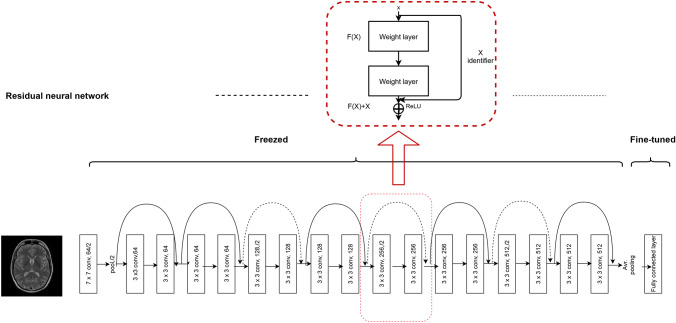
“Notably, we used pre-trained VGG16 67 and ResNet-18 68 models in this study, as detailed in the following sections.”
MethodInfluential(2010) · Cited by 14,134
Parkinsonism: onset, progression, and mortality
Hoehn, M. M., & Yahr, M. D. (1967) · Neurology · doi:10.1212/wnl.17.5.427 · Cited by 12,107
(2016) · Cited by 11,679
The Clinical Dementia Rating (CDR): Current version and scoring rules
Morris, J. C. (1993) · Neurology · doi:10.1212/wnl.43.11.2412-a · Cited by 9,882
Research works printed but not linked: 4
- Simonyan, K. & Zisserman, A. Very deep convolutional networks for large-scale image recognition. Preprint at http://arXiv.org/1409.1556 (2015).
- Lin, M., Chen, Q. & Yan, S. Network in network. Preprint at http://arXiv.org/1312.4400 (2014).
- TensorFlow Developers. TensorFlow (2021).
- Brett, M. et al. Nipy/nibabel: 2.3.3 (2019).
Cited by
Overview of leakage scenarios in supervised machine learning
Sasse, L., Nicolaisen‐Sobesky, E., Dukart, J., Eickhoff, S. B., GOETZ, M. A., Hamdan, S., Komeyer, V., Kulkarni, A. J., Lahnakoski, J. M., Love, B. C., et al. (2025) · Journal Of Big Data · doi:10.1186/s40537-025-01193-8 · Cited by 146
“…examples demonstrating such leakage include, existence of the same genomic loci in the training and test sets when performing cross-cell type predictions [62], and using 2D slices from the 3D brain images of the same individual for training and testing for predicting neurodegenerative disease [82].”
MethodTang, A. S., Rankin, K. P., Cerono, G., Miramontes, S., Mills, H., Roger, J., Zeng, B., Nelson, C., Soman, K., Woldemariam, S., et al. (2024) · Nature Aging · doi:10.1038/s43587-024-00573-8 · Cited by 86
“Cohort selection and data preprocessing is a crucial first step to identify available clinical measures and optimal ground truth that is close to biological AD and avoid overly optimistic model performance due to nonspecific AD or improper data preprocessing 36 .”
Marzi, C., Giannelli, M., Barucci, A., Tessa, C., Mascalchi, M., & Diciotti, S. (2024) · Scientific Data · doi:10.1038/s41597-023-02421-7 · Cited by 85
Self-citationApplying oversampling before cross-validation will lead to high bias in radiomics
Demircioğlu, A. (2024) · Scientific Reports · doi:10.1038/s41598-024-62585-z · Cited by 85
Machine and Deep Learning Prediction Of Prostate Cancer Aggressiveness Using Multiparametric MRI
Bertelli, E., Mercatelli, L., Marzi, C., Pachetti, E., Baccini, M., Barucci, A., Colantonio, S., Gherardini, L., Lattavo, L., Pascali, M. A., et al. (2022) · Frontiers in Oncology · doi:10.3389/fonc.2021.802964 · Cited by 77
“It is essential to underline that, unlike other works (74, 75), we performed a patient-based splitting, and thus avoiding results inflated by the phenomenon of data leakage (80).”
Self-citation
Metadata
- Authors
- Yagis, E., Atnafu, S. W., García Seco de Herrera, A., Marzi, C., Scheda, R., Giannelli, M., Tessa, C., Citi, L., & Diciotti, S.
- Affiliations
- University of Bologna (IT)
- Azienda Ospedaliera Universitaria Pisana (IT)
- Ospedale Versilia (IT)
- University of Essex (GB)
- Corresponding author
- Diciotti, Stefano
- ORCID
- Venue
- Scientific Reports
- Published
- 2021-11-19
- Volume
- 11
- Issue
- 1
- Pages
- 22544-22544
- ISSN
- 2045-2322 (ISSN-L)
- PMC
- PMC8604922
- OpenAlex
- W3214734349
- Cited by
- 161
- References
- 81
- Citations by year
- 2026: 61 · 2025: 32 · 2024: 26 · 2023: 25 · 2022: 16
- FWCI
- 12.02
- Type
- journal article
- Language
- en
- Open access
- gold
- doi.org
- Licence
- cc-by
- creativecommons.org/licenses/by/4.0 (tdm)
- creativecommons.org/licenses/by/4.0 (vor)
- Locations
- Scientific Reports (publishedVersion, cc-by)
- Research Square (acceptedVersion, cc-by)
- PubMed Central (publishedVersion, cc-by)
- PubMed (publishedVersion)
- UNED repository (publishedVersion, other-oa)
- Open Access at Essex (University of Essex) (acceptedVersion, other-oa)
- Archivio istituzionale della ricerca (Alma Mater Studiorum Università di Bologna) (submittedVersion, cc-by)
- DOAJ (DOAJ: Directory of Open Access Journals) (submittedVersion, cc-by-sa)
- Florence Research (University of Florence) (submittedVersion)
- Funders
- European Union's Horizon 2020 research and innovation programme (824153 “POTION”)
- NVIDIA Academic GPU Grant Program
- Topics
- Health Sciences › Medicine › Psychiatry and Mental health › Dementia and Cognitive Impairment Research
- Life Sciences › Neuroscience › Cognitive Neuroscience › Functional Brain Connectivity Studies
- Health Sciences › Health Professions › Health Information Management › Artificial Intelligence in Healthcare
- Keywords
- data leakage, cross-validation, 2D convolutional neural network, brain MRI classification, Alzheimer's disease, Parkinson's disease, model generalization, neurological disease diagnosis, small datasets
- MeSH terms
- Deep Learning, Aged, Aged, 80 and over, Alzheimer Disease, Brain, Cross-Sectional Studies, Female, Humans, Image Interpretation, Computer-Assisted, Magnetic Resonance Imaging, Male, Middle Aged, Parkinson Disease, Predictive Value of Tests, Reproducibility of Results, Case-Control Studies, Neural Networks, Computer, Neuroimaging
About these checks
Registry, retraction, Cites and statistics results are computed, not judged, with one exception: a printed reference that no index lists is read once by a model before it counts as a citation error. Claims are extracted by a model and kept only when their quote appears verbatim in the text; each cited source is then checked, with a model’s help, for whether it says what the claim relies on. Those verdicts can be wrong — read the claim’s quote and the cited source before relying on one.
Statistics and arithmetic are recomputed, not judged.
Confidence bands are shown only for fields calibrated on our annotated test set. None is calibrated yet, so no band is shown.
What counts as a claim ›How we measure confidence ›How we check this ›
Are you an author, or do you see a problem with this page? Request a review
How to cite
Cite CoChat for the checks on this page, and the paper for its own findings.
- This page
- CoChat. (2026). Citation check: Effect of data leakage in brain MRI classification using 2D convolutional neural networks. https://app.cochat.ai/papers/10.1038/s41598-021-01681-w
- The paper
- Yagis, E., Atnafu, S. W., García Seco de Herrera, A., Marzi, C., Scheda, R., Giannelli, M., Tessa, C., Citi, L., & Diciotti, S. (2021). Effect of data leakage in brain MRI classification using 2D convolutional neural networks. Scientific Reports. https://doi.org/10.1038/s41598-021-01681-w
Data sources
Bibliographic data: Semantic Scholar, OpenAlex, Crossref.
Contains information from the Semantic Scholar Academic Graph Datasets, made available under the ODC Attribution License (ODC-BY 1.0).
Semantic Scholar’s data is described in: Kinney, R., et al. (2023). The Semantic Scholar Open Data Platform. arXiv:2301.10140.
