

CD8-positive T cells and CD204-positive M2-like macrophages predict postoperative prognosis of very high-risk prostate cancer
Open accessThe DOI matches its Crossref record; 30 of the 30 references it cites were found in a registry or an index.
Abstract
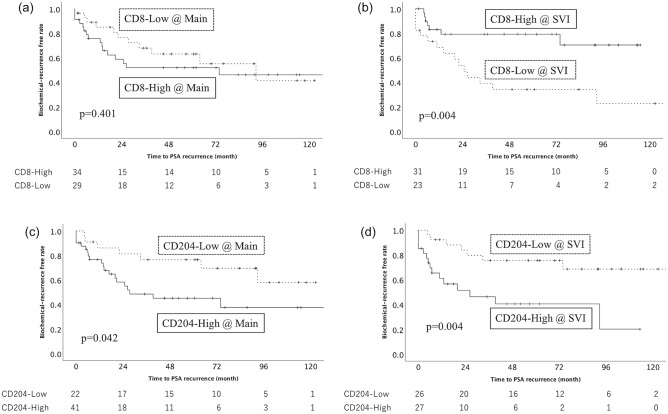
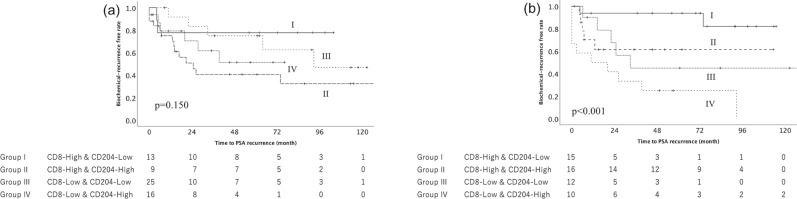
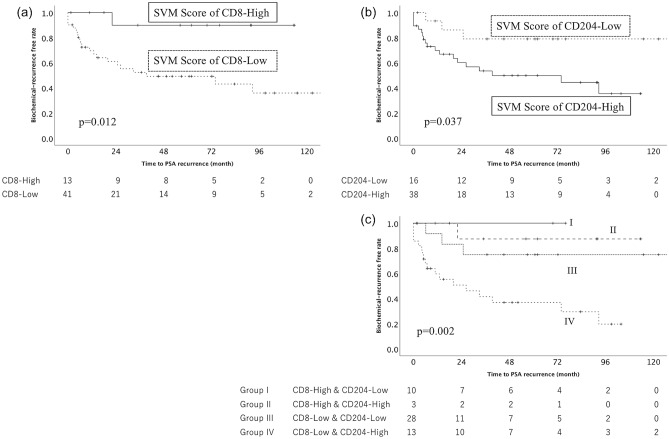
Abstract To stratify the heterogeneity of prostate cancer (PCa) with seminal vesicle invasion (SVI) immunologically after radical prostatectomy focusing on the tumor microenvironment. We retrospectively reviewed the clinicopathological data of 71 PCa patients with SVI, which is known as a factor of very high-risk PCa. Preoperative clinical variables and postoperative pathological variables were evaluated as predictors of biochemical recurrence (BCR) with a multivariate logistic regression. Immune cell infiltration including the CD8-positive cell (CD8+ cell) and CD204-positive M2-like macrophage (CD204+ cell) was investigated by immunohistochemistry. The cumulative incidence and risk of BCR were assessed with a Kaplan–Meier analysis and competing risks regression. A higher CD8+ cell count in the SVI area significantly indicated a favorable prognosis for cancers with SVI (p = 0.004). A lower CD204+ cell count in the SVI area also significantly indicated a favorable prognosis for cancers with SVI (p = 0.004). Furthermore, the combination of the CD8+ and CD204+ cell infiltration ratio of the SVI area to the main tumor area was a significant factor for BCR in the patients with the PCa with SVI (p = 0.001). In PCa patients with SVI, the combination of CD8+ and CD204+ cell infiltration is useful to predict the prognosis.
Overview
The claims and statistics of this paper haven’t been checked yet.
Free: it reads the open-access text and checks the first 5 claims that cite a source we can check. Create a free account to check every claim.
Integrity signals
Registry
Cites
Statistics
Figures
Verification
Claims the paper makes
The claims and statistics of this paper haven’t been checked yet.
Free: it reads the open-access text and checks the first 5 claims that cite a source we can check. Create a free account to check every claim.
Claims other papers make about this one
Each is checked against this paper’s own text: does it say what the citing paper says it does?
The source backs part of the claim, not all of it — or backs it for a different population, condition or comparison.
In the citing paper
“In addition, mast cells contribute to increased chemotherapy and radiotherapy resistance (Xie et al., 2016), while tumor infiltrating CD8+ T cells are–similar to ovarian cancers or other ‘hot’ tumors–associated with improved clinical outcome (Yanai et al., 2021; Yang et al., 2021).”
From Microphysiological systems as models for immunologically ‘cold’ tumors (2024) · cites this paper as Yanai et al., 2021
Experimental — accuracy not yet measured
Self-check
Percentages, sums and reported differences re-computed from the paper’s own numbers.
The self-check needs the paper’s full text.
Citations
Cites
PD-1 and PD-L1 Immune Checkpoint Blockade to Treat Breast Cancer
Hartkopf, A. D., Taran, F.-A., Wallwiener, M., Walter, C. B., Krämer, B., Grischke, E.-M., & Brucker, S. Y. (2016) · Breast Care · doi:10.1159/000453569 · Cited by 30,845
Type, Density, and Location of Immune Cells Within Human Colorectal Tumors Predict Clinical Outcome
Galon, J., Costes, A., Sanchez-Cabo, F., Kirilovsky, A., Mlecnik, B., Lagorce-Pagès, C., Tosolini, M., Camus, M., Berger, A., Wind, P., et al. (2006) · Science · doi:10.1126/science.1129139 · Cited by 6,516
The immune contexture and Immunoscore in cancer prognosis and therapeutic efficacy
Bruni, D., Angell, H. K., & Galon, J. (2020) · Nature reviews. Cancer · doi:10.1038/s41568-020-0285-7 · Cited by 1,586
Bates, G. J., Fox, S. B., Han, C., Leek, R. D., Garcia, J. F., Harris, A. L., & Banham, A. H. (2006) · Journal of Clinical Oncology · doi:10.1200/jco.2006.05.9584 · Cited by 1,200
Cookson, M. S., Aus, G., Burnett, A. L., Canby-Hagino, E. D., D’Amico, A. V., Dmochowski, R. R., Eton, D. T., Forman, J. D., Goldenberg, S. L., Hernandez, J., et al. (2007) · Journal of Urology · doi:10.1016/j.juro.2006.10.097 · Cited by 844
Spranger, S., Koblish, H. K., Horton, B., Scherle, P. A., Newton, R., & Gajewski, T. F. (2014) · Journal for ImmunoTherapy of Cancer · doi:10.1186/2051-1426-2-3 · Cited by 552
Wiegel, T., Bartkowiak, D., Bottke, D., Bronner, C., Steiner, U., Siegmann, A., Golz, R., Störkel, S., Willich, N., Semjonow, A., et al. (2014) · European Urology · doi:10.1016/j.eururo.2014.03.011 · Cited by 440
Becht, E., Giraldo, N. A., Germain, C., de Reyniès, A., Laurent-Puig, P., Zucman-Rossi, J., Dieu-Nosjean, M.-C., Sautès-Fridman, C., & Fridman, W. H. (2016) · Advances in Immunology · doi:10.1016/bs.ai.2015.12.002 · Cited by 213
CD73 Expression Is an Independent Prognostic Factor in Prostate Cancer
Leclerc, B. G., Charlebois, R., Chouinard, G., Allard, B., Pommey, S., Saad, F., & Stagg, J. (2016) · Clinical Cancer Research · doi:10.1158/1078-0432.ccr-15-1181 · Cited by 200
High Oct4 expression: implications in the pathogenesis of neuroblastic tumours
Monferrer, E., Burgos-Panadero, R., Blanquer-Maceiras, M., Cañete, A., Navarro, S., & Noguera, R. (2019) · BMC Cancer · doi:10.1186/s12885-018-5219-3 · Cited by 196
Cited by
The role of macrophage scavenger receptor 1 (MSR1) in inflammatory disorders and cancer
Gudgeon, J., Marín-Rubio, J. L., & Trost, M. (2022) · Frontiers in Immunology · doi:10.3389/fimmu.2022.1012002 · Cited by 124
Hansen, S. B., Unal, B., Kuzu, O. F., & Saatcioglu, F. (2024) · Theranostics · doi:10.7150/thno.100555 · Cited by 45
“…task, however, as some studies associate high numbers of CTLs with increased time to biochemical recurrence and overall survival after surgery [70, 73], while others find a shorter time to cancer progression with high cell density [74, 75], suggesting a context dependency the basis of which is…”
BackgroundDietary fat and lipid metabolism in the tumor microenvironment
Goswami, S., Zhang, Q., Celik, C. E., Reich, E. M., & Yilmaz, Ö. H. (2023) · Biochimica et Biophysica Acta (BBA) - Reviews on Cancer · doi:10.1016/j.bbcan.2023.188984 · Cited by 41
Macrophage scavenger receptors: Tumor support and tumor inhibition
Kazakova, E., Iamshchikov, P. S., Larionova, I., & Kzhyshkowska, J. G. (2023) · Frontiers in Oncology · doi:10.3389/fonc.2022.1096897 · Cited by 34
Epigenetic modulation and prostate cancer: Paving the way for NK cell anti-tumor immunity
dos Reis, F. D., Jerónimo, C., & Correia, M. P. (2023) · Frontiers in Immunology · doi:10.3389/fimmu.2023.1152572 · Cited by 17
“While a high CD8 TIL density in PCa has been independently associated with improved OS, PCa‐specific survival (41, 42) and longer time to biochemical recurrence in patients with seminal vesicle invasion (43), other studies have found an association between high CD8 T cell density, worse clinical progression and PCa ma…”
ResultMicrophysiological systems as models for immunologically ‘cold’ tumors
Gaebler, D., Hachey, S. J., & Hughes, C. C. W. (2024) · Frontiers in Cell and Developmental Biology · doi:10.3389/fcell.2024.1389012 · Cited by 14
Xin, S., Mao, J., Cui, K., Li, Q., Chen, L., Li, Q., Tu, B., Liu, X., Wang, T., Wang, S., et al. (2022) · Frontiers in Molecular Biosciences · doi:10.3389/fmolb.2022.974722 · Cited by 14
“Highly infiltratedCD8T cells andNK cells in highrisk patients have antitumor effects (Wu et al., 2020; Yanai et al., 2021).”
BackgroundXin, S., Deng, Y., Mao, J., Wang, T., Liu, J., Wang, S., Song, X., Song, W., & Liu, X. (2022) · Frontiers in Oncology · doi:10.3389/fonc.2022.900203 · Cited by 13
Zhu, Y., Zhang, H., Pan, C., He, G., Cui, X., Yu, X., Zhang, X., Wu, D., Yang, J., Wu, X., et al. (2022) · Cancer Medicine · doi:10.1002/cam4.5372 · Cited by 12
Yu, Z., Chao, H., Xu, F., Deng, H., Deng, L., Song, Z., & Zeng, T. (2023) · Frontiers in Oncology · doi:10.3389/fonc.2023.1115718 · Cited by 11
Xie, Y., Tang, G., Xie, P., Zhao, X., Chen, C., Li, X., Zhang, Y., Wang, B., & Luo, Y. (2024) · Journal of Cancer · doi:10.7150/jca.91928 · Cited by 10
“A higher ratio of CD8 + T cells to CD204 + TAMs is associated with a favorable postoperative prognosis in prostate cancer [24] .”
BackgroundDetailed role of SR-A1 and SR-E3 in tumor biology, progression, and therapy
Saadh, M. J., Pallathadka, H., Abed, H. S., Menon, S. V., Sivaprasad, G. V., Hjazi, A. M., Rizaev, J. A., Suri, S., Jawad, M. A., & Husseen, B. (2024) · Cell Biochemistry and Biophysics · doi:10.1007/s12013-024-01350-5 · Cited by 9
“Additionally, a signi fi cant contributing factor to bio-chemical recurrence (BCR) in patients with PCa with SVI was the ratio of CD8 + and SR-A1 + cell in fi ltration in the SVI area to the primary tumor area [73].”
Mejía-Hernández, J. O., Keam, S. P., Saleh, R., Muntz, F., Fox, S. B., Byrne, D. J., Kogan, A., Pang, L., Huynh, J., Litchfield, C., et al. (2022) · Cell Death and Disease · doi:10.1038/s41419-022-05211-y · Cited by 9
“Importantly, these features of Trp53, are relevant to the characteristics of very high risk PC in humans [69].”
BackgroundBardoscia, L., Sardaro, A., Quattrocchi, M., Cocuzza, P., Ciurlia, E., Furfaro, I. F., Gilio, M. A., Mignogna, M., Detti, B., & Ingrosso, G. (2025) · Journal of Personalized Medicine · doi:10.3390/jpm15080367 · Cited by 5
Yanai, Y., Mikami, S., Yasumizu, Y., Takeda, T., Matsumoto, K., Kitano, S., Oya, M., & Kosaka, T. (2024) · International Journal of Urology · doi:10.1111/iju.15592 · Cited by 5
“2 In this study, we explored another alternative strategy to clarify the heterogeneity of PCa by adding existing clinical and pathological parameters and evaluated its ef fi cacy in improving prognostic accuracy.”
Self-citationBu, Y., Liu, Y., Hu, C. W., Yuan, D., Luo, L., Li, M., Hu, J., Dong, H., & Xu, Z. (2024) · International Immunopharmacology · doi:10.1016/j.intimp.2024.113811 · Cited by 5
Zhang, Z., Liu, H., Gu, X., Qiu, Y., Ma, J., Ai, G., & He, X. (2025) · BMC Medical Imaging · doi:10.1186/s12880-025-01869-w · Cited by 4
“This performance may be attributed to the critical role of CD3 + and CD8 + T cells in shaping tumor behavior within the complex PCa microenvironment [21].”
TMPRSS11B promotes an acidified microenvironment and immune suppression in squamous lung cancer
Sunil, H. S., Clemenceau, J. R. V., Grichuk, A., Barnfather, I., Nakkireddy, S. R., Izzo, L., Feng, Q., Hartnett, W., Evers, B. M., Thomas, L., et al. (2025) · EMBO Reports · doi:10.1038/s44319-025-00631-1 · Cited by 4
“5D and EV6D) (Hirayama et al, 2012; Katzenelenbogen et al, 2020; Liu et al, 2022b; Ma et al, 2022a; Muliaditan et al, 2018; Wang et al, 2024; Wu et al, 2022; Yanai et al, 2021; Yu et al, 2019).”
T-reg transcriptomic signatures identify response to check-point inhibitors
Noblejas‐López, M. D. M., García, E. G., Pérez‐Segura, P., Pandiella, A., Győrffy, B., & Ocaña, A. (2024) · Scientific Reports · doi:10.1038/s41598-024-60819-8 · Cited by 4
“MSR1 has been described as present in M2 macrophages contributing to inflammation and patient outcome 27,28 .”
BackgroundDynamics in the Prostate Immune Microenvironment Induced by Androgen Deprivation Therapy
Yanai, Y., Kosaka, T., Mikami, S., Arai, M., Watanabe, K., Takeda, T., Matsumoto, K., Yamashita, M., Kitano, S., & Oya, M. (2024) · The Prostate · doi:10.1002/pros.24828 · Cited by 3
“These cells have been identified as a poor prognostic factor, such as M2 macrophages, a type of immunosuppressive cell [14, 15].”
Self-citationLuo, Y., Liu, X., Lin, J., Zhong, W., & Chen, Q.-B. (2022) · Mathematical Biosciences & Engineering · doi:10.3934/mbe.2022528 · Cited by 2
Popescu, S. N., Milligan, K., Wiebe, M., Fuentes, A. M., Brewer, J. M., Haston, C. K., Lum, J. J., Punch, S., Raudales, A., Brolo, A. G., et al. (2025) · Scientific Reports · doi:10.1038/s41598-025-20107-5 · Cited by 2
“In general, lower concentrations of CD68 + cells and higher concentrations of CD8 + CD3 + cells have been indicative of a more favourable prognosis 40–42 , although there remains variation in the strength of the association between these cells and the ability to accurately predict treatment outcome.”
Liu, J., Liu, X., Li, Z., Yu, X., Qian, J., Zhang, Z., Ding, X., Su, R., Mao, J. Y., Luo, X., et al. (2026) · Cancer Letters · doi:10.1016/j.canlet.2026.218449 · Cited by 2
Bardoscia, L., Camilli, F., Triggiani, L., Ciurlia, E., Iori, F., Festa, E., Trovò, M., Lancia, A., Detti, B., & Ingrosso, G. (2026) · Expert Review of Clinical Pharmacology · doi:10.1080/17512433.2026.2677891 · Cited by 1
MAZZIO, E. A., Barnes, A. S., Badisa, R. B., Darling‐Reed, S., & Soliman, K. F. A. (2026) · Frontiers in Immunology · doi:10.3389/fimmu.2026.1729108 · Cited by 1
Hirschmann, M., Schnellhardt, S., Rübner, M., Segelhorst, S., Ott, O. J., Erber, R., Daniel, C., Büttner-Herold, M. J., Gaß, P., Fietkau, R., et al. (2025) · Cells · doi:10.3390/cells14110828 · Cited by 1
“For further differentiation, some studies used CD204 as a M2-like macrophage marker [43,44].”
Chen, X., Li, S., & Sun, B. (2024) · Drug Development Research · doi:10.1002/ddr.70006
“Yanai et al. observed that a significant infiltration of CD8 + T cells in the seminal vesicle invasion (SVI) area indicated a favorable prognosis for prostate cancer patients with SVI (Yanai et al., 2021).”
CD20+ and CD204+ exhibit distinct prognostic associations in thymic epithelial tumors
Chen, Q., Zhang, J., Feng, J., Chen, C., Su, C., & Yao, W. (2025) · Frontiers in Oncology · doi:10.3389/fonc.2025.1710544
Baxevanis, C., Stokidis, S., Fortis, S. P., Goulielmaki, M., Tsitsilonis, O., & Gritzapis, A. D. (2026) · International Journal of Oncology · doi:10.3892/ijo.2026.5917 · Cited by 1
“In high‑risk disease, increased CD8 + cells, espe‑ cially with low M2 macrophages, correlate with markedly improved PFS (~91% at 5 years) (96).”
Metadata
- Authors
- Yanai, Y., Kosaka, T., Mikami, S., Hongo, H., Yasumizu, Y., Takeda, T., Matsumoto, K., Miyauchi, J., Kitano, S., & Oya, M.
- Affiliations
- Keio University (JP)
- Saitama Municipal Hospital (JP)
- National Cancer Center Hospital (JP)
- Corresponding author
- Kosaka, Takeo
- ORCID
- Venue
- Scientific Reports
- Published
- 2021-11-18
- Volume
- 11
- Issue
- 1
- Pages
- 22495-22495
- ISSN
- 2045-2322 (ISSN-L)
- PMC
- PMC8602636
- OpenAlex
- W3182507454
- Cited by
- 28
- References
- 30
- Citations by year
- 2026: 2 · 2025: 8 · 2024: 8 · 2023: 4 · 2022: 6
- FWCI
- 2.92
- Type
- journal article
- Language
- en
- Open access
- gold
- doi.org
- Licence
- cc-by
- creativecommons.org/licenses/by/4.0 (tdm)
- creativecommons.org/licenses/by/4.0 (vor)
- Locations
- Scientific Reports (publishedVersion, cc-by)
- PubMed Central (publishedVersion, cc-by)
- PubMed (publishedVersion)
- DOAJ (DOAJ: Directory of Open Access Journals) (submittedVersion, cc-by-sa)
- Funders
- Grants-in-Aid for Scientific Research (#18K16709, #17K11158)
- Takeda Science Foundation
- Japan from the Ministry of Education, Culture, Sports, Science, and Technology of Japan, and from SGH foundation
- Topics
- Life Sciences › Biochemistry, Genetics and Molecular Biology › Cancer Research › Prostate Cancer Treatment and Research
- Health Sciences › Medicine › Urology › Prostate Cancer Diagnosis and Treatment
- Health Sciences › Medicine › Oncology › Inflammatory Biomarkers in Disease Prognosis
- Keywords
- prostate cancer, seminal vesicle invasion, CD8+ T cells, CD204, M2 macrophages, tumor microenvironment, radical prostatectomy, biochemical recurrence, prognostic factors, immune cell infiltration, very high-risk prostate cancer
- MeSH terms
- Aged, Humans, Macrophages, Male, Middle Aged, Neoplasm Recurrence, Local, Neoplasm Staging, Prognosis, Prostate, Prostatectomy, Prostatic Neoplasms, Regression Analysis, Retrospective Studies, Risk, Seminal Vesicles, Incidence, Multivariate Analysis, Prostate-Specific Antigen, CD8-Positive T-Lymphocytes, Scavenger Receptors, Class A, Kaplan-Meier Estimate, Tumor Microenvironment, Neoplasm Grading
About these checks
Registry, retraction, Cites and statistics results are computed, not judged, with one exception: a printed reference that no index lists is read once by a model before it counts as a citation error. Claims are extracted by a model and kept only when their quote appears verbatim in the text; each cited source is then checked, with a model’s help, for whether it says what the claim relies on. Those verdicts can be wrong — read the claim’s quote and the cited source before relying on one.
Statistics and arithmetic are recomputed, not judged.
Confidence bands are shown only for fields calibrated on our annotated test set. None is calibrated yet, so no band is shown.
What counts as a claim ›How we measure confidence ›How we check this ›
Are you an author, or do you see a problem with this page? Request a review
Data sources
Bibliographic data: Semantic Scholar, OpenAlex, Crossref.
Contains information from the Semantic Scholar Academic Graph Datasets, made available under the ODC Attribution License (ODC-BY 1.0).
Semantic Scholar’s data is described in: Kinney, R., et al. (2023). The Semantic Scholar Open Data Platform. arXiv:2301.10140.
