

The DOI matches its Crossref record; 76 of the 76 references it cites were found in a registry or an index.
Positive expectations predict improved mental-health outcomes linked to psychedelic microdosing
Open accessAbstract
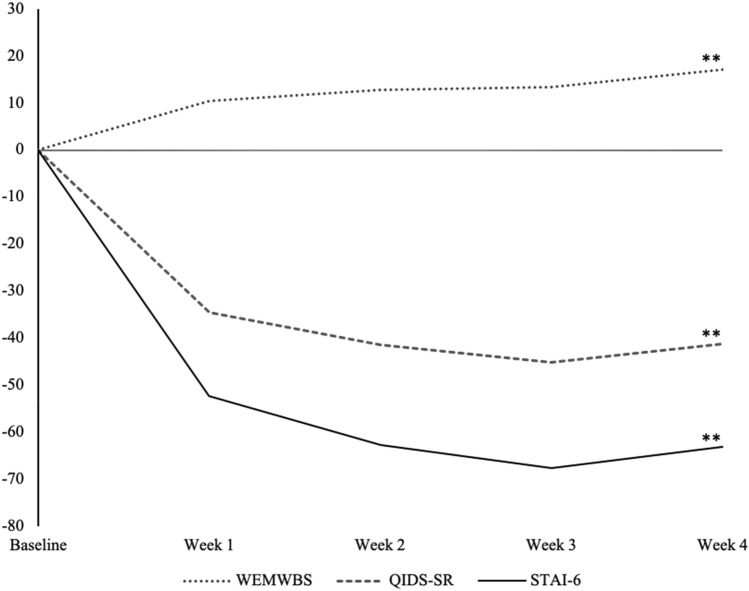
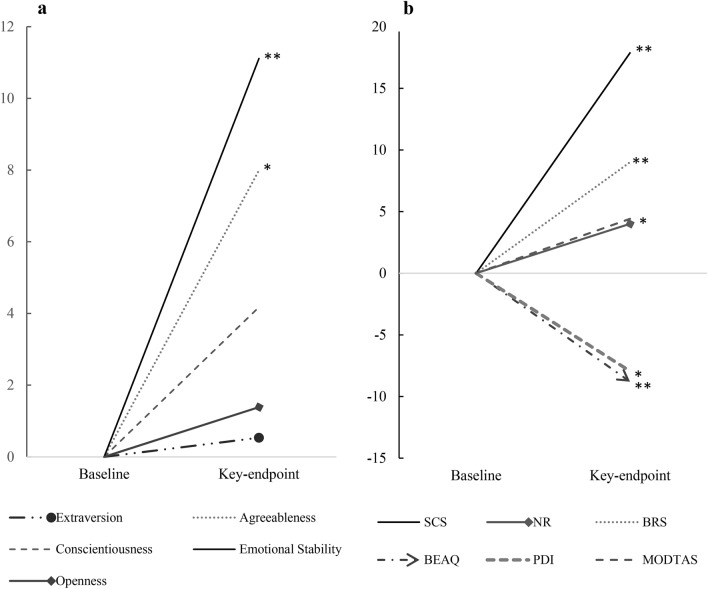
Psychedelic microdosing describes the ingestion of near-threshold perceptible doses of classic psychedelic substances. Anecdotal reports and observational studies suggest that microdosing may promote positive mood and well-being, but recent placebo-controlled studies failed to find compelling evidence for this. The present study collected web-based mental health and related data using a prospective (before, during and after) design. Individuals planning a weekly microdosing regimen completed surveys at strategic timepoints, spanning a core four-week test period. Eighty-one participants completed the primary study endpoint. Results revealed increased self-reported psychological well-being, emotional stability and reductions in state anxiety and depressive symptoms at the four-week primary endpoint, plus increases in psychological resilience, social connectedness, agreeableness, nature relatedness and aspects of psychological flexibility. However, positive expectancy scores at baseline predicted subsequent improvements in well-being, suggestive of a significant placebo response. This study highlights a role for positive expectancy in predicting positive outcomes following psychedelic microdosing and cautions against zealous inferences on its putative therapeutic value.
Overview
The claims and statistics of this paper haven’t been checked yet.
Run the check — free, no account needed. It reads the open-access text and checks the sources it cites.
Integrity signals
Registry
Cites
Statistics
Figures
Verification
Claims the paper makes
The claims and statistics of this paper haven’t been checked yet.
Run the check — free, no account needed. It reads the open-access text and checks the sources it cites.
Claims other papers make about this one
Each is checked against this paper’s own text: does it say what the citing paper says it does?
The source backs part of the claim, not all of it — or backs it for a different population, condition or comparison.
In the citing paper
“Agreeableness and openness to experience did not change at all after MD compared to baseline in the current study, contrasting results from earlier MD studies (12, 28).”
From Trait mindfulness and personality characteristics in a microdosing ADHD sample: a naturalistic prospective survey study (2023) · cites this paper as [12]
Experimental — accuracy not yet measuredThe cited source says what the claim attributes to it.
In the citing paper
“Agreeableness was increased after MD in a general population sample (12)”
From Trait mindfulness and personality characteristics in a microdosing ADHD sample: a naturalistic prospective survey study (2023) · cites this paper as [12]
The cited source says what the claim attributes to it.
In the citing paper
“but other studies did not find this effect in a general population sample (12) and a general sample without individuals diagnosed with a mood, anxiety, substance use, psychotic or dissociative disorder (13).”
From Trait mindfulness and personality characteristics in a microdosing ADHD sample: a naturalistic prospective survey study (2023) · cites this paper as [12]
The cited source says what the claim attributes to it.
In the citing paper
“Neuroticism decreased after MD in healthy adults (29) and a general population sample (12)”
From Trait mindfulness and personality characteristics in a microdosing ADHD sample: a naturalistic prospective survey study (2023) · cites this paper as [12]
The cited source says what the claim attributes to it.
In the citing paper
“The decrease in neuroticism reported here is consistent with two previous prospective MD studies (12, 29).”
From Trait mindfulness and personality characteristics in a microdosing ADHD sample: a naturalistic prospective survey study (2023) · cites this paper as [12]
The cited source says what the claim attributes to it.
In the citing paper
“Kaertner et al. (2021) found that positive expectancy scores regarding the effects of microdosing at baseline predicted subsequent improvements in wellbeing.”
From Psychedelic Microdosing, Mindfulness, and Anxiety: A Cross-Sectional Mediation Study (2023) · cites this paper as Kaertner et al. (2021)
Self-check
Percentages, sums and reported differences re-computed from the paper’s own numbers.
The self-check needs the paper’s full text.
Citations
Cites
A very brief measure of the Big-Five personality domains
Gosling, S. D., Rentfrow, P. J., & Swann, W. B. (2003) · Journal of Research in Personality · doi:10.1016/s0092-6566(03)00046-1 · Cited by 8,307
The brief resilience scale: Assessing the ability to bounce back
Smith, B. W., Dalen, J., Wiggins, K., Tooley, E., Christopher, P., & Bernard, J. (2008) · International Journal of Behavioral Medicine · doi:10.1080/10705500802222972 · Cited by 6,439
The Warwick-Edinburgh Mental Well-being Scale (WEMWBS): development and UK validation
Tennant, R., Hiller, L., Fishwick, R., Platt, S., Joseph, S., Weich, S., Parkinson, J., Secker, J., & Stewart-Brown, S. (2007) · Health and Quality of Life Outcomes · doi:10.1186/1477-7525-5-63 · Cited by 5,031
Rush, A. J., Trivedi, M. H., Ibrahim, H. M., Carmody, T. J., Arnow, B., Klein, D. N., Markowitz, J. C., Ninan, P. T., Kornstein, S., Manber, R., et al. (2003) · Biological Psychiatry · doi:10.1016/s0006-3223(02)01866-8 · Cited by 3,829
Marteau, T. M., & Bekker, H. (1992) · British Journal of Clinical Psychology · doi:10.1111/j.2044-8260.1992.tb00997.x · Cited by 3,238
Psychometric properties of the credibility/expectancy questionnaire
Devilly, G. J., & Borkovec, T. D. (2000) · Journal of Behavior Therapy and Experimental Psychiatry · doi:10.1016/s0005-7916(00)00012-4 · Cited by 2,295
Griffiths, R. R., Johnson, M. W., Carducci, M. A., Umbricht, A., Richards, W. A., Richards, B. D., Cosimano, M. P., & Klinedinst, M. A. (2016) · Journal of Psychopharmacology · doi:10.1177/0269881116675513 · Cited by 2,201
Tellegen, A., & Atkinson, G. (1974) · Journal of Abnormal Psychology · doi:10.1037/h0036681 · Cited by 2,196
Ross, S., Bossis, A., Guss, J., Agin-Liebes, G., Malone, T., Cohen, B., Mennenga, S. E., Belser, A., Kalliontzi, K., Babb, J., et al. (2016) · Journal of Psychopharmacology · doi:10.1177/0269881116675512 · Cited by 1,698
Griffiths, R. R., Richards, W. A., McCann, U., & Jesse, R. (2006) · Psychopharmacology · doi:10.1007/s00213-006-0457-5 · Cited by 1,684
Cited by
Sorted by citations
Items 101–144 of 144
Change, Career Transitions, and Retirement in Allergy-Immunology
Rathkopf, M. M., Davis, R. S., Wallace, D. V., Fleisher, T. A., Conti, M. E., Verdi, M., Ledford, D. K., Bukstein, D. A., Golden, D. B. K., Bernstein, J. A., et al. (2025) · The Journal of Allergy and Clinical Immunology In Practice · doi:10.1016/j.jaip.2025.11.018 · Cited by 2
Oña, G. (2023) · Quaderns de l'Institut Català d'Antropologia · doi:10.56247/qua.401 · Cited by 3
Mann, J. D. (2022) · Drugs Education Prevention and Policy · doi:10.1080/09687637.2022.2064268 · Cited by 2
Psychedelic Microdosing: What Is It Good For?
Bershad, A. K. (2023) · Biological Psychiatry · doi:10.1016/j.biopsych.2023.06.021 · Cited by 2
Ferenstein, G. (2021) · SSRN Electronic Journal · doi:10.2139/ssrn.3910688 · Cited by 2
Polito, V., & Liknaitzky, P. (2021) · doi:10.31234/osf.io/edhqz · Cited by 2
Is Microdosing a Placebo?Preprint
Polito, V., & Liknaitzky, P. (2023) · doi:10.31234/osf.io/3ykst · Cited by 2
Exploring the importance of bodyset for the psychedelic experience and beyond
Uthaug, M. V., Allocca, G., Havenith, M. N., Szabó, A., Rosas, F. E., & Ramaekers, J. G. (2025) · Journal of Psychedelic Studies · doi:10.1556/2054.2025.00418 · Cited by 1
Pierre, M. S., Argento, E., Cates, J., Kryskow, P., Harvey, K., Stamets, P. E., Santos-Brault, E., Paschall, S. A., Kuypers, K. P. C., Rootman, J. M., et al. (2025) · Psychopharmacology · doi:10.1007/s00213-025-06913-9 · Cited by 1
Beidas, Z., Ragnhildstveit, A., Blackman, A., Anderson, T., Fewster, E. C., Syed, O. A., Sobolenko, V., Kanca, I. K., Jaglinska, M., Son, T., et al. (2026) · BJPsych Open · doi:10.1192/bjo.2025.10968 · Cited by 1
Golia, K. (2022) · Consciousness Spirituality & Transpersonal Psychology · doi:10.53074/cstp.2022.37 · Cited by 1
Mental disorder and its treatment as a transformative experience
Villiger, D. (2025) · Phenomenology and the Cognitive Sciences · doi:10.1007/s11097-025-10059-6 · Cited by 1
Do undergraduates’ views of psychedelics relate to the context for psychedelic use?
Petrovitch, D., Allen, J. V., Mitchell, S. M., & Littlefield, A. K. (2025) · Drug Science Policy and Law · doi:10.1177/20503245241308747 · Cited by 2
Li, H., Li, W., Kong, X., Wang, Z., Lu, C., & Shi, D. (2025) · Frontiers in Public Health · doi:10.3389/fpubh.2025.1577538 · Cited by 1
Journey To The Centre Of The Mind: Psychedelic Treatment of Mental Health in Aotearoa
Lutyens, D. (2023) · Open Access Victoria University of Wellington | Te Herenga Waka (Figshare) · doi:10.26686/wgtn.21904854 · Cited by 2
Expectancy effects cannot be neglected in MDMA-assisted therapy researchPreprint
Flameling, L. J., Aday, J. S., & van Elk, M. (2023) · doi:10.31234/osf.io/j4rme · Cited by 1
Enriquez‐Geppert, S., Krc, J., O'Higgins, F., & Lietz, M. P. (2023) · doi:10.31234/osf.io/jqasf · Cited by 1
Gazarian, D., & Addis, M. E. (2023) · Cognitive and Behavioral Practice · doi:10.1016/j.cbpra.2023.08.004 · Cited by 2
Investigación sobre microdosificación con hongos psilocibios: un artículo de reflexión
Duque, L. (2023) · Cultura y Droga · doi:10.17151/culdr.2023.28.35.3
Zeifman, R. J. (2024) · doi:10.32920/26052859.v1 · Cited by 1
Ferreira, A. S. M., Martindale, S., & Luke, D. P. (2024) · Journal of Psychedelic Studies · doi:10.1556/2054.2024.00368
Su, D., Huang, L., Zou, H., Zhang, L., & Feng, Y. (2024) · Frontiers in Public Health · doi:10.3389/fpubh.2024.1412199
Psilocybin Microdosing for Anxiety Relief in Young Adults: A Comparative Review of Emerging Evidence
Shabir, K. (2024) · Premier journal of science. · doi:10.70389/pjs.100036
Totomanova, I., Haijen, E. C. H. M., Hurks, P. P. M., Ramaekers, J. G., & Kuypers, K. P. C. (2025) · International review of neurobiology · doi:10.1016/bs.irn.2025.03.002
Ding, D., & Fang, S. (2025) · Journal of School Health · doi:10.1111/josh.70040 · Cited by 3
The Potential of Psychedelics in the Treatment of Eating Disorders
Gukasyan, N., Hilbert, S. N., & Guarda, Á. S. (2025) · Oxford University Press eBooks · doi:10.1093/9780197675212.003.0027
Murphy, R. J., Wardlaw, M., Smith, T., Noorani, T. N., Evans, W., Reynolds, L., Menkes, D. B., Sumner, R. L., & Muthukumaraswamy, S. D. (2025) · Journal of Humanistic Psychology · doi:10.1177/00221678251382624
Donegan, C. J., Daldegan‐Bueno, D., Sumner, R. L., Forsyth, A., Evans, W., Hoeh, N. R., Sundram, F., Menkes, D. B., Muthukumaraswamy, S. D., & Reynolds, L. (2025) · Therapeutic Advances in Psychopharmacology · doi:10.1177/20451253251396253
Causal Inference in Studies with Functional Unmasking: Psychedelics and BeyondPreprint
Loewinger, G. C., Stensrud, M. J., Nayak, S. M., Yaden, D. B., & Levis, A. W. (2025) · medRxiv · doi:10.64898/2025.12.05.25341713
Wells, A., Muthukumaraswamy, A. P. S., Morunga, E., Evans, W., Cavadino, A., Bansal, M., Lawrence, N. J., Ashley, A., Hoeh, N. R., Sundram, F., et al. (2024) · Figshare · doi:10.6084/m9.figshare.25210532
Murphy, R. J., Godfrey, K., Shaw, A. D., Muthukumaraswamy, S., & Sumner, R. L. (2024) · Figshare · doi:10.6084/m9.figshare.25150540
Ketamine as a prophylactic agent against post-traumatic stress disorder
Peavey, J. (2023) · Journal of High School Science · doi:10.64336/001c.87422
Wells, A., Muthukumaraswamy, A. P. S., Morunga, E., Evans, W., Cavadino, A., Bansal, M., Lawrence, N. J., Ashley, A., Hoeh, N. R., Sundram, F., et al. (2024) · Figshare · doi:10.6084/m9.figshare.25210812
Donegan, C. J., Daldegan‐Bueno, D., Sumner, R. L., Menkes, D., Evans, W. J., Hoeh, N. R., Sundram, F., Reynolds, L., Ponton, R., Cavadino, A., et al. (2023) · Figshare · doi:10.6084/m9.figshare.24257434
Daldegan‐Bueno, D., Donegan, C. J., Forsyth, A., Sumner, R. L., Murphy, R. J., Menkes, D. B., Evans, W. J., Hoeh, N. R., Sundram, F., Reynolds, L., et al. (2024) · Figshare · doi:10.6084/m9.figshare.26942922
Daldegan‐Bueno, D., Donegan, C. J., Forsyth, A., Sumner, R. L., Murphy, R. J., Menkes, D. B., Evans, W. J., Hoeh, N. R., Sundram, F., Reynolds, L., et al. (2024) · Figshare · doi:10.6084/m9.figshare.26827416
Murphy, R. J., Sumner, R. L., Evans, W. J., Menkes, D., Lambrecht, I., Ponton, R., Sundram, F., Hoeh, N. R., Ram, S., Reynolds, L., et al. (2021) · Figshare · doi:10.6084/m9.figshare.14478492
Daldegan‐Bueno, D., Donegan, C. J., Forsyth, A., Sumner, R. L., Murphy, R. J., Menkes, D. B., Evans, W. J., Hoeh, N. R., Sundram, F., Reynolds, L., et al. (2024) · Figshare · doi:10.6084/m9.figshare.26827380
Halberstadt, A. L., & Young, J. W. (2026) · Neuropharmacology · doi:10.1016/j.neuropharm.2026.110972
Carhart-Harris, R. L., Zeifman, R. J., Pasquini, L., Nandi, B., Rohani-Shukla, C., Suseelan, S., Mediano, P. A. M., Rosas, F. C. W., Timmermann, C., Kettner, H., et al. (2026) · Frontiers in Neuroscience · doi:10.3389/fnins.2026.1875339
Psychedelics in the Future of Global Mental Healthcare
Aleksandrova, L. R., Thiessen, K. A., Chen, F. X. F., Phillips, A. G., Schütz, C. G., & Krausz, M. (2026) · Springer eBooks · doi:10.1007/978-3-319-70134-9_174-1
Jankowska, E., & Świeczkowski, D. (2026) · Drugs Education Prevention and Policy · doi:10.1080/09687637.2026.2729740
Psychedelic-Induced Changes in Personality Traits: A Systematic Review
Bartkiewicz, P. A., Baran, W. P., & Lachowska, E. M. (2026) · Roczniki Psychologiczne · doi:10.18290/rpsych2025.0017
Metadata
- Authors
- Kaertner, L. S., Steinborn, M. B., Kettner, H., Spriggs, M. J., Roseman, L., Buchborn, T., Balaet, M., Timmermann, C., Erritzoe, D., & Carhart-Harris, R. L.
- Affiliations
- University of Würzburg (DE)
- Imperial College London (GB)
- ORCID
- Venue
- Scientific Reports
- Published
- 2021-01-21
- Volume
- 11
- Issue
- 1
- Pages
- 1941-1941
- ISSN
- 2045-2322 (ISSN-L)
- PMC
- PMC7820236
- OpenAlex
- W3122801192
- Cited by
- 145
- References
- 76
- Citations by year
- 2026: 6 · 2025: 26 · 2024: 34 · 2023: 37 · 2022: 24 · 2021: 18
- FWCI
- 19.24
- Type
- journal article
- Language
- en
- Open access
- gold
- doi.org
- Locations
- Scientific Reports (publishedVersion, cc-by)
- Europe PMC (PubMed Central) (publishedVersion, other-oa)
- PubMed Central (publishedVersion, cc-by)
- PubMed (publishedVersion)
- DOAJ (DOAJ: Directory of Open Access Journals) (submittedVersion, cc-by-sa)
- eScholarship (California Digital Library) (submittedVersion, cc-by)
- Online Publication Service of Würzburg University (Würzburg University) (submittedVersion, cc-by)
- Spiral (Imperial College London) (submittedVersion, cc-by)
- Funders
- National Institute for Health and Care Research (ACF-2013-21-501, CL-2017-21-004)
- Academy of Medical Sciences (SGL019\1063)
- Imperial College London
- Topics
- Social Sciences › Psychology › Clinical Psychology › Psychedelics and Drug Studies
- Life Sciences › Neuroscience › Cognitive Neuroscience › Pain Management and Placebo Effect
- Social Sciences › Psychology › Social Psychology › Psychological Well-being and Life Satisfaction
- Keywords
- psychedelic microdosing, positive expectations, placebo response, psychological well-being, state anxiety, depressive symptoms, emotional stability, psychological resilience, social connectedness, agreeableness, nature relatedness, psychological flexibility, classic psychedelics
- MeSH terms
- Adult, Affect, Anxiety, Dose-Response Relationship, Drug, Emotions, Female, Hallucinogens, Humans, Lysergic Acid Diethylamide, Male, Mental Health, Middle Aged, Motivation, Psilocybin, Quality of Life, Placebo Effect, Outcome Assessment, Health Care
About these checks
Registry, retraction, Cites and statistics results are computed, not judged, with one exception: a printed reference that no index lists is read once by a model before it counts as a citation error. Claims are extracted by a model and kept only when their quote appears verbatim in the text; each cited source is then checked, with a model’s help, for whether it says what the claim relies on. Those verdicts can be wrong — read the claim’s quote and the cited source before relying on one.
Statistics and arithmetic are recomputed, not judged.
Confidence bands are shown only for fields calibrated on our annotated test set. None is calibrated yet, so no band is shown.
What counts as a claim ›How we measure confidence ›How we check this ›
Are you an author, or do you see a problem with this page? Request a review
