

TNFα promotes oral cancer growth, pain, and Schwann cell activation
Open accessThe DOI matches its Crossref record; 66 of the 67 references it cites were found in a registry or an index.
Abstract
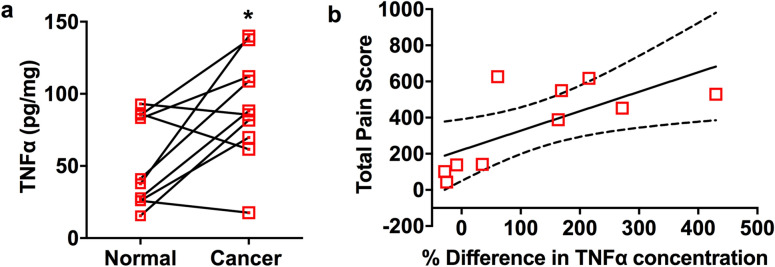
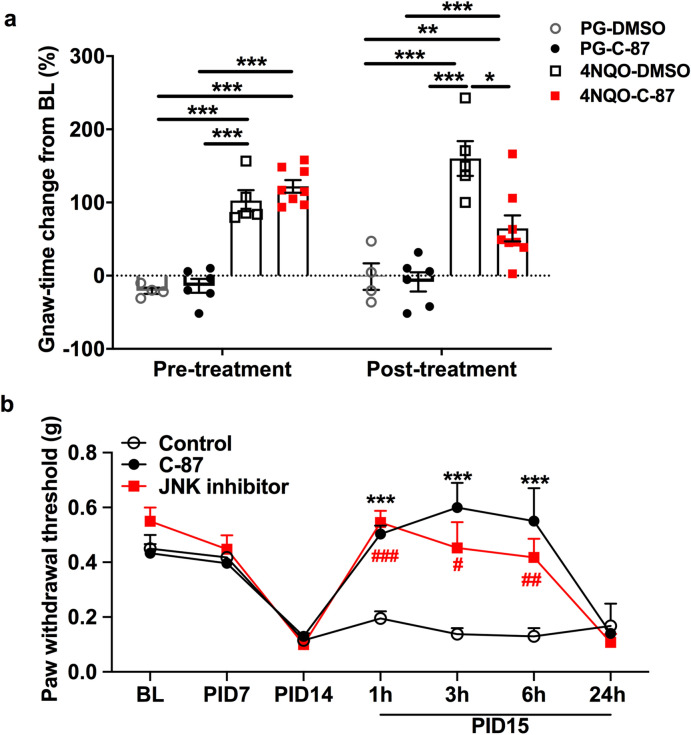
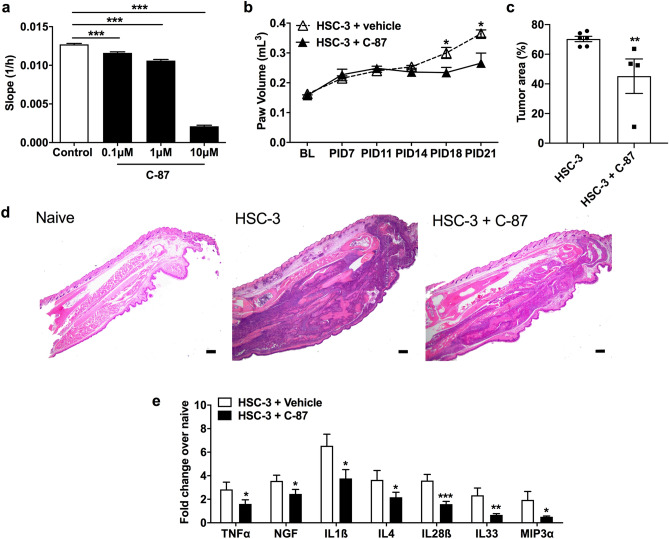
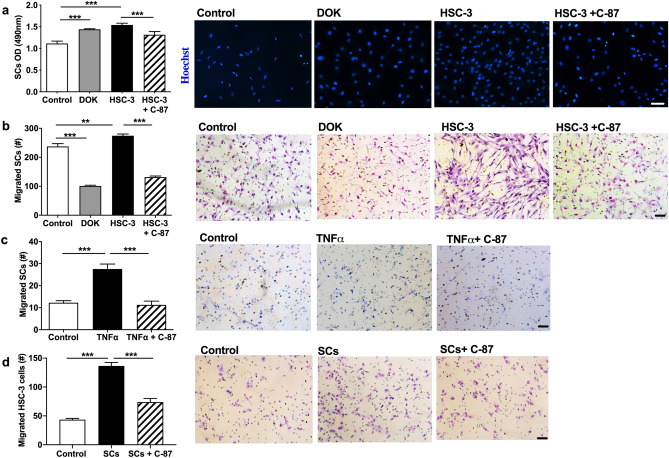
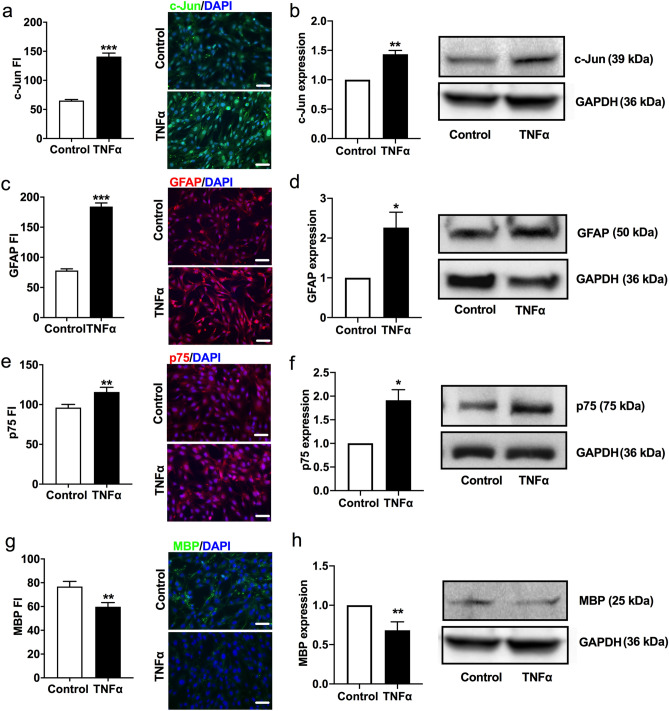
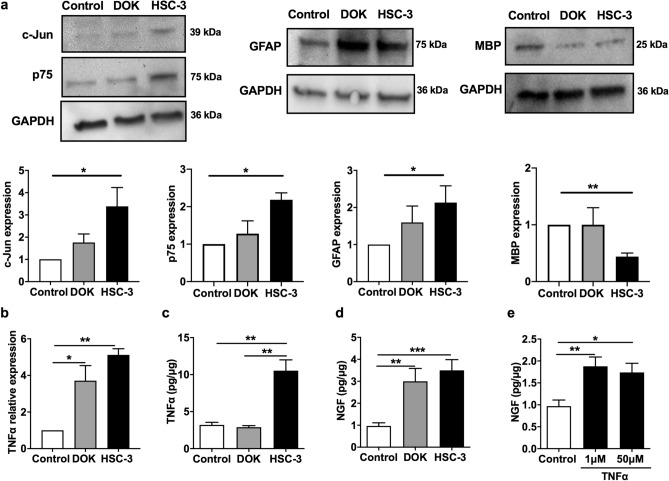
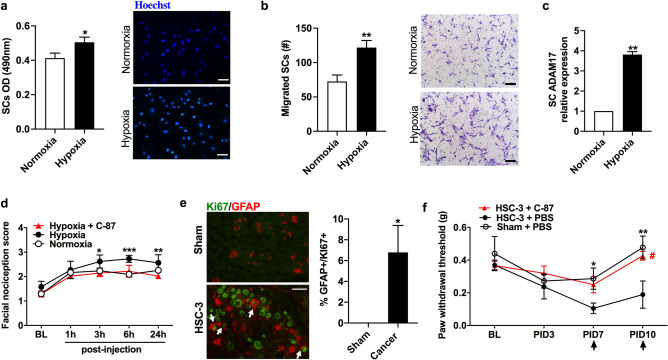
Oral cancer is very painful and impairs a patient’s ability to eat, talk, and drink. Mediators secreted from oral cancer can excite and sensitize sensory neurons inducing pain. Cancer mediators can also activate Schwann cells, the peripheral glia that regulates neuronal function and repair. The contribution of Schwann cells to oral cancer pain is unclear. We hypothesize that the oral cancer mediator TNFα activates Schwann cells, which further promotes cancer progression and pain. We demonstrate that TNFα is overexpressed in human oral cancer tissues and correlates with increased self-reported pain in patients. Antagonizing TNFα reduces oral cancer proliferation, cytokine production, and nociception in mice with oral cancer. Oral cancer or TNFα alone increases Schwann cell activation (measured by Schwann cell proliferation, migration, and activation markers), which can be inhibited by neutralizing TNFα. Cancer- or TNFα-activated Schwann cells release pro-nociceptive mediators such as TNFα and nerve growth factor (NGF). Activated Schwann cells induce nociceptive behaviors in mice, which is alleviated by blocking TNFα. Our study suggests that TNFα promotes cancer proliferation, progression, and nociception at least partially by activating Schwann cells. Inhibiting TNFα or Schwann cell activation might serve as therapeutic approaches for the treatment of oral cancer and associated pain.
Overview
The claims and statistics of this paper haven’t been checked yet.
Free: it reads the open-access text and checks the first 5 claims that cite a source we can check. Create a free account to check every claim.
Integrity signals
Registry
Cites
Statistics
Figures
Verification
Claims the paper makes
The claims and statistics of this paper haven’t been checked yet.
Free: it reads the open-access text and checks the first 5 claims that cite a source we can check. Create a free account to check every claim.
Claims other papers make about this one
Each is checked against this paper’s own text: does it say what the citing paper says it does?
The check wasn’t confident either way, so it gives no verdict — never disputed.
In the citing paper
“TNF also induces the formation of cancer stem-like phenotypes in oral squamous cell carcinoma (44, 45).”
From Tumor-Induced Inflammatory Cytokines and the Emerging Diagnostic Devices for Cancer Detection and Prognosis (2021) · cites this paper as [45]
Experimental — accuracy not yet measured
Self-check
Percentages, sums and reported differences re-computed from the paper’s own numbers.
The self-check needs the paper’s full text.
Citations
Cites
Prevalence of pain in patients with cancer: a systematic review of the past 40 years
van den Beuken-van Everdingen, M. H. J., de Rijke, J. M., Kessels, A. G., Schouten, H. C., van Kleef, M., & Patijn, J. (2007) · Annals of Oncology · doi:10.1093/annonc/mdm056 · Cited by 1,923
Methods Used to Evaluate Pain Behaviors in Rodents
Deuis, J. R., Dvorakova, L. S., & Vetter, I. (2017) · Frontiers in Molecular Neuroscience · doi:10.3389/fnmol.2017.00284 · Cited by 1,249
Arthur-Farraj, P. J., Latouche, M., Wilton, D. K., Quintes, S., Chabrol, E., Banerjee, A., Woodhoo, A., Jenkins, B., Rahman, M., Turmaine, M., et al. (2012) · Neuron · doi:10.1016/j.neuron.2012.06.021 · Cited by 857
The pivotal role of tumour necrosis factor α in the development of inflammatory hyperalgesia
Cunha, F. Q., Poole, S., Lorenzetti, B. B., & Ferreira, S. H. (1992) · British Journal of Pharmacology · doi:10.1111/j.1476-5381.1992.tb14503.x · Cited by 792
ADAM17: a molecular switch to control inflammation and tissue regeneration
Scheller, J., Chalaris, A., Garbers, C., & Rose-John, S. (2011) · Trends in Immunology · doi:10.1016/j.it.2011.05.005 · Cited by 526
Molecular mechanisms of cancer pain
Mantyh, P. W., Clohisy, D. R., Koltzenburg, M., & Hunt, S. P. (2002) · Nature Reviews Cancer · doi:10.1038/nrc747 · Cited by 477
Oral Cavity and Esophageal Carcinogenesis Modeled in Carcinogen-Treated Mice
Tang, X.-H., Knudsen, B., Bemis, D., Tickoo, S., & Gudas, L. J. (2004) · Clinical Cancer Research · doi:10.1158/1078-0432.ccr-0999-3 · Cited by 390
A Prospective Study of Quality of Life in Head and Neck Cancer Patients. Part II: Longitudinal Data
Bjordal, K., Ahlner‐Elmqvist, M., Hammerlid, E., Boysen, M., Evensen, J. F., Biörklund, A., Jannert, M., Westin, T., & Kaasa, S. (2001) · The Laryngoscope · doi:10.1097/00005537-200108000-00022 · Cited by 318
Schwann cells induce cancer cell dispersion and invasion
Deborde, S., Omelchenko, T., Lyubchik, A., Zhou, Y., He, S., McNamara, W. F., Chernichenko, N., Lee, S.-Y., Barajas, F., Chen, C.-H., et al. (2016) · Journal of Clinical Investigation · doi:10.1172/jci82658 · Cited by 290
Neural plasticity in pancreatitis and pancreatic cancer
Demir, I. E., Friess, H., & Ceyhan, G. O. (2015) · Nature Reviews Gastroenterology & Hepatology · doi:10.1038/nrgastro.2015.166 · Cited by 255
Cited by
Kartikasari, A. E. R., Huertas, C. S., Mitchell, A., & Plebanski, M. (2021) · Frontiers in Oncology · doi:10.3389/fonc.2021.692142 · Cited by 343
“TNF also induces the formation of cancer stem-like phenotypes in oral squamous cell carcinoma (44, 45).”
BackgroundProliferation and Apoptosis Pathways and Factors in Oral Squamous Cell Carcinoma
He, S., Chakraborty, R., & Ranganathan, S. (2022) · International Journal of Molecular Sciences · doi:10.3390/ijms23031562 · Cited by 113
“[94] TNFR1 (CD120a) Related to oral cancer pain and inflammation Scheff et al.”
BackgroundPhysical Cue‐Based Strategies on Peripheral Nerve Regeneration
Wei, Z., Jin, F., Li, T., Qian, L., Zheng, W., Wang, T., & Feng, Z. (2022) · Advanced Functional Materials · doi:10.1002/adfm.202209658 · Cited by 57
Advances in Head and Neck Cancer Pain
Ye, Y., Jensen, D. D., Viet, C. T., Pan, H., Campana, W. M., Amit, M., & Boada, M. D. (2022) · Journal of Dental Research · doi:10.1177/00220345221088527 · Cited by 52
“The role of fibroblast, macrophages, endothelial cells, T cells, and muscle cells in oral cancer pain is unknown. β-endo, β-endorphin; A2BR, adenosine receptor 2B; ADO, adenosine; MOPr, µ-opioid receptor; TNF, tumor necrosis factor α; TNFR1, tumor necrosis factor receptor 1.”
BackgroundInfluentialSelf-citationThe Role of Schwann Cells in Cancer
Deborde, S., & Wong, R. J. (2022) · Advanced Biology · doi:10.1002/adbi.202200089 · Cited by 57
Metadata
- Authors
- Salvo, E., Tu, N. H., Scheff, N. N., Dubeykovskaya, Z. A., Chavan, S. A., Aouizerat, B. E., & Ye, Y.
- Affiliations
- New York University (US)
- University of Pittsburgh (US)
- Corresponding author
- Ye, Yi
- Venue
- Scientific Reports
- Published
- 2021-01-19
- Volume
- 11
- Issue
- 1
- Pages
- 1840-1840
- ISSN
- 2045-2322 (ISSN-L)
- PMC
- PMC7815837
- OpenAlex
- W3123628395
- Cited by
- 71
- References
- 67
- Citations by year
- 2026: 12 · 2025: 19 · 2024: 9 · 2023: 12 · 2022: 17 · 2021: 2
- FWCI
- 6.28
- Type
- journal article
- Language
- en
- Open access
- gold
- doi.org
- Licence
- cc-by
- creativecommons.org/licenses/by/4.0 (tdm)
- creativecommons.org/licenses/by/4.0 (vor)
- Locations
- Scientific Reports (publishedVersion, cc-by)
- PubMed Central (publishedVersion, cc-by)
- PubMed (publishedVersion)
- DOAJ (DOAJ: Directory of Open Access Journals) (submittedVersion, cc-by-sa)
- Funders
- National Institute of Dental and Craniofacial Research (R01DE029493)
- Rita Allen Foundation
- Topics
- Health Sciences › Medicine › Physiology (medical) › Pain Mechanisms and Treatments
- Life Sciences › Biochemistry, Genetics and Molecular Biology › Cancer Research › Cancer, Stress, Anesthesia, and Immune Response
- Life Sciences › Neuroscience › Sensory Systems › Ion Channels and Receptors
- Keywords
- TNF-α, oral cancer, cancer pain, Schwann cell activation, peripheral glia, nociception, nerve growth factor, tumor progression, sensory neuron sensitization
- MeSH terms
- Cancer Pain, Animals, Humans, Mouth Neoplasms, Pain Measurement, Schwann Cells, Tumor Necrosis Factor-alpha, Disease Progression, Nerve Growth Factor, Cell Proliferation, Mice
About these checks
Registry, retraction, Cites and statistics results are computed, not judged, with one exception: a printed reference that no index lists is read once by a model before it counts as a citation error. Claims are extracted by a model and kept only when their quote appears verbatim in the text; each cited source is then checked, with a model’s help, for whether it says what the claim relies on. Those verdicts can be wrong — read the claim’s quote and the cited source before relying on one.
Statistics and arithmetic are recomputed, not judged.
Confidence bands are shown only for fields calibrated on our annotated test set. None is calibrated yet, so no band is shown.
What counts as a claim ›How we measure confidence ›How we check this ›
Are you an author, or do you see a problem with this page? Request a review
How to cite
Cite CoChat for the checks on this page, and the paper for its own findings.
- This page
- CoChat. (2026). Citation check: TNFα promotes oral cancer growth, pain, and Schwann cell activation. https://app.cochat.ai/papers/10.1038/s41598-021-81500-4
- The paper
- Salvo, E., Tu, N. H., Scheff, N. N., Dubeykovskaya, Z. A., Chavan, S. A., Aouizerat, B. E., & Ye, Y. (2021). TNFα promotes oral cancer growth, pain, and Schwann cell activation. Scientific Reports. https://doi.org/10.1038/s41598-021-81500-4
Data sources
Bibliographic data: Semantic Scholar, OpenAlex, Crossref.
Contains information from the Semantic Scholar Academic Graph Datasets, made available under the ODC Attribution License (ODC-BY 1.0).
Semantic Scholar’s data is described in: Kinney, R., et al. (2023). The Semantic Scholar Open Data Platform. arXiv:2301.10140.
