

The DOI matches its Crossref record; 17 of the 17 references it cites were found in a registry or an index.
Multicenter prospective surveillance study of viral agents causing meningoencephalitis
Open accessAbstract
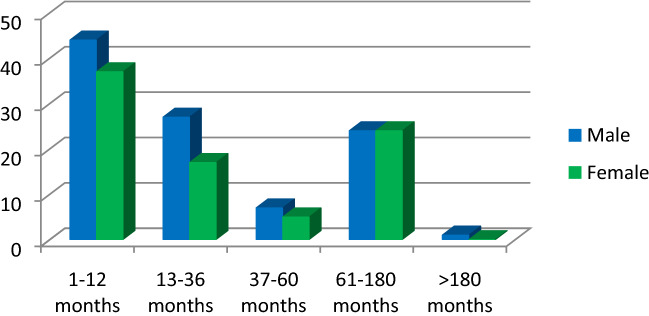
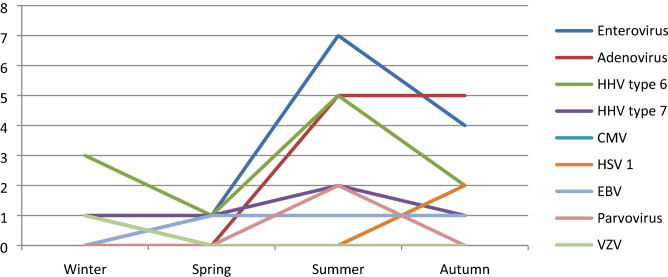
The frequency of bacterial factors causing central nervous system infections has decreased as a result of the development of our national immunization program. In this study, it is aimed to obtain the data of our local surveillance by defining the viral etiology in cases diagnosed with meningoencephalitis for 1 year. Previously healhty 186 children, who applied with findings suggesting viral meningoencephalitis to 8 different tertiary health centers between August 2018 and August 2019, in Istanbul, were included. The cerebrospinal fluid (CSF) sample was evaluated by polymerase chain reaction. The M:F ratio was 1.24 in the patient group, whose age ranged from 1 to 216 months (mean 40.2 ± 48.7). Viral factor was detected in 26.8%. Enterovirus was the most common agent (24%) and followed by Adenovirus (22%) and HHV type 6 (22%). In the rest of the samples revealed HHV type 7 (10%), EBV (6%), CMV (6%), HSV type 1 (6%), Parvovirus (4%) and VZV (2%). The most common symptoms were fever (79%) and convulsions (45.7%). Antibiotherapy and antiviral therapy was started 48.6% and 4% respectively. Mortality and sequela rate resulted 0.53% and 3.7%, respectively. This highlights the importance of monitoring trends in encephalitis in Turkey with aview to improving pathogen diagnosis for encephalitis and rapidly identifying novel emerging encephalitis-causing pathogens that demand public health action especially in national immunisation programme.
Overview
The claims and statistics of this paper haven’t been checked yet.
Run the check — free, no account needed. It reads the open-access text and checks the sources it cites.
Integrity signals
Registry
Cites
Statistics
Figures
Verification
Claims the paper makes
The claims and statistics of this paper haven’t been checked yet.
Run the check — free, no account needed. It reads the open-access text and checks the sources it cites.
Claims other papers make about this one
Each is checked against this paper’s own text: does it say what the citing paper says it does?
The source backs part of the claim, not all of it — or backs it for a different population, condition or comparison.
In the citing paper
“Although HSV-1 is encountered less frequently, it is the most common cause of sporadic necrotizing encephalitis17.”
From Clinical Impact of Cerebrospinal Fluid Multiplex Polymerase Chain Reaction (PCR) Testing in Children with Suspected Central Nervous System Infection (2025) · cites this paper as [17]
Experimental — accuracy not yet measured
Self-check
Percentages, sums and reported differences re-computed from the paper’s own numbers.
The self-check needs the paper’s full text.
Citations
Cites
Venkatesan, A., Tunkel, A. R., Bloch, K. C., Lauring, A. S., Sejvar, J. J., Bitnun, A., Stahl, J. ‐., Mailles, A., DREBOT, M. A., Rupprecht, C. E., et al. (2013) · Clinical Infectious Diseases · doi:10.1093/cid/cit458 · Cited by 1,247
Enterovirus Surveillance - United States, 1970-2005: (540562006-001)
Khetsuriani, N., LaMonte-Fowlkes, A., Oberste, M. S., & Pallansch, M. A. (2006) · PsycEXTRA Dataset · doi:10.1037/e540562006-001 · Cited by 702
Burden of encephalitis-associated hospitalizations in the United States, 1988-1997
Khetsuriani, N., Holman, R. C., & Anderson, L. J. (2002) · Clinical Infectious Diseases · doi:10.1086/341301 · Cited by 200
Viral Encephalitis in England, 1989–1998: What Did We Miss?
Davison, K. L., Crowcroft, N. S., Ramsay, M. E., Brown, D., & Andrews, N. J. (2003) · Emerging infectious diseases · doi:10.3201/eid0902.020218 · Cited by 183
Epidemiology of encephalitis in children. A prospective multicentre study
Koskiniemi, M., Korppi, M. O., Mustonen, K., Rantala, H., Muttilainen, M., Herrgård, E. A., Ukkonen, P., & Vaheri, A. (1997) · European Journal of Pediatrics · doi:10.1007/s004310050658 · Cited by 144
Childhood encephalitis in Sweden: Etiology, clinical presentation and outcome
Fowler, Å., Stödberg, T., Eriksson, M., et al. (2008) · European Journal of Paediatric Neurology · doi:10.1016/j.ejpn.2007.12.009 · Cited by 102
Central Nervous System Complications of Varicella-Zoster Virus
Science, M. E., MacGregor, D., Richardson, S. E., et al. (2014) · The Journal of Pediatrics · doi:10.1016/j.jpeds.2014.06.014 · Cited by 91
Diagnostic assays for active infection with human herpesvirus 6 (HHV-6)
Caserta, M. T., Hall, C. B., Schnabel, K. C., Lofthus, G. K., Marino, A. S., Shelley, L. M., Yoo, C., Carnahan, J. A., Anderson, L. T., & Wang, H. (2010) · Journal of Clinical Virology · doi:10.1016/j.jcv.2010.02.007 · Cited by 89
Lee, B. E., Chawla, R., Langley, J. M., Forgie, S. E., Al-Hosni, M., Baerg, K., Husain, E., Strong, J., Robinson, J. L., Allen, U., et al. (2006) · BMC Infectious Diseases · doi:10.1186/1471-2334-6-68 · Cited by 62
Aetiology of acute meningoencephalitis in Cambodian children, 2010–2013
Horwood, P. F., Duong, V., Laurent, D., Mey, C., Heng, S., Santy, K., Richner, B., Heng, S., Hem, S., Cheval, J., et al. (2017) · Emerging Microbes & Infections · doi:10.1038/emi.2017.15 · Cited by 50
Research works printed but not linked: 1
- Khetsuriani, N. et al. Enterovirus surveillance–United States, 1970–2005. MMWR Surveill. Summ. 55, 1 (2006).
Cited by
Sorted by citations
GOKTUG, A., AK GUNDOGDU, I., DUYU, M., & BESLI, E. (2025) · Medeniyet Medical Journal · doi:10.4274/mmj.galenos.2025.43895 · Cited by 4
“%) to be the most common, 13,18 ; HSV-1 positivity in the latter study was 5.9%.”
InfluentialMERDAN, O., SAĞLIK, İ., AKSOY, F. D., ÖNAL, U., ÖZAKIN, C., HACIMUSTAFAOĞLU, M. K., ÇELEBİ, S., AĞCA, H., TEKİNSOY, M., & ENER, B. (2024) · Mikrobiyoloji Bulteni · doi:10.5578/mb.202497189 · Cited by 2
Metadata
- Authors
- Törün, S. H., Kaba, Ö., Yakut, N., Kadayıfçı, E. K., Kara, M., Yanartaş, M. S., Somer, A., Duramaz, B. B., Türel, Ö., Dalgıç, N., Alp, E. E., Salı, E., Çakır, D., Önal, P., Çokuğraş, H., Aygün, F. D., Karbuz, A., Önel, M., Meşe, S., & Ağaçfidan, A.
- Affiliations
- Istanbul University (TR)
- Marmara University (TR)
- Bezmiâlem Vakıf Üniversitesi (TR)
- Sağlık Bilimleri Üniversitesi (TR)
- Ümraniye Eğitim ve Araştırma Hastanesi (TR)
- Istanbul University-Cerrahpaşa (TR)
- ORCID
- Venue
- Scientific Reports
- Published
- 2021-03-30
- Volume
- 11
- Issue
- 1
- Pages
- 7216-7216
- ISSN
- 2045-2322 (ISSN-L)
- PMC
- PMC8010096
- OpenAlex
- W3145486091
- Cited by
- 15
- References
- 17
- Citations by year
- 2026: 2 · 2025: 2 · 2024: 6 · 2023: 3 · 2022: 2
- FWCI
- 0.87
- Type
- journal article
- Language
- en
- Open access
- gold
- doi.org
- Locations
- Scientific Reports (publishedVersion, cc-by)
- PubMed Central (publishedVersion, cc-by)
- PubMed (publishedVersion)
- Dspace Repository (Marmara Üniversitesi) (submittedVersion, other-oa)
- DOAJ (DOAJ: Directory of Open Access Journals) (submittedVersion, cc-by-sa)
- Funders
- This study was supported by the Turkish Pediatric Institution within the framework of the "Initial R
- Topics
- Health Sciences › Medicine › Infectious Diseases › Infectious Encephalopathies and Encephalitis
- Health Sciences › Medicine › Infectious Diseases › Viral Infections and Immunology Research
- Health Sciences › Medicine › Epidemiology › Virology and Viral Diseases
- Keywords
- viral meningoencephalitis, viral etiology, enterovirus, adenovirus, human herpesvirus 6, human herpesvirus 7, herpes simplex virus type 1, cytomegalovirus, varicella-zoster virus, parvovirus, cerebrospinal fluid PCR, pediatric encephalitis, immunization programs, Istanbul
- MeSH terms
- Adolescent, Antiviral Agents, Child, Child, Preschool, Enterovirus Infections, Enterovirus, Female, Humans, Infant, Infant, Newborn, Male, Meningoencephalitis, Prospective Studies, Virus Diseases, Viruses
About these checks
Registry, retraction, Cites and statistics results are computed, not judged, with one exception: a printed reference that no index lists is read once by a model before it counts as a citation error. Claims are extracted by a model and kept only when their quote appears verbatim in the text; each cited source is then checked, with a model’s help, for whether it says what the claim relies on. Those verdicts can be wrong — read the claim’s quote and the cited source before relying on one.
Statistics and arithmetic are recomputed, not judged.
Confidence bands are shown only for fields calibrated on our annotated test set. None is calibrated yet, so no band is shown.
What counts as a claim ›How we measure confidence ›How we check this ›
Are you an author, or do you see a problem with this page? Request a review
