

Retrospective methodology to estimate daily infections from deaths (REMEDID) in COVID-19: the Spain case study
Open accessPublished version of a preprint
The DOI matches its Crossref record; 26 of the 26 references it cites were found in a registry or an index.
Abstract
The number of new daily infections is one of the main parameters to understand the dynamics of an epidemic. During the COVID-19 pandemic in 2020, however, such information has been underestimated. Here, we propose a retrospective methodology to estimate daily infections from daily deaths, because those are usually more accurately documented. Given the incubation period, the time from illness onset to death, and the case fatality ratio, the date of death can be estimated from the date of infection. We apply this idea conversely to estimate infections from deaths. This methodology is applied to Spain and its 19 administrative regions. Our results showed that probable daily infections during the first wave were between 35 and 42 times more than those officially documented on 14 March, when the national government decreed a national lockdown and 9 times more than those documented by the updated version of the official data. The national lockdown had a strong effect on the growth rate of virus transmission, which began to decrease immediately. Finally, the first inferred infection in Spain is about 43 days before the official data were available during the first wave. The current official data show delays of 15–30 days in the first infection relative to the inferred infections in 63% of the regions. In summary, we propose a methodology that allows reinterpretation of official daily infections, improving data accuracy in infection magnitude and dates because it assimilates valuable information from the National Seroprevalence Studies.
Overview
The claims and statistics of this paper haven’t been checked yet.
Free: it reads the open-access text and checks the first 5 claims that cite a source we can check. Create a free account to check every claim.
Integrity signals
Registry
Cites
Statistics
Figures
Verification
Claims the paper makes
The claims and statistics of this paper haven’t been checked yet.
Free: it reads the open-access text and checks the first 5 claims that cite a source we can check. Create a free account to check every claim.
Claims other papers make about this one
Each is checked against this paper’s own text: does it say what the citing paper says it does?
In the citing paper
“Several studies have estimated cumulative infections in select countries at specific points in time.6, 7, 8, 9”
From Estimating global, regional, and national daily and cumulative infections with SARS-CoV-2 through Nov 14, 2021: a statistical analysis (2022) · cites this paper as [8]
Self-check
Percentages, sums and reported differences re-computed from the paper’s own numbers.
The self-check needs the paper’s full text.
Citations
Cites
Li, R., Pei, S., Chen, B., Song, Y., Zhang, T., Yang, W., & Shaman, J. (2020) · Science · doi:10.1126/science.abb3221 · Cited by 3,633 · cited 3×
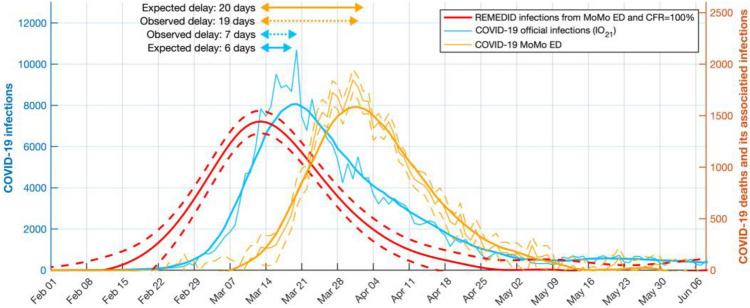
“Note three main differences between this time series and that 302 estimated from official COVID-19 deaths: (1) time series estimated from MoMo ED 303 was 7 days shorter due to the updating delay on MoMo statistics; (2) MoMo data 304 present an error band that was inherited by the estimated infections; (3) MoMo ED 305…”
BackgroundResultHanski, L. (1999) · doi:10.1093/oso/9780198540663.001.0001 · Cited by 3,535
Some Demographic and Genetic Consequences of Environmental Heterogeneity for Biological Control
Levins, R. (1969) · Bulletin of the Entomological Society of America · doi:10.1093/besa/15.3.237 · Cited by 3,474
Pollán, M., Pérez-Gómez, B., Pastor-Barriuso, R., Oteo, J., Hernán, M. A., Pérez-Olmeda, M., Sanmartín, J. L., Fernández-García, A., Cruz, I., Fernández de Larrea, N., et al. (2020) · The Lancet · doi:10.1016/s0140-6736(20)31483-5 · Cited by 1,639
Yang, Z., Zeng, Z., Wang, K., Wong, S.-S., Liang, W., Zanin, M., Liu, P., Cao, X., Gao, Z., Mai, Z., et al. (2020) · Journal of Thoracic Disease · doi:10.21037/jtd.2020.02.64 · Cited by 1,396
Effect of non-pharmaceutical interventions to contain COVID-19 in China
Lai, S., Ruktanonchai, N. W., Zhou, L., Prosper, O., Luo, W., Floyd, J. R., Wesolowski, A., Santillana, M., Zhang, C., Du, X., et al. (2020) · Nature · doi:10.1038/s41586-020-2293-x · Cited by 1,375
Linton, N., Kobayashi, T., Yang, Y., Hayashi, K., Akhmetzhanov, A., Jung, S.-M., Yuan, B., Kinoshita, R., & Nishiura, H. (2020) · Journal of Clinical Medicine · doi:10.3390/jcm9020538 · Cited by 1,361
Wallinga, J. (2004) · American Journal of Epidemiology · doi:10.1093/aje/kwh255 · Cited by 1,197
Introduction to Mathematical Probability
(1938) · Nature · doi:10.1038/141769d0 · Cited by 531
Wrong but Useful — What Covid-19 Epidemiologic Models Can and Cannot Tell Us
Holmdahl, I., & Buckee, C. (2020) · New England Journal of Medicine · doi:10.1056/nejmp2016822 · Cited by 431
Research works printed but not linked: 7
- World Health Organization Coronavirus Disease 2019 (COVID-19) Situation Report—24 2020 WHO
- Centro de Coordinación de Alertas y Emergencias Sanitarias Actualización No 84. Enfermedad por el Coronavirus (COVID-19) 2020 CCAES
- Centro de Coordinación de Alertas y Emergencias Sanitarias Actualización No 85. Enfermedad por el Coronavirus (COVID-19) 2020 CCAES
- Centro de Coordinación de Alertas y Emergencias Sanitarias Actualización No 111. Enfermedad por el Coronavirus (COVID-19) 2020 CCAES
- Centro de Coordinación de Alertas y Emergencias Sanitarias Actualización No 112. Enfermedad por el Coronavirus (COVID-19) 2020 CCAES
- Dirección General de Tráfico, Ministry of Interior Cuadro Comparativo de Accidentes Mortales y Fallecidos a 24 h en vías Interurbanas 2020 DGT
- Ministerio de Trabajo y Economía Social Estadística de Accidentes de Trabajo, Avance enero-marzo 2020 2020 MTES
Cited by
Barber, R. M., Sorensen, R. J. D., Pigott, D. M., Bisignano, C., Carter, A., Amlag, J. O., Collins, J. K., Abbafati, C., Adolph, C., Allorant, A., et al. (2022) · The Lancet · doi:10.1016/s0140-6736(22)00484-6 · Cited by 298
Meslé, M. M., Brown, J., Mook, P., Hagan, J., Pastore, R., Bundle, N., Spiteri, G., Ravasi, G., Nicolay, N., Andrews, N., et al. (2021) · Eurosurveillance · doi:10.2807/1560-7917.es.2021.26.47.2101021 · Cited by 266
Vall‐Roqué, H., Andrés, A., González‐Pacheco, H., & Saldaña, C. (2022) · International Journal of Eating Disorders · doi:10.1002/eat.23827 · Cited by 29
Burden of COVID-19: a preliminary analysis in the population of Saudi Arabia
Asdaq, S. M. B., Rabbani, S. I., Alshammari, M. K., Alshammari, R. S., Kamal, M., Imran, M., AlShammari, N. A., Al-Twallah, M. F., & Alshahrani, A. H. (2022) · PeerJ · doi:10.7717/peerj.13219 · Cited by 22
Recchi, E., Ferrara, A., Sánchez, A. R., Deutschmann, E., Gabrielli, L., Iacus, S. M., Bastiani, L., Spyratos, S., & Vespe, M. (2022) · Scientific Reports · doi:10.1038/s41598-022-20263-y · Cited by 21
Caveats on COVID-19 herd immunity threshold: the Spain case
García‐García, D., Morales, E., Fonfría, E. S., Vigo, I., & Bordehore, C. (2022) · Scientific Reports · doi:10.1038/s41598-021-04440-z · Cited by 15
Self-citationParameterization of the durations of phases of foot-and-mouth disease in pigs
Moreno-Torres, K. I., Delgado, A. H., Branan, M., Yadav, S., Stenfeldt, C., & Arzt, J. (2022) · Preventive Veterinary Medicine · doi:10.1016/j.prevetmed.2022.105615 · Cited by 10
Nova, A., Fazia, T., & Bernardinelli, L. (2023) · Public Health · doi:10.1016/j.puhe.2023.09.031 · Cited by 10
Sun, Y., Zhang, G., Liu, W., & Shi, P. (2023) · International Journal of Disaster Risk Reduction · doi:10.1016/j.ijdrr.2023.104187 · Cited by 9
Nassiri, H., Mohammadpour, S. I., & Dahaghin, M. (2022) · PLoS ONE · doi:10.1371/journal.pone.0276276 · Cited by 9
Disproportionate impacts of COVID-19 in a large US city
Fox, S. J., Javan, E. M., Pasco, R. F., Gibson, G., Betke, B. A., Herrera, J. L., Woody, S., Pierce, K. A., Johnson, K. E., Johnson-León, M., et al. (2023) · PLoS Computational Biology · doi:10.1371/journal.pcbi.1011149 · Cited by 8
Rodríguez, J. P., Aleta, A., & Moreno, Y. (2023) · Frontiers in Public Health · doi:10.3389/fpubh.2023.1122230 · Cited by 7
Kinoshita, T., Matsumoto, T., Taura, N., Usui, T., Matsuya, N., Nishiguchi, M., Horita, H., & Nakao, K. (2022) · JMIR Formative Research · doi:10.2196/36525 · Cited by 6
“In addition, there is a time lag for COVID-19 infection, onset, admission, and death [16], and the decision for admission differs by hospital.”
Machine learning mathematical models for incidence estimation during pandemics
Fajardo-Fontiveros, O., Mattei, M., Burgio, G., Granell, C., Gómez, S., Arenas, À., Sales‐Pardo, M., & Guimerà, R. (2024) · PLoS Computational Biology · doi:10.1371/journal.pcbi.1012687 · Cited by 6
Hadianfar, A., Rastaghi, S., Tabesh, H., & Saki, A. (2023) · Scientific Reports · doi:10.1038/s41598-023-44830-z · Cited by 6
Islam, N., López, F. J. G., Jdanov, D. A., Royo‐Bordonada, M. Á., Khunti, K., Lewington, S., Lacey, B., White, M., Morris, E. J. A., & Zunzunegui, M. V. (2024) · Gaceta Sanitaria · doi:10.1016/j.gaceta.2024.102424 · Cited by 6
Identification of the first COVID-19 infections in the US using a retrospective analysis (REMEDID)
García‐García, D., Morales, E., de la Fuente‐Núñez, C., Vigo, I., Fonfría, E. S., & Bordehore, C. (2022) · Spatial and Spatio-temporal Epidemiology · doi:10.1016/j.sste.2022.100517 · Cited by 5
Self-citationLeveraging cellphone-derived mobility networks to assess Covid-19 travel risk
Slater, J., Brown, P. E., Rosenthal, J. S., & Mateu, J. (2025) · The Annals of Applied Statistics · doi:10.1214/24-aoas1914 · Cited by 4
Benavides, E. M., Gavín, M. O., García, R. M., de Miguel, S., Ortiz-Pinto, M. A., Giménez, R. D., & Grande, A. G. (2022) · PLoS ONE · doi:10.1371/journal.pone.0279080 · Cited by 3
Le Covid-19 en Espagne. Les défis géopolitiques de la gouvernance d’un problème de santé
Villalón, J. C., González, R. C. L., Carballada, Á. M., & Cantos, J. O. (2021) · Hérodote · doi:10.3917/her.183.0197 · Cited by 3
Capistrán, M. A., Infante, J.-A., Ramos, A. M., & Rey, J. M. (2023) · Applied Mathematical Modelling · doi:10.1016/j.apm.2023.05.027 · Cited by 3
Dynamical regulations on mobility and vaccinations for controlling COVID-19 spread
Rajakaruna, M., Rajakaruna, H., & Rajakaruna, R. S. (2022) · Scientific Reports · doi:10.1038/s41598-022-07371-5 · Cited by 2
Sun, Y., Liu, W., Zhang, G., & Shi, P. (2024) · GeoHealth · doi:10.1029/2024gh001025 · Cited by 2
Márquez, J., García‐García, D., Vigo, I., & Bordehore, C. (2024) · Gaceta Sanitaria · doi:10.1016/j.gaceta.2024.102357 · Cited by 1
Self-citationBenatia, D., Godefroy, R., & Lewis, J. (2024) · PLoS ONE · doi:10.1371/journal.pone.0311001 · Cited by 1
A Feedback SAIR Model for the Spread of Infectious Disease with Application to COVID-19 Pandemic
March, D., Bond, J., & Buzi, G. (2022) · Proceedings of the ... American Control Conference/Proceedings of the American Control Conference · doi:10.23919/acc53348.2022.9867866 · Cited by 1
Hadianfar, A., Delavary, M., Lavallière, M., Nejatian, A., & Mehrpour, O. (2023) · PLoS ONE · doi:10.1371/journal.pone.0291205 · Cited by 1
Hadianfar, A., Rastaghi, S., Sharak, N. A., Saki, A., & Mishra, P. (2022) · Research Square · doi:10.21203/rs.3.rs-1364845/v1
Cumulative COVID-19 incidence indicators should account for the population-at-risk dynamicsPreprint
Masjuan, P., Trias‐Llimós, S., Rojas, C., Prakash, A. K., Gullón, P., Tobías, A., & López‐Gay, A. (2022) · medRxiv · doi:10.1101/2022.10.18.22281225
Fonfría, E. S., Vigo, I., García‐García, D., Herrador, Z., Navarro, M., & Bordehore, C. (2022) · medRxiv · doi:10.1101/2022.10.23.22281408
Self-citationOn the Probabilistic Extension of the Classical Epidemiological Compartmental Model
Barber, X., Falcó, A., & Martinez-Garcia, M. (2022) · Nonlinear systems and complexity · doi:10.1007/978-3-031-06632-0_9
COVID-19 incidence estimates and forecast by metaprediction for the Comunidad de Madrid *
Martínez, A. C., Muñoz-Organero, M., Moriña, D., Gómez‐Barroso, D., & Singh, D. E. (2023) · IEEE International Conference on Bioinformatics and Biomedicine (BIBM) · doi:10.1109/bibm58861.2023.10385648
Vall‐Roqué, H. (2023) · Dipòsit Digital de la Universitat de Barcelona (Universitat de Barcelona)
Retrospective estimate of COVID-19 infections in nine Colombian cities in 2020
Márquez, J., David, G.-G., Vigo, I., & Bordehore, C. (2026) · Epidemiology and Infection · doi:10.1017/s095026882610106x
Self-citationBraeye, T., Pauw, R. D., Geebelen, L., Abrams, S. A., Desombere, I., Hens, N., Hammami, N., Roelants, M., Muylaert, A., & Herzog, S. A. (2026) · Archives of Public Health · doi:10.1186/s13690-026-01860-z
Желіба, М. М. (2025) · INSTITUTIONAL REPOSITORY OF ODESSA NATIONAL UNIVERSITY NAMED I.I. Mechnykova (Odesa I.I.Mechnikov National University)
Türkmen-Ceylan, F. B., Matteis, A. D., & Urpis, E. (2026) · Global Health Economics and Sustainability · doi:10.36922/ghes026280044
Fajardo-Fontiveros, O., Mattei, M., Burgio, G., Granell, C., Gómez, S., Arenas, A., Sales-Pardo, M., & Guimerà, R. (2024) · doi:10.1371/journal.pcbi.1012687.r005
Metadata
- Authors
- García-García, D., Vigo, M. I., Fonfría, E. S., Herrador, Z., Navarro, M., & Bordehore, C.
- Affiliations
- University of Alicante (ES)
- Instituto de Salud Carlos III (ES)
- Venue
- Scientific Reports
- Published
- 2021-05-28
- Volume
- 11
- Issue
- 1
- Pages
- 11274-11274
- ISSN
- 2045-2322 (ISSN-L)
- PMC
- PMC8163852
- OpenAlex
- W3164522179
- Semantic Scholar
- 43cef94529c3b9809794f09e98a13a50296c0bb4
- Cited by
- 43
- References
- 24
- Citations by year
- 2026: 1 · 2025: 2 · 2024: 6 · 2023: 8 · 2022: 21 · 2021: 5
- FWCI
- 3.86
- Type
- journal article
- Language
- en
- Open access
- gold
- doi.org
- Licence
- cc-by
- creativecommons.org/licenses/by/4.0 (tdm)
- creativecommons.org/licenses/by/4.0 (vor)
- Locations
- Scientific Reports (publishedVersion, cc-by)
- medRxiv (acceptedVersion, cc-by-nc-nd)
- PubMed Central (publishedVersion, cc-by)
- PubMed (publishedVersion)
- DOAJ (DOAJ: Directory of Open Access Journals) (submittedVersion, cc-by-sa)
- RUA, Repositorio Institucional de la Universidad de Alicante (Universidad de Alicante) (submittedVersion, cc-by)
- Funders
- Universidad de Alicante (COVID-19 2020-41.30.6P.0016)
- Ajuntament de Dénia - Montgó-Dénia Research Station (2020-41.30.6O.00.01)
- Topics
- Physical Sciences › Mathematics › Modeling and Simulation › COVID-19 epidemiological studies
- Health Sciences › Medicine › Epidemiology › Data-Driven Disease Surveillance
- Health Sciences › Medicine › Infectious Diseases › SARS-CoV-2 and COVID-19 Research
- Keywords
- COVID-19 pandemic, SARS-CoV-2, case fatality rate, incubation period, epidemic growth rate, Spain
- MeSH terms
- COVID-19, Communicable Disease Control, Humans, Retrospective Studies, Spain, Seroepidemiologic Studies, Infectious Disease Incubation Period, Pandemics
About these checks
Registry, retraction, Cites and statistics results are computed, not judged, with one exception: a printed reference that no index lists is read once by a model before it counts as a citation error. Claims are extracted by a model and kept only when their quote appears verbatim in the text; each cited source is then checked, with a model’s help, for whether it says what the claim relies on. Those verdicts can be wrong — read the claim’s quote and the cited source before relying on one.
Statistics and arithmetic are recomputed, not judged.
Confidence bands are shown only for fields calibrated on our annotated test set. None is calibrated yet, so no band is shown.
What counts as a claim ›How we measure confidence ›How we check this ›
Are you an author, or do you see a problem with this page? Request a review
Data sources
Bibliographic data: Semantic Scholar, OpenAlex, Crossref.
Contains information from the Semantic Scholar Academic Graph Datasets, made available under the ODC Attribution License (ODC-BY 1.0).
Semantic Scholar’s data is described in: Kinney, R., et al. (2023). The Semantic Scholar Open Data Platform. arXiv:2301.10140.
