

AI outperformed every dermatologist in dermoscopic melanoma diagnosis, using an optimized deep-CNN architecture with custom mini-batch logic and loss function
Open accessThe DOI matches its Crossref record; 28 of the 28 references it cites were found in a registry or an index.
Abstract
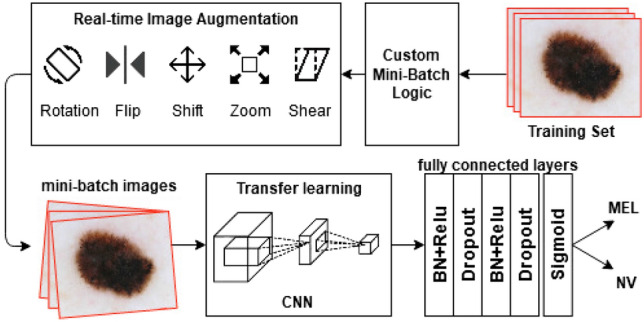
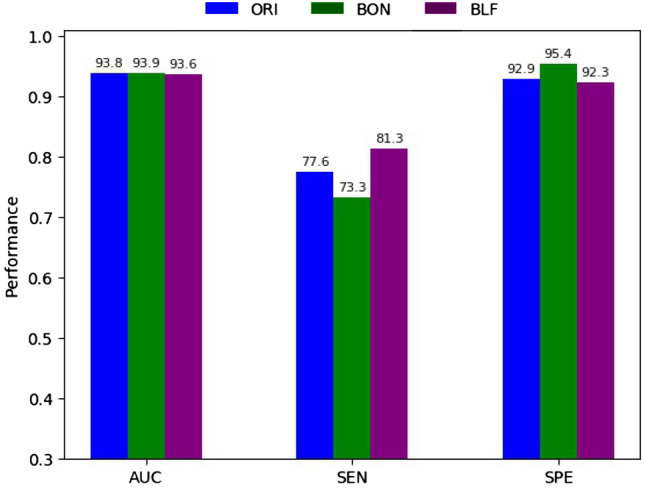
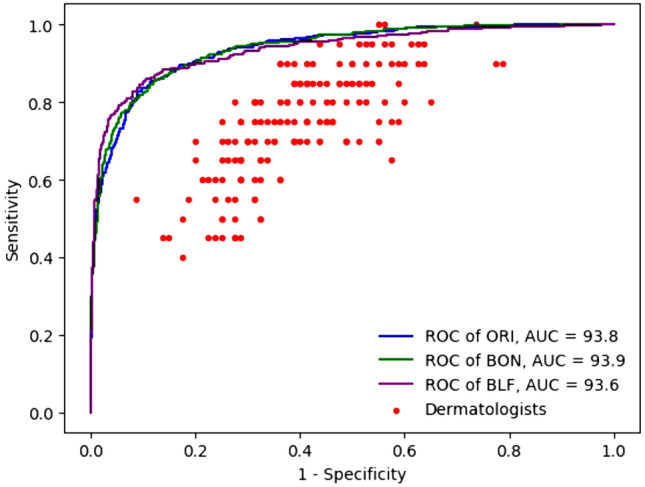
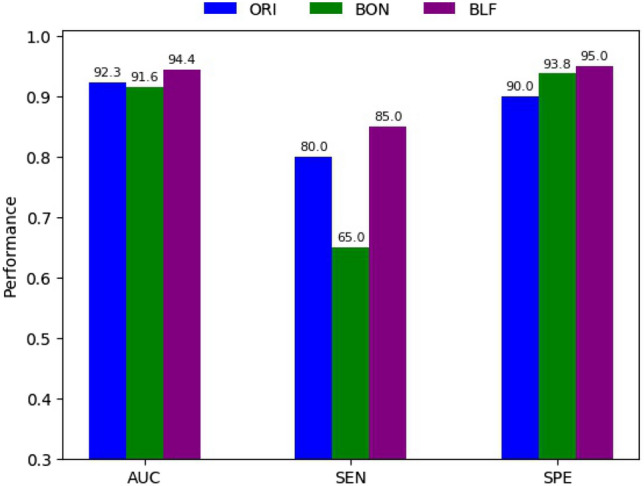
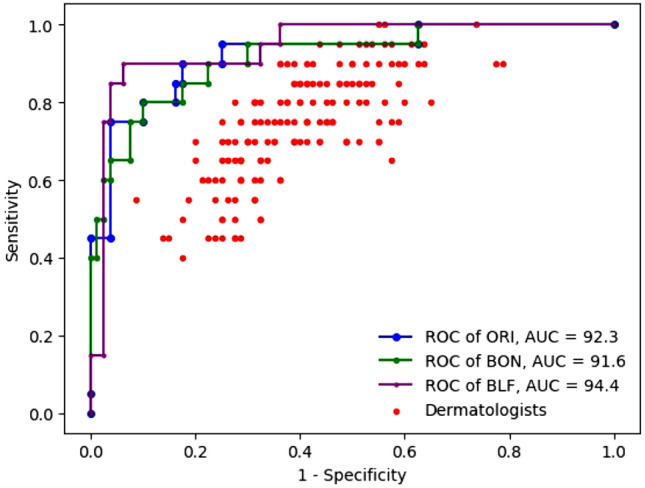
Melanoma, one of the most dangerous types of skin cancer, results in a very high mortality rate. Early detection and resection are two key points for a successful cure. Recent researches have used artificial intelligence to classify melanoma and nevus and to compare the assessment of these algorithms to that of dermatologists. However, training neural networks on an imbalanced dataset leads to imbalanced performance, the specificity is very high but the sensitivity is very low. This study proposes a method for improving melanoma prediction on an imbalanced dataset by reconstructed appropriate CNN architecture and optimized algorithms. The contributions involve three key features as custom loss function, custom mini-batch logic, and reformed fully connected layers. In the experiment, the training dataset is kept up to date including 17,302 images of melanoma and nevus which is the largest dataset by far. The model performance is compared to that of 157 dermatologists from 12 university hospitals in Germany based on the same dataset. The experimental results prove that our proposed approach outperforms all 157 dermatologists and achieves higher performance than the state-of-the-art approach with area under the curve of 94.4%, sensitivity of 85.0%, and specificity of 95.0%. Moreover, using the best threshold shows the most balanced measure compare to other researches, and is promisingly application to medical diagnosis, with sensitivity of 90.0% and specificity of 93.8%. To foster further research and allow for replicability, we made the source code and data splits of all our experiments publicly available.
Overview
The claims and statistics of this paper haven’t been checked yet.
Free: it reads the open-access text and checks the first 5 claims that cite a source we can check. Create a free account to check every claim.
Integrity signals
Registry
Cites
Statistics
Figures

Verification
Claims the paper makes
The claims and statistics of this paper haven’t been checked yet.
Free: it reads the open-access text and checks the first 5 claims that cite a source we can check. Create a free account to check every claim.
Self-check
Percentages, sums and reported differences re-computed from the paper’s own numbers.
The self-check needs the paper’s full text.
Citations
Cites
Deep Residual Learning for Image Recognition
He, K., Zhang, X., Ren, S., & Sun, J. (2016) · 2016 IEEE Conference on Computer Vision and Pattern Recognition (CVPR) · doi:10.1109/cvpr.2016.90 · Cited by 235,474
LeCun, Y., Bengio, Y., & Hinton, G. (2015) · Nature · doi:10.1038/nature14539 · Cited by 84,126
Densely Connected Convolutional Networks
Huang, G., Liu, Z., Van Der Maaten, L., & Weinberger, K. Q. (2017) · 2017 IEEE Conference on Computer Vision and Pattern Recognition (CVPR) · doi:10.1109/cvpr.2017.243 · Cited by 48,566
(2014) · Cited by 33,419
Rethinking the Inception Architecture for Computer Vision
Szegedy, C., Vanhoucke, V., Ioffe, S., Shlens, J., & Wojna, Z. (2016) · 2016 IEEE Conference on Computer Vision and Pattern Recognition (CVPR) · doi:10.1109/cvpr.2016.308 · Cited by 32,138
Batch Normalization: Accelerating Deep Network Training by Reducing Internal Covariate Shift
Ioffe, S., & Szegedy, C. (2015) · arXiv · doi:10.48550/arxiv.1502.03167 · Cited by 27,818
Dermatologist-level classification of skin cancer with deep neural networks
Esteva, A., Kuprel, B., Novoa, R. A., Ko, J., Swetter, S. M., Blau, H. M., & Thrun, S. (2017) · Nature · doi:10.1038/nature21056 · Cited by 14,362
Batch Normalization: Accelerating Deep Network Training by Reducing Internal Covariate Shift
Ioffe, S. (2024) · arXiv (Cornell University) · doi:10.57702/o9raffed · Cited by 14,214
Tschandl, P., Rosendahl, C., & Kittler, H. (2018) · Scientific Data · doi:10.1038/sdata.2018.161 · Cited by 3,628
Cyclical Learning Rates for Training Neural Networks
Smith, L. N. (2017) · 2017 IEEE Winter Conference on Applications of Computer Vision (WACV) · doi:10.1109/wacv.2017.58 · Cited by 2,670
Research works printed but not linked: 1
- Codella, N. C. et al. International symposium on biomedical imaging (ISBI), hosted by the international skin imaging collaboration (ISIC). in 2018 IEEE 15th International Symposium on Biomedical Imaging (ISBI 2018). 168–172 (IEEE, 2017).
Cited by
Items 101–123 of 123
Image Processing Techniques for Skin Diseases
Guo, S., Song, X., & Han, L. (2025) · Springer eBooks · doi:10.1007/978-981-96-6135-0_1
A model combining deep learning and ensemble learning for melanoma recognition via dermoscopy
Jiang, J., & Yang, S. (2026) · Frontiers in Oncology · doi:10.3389/fonc.2026.1782150
Zhang, Q., Vasudev, P., Li, K., & Kunz, H. (2026) · Frontiers in Digital Health · doi:10.3389/fdgth.2026.1883337
Awad, L., Tagalpallewar, S., Parthiban, S., Jiao, R., Shah, D., Burton, H. R., Butler, P. E. M., & Ponniah, A. J. T. (2026) · Journal of Plastic Reconstructive & Aesthetic Surgery · doi:10.1016/j.bjps.2026.06.023
Dlugatch, R., Georgieva, A., & Kerasidou, A. (2024) · Figshare · doi:10.6084/m9.figshare.24954509
Classification of 36 paediatric skin diseases using self‐supervised learning
Paik, K., Youn, S. W., Huh, C., Choi, C. W., Shin, J. W., Kim, B. R., Park, J. Y., & Na, J. (2025) · Journal of the European Academy of Dermatology and Venereology · doi:10.1111/jdv.70273
Chai, H., & Gilmore, S. J. (2026) · Australasian Journal of Dermatology · doi:10.1111/ajd.70061
Ethical, Regulatory, and Data Privacy Challenges of AI in Dermatology
Rajesh, P. H., Dwarampudi, L. P., Krishnaraj, R., & Dhamne, V. M. (2026) · Advances in computational intelligence and robotics book series · doi:10.4018/979-8-2600-0567-5.ch017
Skin Cancer Detection and Classification Using Deep Learning Techniques
Suvarna, S., Ashwin Shenoy, M., Naik, N. N., Rahul, Naik, R., & Prabhu, P. (2026) · International Conference on Artificial Intelligence and Data Engineering (AIDE) · doi:10.1109/aide69088.2026.11544172
Advanced AI Algorithms for Personalized Skincare Recommendations
Dinesh Karthick, A., Kishor, T., Praveen, K., Rajan, C., & Thivya, V. (2026) · International Conference on Intelligent Computing and Control Systems (ICICCS) · doi:10.1109/iciccs67901.2026.11502836
Dermatoscopy Image Classification Using Convolutional Neural Networks
Смалюк, А. Ф. (2026) · Science & Technique · doi:10.21122/2227-1031-2026-25-1-5-13
Artificial Intelligence-based Image Analysis for Early Cancer Detection: Review
Almehmadi, M. A. (2024) · Review of Contemporary Philosophy
Artificial Intelligence Tools and Their Ability to Refine Skin Cancer Diagnostics
Ganesan, K. (2026) · Oxford Journal of Student Scholarship · doi:10.65161/recbyigxl0awlpbyg
Santy, Prabowo, A. S., Prasetyo, S. Y., Asmare, M. H., Aditjakra, C., & Clarawita (2025) · International Seminar on Research of Information Technology and Intelligent Systems (ISRITI) · doi:10.1109/isriti68345.2025.11393193
Pfaar, O., Traidl, S., Bärhold, F., Becker, S., Bergmann, C., Buters, J., Dramburg, S., Francuzik, W., Gerstlauer, M., Hamelmann, E., et al. (2026) · Allergologie select · doi:10.5414/alx02643e · Cited by 1
Hazarika, R. A., Haddadi, Y. R., Guzzo, A., Provenzano, E., & Fortino, G. (2026) · IEEE Smart World Congress (SWC) · doi:10.1109/swc69865.2026.11764098
Song, X., Mei, Y., Zhao, Z., Chang, H., Han, L., Wang, H., Zhang, X., & Wang, G. (2025) · Machine Learning Science and Technology · doi:10.1088/2632-2153/ade4f0
Challenges, Innovations, and Recommendations
Alguno, A. C., Capangpangan, R. Y., Dumancas, G. G., Lubguban, A. A.-O., Malaluan, R. M., & Rivera, R. B. P. (2025) · Engineering materials · doi:10.1007/978-981-96-6771-0_8
Ibad, S., Gronbeck, C., & Perlis, C. (2026) · Journal of the American Academy of Dermatology · doi:10.1016/j.jaad.2026.02.110
EMG-derived chaotic feature-based induced pain assessment technique using CNN architecture
Sen, K., & Pal, S. (2026) · Biomedical Signal Processing and Control · doi:10.1016/j.bspc.2026.111094
Mubarik, T., & Aftab, S. (2026) · ICCK Journal of Software Engineering · doi:10.62762/jse.2026.541211
Nimrah, Devadiga, S. S., & Koppad, S. (2026) · doi:10.1109/incect72370.2026.11742643
Cheng, T. W., Ahern, M. C., & Giubellino, A. (2022) · doi:10.3389/fonc.2022.889223.s001
Metadata
- Authors
- Pham, T.-C., Luong, C.-M., Hoang, V.-D., & Doucet, A.
- Affiliations
- Thuyloi University (VN)
- Trường Đại học Khoa học và Công nghệ Hà Nội (VN)
- Ho Chi Minh City University of Technology and Engineering (VN)
- Laboratoire Informatique, Image et Interaction (L3i) (FR)
- Corresponding author
- Doucet, Antoine
- Venue
- Scientific Reports
- Published
- 2021-09-01
- Volume
- 11
- Issue
- 1
- Pages
- 17485-17485
- ISSN
- 2045-2322 (ISSN-L)
- PMC
- PMC8410796
- OpenAlex
- W3198806597
- Cited by
- 101
- References
- 28
- Citations by year
- 2026: 13 · 2025: 23 · 2024: 27 · 2023: 24 · 2022: 13 · 2021: 1
- FWCI
- 5.91
- Type
- journal article
- Language
- en
- Open access
- gold
- doi.org
- Licence
- cc-by
- creativecommons.org/licenses/by/4.0 (tdm)
- creativecommons.org/licenses/by/4.0 (vor)
- Locations
- Scientific Reports (publishedVersion, cc-by)
- PubMed Central (publishedVersion, cc-by)
- PubMed (publishedVersion)
- DOAJ (DOAJ: Directory of Open Access Journals) (submittedVersion, cc-by-sa)
- Greater South Information System
- Topics
- Health Sciences › Medicine › Oncology › Cutaneous Melanoma Detection and Management
- Physical Sciences › Computer Science › Artificial Intelligence › AI in cancer detection
- Physical Sciences › Computer Science › Computer Vision and Pattern Recognition › Advanced Neural Network Applications
- Keywords
- melanoma diagnosis, dermoscopy, convolutional neural networks, class imbalance, custom loss function, dermatologist comparison, early detection of skin cancer, sensitivity and specificity
- MeSH terms
- Dermatologists, Deep Learning, Algorithms, Artificial Intelligence, Humans, Melanoma, ROC Curve, Skin Neoplasms, Neural Networks, Computer, Dermoscopy
About these checks
Registry, retraction, Cites and statistics results are computed, not judged, with one exception: a printed reference that no index lists is read once by a model before it counts as a citation error. Claims are extracted by a model and kept only when their quote appears verbatim in the text; each cited source is then checked, with a model’s help, for whether it says what the claim relies on. Those verdicts can be wrong — read the claim’s quote and the cited source before relying on one.
Statistics and arithmetic are recomputed, not judged.
Confidence bands are shown only for fields calibrated on our annotated test set. None is calibrated yet, so no band is shown.
What counts as a claim ›How we measure confidence ›How we check this ›
Are you an author, or do you see a problem with this page? Request a review
Data sources
Bibliographic data: Semantic Scholar, OpenAlex, Crossref.
Contains information from the Semantic Scholar Academic Graph Datasets, made available under the ODC Attribution License (ODC-BY 1.0).
Semantic Scholar’s data is described in: Kinney, R., et al. (2023). The Semantic Scholar Open Data Platform. arXiv:2301.10140.
