

The DOI matches its Crossref record.
Impact of drying methods on the yield and chemistry of Origanum vulgare L. essential oil
Abstract
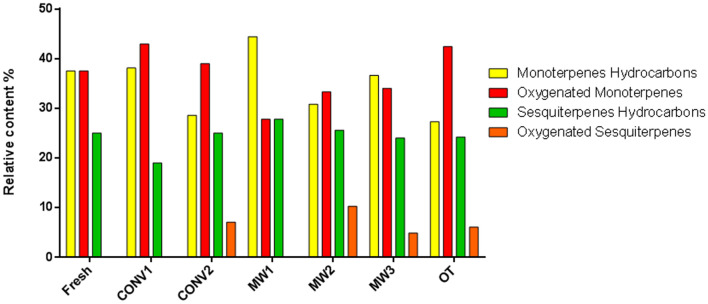
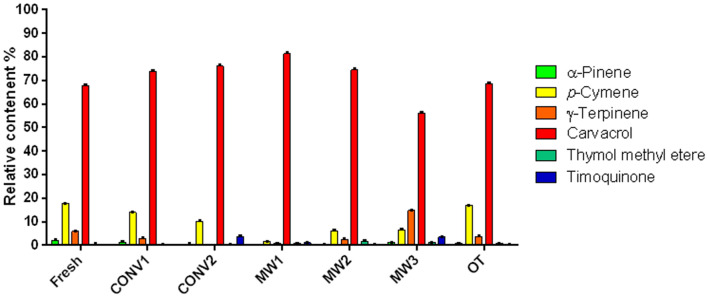
Oregano (Origanum vulgare L.) is mainly cultivated, both as fresh and dried herb, for several purposes, such as ailments, drugs, and spices. To evaluate the influence of some drying methods on the chemical composition of the essential oil of oregano, its aerial parts were dehydrated by convective drying techniques (shade, static oven), microwave-assisted heating (three different treatments) and osmotic treatment. The oils were analyzed by GC-FID and GC–MS. The highest essential oil yield was achieved from microwave and shade drying methods. In total, 39 components were found, with carvacrol (ranging from 56.2 to 81.4%) being the main constituent; other compounds present in lower amounts were p-cymene (1.6–17.7%), γ-terpinene (0.8–14.2%), α-pinene (0.1–2.1%), thymol methyl ether (0.4–1.8%) and thimoquinone (0.5–3.5%). The essential oil yields varied among the different treatments as well as the relative compositions. The percentages of p-cymene, γ-terpinene and α-pinene decreased significantly in the dried sample compared with the fresh sample; on the other hand, carvacrol, isoborneol and linalool increased significantly in the dried materials. The choice of the drying method for obtaining the essential oil therefore appears crucial not only in relation to the higher yield but also and above all in reference to the percentage presence of components that can direct the essential oil toward an appropriate use.
Overview
The claims and statistics of this paper haven’t been checked yet.
Run the check — free, no account needed. It reads the open-access text and checks the sources it cites.
Integrity signals
Registry
Cites
Statistics
Figures
Verification
Claims the paper makes
The claims and statistics of this paper haven’t been checked yet.
Run the check — free, no account needed. It reads the open-access text and checks the sources it cites.
Claims other papers make about this one
Each is checked against this paper’s own text: does it say what the citing paper says it does?
In the citing paper
“Similar findings have been reported by other researchers, indicating that lower DTs (such as 40°C) help maintain the quality of essential oilswhile providing high yields [32].”
From Thermal processing and geographical origin as drivers of terpenoids variation in Anethum graveolens L. essential oils: A biplot analysis (2025) · cites this paper as [32]
Self-check
Percentages, sums and reported differences re-computed from the paper’s own numbers.
The self-check needs the paper’s full text.
Citations
Cites
No references could be resolved yet.
Research works printed but not linked: 43
- Elshafie, H. S. et al. Cytotoxic activity of Origanum vulgare L. on hepatocellular carcinoma cell line HepG2 and evaluation of its biological activity. Molecules 22, 1435. https://doi.org/10.3390/molecules22091435 (2017). · DOI
- Boutebouhart, H., Didaoui, L., Tata, S. & Sabaou, N. Effect of extraction and drying method on chemical composition, and evaluation of antioxidant and antimicrobial activities of essential oils from Salvia officinalis L. J. Essent. Oil.-Bear. Pl. 22, 717–727. https://doi.org/10.1080/0972060X.2019.1651223 (2019). · DOI
- Bhatt, S., Tewari, G., Pande, C., Prakash, O. & Tripathi, S. Aroma profile and antioxidant potential of Origanum vulgare L.: Impact of drying. J. Essent. Oil.-Bear. Pl. 22, 214–230. https://doi.org/10.1080/0972060X.2019.1599736 (2019). · DOI
- Calín-Sánchez, Á. et al. Dying methods affect the aroma of Origanum majorana L. analyzed by GC–MS and descriptive sensory analysis. Ind. Crop. Prod. 74, 218–227. https://doi.org/10.1016/j.indcrop.2015.04.067 (2015). · DOI
- Figiel, A., Szumny, A., Gutiérrez-Ortíz, A. & Carbonell-Barrachina, Á. A. Composition of oregano essential oil (Origanum vulgare) as affected by drying method. J. Food Eng. 98, 240–247. https://doi.org/10.1016/j.jfoodeng.2010.01.002 (2010). · DOI
- Soysal, Y., Arslan, M. & Keskin, M. Intermittent microwave-convective air drying of oregano. Food Sci. Technol. Int. 15, 397–406. https://doi.org/10.1177/1082013209346588 (2009). · DOI
- Sellami, I. H. et al. Qualitative and quantitative changes in the essential oil of Laurus nobilis L. leaves as affected by different drying methods. Food Chem. 126, 691–697. https://doi.org/10.1016/j.foodchem.2010.11.022 (2011). · DOI
- Grosch, W. Evaluation of the key odorants of foods by dilution experiments, aroma models and omission. Chem. Senses 26, 533–545. https://doi.org/10.1093/chemse/26.5.533 (2001). · DOI
- Thamkaew, G., Sjöholm, I. & Galindo, F. G. A review of drying methods for improving the quality of dried herbs. Crit. Rev. Food Sci. Nutr. 61, 1763–1786. https://doi.org/10.1080/10408398.2020.1765309 (2020). · DOI
- Özer, Z., Kiliç, T., Selvi, S. & Pasa, C. Effect of different drying methods and development stages on the essential oil chemical composition of aerial parts of Origanum vulgare L. subsp. hirtum (link) Ietsw. J. Essent. Oil.-Bear. Pl. 21, 1403–1409. https://doi.org/10.1080/0972060X.2018.1439774 (2018). · DOI
- Orphanides, A., Goulas, V. & Gekas, V. Drying technologies: Vehicle to high-quality herbs. Food Eng. Rev. 8, 164–180. https://doi.org/10.1007/s12393-015-9128-9 (2016). · DOI
- Janjai, S. & Bala, B. K. Solar drying technology. Food Eng. Rev. 4, 16–54. https://doi.org/10.1007/s12393-011-9044-6 (2012). · DOI
- Vega-Mercado, H., Góngora-Nieto, M. M. & Barbosa-Cánovas, G. V. Advances in dehydration of foods. J. Food Eng. 49, 271–289. https://doi.org/10.1016/S0260-8774(00)00224-7 (2001). · DOI
- Chua, L. Y., Chong, C. H., Chua, B. L. & Figiel, A. Influence of drying methods on the antibacterial, antioxidant and essential oil volatile composition of herbs: A review. Food Bioprocess. Technol. 12, 450–476. https://doi.org/10.1007/s11947-018-2227-x (2019). · DOI
- Barba, A. A. & D’Amore, M. Relevance of dielectric properties in microwave assisted processes, Chapter 6. In Microwave Materials Characterization (ed. Costanzo, S.) 91–118 ISBN 9799533078938. (InTechOpen, 2012). https://doi.org/10.5772/51098. · DOI
- Divya, P., Puthusseri, B. & Neelwarne, B. Carotenoid content, its stability during drying and the antioxidant activity of commercial coriander (Coriandrum sativum L.) varieties. Food Res. Int. 45, 342–350. https://doi.org/10.1016/j.foodres.2011.09.021 (2012). · DOI
- Stankiewicz, A. & Moulijn, J. Re-engineering the Chemical Processing Plant: Process Intensification. Series Chemical Industries, 98. ISBN 0824743024 9780824743024. (M Dekker, 2004). · DOI
- Fennell, C. W., Light, M. E., Sparg, S. G., Stafford, G. I. & van Staden, J. Assessing African medicinal plants for efficacy and safety: Agricultural and storage practices. J. Ethnopharmacol. 95, 113–121. https://doi.org/10.1016/j.jep.2004.05.025 (2004). · DOI
- Calín-Sánchez, A., Lech, K., Szumny, A., Figiel, A. & Carbonell-Barrachina, A. Volatile composition of sweet basil essential oil (Ocimum basilicum L.) as affected by drying method. Food Res. Int. 48, 217–225. https://doi.org/10.1016/j.foodres.2012.03.015 (2012). · DOI · Paper page
- Ahmed, A., Ayoub, K., Chaima, A. J., Hanaa, L. & Abdelaziz, C. Effect of drying methods on yield, chemical composition and bioactivities of essential oil obtained from Moroccan Mentha pulegium L. Biocatal. Agric. Biotechnol. 16, 638–643. https://doi.org/10.1016/j.bcab.2018.10.016 (2018). · DOI
- Jałoszyński, K., Figiel, A. & Wojdyło, A. Drying kinetics and antioxidant activity of oregano. Acta Agrophys. 11(1), 81–90 (2008).
- Sourestani, M., Malekzadeh, M. & Tava, A. Influence of drying, storage and distillation times on essential oil yield and composition of anise hyssop [Agastache foeniculum (Pursh). Kuntze]. J. Essent. Oil Res. 26, 177–184. https://doi.org/10.1080/10412905.2014.882274 (2014). · DOI
- Bhatt, S., Tewari, G., Pande, C. & Rana, L. Impact of drying methods on essential oil composition of Ocimum americanum L. from Kumaun Himalayas. J. Essent. Oil-Bear. Pl. 21, 1385–1396. https://doi.org/10.1080/0972060X.2018.1543031 (2018). · DOI
- Parizotto, C. A. et al. Measuring dielectric properties for microwave assisted extraction of essential oils using single mode and multimode reactors. RSC Adv. 9, 5259. https://doi.org/10.1039/C8RA08727J (2019). · DOI
- Guiné, R. The drying of foods and its effect on the physical–chemical, sensorial and nutritional properties. Int. J. Food Eng. 2, 93–100. https://doi.org/10.18178/ijfe.4.2.93-100 (2018). · DOI
- Martínez-Sánchez, A., Tudela, J. A., Luna, C., Allende, A. & Gil, M. I. Low oxygen levels and light exposure affect quality of fresh-cut Romaine lettuce. Postharvest Biol. Technol. 59, 34–42. https://doi.org/10.1016/j.postharvbio.2010.07.005 (2011). · DOI
- Mihailova, G., Kocheva, K., Goltsev, V., Kalaji, H. M. & Georgieva, K. Application of a diffusion model to measure ion leakage of resurrection plant leaves undergoing desiccation. Plant Physiol. Biochem. 125, 185–192. https://doi.org/10.1016/j.plaphy.2018.02.008 (2018). · DOI
- Barba, A. A. et al. Microwave treatments of cereals: Effects on thermophysical and parenchymal-related properties. Foods 9, 14. https://doi.org/10.3390/foods9060711 (2019). · DOI
- Rahimmalek, M. & Goli, S. A. H. Evaluation of six drying treatments with respect to essential oil yield, composition and color characteristics of Thymys daenensis subsp. daenensis Celak leaves. Ind. Crops Prod. 42, 613–619. https://doi.org/10.1016/j.indcrop.2012.06.012 (2013). · DOI
- Sellami, H. I. et al. Total phenolics, flavonoids, and antioxidant activity of sage (Salvia officinalis L.) plants as affected by different drying methods. Food Bioprocess. Technol. 6, 806–817. https://doi.org/10.1007/s11947-012-0877-7 (2013). · DOI
- Mashkani, M. R. D., Larijani, K., Mehrafarin, A. & Badi, H. N. Changes in the essential oil content and composition of Thymus daenensis Celak. under different drying methods. Ind. Crops Prod. 112, 389–395. https://doi.org/10.1016/j.indcrop.2017.12.012 (2018). · DOI
- Jerković, I., Mastelić, J. & Miloš, M. The impact of both the season of collection and drying on the volatile constituents of Origanum vulgare L. ssp. hirtum grown wild in Croatia. Int. J. Food Sci. Technol. 36, 649–654. https://doi.org/10.1046/j.1365-2621.2001.00502.x (2001). · DOI
- Ghasemi Pirbalouti, A., Mahdad, E. & Craker, L. Effects of drying methods on qualitative and quantitative properties of essential oil of two basil landraces. Food Chem. 141, 2440–2449. https://doi.org/10.1016/j.foodchem.2013.05.098 (2013). · DOI
- Stewart, D. The Chemistry of Essential Oils Made Simple: God’s Love Manifest in Molecules (Care Publications, 2005).
- Drinić, Z., Pljevljakušić, D., Živković, J., Bigović, D. & Šavikin, K. Microwave-assisted extraction of O. vulgare L. spp. hirtum essential oil: Comparison with conventional hydrodistillation. Food Bioprod. Process. 120, 158–165. https://doi.org/10.1016/j.fbp.2020.01.011 (2020). · DOI
- Kokkini, S., Vokou, D. & Karousou, R. Morphological and chemical variation of Origanum vulgare L. in Greece. Bot. Chron. 10, 337–346 (1991).
- Adam, K., Sivropoulou, A., Kokkini, S., Lanaras, T. & Arsenakis, M. Antifungal activities of Origanum vulgare subsp. hirtum, Mentha spicata, Lavandula angustifolia, and Salvia fruticosa essential oils against human pathogenic fungi. J. Agric. Food Chem. 46, 1739–1745. https://doi.org/10.1021/jf9708296 (1998). · DOI
- Della Pepa, T. et al. Antimicrobial and phytotoxic activity of Origanum heracleoticum and O. majorana essential oils growing in Cilento (Southern Italy). Molecules 24(14), 2576 (2019). · DOI
- Jennings, W. & Shibamoto, T. Qualitative Analysis of Flavor and Fragrance Volatiles by Glass Capillary Gas Chromatography (Academic Press, 1980).
- Davies, N. W. Gas chromatographic retention indices of monoterpenes and sesquiterpenes on methyl silicone and Carbowax 20 M phases. J. Chromatogr. A 503, 1–24. https://doi.org/10.1016/S0021-9673(01)81487-4 (1990). · DOI
- Adams, R. P. Identification of Essential Oil Components by Gas Chromatography/Mass Spectroscopy 4th edn. (Allured Publishing, 2007).
- Goodner, K. L. Practical retention index models of OV-101, DB-1, DB-5, and DB-Wax for flavor and fragrance compounds. LWT Food Sci. Technol. 41, 951–958. https://doi.org/10.1016/j.lwt.2007.07.007 (2008). · DOI
- Wiley, The Wiley Registry of Mass Spectral Data, with NIST Spectral Data CD Rom, 7th ed. (Wiley, 1998).
Cited by
Farmanpour Kalalagh, K., Mohebodini, M., Sabaghnia, N., Beyraghdar Kashkooli, A., & Esmaeili, H. (2025) · PLOS One · doi:10.1371/journal.pone.0327018 · Cited by 4
Metadata
- Authors
- Caputo, L., Amato, G., de Bartolomeis, P., De Martino, L., Manna, F., Nazzaro, F., De Feo, V., & Barba, A. A.
- Venue
- Scientific Reports
- Published
- 2022-03-09
- Volume
- 12
- Issue
- 1
- ISSN
- 2045-2322
- PMC
- PMC8907181
- Cited by
- 64
- References
- 0
- Language
- en
About these checks
Registry, retraction, Cites and statistics results are computed, not judged, with one exception: a printed reference that no index lists is read once by a model before it counts as a citation error. Claims are extracted by a model and kept only when their quote appears verbatim in the text; each cited source is then checked, with a model’s help, for whether it says what the claim relies on. Those verdicts can be wrong — read the claim’s quote and the cited source before relying on one.
Statistics and arithmetic are recomputed, not judged.
Confidence bands are shown only for fields calibrated on our annotated test set. None is calibrated yet, so no band is shown.
What counts as a claim ›How we measure confidence ›How we check this ›
Are you an author, or do you see a problem with this page? Request a review
How to cite
Cite CoChat for the checks on this page, and the paper for its own findings.
- This page
- CoChat. (2026). Citation check: Impact of drying methods on the yield and chemistry of Origanum vulgare L. essential oil. https://app.cochat.ai/papers/10.1038/s41598-022-07841-w
- The paper
- Caputo, L., Amato, G., de Bartolomeis, P., De Martino, L., Manna, F., Nazzaro, F., De Feo, V., & Barba, A. A. (2022). Impact of drying methods on the yield and chemistry of Origanum vulgare L. essential oil. Scientific Reports. https://doi.org/10.1038/s41598-022-07841-w
