

Effects of ALT-801, a GLP-1 and glucagon receptor dual agonist, in a translational mouse model of non-alcoholic steatohepatitis
Open accessThe DOI matches its Crossref record; 43 of the 43 references it cites were found in a registry or an index.
Abstract
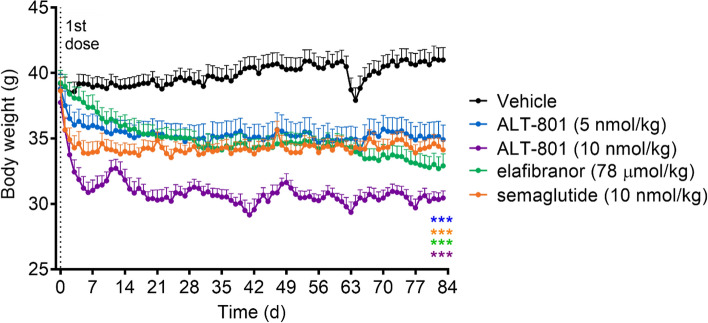
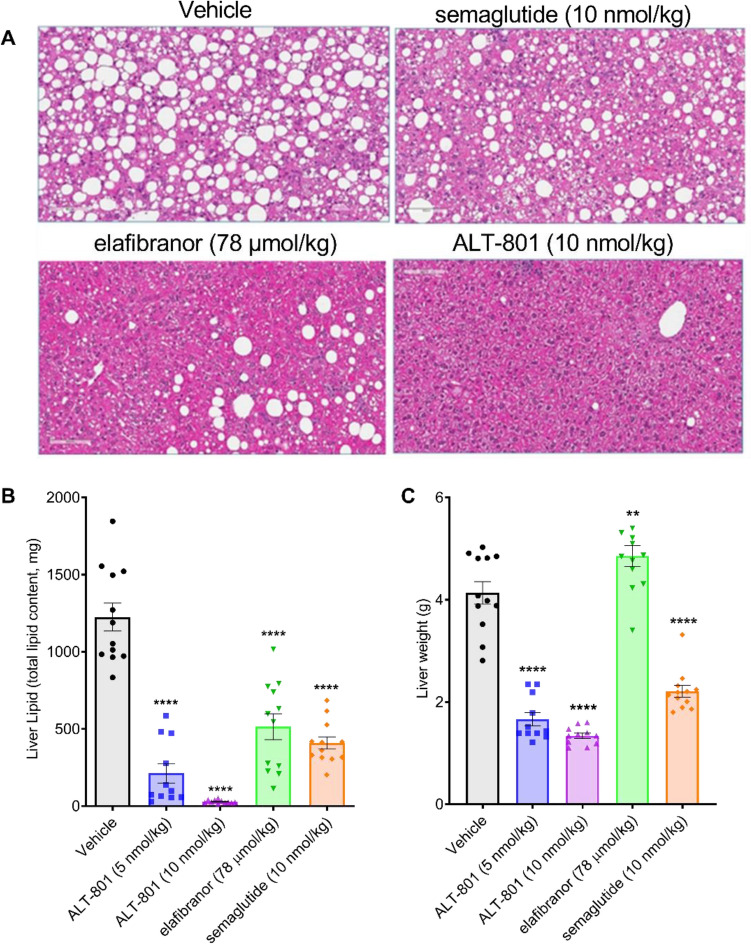
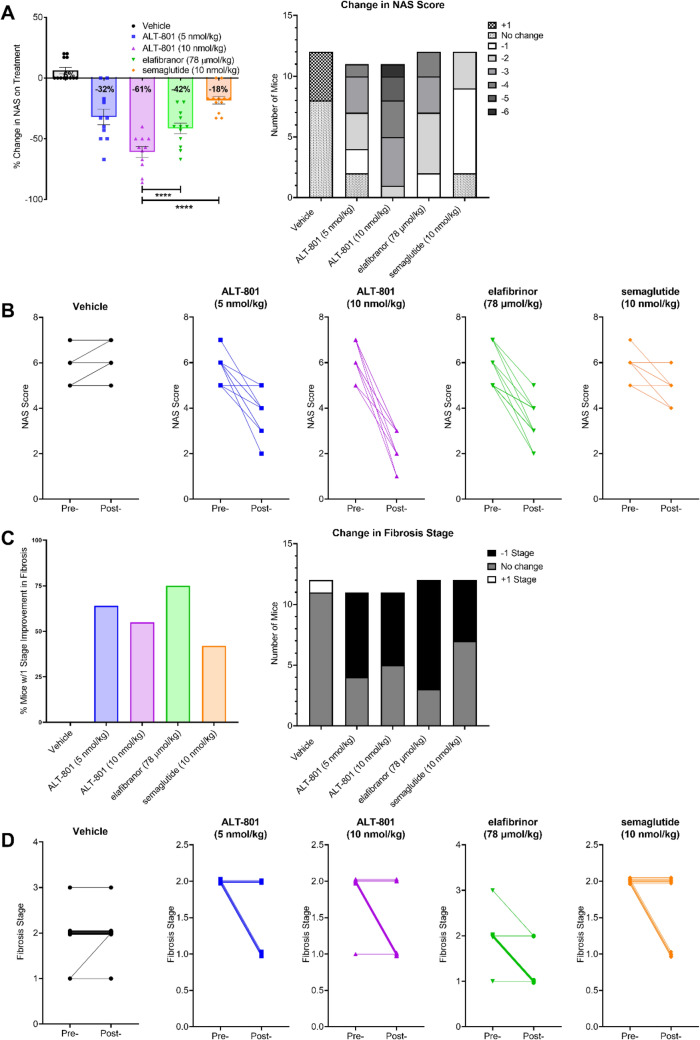
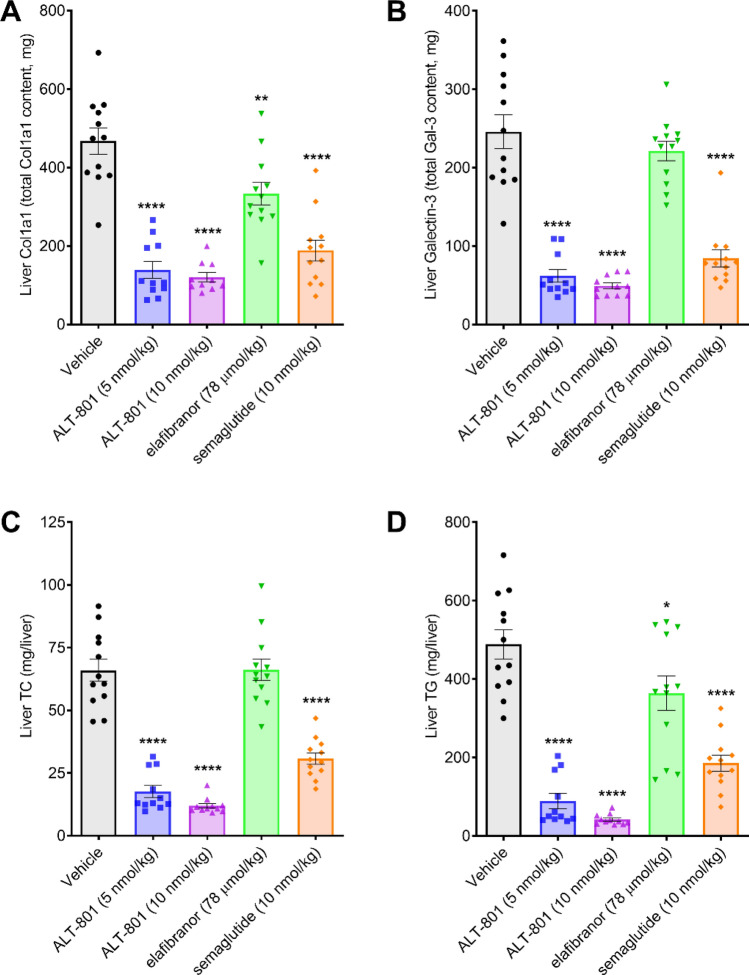
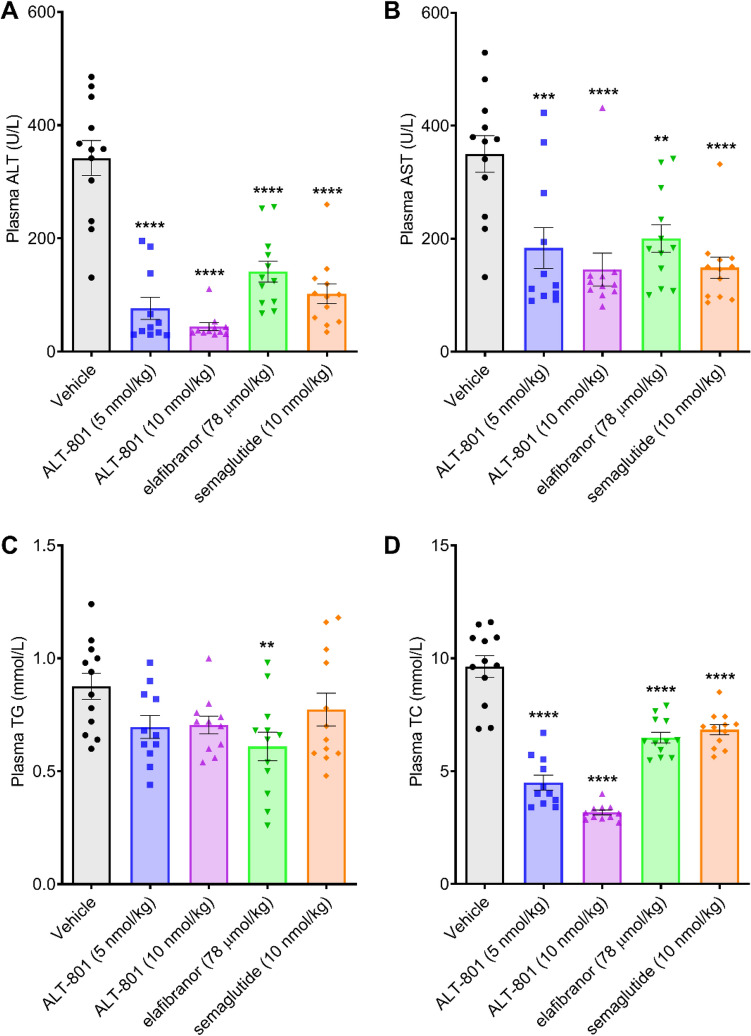
Body weight loss of ≥ 10% improves the metabolic derangements and liver disease in the majority of non-alcoholic steatohepatitis (NASH) patients, suggesting metabolic modulators may be effective in controlling disease. The pharmacodynamics of ALT-801, a GLP-1/glucagon receptor dual agonist optimized for NASH and weight loss, were compared to semaglutide (GLP-1 receptor agonist) and elafibranor (peroxisome proliferator-activated receptor, PPAR-α/δ, agonist) in a biopsy-confirmed, diet-induced obese (DIO) mouse model of NASH (DIO-NASH). Male C57BL/6J mice were fed Amylin Liver NASH (AMLN) diet for 32 weeks. Animals with biopsy-confirmed steatosis and fibrosis received ALT-801, semaglutide, elafibranor, or vehicle daily for 12 weeks while maintained on the AMLN diet. Study endpoints included body and liver weight, liver and plasma total cholesterol and triglycerides, plasma aminotransferases, histological analysis of liver steatosis, inflammation (galectin-3) and fibrosis (collagen type 1 alpha 1), and evaluation of individual animal changes in composite Non-alcoholic Fatty Liver Disease Activity Score (NAS), and fibrosis stage. ALT-801 demonstrated significant reductions in body weight (approx. 25%), plasma aminotransferases, plasma total cholesterol and liver triglycerides/total cholesterol in conjunction with improved liver steatosis, with greater reductions (p < 0.05) compared to semaglutide and elafibranor. ALT-801 significantly reduced the inflammation marker galectin-3 and the fibrosis marker collagen type 1 alpha 1 vs. vehicle (p < 0.05), with ALT-801 producing greater reductions in galectin-3 vs. elafibranor (p < 0.05). Importantly, all animals treated with ALT-801 significantly improved composite NAS compared to the active controls. This study provides evidence for a potential role for ALT-801 in the therapeutic treatment of NASH.
Overview
The claims and statistics of this paper haven’t been checked yet.
Free: it reads the open-access text and checks the first 5 claims that cite a source we can check. Create a free account to check every claim.
Integrity signals
Registry
Cites
Statistics
Figures
Verification
Claims the paper makes
The claims and statistics of this paper haven’t been checked yet.
Free: it reads the open-access text and checks the first 5 claims that cite a source we can check. Create a free account to check every claim.
Claims other papers make about this one
Each is checked against this paper’s own text: does it say what the citing paper says it does?
The check wasn’t confident either way, so it gives no verdict — never disputed.
In the citing paper
“Combined, the SURPASS and SURMOUNT trials have verified the safety of tirzepatide to be consistent with GLP-1R agonists, along with its enhanced efficacy at maximal doses of 5, 10 and 15 mg (Table 1)132-136,143,145-147”
From Transforming obesity: The advancement of multi-receptor drugs (2024) · cites this paper as [133]
Experimental — accuracy not yet measuredThe check wasn’t confident either way, so it gives no verdict — never disputed.
In the citing paper
“tirzepatide proved superior in improving glycemic control relative to treatment with semaglutide (1 mg)133, insulin degludec134, insulin glargine135,136, and insulin lispro137; importantly, with preserved efficacy and without compromising safety in subjects at risk for cardiovascular diseases136.”
From Transforming obesity: The advancement of multi-receptor drugs (2024) · cites this paper as [133]
Experimental — accuracy not yet measuredThe check wasn’t confident either way, so it gives no verdict — never disputed.
In the citing paper
“Despite the slight differences based on the subject cohort and the duration of treatment, this magnitude of weight loss was largely consistent with the SURPASS trials132-140.”
From Transforming obesity: The advancement of multi-receptor drugs (2024) · cites this paper as [133]
Experimental — accuracy not yet measured
Self-check
Percentages, sums and reported differences re-computed from the paper’s own numbers.
The self-check needs the paper’s full text.
Citations
Cites
Design and validation of a histological scoring system for nonalcoholic fatty liver disease†
Kleiner, D. E., Brunt, E. M., Van Natta, M., Behling, C., Contos, M. J., Cummings, O. W., Ferrell, L. D., Liu, Y., Torbenson, M. S., Unalp‐Arida, A., et al. (2005) · Hepatology · doi:10.1002/hep.20701 · Cited by 10,791
Once-Weekly Semaglutide in Adults with Overweight or Obesity
Wilding, J. P. H., Batterham, R. L., Calanna, S., Davies, M., Van Gaal, L. F., Lingvay, I., McGowan, B. M., Rosenstock, J., Tran, M. T. D., Wadden, T. A., et al. (2021) · New England Journal of Medicine · doi:10.1056/nejmoa2032183 · Cited by 5,205
MAFLD: a consensus-driven proposed nomenclature for metabolic associated fatty liver disease
Eslam, M., Sanyal, A. J., George, J., Sanyal, A., Neuschwander-Tetri, B., Tiribelli, C., Kleiner, D. E., Brunt, E., Bugianesi, E., Yki-Järvinen, H., et al. (2020) · Gastroenterology · doi:10.1053/j.gastro.2019.11.312 · Cited by 3,286
Vilar-Gomez, E., Martinez-Perez, Y., Calzadilla-Bertot, L., Torres-Gonzalez, A., Gra-Oramas, B., Gonzalez-Fabian, L., Friedman, S. L., Diago, M., & Romero-Gomez, M. (2015) · Gastroenterology · doi:10.1053/j.gastro.2015.04.005 · Cited by 2,492
Tirzepatide versus Semaglutide Once Weekly in Patients with Type 2 Diabetes
Frías, J. P., Davies, M. J., Rosenstock, J., Pérez Manghi, F. C., Fernández Landó, L., Bergman, B. K., Liu, B., Cui, X., & Brown, K. (2021) · New England Journal of Medicine · doi:10.1056/nejmoa2107519 · Cited by 2,096
Randomized controlled trial testing the effects of weight loss on nonalcoholic steatohepatitis
Promrat, K., Kleiner, D. E., Niemeier, H. M., Jackvony, E., Kearns, M., Wands, J. R., Fava, J. L., & Wing, R. R. (2010) · Hepatology · doi:10.1002/hep.23276 · Cited by 1,330
Discovery of the once-weekly glucagon-like peptide-1 (GLP-1) analogue semaglutide
Lau, J., Bloch, P., Schäffer, L., Pettersson, I., Spetzler, J., Kofoed, J., Madsen, K., Knudsen, L. B., McGuire, J., Steensgaard, D. B., et al. (2015) · Journal of Medicinal Chemistry · doi:10.1021/acs.jmedchem.5b00726 · Cited by 1,105
Ratziu, V., Harrison, S. A., Francque, S., Bedossa, P., Lehert, P., Serfaty, L., Romero-Gomez, M., Boursier, J., Abdelmalek, M., Caldwell, S., et al. (2016) · Gastroenterology · doi:10.1053/j.gastro.2016.01.038 · Cited by 1,035
The Discovery and Development of Liraglutide and Semaglutide
Knudsen, L. B., & Lau, J. (2019) · Frontiers in Endocrinology · doi:10.3389/fendo.2019.00155 · Cited by 970
Pyke, C., Heller, R. S., Kirk, R. K., Ørskov, C., Reedtz-Runge, S., Kaastrup, P., Hvelplund, A., Bardram, L., Calatayud, D., & Knudsen, L. B. (2014) · Endocrinology · doi:10.1210/en.2013-1934 · Cited by 876
Cited by
GLP-1-based therapies for diabetes, obesity and beyond
Drucker, D. J. (2025) · Nature Reviews Drug Discovery · doi:10.1038/s41573-025-01183-8 · Cited by 236
“Some of the glucagon–GLP-1 medicines robustly lower glucose; others, such as efinopegdutide and pemvidutide, do not 88,93 .”
Incretins (GLP-1 receptor agonists and dual/triple agonists) and the liver
Newsome, P. N., & Ambery, P. (2023) · Journal of Hepatology · doi:10.1016/j.jhep.2023.07.033 · Cited by 211
Glucagon-like Peptide-1 Receptor-based Therapeutics for Metabolic Liver Disease
Yabut, J. M., & Drucker, D. J. (2023) · Endocrine Reviews · doi:10.1210/endrev/bnac018 · Cited by 175
“C57BL6/J mice (with biopsy-confirmed NAS score after 29 weeks on a HFFC diet) were treated with ALT-801 (either 5 or 10 nmol/kg) for 12 weeks (136) and compared to mice treated with semaglutide (10 nmol/kg) or elafibranor (78 µ g/ kg).”
Harrison, S. A., Browne, S. K., Suschak, J. J., Tomah, S., Gutierrez, J. A., Yang, J., Roberts, M. S., & Harris, M. S. (2025) · Journal of Hepatology · doi:10.1016/j.jhep.2024.07.006 · Cited by 176
Self-citationTransforming obesity: The advancement of multi-receptor drugs
Kusminski, C. M., Perez-Tilve, D., Müller, T. D., DiMarchi, R. D., Tschöp, M. H., & Scherer, P. E. (2024) · Cell · doi:10.1016/j.cell.2024.06.003 · Cited by 126
An update on peptide-based therapies for type 2 diabetes and obesity
Bailey, C. J., Flatt, P. R., & Conlon, J. M. (2023) · Peptides · doi:10.1016/j.peptides.2023.170939 · Cited by 111
Xie, Z., Yang, S., Deng, W., Li, J., & Chen, J. (2022) · Clinical Epidemiology · doi:10.2147/clep.s391819 · Cited by 93
“The extracted data includes the following information: (1) Basic information of included studies: title, author, year of publication, gender, age, average body mass index, HbA1c (%).”
BackgroundFeng, X., Zhang, R., Yang, Z., Zhang, K., & Xing, J. (2024) · Journal of Clinical and Translational Hepatology · doi:10.14218/jcth.2024.00019 · Cited by 84
MASLD treatment—a shift in the paradigm is imminent
Machado, M. V. (2023) · Frontiers in Medicine · doi:10.3389/fmed.2023.1316284 · Cited by 51
Petersen, K. F., Dufour, S., Mehal, W. Z., & Shulman, G. I. (2024) · Cell Metabolism · doi:10.1016/j.cmet.2024.07.023 · Cited by 47
Hinds, C. E., Peace, E., Chen, S., Davies, I., Eid, L. E., Tomás, A., Tan, T., MINNION, J. S., Jones, B. J., & Bloom, S. R. (2023) · Diabetes Obesity and Metabolism · doi:10.1111/dom.15288 · Cited by 42
“30 We also assessed the same phenomenon in INS-1832/3 cells and intact mouse pancreatic islets using post-labelling with exendin-4-Cy5 6 ; here, with 4% supplemental HSA treatment, 100 nM SRB107 again led to moderately preserved surface GLP-1R compared with SRB106 (Figure 3C, D).”
MethodCurrent Therapeutical Approaches Targeting Lipid Metabolism in NAFLD
Vitulo, M., Gnodi, E., Rosini, G., Meneveri, R., Giovannoni, R., & Barisani, D. (2023) · International Journal of Molecular Sciences · doi:10.3390/ijms241612748 · Cited by 37
“With this promising view, other dual agonists have been developed, such as ALT-801, which has just concluded a safety assessment in patients, after improving NAFLD characteristics in vivo more than semaglutide or elafibranor [133], or tirzepatide, a novel dual agonist for GIP and GLP-1, approved for T2D therapy in 202…”
BackgroundGlucagon-like peptide-1 analogs: Miracle drugs are blooming?
Gong, B., Yao, Z., Zhou, C., Wang, W., Sun, L., & Han, J. D. J. (2024) · European Journal of Medicinal Chemistry · doi:10.1016/j.ejmech.2024.116342 · Cited by 29
Newer pharmacological interventions directed at gut hormones for obesity
Camilleri, M., & Acosta, A. J. (2023) · British Journal of Pharmacology · doi:10.1111/bph.16278 · Cited by 29
“ALT-801 significantly reduced the inflammation marker galectin-3 and the fibrosis marker collagen type 1 alpha 1 (COL1A1) compared to vehicle, and significantly improved composite NASH compared to the active controls (Nestor et al., 2022).”
BackgroundResearch Progress on the GIP/GLP-1 Receptor Coagonist Tirzepatide, a Rising Star in Type 2 Diabetes
Ma, Z., Jin, K., Yue, M., Chen, X., & Chen, J. (2023) · Journal of Diabetes Research · doi:10.1155/2023/5891532 · Cited by 30
Chrysavgis, L., Kazanas, S., Bafa, K., Rozani, S., Koloutsou, M. E., & Cholongitas, Ε. (2024) · International Journal of Molecular Sciences · doi:10.3390/ijms25073832 · Cited by 27
“More importantly, ALT-801 ameliorated NAS score vs. both active controls, as well as inducing a greater reduction in the inflammation marker galectin-3 compared with elafibranor [86].”
BackgroundMuzurović, E. M., Katsiki, N., Volčanšek, Š., Plescia, F., Rizzo, M., & Mantzoros, C. S. (2026) · Metabolism · doi:10.1016/j.metabol.2026.156494 · Cited by 25
Xie, C., Alkhouri, N., & Elfeki, M. A. (2024) · World Journal of Hepatology · doi:10.4254/wjh.v16.i5.731 · Cited by 24
Sarzani, R., Landolfo, M., Pentima, C. D., Ortensi, B., Falcioni, P., Sabbatini, L., Massacesi, A., Rampino, I., Spannella, F., & Giulietti, F. (2024) · Frontiers in Medicine · doi:10.3389/fmed.2024.1365183 · Cited by 26
Nielsen, M. H., Nøhr-Meldgaard, J., Møllerhøj, M. B., Oró, D., Pors, S. E., Andersen, M. W., Kamzolas, I., Petsalaki, E., Vacca, M., Harder, L. M., et al. (2024) · American Journal of Physiology-Gastrointestinal and Liver Physiology · doi:10.1152/ajpgi.00110.2024 · Cited by 22
Self-citationA new NASH model in aged mice with rapid progression of steatohepatitis and fibrosis
Li, X., Lu, Y., Liang, X., Zhou, X., Li, D., Zhang, Z., Niu, Y., Liu, S., Ye, L., & Zhang, R. (2023) · PLoS ONE · doi:10.1371/journal.pone.0286257 · Cited by 21
“In young C57BL/6 mice, induction with a high-fat, high-sugar, high-cholesterol diet can mimic most of the features of human NASH disease, but it usually requires a long period of time and the degree of fibrosis is not obvious [19,25,26].”
Recent progress in the pharmacotherapy for obesity
Lu, J., Liu, P., Cai, M., Lv, T., Zhang, M., Yin, K., Cheng, J., & Zhang, G. (2025) · European Journal of Pharmacology · doi:10.1016/j.ejphar.2025.177850 · Cited by 17
Zhihong, Y., Chen, W., Qianqian, Z., Lidan, S., Zhou, Q., Han, J. D. J., Wenxi, W., & Bhawal, R. P. (2023) · Peptides · doi:10.1016/j.peptides.2023.170955 · Cited by 18
Browne, S., Suschak, J. J., Tomah, S., Gutierrez, J. A., Yang, J., Georges, B., Roberts, M. S., & Harris, M. S. (2025) · JHEP Reports · doi:10.1016/j.jhepr.2025.101483 · Cited by 18
“16 In a 12-week randomized, double-blind, placebo-controlled clinical trial in individuals with MASLD, pemvidutide-treated participants exhibited statistically significant reductions in LFC, markers of hepatic inflammation including alanine amino-transferase (ALT), iron-corrected T1 (cT1) magnetic…”
Self-citationClass B1 GPCRs: insights into multireceptor pharmacology for the treatment of metabolic disease
Sangwung, P., Ho, J. D., Siddall, T., Lin, J., Tomás, A., Jones, B. J., & Sloop, K. W. (2024) · American Journal of Physiology-Endocrinology and Metabolism · doi:10.1152/ajpendo.00371.2023 · Cited by 15
Tsiampali, C., Vachliotis, I. D., Goulas, A., & Pοlyzos, S. A. (2024) · HORMONES · doi:10.1007/s42000-024-00541-2 · Cited by 13
Martos, N., Vergara, A., Llorens-Cebrià, C., Motto, A. E., Martínez-Díaz, I., Gonçalves, F., Garcias-Ramis, M. M., Allo-Urzainqui, E., Narváez, A., Bermejo, S., et al. (2024) · Frontiers in Pharmacology · doi:10.3389/fphar.2024.1415879 · Cited by 13
“The semaglutide dose (10 nmol/kg diluted in PBS1x) was selected according to results obtained by other authors using similar mouse models (Nestor et al., 2022; Jiang et al., 2023).”
MethodMcGlone, E. R., Hope, D. C. D., Davies, I., Dore, M. H., Goldin, R. D., Jones, B. J., Liu, Z., Li, J. V., Vorkas, P. A., Khoo, B. C. E., et al. (2024) · Biomedicine & Pharmacotherapy · doi:10.1016/j.biopha.2024.116888 · Cited by 13
Neff, G. W. (2025) · Diabetes Obesity and Metabolism · doi:10.1111/dom.70148 · Cited by 13
Computational Peptide Design Cotargeting Glucagon and Glucagon-like Peptide-1 Receptors
Vishnoi, S., Bhattacharya, S., Walsh, E. M., Okoh, G., & Thompson, D. (2023) · Journal of Chemical Information and Modeling · doi:10.1021/acs.jcim.3c00752 · Cited by 14
Management of patients with type 2 diabetes and MASLD: An overview and joint statement
Chouik, Y., Canivet, C. M., Julla, J., Mouillot, T., Parlati, L., Rouland, A., Smati, S., Tramunt, B., Anty, R., Boursier, J., et al. (2025) · Diabetes & Metabolism · doi:10.1016/j.diabet.2025.101709 · Cited by 12
OXM-104, a potential candidate for the treatment of obesity, NASH and type 2 diabetes
Melander, S. A., Kayed, A., Andreassen, K. V., Karsdal, M. A., & Henriksen, K. (2023) · European Journal of Pharmacology · doi:10.1016/j.ejphar.2023.176215 · Cited by 11
Focus on Glucagon-like Peptide-1 Target: Drugs Approved or Designed to Treat Obesity
Zhang, J., Wei, J., Lai, W., Sun, J., Bai, Y., Cao, H., Guo, J., & Su, Z. (2025) · International Journal of Molecular Sciences · doi:10.3390/ijms26041651 · Cited by 9
“They contain Pmvidutide [71], NNC9204-1177, OPK88003, MK8521 [55], and MOD-6031 [72].”
Mouse Models for the Study of Liver Fibrosis Regression In Vivo and Ex Vivo
Schönke, M., & Rensen, P. C. N. (2024) · Journal of Clinical and Translational Hepatology · doi:10.14218/jcth.2024.00212 · Cited by 13
“78 Unless particularly relevant to the research question, methionine-choline-deficient diets are less recommended for studying treatments in a human-like metabolic context of fibrotic MASLD, as they induce substantial weight loss due to adverse reactions.”
Camilleri, M. (2024) · The Journal of Physiology · doi:10.1113/jp287535 · Cited by 7
“Pemvidutide (ALT-801) significantly improved weight and cardiometabolic risk factors in overweight/obese participants (Klein et al., 2022) and reduced the inflammation and fibrosis in non-alcoholic steatohepatitis compared to the active controls (Nestor et al., 2022).”
Kayed, A., Melander, S. A., Khan, S., Andreassen, K. V., Karsdal, M. A., & Henriksen, K. (2022) · Journal of Pharmacology and Experimental Therapeutics · doi:10.1124/jpet.122.001440 · Cited by 7
Hope, D. C. D., Ansari, S., Choudhury, S., Αλεξιάδου, Κ., Tabbakh, Y., Ilesanmi, I., Lazarus, K., Davies, I., Jimenez‐Pacheco, L., Yang, W. P., et al. (2024) · Diabetes Obesity and Metabolism · doi:10.1111/dom.15448 · Cited by 6
“12,44 G3215 also led to a broad reduction in circulating amino acids over the duration of the infusion.”
BackgroundIncretins and Development of Incretin‐based Therapeutics
Zheng, N., Su, X., Zhang, S., & Shen, W. (2025) · Wiley eBooks · doi:10.1002/9781119824701.ch09 · Cited by 6
Jain, N., Pandey, A. P., & Mutalik, S. (2026) · Journal of Drug Delivery Science and Technology · doi:10.1016/j.jddst.2026.108310 · Cited by 5
Peptide drugs for obesity and type 2 diabetes mellitus: an overview of clinical trials
Barzgar, H., Darmadi, D., Nafisa, J., Narkulov, S., & Sviridova, M. B. (2025) · Clinica Chimica Acta · doi:10.1016/j.cca.2025.120772 · Cited by 2
Zheng, N., 涂龙芳, Xu, P., Chen, R., Lu, J., Dai, W., Lin, Y., Ouyang, J., Qiu, J., Wang, Y., et al. (2026) · Journal of Medicinal Chemistry · doi:10.1021/acs.jmedchem.5c03845 · Cited by 2
Kim, J., Chang, N., Kim, Y.-K., Lee, J., Oh, D., Choi, J., Kim, O., Kim, S., Choi, M., Lee, J., et al. (2023) · Pharmaceuticals · doi:10.3390/ph16111601 · Cited by 1
“GCG also increases hepatic glucose production during fasting, which is often associated with NASH progression due to inflammation [24,25].”
BackgroundDas, S., Ravi, H., Babu, A., Banerjee, M., Ramasubbu, K., Sivaraman, D., Rajeswari, V. D., Venkatraman, G., & Ramanathan, G. (2024) · Advances in protein chemistry and structural biology · doi:10.1016/bs.apcsb.2023.12.017 · Cited by 1
Rapid quantification of Semaglutide in mouse plasma: An optimized LC-MS/MS approach
Bokka, V. M., Jitta, S. R., Kolli, K., Patil, D., & Mullapudi, T. R. (2025) · Journal of the Indian Chemical Society · doi:10.1016/j.jics.2025.102276 · Cited by 1
Machine learning trims the peptide drug design process to a sweet spot
Markey, C., & Reker, D. (2024) · Nature Chemistry · doi:10.1038/s41557-024-01610-0
Alshammari, A. S. R., Alarfaj, S. S. A., & Kofi, M. A. (2025) · Scientia. Technology, science and society. · doi:10.59324/stss.2025.2(3).01
“…it can increase the risk of developing type 2 diabetes, cardiovascular disease, and non-alcoholic fatty liver disease, as well as increase the likelihood of developing insulin resistance, hypertension, and dyslipidemia (Nestor, et al., 2022; Bradley, et al., 2021; van Ruiten, et al., (2022).”
HamaSalih, R. M., Aziz, T. A., & Hamaamin, K. S. (2026) · Al-Rafidain Journal of Medical Sciences · doi:10.54133/ajms.v10i1.2626
“In line with a previous study on rodents [11] the findings of the current study elucidate that different doses of semaglutide mitigated serum levels of ALT, LDH, and AST; such findings could indicate the protective effect of semaglutide against DOX-induced hepatotoxicity.”
Kristensen, J. B., Nøhr-Meldgaard, J., Pors, S. E., Norlin, J., Veidal, S. S., Bendtsen, K. M., Niss, K., Andersen, M. W., Harder, L. M., Dalhoff, M. T., et al. (2026) · American Journal of Physiology-Gastrointestinal and Liver Physiology · doi:10.1152/ajpgi.00011.2026 · Cited by 1
Self-citationHan, S., Shin, J., Kim, J. C., & Na, D. H. (2026) · Journal of Pharmaceutical Investigation · doi:10.1007/s40005-026-00815-4
“In rodent MASH models, GLP-1R/GCGR dual agonists such as pemvidutide and NN1177 improved liver enzyme levels, body weight, steatosis, inflammation, and fibrosis (Nestor et al. 2022; Monfeuga et al. 2024; Harrison et al. 2025).”
Mori, Y., Osaka, N., Terasaki, M., Yashima, H., Saito, T., Tanno, D., Ogino, M., Ohara, M., & Yamagishi, S. (2026) · Biomedicines · doi:10.3390/biomedicines14071554
“Tirzepatide doses were determined based on previous studies [21–23], and semaglutide was given at a molar dose equivalent to tirzepatide [24].”
Chouik, Y., Canivet, C. M., Julla, J., Mouillot, T., Parlati, L., Rouland, A., Smati, S., Tramunt, B., Anty, R., Boursier, J., et al. (2026) · Médecine des Maladies Métaboliques · doi:10.1016/j.mmm.2026.06.013
Alotaibi, R. R., Alharbi, L. N., Albash, A., Dumlu, G. Y., Alahmadi, R., Alharbi, A. F., Alhassan, R. A., Alkarri, M. N., Farj, T. E., Haqwi, M. F., et al. (2026) · Journal of Advanced Trends in Medical Research · doi:10.4103/atmr.atmr_146_25
Ard, J. D., & Almandoz, J. P. (2026) · Obesity Reviews · doi:10.1111/obr.70228
BindingDB Entry 50022803: Glucagon-like peptide-1 analogs: Miracle drugs are blooming?
BindingDB (2026) · UC San Diego · doi:10.7270/q2028xcf
Noureddin, M., Alkhouri, N., Loomba, R., Chalasani, N., Sheikh, M. Y., Tomah, S., Gutierrez, J. A., Urbina, S., Suschak, J. J., Yang, J., et al. (2026) · The Lancet. Gastroenterology & hepatology · doi:10.1016/s2468-1253(26)00263-3
Self-citation
Metadata
- Authors
- Nestor, J. J., Parkes, D., Feigh, M., Suschak, J. J., & Harris, M. S.
- Affiliations
- Altimmune (United States) (US)
- Gubra (Denmark) (DK)
- Corresponding author
- Harris, M. Scott
- Venue
- Scientific Reports
- Published
- 2022-04-23
- Volume
- 12
- Issue
- 1
- Pages
- 6666-6666
- ISSN
- 2045-2322 (ISSN-L)
- PMC
- PMC9035150
- OpenAlex
- W4225589081
- Cited by
- 53
- References
- 43
- Citations by year
- 2026: 10 · 2025: 10 · 2024: 18 · 2023: 12 · 2022: 3
- FWCI
- 7.76
- Type
- journal article
- Language
- en
- Open access
- gold
- doi.org
- Licence
- cc-by
- creativecommons.org/licenses/by/4.0 (tdm)
- creativecommons.org/licenses/by/4.0 (vor)
- Locations
- Scientific Reports (publishedVersion, cc-by)
- Research Square (acceptedVersion, cc-by)
- PubMed Central (publishedVersion, cc-by)
- PubMed (publishedVersion)
- DOAJ (DOAJ: Directory of Open Access Journals) (submittedVersion, cc-by-sa)
- Funders
- Spitfire Pharma Inc
- Topics
- Health Sciences › Medicine › Hepatology › Liver Disease Diagnosis and Treatment
- Health Sciences › Medicine › Hepatology › Liver physiology and pathology
- Health Sciences › Medicine › Endocrinology, Diabetes and Metabolism › Diabetes Treatment and Management
- Keywords
- nonalcoholic steatohepatitis, diet-induced obesity, semaglutide, elafibranor, hepatic steatosis, liver fibrosis, galectin-3, collagen type I alpha 1, transaminases, weight loss, mouse model
- MeSH terms
- Transaminases, Animals, Cholesterol, Collagen, Disease Models, Animal, Glucagon, Inflammation, Interleukin-2, Liver, Liver Cirrhosis, Male, Mice, Inbred C57BL, Mice, Obese, Obesity, Receptors, Antigen, T-Cell, Recombinant Fusion Proteins, Triglycerides, Receptors, Glucagon, Galectin 3, Mice, Glucagon-Like Peptide 1, Non-alcoholic Fatty Liver Disease
About these checks
Registry, retraction, Cites and statistics results are computed, not judged, with one exception: a printed reference that no index lists is read once by a model before it counts as a citation error. Claims are extracted by a model and kept only when their quote appears verbatim in the text; each cited source is then checked, with a model’s help, for whether it says what the claim relies on. Those verdicts can be wrong — read the claim’s quote and the cited source before relying on one.
Statistics and arithmetic are recomputed, not judged.
Confidence bands are shown only for fields calibrated on our annotated test set. None is calibrated yet, so no band is shown.
What counts as a claim ›How we measure confidence ›How we check this ›
Are you an author, or do you see a problem with this page? Request a review
Data sources
Bibliographic data: Semantic Scholar, OpenAlex, Crossref.
Contains information from the Semantic Scholar Academic Graph Datasets, made available under the ODC Attribution License (ODC-BY 1.0).
Semantic Scholar’s data is described in: Kinney, R., et al. (2023). The Semantic Scholar Open Data Platform. arXiv:2301.10140.
