

Effects of ALT-801, a GLP-1 and glucagon receptor dual agonist, in a translational mouse model of non-alcoholic steatohepatitis
Open accessThe DOI matches its Crossref record; 43 of the 43 references it cites were found in a registry or an index.
Abstract
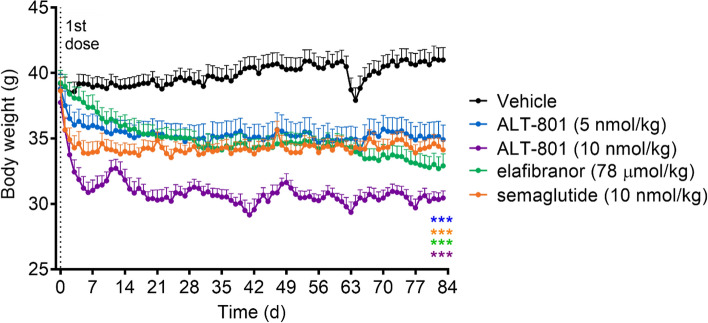
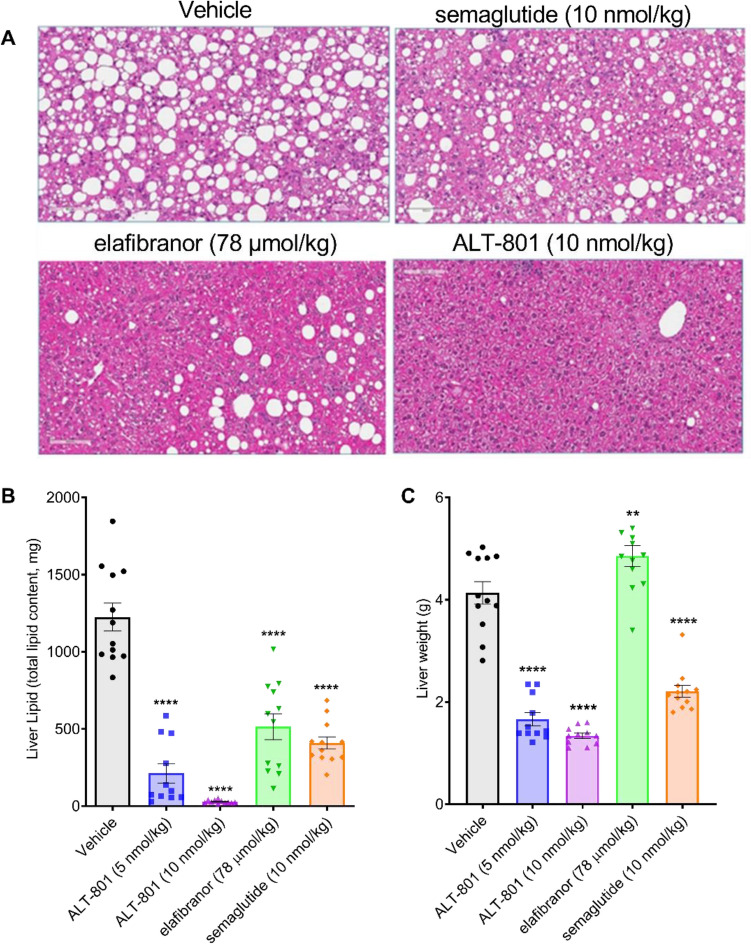
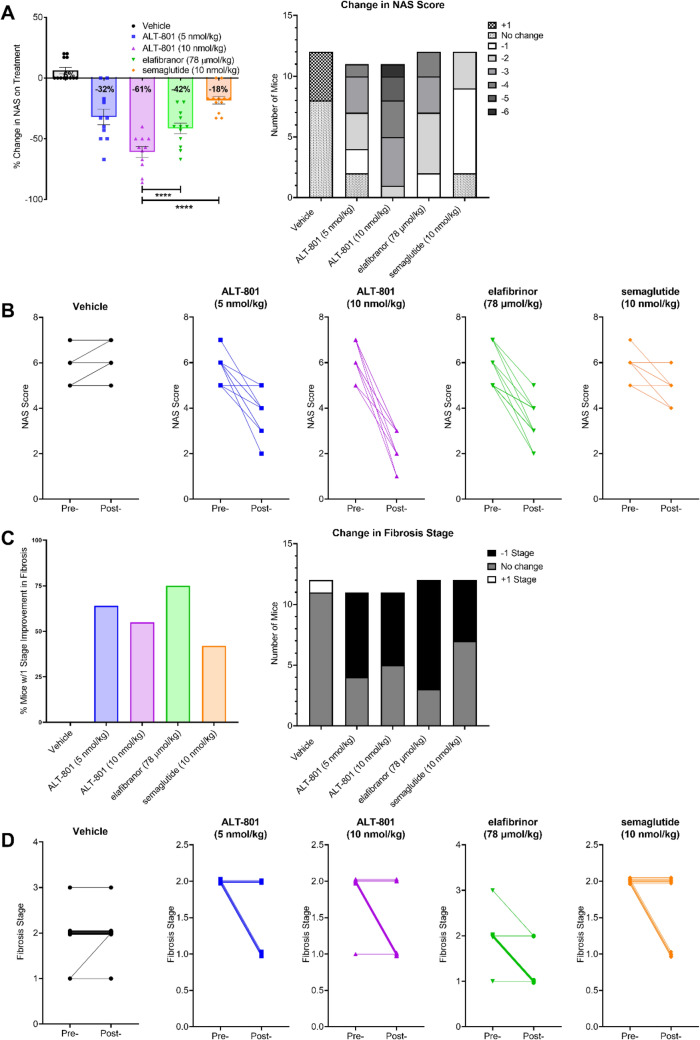
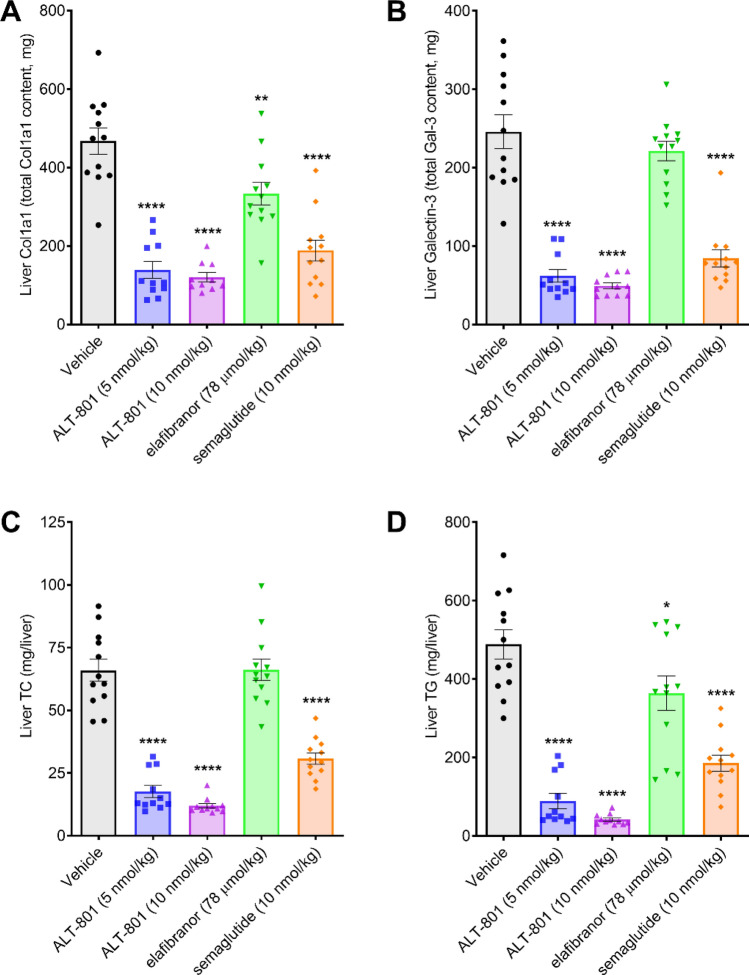
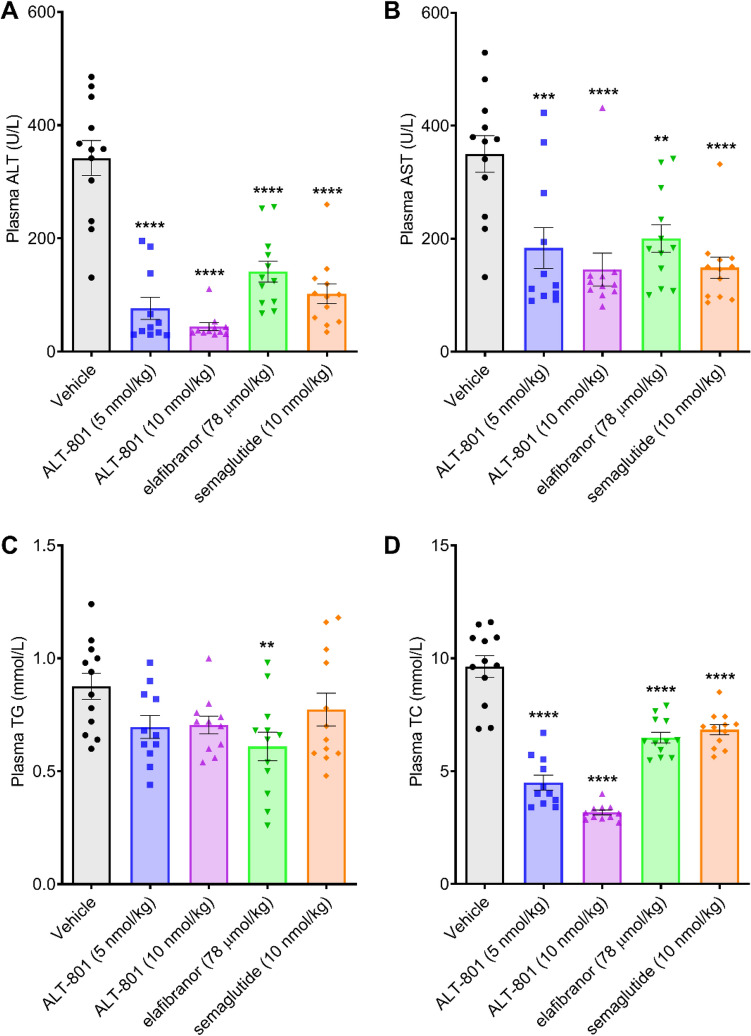
Body weight loss of ≥ 10% improves the metabolic derangements and liver disease in the majority of non-alcoholic steatohepatitis (NASH) patients, suggesting metabolic modulators may be effective in controlling disease. The pharmacodynamics of ALT-801, a GLP-1/glucagon receptor dual agonist optimized for NASH and weight loss, were compared to semaglutide (GLP-1 receptor agonist) and elafibranor (peroxisome proliferator-activated receptor, PPAR-α/δ, agonist) in a biopsy-confirmed, diet-induced obese (DIO) mouse model of NASH (DIO-NASH). Male C57BL/6J mice were fed Amylin Liver NASH (AMLN) diet for 32 weeks. Animals with biopsy-confirmed steatosis and fibrosis received ALT-801, semaglutide, elafibranor, or vehicle daily for 12 weeks while maintained on the AMLN diet. Study endpoints included body and liver weight, liver and plasma total cholesterol and triglycerides, plasma aminotransferases, histological analysis of liver steatosis, inflammation (galectin-3) and fibrosis (collagen type 1 alpha 1), and evaluation of individual animal changes in composite Non-alcoholic Fatty Liver Disease Activity Score (NAS), and fibrosis stage. ALT-801 demonstrated significant reductions in body weight (approx. 25%), plasma aminotransferases, plasma total cholesterol and liver triglycerides/total cholesterol in conjunction with improved liver steatosis, with greater reductions (p < 0.05) compared to semaglutide and elafibranor. ALT-801 significantly reduced the inflammation marker galectin-3 and the fibrosis marker collagen type 1 alpha 1 vs. vehicle (p < 0.05), with ALT-801 producing greater reductions in galectin-3 vs. elafibranor (p < 0.05). Importantly, all animals treated with ALT-801 significantly improved composite NAS compared to the active controls. This study provides evidence for a potential role for ALT-801 in the therapeutic treatment of NASH.
Overview
The claims and statistics of this paper haven’t been checked yet.
Free: it reads the open-access text and checks the first 5 claims that cite a source we can check. Create a free account to check every claim.
Integrity signals
Registry
Cites
Statistics
Figures
Verification
Claims the paper makes
The claims and statistics of this paper haven’t been checked yet.
Free: it reads the open-access text and checks the first 5 claims that cite a source we can check. Create a free account to check every claim.
Claims other papers make about this one
Each is checked against this paper’s own text: does it say what the citing paper says it does?
The check wasn’t confident either way, so it gives no verdict — never disputed.
In the citing paper
“Combined, the SURPASS and SURMOUNT trials have verified the safety of tirzepatide to be consistent with GLP-1R agonists, along with its enhanced efficacy at maximal doses of 5, 10 and 15 mg (Table 1)132-136,143,145-147”
From Transforming obesity: The advancement of multi-receptor drugs (2024) · cites this paper as [133]
Experimental — accuracy not yet measuredThe check wasn’t confident either way, so it gives no verdict — never disputed.
In the citing paper
“tirzepatide proved superior in improving glycemic control relative to treatment with semaglutide (1 mg)133, insulin degludec134, insulin glargine135,136, and insulin lispro137; importantly, with preserved efficacy and without compromising safety in subjects at risk for cardiovascular diseases136.”
From Transforming obesity: The advancement of multi-receptor drugs (2024) · cites this paper as [133]
Experimental — accuracy not yet measuredThe check wasn’t confident either way, so it gives no verdict — never disputed.
In the citing paper
“Despite the slight differences based on the subject cohort and the duration of treatment, this magnitude of weight loss was largely consistent with the SURPASS trials132-140.”
From Transforming obesity: The advancement of multi-receptor drugs (2024) · cites this paper as [133]
Experimental — accuracy not yet measured
Self-check
Percentages, sums and reported differences re-computed from the paper’s own numbers.
The self-check needs the paper’s full text.
Citations
Cites
Design and validation of a histological scoring system for nonalcoholic fatty liver disease†
Kleiner, D. E., Brunt, E. M., Van Natta, M., Behling, C., Contos, M. J., Cummings, O. W., Ferrell, L. D., Liu, Y., Torbenson, M. S., Unalp‐Arida, A., et al. (2005) · Hepatology · doi:10.1002/hep.20701 · Cited by 10,791
Once-Weekly Semaglutide in Adults with Overweight or Obesity
Wilding, J. P. H., Batterham, R. L., Calanna, S., Davies, M., Van Gaal, L. F., Lingvay, I., McGowan, B. M., Rosenstock, J., Tran, M. T. D., Wadden, T. A., et al. (2021) · New England Journal of Medicine · doi:10.1056/nejmoa2032183 · Cited by 5,205
MAFLD: a consensus-driven proposed nomenclature for metabolic associated fatty liver disease
Eslam, M., Sanyal, A. J., George, J., Sanyal, A., Neuschwander-Tetri, B., Tiribelli, C., Kleiner, D. E., Brunt, E., Bugianesi, E., Yki-Järvinen, H., et al. (2020) · Gastroenterology · doi:10.1053/j.gastro.2019.11.312 · Cited by 3,286
Vilar-Gomez, E., Martinez-Perez, Y., Calzadilla-Bertot, L., Torres-Gonzalez, A., Gra-Oramas, B., Gonzalez-Fabian, L., Friedman, S. L., Diago, M., & Romero-Gomez, M. (2015) · Gastroenterology · doi:10.1053/j.gastro.2015.04.005 · Cited by 2,492
Tirzepatide versus Semaglutide Once Weekly in Patients with Type 2 Diabetes
Frías, J. P., Davies, M. J., Rosenstock, J., Pérez Manghi, F. C., Fernández Landó, L., Bergman, B. K., Liu, B., Cui, X., & Brown, K. (2021) · New England Journal of Medicine · doi:10.1056/nejmoa2107519 · Cited by 2,096
Randomized controlled trial testing the effects of weight loss on nonalcoholic steatohepatitis
Promrat, K., Kleiner, D. E., Niemeier, H. M., Jackvony, E., Kearns, M., Wands, J. R., Fava, J. L., & Wing, R. R. (2010) · Hepatology · doi:10.1002/hep.23276 · Cited by 1,330
Discovery of the once-weekly glucagon-like peptide-1 (GLP-1) analogue semaglutide
Lau, J., Bloch, P., Schäffer, L., Pettersson, I., Spetzler, J., Kofoed, J., Madsen, K., Knudsen, L. B., McGuire, J., Steensgaard, D. B., et al. (2015) · Journal of Medicinal Chemistry · doi:10.1021/acs.jmedchem.5b00726 · Cited by 1,105
Ratziu, V., Harrison, S. A., Francque, S., Bedossa, P., Lehert, P., Serfaty, L., Romero-Gomez, M., Boursier, J., Abdelmalek, M., Caldwell, S., et al. (2016) · Gastroenterology · doi:10.1053/j.gastro.2016.01.038 · Cited by 1,035
The Discovery and Development of Liraglutide and Semaglutide
Knudsen, L. B., & Lau, J. (2019) · Frontiers in Endocrinology · doi:10.3389/fendo.2019.00155 · Cited by 970
Pyke, C., Heller, R. S., Kirk, R. K., Ørskov, C., Reedtz-Runge, S., Kaastrup, P., Hvelplund, A., Bardram, L., Calatayud, D., & Knudsen, L. B. (2014) · Endocrinology · doi:10.1210/en.2013-1934 · Cited by 876
Albumin-based drug delivery: harnessing nature to cure disease
Larsen, M. T., Kuhlmann, M., Hvam, M. L., & Howard, K. A. (2016) · Molecular and Cellular Therapies · doi:10.1186/s40591-016-0048-8 · Cited by 683
Current and future pharmacological therapies for NAFLD/NASH
Sumida, Y., & Yoneda, M. (2018) · Journal of Gastroenterology · doi:10.1007/s00535-017-1415-1 · Cited by 667
A new glucagon and GLP-1 co-agonist eliminates obesity in rodents
Day, J. W., Ottaway, N., Patterson, J. T., Gelfanov, V., Smiley, D., Gidda, J., Findeisen, H., Bruemmer, D., Drucker, D. J., Chaudhary, N., et al. (2009) · Nature Chemical Biology · doi:10.1038/nchembio.209 · Cited by 641
Lassailly, G., Caiazzo, R., Ntandja-Wandji, L.-C., Gnemmi, V., Baud, G., Verkindt, H., Ningarhari, M., Louvet, A., Leteurtre, E., Raverdy, V., et al. (2020) · Gastroenterology · doi:10.1053/j.gastro.2020.06.006 · Cited by 622
Staels, B., Rubenstrunk, A., Noel, B., Rigou, G., Delataille, P., Millatt, L. J., Baron, M., Lucas, A., Tailleux, A., Hum, D. W., et al. (2013) · Hepatology · doi:10.1002/hep.26461 · Cited by 414
Glucagon-Like Peptide 1/Glucagon Receptor Dual Agonism Reverses Obesity in Mice
Pocai, A., Carrington, P. E., Adams, J. R., Wright, M., Eiermann, G., Zhu, L., Du, X., Petrov, A., Lassman, M. E., Jiang, G., et al. (2009) · Diabetes · doi:10.2337/db09-0278 · Cited by 409
Clapper, J. R., Hendricks, M. D., Gu, G., Wittmer, C., Dolman, C. S., Herich, J., Athanacio, J., Villescaz, C., Ghosh, S. S., Heilig, J. S., et al. (2013) · American Journal of Physiology-Gastrointestinal and Liver Physiology · doi:10.1152/ajpgi.00079.2013 · Cited by 294
Marchesini, G., Petta, S., & Dalle Grave, R. (2016) · Hepatology · doi:10.1002/hep.28392 · Cited by 292
Mouse models of nonalcoholic steatohepatitis in preclinical drug development
Hansen, H. H., Feigh, M., Veidal, S. S., Rigbolt, K. T., Vrang, N., & Fosgerau, K. (2017) · Drug Discovery Today · doi:10.1016/j.drudis.2017.06.007 · Cited by 270
Self-citationMANAGEMENT OF ENDOCRINE DISEASE: Are all GLP-1 agonists equal in the treatment of type 2 diabetes?
Nauck, M. A., & Meier, J. J. (2019) · European Journal of Endocrinology · doi:10.1530/eje-19-0566 · Cited by 254
Aroda, V. R. (2018) · Diabetes, Obesity and Metabolism · doi:10.1111/dom.13162 · Cited by 253
Henderson, S. J., Konkar, A., Hornigold, D. C., Trevaskis, J. L., Jackson, R., Fritsch Fredin, M., Jansson‐Löfmark, R., Naylor, J., Rossi, A., Bednarek, M. A., et al. (2016) · Diabetes, Obesity and Metabolism · doi:10.1111/dom.12735 · Cited by 240
Self-citationFlint, A., Andersen, G., Hockings, P., Johansson, L., Morsing, A., Sundby Palle, M., Vogl, T., Loomba, R., & Plum‐Mörschel, L. (2021) · Alimentary Pharmacology & Therapeutics · doi:10.1111/apt.16608 · Cited by 224
Health Effects of Overweight and Obesity in 195 Countries
(2017) · New England Journal of Medicine · doi:10.1056/nejmc1710026 · Cited by 219
Cariou, B., Hanf, R., Lambert-Porcheron, S., Zaïr, Y., Sauvinet, V., Noël, B., Flet, L., Vidal, H., Staels, B., & Laville, M. (2013) · Diabetes Care · doi:10.2337/dc12-2012 · Cited by 215
Newsome, P., Francque, S., Harrison, S., Ratziu, V., Van Gaal, L., Calanna, S., Hansen, M., Linder, M., & Sanyal, A. (2019) · Alimentary Pharmacology & Therapeutics · doi:10.1111/apt.15316 · Cited by 186
Glass, L. M., Dickson, R. C., Anderson, J. C., Suriawinata, A. A., Putra, J., Berk, B. S., & Toor, A. (2015) · Digestive Diseases and Sciences · doi:10.1007/s10620-014-3380-3 · Cited by 176
Cariou, B., Zaïr, Y., Staels, B., & Bruckert, E. (2011) · Diabetes Care · doi:10.2337/dc11-0093 · Cited by 172
Tillner, J., Posch, M. G., Wagner, F., Teichert, L., Hijazi, Y., Einig, C., Keil, S., Haack, T., Wagner, M., Bossart, M., et al. (2019) · Diabetes, Obesity and Metabolism · doi:10.1111/dom.13494 · Cited by 164
Tølbøl, K. S., Kristiansen, M. N., Hansen, H. H., Veidal, S. S., Rigbolt, K. T., Gillum, M. P., Jelsing, J., Vrang, N., & Feigh, M. (2018) · World Journal of Gastroenterology · doi:10.3748/wjg.v24.i2.179 · Cited by 134
Self-citationDay, J. W., Gelfanov, V., Smiley, D., Carrington, P. E., Eiermann, G., Chicchi, G., Erion, M. D., Gidda, J., Thornberry, N. A., Tschöp, M. H., et al. (2012) · Peptide Science · doi:10.1002/bip.22072 · Cited by 133
The Medicinal Chemistry of Peptides
Nestor Jr., J. (2009) · Current Medicinal Chemistry · doi:10.2174/092986709789712907 · Cited by 131
Self-citationBoland, M. L., Oró, D., Tølbøl, K. S., Thrane, S. T., Nielsen, J. C., Cohen, T. S., Tabor, D. E., Fernandes, F., Tovchigrechko, A., Veidal, S. S., et al. (2019) · World Journal of Gastroenterology · doi:10.3748/wjg.v25.i33.4904 · Cited by 129
Self-citationObese diet-induced mouse models of nonalcoholic steatohepatitis-tracking disease by liver biopsy
Kristiansen, M. N. B., Veidal, S. S., Rigbolt, K. T. G., Tølbøl, K. S., Roth, J. D., Jelsing, J., Vrang, N., & Feigh, M. (2016) · World Journal of Hepatology · doi:10.4254/wjh.v8.i16.673 · Cited by 124
Self-citationComorbidities and Nonalcoholic Fatty Liver Disease: The Chicken, the Egg, or Both?
Glass, L. M., Hunt, C. M., Fuchs, M. A., & Su, G. L. (2019) · Europe PMC (PubMed Central) · Cited by 78
Elvert, R., Herling, A. W., Bossart, M., Weiss, T., Zhang, B., Wenski, P., Wandschneider, J., Kleutsch, S., Butty, U., Kannt, A., et al. (2018) · Diabetes, Obesity and Metabolism · doi:10.1111/dom.13212 · Cited by 42
Zhou, J., Cai, X., Huang, X., Dai, Y., Sun, L., Zhang, B., Yang, B., Lin, H., Huang, W., & Qian, H. (2017) · European Journal of Medicinal Chemistry · doi:10.1016/j.ejmech.2017.07.046 · Cited by 40
Patel, V., Joharapurkar, A., Kshirsagar, S., Sutariya, B., Patel, M., Patel, H., Pandey, D., Patel, D., Ranvir, R., Kadam, S., et al. (2018) · Cardiovascular & Hematological Agents in Medicinal Chemistry · doi:10.2174/1871525716666180118152158 · Cited by 37
NESTOR, J. J. J., Zhang, X., Jaw‐Tsai, S., Parkes, D. G., & Becker, C. (2021) · Peptide Science · doi:10.1002/pep2.24221 · Cited by 24
Self-citationNuevas perspectivas terapéuticas en la esteatohepatitis no alcohólica
Ampuero, J., Sanchez-Torrijos, Y. M., Aguilera, V., Bellido, F., & Romero‐Gómez, M. (2017) · Gastroenterología y Hepatología · doi:10.1016/j.gastrohep.2017.07.006 · Cited by 20
Softic, S., & Kahn, C. R. (2018) · European Journal of Gastroenterology & Hepatology · doi:10.1097/meg.0000000000001279 · Cited by 20
NESTOR, J. J. J., & Wang, W. (2021) · Peptide Science · doi:10.1002/pep2.24225 · Cited by 5
Self-citationShortcomings in the trough to peak ratio as a guide to the dose interval for antihypertensive drugs
Millar, J. A. (1998) · Journal of Human Hypertension · doi:10.1038/sj.jhh.1000537 · Cited by 2
Cited by
GLP-1-based therapies for diabetes, obesity and beyond
Drucker, D. J. (2025) · Nature Reviews Drug Discovery · doi:10.1038/s41573-025-01183-8 · Cited by 236
“Some of the glucagon–GLP-1 medicines robustly lower glucose; others, such as efinopegdutide and pemvidutide, do not 88,93 .”
Incretins (GLP-1 receptor agonists and dual/triple agonists) and the liver
Newsome, P. N., & Ambery, P. (2023) · Journal of Hepatology · doi:10.1016/j.jhep.2023.07.033 · Cited by 211
Glucagon-like Peptide-1 Receptor-based Therapeutics for Metabolic Liver Disease
Yabut, J. M., & Drucker, D. J. (2023) · Endocrine Reviews · doi:10.1210/endrev/bnac018 · Cited by 175
“C57BL6/J mice (with biopsy-confirmed NAS score after 29 weeks on a HFFC diet) were treated with ALT-801 (either 5 or 10 nmol/kg) for 12 weeks (136) and compared to mice treated with semaglutide (10 nmol/kg) or elafibranor (78 µ g/ kg).”
Harrison, S. A., Browne, S. K., Suschak, J. J., Tomah, S., Gutierrez, J. A., Yang, J., Roberts, M. S., & Harris, M. S. (2025) · Journal of Hepatology · doi:10.1016/j.jhep.2024.07.006 · Cited by 176
Self-citationTransforming obesity: The advancement of multi-receptor drugs
Kusminski, C. M., Perez-Tilve, D., Müller, T. D., DiMarchi, R. D., Tschöp, M. H., & Scherer, P. E. (2024) · Cell · doi:10.1016/j.cell.2024.06.003 · Cited by 126
Metadata
- Authors
- Nestor, J. J., Parkes, D., Feigh, M., Suschak, J. J., & Harris, M. S.
- Affiliations
- Altimmune (United States) (US)
- Gubra (Denmark) (DK)
- Corresponding author
- Harris, M. Scott
- Venue
- Scientific Reports
- Published
- 2022-04-23
- Volume
- 12
- Issue
- 1
- Pages
- 6666-6666
- ISSN
- 2045-2322 (ISSN-L)
- PMC
- PMC9035150
- OpenAlex
- W4225589081
- Cited by
- 53
- References
- 43
- Citations by year
- 2026: 10 · 2025: 10 · 2024: 18 · 2023: 12 · 2022: 3
- FWCI
- 7.76
- Type
- journal article
- Language
- en
- Open access
- gold
- doi.org
- Licence
- cc-by
- creativecommons.org/licenses/by/4.0 (tdm)
- creativecommons.org/licenses/by/4.0 (vor)
- Locations
- Scientific Reports (publishedVersion, cc-by)
- Research Square (acceptedVersion, cc-by)
- PubMed Central (publishedVersion, cc-by)
- PubMed (publishedVersion)
- DOAJ (DOAJ: Directory of Open Access Journals) (submittedVersion, cc-by-sa)
- Funders
- Spitfire Pharma Inc
- Topics
- Health Sciences › Medicine › Hepatology › Liver Disease Diagnosis and Treatment
- Health Sciences › Medicine › Hepatology › Liver physiology and pathology
- Health Sciences › Medicine › Endocrinology, Diabetes and Metabolism › Diabetes Treatment and Management
- Keywords
- nonalcoholic steatohepatitis, diet-induced obesity, semaglutide, elafibranor, hepatic steatosis, liver fibrosis, galectin-3, collagen type I alpha 1, transaminases, weight loss, mouse model
- MeSH terms
- Transaminases, Animals, Cholesterol, Collagen, Disease Models, Animal, Glucagon, Inflammation, Interleukin-2, Liver, Liver Cirrhosis, Male, Mice, Inbred C57BL, Mice, Obese, Obesity, Receptors, Antigen, T-Cell, Recombinant Fusion Proteins, Triglycerides, Receptors, Glucagon, Galectin 3, Mice, Glucagon-Like Peptide 1, Non-alcoholic Fatty Liver Disease
About these checks
Registry, retraction, Cites and statistics results are computed, not judged, with one exception: a printed reference that no index lists is read once by a model before it counts as a citation error. Claims are extracted by a model and kept only when their quote appears verbatim in the text; each cited source is then checked, with a model’s help, for whether it says what the claim relies on. Those verdicts can be wrong — read the claim’s quote and the cited source before relying on one.
Statistics and arithmetic are recomputed, not judged.
Confidence bands are shown only for fields calibrated on our annotated test set. None is calibrated yet, so no band is shown.
What counts as a claim ›How we measure confidence ›How we check this ›
Are you an author, or do you see a problem with this page? Request a review
Data sources
Bibliographic data: Semantic Scholar, OpenAlex, Crossref.
Contains information from the Semantic Scholar Academic Graph Datasets, made available under the ODC Attribution License (ODC-BY 1.0).
Semantic Scholar’s data is described in: Kinney, R., et al. (2023). The Semantic Scholar Open Data Platform. arXiv:2301.10140.
