

The DOI matches its Crossref record; 26 of the 26 references it cites were found in a registry or an index.
Prevalence of cerebrovascular accidents in patients with ulcerative colitis in a single academic health system
Open accessAbstract
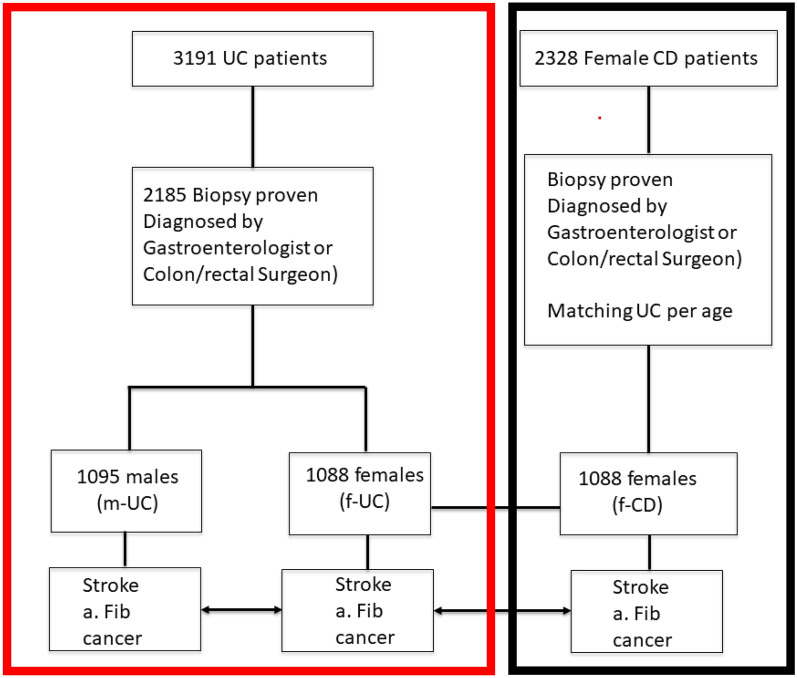
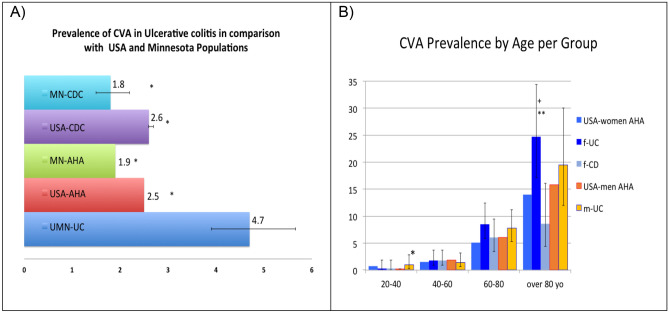
In general, IBD increases arteriovenous thromboembolic events, though the association between UC and cerebrovascular complications remains inconclusive. Some studies suggest young women with UC have an increased risk of cerebrovascular accidents (CVA). The focus of this study was to characterize the rates, anatomic distribution, and risk factors for CVA in patients with UC. We developed a retrospective cohort of patients with UC at a single health care system from June 2010 to June 2015. Neuroimaging was used to document presence, location and type of stroke and traditional risk factors were considered. Prevalence of CVAs in patients with UC was compared to that of the general population of Minnesota (MN) and the United States (U.S.). A total of 2,183 UC patients were identified (1088 females [f-UC], 1095 males [m-UC]). The prevalence of CVA in UC patients (4.7%, 95% CI 3.9-5.6) was higher than in the U.S. (2.5-2.7%, p < 0.0001) and in Minnesota (1.8% CI 1.5-2.2, p < 0.0001) . The prevalence increased in both sexes with a peak prevalence of 24.7% (95% CI 17.1-34.4) in women with UC over the age of 80. Older age, cancer and atrial fibrillation were risk factors for CVA in univariate analysis for both sexes. In multifactorial analysis, both age and atrial fibrillation were risk factors for CVA in the m-UC cohort, but only age was associated with CVA in f-UC. The most common type of CVA was ischemic stroke (77.7%). The most common locations for CVAs in UC patients were frontal and occipital lobes (19% and 18%, respectively). UC patients have an increased risk for CVA, with women over 80 demonstrating the highest risk. Providers should be aware of these risks in making treatment decisions for UC.
Overview
The claims and statistics of this paper haven’t been checked yet.
Run the check — free, no account needed. It reads the open-access text and checks the sources it cites.
Integrity signals
Registry
Cites
Statistics
Figures
Verification
Claims the paper makes
The claims and statistics of this paper haven’t been checked yet.
Run the check — free, no account needed. It reads the open-access text and checks the sources it cites.
Claims other papers make about this one
Each is checked against this paper’s own text: does it say what the citing paper says it does?
In the citing paper
“Inflammatory bowel disease has been associated with a higher risk of cerebrovascular accidents [99] according to a study including 261,890 IBD patients compared to non-IBD patients (6.24% vs. 0.48%, p < 0.0001) [100].”
From Association between Childhood Onset Inflammatory Bowel Disease and Psychiatric Comorbidities in Adulthood (2023) · cites this paper as [99]
Self-check
Percentages, sums and reported differences re-computed from the paper’s own numbers.
The self-check needs the paper’s full text.
Citations
Cites
Adams, H. P., Bendixen, B. H., Kappelle, L. J., Biller, J., Love, B. B., Gordon, D., & Marsh, E. E. (1993) · Stroke · doi:10.1161/01.str.24.1.35 · Cited by 12,350
Isolated Hand Paresis: A Case Series
Alstadhaug, K. B., & Sjulstad, A. S. (2013) · Cerebrovascular Diseases Extra · doi:10.1159/000350708 · Cited by 4,090
Abraham, C., & Cho, J. H. (2009) · New England Journal of Medicine · doi:10.1056/nejmra0804647 · Cited by 2,712
Estrogen–gut microbiome axis: Physiological and clinical implications
Baker, J. M., Al‐Nakkash, L., & Herbst‐Kralovetz, M. M. (2017) · Maturitas · doi:10.1016/j.maturitas.2017.06.025 · Cited by 1,056
Grainge, M. J., West, J., & Card, T. R. (2010) · The Lancet · doi:10.1016/s0140-6736(09)61963-2 · Cited by 729
Dregan, A., Charlton, J., Chowienczyk, P., & Gulliford, M. C. (2014) · Circulation · doi:10.1161/circulationaha.114.009990 · Cited by 303
Singh, S., Singh, H., Loftus, E. V., & Pardi, D. S. (2013) · Clinical Gastroenterology and Hepatology · doi:10.1016/j.cgh.2013.08.023 · Cited by 281
Kristensen, S. L., Ahlehoff, O., Lindhardsen, J., Erichsen, R., Jensen, G. V. H., Torp-Pedersen, C. T., Nielsen, O. H., Gislason, G., & Hansen, P. R. (2013) · PLoS ONE · doi:10.1371/journal.pone.0056944 · Cited by 256
Bernstein, C. N., Wajda, A., & Blanchard, J. (2007) · Clinical Gastroenterology and Hepatology · doi:10.1016/j.cgh.2007.09.016 · Cited by 241
Chung, J., Park, S. H., Kim, N., Kim, W., Park, J. H., Ko, Y., Yang, M., Jang, M. S., Han, M., Jung, C., et al. (2014) · Journal of the American Heart Association · doi:10.1161/jaha.114.001119 · Cited by 237
Cited by
Sorted by citations
Sălcudean, A., Nan, A. G., Bodo, C. R., Cosma, M. C., Strete, E. G., & Lica, M. M. (2023) · Diagnostics · doi:10.3390/diagnostics13111868 · Cited by 24
Metadata
- Authors
- Horta, E., Burke-Smith, C., Megna, B. W., Nichols, K. J., Vaughn, B. P., Reshi, R., & Shmidt, E.
- Affiliations
- University of Arkansas for Medical Sciences (US)
- University of Iowa (US)
- University of Minnesota (US)
- University of Oklahoma Health Sciences Center (US)
- Corresponding author
- Megna, Bryant W.
- Venue
- Scientific Reports
- Published
- 2022-11-04
- Volume
- 12
- Issue
- 1
- Pages
- 18668-18668
- ISSN
- 2045-2322 (ISSN-L)
- PMC
- PMC9636207
- OpenAlex
- W4308342872
- Cited by
- 5
- References
- 26
- Citations by year
- 2024: 3 · 2023: 2
- FWCI
- 0.75
- Type
- journal article
- Language
- en
- Open access
- gold
- doi.org
- Locations
- Scientific Reports (publishedVersion, cc-by)
- Research Square (acceptedVersion, cc-by)
- PubMed Central (publishedVersion, cc-by)
- PubMed (publishedVersion)
- DOAJ (DOAJ: Directory of Open Access Journals) (submittedVersion, cc-by-sa)
- Topics
- Health Sciences › Medicine › Gastroenterology › Inflammatory Bowel Disease
- Health Sciences › Medicine › Clinical Neurology › Acute Ischemic Stroke Management
- Health Sciences › Medicine › Clinical Neurology › Cerebral Venous Sinus Thrombosis
- Keywords
- ulcerative colitis, stroke, ischemic stroke, prevalence, risk factors, atrial fibrillation, age, sex differences, cancer, inflammatory bowel disease
- MeSH terms
- Atrial Fibrillation, Colitis, Ulcerative, Female, Humans, Male, Retrospective Studies, Risk Factors, United States, Prevalence, Stroke
About these checks
Registry, retraction, Cites and statistics results are computed, not judged, with one exception: a printed reference that no index lists is read once by a model before it counts as a citation error. Claims are extracted by a model and kept only when their quote appears verbatim in the text; each cited source is then checked, with a model’s help, for whether it says what the claim relies on. Those verdicts can be wrong — read the claim’s quote and the cited source before relying on one.
Statistics and arithmetic are recomputed, not judged.
Confidence bands are shown only for fields calibrated on our annotated test set. None is calibrated yet, so no band is shown.
What counts as a claim ›How we measure confidence ›How we check this ›
Are you an author, or do you see a problem with this page? Request a review
