

The DOI matches its Crossref record; 34 of the 34 references it cites were found in a registry or an index.
Depression, anxiety and post-traumatic stress during the 2022 Russo-Ukrainian war, a comparison between populations in Poland, Ukraine, and Taiwan
Open accessPublished version of a preprint
Abstract
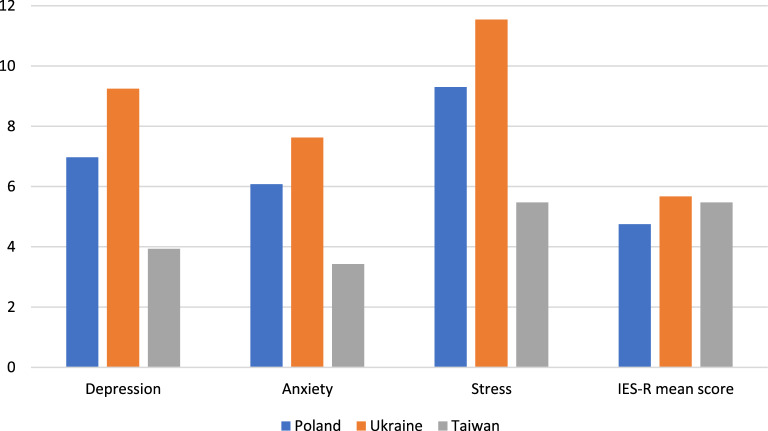
Ukraine has been embroiled in an increasing war since February 2022. In addition to Ukrainians, the Russo-Ukraine war has affected Poles due to the refugee crisis and the Taiwanese, who are facing a potential crisis with China. We examined the mental health status and associated factors in Ukraine, Poland, and Taiwan. The data will be used for future reference as the war is still ongoing. From March 8 to April 26, 2022, we conducted an online survey using snowball sampling techniques in Ukraine, Poland, and Taiwan. Depression, anxiety, and stress were measured using the Depression, Anxiety, and Stress (DASS)-21 item scale; post-traumatic stress symptoms by the Impact of Event Scale-Revised (IES-R) and coping strategies by the Coping Orientation to Problems Experienced Inventory (Brief-COPE). We used multivariate linear regression to identify factors significantly associated with DASS-21 and IES-R scores. There were 1626 participants (Poland: 1053; Ukraine: 385; Taiwan: 188) in this study. Ukrainian participants reported significantly higher DASS-21 ( p < 0.001) and IES-R ( p < 0.01) scores than Poles and Taiwanese. Although Taiwanese participants were not directly involved in the war, their mean IES-R scores (40.37 ± 16.86) were only slightly lower than Ukrainian participants (41.36 ± 14.94). Taiwanese reported significantly higher avoidance scores (1.60 ± 0.47) than the Polish (0.87 ± 0.53) and Ukrainian (0.91 ± 0.5) participants ( p < 0.001). More than half of the Taiwanese (54.3%) and Polish (80.3%) participants were distressed by the war scenes in the media. More than half (52.5%) of the Ukrainian participants would not seek psychological help despite a significantly higher prevalence of psychological distress. Multivariate linear regression analyses found that female gender, Ukrainian and Polish citizenship, household size, self-rating health status, past psychiatric history, and avoidance coping were significantly associated with higher DASS-21 and IES-R scores after adjustment of other variables ( p < 0.05). We have identified mental health sequelae in Ukrainian, Poles, and Taiwanese with the ongoing Russo-Ukraine war. Risk factors associated with developing depression, anxiety, stress, and post-traumatic stress symptoms include female gender, self-rating health status, past psychiatric history, and avoidance coping. Early resolution of the conflict, online mental health interventions, delivery of psychotropic medications, and distraction techniques may help to improve the mental health of people who stay inside and outside Ukraine.
Overview
The claims and statistics of this paper haven’t been checked yet.
Run the check — free, no account needed. It reads the open-access text and checks the sources it cites.
Integrity signals
Registry
Cites
Statistics
Figures
Verification
Claims the paper makes
The claims and statistics of this paper haven’t been checked yet.
Run the check — free, no account needed. It reads the open-access text and checks the sources it cites.
Claims other papers make about this one
Each is checked against this paper’s own text: does it say what the citing paper says it does?
The source backs part of the claim, not all of it — or backs it for a different population, condition or comparison.
In the citing paper
“Individuals living in such chronic situations seem to be mainly concerned with the future, that is, with anticipated future danger and threat, and their thinking is dominated by fantasies of what might happen and ways of avoiding it [54,55].”
From Impact of Media-Induced Uncertainty on Mental Health: Narrative-Based Perspective. (2025) · cites this paper as [55]
Experimental — accuracy not yet measuredThe source backs part of the claim, not all of it — or backs it for a different population, condition or comparison.
In the citing paper
“Recent research highlights that war-related uncertainty, particularly media-induced exposure to conflict, has significantly augmented levels of stress, anxiety, depression, and posttraumatic stress in Czech, Slovak, German, Polish, Italian, and even Taiwanese populations [55,81-83].”
From Impact of Media-Induced Uncertainty on Mental Health: Narrative-Based Perspective. (2025) · cites this paper as [55]
Experimental — accuracy not yet measured
Self-check
Percentages, sums and reported differences re-computed from the paper’s own numbers.
The self-check needs the paper’s full text.
Citations
Cites
Fazel, M., Wheeler, J., & Danesh, J. (2005) · The Lancet · doi:10.1016/s0140-6736(05)61027-6 · Cited by 2,292
Ungar, M. T. (2006) · The British Journal of Social Work · doi:10.1093/bjsw/bcl343 · Cited by 2,206
Prevalence of Depression in the Community from 30 Countries between 1994 and 2014
Lim, G. Y., Tam, W. W., Lu, Y., Ho, C. S., Zhang, M. W., & Ho, R. C. (2018) · Scientific Reports · doi:10.1038/s41598-018-21243-x · Cited by 1,557
Self-citationLong-term mental health of war-refugees: a systematic literature review
Bogic, M., Njoku, A., & Priebe, S. (2015) · BMC International Health and Human Rights · doi:10.1186/s12914-015-0064-9 · Cited by 1,166
Kirchherr, J., & Charles, K. (2018) · PLoS ONE · doi:10.1371/journal.pone.0201710 · Cited by 971
Mental health consequences of war: a brief review of research findings.
Murthy, R. S., & Lakshminarayana, R. (2006) · Europe PMC (PubMed Central) · Cited by 582
Media’s role in broadcasting acute stress following the Boston Marathon bombings
Holman, E. A., Garfin, D. R., & Silver, R. C. (2014) · Proceedings of the National Academy of Sciences · doi:10.1073/pnas.1316265110 · Cited by 513
Soh, H. L., Ho, R. C., Ho, C. S., & Tam, W. W. (2020) · Sleep Medicine · doi:10.1016/j.sleep.2020.08.020 · Cited by 482
Self-citationMollica, R. F. (2001) · JAMA · doi:10.1001/jama.286.5.546 · Cited by 419
Hoge, C., Riviere, L., Wilk, J., Herrell, R., & Weathers, F. W. (2014) · Lancet psychiatry · doi:10.1016/s2215-0366(14)70235-4 · Cited by 363
Research works printed but not linked: 1
- Aldwin, C. M. Culture, coping and resilience to stress. in Gross National Happiness and Development - Proceedings of the First International Conference on Operationalization of Gross National Happiness. 563–573 (Centre for Bhutan Studies, Thimphu, 2004).
Cited by
Sorted by citations
Lushchak, O. V., Velykodna, M., Bolman, S., Strilbytska, O. M., Berezovskyi, V., & Storey, K. B. (2023) · The Lancet Regional Health - Europe · doi:10.1016/j.lanepe.2023.100773 · Cited by 161
War trauma and strategies for coping with stress among Ukrainian refugees staying in Poland
Długosz, P. (2023) · Journal of Migration and Health · doi:10.1016/j.jmh.2023.100196 · Cited by 133
Seleznova, V., Пінчук, І., Feldman, I., Вирченко, В., Wang, B., & Skokauskas, N. (2023) · International Journal of Mental Health Systems · doi:10.1186/s13033-023-00598-3 · Cited by 84
Павлова, Ю., & Rogowska, A. M. (2023) · Journal of Affective Disorders · doi:10.1016/j.jad.2023.09.003 · Cited by 70
Rizzi, D., Ciuffo, G., Landoni, M., Mangiagalli, M., & Ionio, C. (2023) · Frontiers in Psychology · doi:10.3389/fpsyg.2023.1266125 · Cited by 75
Metadata
- Authors
- Chudzicka-Czupała, A., Hapon, N., Chiang, S.-K., Żywiołek-Szeja, M., Karamushka, L., Lee, C. T., Grabowski, D., Paliga, M., Rosenblat, J. D., Ho, R., McIntyre, R. S., & Chen, Y.-L.
- Affiliations
- Uniwersytet SWPS (PL)
- Lviv University (UA)
- National University of Singapore (SG)
- National Academy of Educational Sciences of Ukraine (UA)
- University of Silesia in Katowice (PL)
- University Health Network (CA)
- Asia University (TW)
- Corresponding author
- Ho, Roger
- ORCID
- Venue
- Scientific Reports
- Published
- 2023-03-03
- Volume
- 13
- Issue
- 1
- Pages
- 3602-3602
- ISSN
- 2045-2322 (ISSN-L)
- PMC
- PMC9982762
- OpenAlex
- W4323042680
- Cited by
- 187
- References
- 34
- Citations by year
- 2026: 29 · 2025: 61 · 2024: 61 · 2023: 34
- FWCI
- 53.72
- Type
- journal article
- Language
- en
- Open access
- gold
- doi.org
- Locations
- Scientific Reports (publishedVersion, cc-by)
- Research Square (acceptedVersion, cc-by)
- PubMed Central (publishedVersion, cc-by)
- PubMed (publishedVersion)
- DOAJ (DOAJ: Directory of Open Access Journals) (submittedVersion, cc-by-sa)
- Rare & Special e-Zone (The Hong Kong University of Science and Technology) (submittedVersion)
- Funders
- National University of Singapore, Department of Psychological Medicine (R-177-000-100-001/R-177-000-003-001/ R177000702733)
- National University of Singapore, iHeathtech (R-722-000-004-731)
- Topics
- Social Sciences › Psychology › Clinical Psychology › Posttraumatic Stress Disorder Research
- Social Sciences › Psychology › Clinical Psychology › COVID-19 and Mental Health
- Social Sciences › Psychology › Clinical Psychology › Migration, Health and Trauma
- Keywords
- depression, anxiety, post-traumatic stress, psychological distress, war trauma, coping strategies, avoidance coping, help-seeking barriers, refugees, cross-national comparison, Ukraine, Poland, Taiwan, DASS-21, Impact of Event Scale-Revised, Brief COPE, gender differences, citizenship, household size, self-rated health
- MeSH terms
- Anxiety, Depression, Female, Humans, Poland, Stress Disorders, Post-Traumatic, Taiwan, Ukraine
About these checks
Registry, retraction, Cites and statistics results are computed, not judged, with one exception: a printed reference that no index lists is read once by a model before it counts as a citation error. Claims are extracted by a model and kept only when their quote appears verbatim in the text; each cited source is then checked, with a model’s help, for whether it says what the claim relies on. Those verdicts can be wrong — read the claim’s quote and the cited source before relying on one.
Statistics and arithmetic are recomputed, not judged.
Confidence bands are shown only for fields calibrated on our annotated test set. None is calibrated yet, so no band is shown.
What counts as a claim ›How we measure confidence ›How we check this ›
Are you an author, or do you see a problem with this page? Request a review
