

Effects of social deprivation on risk factors for suicidal ideation and suicide attempts in commercially insured US youth and adults
Open accessThe DOI matches its Crossref record; 45 of the 45 references it cites were found in a registry or an index.
Abstract
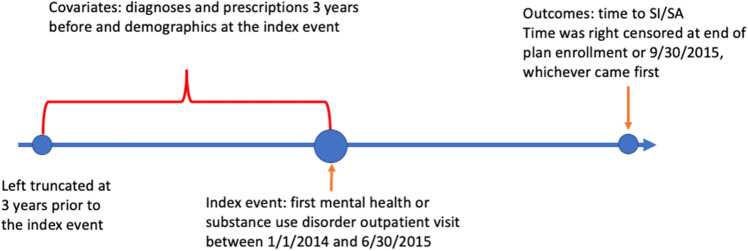
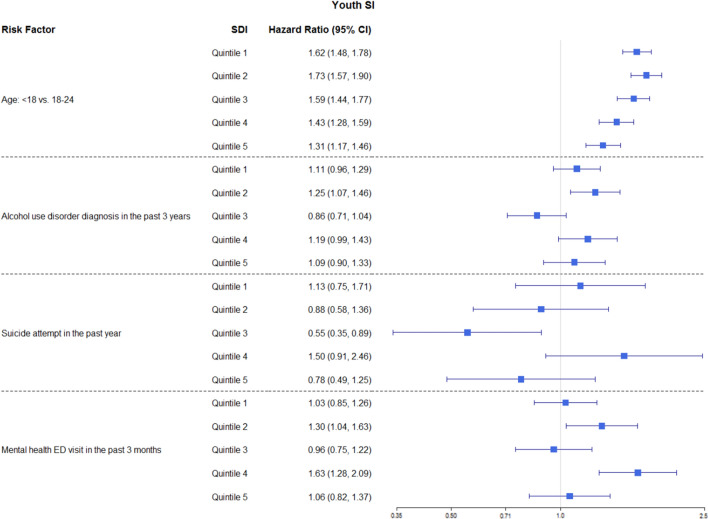
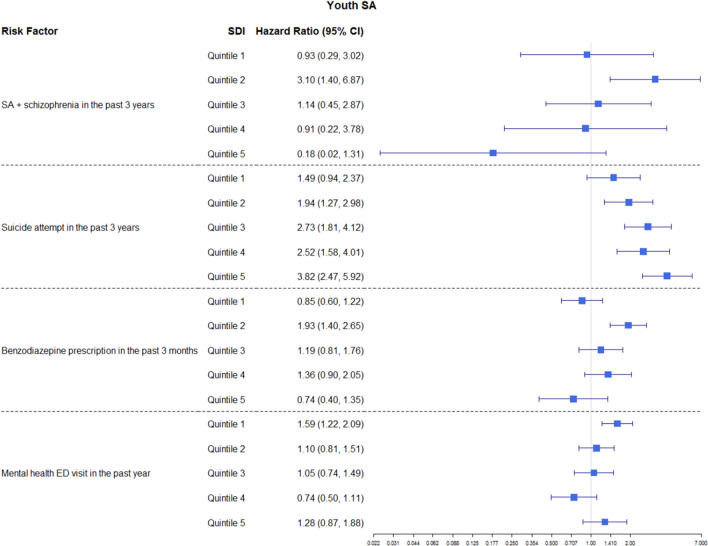
We used US nationwide commercial insurance claims data (2011–2015) to study the effect of social deprivation on clinical and demographic risk factors for suicidal ideation (SI) and suicide attempts (SA) among US youth and adults < 65 years, after having a mental health or substance use disorder-related outpatient encounter. Neighborhood social deprivation level was summarized by the quintile of social deprivation index (SDI) at individuals’ zip code level. Cox proportional hazard models were used to evaluate the effect of social deprivation on demographic and clinical risk factors for SI and SA. The study cohort consisted of 317,383 individuals < 65 years, with 124,424 aged < 25 (youth) and 192,959 aged between 25 and 64 (adults). Neighborhood social deprivation impacted risk factors for SI and SA differently for youth and adults. Among youth, SDI interacted with multiple risk factors for both SI and SA. The effects of the risk factors were larger on youth from middle socioeconomic neighborhoods. Among adults, risk of SI was the strongest in the most deprived neighborhoods, but risk of SA did not vary by neighborhood deprivation level. Our findings suggest community-based suicide prevention initiatives should be tailored according to neighborhood deprivation level and the targeted individual’s age to maximize the impact.
Overview
The claims and statistics of this paper haven’t been checked yet.
Free: it reads the open-access text and checks the first 5 claims that cite a source we can check. Create a free account to check every claim.
Integrity signals
Registry
Cites
Statistics
Figures
Verification
Claims the paper makes
The claims and statistics of this paper haven’t been checked yet.
Free: it reads the open-access text and checks the first 5 claims that cite a source we can check. Create a free account to check every claim.
Claims other papers make about this one
Each is checked against this paper’s own text: does it say what the citing paper says it does?
In the citing paper
“The combination of these risk factors—mental disorders, substance use, trauma or violence, social and cultural factors, ease of access to lethal means, poverty, and deprivation10, 14, 18, 19, 22, 24—are all important potential contributors to global suicide incidence.”
From Global, regional, and national burden of suicide, 1990–2021: a systematic analysis for the Global Burden of Disease Study 2021 (2025) · cites this paper as [24]
Self-check
Percentages, sums and reported differences re-computed from the paper’s own numbers.
The self-check needs the paper’s full text.
Citations
Cites
Neighborhood Socioeconomic Disadvantage and 30-Day Rehospitalization: A Retrospective Cohort Study
Kind, A. J. H., Jencks, S., Brock, J., Yu, M., Bartels, C., Ehlenbach, W., Greenberg, C., & Smith, M. (2014) · Annals of Internal Medicine · doi:10.7326/m13-2946 · Cited by 1,379
Risk factors for suicide in psychiatric outpatients: A 20-year prospective study.
Brown, G. K., Beck, A. T., Steer, R. A., & Grisham, J. R. (2000) · Journal of Consulting and Clinical Psychology · doi:10.1037/0022-006x.68.3.371 · Cited by 1,317
Youth Suicide Risk and Preventive Interventions: A Review of the Past 10 Years
GOULD, M. S., GREENBERG, T., VELTING, D. M., & SHAFFER, D. (2003) · Journal of the American Academy of Child & Adolescent Psychiatry · doi:10.1097/01.chi.0000046821.95464.cf · Cited by 1,264
Butler, D. C., Petterson, S., Phillips, R. L., & Bazemore, A. W. (2013) · Health Services Research · doi:10.1111/j.1475-6773.2012.01449.x · Cited by 689
REHKOPF, D. H., & BUKA, S. L. (2006) · Psychological Medicine · doi:10.1017/s003329170500588x · Cited by 471
Simon, G. E., Johnson, E., Lawrence, J. M., Rossom, R. C., Ahmedani, B., Lynch, F. L., Beck, A., Waitzfelder, B., Ziebell, R., Penfold, R. B., et al. (2018) · American Journal of Psychiatry · doi:10.1176/appi.ajp.2018.17101167 · Cited by 400
Area Deprivation Index Predicts Readmission Risk at an Urban Teaching Hospital
Hu, J., Kind, A. J. H., & Nerenz, D. (2018) · American Journal of Medical Quality · doi:10.1177/1062860617753063 · Cited by 389
A systematic review of online youth mental health promotion and prevention interventions
Clarke, A. M., Kuosmanen, T., & Barry, M. M. (2015) · Journal of Youth and Adolescence · doi:10.1007/s10964-014-0165-0 · Cited by 381
Suicidal ideation reported on the PHQ9 and risk of suicidal behavior across age groups
Rossom, R. C., Coleman, K. J., Ahmedani, B. K., Beck, A., Johnson, E., Oliver, M., & Simon, G. E. (2017) · Journal of Affective Disorders · doi:10.1016/j.jad.2017.03.037 · Cited by 325
Integrating Data On Social Determinants Of Health Into Electronic Health Records
Cantor, M. N., & Thorpe, L. (2018) · Health Affairs · doi:10.1377/hlthaff.2017.1252 · Cited by 308
Research works printed but not linked: 2
- Catalyst. Social determinants of health (SDOH). NEJM Catal. 10.1056/cat.17.0312. · doi:10.1056/cat.17.0312
- Institute of Medicine, Board on Health Promotion and Disease Prevention, Committee on Assuring the Health of the Public in the 21st Century. The Future of the Public’s Health in the 21st Century. National Academies Press (2003).
Cited by
Davis Weaver, N., Bertolacci, G. J., Rosenblad, E., Ghoba, S., Cunningham, M., Ikuta, K. S., Moberg, M. E., Mougin, V., Han, C., Wool, E. E., et al. (2025) · The Lancet Public Health · doi:10.1016/s2468-2667(25)00006-4 · Cited by 181
Structural Racism and Adolescent Mental Health Disparities in Northern California
Acker, J., Aghaee, S., Mujahid, M. S., Deardorff, J., & Kubo, A. (2023) · JAMA Network Open · doi:10.1001/jamanetworkopen.2023.29825 · Cited by 45
Marco, M., López‐Quílez, A., Sánchez‐Sáez, F., Escobar-Hernández, P., Montagud-Andrés, M., Lila, M., & Gracia, E. (2024) · Psychosocial Intervention · doi:10.5093/pi2024a8 · Cited by 13
“Other research has assessed the relationship between community risk factors and suicide risk (Dykxhoorn et al., 2023; Hoffman et al., 2020; Kandula, Martínez-Alés, et al., 2023; Marco et al., 2018; Rehkopf & Buka, 2006; Vandoros & Kawachi, 2021; Xi et al., 2023; Yoshioka et al., 2022).”
BackgroundHassett, T. C., Stuhlsatz, G. L., & Snyder, J. E. (2024) · Public Health Reports · doi:10.1177/00333549241252582 · Cited by 18
Jacobs, M., Kirby, A. V., Kramer, J. M., & Marlow, N. M. (2025) · Frontiers in Psychiatry · doi:10.3389/fpsyt.2025.1511966 · Cited by 12
Effects of Geography on Risk for Future Suicidal Ideation and Attempts Among Children and Youth
Xi, W., Banerjee, S., Zima, B. T., Alexopoulos, G. S., Olfson, M., Xiao, Y., & Pathak, J. (2023) · JAACAP Open · doi:10.1016/j.jaacop.2023.07.002 · Cited by 9
“18 To ensure that the predictors were valid in our study population, we adopted a study design similar to that in the previous study 16 by restricting the cohort to those individuals who had at least 1 outpatient care encounter for mental health or substance use disorder (MH/SUD).”
MethodSelf-citationMin, J., Tam, V. W., Fein, J. A., Vasan, A., Griffis, H. M., Krass, P., & Doupnik, S. K. (2024) · Journal of Adolescent Health · doi:10.1016/j.jadohealth.2024.05.025 · Cited by 9
Salari, M., Hasankhani, M. B., & Rezaeian, M. (2025) · BMC Public Health · doi:10.1186/s12889-025-23085-5 · Cited by 7
“In recent years, various studies have shown that suicide rates can be affected by economic and social inequalities that reflect regional differences in human development [10, 11].”
Kim, K., Lee, D. W., & Jung, S. J. (2024) · SSM - Population Health · doi:10.1016/j.ssmph.2024.101654 · Cited by 6
Factors associated with suicidal ideation among people with HIV engaged in care
Satre, D. D., Sarovar, V., Levine, T., Leibowitz, A., Lea, A. N., Ridout, K. K., Hare, C. B., Luu, M. N., Flamm, J., Dilley, J., et al. (2024) · Journal of Affective Disorders · doi:10.1016/j.jad.2024.05.036 · Cited by 6
Bailey, J. P. M., Schartau, P., Fazel, S., Nazareth, I., & Petersen, I. (2025) · EClinicalMedicine · doi:10.1016/j.eclinm.2025.103441 · Cited by 3
Caswell, E. D., Hartley, S. D., Groth, C. P., Christensen, M., & Bhandari, R. (2024) · PLoS ONE · doi:10.1371/journal.pone.0312373 · Cited by 7
Marlow, N. M., Kramer, J. M., Kirby, A. V., & Jacobs, M. (2025) · PLoS ONE · doi:10.1371/journal.pone.0319396 · Cited by 3
Pagliaccio, D., Kirshenbaum, J. S., Greenblatt, J., Mroczkowski, M. M., Chernick, L. S., Dayan, P. S., & Auerbach, R. P. (2025) · JAACAP Open · doi:10.1016/j.jaacop.2025.08.002 · Cited by 3
“39 Furthermore, girls were more likely to indicate STB and were more likely to exhibit multiple or return visits.”
Xi, W., Banerjee, S., Alexopoulos, G. S., Olfson, M., & Pathak, J. (2025) · Journal of Psychiatric Research · doi:10.1016/j.jpsychires.2025.01.054 · Cited by 2
Self-citationShin, J., Wu, J. S., Kim, H. J., & Xi, W. (2025) · Schizophrenia Research · doi:10.1016/j.schres.2025.04.035 · Cited by 2
Self-citationMaternal Area of Residence and Outcomes for Mother–Infant Dyads with Perinatal Opioid Exposure
Pahl, A., Hu, Z., Young, L., Ramsey, K. W., Whalen, B. L., Akshatha, A., Benninger, K. L., Fung, C. M., Howell, M. P., Markee, S. M., et al. (2025) · American Journal of Perinatology · doi:10.1055/a-2622-3839 · Cited by 1
Rashid, F., Connor, L., Jones, S. S., Rahman, M. M., & Khan, K. M. (2026) · Discover Public Health · doi:10.1186/s12982-026-02103-w · Cited by 1
“For instance, Xi et al. [38] demonstrated that higher social vulnerability is associated with poorer overall and mental health service utilization, although these social vulnerability indices are seldom used prospectively as predictors of treatment engagement [38].”
Considerations and Challenges When Using Clinical and Vital Record Review for Suicide Research
Arias, S. A., Gaudiano, B. A., Epstein-Lubow, G. P., Zylberfuden, S., & Weinstock, L. M. (2025) · Journal of Patient Safety · doi:10.1097/pts.0000000000001325 · Cited by 2
“…computational work being done at the Brown University Center for Biomedical Informatics, 71 – 73 Weill Cornell Medical School/Cornell University, 74,75 the University of Massachusetts Medical School, 16 the National Institute of Mental Health (NIMH)-funded Mental Health Research Network, 3,18,19…”
Wang, R., & Tsang, K. C. H. (2025) · IEEE International Conference on Healthcare Informatics (ICHI) · doi:10.1109/ichi64645.2025.00026 · Cited by 1
“Socio-demographic factors, such as poverty and education, exacerbate asthma conditions by limiting access to care, adherence to treatment plans, and avoidance of environmental triggers [2].”
Cafferty, R., Dillon, M., Ambroggio, L., Anthony, B. J., Haasz, M., & O’Leary, S. T. (2025) · Journal of Adolescent Health · doi:10.1016/j.jadohealth.2025.08.013 · Cited by 1
Sifer, S. D., Tefera, N. L., Kebede, A. Z., Abte, M., & Geremew, M. (2026) · BioMed Research International · doi:10.1155/bmri/9163340
Reuben, A., Milne, B., Shah, D., Brennan, G. M., Pearson, A. L., Richmond‐Rakerd, L. S., Guiney, H., Harrington, H., Hobbs, M., Houts, R., et al. (2026) · Clinical Psychological Science · doi:10.1177/21677026261425570
“…substance misuse, Karriker-Jaffe, 2013; sleep problems, Fuller-Rowell et al., 2016; Nahmod et al., 2022; and suicidality, Jakobsen & Lund, 2022; Xi et al., 2023) over short time spans or in ecological studies, it has yet to be examined in relation to the full despair syndrome (reflecting…”
Metadata
- Authors
- Xi, W., Banerjee, S., Olfson, M., Alexopoulos, G. S., Xiao, Y., & Pathak, J.
- Affiliations
- Weill Cornell Medicine (US)
- Columbia University Irving Medical Center (US)
- Corresponding author
- Pathak, Jyotishman
- Venue
- Scientific Reports
- Published
- 2023-03-13
- Volume
- 13
- Issue
- 1
- Pages
- 4151-4151
- ISSN
- 2045-2322 (ISSN-L)
- PMC
- PMC10011396
- OpenAlex
- W4324129462
- Cited by
- 23
- References
- 45
- Citations by year
- 2026: 3 · 2025: 12 · 2024: 6 · 2023: 2
- FWCI
- 6.71
- Type
- journal article
- Language
- en
- Open access
- gold
- doi.org
- Licence
- cc-by
- creativecommons.org/licenses/by/4.0 (tdm)
- creativecommons.org/licenses/by/4.0 (vor)
- Locations
- Scientific Reports (publishedVersion, cc-by)
- PubMed Central (publishedVersion, cc-by)
- PubMed (publishedVersion)
- DOAJ (DOAJ: Directory of Open Access Journals) (submittedVersion, cc-by-sa)
- Funders
- National Institutes of Health (R01MH119177)
- Topics
- Social Sciences › Psychology › Clinical Psychology › Suicide and Self-Harm Studies
- Social Sciences › Health › Health disparities and outcomes
- Social Sciences › Sociology and Political Science › Homicide, Infanticide, and Child Abuse
- Keywords
- social deprivation, suicidal ideation, suicide attempts, neighborhood disadvantage, social deprivation index, youth, adults, mental illness, substance use disorders, socioeconomic status, suicide prevention, commercial insurance claims
- MeSH terms
- Social Deprivation, Adolescent, Adult, Female, Humans, Insurance, Health, Male, Middle Aged, Risk Factors, Suicide, Attempted, United States, Insurance Coverage, Young Adult, Suicidal Ideation
About these checks
Registry, retraction, Cites and statistics results are computed, not judged, with one exception: a printed reference that no index lists is read once by a model before it counts as a citation error. Claims are extracted by a model and kept only when their quote appears verbatim in the text; each cited source is then checked, with a model’s help, for whether it says what the claim relies on. Those verdicts can be wrong — read the claim’s quote and the cited source before relying on one.
Statistics and arithmetic are recomputed, not judged.
Confidence bands are shown only for fields calibrated on our annotated test set. None is calibrated yet, so no band is shown.
What counts as a claim ›How we measure confidence ›How we check this ›
Are you an author, or do you see a problem with this page? Request a review
Data sources
Bibliographic data: Semantic Scholar, OpenAlex, Crossref.
Contains information from the Semantic Scholar Academic Graph Datasets, made available under the ODC Attribution License (ODC-BY 1.0).
Semantic Scholar’s data is described in: Kinney, R., et al. (2023). The Semantic Scholar Open Data Platform. arXiv:2301.10140.
