

Quantum-resistance in blockchain networks
Open accessThe DOI matches its Crossref record; 67 of the 71 references it cites were found in a registry or an index, and 3 are not checked yet; 23 of the 64 sources its claims cite were checked for support.
Abstract
The advent of quantum computing threatens blockchain protocols and networks because they utilize non-quantum resistant cryptographic algorithms. When quantum computers become robust enough to run Shor's algorithm on a large scale, the most used asymmetric algorithms, utilized for digital signatures and message encryption, such as RSA, (EC)DSA, and (EC)DH, will be no longer secure. Quantum computers will be able to break them within a short period of time. Similarly, Grover's algorithm concedes a quadratic advantage for mining blocks in certain consensus protocols such as proof of work. Today, there are hundreds of billions of dollars denominated in cryptocurrencies and other digital assets that rely on blockchain ledgers as well as thousands of blockchain-based applications storing value in blockchain networks. Cryptocurrencies and blockchain-based applications require solutions that guarantee quantum resistance in order to preserve the integrity of data and assets in these public and immutable ledgers. The quantum threat and some potential solutions are well understood and presented in the literature. However, most proposals are theoretical, require large QKD networks, or propose new quantum-resistant blockchain networks to be built from scratch. Our work, which is presented in this paper, is pioneer in proposing an end-to-end framework for post-quantum blockchain networks that can be applied to existing blockchain to achieve quantum-resistance. We have developed an open-source implementation in an Ethereum-based (i.e., EVM compatible) network that can be extended to other existing blockchains. For the implementation we have (i) used quantum entropy to generate post-quantum key pairs, (ii) established post-quantum TLS connections and X.509 certificates to secure the exchange of information between blockchain nodes over the internet without needing a large QKD network, (iii) introduced a post-quantum second signature in transactions using Falcon-512 post-quantum keys, and (iv) developed the first on-chain verification of post-quantum signatures using three different mechanisms that are compared and analyzed: Solidity smart-contracts run by the validators for each transaction, modified EVM Opcode, and precompiled smart contracts.
Verified 2026-11-22 · 3 references not checked yet
Overview
CoChat Summary
## TL;DR
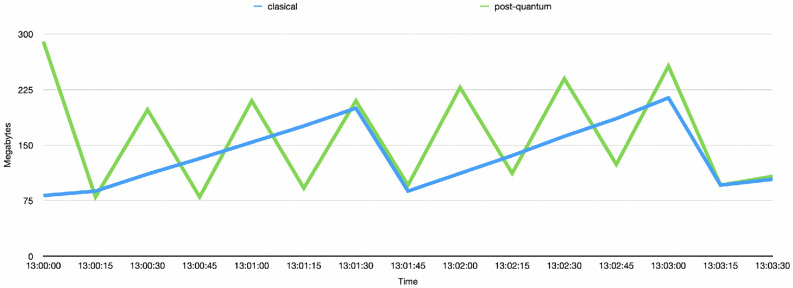
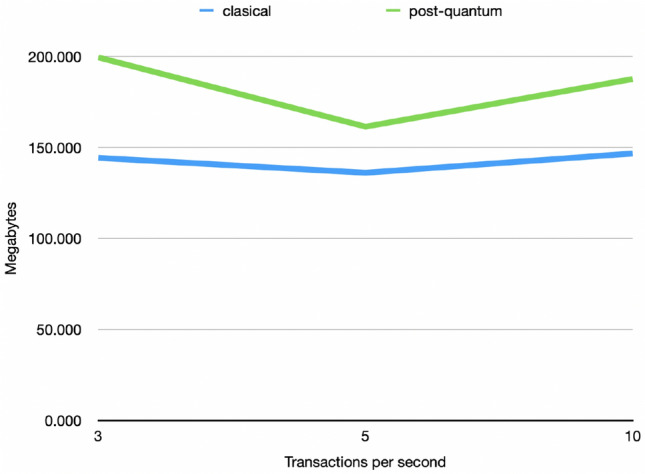
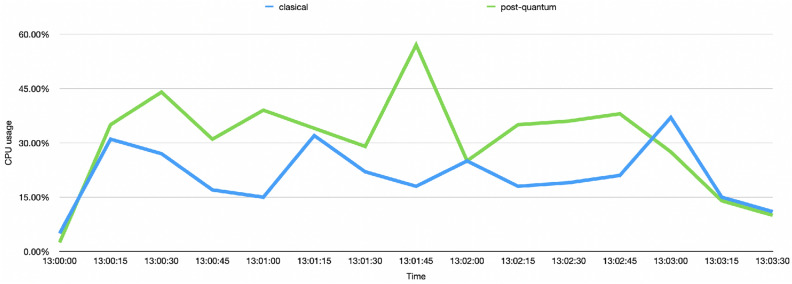
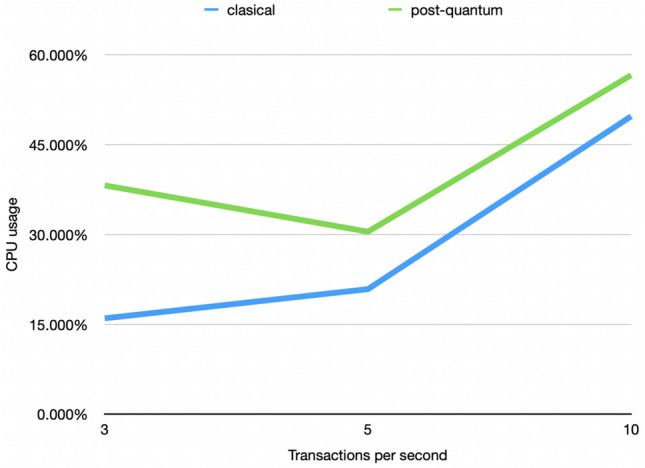
The paper proposes and implements an end-to-end framework for making existing blockchain networks quantum-resistant by combining quantum entropy, post-quantum TLS/X.509, post-quantum transaction signatures, and on-chain verification. In an EVM-compatible LACChain pilot, the authors report that their preferred verification approach adds about 22 bytes per packet, increases memory from about 150 MB to about 200 MB, and raises CPU use by 10% to 30%.
## Key findings
- The paper identifies two critical quantum-risk areas for blockchains: node-to-node communication and transaction signatures.
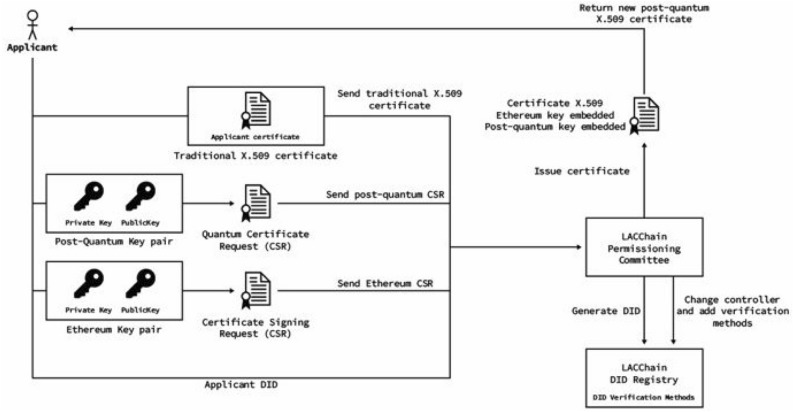
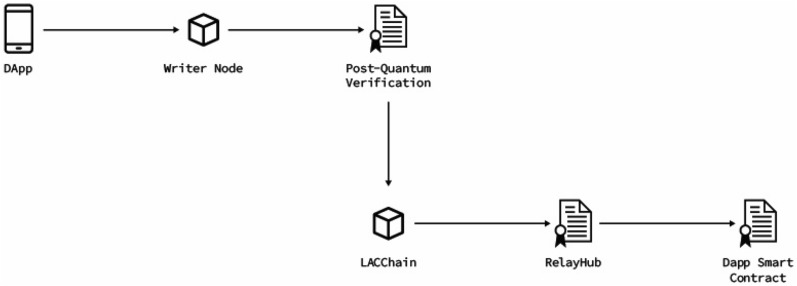
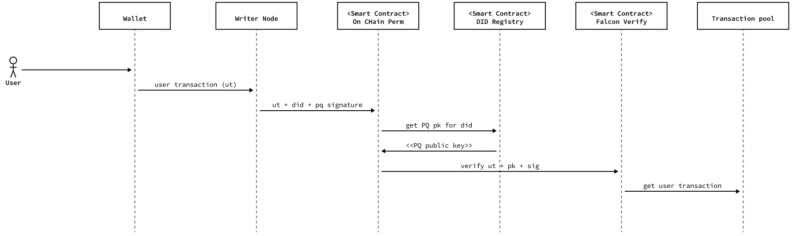
- It implements a 5-step framework in LACChain: quantum entropy, post-quantum certificates, post-quantum TLS tunnels, post-quantum transaction signatures, and on-chain verification.
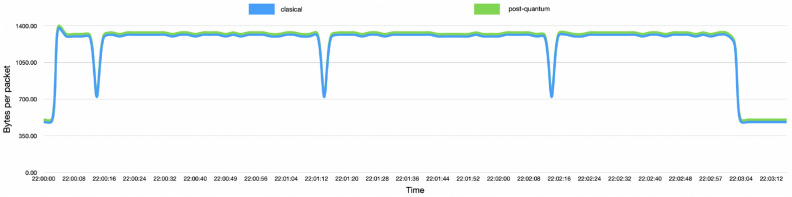
- For communication overhead, the post-quantum channel adds a constant 22 bytes per packet.
- For the preferred verification approach, node memory rises from around 150 MB to around 200 MB, and CPU overhead is reported as 10% to 30%.
## Methods
- Design: A 5-step end-to-end post-quantum framework for blockchain networks, implemented on an EVM-compatible LACChain/Hyperledger Besu network.
- Data/sample: A pilot deployment on LACChain nodes, using Quantum Origin as the entropy source and Falcon-512 for post-quantum signatures; tests were run in Google Cloud on a virtual environment with 2 vCPUs and 7.5 GB memory.
- Analysis: The authors compare three on-chain verification mechanisms for Falcon signatures—Solidity smart contract, modified EVM opcode, and precompiled smart contract—and measure packet overhead, Java memory, and CPU consumption under classical vs post-quantum configurations.
## Limitations
- The paper states that QKD is “not scalable today” and therefore was not used as the solution; instead it relies on post-quantum cryptography and a central entropy source for the pilot.
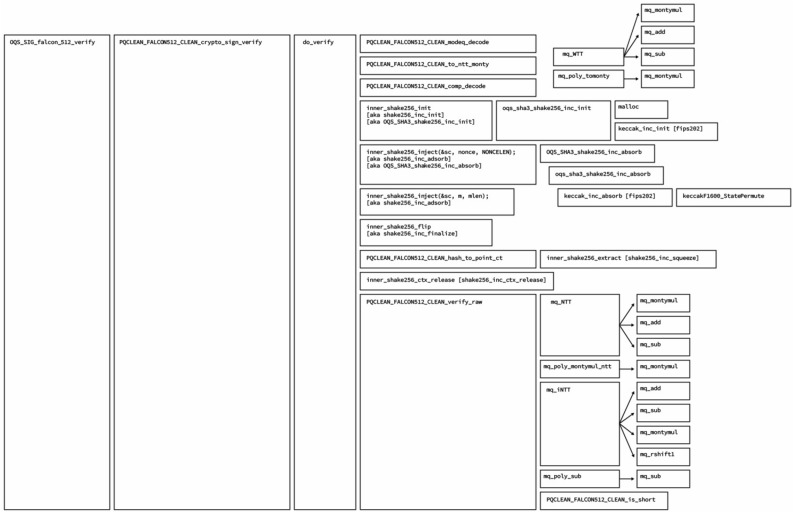
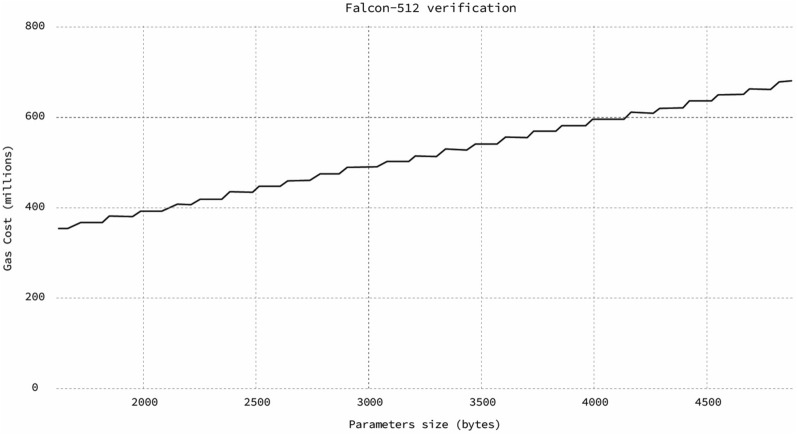
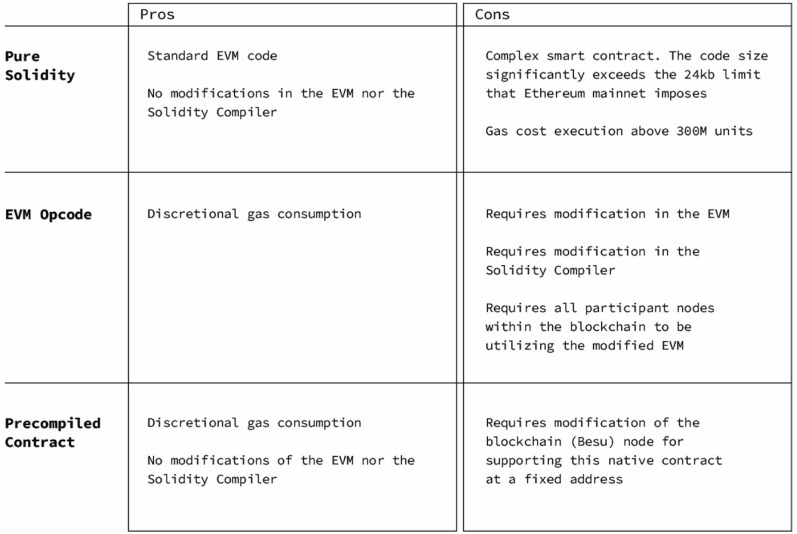
- The Solidity on-chain verification approach is described as impractical because it needs about 500 million gas per Falcon signature verification and exceeds the 24 kb code-size limit; this is a limitation stated in the paper.
- Evident from the text: the implementation was tested in LACChain, so the reported performance and feasibility results are specific to that network and may not directly generalize to non-EVM blockchains.
Model-written summary. Check it against the paper before relying on it.
Integrity signals
Registry
Cites
Statistics
Figures
Verification
Claims the paper makes
17 Valid · 9 Not valid · 21 Not checked · 63 Own results and interpretations
The cited sources support only part of this claim — read each source’s verdict below.
In the paper
“Similarly, Grover’s algorithm concedes a quadratic advantage for mining blocks in certain consensus protocols such as proof of work.”
§ Quantum-resistance in blockchain networks > Abstract The advent of quantum computing threatens blockchain protocols and networks because they utilize non-quantum resistant cryptographic algorithms. When quantum computers become robust enough to run Shor’s algorithm on a large scale, the most used asymmetric algorithms, utilized for digital signatures and message encryption, such as RSA, (EC)DSA, and (EC)DH, will be no longer secure. Quantum computers will be able to break them within a short period of time. Similarly, Grover’s algorithm concedes a quadratic advantage for mining blocks in certain consensus protocols such as proof of work. Today, there are hundreds of billions of dollars denominated in cryptocurrencies and other digital assets that rely on blockchain ledgers as well as thousands of blockchain-based applications storing value in blockchain networks. Cryptocurrencies and blockchain-based applications require solutions that guarantee quantum resistance in order to preserve the integrity of data and assets in these public and immutable ledgers. The quantum threat and some potential solutions are well understood and presented in the literature. However, most proposals are theoretical, require large QKD networks, or propose new quantum-resistant blockchain networks to be built from scratch. Our work, which is presented in this paper, is pioneer in proposing an end-to-end framework for post-quantum blockchain networks that can be applied to existing blockchain to achieve quantum-resistance. We have developed an open-source implementation in an Ethereum-based (i.e., EVM compatible) network that can be extended to other existing blockchains. For the implementation we have (i) used quantum entropy to generate post-quantum key pairs, (ii) established post-quantum TLS connections and X.509 certificates to secure the exchange of information between blockchain nodes over the internet without needing a large QKD network, (iii) introduced a post-quantum second signature in transactions using Falcon-512 post-quantum keys, and (iv) developed the first on-chain verification of post-quantum signatures using three different mechanisms that are compared and analyzed: Solidity smart-contracts run by the validators for each transaction, modified EVM Opcode, and precompiled smart contracts.
What the sources say
- Partly supportedcites [71] Grover, L. K. A fast quantum mechanical algorithm for database search. in Proceedings of the 28th Annual ACM Symposium on the Theory of Computing. 212–219 (1996). sourceExperimental — accuracy not yet measured
The Abstract (page not listed) reports an O(√N) quantum search algorithm versus O(N) classical search, supporting the quadratic advantage. It does not address block mining or proof-of-work consensus, so the application to those protocols is not established by this paper. (LLM, conf=0.88)
plainstates a cause- Asserted: passes — The authors put it forward as true.
- Checkable: passes — It can be checked against evidence.
- Load-bearing: unclear — It is unclear whether the paper’s conclusions depend on it.
- Based: passes — The paper gives a reason why it holds.
- Partly supported
The cited sources support only part of this claim — read each source’s verdict below.
In the paper
“The advent of quantum computing threatens blockchain protocols and networks because they utilize non-quantum resistant cryptographic algorithms.”
§ Quantum-resistance in blockchain networks > Abstract The advent of quantum computing threatens blockchain protocols and networks because they utilize non-quantum resistant cryptographic algorithms. When quantum computers become robust enough to run Shor’s algorithm on a large scale, the most used asymmetric algorithms, utilized for digital signatures and message encryption, such as RSA, (EC)DSA, and (EC)DH, will be no longer secure. Quantum computers will be able to break them within a short period of time. Similarly, Grover’s algorithm concedes a quadratic advantage for mining blocks in certain consensus protocols such as proof of work. Today, there are hundreds of billions of dollars denominated in cryptocurrencies and other digital assets that rely on blockchain ledgers as well as thousands of blockchain-based applications storing value in blockchain networks. Cryptocurrencies and blockchain-based applications require solutions that guarantee quantum resistance in order to preserve the integrity of data and assets in these public and immutable ledgers. The quantum threat and some potential solutions are well understood and presented in the literature. However, most proposals are theoretical, require large QKD networks, or propose new quantum-resistant blockchain networks to be built from scratch. Our work, which is presented in this paper, is pioneer in proposing an end-to-end framework for post-quantum blockchain networks that can be applied to existing blockchain to achieve quantum-resistance. We have developed an open-source implementation in an Ethereum-based (i.e., EVM compatible) network that can be extended to other existing blockchains. For the implementation we have (i) used quantum entropy to generate post-quantum key pairs, (ii) established post-quantum TLS connections and X.509 certificates to secure the exchange of information between blockchain nodes over the internet without needing a large QKD network, (iii) introduced a post-quantum second signature in transactions using Falcon-512 post-quantum keys, and (iv) developed the first on-chain verification of post-quantum signatures using three different mechanisms that are compared and analyzed: Solidity smart-contracts run by the validators for each transaction, modified EVM Opcode, and precompiled smart contracts.
What the sources say
- Not checked — no full text of the sourcecites [19] Shor PW Polynomial-time algorithms for prime factorization and discrete algorithms on a quantum computer SIAM J. Comput. 1997 26 5 1484 1509 10.1137/S0097539795293172 source
- Partly supportedcites [25] Chen, L., Jordan, S., Liu, Y.-K., Moody, D., Peralta, R., Perlner, R. & Smith-Tone, D. NIST Report on Post-Quantum Cryptography (2026). https://nvlpubs.nist.gov/nistpubs/ir/2016/nist.ir.8105.pdf. Accessed 07 Mar 2023 (2023). sourceExperimental — accuracy not yet measured
The Introduction (Table 1) says a large-scale quantum computer would make RSA and ECDSA insecure, supporting the general threat to existing cryptography. The paper does not identify blockchain protocols or networks or establish which algorithms they use, so the blockchain-specific claim goes beyond this source. (LLM, conf=0.86)
- Not matchedcites [26] National Security Agency/Central Security Service. The Commercial National Security Algorithm Suite 2.0 and Quantum Computing FAQ, NSA (2016). https://media.defense.gov/2022/Sep/07/2003071836/-1/-1/0/CSI_CNSA_2.0_FAQ_.PDF. Accessed 07 Mar 2023 (2023).
We searched by its title and found no matching paper.
- Not matchedcites [27] Campagna, M., et al. (ETSI) Quantum safe cryptography and security. An introduction, benefits, enablers and challenges. in Technical Report of the European Telecommunications Standard Institute (2015).
Its entry has no title and year that we can search by.
plainstates a cause- Asserted: passes — The authors put it forward as true.
- Checkable: passes — It can be checked against evidence.
- Load-bearing: passes — The paper’s conclusions depend on it.
- Based: passes — The paper gives a reason why it holds.
The cited sources support only part of this claim — read each source’s verdict below.
In the paper
“QKD is not fully scalable today because ground-based key exchanges using optical fibers are limited to a few hundreds kilometers due to the degradation of the quantum states containing the keys35.”
§ Quantum-resistance in blockchain networks > Context > Current approaches for quantum-safe cryptography
What the sources say
- Partly supportedcites [35] Lucamarini M Yuan ZL Dynes JF Shields AJ Overcoming the rate-distance limit of quantum key distribution without quantum repeaters Nature 2018 557 400 403 10.1038/s41586-018-0066-6 29720656 sourceExperimental — accuracy not yet measured
The Abstract reports a severe rate–distance limit for conventional fibre QKD, with an experimental example reaching 404 km only at 1.16 bits per hour. But it describes the limiting mechanism as optical-channel loss and falling key rates, not specifically degradation of quantum states, and proposes a scheme feasible over 550 km of standard fibre; it therefore does not establish a hard limit of a few hundred kilometres for fibre QKD generally. (LLM, conf=0.84)
plainstates a cause- Asserted: passes — The authors put it forward as true.
- Checkable: passes — It can be checked against evidence.
- Load-bearing: passes — The paper’s conclusions depend on it.
- Based: passes — The paper gives a reason why it holds.
- Partly supported
The sources with a verdict support this claim; the rest weren’t checked yet, have no full text we could read, or their verdicts aren’t rated yet.
In the paper
“The most popular asymmetric cryptography schemes used today are believed to be vulnerable against quantum adversaries. These include RSA40,41, (Elliptic Curve) Digital Signature Algorithm42, and (Elliptic Curve) Diffie-Hellman43,44.”
§ Quantum-resistance in blockchain networks > Context > Current approaches for quantum-safe cryptography
What the sources say
- Supportedcites [40] Rivest RL Shamir A Adleman L A method for obtaining digital signatures and public-key cryptosystems Commun. ACM 1978 21 120 126 10.1145/359340.359342 source
The citation is attached to “RSA” in the list of schemes, identifying the scheme rather than supporting the sentence’s quantum-vulnerability claim. The Abstract and Section XI describe the public-key cryptosystem introduced by Rivest, Shamir, and Adleman, so the identification is supported. (LLM, conf=0.90)
- Not matchedcites [42] Nigel P Smart, Cryptography Made Simple 2016 Springer
We searched by its title and found no matching paper.
- Not checked — no full text of the sourcecites [43] Diffie W Hellman MR New directions in cryptography IEEE Trans. Inf. Theory 1976 22 644 654 10.1109/TIT.1976.1055638 source
plain- Asserted: passes — The authors put it forward as true.
- Checkable: passes — It can be checked against evidence.
- Load-bearing: passes — The paper’s conclusions depend on it.
- Based: passes — The paper gives a reason why it holds.
- Supported
The cited sources support only part of this claim — read each source’s verdict below.
In the paper
“ground-to-satellite key exchanges require sophisticated infrastructure for generation, transmission, and reception of quantum keys36,37.”
§ Quantum-resistance in blockchain networks > Context > Current approaches for quantum-safe cryptography
What the sources say
- Partly supportedcites [36] Liao S-K Cai W-Q Liu W-Y Zhang L Li Y Ren J-G Yin J Shen Q Cao Y Li Z-P Li F-Z Chen X-W Sun L Jia J-J Wu J-C Jiang X-J Wang J-F Huang Y-M Wang Q Zhou Y-L Deng L Xi T Ma L Hu T Zhang Q Chen Y-A Liu N-L Wang X-B Zhu Z-C Lu C-Y Shu R Peng C-Z Wang J-Y Pan J-W Satellite-to-ground quantum key distribution Nature 2017 549 43 47 10.1038/nature23655 28825707 sourceExperimental — accuracy not yet measured
The figure caption (p. 13) and Experimental challenges and solutions (p. 5) describe sophisticated equipment for generating, transmitting, and receiving quantum signals, including lasers, telescopes, detectors, and tracking systems. But the experiment sends those signals from satellite to ground; the paper does not establish the same infrastructure requirements for the claimed ground-to-satellite direction. (LLM, conf=0.86)
- Not checked — no full text of the sourcecites [37] Li Y-P Chen W Wang F-X Yin Z-Q Zhang L Liu H Wang S He D-Y Zhou Z Guo G-C Han Z-F Experimental realization of a reference-frame-independent decoy BB84 quantum key distribution based on Sagnac interferometer Opt. Lett. 2019 18 44 4523 4526 10.1364/OL.44.004523 31517921 source
plain- Asserted: passes — The authors put it forward as true.
- Checkable: passes — It can be checked against evidence.
- Load-bearing: passes — The paper’s conclusions depend on it.
- Based: passes — The paper gives a reason why it holds.
- Partly supported
38 more claims · 2 with their cited sources checked
Create a free account to see all 110 claims and to verify the 1 reference still open.
- Probably not a substantial claim. 46
- It may state two separate claims as one. 35
- The quote only partly states this claim. 1
Self-check
Percentages, sums and reported differences re-computed from the paper’s own numbers.
Each contradiction between two passages listed here was confirmed by an independent check.
Rated minor: it would not touch a result — a value no result rests on, a p-value that stays on the same side of the significance level, or a conflict that is clerical, resolved elsewhere in the paper, or outside its own findings.
In the paper
§ Quantum-resistance in blockchain networks > Results II—our implementation in the EVM-compatible LACChain blockchain > Performance results
“In the classical scenario, the memory reaches maximum CPU consumption peaks between 30% and 35% and averages 21%, while the classical scenario reaches maximum CPU consumption peaks between 40% and 60% and averages 30%.”
§ Quantum-resistance in blockchain networks > Results II—our implementation in the EVM-compatible LACChain blockchain > Performance results
“Figure 15 depicts the behavior of the CPU consumption when sending 5 tx/s in both the classical and post-quantum scenarios.”
Citations
Cites
Quantum computation and quantum information
Law, J. (2001) · ACM SIGSOFT Software Engineering Notes · doi:10.1145/505482.505499 · Cited by 18,842
New directions in cryptography
Diffie, W., & Hellman, M. (1976) · IEEE Transactions on Information Theory · doi:10.1109/tit.1976.1055638 · Cited by 14,713
A method for obtaining digital signatures and public-key cryptosystems
Rivest, R. L., Shamir, A., & Adleman, L. (1978) · Communications of the ACM · doi:10.1145/359340.359342 · Cited by 13,462 · cited 1×
“In contrast, it is well known that public (asymmetric) key cryptographic protocols such as RSA [36, 37], (Elliptic Curve) Digital Signature Algorithm [38], and (Elliptic Curve) Diffie-Hellman [39, 40] are considered vulnerable to quantum attacks.”
BackgroundQuantum cryptography based on Bell’s theorem
Ekert, A. K. (1991) · Physical Review Letters · doi:10.1103/physrevlett.67.661 · Cited by 10,777 · cited 1×
“vesdropper, the information they contain (i.e., the bits of the key) is modied, and therefore the key is corrupted and the eavesdropper is detected. Best known QKD protocols are BB84 [26,27] and E91 [28]. An illustrative example of a QKD implementation is the BB84 protocol using polarized photons. In this protocol, we…”
BackgroundA fast quantum mechanical algorithm for database search
Grover, L. K. (1996) · Proceedings of the twenty-eighth annual ACM symposium on Theory of computing - STOC '96 · doi:10.1145/237814.237866 · Cited by 8,830 · cited 1×
“Quantum computers will be able to find these nonces quadratically faster using Grover’s algorithm [69].”
MethodPolynomial-time algorithms for prime factorization and discrete logarithms on a quantum computer
Shor, P. W. (1997) · SIAM Journal on Computing · doi:10.1137/s0097539795293172 · Cited by 8,472
Quantum cryptography: Public key distribution and coin tossing
Bennett, C. H., & Brassard, G. (2014) · Theoretical Computer Science · doi:10.1016/j.tcs.2014.05.025 · Cited by 8,299 · cited 3×
“Best known QKD protocols are BB84 [26,27] and E91 [28].”
InfluentialQuantum cryptography: Public key distribution and coin tossing
Bennett, C. H., & Brassard, G. (2020) · arXiv · doi:10.48550/arxiv.2003.06557 · Cited by 8,299
Simulating physics with computers
Feynman, R. P. (1982) · International Journal of Theoretical Physics · doi:10.1007/bf02650179 · Cited by 7,691
Quantum theory, the Church–Turing principle and the universal quantum computer
Deutsch, D. (1985) · Proceedings of the Royal Society of London. A. Mathematical and Physical Sciences · doi:10.1098/rspa.1985.0070 · Cited by 4,597
Research works printed but not linked: 7
- Feynman RP Feynman Lectures on Computation 2009 Penguin Books
- Kitaev, A.Y., Shen, A.H. & Vyhalyi, M.N. Classical and quantum computation. in Graduate Studies in Mathematics. Vol. 47. (American Mathematical Society, 1999).
- Nigel P Smart, Cryptography Made Simple 2016 Springer
- Punathumkandi, S. & Boscovic, D. A survey on quantum-safe blockchain system. in Annual Computer Security Applications Conference, Austin TX USA (2022).
- Chen, L., Jordan, S., Liu, Y.-K., Moody, D., Peralta, R., Perlner, R. & Smith-Tone, D. Report on Post-Quantum Cryptography-NISTIR 8105. https://nvlpubs.nist.gov/nistpubs/ir/2016/NIST.IR.8105.pdf. Accessed 15 Mar 2021 (NIST, 2016). · DOI · Paper page
- Khalid ZM Askar S Resistant blockchain cryptography to quantum computing attacks Int. J. Sci. Bus. 2021 5 3 116 125
- Kwiatkowski, K., Sullivan, N., Langley, A., Levin, D. & Mislove, A. Measuring TLS key exchange with post-quantum KEM in Workshop Record of the Second PQC Standardization Conference. https://csrc.nist.gov/CSRC/media/Events/Second-PQC-Standardization-Conference/documents/accepted-papers/kwiatkowski-measuring-tls.pdf. Accessed 07 Mar 2023 (2023).
Cited by
Post-Quantum Blockchain Security for the Internet of Things: Survey and Research Directions
Gharavi, H., Granjal, J., & Monteiro, E. (2024) · IEEE Communications Surveys & Tutorials · doi:10.1109/comst.2024.3355222 · Cited by 203
“Furthermore, to protect the transmission of data between nodes in the LACChain blockchain, it can generate post-quantum X.509 certificates by modifying a version of libSSL, making post-quantum TLS connections between nodes using these certificates [161].”
MethodKuznetsov, A. A., Sernani, P., Romeo, L., Frontoni, E., & Mancini, A. (2024) · IEEE Access · doi:10.1109/access.2023.3349019 · Cited by 221
“…the strategies mentioned involve a combination of technical solutions, such as the design of robust models or the adoption of quantum-resistant cryptography [71], and structural solutions [69], [70], such as the creation of interoperability standards or the implementation of regulations.”
Far, S. B., Rad, A. I., Bamakan, S. M. H., & Asaar, M. R. (2023) · Journal of Network and Computer Applications · doi:10.1016/j.jnca.2023.103675 · Cited by 91
Integrating Post-Quantum Cryptography and Blockchain to Secure Low-Cost IoT Devices
Castiglione, A., Esposito, J. G., Loia, V., Nappi, M., Pero, C., & Polsinelli, M. (2024) · IEEE Transactions on Industrial Informatics · doi:10.1109/tii.2024.3485796 · Cited by 97
Archives of Quantum Computing: Research Progress and Challenges
Sood, V., & Chauhan, R. P. (2023) · Archives of Computational Methods in Engineering · doi:10.1007/s11831-023-09973-2 · Cited by 70
Vidaković, M., & Miličević, K. (2023) · Algorithms · doi:10.3390/a16110518 · Cited by 58
“- Performance speed: Dilithium leads in key generation and signing speed, while Falcon is optimal for fast signature verification.”
BackgroundQuantum-resistant blockchain and performance analysis
Wu, F., Zhou, B., Song, J., & Xie, L. (2025) · The Journal of Supercomputing · doi:10.1007/s11227-025-07018-y · Cited by 43
Al-Matari, N. Y., Zahary, A. T., & Al-Shargabi, A. A. (2024) · Scientific Reports · doi:10.1038/s41598-024-82126-y · Cited by 44
“As quantum computers become capable of breaking conventional cryptographic algorithms like RSA, (EC)DSA, and (EC)DH within a short time frame 131 .”
Navigating the quantum computing threat landscape for blockchains: A comprehensive survey
Khodaiemehr, H., Bagheri, K., & Feng, C. (2025) · Computer Science Review · doi:10.1016/j.cosrev.2025.100846 · Cited by 44
Quantum blockchain: Trends, technologies, and future directions
Manjula Gandhi, S., Mulay, C., Durai, K., Murali, G., Masood, J. A. I. S., Vijayarajan, V., Gautam, K., Chakravarthy, N., Kumar, S., Agarwal, S., et al. (2024) · IET Quantum Communication · doi:10.1049/qtc2.12119 · Cited by 34
Enhanced Security with Quantum Key Distribution and Blockchain for Digital Identities
Zeydan, E., Blanco, L., Mangues‐Bafalluy, J., Aydeger, A., Arslan, Ş. S., Türk, Y., Bas, J., & Mishra, S. K. (2024) · IEEE International Mediterranean Conference on Communications and Networking (MeditCom) · doi:10.1109/meditcom61057.2024.10621406 · Cited by 23
“QKD can be used to establish secure communication channels between mobile devices and blockchain nodes that ensure the confidentiality and integrity of key exchanges [9], [10].”
Effects of Quantum Technology on the Metaverse
Sihare, S. R., & Khang, A. (2023) · Advances in computational intelligence and robotics book series · doi:10.4018/978-1-6684-8851-5.ch009 · Cited by 21
Yakubu, M. M., Hassan, M. F., Danyaro, K. U., Junejo, A. Z., Siraj, M., Saidu, Y., Adamu, S., & Abdulsalam, K. (2024) · Computer Systems Science and Engineering · doi:10.32604/csse.2024.054556 · Cited by 37
Blockchain Security Risk Assessment in Quantum Era, Migration Strategies, and Proactive Defense
Baseri, Y., Hafid, A. S., Shahsavari, Y., Makrakis, D., & Khodaiemehr, H. (2025) · IEEE Communications Surveys & Tutorials · doi:10.1109/comst.2025.3621113 · Cited by 42
“Although not part of the mining process, these components are also exposed to quantum risks such as eavesdropping and message tampering [2], [121].”
InfluentialPost-Quantum Delegated Proof of Luck for Blockchain Consensus Algorithm
Kim, H., Kim, W., Kang, Y., Kim, H., & Seo, H. (2024) · Applied Sciences · doi:10.3390/app14188394 · Cited by 26
On the possibility of implementing a quantum entanglement distribution in a biosystem: Microtubules
Shirmovsky, S. E. (2024) · Biosystems · doi:10.1016/j.biosystems.2024.105320 · Cited by 19
A survey on quantum-safe blockchain security infrastructure
Wicaksana, A. (2025) · Computer Science Review · doi:10.1016/j.cosrev.2025.100752 · Cited by 25
Joni, S. A., Rahat, R., Tasnin, N., Ghose, P., Uddin, M. A., & Ayoade, J. (2024) · Blockchains · doi:10.3390/blockchains2040017 · Cited by 18
Optimizing SIKE for blockchain-based IoT ecosystems with resource constraints
Ismail, N. A., Khadra, S. A., Attiya, G., & Abdulrahman, S. E. S. E. (2025) · The Journal of Supercomputing · doi:10.1007/s11227-024-06906-z · Cited by 18
Investigation of personal data protection mechanism based on blockchain technology
Zhu, R., Wang, M., Zhang, X., & Peng, X. (2023) · Scientific Reports · doi:10.1038/s41598-023-48661-w · Cited by 24
QUMA: Quantum Unified Medical Architecture Using Blockchain
Balasubramaniam, A., & Balasubramanian, S. (2024) · Informatics · doi:10.3390/informatics11020033 · Cited by 14
The security and vulnerability issues of blockchain technology: A SWOC analysis
Punia, A., Gulia, P., Gill, N. S., Rani, D., Kaushik, D. K., Sabry, A. M., Hassan, M. M., & Shukla, P. K. (2025) · Peer-to-Peer Networking and Applications · doi:10.1007/s12083-025-01981-2 · Cited by 16
Morgan, E. F., & Ali, M. H. (2025) · Energies · doi:10.3390/en18226048 · Cited by 19
Islam, M. J., Islam, S., Hossain, M., Noor, S., & Islam, S. (2025) · Future Internet · doi:10.3390/fi17050205 · Cited by 24
“To address this issue, the development and implementation of quantum-resistant key generation techniques have become a priority [44].”
Mampilly, A. J., Manda, V. K., & Selvan, C. P. (2024) · Advances in information security, privacy, and ethics book series · doi:10.4018/979-8-3693-9225-6.ch003 · Cited by 10
Weinberg, A. I., Petratos, P. N., & Faccia, A. (2025) · Discover Analytics · doi:10.1007/s44257-025-00034-5 · Cited by 14
“This involves transitioning blockchain networks, addresses, and cryptography to post-quantum secure algorithms theorized to withstand even fault-tolerant quantum computers [37].”
Secure LoRa Drone-to-Drone Communication for Public Blockchain-Based UAV Traffic Management
Khor, J. H., Sidorov, M., & Chong, M. J. Y. (2025) · Sensors · doi:10.3390/s25165087 · Cited by 7
“Since the SHA256 hash function is resistant to preimage attacks [32], the attackers are unable to reverse engineer the session key, even with knowledge of the timestamp, because the secret random number s is used.”
Quantum Blockchain for Internet of Things: A systematic review, proposed solutions and challenges
Chawla, D., Kumari, S., Rathore, R. S., Mehra, P. S., Das, A. K., & Kumar, N. (2025) · Computers & Electrical Engineering · doi:10.1016/j.compeleceng.2025.110524 · Cited by 10
Lattice-Based Cryptography in the Quantum Era: A Survey
Laule, M. S. C., & Olazabal, J. (2023) · Interfases · doi:10.26439/interfases2023.n018.6631 · Cited by 8
“…representation through Bloch’s sphere Note . qiskit.visualization library Because of the ability to effectively use quantum superposition, this computing paradigm poses a threat to the public key encryption protocols, currently regarded as the most resilient protocols in use (Allende et al., 2023).”
BackgroundA Comprehensive Review of Quantum-Resistant Architectures for Blockchain Security
Taherdoost, H. (2026) · Sci · doi:10.3390/sci8020047 · Cited by 11
“The applications of Grover’s algorithm are especially noteworthy for blockchain proof-of-work mining protocols, where the efficiency of finding valid blocks can be greatly enhanced, presenting the opportunity for faster mining and greater centralization risks [18].”
InfluentialPrivacy-Protection Method for Blockchain Transactions Based on Lightweight Homomorphic Encryption
Wang, G., Li, C., Dai, B., et al. (2024) · Information · doi:10.3390/info15080438 · Cited by 6
On PQ/T Hybrid Verifiable Credentials and Presentations to Build Trust in IoT Systems
Pino, A., Margaria, D., & Vesco, A. (2024) · International Conference on Smart and Sustainable Technologies (SpliTech) · doi:10.23919/splitech61897.2024.10612295 · Cited by 7
“Migration to PQC of TLS and DLT protocols is also required; however, they are outside the scope of this paper and addressed by other works in the recent scientific literature [4]–[6].”
BackgroundA Survey for Blockchain-Enabled Resource Management in Edge Networks
Boamah, S. A., Louis, J. D., McNair, J. Y., & Gilbert, J. E. (2025) · IEEE Access · doi:10.1109/access.2025.3562126 · Cited by 11
“Most importantly, the emergence of quantum computing undermines the effectiveness of encryption [106].”
An Efficient Quantum Blockchain Framework With Edge Computing for Privacy-Preserving 6G Networks
Singamaneni, K. K., Budati, A. K., Kolandaisamy, R. A. L., Dommeti, V. S., & Katragadda, S. (2025) · IEEE Access · doi:10.1109/access.2025.3592793 · Cited by 12
“This section explored some related and critical QRS schemes for the proposed model [37], [38].”
Enhancing secure IoT data sharing through dynamic Q-learning and blockchain at the edge
Bayat, M., Jamali, M. A. J., Abbasi, M., Anari, B., & Akbarpour, S. (2025) · Scientific Reports · doi:10.1038/s41598-025-24510-w · Cited by 9
PDaaS: A Personal Data-as-a-Service Platform using Permissioned Blockchain and IPFS
Merlec, M. M., Sinai, N. K., Hong, S.-P., & In, H. P. (2024) · International Conference on Blockchain Computing and Applications (BCCA) · doi:10.1109/bcca62388.2024.10844495 · Cited by 5
“Finally, multivariate polynomial cryptography, based on solving complex systems of multivariate polynomials, is another viable quantum-resistant method [45].”
InfluentialArtificial intelligence and blockchain for quantum satellites and UAV-based communications: a review
Kumar, A., Awad, A. I., Sharma, G., Krishnamurthi, R., Jain, S., Srikanth, P., Sharma, K., Hedabou, M., & Sood, S. (2025) · Quantum Machine Intelligence · doi:10.1007/s42484-025-00271-7 · Cited by 27
Quantum blockchain for a greener tomorrow: A survey of emerging applications
Rani, P., Rani, P., & Sachan, R. K. (2025) · Computers & Electrical Engineering · doi:10.1016/j.compeleceng.2025.110322 · Cited by 7
Insecurity of Quantum Blockchains Based on Entanglement in Time
Zawadzki, P. (2023) · Entropy · doi:10.3390/e25091344 · Cited by 7
“A holistic proposal of a blockchain system based on the above principles is presented in [14].”
BackgroundA Review of Reentrancy Attack in Ethereum Smart Contracts
Al-E’mari, S., & Sanjalawe, Y. K. (2024) · Lecture notes in networks and systems · doi:10.1007/978-981-97-2671-4_5 · Cited by 5
Hybrid Quantum-Safe Cryptographic Scheme With Secure Key Exchange and Signature Scheme
Maduni, P. K., Byun, I., Seo, J., & Ko, K. (2025) · IEEE Access · doi:10.1109/access.2025.3600068 · Cited by 16
Wang, Y., Li, L., Zhou, Y., & Zhang, H. (2024) · Axioms · doi:10.3390/axioms13110741 · Cited by 6
Blockchain adoption for authentication: A survey
Pham, H.-A., Nguyen, C. T., & Lam, T. C. (2025) · Blockchain Research and Applications · doi:10.1016/j.bcra.2025.100383 · Cited by 11
Joni, S. A., Rahat, R., Tasnin, N., Ghose, P., & Biswas, M. (2024) · Lecture notes in networks and systems · doi:10.1007/978-981-97-3937-0_47 · Cited by 5
Unfolding Post-Quantum Cryptosystems: CRYSTALS-Dilithium, McEliece, BIKE, and HQC
Ojha, V. P., Chauhan, S., Yarahmadian, S., & Carvalho, D. B. (2025) · Mathematics · doi:10.3390/math13172841 · Cited by 6
“In contrast to Quantum Key Distribution (QDK), PQC concerns more complex mathematical issues rather than underlying processes [7,12].”
poqeth: Efficient, post-quantum signature verification on Ethereum
Kysil, R., Seres, I. A., Kutas, P., & Kelecsényi, N. (2025) · ACM Asia Conference on Computer and Communications Security (ASIA CCS) · doi:10.1145/3708821.3736193 · Cited by 7
“Allende et al. observe that verifying Falcon signatures in the EVM would cost 500 million gas on average [2].”
Blay, K. B., Darko, A., Hwang, S., Brilakis, I. K., Foster, F., & Wei, R. (2025) · Automation in Construction · doi:10.1016/j.autcon.2025.106480 · Cited by 5
Rahat, R., Joni, S. A., Tasnin, N., Ghose, P., & Gaur, L. (2025) · International Journal of Systems Assurance Engineering and Management · doi:10.1007/s13198-025-02927-w · Cited by 5
Kumar, A., Hedabou, M., & Pacheco, D. A. D. J. (2024) · IET Quantum Communication · doi:10.1049/qtc2.12102 · Cited by 3
Improved blockchain-based ECDSA batch verification scheme
Wu, G., Zhou, J., & Fu, X. (2025) · Frontiers in Blockchain · doi:10.3389/fbloc.2025.1495984 · Cited by 2
Optimizing SIKE for Blockchain-Based IoT Ecosystems with Resource ConstraintsPreprint
Ismail, N. A., Khadra, S. A., Attiya, G., et al. (2024) · Research Square · doi:10.21203/rs.3.rs-5313453/v1 · Cited by 2
Benaich, R., Mendili, S. E., & Gahi, Y. (2025) · doi:10.1002/9781394242399.ch3 · Cited by 2
Performance Evaluation of Quantum-Resistant Cryptography on a Blockchain
Deterding, J., Janzen, N., Rohrschneider, D., Lösch, P., & Jansen, M. (2023) · Lecture notes in networks and systems · doi:10.1007/978-3-031-45155-3_13 · Cited by 2
Implementing Quantum Resistant Algorithm in Blockchain-Based Applications
Ridhorkar, S., & Mishra, M. S. S. (2024) · International Journal of Advanced Research in Science Communication and Technology · doi:10.48175/ijarsct-17899 · Cited by 1
Quantum-resilient blockchain framework for privacy-preserving genomic data sharing and analysis
Das, P., Jain, C., AlShahrani, A. M., Singh, M., Zeyaullah, M., & Hummad, H. (2025) · Journal of Information Security and Applications · doi:10.1016/j.jisa.2025.104245 · Cited by 1
Quantum Computing in Healthcare: A New Frontier
Gandhi, K., Garg, D., Shah, M., Goel, P., & Gite, S. (2026) · Smart sensors, measurement and instrumentation · doi:10.1007/978-3-032-05507-1_26 · Cited by 1
A blockchain model for ensuring privacy, trust, and dependability of electronic voting systems
Joni, S. A., Rahat, R., Tasnin, N., Ghose, P., & Jamil, H. M. (2026) · Knowledge and Information Systems · doi:10.1007/s10115-026-02693-6 · Cited by 1
Quantum-Resistant Blockchain Protocol for Secure Smart Contracts in Cross-Border Finance
Hasan, D. I., Alsadh, M. H. A., Shakir, H. M., Mahmood, H. E., Ahmed, A. A., Abdeldayem, M. M., & Ibrahim, N. J. (2026) · Procedia Computer Science · doi:10.1016/j.procs.2026.01.098 · Cited by 2
The Convergence of Quantum Computing and Blockchain
Özdenizci, B. (2024) · Advances in computer and electrical engineering book series · doi:10.4018/979-8-3693-1168-4.ch021 · Cited by 1
How Does Post-quantum Cryptography Affect Central Bank Digital Currency?
Hupel, L., & Rafiee, M. (2024) · Communications in computer and information science · doi:10.1007/978-981-97-1274-8_4 · Cited by 6
“The latter paper also provides an “end-to-end framework for for post-quantum blockchain networks,” based on Ethereum [1].”
BackgroundAnalysis of Security Methods for Medical Data in Cloud Systems
Pîrnău, M., Priescu, I., Joița, D., et al. (2024) · World Congress on Medical Physics and Biomedical Engineering, September 7 - 12, 2009, Munich, Germany · doi:10.1007/978-3-031-62502-2_61 · Cited by 1
Ntayagabiri, J. P., Ndikumagenge, J., Bentaleb, Y., & Makhtoum, H. E. (2024) · International Journal of Scientific Research in Computer Science Engineering and Information Technology · doi:10.32628/cseit2410457 · Cited by 3
Provoke and Approach for Developing PET DApp Using Blockchain Based Technology
Shakila, M. (2024) · doi:10.1109/icicnis64247.2024.10823251 · Cited by 1
Sharma, K., Kumar, A., & Hedabou, M. (2024) · Research Square · doi:10.21203/rs.3.rs-4842086/v1 · Cited by 1
Santoni, S. (2024) · Administrative Science Quarterly · doi:10.1177/00018392241241063
“However, these technological advances may break the algorithms used for digital signature and information encryption, thus threatening the security of blockchains if not their very existence (Allende et al., 2023).”
Avances de la computación cuántica en México
Palacios-Razo, L., & Sun, G.-H. (2024) · PÄDI Boletín Científico de Ciencias Básicas e Ingenierías del ICBI · doi:10.29057/icbi.v12i23.11467 · Cited by 1
A Detailed Exploration to Quantum Resistant Blockchain Technology
Shah, K. A., Ukani, M., & Bhadja, S. (2024) · IEEE International Conference on Electronics, Computing and Communication Technologies (CONECCT) · doi:10.1109/conecct62155.2024.10677253 · Cited by 5
“[5] The key principles underlying quantum cryptography include Heinsberg’s uncertainty principle, the superposition principle used by Qubits (Quantum bits) and quantum entanglement used by Quantum Key Distribution (QKD) as discussed further.”
MethodBlockchain-Enabled Distributed Rummy: Proof for the Designers in Online Skill Gaming Industries
Das, D., & Maitra, S. (2024) · Lecture notes in computer science · doi:10.1007/978-3-031-80311-6_15
Exploring the Future of Quantum Computing-Enabled Blockchain Development: A Survey
Li, Z., & Zhu, P. (2024) · IEEE International Conference on Digital Twins and Parallel Intelligence (DTPI) · doi:10.1109/dtpi61353.2024.10778714
Weinberg, A. I., & Faccia, A. (2024) · SSRN Electronic Journal · doi:10.2139/ssrn.5034930 · Cited by 3
Blockchain Security: Threats, Vulnerabilities and Countermeasures − A Review
Kumar, K., Kumar, D., Baghel, S., et al. (2025) · International Journal of Blockchain Technologies and Applications · doi:10.18178/ijbta.2025.3.2.138-145
Peng, X. T., & Li, L. (2025) · Springer eBooks · doi:10.1007/978-981-96-2516-1_33
Transforming Governance and Society
Poças, M. Q. (2025) · Professional practice in governance and public organizations · doi:10.1007/978-3-031-85936-6_4
Integrating Blockchain and Post-Quantum Cryptography: Opportunities and Challenges
Singh, M., & Singh, I. (2025) · Lecture notes in computer science · doi:10.1007/978-3-031-88881-6_6
Quantum technologies in decentralization
Griffin, P., Raymond, R., & Idé, T. (2025) · Elsevier eBooks · doi:10.1016/b978-0-443-34717-7.00023-4
Quantum-Resistant UAV System Using Lattice-Based Key Agreement Protocol
Baidya, B., Mondal, A., Abdullah, S. H., Tawfiq, A. T., & Arshi, O. (2025) · Lecture notes in networks and systems · doi:10.1007/978-3-031-94620-2_17
The Art of Quantum Computing for Finance: Brief Overview and ProspectsPreprint
Mengara, O. (2025) · SSRN Electronic Journal · doi:10.2139/ssrn.5373357 · Cited by 1
The Art of Quantum Computing for Finance: Brief Overview and ProspectsPreprint
Mengara, O. (2025) · SSRN Electronic Journal · doi:10.2139/ssrn.5362526
Navigating Post-quantum Blockchain: Resilient Cryptography in Quantum Threats
Tiwari, A., & Sharma, N. V. (2025) · Lecture notes in networks and systems · doi:10.1007/978-981-96-3284-8_1 · Cited by 1
Adaptive Ensemble Machine Learning Framework for Proactive Blockchain Security
Omonayajo, B., Oke, O. A., & Çavuş, N. (2025) · Applied Sciences · doi:10.3390/app151910848
“Hence, future work should extend validation on real blockchain systems, incorporate quantum-resilient protocols, and adopt some automated hyperparameter tuning or data augmentation strategies to enhance the defense against rare attack patterns [20,27–29].”
Securing Blockchain with Quantum-Inspired Protocols
Batta, P., Wasson, V., & Sardar, S. (2025) · Blockchain technologies · doi:10.1007/978-981-96-9148-7_1 · Cited by 1
Quantum Protocols in Blockchain: Strengthening Security and Consensus Mechanisms
Mamta, . (2025) · Blockchain technologies · doi:10.1007/978-981-96-9148-7_19
Towards a Post-Quantum-Resistant Blockchain Ledger to Mitigate EMV Chip Cloning Attacks
Alothman, B., Allanqawi, K., Faraj, A., Abouelhassan, Z., Buhamad, Y., & Wadaan, E. (2025) · International Conference on Blockchain Computing and Applications (BCCA) · doi:10.1109/bcca66705.2025.11229675 · Cited by 1
Quantum Enhanced Energy Blockchain for Peer-to-Peer Trading
Toderean, L., Daian, M., Cioara, T., Suciu, A., Anghel, I. M., Michalakopoulos, V., & Sarmas, E. (2025) · International Conference on Information, Intelligence, Systems & Applications (IISA) · doi:10.1109/iisa66859.2025.11311303 · Cited by 1
“…threat to blockchain can be addressed by upgrading existing blockchains to achieve QR without building new networks from scratch Allende et al. [29] implement and test such solutions on an Ethereum-based network, using quantum entropy for key generation, post-quantum TLS, and on-chain…”
Simulating Quantum Threats to Web3 Cryptographic Primitives using Qiskit
Kumar, V., Sharma, R., Aggarwal, I., & Ghosh, D. (2025) · International Conference on Contemporary Computing · doi:10.1109/ic366947.2025.11290415 · Cited by 1
“Therefore, the proactive research into and migration toward post-quantum cryptographic standards is an essential undertaking for the long-term security and viability of the Web3 ecosystem [22].”
Tensor Networks in Quantum Neural Network Architectures
Meenakshi, K., Chauhan, R., & Bhargava, D. (2026) · Signals and communication technology · doi:10.1007/978-981-95-1683-4_2
Quantum-Resistant Blockchain Framework for Securing IoT Networks
Mahajan, S., Sharma, G., Thakur, A., et al. (2026) · Lecture notes in networks and systems · doi:10.1007/978-3-032-04539-3_19
Enhancing quantum audio watermarking security through joint verification and certification
Xing, Z., Lam, C., & Yuan, X. (2026) · Scientific Reports · doi:10.1038/s41598-026-36535-w
1Chapter 1 Quantum blockchain and secure data flow
Ahmad, R., Polat, K., Shukla, S. K., & Nandhini, K. M. (2025) · De Gruyter eBooks · doi:10.1515/9783112213049-001
A Three-Layers Defense Scheme for Resilient CRYSTALS-Dilithium in Blockchain Security
Wati, K. M., Anwar, K., & Sanjoyo, D. D. (2025) · International Conference on Information and Communications Technology (ICOIACT) · doi:10.1109/icoiact67584.2025.11344953 · Cited by 1
“The rapid advancement of quantum computers poses a severe threat to public-key cryptographic algorithms relying on integer factorization and discrete logarithms [1]–[3], which form the foundation of blockchain security [4], [5].”
Blockchain-based Peer-to-peer Smart Grid Secure Energy Trading and Load Management
He, P., Zhou, L., Wang, J., et al. (2025) · International Conference on Cyber Security and Information Engineering (ICCSIE) · doi:10.1109/iccsie65832.2025.00064
“This design achieves high throughput while maintaining robust security [15].”
Enhancing Blockchain Security with Multivariate Post-Quantum Digital Signatures
Immanuel, T. P., & Kumari, K. A. (2025) · International Conference on Intelligent Innovations in Engineering and Technology (ICIIET) · doi:10.1109/iciiet65921.2025.11377810
Exploration of Business Management Through Quantum AI
Manoharan, G., & Kumar, S. (2026) · Advances in computational intelligence and robotics book series · doi:10.4018/979-8-3373-4347-1.ch003 · Cited by 1
Manoharan, G., & Kumar, S. (2026) · Advances in computational intelligence and robotics book series · doi:10.4018/979-8-3373-4347-1.ch002
Quantum-resistant timestamping for open science: a non-technical guide
Krägeloh, C. U., Bartholomew, E. J., & Medvedev, O. N. (2026) · Journal of Psychology and AI · doi:10.1080/29974100.2026.2639409
Future-Proofing Quantum Networks: Blockchain's Role in Secure Key Distribution and Authentication
Rajkumar, S., & Kavitha, K. (2026) · Advances in computational intelligence and robotics book series · doi:10.4018/979-8-2600-0547-7.ch004
Noreen, T., Haider, M. Z., Zhang, K., Bensalem, H., & Gagnon, G. (2026) · Distributed Ledger Technologies Research and Practice · doi:10.1145/3801095
Quantum-Resistant Blockchain: Evaluating Falcon, Dilithium & SPHINCS+
Rajkumar, E. R., Harish, K., Suman Maitreya, M., et al. (2026) · IEEE International Conference on Interdisciplinary Approaches in Technology and Management for Social Innovation (IATMSI) · doi:10.1109/iatmsi68868.2026.11465535
“However, that foundation is in danger due to the emergence of quantum computing [2].”
SWMT: A Sliding Window Merkle Tree with Delayed Writes for Scalable Blockchain State Management
Sheng, N., Zhou, T., Zhao, H., et al. (2026) · Proceedings of the ACM on Management of Data · doi:10.1145/3786701
Enhancing Blockchain Resilience: A Quantum-Secure Model Against Cryptographic Threats
Gupta, A., Kumar, J., Gupta, V. K., & Chaudhary, A. (2026) · Lecture notes in networks and systems · doi:10.1007/978-3-032-15395-1_18
Metadata
- Authors
- Allende, M., León, D. L., Cerón, S., Pareja, A., Pacheco, E., Leal, A., Da Silva, M., Pardo, A., Jones, D., Worrall, D. J., Merriman, B., Gilmore, J., Kitchener, N., & Venegas-Andraca, S. E.
- Affiliations
- Inter-American Development Bank (US)
- Quantinuum (United Kingdom)
- Tecnológico de Monterrey (MX)
- Corresponding author
- Venegas-Andraca, Salvador E.
- Venue
- Scientific Reports
- Published
- 2023-04-06
- Volume
- 13
- Issue
- 1
- Pages
- 5664-5664
- ISSN
- 2045-2322 (ISSN-L)
- PMC
- PMC10079930
- OpenAlex
- W4362661849
- Cited by
- 109
- References
- 71
- Citations by year
- 2026: 21 · 2025: 44 · 2024: 33 · 2023: 8
- FWCI
- 13.96
- Type
- journal article
- Language
- en
- Open access
- gold
- doi.org
- Licence
- cc-by
- creativecommons.org/licenses/by/4.0 (tdm)
- creativecommons.org/licenses/by/4.0 (vor)
- Locations
- Scientific Reports (publishedVersion, cc-by)
- PubMed (publishedVersion)
- PubMed Central (submittedVersion, cc-by)
- DOAJ (DOAJ: Directory of Open Access Journals) (submittedVersion, cc-by-sa)
- Funders
- Inter-American Development Bank
- Topics
- Physical Sciences › Computer Science › Artificial Intelligence › Quantum Computing Algorithms and Architecture
- Physical Sciences › Physics and Astronomy › Atomic and Molecular Physics, and Optics › Quantum Information and Cryptography
- Physical Sciences › Physics and Astronomy › Atomic and Molecular Physics, and Optics › Quantum Mechanics and Applications
- Keywords
- quantum resistance, post-quantum cryptography, X.509 certificates, Solidity smart contracts, Ethereum, Shor's algorithm, Grover's algorithm, proof-of-work
About these checks
Registry, retraction, Cites and statistics results are computed, not judged, with one exception: a printed reference that no index lists is read once by a model before it counts as a citation error. Claims are extracted by a model and kept only when their quote appears verbatim in the text; each cited source is then checked, with a model’s help, for whether it says what the claim relies on. Those verdicts can be wrong — read the claim’s quote and the cited source before relying on one.
The claim verdicts this report counts are experimental: their accuracy is not yet measured.
A language model drew the claims from the paper on 2026-10-10, under version 3 of the claim definition (model deepseek-v4.1-flash, prompt extract-v3).
A second model labelled each claim on 2026-10-10 (model jev-1.13-20260917, definition revision gold-guideline-v0.2).
Cited sources are checked with a language model’s help (gpt-6-sol).
Statistics and arithmetic are recomputed, not judged.
Confidence bands are shown only for fields calibrated on our annotated test set. None is calibrated yet, so no band is shown.
What counts as a claim ›How we measure confidence ›How we check this ›
Are you an author, or do you see a problem with this page? Request a review
Data sources
Bibliographic data: Semantic Scholar, OpenAlex, Crossref.
Contains information from the Semantic Scholar Academic Graph Datasets, made available under the ODC Attribution License (ODC-BY 1.0).
Semantic Scholar’s data is described in: Kinney, R., et al. (2023). The Semantic Scholar Open Data Platform. arXiv:2301.10140.
