

Quantum-resistance in blockchain networks
Open accessThe DOI matches its Crossref record; 67 of the 71 references it cites were found in a registry or an index, and 3 are not checked yet; 23 of the 64 sources its claims cite were checked for support.
Abstract
The advent of quantum computing threatens blockchain protocols and networks because they utilize non-quantum resistant cryptographic algorithms. When quantum computers become robust enough to run Shor's algorithm on a large scale, the most used asymmetric algorithms, utilized for digital signatures and message encryption, such as RSA, (EC)DSA, and (EC)DH, will be no longer secure. Quantum computers will be able to break them within a short period of time. Similarly, Grover's algorithm concedes a quadratic advantage for mining blocks in certain consensus protocols such as proof of work. Today, there are hundreds of billions of dollars denominated in cryptocurrencies and other digital assets that rely on blockchain ledgers as well as thousands of blockchain-based applications storing value in blockchain networks. Cryptocurrencies and blockchain-based applications require solutions that guarantee quantum resistance in order to preserve the integrity of data and assets in these public and immutable ledgers. The quantum threat and some potential solutions are well understood and presented in the literature. However, most proposals are theoretical, require large QKD networks, or propose new quantum-resistant blockchain networks to be built from scratch. Our work, which is presented in this paper, is pioneer in proposing an end-to-end framework for post-quantum blockchain networks that can be applied to existing blockchain to achieve quantum-resistance. We have developed an open-source implementation in an Ethereum-based (i.e., EVM compatible) network that can be extended to other existing blockchains. For the implementation we have (i) used quantum entropy to generate post-quantum key pairs, (ii) established post-quantum TLS connections and X.509 certificates to secure the exchange of information between blockchain nodes over the internet without needing a large QKD network, (iii) introduced a post-quantum second signature in transactions using Falcon-512 post-quantum keys, and (iv) developed the first on-chain verification of post-quantum signatures using three different mechanisms that are compared and analyzed: Solidity smart-contracts run by the validators for each transaction, modified EVM Opcode, and precompiled smart contracts.
Verified 2026-11-22 · 3 references not checked yet
Overview
CoChat Summary
## TL;DR
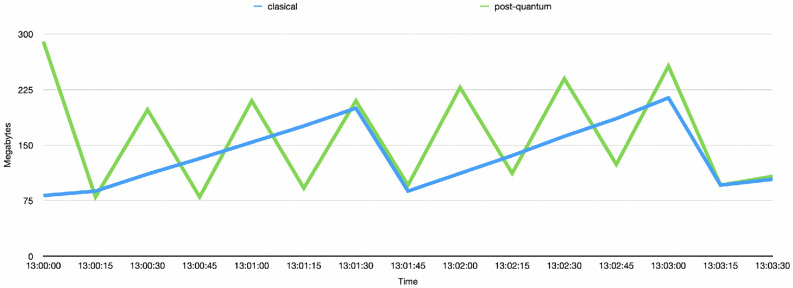
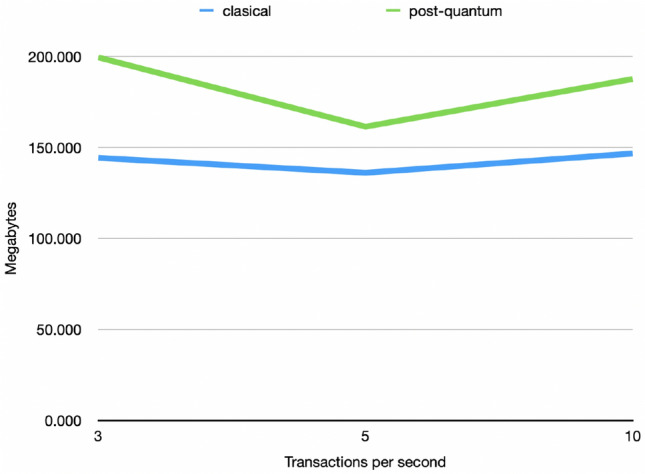
The paper proposes and implements an end-to-end framework for making existing blockchain networks quantum-resistant by combining quantum entropy, post-quantum TLS/X.509, post-quantum transaction signatures, and on-chain verification. In an EVM-compatible LACChain pilot, the authors report that their preferred verification approach adds about 22 bytes per packet, increases memory from about 150 MB to about 200 MB, and raises CPU use by 10% to 30%.
## Key findings
- The paper identifies two critical quantum-risk areas for blockchains: node-to-node communication and transaction signatures.
- It implements a 5-step framework in LACChain: quantum entropy, post-quantum certificates, post-quantum TLS tunnels, post-quantum transaction signatures, and on-chain verification.
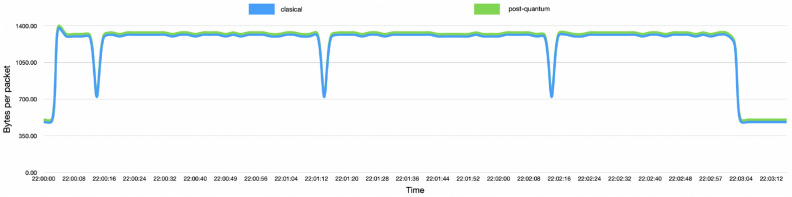
- For communication overhead, the post-quantum channel adds a constant 22 bytes per packet.
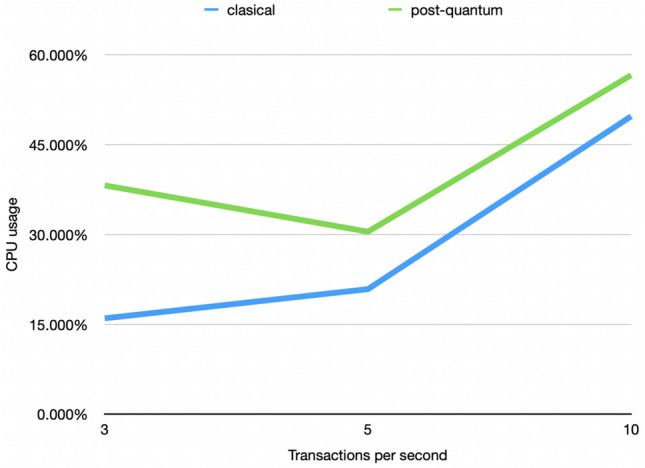
- For the preferred verification approach, node memory rises from around 150 MB to around 200 MB, and CPU overhead is reported as 10% to 30%.
## Methods
- Design: A 5-step end-to-end post-quantum framework for blockchain networks, implemented on an EVM-compatible LACChain/Hyperledger Besu network.
- Data/sample: A pilot deployment on LACChain nodes, using Quantum Origin as the entropy source and Falcon-512 for post-quantum signatures; tests were run in Google Cloud on a virtual environment with 2 vCPUs and 7.5 GB memory.
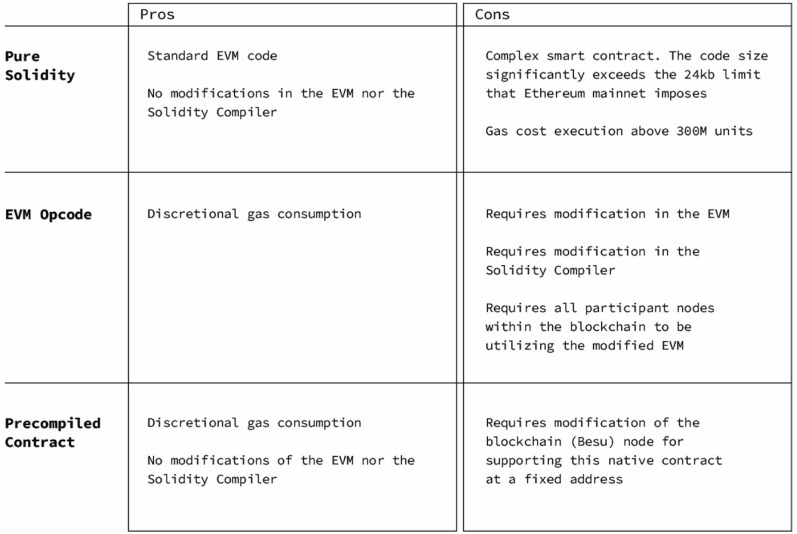
- Analysis: The authors compare three on-chain verification mechanisms for Falcon signatures—Solidity smart contract, modified EVM opcode, and precompiled smart contract—and measure packet overhead, Java memory, and CPU consumption under classical vs post-quantum configurations.
## Limitations
- The paper states that QKD is “not scalable today” and therefore was not used as the solution; instead it relies on post-quantum cryptography and a central entropy source for the pilot.
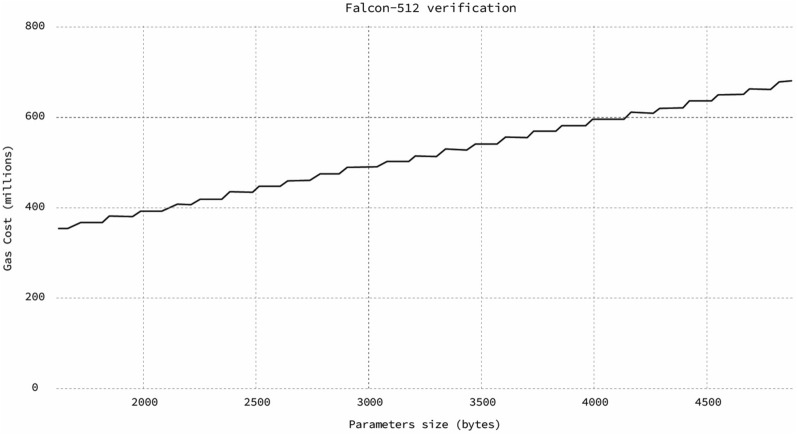
- The Solidity on-chain verification approach is described as impractical because it needs about 500 million gas per Falcon signature verification and exceeds the 24 kb code-size limit; this is a limitation stated in the paper.
- Evident from the text: the implementation was tested in LACChain, so the reported performance and feasibility results are specific to that network and may not directly generalize to non-EVM blockchains.
Model-written summary. Check it against the paper before relying on it.
Integrity signals
Registry
Cites
Statistics
Figures
Verification
Claims the paper makes
17 Valid · 9 Not valid · 21 Not checked · 63 Own results and interpretations
The cited sources support only part of this claim — read each source’s verdict below.
In the paper
“Similarly, Grover’s algorithm concedes a quadratic advantage for mining blocks in certain consensus protocols such as proof of work.”
§ Quantum-resistance in blockchain networks > Abstract The advent of quantum computing threatens blockchain protocols and networks because they utilize non-quantum resistant cryptographic algorithms. When quantum computers become robust enough to run Shor’s algorithm on a large scale, the most used asymmetric algorithms, utilized for digital signatures and message encryption, such as RSA, (EC)DSA, and (EC)DH, will be no longer secure. Quantum computers will be able to break them within a short period of time. Similarly, Grover’s algorithm concedes a quadratic advantage for mining blocks in certain consensus protocols such as proof of work. Today, there are hundreds of billions of dollars denominated in cryptocurrencies and other digital assets that rely on blockchain ledgers as well as thousands of blockchain-based applications storing value in blockchain networks. Cryptocurrencies and blockchain-based applications require solutions that guarantee quantum resistance in order to preserve the integrity of data and assets in these public and immutable ledgers. The quantum threat and some potential solutions are well understood and presented in the literature. However, most proposals are theoretical, require large QKD networks, or propose new quantum-resistant blockchain networks to be built from scratch. Our work, which is presented in this paper, is pioneer in proposing an end-to-end framework for post-quantum blockchain networks that can be applied to existing blockchain to achieve quantum-resistance. We have developed an open-source implementation in an Ethereum-based (i.e., EVM compatible) network that can be extended to other existing blockchains. For the implementation we have (i) used quantum entropy to generate post-quantum key pairs, (ii) established post-quantum TLS connections and X.509 certificates to secure the exchange of information between blockchain nodes over the internet without needing a large QKD network, (iii) introduced a post-quantum second signature in transactions using Falcon-512 post-quantum keys, and (iv) developed the first on-chain verification of post-quantum signatures using three different mechanisms that are compared and analyzed: Solidity smart-contracts run by the validators for each transaction, modified EVM Opcode, and precompiled smart contracts.
What the sources say
- Partly supportedcites [71] Grover, L. K. A fast quantum mechanical algorithm for database search. in Proceedings of the 28th Annual ACM Symposium on the Theory of Computing. 212–219 (1996). sourceExperimental — accuracy not yet measured
The Abstract (page not listed) reports an O(√N) quantum search algorithm versus O(N) classical search, supporting the quadratic advantage. It does not address block mining or proof-of-work consensus, so the application to those protocols is not established by this paper. (LLM, conf=0.88)
plainstates a cause- Asserted: passes — The authors put it forward as true.
- Checkable: passes — It can be checked against evidence.
- Load-bearing: unclear — It is unclear whether the paper’s conclusions depend on it.
- Based: passes — The paper gives a reason why it holds.
- Partly supported
The cited sources support only part of this claim — read each source’s verdict below.
In the paper
“The advent of quantum computing threatens blockchain protocols and networks because they utilize non-quantum resistant cryptographic algorithms.”
§ Quantum-resistance in blockchain networks > Abstract The advent of quantum computing threatens blockchain protocols and networks because they utilize non-quantum resistant cryptographic algorithms. When quantum computers become robust enough to run Shor’s algorithm on a large scale, the most used asymmetric algorithms, utilized for digital signatures and message encryption, such as RSA, (EC)DSA, and (EC)DH, will be no longer secure. Quantum computers will be able to break them within a short period of time. Similarly, Grover’s algorithm concedes a quadratic advantage for mining blocks in certain consensus protocols such as proof of work. Today, there are hundreds of billions of dollars denominated in cryptocurrencies and other digital assets that rely on blockchain ledgers as well as thousands of blockchain-based applications storing value in blockchain networks. Cryptocurrencies and blockchain-based applications require solutions that guarantee quantum resistance in order to preserve the integrity of data and assets in these public and immutable ledgers. The quantum threat and some potential solutions are well understood and presented in the literature. However, most proposals are theoretical, require large QKD networks, or propose new quantum-resistant blockchain networks to be built from scratch. Our work, which is presented in this paper, is pioneer in proposing an end-to-end framework for post-quantum blockchain networks that can be applied to existing blockchain to achieve quantum-resistance. We have developed an open-source implementation in an Ethereum-based (i.e., EVM compatible) network that can be extended to other existing blockchains. For the implementation we have (i) used quantum entropy to generate post-quantum key pairs, (ii) established post-quantum TLS connections and X.509 certificates to secure the exchange of information between blockchain nodes over the internet without needing a large QKD network, (iii) introduced a post-quantum second signature in transactions using Falcon-512 post-quantum keys, and (iv) developed the first on-chain verification of post-quantum signatures using three different mechanisms that are compared and analyzed: Solidity smart-contracts run by the validators for each transaction, modified EVM Opcode, and precompiled smart contracts.
What the sources say
- Not checked — no full text of the sourcecites [19] Shor PW Polynomial-time algorithms for prime factorization and discrete algorithms on a quantum computer SIAM J. Comput. 1997 26 5 1484 1509 10.1137/S0097539795293172 source
- Partly supportedcites [25] Chen, L., Jordan, S., Liu, Y.-K., Moody, D., Peralta, R., Perlner, R. & Smith-Tone, D. NIST Report on Post-Quantum Cryptography (2026). https://nvlpubs.nist.gov/nistpubs/ir/2016/nist.ir.8105.pdf. Accessed 07 Mar 2023 (2023). sourceExperimental — accuracy not yet measured
The Introduction (Table 1) says a large-scale quantum computer would make RSA and ECDSA insecure, supporting the general threat to existing cryptography. The paper does not identify blockchain protocols or networks or establish which algorithms they use, so the blockchain-specific claim goes beyond this source. (LLM, conf=0.86)
- Not matchedcites [26] National Security Agency/Central Security Service. The Commercial National Security Algorithm Suite 2.0 and Quantum Computing FAQ, NSA (2016). https://media.defense.gov/2022/Sep/07/2003071836/-1/-1/0/CSI_CNSA_2.0_FAQ_.PDF. Accessed 07 Mar 2023 (2023).
We searched by its title and found no matching paper.
- Not matchedcites [27] Campagna, M., et al. (ETSI) Quantum safe cryptography and security. An introduction, benefits, enablers and challenges. in Technical Report of the European Telecommunications Standard Institute (2015).
Its entry has no title and year that we can search by.
plainstates a cause- Asserted: passes — The authors put it forward as true.
- Checkable: passes — It can be checked against evidence.
- Load-bearing: passes — The paper’s conclusions depend on it.
- Based: passes — The paper gives a reason why it holds.
The cited sources support only part of this claim — read each source’s verdict below.
In the paper
“QKD is not fully scalable today because ground-based key exchanges using optical fibers are limited to a few hundreds kilometers due to the degradation of the quantum states containing the keys35.”
§ Quantum-resistance in blockchain networks > Context > Current approaches for quantum-safe cryptography
What the sources say
- Partly supportedcites [35] Lucamarini M Yuan ZL Dynes JF Shields AJ Overcoming the rate-distance limit of quantum key distribution without quantum repeaters Nature 2018 557 400 403 10.1038/s41586-018-0066-6 29720656 sourceExperimental — accuracy not yet measured
The Abstract reports a severe rate–distance limit for conventional fibre QKD, with an experimental example reaching 404 km only at 1.16 bits per hour. But it describes the limiting mechanism as optical-channel loss and falling key rates, not specifically degradation of quantum states, and proposes a scheme feasible over 550 km of standard fibre; it therefore does not establish a hard limit of a few hundred kilometres for fibre QKD generally. (LLM, conf=0.84)
plainstates a cause- Asserted: passes — The authors put it forward as true.
- Checkable: passes — It can be checked against evidence.
- Load-bearing: passes — The paper’s conclusions depend on it.
- Based: passes — The paper gives a reason why it holds.
- Partly supported
The sources with a verdict support this claim; the rest weren’t checked yet, have no full text we could read, or their verdicts aren’t rated yet.
In the paper
“The most popular asymmetric cryptography schemes used today are believed to be vulnerable against quantum adversaries. These include RSA40,41, (Elliptic Curve) Digital Signature Algorithm42, and (Elliptic Curve) Diffie-Hellman43,44.”
§ Quantum-resistance in blockchain networks > Context > Current approaches for quantum-safe cryptography
What the sources say
- Supportedcites [40] Rivest RL Shamir A Adleman L A method for obtaining digital signatures and public-key cryptosystems Commun. ACM 1978 21 120 126 10.1145/359340.359342 source
The citation is attached to “RSA” in the list of schemes, identifying the scheme rather than supporting the sentence’s quantum-vulnerability claim. The Abstract and Section XI describe the public-key cryptosystem introduced by Rivest, Shamir, and Adleman, so the identification is supported. (LLM, conf=0.90)
- Not matchedcites [42] Nigel P Smart, Cryptography Made Simple 2016 Springer
We searched by its title and found no matching paper.
- Not checked — no full text of the sourcecites [43] Diffie W Hellman MR New directions in cryptography IEEE Trans. Inf. Theory 1976 22 644 654 10.1109/TIT.1976.1055638 source
plain- Asserted: passes — The authors put it forward as true.
- Checkable: passes — It can be checked against evidence.
- Load-bearing: passes — The paper’s conclusions depend on it.
- Based: passes — The paper gives a reason why it holds.
- Supported
The cited sources support only part of this claim — read each source’s verdict below.
In the paper
“ground-to-satellite key exchanges require sophisticated infrastructure for generation, transmission, and reception of quantum keys36,37.”
§ Quantum-resistance in blockchain networks > Context > Current approaches for quantum-safe cryptography
What the sources say
- Partly supportedcites [36] Liao S-K Cai W-Q Liu W-Y Zhang L Li Y Ren J-G Yin J Shen Q Cao Y Li Z-P Li F-Z Chen X-W Sun L Jia J-J Wu J-C Jiang X-J Wang J-F Huang Y-M Wang Q Zhou Y-L Deng L Xi T Ma L Hu T Zhang Q Chen Y-A Liu N-L Wang X-B Zhu Z-C Lu C-Y Shu R Peng C-Z Wang J-Y Pan J-W Satellite-to-ground quantum key distribution Nature 2017 549 43 47 10.1038/nature23655 28825707 sourceExperimental — accuracy not yet measured
The figure caption (p. 13) and Experimental challenges and solutions (p. 5) describe sophisticated equipment for generating, transmitting, and receiving quantum signals, including lasers, telescopes, detectors, and tracking systems. But the experiment sends those signals from satellite to ground; the paper does not establish the same infrastructure requirements for the claimed ground-to-satellite direction. (LLM, conf=0.86)
- Not checked — no full text of the sourcecites [37] Li Y-P Chen W Wang F-X Yin Z-Q Zhang L Liu H Wang S He D-Y Zhou Z Guo G-C Han Z-F Experimental realization of a reference-frame-independent decoy BB84 quantum key distribution based on Sagnac interferometer Opt. Lett. 2019 18 44 4523 4526 10.1364/OL.44.004523 31517921 source
plain- Asserted: passes — The authors put it forward as true.
- Checkable: passes — It can be checked against evidence.
- Load-bearing: passes — The paper’s conclusions depend on it.
- Based: passes — The paper gives a reason why it holds.
- Partly supported
38 more claims · 2 with their cited sources checked
Create a free account to see all 110 claims and to verify the 1 reference still open.
- Probably not a substantial claim. 46
- It may state two separate claims as one. 35
- The quote only partly states this claim. 1
Self-check
Percentages, sums and reported differences re-computed from the paper’s own numbers.
Each contradiction between two passages listed here was confirmed by an independent check.
Rated minor: it would not touch a result — a value no result rests on, a p-value that stays on the same side of the significance level, or a conflict that is clerical, resolved elsewhere in the paper, or outside its own findings.
In the paper
§ Quantum-resistance in blockchain networks > Results II—our implementation in the EVM-compatible LACChain blockchain > Performance results
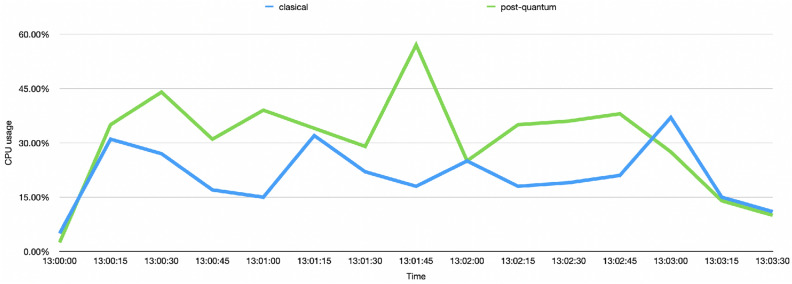
“In the classical scenario, the memory reaches maximum CPU consumption peaks between 30% and 35% and averages 21%, while the classical scenario reaches maximum CPU consumption peaks between 40% and 60% and averages 30%.”
§ Quantum-resistance in blockchain networks > Results II—our implementation in the EVM-compatible LACChain blockchain > Performance results
“Figure 15 depicts the behavior of the CPU consumption when sending 5 tx/s in both the classical and post-quantum scenarios.”
Citations
Cites
Quantum computation and quantum information
Law, J. (2001) · ACM SIGSOFT Software Engineering Notes · doi:10.1145/505482.505499 · Cited by 18,842
New directions in cryptography
Diffie, W., & Hellman, M. (1976) · IEEE Transactions on Information Theory · doi:10.1109/tit.1976.1055638 · Cited by 14,713
A method for obtaining digital signatures and public-key cryptosystems
Rivest, R. L., Shamir, A., & Adleman, L. (1978) · Communications of the ACM · doi:10.1145/359340.359342 · Cited by 13,462 · cited 1×
“In contrast, it is well known that public (asymmetric) key cryptographic protocols such as RSA [36, 37], (Elliptic Curve) Digital Signature Algorithm [38], and (Elliptic Curve) Diffie-Hellman [39, 40] are considered vulnerable to quantum attacks.”
BackgroundQuantum cryptography based on Bell’s theorem
Ekert, A. K. (1991) · Physical Review Letters · doi:10.1103/physrevlett.67.661 · Cited by 10,777 · cited 1×
“vesdropper, the information they contain (i.e., the bits of the key) is modied, and therefore the key is corrupted and the eavesdropper is detected. Best known QKD protocols are BB84 [26,27] and E91 [28]. An illustrative example of a QKD implementation is the BB84 protocol using polarized photons. In this protocol, we…”
BackgroundA fast quantum mechanical algorithm for database search
Grover, L. K. (1996) · Proceedings of the twenty-eighth annual ACM symposium on Theory of computing - STOC '96 · doi:10.1145/237814.237866 · Cited by 8,830 · cited 1×
“Quantum computers will be able to find these nonces quadratically faster using Grover’s algorithm [69].”
MethodPolynomial-time algorithms for prime factorization and discrete logarithms on a quantum computer
Shor, P. W. (1997) · SIAM Journal on Computing · doi:10.1137/s0097539795293172 · Cited by 8,472
Quantum cryptography: Public key distribution and coin tossing
Bennett, C. H., & Brassard, G. (2014) · Theoretical Computer Science · doi:10.1016/j.tcs.2014.05.025 · Cited by 8,299 · cited 3×
“Best known QKD protocols are BB84 [26,27] and E91 [28].”
InfluentialQuantum cryptography: Public key distribution and coin tossing
Bennett, C. H., & Brassard, G. (2020) · arXiv · doi:10.48550/arxiv.2003.06557 · Cited by 8,299
Simulating physics with computers
Feynman, R. P. (1982) · International Journal of Theoretical Physics · doi:10.1007/bf02650179 · Cited by 7,691
Quantum theory, the Church–Turing principle and the universal quantum computer
Deutsch, D. (1985) · Proceedings of the Royal Society of London. A. Mathematical and Physical Sciences · doi:10.1098/rspa.1985.0070 · Cited by 4,597
Use of Elliptic Curves in Cryptography
Miller, V. S. (2007) · Lecture Notes in Computer Science · doi:10.1007/3-540-39799-x_31 · Cited by 3,946 · cited 1×
“versaries. In contrast, it is well known that public (asymmetric) key cryptographic protocols such as RSA [36,37], (Elliptic Curve) Digital Signature Algorithm [38], and (Elliptic Curve) Die-Hellman [39,40] are considered vulnerable to quantum attacks. Post-Quantum Cryptography (PQC) refers to a new generation of asym…”
BackgroundQuantum annealing in the transverse Ising model
Kadowaki, T., & Nishimori, H. (1998) · Physical Review E · doi:10.1103/physreve.58.5355 · Cited by 2,339 · cited 1×
“Quantum computing is now an established research field with solid theoretical and experimental results [8–12].”
BackgroundSpeakable and unspeakable in quantum mechanics
Whitaker, M. A. B. (1988) · Endeavour · doi:10.1016/0160-9327(88)90092-0 · Cited by 2,098
Satellite-to-ground quantum key distribution
Liao, S.-K., Cai, W.-Q., Liu, W.-Y., Zhang, L., Li, Y., Ren, J.-G., Yin, J., Shen, Q., Cao, Y., Li, Z.-P., et al. (2017) · Nature · doi:10.1038/nature23655 · Cited by 1,821 · cited 1×
“Additionally, ground-to-satellite key exchanges require sophisticated infrastructure for generation, transmission, and reception of quantum keys [32,33].”
BackgroundFeynman, R. P. (1986) · Foundations of Physics · doi:10.1007/bf01886518 · Cited by 1,770 · cited 1×
“Quantum computing, one of the most recent cross-pollination efforts between physics and computer science, is a scientific and engineering field focused on developing information processing devices and algorithms based on quantum mechanics [1–7].”
BackgroundHow to time-stamp a digital document
Haber, S., & Stornetta, W. S. (1991) · Journal of Cryptology · doi:10.1007/bf00196791 · Cited by 1,483 · cited 3×
“Blockchain is a technology that allows one to build decentralized ledgers in which different entities can register transactions that are grouped into blocks that are linked using hashes [21].”
BackgroundInfluentialOvercoming the rate–distance limit of quantum key distribution without quantum repeaters
Lucamarini, M., Yuan, Z. L., Dynes, J. F., & Shields, A. J. (2018) · Nature · doi:10.1038/s41586-018-0066-6 · Cited by 1,247 · cited 1×
“However, QKD is not fully scalable today because ground-based key exchanges using optical fibers are limited to a few hundreds kilometers due to the degradation of the quantum states containing the keys [31].”
BackgroundBenioff, P. (1980) · Journal of Statistical Physics · doi:10.1007/bf01011339 · Cited by 1,244
Bernstein, D. J., & Lange, T. (2017) · Nature · doi:10.1038/nature23461 · Cited by 1,242 · cited 1×
“Post-Quantum Cryptography encompasses a new generation of algorithms for the creation of asymmetric keys that are thought to be resistant to attacks by quantum computers [20].”
BackgroundThe Physics of Quantum Information
(2000) · doi:10.1007/978-3-662-04209-0 · Cited by 1,086 · cited 1×
“Due to the properties of measurement in quantum mechanics, Eve’s eavesdropping activities will eventually be detected (that is, Eve’s activities will leave a trace that will eventually be detected by Alice and Bob) and, consequently, the protocol will stop and start over at a later stage [29,30].”
BackgroundReport on Post-Quantum Cryptography
Chen, L., Jordan, S., Liu, Y.-K., Moody, D., Peralta, R., Perlner, R., & Smith-Tone, D. (2016) · doi:10.6028/nist.ir.8105 · Cited by 1,034 · cited 1×
“in conjunction with expected near-to-mid future scalability and robust developments have attracted the attention of international standards agencies in cyber security and cryptography, including NIST [22], NSA [23], and ETSI [24]. They have made critical warnings that running some quantum algorithms on full-scale quan…”
BackgroundQuantum walks: a comprehensive review
Venegas-Andraca, S. E. (2012) · Quantum Information Processing · doi:10.1007/s11128-012-0432-5 · Cited by 934 · cited 1×
“Quantum computing is now an established research field with solid theoretical and experimental results [8–12].”
BackgroundSelf-citationQuantum random number generators
Herrero-Collantes, M., & Garcia-Escartin, J. C. (2017) · Reviews of Modern Physics · doi:10.1103/revmodphys.89.015004 · Cited by 791 · cited 1×
“Generating quantum random numbers [73] can be built in many ways, as has been illustrated by the various approaches used to date, including beam splitters with detectors, vacuum fluctuations in coherent light, and squeezed coherent light mechanisms, among others [74, 75].”
BackgroundQuantum memories: emerging applications and recent advances
Heshami, K., England, D. G., Humphreys, P. C., Bustard, P. J., Acosta, V. M., Nunn, J., & Sussman, B. J. (2016) · Journal of Modern Optics · doi:10.1080/09500340.2016.1148212 · Cited by 503 · cited 1×
“This is still an area under development [34,35].”
BackgroundAdiabatic Quantum Computation is Equivalent to Standard Quantum Computation
Aharonov, D., van Dam, W., Kempe, J., Landau, Z., Lloyd, S., & Regev, O. (2007) · SIAM Journal on Computing · doi:10.1137/s0097539705447323 · Cited by 457
Shor's discrete logarithm quantum algorithm for elliptic curves
Proos, J., & Zalka, C. (2003) · Quantum Information and Computation · doi:10.26421/qic3.4-3 · Cited by 421
The impact of quantum computing on present cryptography
Mavroeidis, V., Vishi, K., D., M., & Jøsang, A. (2018) · International Journal of Advanced Computer Science and Applications · doi:10.14569/ijacsa.2018.090354 · Cited by 361
Adiabatic Quantum Computation and Quantum Annealing: Theory and Practice
McGeoch, C. C. (2014) · Synthesis lectures on quantum computing · doi:10.2200/s00585ed1v01y201407qmc008 · Cited by 346
Quantum Mechanical Models of Turing Machines That Dissipate No Energy
Benioff, P. (1982) · Physical Review Letters · doi:10.1103/physrevlett.48.1581 · Cited by 295 · cited 1×
“Quantum computing, one of the most recent cross-pollination efforts between physics and computer science, is a scientific and engineering field focused on developing information processing devices and algorithms based on quantum mechanics [1–7].”
BackgroundKiktenko, E. O., Pozhar, N. O., Anufriev, M. N., Trushechkin, A. S., Yunusov, R. R., Kurochkin, Y. V., Lvovsky, A. I., & Fedorov, A. K. (2018) · Quantum Science and Technology · doi:10.1088/2058-9565/aabc6b · Cited by 264 · cited 1×
“In 2018, three groups of scientists from Russia and Canada achieved an implementation of a quantum-secured blockchain based on an exchange of keys using QKD techniques [57], but their scalability is limited by the limitations of the channels for QKD exchange.”
BackgroundQuantum Attacks on Bitcoin, and How to Protect Against Them
Aggarwal, D., Brennen, G., Lee, T., Santha, M., & Tomamichel, M. (2018) · Ledger · doi:10.5195/ledger.2018.127 · Cited by 231 · cited 1×
“Another study by researchers in Singapore, Australia, and France claimed in 2017 that quantum computers will be large and robust enough to break Bitcoin keys in 10 minutes by 2017 [56].”
BackgroundQuantum Resource Estimates for Computing Elliptic Curve Discrete Logarithms
Roetteler, M., Naehrig, M., Svore, K. M., & Lauter, K. (2017) · Lecture Notes in Computer Science · doi:10.1007/978-3-319-70697-9_9 · Cited by 212
Transitioning to a Quantum-Resistant Public Key Infrastructure
Bindel, N., Herath, U., McKague, M., & Stebila, D. (2017) · Lecture notes in computer science · doi:10.1007/978-3-319-59879-6_22 · Cited by 179
Feynman Lectures on Computation: Anniversary Edition
Hey, T. (2023) · CRC Press eBooks · doi:10.1201/9781003358817 · Cited by 175
Machines, Logic and Quantum Physics
Deutsch, D., EKERT, A. K., & Lupacchini, R. (2000) · Bulletin of Symbolic Logic · doi:10.2307/421056 · Cited by 138 · cited 1×
“Quantum computing, one of the most recent cross-pollination efforts between physics and computer science, is a scientific and engineering field focused on developing information processing devices and algorithms based on quantum mechanics [1–7].”
BackgroundFactoring integers with sublinear resources on a superconducting quantum processorPreprint
Yan, B., Tan, Z., Wei, S., Jiang, H., Wang, W., Wang, H., Luo, L., Duan, Q.-H., Liu, Y., Shi, W., et al. (2022) · arXiv (Cornell University) · doi:10.48550/arxiv.2212.12372 · Cited by 138
A New Lattice-Based Signature Scheme in Post-Quantum Blockchain Network
Li, C.-Y., Chen, X.-B., Chen, Y.-L., Hou, Y.-Y., & Li, J. (2019) · IEEE Access · doi:10.1109/access.2018.2886554 · Cited by 126
An Anti-Quantum E-Voting Protocol in Blockchain With Audit Function
Gao, S., Zheng, D., Guo, R., Jing, C., & Hu, C. (2019) · IEEE Access · doi:10.1109/access.2019.2935895 · Cited by 106
Universal variational quantum computation
Biamonte, J. (2021) · Physical Review A · doi:10.1103/physreva.103.l030401 · Cited by 102 · cited 1×
“Quantum computing is now an established research field with solid theoretical and experimental results [8–12].”
BackgroundDecentralization Using Quantum Blockchain: A Theoretical Analysis
Yang, Z., Salman, T., Jain, R. K., & Pietro, R. D. (2022) · IEEE Transactions on Quantum Engineering · doi:10.1109/tqe.2022.3207111 · Cited by 97
MatRiCT: Efficient, Scalable and Post-Quantum Blockchain Confidential Transactions Protocol
Esgin, M. F., Zhao, R. K., Steinfeld, R., Liu, J. K., & Liu, D. (2019) · Proceedings of the 2019 ACM SIGSAC Conference on Computer and Communications Security · doi:10.1145/3319535.3354200 · Cited by 96
Quantum Blockchain Using Entanglement in Time
Rajan, D., & Visser, M. (2019) · Quantum Reports · doi:10.3390/quantum1010002 · Cited by 95
Suhail, S., Hussain, R., Khan, A., & Hong, C. S. (2021) · IEEE Internet of Things Journal · doi:10.1109/jiot.2020.3013019 · Cited by 85
When Quantum Information Technologies Meet Blockchain in Web 3.0
Xu, M., Ren, X., Niyato, D. T., Kang, J., Qiu, C., Xiong, Z., Wang, X., & Leung, V. C. M. (2023) · IEEE Network · doi:10.1109/mnet.134.2200578 · Cited by 74
A novel quantum blockchain scheme base on quantum entanglement and DPoS
Yu-long, G., Chen, X., Xu, G., Yuan, K., Liu, W., & Yang, Y. (2020) · Quantum Information Processing · doi:10.1007/s11128-020-02915-y · Cited by 70
Blockchained Post-Quantum Signatures
Chalkias, K., Brown, J., Hearn, M., Lillehagen, T., Nitto, I., & Schroeter, T. (2018) · 2018 IEEE International Conference on Internet of Things (iThings) and IEEE Green Computing and Communications (GreenCom) and IEEE Cyber, Physical and Social Computing (CPSCom) and IEEE Smart Data (SmartData) · doi:10.1109/cybermatics_2018.2018.00213 · Cited by 69
Random numbers from vacuum fluctuations
Shi, Y., Chng, B., & Kurtsiefer, C. (2016) · Applied Physics Letters · doi:10.1063/1.4959887 · Cited by 58 · cited 1×
“Generating quantum random numbers [73] can be built in many ways, as has been illustrated by the various approaches used to date, including beam splitters with detectors, vacuum fluctuations in coherent light, and squeezed coherent light mechanisms, among others [74,75].”
BackgroundProtecting Information: From Classical Error Correction to Quantum Cryptography
Loepp, S., & Wootters, W. K. (2006) · doi:10.1017/cbo9780511813719 · Cited by 47
Brennen, G., Giacobino, E., & Simon, C. (2015) · New Journal of Physics · doi:10.1088/1367-2630/17/5/050201 · Cited by 43 · cited 1×
“This is still an area under development [34,35].”
BackgroundThe impact of hardware specifications on reaching quantum advantage in the fault tolerant regime
Webber, M., Elfving, V., Weidt, S., & Hensinger, W. K. (2022) · AVS Quantum Science · doi:10.1116/5.0073075 · Cited by 40
A Blockchain Smart Contract Based on Light- Weighted Quantum Blind Signature
Cai, Z., Qu, J., Liu, P., & Yu, J. (2019) · IEEE Access · doi:10.1109/access.2019.2941153 · Cited by 40
Information technology in the laboratory
Mahaffey, R. R. (1991) · Chemometrics and Intelligent Laboratory Systems · doi:10.1016/0169-7439(91)90022-t · Cited by 38
Mermin's inequalities of multiple qubits with orthogonal measurements on IBM Q 53‐qubit system
Huang, W., Chien, W., Cho, C., Huang, C., Huang, T., & Chang, C. (2020) · Quantum Engineering · doi:10.1002/que2.45 · Cited by 32 · cited 1×
“ndomness through a quantum process evaluated as quantum certiable which utilizes a test for the violation of a Bell Inequality [76,77] or a higher order test of a Mermin Inequality on a NISQ machine [78]. Such a violation, along with various other security tests, are taken as mathematical proof that the output could h…”
MethodHybrid Post-quantum Signatures in Hardware Security Keys
Ghinea, D., Kaczmarczyck, F., Pullman, J., Cretin, J., Kölbl, S., Misoczki, R., Picod, J.-M., Invernizzi, L., & Bursztein, E. (2023) · Lecture notes in computer science · doi:10.1007/978-3-031-41181-6_26 · Cited by 32
Li, Y.-P., Chen, W., Wang, F.-X., Yin, Z.-Q., Zhang, L., Liu, H., Wang, S., He, D.-Y., Zhou, Z., Guo, G.-C., et al. (2019) · Optics Letters · doi:10.1364/ol.44.004523 · Cited by 30 · cited 1×
“dation of the quantum states containing the keys [31]. Additionally, ground-to-satellite key exchanges require sophisticated infrastructure for generation, transmission, and reception of quantum keys [32,33]. The scalability of these networks depends on the development of quantum repeaters, which require very sophisti…”
BackgroundBias-free source-independent quantum random number generator
Zheng, Z., Zhang, Y., Huang, M., Chen, Z., Yu, S., & Guo, H. (2020) · Optics Express · doi:10.1364/oe.396461 · Cited by 26 · cited 1×
“graphic processes can lead to real-world attacks on otherwise secure systems. This even extends to quantum random number generators which is why there is a need to develop schemes for true randomness [72]. Conversely, quantum generation of randomness harnesses the power of the non-deterministic nature of quantum mecha…”
BackgroundLee, J., Kim, W., & Kim, J.-H. (2023) · Sensors · doi:10.3390/s23239408 · Cited by 24
An optical chip for self-testing quantum random number generation
Leone, N., Rusca, D., Azzini, S., Fontana, G., Acerbi, F., Gola, A. G., Tontini, A., Massari, N., Zbinden, H., & Pavesi, L. (2020) · APL Photonics · doi:10.1063/5.0022526 · Cited by 23 · cited 1×
“Generating quantum random numbers [73] can be built in many ways, as has been illustrated by the various approaches used to date, including beam splitters with detectors, vacuum fluctuations in coherent light, and squeezed coherent light mechanisms, among others [74,75].”
BackgroundA blockchain-based quantum-secure reporting protocol
Far, S. B., & Asaar, M. R. (2021) · Peer-to-Peer Networking and Applications · doi:10.1007/s12083-021-01152-z · Cited by 20
Quantum Information Protocols for Cryptography
Abd-El-Atty, B., Venegas-Andraca, S. E., & El‐Latif, A. A. A. (2017) · Studies in big data · doi:10.1007/978-3-319-63639-9_1 · Cited by 18 · cited 1×
“Due to the properties of measurement in quantum mechanics, Eve’s eavesdropping activities will eventually be detected (that is, Eve’s activities will leave a trace that will eventually be detected by Alice and Bob) and, consequently, the protocol will stop and start over at a later stage [29,30].”
BackgroundSelf-citationQuantum Technologies: Digital Transformation, Social Impact, and Cross-sector Disruption
Allende López, M., & Da Silva, M. M. (2019) · doi:10.18235/0001613 · Cited by 17
Self-citationQuantum Technologies: A Review of the Patent LandscapePreprint
Alex, M. E. (2021) · arXiv (Cornell University) · doi:10.48550/arxiv.2102.04552 · Cited by 15
Digital signatures over hash-entangled chains
Lizama-Pérez, L. A. (2019) · SN Applied Sciences · doi:10.1007/s42452-019-1618-6 · Cited by 14
Analysis of patent activity in the field of quantum information processingPreprint
Winiarczyk, R., Gawron, P., Adam, J., Pawela, M. Ł., & Puchała, Z. (2016) · Cited by 8
ANALYSIS OF PATENT ACTIVITY IN THE FIELD OF QUANTUM INFORMATION PROCESSING
WINIARCZYK, R., GAWRON, P., Miszczak, J. A., PAWELA, Ł., & PUCHAŁA, Z. (2013) · International Journal of Quantum Information · doi:10.1142/s021974991350007x · Cited by 7 · cited 1×
“Furthermore, high-tech businesses across various sectors are increasingly experimenting with quantum computing technological solutions [13–16].”
BackgroundQuantum Relay Blockchain and Its Applications in Key Service
Chen, H. (2020) · International Conference on Cryptography, Security and Privacy (CSP) · doi:10.1145/3377644.3377657 · Cited by 7
Design of an Exchange Protocol for the Quantum Blockchain
Tudorache, A.-G. (2022) · Mathematics · doi:10.3390/math10213986 · Cited by 5
A Tour of the Student's E-Learning Puddle
Mitha, V. (2018) · Advanced Computing: An International Journal · doi:10.5121/acij.2018.9301 · Cited by 3
Practical randomness amplification and privatisation with implementations on quantum computers
Foreman, C., Wright, S., Edgington, A., Berta, M., & Curchod, F. J. (2020) · arXiv · doi:10.48550/arxiv.2009.06551 · Cited by 1
When Quantum Information Technologies Meet Blockchain in Web 3.0
Xu, M., Ren, X., Niyato, D., Kang, J., Qiu, C., Xiong, Z., Wang, X., & Leung, V. C. M. (2022) · arXiv · doi:10.48550/arxiv.2211.15941
Research works printed but not linked: 7
- Feynman RP Feynman Lectures on Computation 2009 Penguin Books
- Kitaev, A.Y., Shen, A.H. & Vyhalyi, M.N. Classical and quantum computation. in Graduate Studies in Mathematics. Vol. 47. (American Mathematical Society, 1999).
- Nigel P Smart, Cryptography Made Simple 2016 Springer
- Punathumkandi, S. & Boscovic, D. A survey on quantum-safe blockchain system. in Annual Computer Security Applications Conference, Austin TX USA (2022).
- Chen, L., Jordan, S., Liu, Y.-K., Moody, D., Peralta, R., Perlner, R. & Smith-Tone, D. Report on Post-Quantum Cryptography-NISTIR 8105. https://nvlpubs.nist.gov/nistpubs/ir/2016/NIST.IR.8105.pdf. Accessed 15 Mar 2021 (NIST, 2016). · DOI · Paper page
- Khalid ZM Askar S Resistant blockchain cryptography to quantum computing attacks Int. J. Sci. Bus. 2021 5 3 116 125
- Kwiatkowski, K., Sullivan, N., Langley, A., Levin, D. & Mislove, A. Measuring TLS key exchange with post-quantum KEM in Workshop Record of the Second PQC Standardization Conference. https://csrc.nist.gov/CSRC/media/Events/Second-PQC-Standardization-Conference/documents/accepted-papers/kwiatkowski-measuring-tls.pdf. Accessed 07 Mar 2023 (2023).
Cited by
Post-Quantum Blockchain Security for the Internet of Things: Survey and Research Directions
Gharavi, H., Granjal, J., & Monteiro, E. (2024) · IEEE Communications Surveys & Tutorials · doi:10.1109/comst.2024.3355222 · Cited by 203
“Furthermore, to protect the transmission of data between nodes in the LACChain blockchain, it can generate post-quantum X.509 certificates by modifying a version of libSSL, making post-quantum TLS connections between nodes using these certificates [161].”
MethodKuznetsov, A. A., Sernani, P., Romeo, L., Frontoni, E., & Mancini, A. (2024) · IEEE Access · doi:10.1109/access.2023.3349019 · Cited by 221
“…the strategies mentioned involve a combination of technical solutions, such as the design of robust models or the adoption of quantum-resistant cryptography [71], and structural solutions [69], [70], such as the creation of interoperability standards or the implementation of regulations.”
Far, S. B., Rad, A. I., Bamakan, S. M. H., & Asaar, M. R. (2023) · Journal of Network and Computer Applications · doi:10.1016/j.jnca.2023.103675 · Cited by 91
Integrating Post-Quantum Cryptography and Blockchain to Secure Low-Cost IoT Devices
Castiglione, A., Esposito, J. G., Loia, V., Nappi, M., Pero, C., & Polsinelli, M. (2024) · IEEE Transactions on Industrial Informatics · doi:10.1109/tii.2024.3485796 · Cited by 97
Archives of Quantum Computing: Research Progress and Challenges
Sood, V., & Chauhan, R. P. (2023) · Archives of Computational Methods in Engineering · doi:10.1007/s11831-023-09973-2 · Cited by 70
Metadata
- Authors
- Allende, M., León, D. L., Cerón, S., Pareja, A., Pacheco, E., Leal, A., Da Silva, M., Pardo, A., Jones, D., Worrall, D. J., Merriman, B., Gilmore, J., Kitchener, N., & Venegas-Andraca, S. E.
- Affiliations
- Inter-American Development Bank (US)
- Quantinuum (United Kingdom)
- Tecnológico de Monterrey (MX)
- Corresponding author
- Venegas-Andraca, Salvador E.
- Venue
- Scientific Reports
- Published
- 2023-04-06
- Volume
- 13
- Issue
- 1
- Pages
- 5664-5664
- ISSN
- 2045-2322 (ISSN-L)
- PMC
- PMC10079930
- OpenAlex
- W4362661849
- Cited by
- 109
- References
- 71
- Citations by year
- 2026: 21 · 2025: 44 · 2024: 33 · 2023: 8
- FWCI
- 13.96
- Type
- journal article
- Language
- en
- Open access
- gold
- doi.org
- Licence
- cc-by
- creativecommons.org/licenses/by/4.0 (tdm)
- creativecommons.org/licenses/by/4.0 (vor)
- Locations
- Scientific Reports (publishedVersion, cc-by)
- PubMed (publishedVersion)
- PubMed Central (submittedVersion, cc-by)
- DOAJ (DOAJ: Directory of Open Access Journals) (submittedVersion, cc-by-sa)
- Funders
- Inter-American Development Bank
- Topics
- Physical Sciences › Computer Science › Artificial Intelligence › Quantum Computing Algorithms and Architecture
- Physical Sciences › Physics and Astronomy › Atomic and Molecular Physics, and Optics › Quantum Information and Cryptography
- Physical Sciences › Physics and Astronomy › Atomic and Molecular Physics, and Optics › Quantum Mechanics and Applications
- Keywords
- quantum resistance, post-quantum cryptography, X.509 certificates, Solidity smart contracts, Ethereum, Shor's algorithm, Grover's algorithm, proof-of-work
About these checks
Registry, retraction, Cites and statistics results are computed, not judged, with one exception: a printed reference that no index lists is read once by a model before it counts as a citation error. Claims are extracted by a model and kept only when their quote appears verbatim in the text; each cited source is then checked, with a model’s help, for whether it says what the claim relies on. Those verdicts can be wrong — read the claim’s quote and the cited source before relying on one.
The claim verdicts this report counts are experimental: their accuracy is not yet measured.
A language model drew the claims from the paper on 2026-10-10, under version 3 of the claim definition (model deepseek-v4.1-flash, prompt extract-v3).
A second model labelled each claim on 2026-10-10 (model jev-1.13-20260917, definition revision gold-guideline-v0.2).
Cited sources are checked with a language model’s help (gpt-6-sol).
Statistics and arithmetic are recomputed, not judged.
Confidence bands are shown only for fields calibrated on our annotated test set. None is calibrated yet, so no band is shown.
What counts as a claim ›How we measure confidence ›How we check this ›
Are you an author, or do you see a problem with this page? Request a review
Data sources
Bibliographic data: Semantic Scholar, OpenAlex, Crossref.
Contains information from the Semantic Scholar Academic Graph Datasets, made available under the ODC Attribution License (ODC-BY 1.0).
Semantic Scholar’s data is described in: Kinney, R., et al. (2023). The Semantic Scholar Open Data Platform. arXiv:2301.10140.
