

The DOI matches its Crossref record; 33 of the 33 references it cites were found in a registry or an index.
Adipose tissue is associated with kidney function parameters
Open accessAbstract
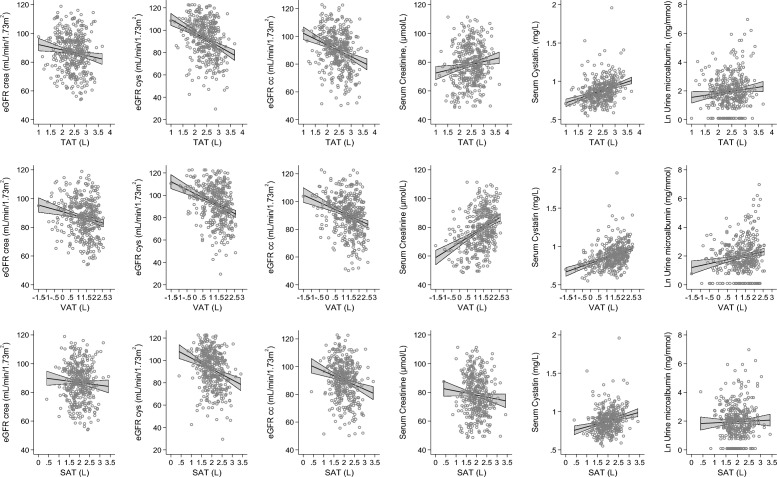
Obesity is characterized by the accumulation of adipose tissue in different body compartments. Whether adipose tissue directly affects kidney function is still unknown. We aimed to investigate the role of the adipose tissue and circulating creatinine, cystatin C and kidney function in subjects free of cardio-renal diseases. In the KORA-MRI population-based study, 377 subjects (mean age 56.2 ± 9.2 years; 41.6% female) underwent whole-body 3T-MRI examination. Adipose tissue defined as visceral adipose tissue (VAT) and subcutaneous adipose tissue (SAT) were quantified from T1-DIXON sequence using a semi-automatic algorithm. Serum creatinine and cystatin C were measured using standard laboratory and estimated glomerular filtration rate (e-GFR) was performed based on creatinine (e-GFR crea), cystatin C (e-GFR cys) and creatinine-cystatin C (e-GFR cc). Linear regression analysis, adjusted for risk factors, was used to investigate the relationship between adipose tissue and circulating creatinine, cystatin C, and kidney function. In multivariate analyses VAT was inversely associated with eGFR cys (ß = − 4.88, p = < 0.001), and positively associated with serum cystatin C (ß = 0.05, p = < 0.001), respectively. No association was found between other adipose parameters such as total adipose tissue (TAT) and subcutaneous adipose tissue (SAT) and serum creatinine, urine microalbumin and eGFR crea. Stratified analyses according to BMI revealed confirmatory results for category of BMI > 30. VAT is positively associated with serum cystatin C and inversely with eGFR based on cystatin C, suggesting a direct involvement of visceral adipose tissue in increased metabolism of cystatin C and consequently decreased kidney function.
Overview
The claims and statistics of this paper haven’t been checked yet.
Free: it reads the open-access text and checks the first 5 claims that cite a source we can check. Create a free account to check every claim.
Integrity signals
Registry
Cites
Statistics
Figures
Verification
Claims the paper makes
The claims and statistics of this paper haven’t been checked yet.
Free: it reads the open-access text and checks the first 5 claims that cite a source we can check. Create a free account to check every claim.
Claims other papers make about this one
Each is checked against this paper’s own text: does it say what the citing paper says it does?
The source backs part of the claim, not all of it — or backs it for a different population, condition or comparison.
In the citing paper
“In addition, reductions in body fat may affect plasma cystatin C levels without real changes in GFR because cystatin C is mainly produced in adipose tissue.31”
From The Effect of Retatrutide on Kidney Parameters in Participants With Type 2 Diabetes Mellitus and/or Obesity (2025) · cites this paper as [31]
Experimental — accuracy not yet measured
Self-check
Percentages, sums and reported differences re-computed from the paper’s own numbers.
The self-check needs the paper’s full text.
Citations
Cites
Bikbov, B., Purcell, C. A., Levey, A. S., Smith, M., Abdoli, A., Abebe, M., Adebayo, O. M., Afarideh, M., Agarwal, S. K., Agudelo-Botero, M., et al. (2020) · The Lancet · doi:10.1016/s0140-6736(20)30045-3 · Cited by 6,648
New creatinine- and cystatin C-based equations to estimate GFR without race
Inker, L. A., Eneanya, N. D., Coresh, J., Tighiouart, H., Wang, D., Sang, Y., Crews, D. C., Doria, A., Estrella, M. M., Froissart, M., et al. (2021) · New England Journal of Medicine · doi:10.1056/nejmoa2102953 · Cited by 4,695
Estimating glomerular filtration rate from serum creatinine and cystatin C
Inker, L. A., Schmid, C. H., Tighiouart, H., Eckfeldt, J. H., Feldman, H. I., Greene, T., Kusek, J. W., Manzi, J., Van Lente, F., Zhang, Y. L., et al. (2012) · New England Journal of Medicine · doi:10.1056/nejmoa1114248 · Cited by 4,102
Fox, C. S., Massaro, J. M., Hoffmann, U., Pou, K. M., Maurovich-Horvat, P., Liu, C.-Y., Vasan, R. S., Murabito, J. M., Meigs, J. B., Cupples, L. A., et al. (2007) · Circulation · doi:10.1161/circulationaha.106.675355 · Cited by 2,882
Visceral and ectopic fat, atherosclerosis, and cardiometabolic disease: a position statement
Neeland, I. J., Ross, R., Després, J.-P., Matsuzawa, Y., Yamashita, S., Shai, I., Seidell, J., Magni, P., Santos, R. D., Arsenault, B., et al. (2019) · The Lancet Diabetes & Endocrinology · doi:10.1016/s2213-8587(19)30084-1 · Cited by 1,603
Limitations of creatinine as a filtration marker in glomerulopathic patients
Shemesh, O., Golbetz, H., Kriss, J. P., & Myers, B. D. (1985) · Kidney International · doi:10.1038/ki.1985.205 · Cited by 1,227
Factors other than glomerular filtration rate affect serum cystatin C levels
Stevens, L. A., Schmid, C. H., Greene, T., Li, L., Beck, G. J., Joffe, M. M., Froissart, M., Kusek, J. W., Zhang, Y. (., Coresh, J., et al. (2009) · Kidney International · doi:10.1038/ki.2008.638 · Cited by 809
Obesity, kidney dysfunction and hypertension: mechanistic links
Hall, J. E., do Carmo, J. M., da Silva, A. A., Wang, Z., & Hall, M. E. (2019) · Nature Reviews Nephrology · doi:10.1038/s41581-019-0145-4 · Cited by 654
Structure and expression of the human cystatin C gene
Abrahamson, M., Olafsson, I., Palsdottir, A., Ulvsbäck, M., Lundwall, Å., Jensson, O., & Grubb, A. (1990) · Biochemical Journal · doi:10.1042/bj2680287 · Cited by 612
Research works printed but not linked: 1
- Fox, C. S. et al. Abdominal visceral and subcutaneous adipose tissue compartments: Association with metabolic risk factors in the Framingham Heart Study. Circulation 116(1), 39–48 (2007). · DOI · Paper page
Cited by
The Kidney in Obesity: Current Evidence, Perspectives and Controversies
Kounatidis, D. C., Vallianou, N. G., Stratigou, T., Voukali, M., Karampela, Ι., & Dalamaga, Μ. (2024) · Current Obesity Reports · doi:10.1007/s13679-024-00583-y · Cited by 54
“While GFR is the primary determinant of cystatin C concentration, it can still be influenced by various conditions, including obesity, though to a lesser extent than SCr [110].”
Heerspink, H. J. L., Lu, Z., Du, Y., Duffin, K. L., Coskun, T., Haupt, A., & Hartman, M. L. (2025) · Kidney International Reports · doi:10.1016/j.ekir.2025.03.049 · Cited by 23
“31 In our study, we did not fi nd correlations between BW changes and cystatin C – derived eGFR in the T2D and obesity trials.”
Mirzai, S., Persits, I., Kazibwe, R., Gabani, M. H., Seals, A. L., Singleton, M. J., Rikhi, R. R., Chevli, P. A., Carbone, S., Tang, W. H. W., et al. (2024) · Hypertension · doi:10.1161/hypertensionaha.124.23011 · Cited by 19
“10,11 21 For us, interaction testing failed to show effect modification by CKD or obesity across all outcomes except mortality reduction with intensive BP control in participants with sarcopenia and CKD.”
Obesity Is Associated with Fatty Liver and Fat Changes in the Kidneys in Humans as Assessed by MRI
Raphael, H., Klang, E., Konen, E., Inbar, Y., Leibowitz, A., Frenkel‐Nir, Y., Apter, S., & Grossman, E. (2024) · Nutrients · doi:10.3390/nu16091387 · Cited by 18
Raphael, H., Klang, E., Konen, E., Leibowitz, A., Frenkel‐Nir, Y., Apter, S., & Grossman, E. (2025) · Journal of Clinical Medicine · doi:10.3390/jcm14124305 · Cited by 12
“Studies have demonstrated that individuals with fatty liver are significantly more likely to have fatty kidneys, suggesting a shared pathogenic mechanism involving ectopic fat deposition [7,8].”
Metadata
- Authors
- Mueller-Peltzer, K., von Krüchten, R., Lorbeer, R., Rospleszcz, S., Schulz, H., Peters, A., Bamberg, F., Schlett, C. L., & Mujaj, B.
- Affiliations
- Ludwig-Maximilians-Universität München (DE)
- Helmholtz Munich (DE)
- University of Freiburg (DE)
- Corresponding author
- Mujaj, Blerim
- ORCID
- Venue
- Scientific Reports
- Published
- 2023-06-06
- Volume
- 13
- Issue
- 1
- Pages
- 9151-9151
- ISSN
- 2045-2322 (ISSN-L)
- PMC
- PMC10244418
- OpenAlex
- W4379536225
- Cited by
- 25
- References
- 33
- Citations by year
- 2026: 7 · 2025: 9 · 2024: 9
- FWCI
- 4.85
- Type
- journal article
- Language
- en
- Open access
- gold
- doi.org
- Licence
- cc-by
- creativecommons.org/licenses/by/4.0 (tdm)
- creativecommons.org/licenses/by/4.0 (vor)
- Locations
- Scientific Reports (publishedVersion, cc-by)
- PubMed Central (publishedVersion, cc-by)
- PubMed (publishedVersion)
- Open access LMU (Ludwid Maxmilian's Universitat Munchen) (submittedVersion, cc-by)
- PuSH - Publication Server of Helmholtz Zentrum München (submittedVersion, cc-by)
- DOAJ (DOAJ: Directory of Open Access Journals) (submittedVersion, cc-by-sa)
- Funders
- Universitätsklinikum Freiburg
- Topics
- Health Sciences › Medicine › Nephrology › Chronic Kidney Disease and Diabetes
- Health Sciences › Medicine › Cardiology and Cardiovascular Medicine › Cardiovascular Disease and Adiposity
- Health Sciences › Medicine › Endocrinology, Diabetes and Metabolism › Adipokines, Inflammation, and Metabolic Diseases
- Keywords
- adipose tissue, visceral adipose tissue, subcutaneous adipose tissue, renal function, cystatin C, serum creatinine, estimated glomerular filtration rate, obesity, body mass index, urinary microalbumin
- MeSH terms
- Aged, Creatinine, Female, Glomerular Filtration Rate, Humans, Kidney, Male, Middle Aged, Obesity, Risk Factors, Subcutaneous Fat, Cystatin C
About these checks
Registry, retraction, Cites and statistics results are computed, not judged, with one exception: a printed reference that no index lists is read once by a model before it counts as a citation error. Claims are extracted by a model and kept only when their quote appears verbatim in the text; each cited source is then checked, with a model’s help, for whether it says what the claim relies on. Those verdicts can be wrong — read the claim’s quote and the cited source before relying on one.
Statistics and arithmetic are recomputed, not judged.
Confidence bands are shown only for fields calibrated on our annotated test set. None is calibrated yet, so no band is shown.
What counts as a claim ›How we measure confidence ›How we check this ›
Are you an author, or do you see a problem with this page? Request a review
How to cite
Cite CoChat for the checks on this page, and the paper for its own findings.
- This page
- CoChat. (2026). Citation check: Adipose tissue is associated with kidney function parameters. https://app.cochat.ai/papers/10.1038/s41598-023-36390-z
- The paper
- Mueller-Peltzer, K., von Krüchten, R., Lorbeer, R., Rospleszcz, S., Schulz, H., Peters, A., Bamberg, F., Schlett, C. L., & Mujaj, B. (2023). Adipose tissue is associated with kidney function parameters. Scientific Reports. https://doi.org/10.1038/s41598-023-36390-z
Data sources
Bibliographic data: Semantic Scholar, OpenAlex, Crossref.
Contains information from the Semantic Scholar Academic Graph Datasets, made available under the ODC Attribution License (ODC-BY 1.0).
Semantic Scholar’s data is described in: Kinney, R., et al. (2023). The Semantic Scholar Open Data Platform. arXiv:2301.10140.
