

Attention and impulsivity assessment using virtual reality games
Open accessThe DOI matches its Crossref record; 49 of the 49 references it cites were found in a registry or an index.
Abstract
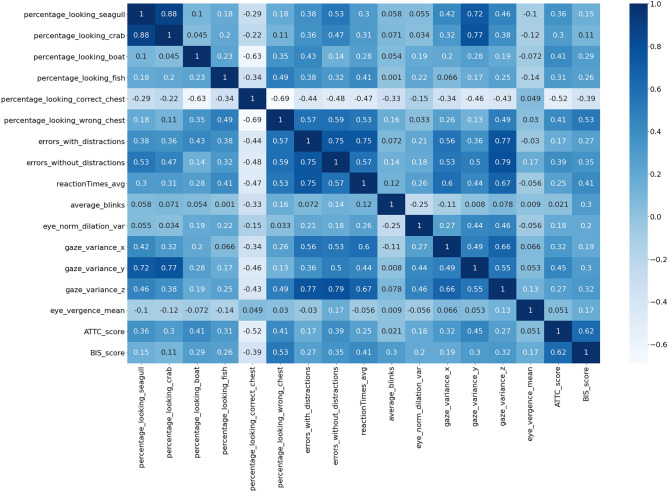
The assessment of cognitive functions is mainly based on standardized neuropsychological tests, widely used in various fields such as personnel recruitment, education, or health. This paper presents a virtual reality game that allows collecting continuous measurements of both the performance and behaviour of the subject in an immersive, controllable, and naturalistic experience. The application registers variables related to the user’s eye movements through the use of virtual reality goggles, as well as variables of the game performance. We study how virtual reality can provide data to help predict scores on the Attention Control Scale Test and the Barratt Impulsiveness Scale. We design the application and test it with a pilot group. We build a random forest regressor model to predict the attention and impulsivity scales’ total score. When evaluating the performance of the model, we obtain a positive correlation with attention (0.434) and with impulsivity (0.382). In addition, our model identified that the most significant variables are the time spent looking at the target or at distractors, the eye movements variability, the number of blinks and the pupil dilation in both attention and impulsivity. Our results are consistent with previous results in the literature showing that it is possible to use data collected in virtual reality to predict the degree of attention and impulsivity.
Overview
The claims and statistics of this paper haven’t been checked yet.
Free: it reads the open-access text and checks the first 5 claims that cite a source we can check. Create a free account to check every claim.
Integrity signals
Registry
Cites
Statistics
Figures




Verification
Claims the paper makes
The claims and statistics of this paper haven’t been checked yet.
Free: it reads the open-access text and checks the first 5 claims that cite a source we can check. Create a free account to check every claim.
Claims other papers make about this one
Each is checked against this paper’s own text: does it say what the citing paper says it does?
The source backs part of the claim, not all of it — or backs it for a different population, condition or comparison.
In the citing paper
“VR tasks to assess ADHD have recently emerged; however, many of them focus on sustained attention tasks in unrealistic settings [34].”
From Enhancing Ecological Validity: Virtual Reality Assessment of Executive Functioning in Children and Adolescents with ADHD (2024) · cites this paper as [34]
Experimental — accuracy not yet measured
Self-check
Percentages, sums and reported differences re-computed from the paper’s own numbers.
The self-check needs the paper’s full text.
Citations
Cites
A continuous performance test of brain damage
Rosvold, H. E., Mirsky, A. F., Sarason, I., Bransome, E. D., & Beck, L. H. (1956) · Journal of Consulting Psychology · doi:10.1037/h0043220 · Cited by 2,261 · cited 1×
“The CPTs have been used in a variety of settings, for instance, to test the attention of brain-damaged patients 12 , or to test the skills of radar operators 30 .”
MethodAnxiety-related attentional biases and their regulation by attentional control.
Derryberry, D., & Reed, M. A. (2002) · Journal of Abnormal Psychology · doi:10.1037/0021-843x.111.2.225 · Cited by 1,729 · cited 2×
“A self-report scale widely used to measure attention control 25 is the Attention Control Scale (ATTC) questionnaire 26 .”
MethodFifty years of the Barratt Impulsiveness Scale: an update and review
Stanford, M. S., Mathias, C. W., Dougherty, D. M., Lake, S. L., Anderson, N. E., & Patton, J. H. (2009) · Personality and Individual Differences · doi:10.1016/j.paid.2009.04.008 · Cited by 1,609 · cited 8×
“In this work, we have proposed the Treasure Hunt VR application that gathers performance and behavioural data that are then used to accurately predict the scores of the ATTC and BIS-11 self-report scales.”
MethodInfluentialThe role of impulsivity in the development of substance use and eating disorders
Dawe, S., & Loxton, N. J. (2004) · Neuroscience & Biobehavioral Reviews · doi:10.1016/j.neubiorev.2004.03.007 · Cited by 944
Updated European Consensus Statement on diagnosis and treatment of adult ADHD
Kooij, J. J. S., Bijlenga, D., Salerno, L., Jaeschke, R., Bitter, I., Balázs, J., Thome, J., Dom, G., Kasper, S., Nunes Filipe, C., et al. (2019) · European Psychiatry · doi:10.1016/j.eurpsy.2018.11.001 · Cited by 686
Lumsden, J., Edwards, E. A., Lawrence, N. S., Coyle, D., & Munafò, M. R. (2016) · JMIR Serious Games · doi:10.2196/games.5888 · Cited by 555
Relations between preschool attention span-persistence and age 25 educational outcomes
McClelland, M. M., Acock, A. C., Piccinin, A., Rhea, S. A., & Stallings, M. C. (2013) · Early Childhood Research Quarterly · doi:10.1016/j.ecresq.2012.07.008 · Cited by 477
Developmental Normative Data on The Test of Variables of Attention (T.O.V.A.™)
Greenberg, L. M., & Waldmant, I. D. (1993) · Journal of Child Psychology and Psychiatry · doi:10.1111/j.1469-7610.1993.tb01105.x · Cited by 446 · cited 5×
“Rodriguez et al. 38 found that Aula Nesplora, another VR-CPT solution within a virtual class, is a better predictor of ADHD than TOVA.”
MethodInfluentialThe d2 Test of Attention: Construct validity and extensions in scoring techniques
BATES, M. E., & LEMAY, E. P. (2004) · Journal of the International Neuropsychological Society · doi:10.1017/s135561770410307x · Cited by 355 · cited 5×
“After the game is over, and in order to determine how well our application is capable of predicting the degree of attention and impulsivity, we administered the Attention Control Scale (ATTC) questionnaire 26 and the Barratt Impulsiveness Scale (BIS-11) 27 .”
MethodInfluentialBruchmüller, K., Margraf, J., & Schneider, S. (2012) · Journal of Consulting and Clinical Psychology · doi:10.1037/a0026582 · Cited by 354
Research works printed but not linked: 1
- Cutler A Cutler DR Stevens JR Random Forests 2012 Springer
Cited by
Romero-Ayuso, D., del Pino-González, A., Torres-Jiménez, A., Juan-González, J., Celdrán, F. J., Franchella, M. C., Ortega-López, N., Triviño-Juárez, J. M., Garach-Gómez, A., Arrabal-Fernández, L., et al. (2024) · Children · doi:10.3390/children11080986 · Cited by 20
“…found between the results of the neuropsychological tests administered and the performance of SmartAction-VR (Table 5), there was a significant negative correlation between accuracy and the total errors, omissions, and commissions. these findings are also supported by other authors [34,43].”
BackgroundResultCognitive Load Inference Using Physiological Markers in Virtual Reality
Wei, J., Siegel, E. H., Sundaramoorthy, P., Gomes, A., Zhang, S., Vankipuram, M., Smathers, K., Ghosh, S., Horii, H., Bailenson, J. N., et al. (2025) · IEEE Conference on Virtual Reality and 3D User Interfaces (VR) · doi:10.1109/vr59515.2025.00098 · Cited by 35
“The cognitive load inference is also widely used by academic researchers to study areas such as virtual commerce in VR [60], VR gaming [36], and virtual assistant in driving [61].”
Liao, K.-L., Huang, M., Shi, J., Chen, M., & Yang, R. (2025) · IEEE Transactions on Visualization and Computer Graphics · doi:10.1109/tvcg.2025.3549543 · Cited by 12
“Emerging technologies, such as eye-tracking, offer more granular insights by directly measuring where and how often a patient’s gaze aligns with crucial elements of the therapeutic activity, providing real-time feedback that is invaluable for adjusting treatments to maximize efficacy [34,44–47].”
Zaheer, A., & Akhtar, A. (2025) · Child Neuropsychology · doi:10.1080/09297049.2025.2468411 · Cited by 19
Prié, Y., Vigier, T., Acier, D., Bonneville, H., Georges, M., Thévenet, S., & Bulteau, S. (2025) · Frontiers in Virtual Reality · doi:10.3389/frvir.2025.1545569 · Cited by 6
Metadata
- Authors
- Mendez-Encinas, D., Sujar, A., Bayona, S., & Delgado-Gomez, D.
- Affiliations
- Universidad Carlos III de Madrid (ES)
- ORCID
- Sujar, Aaron
- Venue
- Scientific Reports
- Published
- 2023-08-22
- Volume
- 13
- Issue
- 1
- Pages
- 13689-13689
- ISSN
- 2045-2322 (ISSN-L)
- PMC
- PMC10444747
- OpenAlex
- W4386068442
- Cited by
- 15
- References
- 49
- Citations by year
- 2026: 6 · 2025: 6 · 2024: 3
- FWCI
- 2.60
- Type
- journal article
- Language
- en
- Open access
- gold
- doi.org
- Licence
- cc-by
- creativecommons.org/licenses/by/4.0 (tdm)
- creativecommons.org/licenses/by/4.0 (vor)
- Locations
- Scientific Reports (publishedVersion, cc-by)
- PubMed Central (publishedVersion, cc-by)
- PubMed (publishedVersion)
- BURJC Digital (King Juan Carlos University) (submittedVersion, cc-by)
- DOAJ (DOAJ: Directory of Open Access Journals) (submittedVersion, cc-by-sa)
- Hispana (submittedVersion, cc-by)
- Funders
- European Commission (MCIN /AEI/ 10.13039/501100011033, 10.13039/501100011033, 13039/501100011033, 501100011033)
- Universidad Carlos III de Madrid
- Instituto de Salud Carlos III (DTS21/00091)
- Agencia Estatal de Investigación (AEI//10.13039/501100011033/, 501100011033, 10.13039/501100011033, MCIN/AEI/10.13039/501 100 011 033, 13039, .13039/501100011033, 10.13039)
- NextGenerationEU
- Topics
- Physical Sciences › Computer Science › Human-Computer Interaction › Gaze Tracking and Assistive Technology
- Physical Sciences › Computer Science › Human-Computer Interaction › Virtual Reality Applications and Impacts
- Life Sciences › Neuroscience › Cognitive Neuroscience › EEG and Brain-Computer Interfaces
- Keywords
- attention, impulsivity, virtual reality games, eye tracking, Barratt Impulsiveness Scale, pupil dilation, eye blink detection, random forest regression, cognitive assessment, game-based assessment
- MeSH terms
- Virtual Reality, Cognition, Educational Status, Eye Movements, Impulsive Behavior
About these checks
Registry, retraction, Cites and statistics results are computed, not judged, with one exception: a printed reference that no index lists is read once by a model before it counts as a citation error. Claims are extracted by a model and kept only when their quote appears verbatim in the text; each cited source is then checked, with a model’s help, for whether it says what the claim relies on. Those verdicts can be wrong — read the claim’s quote and the cited source before relying on one.
Statistics and arithmetic are recomputed, not judged.
Confidence bands are shown only for fields calibrated on our annotated test set. None is calibrated yet, so no band is shown.
What counts as a claim ›How we measure confidence ›How we check this ›
Are you an author, or do you see a problem with this page? Request a review
How to cite
Cite CoChat for the checks on this page, and the paper for its own findings.
- This page
- CoChat. (2026). Citation check: Attention and impulsivity assessment using virtual reality games. https://app.cochat.ai/papers/10.1038/s41598-023-40455-4
- The paper
- Mendez-Encinas, D., Sujar, A., Bayona, S., & Delgado-Gomez, D. (2023). Attention and impulsivity assessment using virtual reality games. Scientific Reports. https://doi.org/10.1038/s41598-023-40455-4
Data sources
Bibliographic data: Semantic Scholar, OpenAlex, Crossref.
Contains information from the Semantic Scholar Academic Graph Datasets, made available under the ODC Attribution License (ODC-BY 1.0).
Semantic Scholar’s data is described in: Kinney, R., et al. (2023). The Semantic Scholar Open Data Platform. arXiv:2301.10140.
