

Co-embedding of edges and nodes with deep graph convolutional neural networks
Open accessThe DOI matches its Crossref record; 39 of the 39 references it cites were found in a registry or an index.
Abstract
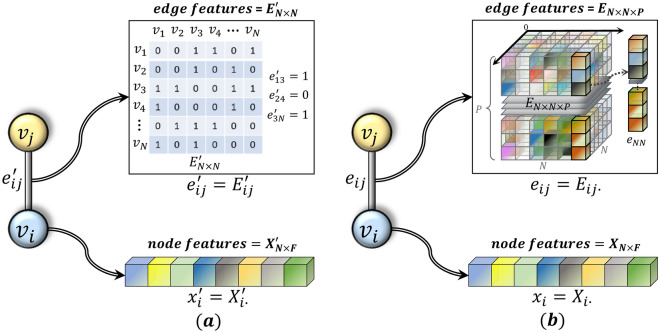
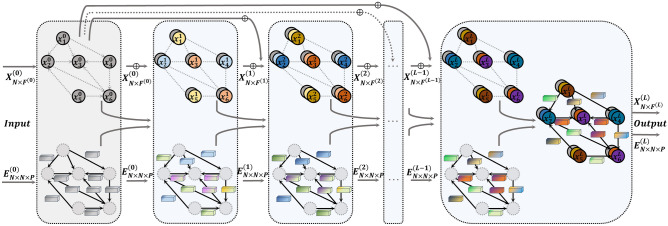
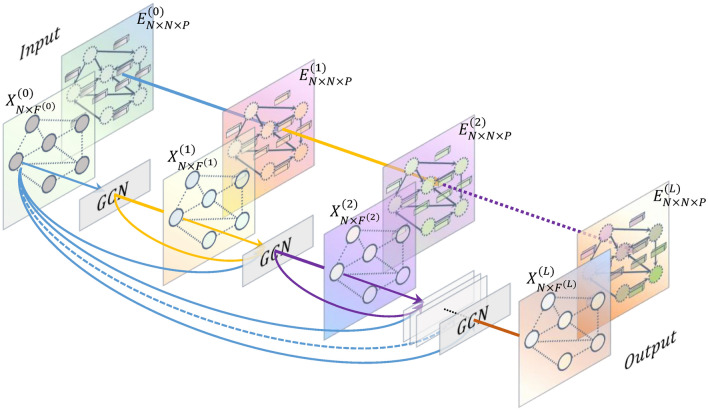
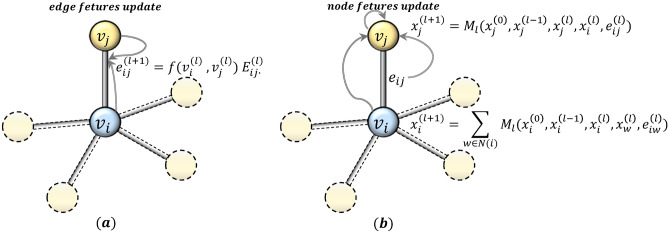
Graph neural networks (GNNs) have significant advantages in dealing with non-Euclidean data and have been widely used in various fields. However, most of the existing GNN models face two main challenges: (1) Most GNN models built upon the message-passing framework exhibit a shallow structure, which hampers their ability to efficiently transmit information between distant nodes. To address this, we aim to propose a novel message-passing framework, enabling the construction of GNN models with deep architectures akin to convolutional neural networks (CNNs), potentially comprising dozens or even hundreds of layers. (2) Existing models often approach the learning of edge and node features as separate tasks. To overcome this limitation, we aspire to develop a deep graph convolutional neural network learning framework capable of simultaneously acquiring edge embeddings and node embeddings. By utilizing the learned multi-dimensional edge feature matrix, we construct multi-channel filters to more effectively capture accurate node features. To address these challenges, we propose the Co-embedding of Edges and Nodes with Deep Graph Convolutional Neural Networks (CEN-DGCNN). In our approach, we propose a novel message-passing framework that can fully integrate and utilize both node features and multi-dimensional edge features. Based on this framework, we develop a deep graph convolutional neural network model that prevents over-smoothing and obtains node non-local structural features and refined high-order node features by extracting long-distance dependencies between nodes and utilizing multi-dimensional edge features. Moreover, we propose a novel graph convolutional layer that can learn node embeddings and multi-dimensional edge embeddings simultaneously. The layer updates multi-dimensional edge embeddings across layers based on node features and an attention mechanism, which enables efficient utilization and fusion of both node and edge features. Additionally, we propose a multi-dimensional edge feature encoding method based on directed edges, and use the resulting multi-dimensional edge feature matrix to construct a multi-channel filter to filter the node information. Lastly, extensive experiments show that CEN-DGCNN outperforms a large number of graph neural network baseline methods, demonstrating the effectiveness of our proposed method.
Overview
The claims and statistics of this paper haven’t been checked yet.
Free: it reads the open-access text and checks the first 5 claims that cite a source we can check. Create a free account to check every claim.
Integrity signals
Registry
Cites
Statistics
Figures

Verification
Claims the paper makes
The claims and statistics of this paper haven’t been checked yet.
Free: it reads the open-access text and checks the first 5 claims that cite a source we can check. Create a free account to check every claim.
Self-check
Percentages, sums and reported differences re-computed from the paper’s own numbers.
The self-check needs the paper’s full text.
Citations
Cites
Deep Residual Learning for Image Recognition
He, K., Zhang, X., Ren, S., & Sun, J. (2016) · 2016 IEEE Conference on Computer Vision and Pattern Recognition (CVPR) · doi:10.1109/cvpr.2016.90 · Cited by 235,474 · cited 1×
“For architecture modification, most of the existing methods mainly introduce the residual connection 23,24 in convolutional neural network (CNN) into GCN. Li et al. 15 borrowed from the concept of CNN, applied methods such as residual connection, dense connection, and dilated convolution to the GCN…”
MethodDensely Connected Convolutional Networks
Huang, G., Liu, Z., Van Der Maaten, L., & Weinberger, K. Q. (2017) · 2017 IEEE Conference on Computer Vision and Pattern Recognition (CVPR) · doi:10.1109/cvpr.2017.243 · Cited by 48,566
A Comprehensive Survey on Graph Neural Networks
Wu, Z., Pan, S., Chen, F., Long, G., Zhang, C., & Yu, P. S. (2021) · IEEE Transactions on Neural Networks and Learning Systems · doi:10.1109/tnnls.2020.2978386 · Cited by 11,000 · cited 1×
“…features between nodes, we hope to build a deep GCN model, but when the model is too deep, it usually appears the phenomenon of over-smoothing 7,21,22 and over-squeezing 19 , and the node representation will become indistinguishable or distorted, resulting in a great degradation of network…”
BackgroundDeepWalk: online learning of social representations
Perozzi, B., Al-Rfou, R., & Skiena, S. (2014) · Proceedings of the 20th ACM SIGKDD international conference on Knowledge discovery and data mining · doi:10.1145/2623330.2623732 · Cited by 10,123
Graph Neural Networks: A Review of Methods and Applications
Zhou, J., Cui, G., Hu, S., Zhang, Z., Yang, C., Liu, Z., Wang, L., Li, C., & Sun, M. (2018) · arXiv · doi:10.48550/arxiv.1812.08434 · Cited by 6,880
Graph neural networks: A review of methods and applications
Zhou, J., Cui, G., Hu, S., Zhang, Z., Yang, C., Liu, Z., Wang, L., Li, C., & Sun, M. (2020) · AI Open · doi:10.1016/j.aiopen.2021.01.001 · Cited by 6,880
Modeling Relational Data with Graph Convolutional Networks
Schlichtkrull, M., Kipf, T. N., Bloem, P., van den Berg, R., Titov, I., & Welling, M. (2018) · Lecture Notes in Computer Science · doi:10.1007/978-3-319-93417-4_38 · Cited by 5,570
Spatial Temporal Graph Convolutional Networks for Skeleton-Based Action Recognition
Yan, S., Xiong, Y., & Lin, D. (2018) · Proceedings of the AAAI Conference on Artificial Intelligence · doi:10.1609/aaai.v32i1.12328 · Cited by 5,410
A Comprehensive Survey on Graph Neural Networks
Wu, Z., Pan, S., Chen, F., Long, G., Zhang, C., & Yu, P. (2020) · UTS ePRESS (University of Technology Sydney) · Cited by 3,174
Representation Learning on Graphs with Jumping Knowledge Networks
Xu, K., Li, C., Tian, Y., Sonobe, T., Kawarabayashi, K.-I., & Jegelka, S. (2018) · arXiv · doi:10.48550/arxiv.1806.03536 · Cited by 2,757 · cited 1×
“Xu et al. 26 proposed the Jumping Knowledge Networks, which differ from common neighborhood aggregation networks that aggregate information from the previous layer in each layer.”
Background
Research works printed but not linked: 24
- Gilmer, J., Schoenholz, S. S., Riley, P. F., Vinyals, O. & Dahl, G. E. Neural message passing for quantum chemistry. In Proceedings of the 34th International Conference on Machine Learning (eds. Precup, D. & Teh, Y. W.) vol. 70 1263–1272 (PMLR, 2017).
- Veličković, P. et al. Graph attention networks. In 6th International Conference on Learning Representations, {ICLR} 2018, Vancouver, BC, Canada, April 30–May 3, 2018, Conference Track Proceedings (OpenReview.net, 2018).
- Li, Q., Han, Z. & Wu, X.-M. Deeper insights into graph convolutional networks for semi-supervised learning. In Proceedings of the Thirty-Second {AAAI} Conference on Artificial Intelligence, (AAAI-18), the 30th innovative Applications of Artificial Intelligence (IAAI-18), and the 8th {AAAI} Symposium on Educational Advances in Artificial Intelligence (EAAI-18), New (eds. McIlraith, S. A. & Weinberger, K. Q.) 3538–3545 ({AAAI} Press, 2018).
- Rusch, T. K., Chamberlain, B., Rowbottom, J., Mishra, S. & Bronstein, M. M. Graph-coupled oscillator networks. In International Conference on Machine Learning, {ICML} 2022, 17–23 July 2022, Baltimore, Maryland, {USA} (eds. Chaudhuri, K. et al.) vol. 162, 18888–18909 (PMLR, 2022).
- Rusch, T. K., Chamberlain, B. P., Mahoney, M. W., Bronstein, M. M. & Mishra, S. Gradient gating for deep multi-rate learning on graphs. In The Eleventh International Conference on Learning Representations, {ICLR} 2023, Kigali, Rwanda, May 1–5, 2023 (OpenReview.net, 2023).
- Bodnar, C., Giovanni, F. Di, Chamberlain, B. P., Lió, P. & Bronstein, M. M. Neural sheaf diffusion: {A} Topological perspective on heterophily and oversmoothing in GNNs. in NeurIPS (2022).
- Oono, K. & Suzuki, T. Graph neural networks exponentially lose expressive power for node classification. In 8th International Conference on Learning Representations, {ICLR} 2020, Addis Ababa, Ethiopia, April 26–30, 2020 (OpenReview.net, 2020).
- Alon, U. & Yahav, E. On the Bottleneck of graph neural networks and its practical implications. In 9th International Conference on Learning Representations, {ICLR} 2021, Virtual Event, Austria, May 3–7, 2021 (OpenReview.net, 2021).
- Chen, M., Wei, Z., Huang, Z., Ding, B. & Li, Y. Simple and deep graph convolutional networks. In Proceedings of the 37th International Conference on Machine Learning, {ICML} 2020, 13–18 July 2020, Virtual Event vol. 119, 1725–1735 (PMLR, 2020).
- Zhao, L. & Akoglu, L., PairNorm: Tackling oversmoothing in GNNs. In 8th International Conference on Learning Representations, {ICLR} 2020, Addis Ababa, Ethiopia, April 26–30, 2020 (OpenReview.net, 2020).
- Li, G., Xiong, C., Thabet, A. K. & Ghanem, B. DeeperGCN: All you need to train deeper GCNs. CoRR abs/2006.0 (2020).
- Srivastava N Hinton GE Krizhevsky A Sutskever I Salakhutdinov R Dropout: A simple way to prevent neural networks from overfitting J. Mach. Learn. Res. 2014 15 1929 1958
- Rong, Y., Huang, W., Xu, T. & Huang, J. DropEdge: Towards deep graph convolutional networks on node classification. In 8th International Conference on Learning Representations, {ICLR} 2020, Addis Ababa, Ethiopia, April 26–30, 2020 (OpenReview.net, 2020).
- Huang, W., Rong, Y., Xu, T., Sun, F. & Huang, J. Tackling over-smoothing for general graph convolutional networks. CoRR abs/2008.0, (2020).
- Corso, G., Cavalleri, L., Beaini, D., Liò, P. & Veličković, P. Principal neighbourhood aggregation for graph nets. In Advances in Neural Information Processing Systems 33: Annual Conference on Neural Information Processing Systems 2020, NeurIPS 2020, December 6–12, 2020, virtual (eds. Larochelle, H., Ranzato, M., Hadsell, R., Balcan, M.-F. & Lin, H.-T.) (2020).
- Bahdanau, D., Cho, K. & Bengio, Y. Neural machine translation by jointly learning to align and translate. In 3rd International Conference on Learning Representations, {ICLR} 2015, San Diego, CA, USA, May 7–9, 2015, Conference Track Proceedings (eds. Bengio, Y. & LeCun, Y.) (2015).
- Yang, Y. & Li, D. {NENN:} Incorporate node and edge features in graph neural networks. In Proceedings of the 12th Asian Conference on Machine Learning, {ACML} 2020, 18–20 November 2020, Bangkok, Thailand (eds. Pan, S. J. & Sugiyama, M.) vol. 129 593–608 (PMLR, 2020).
- Klicpera, J., Bojchevski, A. & Günnemann, S. Predict then propagate: Graph neural networks meet personalized pagerank. In 7th International Conference on Learning Representations, {ICLR} 2019, New Orleans, LA, USA, May 6–9, 2019 (OpenReview.net, 2019).
- Kingma, D. P. & Ba, J. Adam: {A} method for stochastic optimization. In 3rd International Conference on Learning Representations, {ICLR} 2015, San Diego, CA, USA, May 7–9, 2015, Conference Track Proceedings (eds. Bengio, Y. & LeCun, Y.) (2015).
- Klicpera, J., Weißenberger, S. & Günnemann, S. Diffusion improves graph learning. In Advances in Neural Information Processing Systems 32: Annual Conference on Neural Information Processing Systems 2019, NeurIPS 2019, December 8–14, 2019, Vancouver, BC, Canada (eds. Wallach, H. M. et al.) 13333–13345 (2019).
- Kipf, T. N. & Welling, M. Variational graph auto-encoders. CoRR abs/1611.0 (2016).
- Hamilton, W., Ying, Z. & Leskovec, J. Inductive representation learning on large graphs. In Advances in Neural Information Processing Systems (eds. Guyon, I. et al.) vol. 30 (Curran Associates, Inc., 2017).
- Li, G., Müller, M., Ghanem, B. & Koltun, V. Training graph neural networks with 1000 layers. In Proceedings of the 38th International Conference on Machine Learning, {ICML} 2021, 18–24 July 2021, Virtual Event (eds. Meila, M. & Zhang, T.) vol. 139, 6437–6449 (PMLR, 2021).
- Chen, J., Ma, T. & Xiao, C. FastGCN: Fast learning with graph convolutional networks via importance sampling. In 6th International Conference on Learning Representations, {ICLR} 2018, Vancouver, BC, Canada, April 30–May 3, 2018, Conference Track Proceedings (OpenReview.net, 2018).
Cited by
Simon, B. D., Ozyoruk, K. B., Gelikman, D. G., Harmon, S. A., & Türkbey, B. (2024) · Diagnostic and Interventional Radiology · doi:10.4274/dir.2024.242631 · Cited by 73
“37 They can explicitly model the complex relationships between modalities, rather than attempting to map them in grid-like structures, such as CNNs, which may not fully take the structure into account 38 and could introduce biases related to artificial adjacency in grid formatting.”
BackgroundGoeckner, A., Sui, Y., Martinet, N., Li, X. D., & Zhu, Q. (2024) · IEEE/RSJ International Conference on Intelligent Robots and Systems (IROS) · doi:10.1109/iros58592.2024.10802510 · Cited by 68
“Zhou et al. proposed a GNN framework [6] that integrates node and edge features to boost long-distance information transmission and enhance node embeddings.”
Rethinking Reconstruction-based Graph-Level Anomaly Detection: Limitations and a Simple Remedy
Kim, S., Lee, S. Y., Bu, F., Kang, S., Kim, K., Yoo, J., & Shin, K. (2024) · neural information processing systems · doi:10.52202/079017-3040 · Cited by 38
Self-citationUsing DeepSignalingFlow to mine signaling flows interpreting mechanism of synergy of cocktails
Zhang, H., Chen, Y., Payne, P., & Li, F. (2024) · npj Systems Biology and Applications · doi:10.1038/s41540-024-00421-w · Cited by 18
Multilayer biological network alignment based on similarity computation via Graph Neural Networks
Cinaglia, P. (2024) · Journal of Computational Science · doi:10.1016/j.jocs.2024.102259 · Cited by 16
AdaMGT: Molecular representation learning via adaptive mixture of GCN-Transformer
Ding, C., Yan, Z., Ma, L., Cao, B., & Cao, L. (2025) · Knowledge-Based Systems · doi:10.1016/j.knosys.2025.113131 · Cited by 12
Effective Edge-wise Representation Learning in Edge-Attributed Bipartite Graphs
Wang, H., Yang, R., & Xiao, X. (2024) · ACM SIGKDD Conference on Knowledge Discovery and Data Mining (KDD) · doi:10.1145/3637528.3671805 · Cited by 12
Edge-Boosted Graph Learning for Functional Brain Connectivity Analysis
Yang, D., Abdelmegeed, M., Modl, J., & Kim, M. (2025) · IEEE International Symposium on Biomedical Imaging (ISBI) · doi:10.1109/isbi60581.2025.10980882 · Cited by 9
“Inspired by recent co-embedding approaches for GNNs [9], we take nodes and edges as the input and combining them into a node-edge representation, updating the node embedding with the edge embedding layer.”
Fault diagnosis of mechanical seals using graph neural networks with multi-sensor data fusion
Zhu, X., Wang, J., Wang, B., Wang, H., Sheng, R., & Zhai, B. (2025) · Advances in Mechanical Engineering · doi:10.1177/16878132251319141 · Cited by 5
“7,8 Unlike conventional neural networks, GNNs can maintain the structural information of graphs while leveraging the relationships between nodes for feature learning.”
A message passing framework for precise cell state identification with scClassify2
Ding, W., Cao, Y., Fu, X., Torkel, M., & Yang, J. Y. H. (2025) · Genome biology · doi:10.1186/s13059-025-03722-3 · Cited by 4
“A catalogue framework of cell state annotations containing pre-train models for various human tissues is made available via a user-friendly web server (https://shiny.maths.usyd.edu.au/scClassify_catalogue/) as a community resource.”
ADHD Classification With GCN via Joint Feature Learning Among Nodes and Edges
Wang, X., Tang, Y., Gao, Y., Meng, X., Chen, Y., & Jiang, A. (2026) · IEEE Transactions on Medical Imaging · doi:10.1109/tmi.2026.3656430 · Cited by 4
“As a result, researchers have recently paid attention to simultaneously learning node and edge embeddings [17], [18], [19].”
Greener GRASS: Enhancing GNNs with Encoding, Rewiring, and AttentionPreprint
Liao, T., & Póczos, B. (2024) · arXiv (Cornell University) · doi:10.48550/arxiv.2407.05649 · Cited by 4
“To achieve Relationship Representation , edge representations must be updated alongside node representations (Zhou et al., 2023).”
Dirac--Bianconi Graph Neural Networks -- Enabling Non-Diffusive Long-Range Graph PredictionsPreprint
Nauck, C., Gorantla, R., Lindner, M., Schürholt, K., Mey, A. S. J. S., & Hellmann, F. (2024) · arXiv (Cornell University) · doi:10.48550/arxiv.2407.12419 · Cited by 4
“…edge features are updated simultaneously with node features from layer to layer (see for example Yang & Li (2020); Chen & Chen (2021); He et al. (2023); Zhou et al. (2023)) has not been explored as extensively: In contrast to ordinary MPNNs, the variable e cannot be eliminated from the equations.”
A Node Importance Evaluation Method Based on Graph-Transformer
Yang, X., & Shu, J. (2024) · International Conference on Communication and Information Systems (ICCIS) · doi:10.1109/iccis63642.2024.10779437 · Cited by 3
Mithril: A Scalable System for Deep GNN Training
Chen, J., Chen, Z., & Qian, X. (2025) · IEEE International Symposium on High-Performance Computer Architecture (HPCA) · doi:10.1109/hpca61900.2025.00082 · Cited by 3
“Inspired by the success of the deep neural network models like convolution neural networks [22], [24], [52], [55], [56] in deep learning, tremendous research efforts have been devoted to making GNN models deeper [5], [7], [8], [12], [21], [27], [34], [35], [48], [67], [74], [75].”
Nguyen, L. T., & Tran, T. T. (2025) · ACM SIGIR International Conference on Theory of Information Retrieval (ICTIR) · doi:10.1145/3731120.3744576 · Cited by 3
Herb Target Prediction Using Machine Learning Methods in a Heterogeneous Network
Fathi, P., & Charkari, N. M. (2025) · International Journal of Engineering · doi:10.5829/ije.2025.38.04a.02 · Cited by 1
Qian, C., Deng, H., Ni, X., Wang, D., Wei, B., Chen, H., & Huang, J. (2025) · Applied Sciences · doi:10.3390/app15137133 · Cited by 2
QuOp: A Quantum Operator Representation for Nodes
Vlasic, A., & Aguiñaga, S. (2025) · IEEE International Conference on Quantum Computing and Engineering (QCE) · doi:10.1109/qce65121.2025.00046 · Cited by 2
“The probability measure is represented as follows, see Figure 1 and refer to Zhou et al. [30] for context in general graphs, Within Figure 1, Θ( v i ) is the vector representation for node v i , Θ( v i ) T · Θ( v j ) is the dot product of the embedded nodes, and Θ( · ) is the mapping derived from…”
Design Scheme Style Feature Extraction and Machine Learning Classification Algorithm Construction
Wang, W. (2026) · International Scientific Technical and Economic Research · doi:10.67541/istaer2623 · Cited by 2
Edge Convolutional Networks for Style Change Detection in Arabic Multi-Authored Text
Alsheddi, A. S., & Menaï, M. E. B. (2025) · Applied Sciences · doi:10.3390/app15126633 · Cited by 2
Dynamic Graph Learning for Systems Using Selective State Focused Attention Networks
Vashistha, S., & Kumar, N. (2025) · IEEE/ACM International Symposium on Cluster, Cloud and Grid Computing (CCGrid) · doi:10.1109/ccgrid64434.2025.00014 · Cited by 2
“For the inductive task, the averaged F1 score is reported on the nodes of two unseen test graphs averaged after 15 runs, and we reuse the metrics already re-ported in (Xu et al. 2024; Zhang et al. 2024b; Zhou et al. 2023) for the other techniques.”
Unraveling river-tide process connectivity in complex deltaic networks
Wang, Y., Lin, J., Yan, Y., Wang, S., She, Z., Jin, C., Lin, K., Zhao, T., Coco, G., & Cai, H. (2025) · Journal of Hydrology · doi:10.1016/j.jhydrol.2025.134301 · Cited by 1
Self-citationSteele, S., Mazengenya, P., & Chambuso, R. (2026) · Journal of Translational Medicine · doi:10.1186/s12967-026-08426-1 · Cited by 1
“To improve visual clarity without altering feature inclusion, two decongested representations were generated; the final figure displays a reduced but representative edge set that preserves all nodes and their strongest associations while avoiding overplotting [85].”
Zhao, Z., Xie, Z., Zhou, G., Shen, J., & Huang, J. X. (2026) · IEEE Transactions on Audio Speech and Language Processing · doi:10.1109/taslpro.2026.3724404 · Cited by 1
“Motivated by the perspective that “interactions fundamentally occur on edges” [40], [41], this study devises a node–edge collaborative modeling mechanism .”
Multi-Edge Graph Convolutional Networks for Power Systems
Ravi, A., Bai, L., Ding, F., & Wang, H. (2024) · IEEE Texas Power and Energy Conference (TPEC) · doi:10.1109/tpec60005.2024.10472223 · Cited by 1
“Zhou et al. in [8] introduces the co-embedding of edges and nodes with deep graph convolutional neural networks to consider multiple edge attributes simultaneously.”
BackgroundZhang, K., Pang, S., Zhang, Y., Wu, W., He, X., & Gui, H. (2024) · Knowledge-Based Systems · doi:10.1016/j.knosys.2024.111976 · Cited by 1
Graph learning of sequence statistics for polymer representationPreprint
Qiao, J., Chen, Z., Liang, Z., Wu, W., & Luo, Z. (2026) · ChemRxiv · doi:10.26434/chemrxiv-2026-tb0td · Cited by 1
Li, Q., Nichols, C., Welner, R. S., Chen, J. Y., Ku, W.-S., & Yue, Z. (2026) · Briefings in Bioinformatics · doi:10.1093/bib/bbag244
“Co-embedding of PAG–PAG relationships, PAGs, and nodes can be implemented to model multi-dimensional edge features [ 95].”
E2NGD: A Graph Layout Algorithm Based on Edge-Node Message Passing*
Wang, H., Liu, A., Zhang, J., & Zhang, Q. (2024) · International Congress on Image and Signal Processing (CISP) · doi:10.1109/cisp-bmei64163.2024.10906218
“The message passing can be expressed as [16] : Here, UPDATE represents the message update function, and AGGREGATE represents the message aggregation function.”
Saxena, R. R., & Saxena, R. (2025) · Preprints.org · doi:10.20944/preprints202509.1581.v1
Liu, X., Guo, B., Jin, L., An, C. K., Zhang, H., Luo, G. L. J., & Han, Z. (2025) · IEEE Transactions on Intelligent Transportation Systems · doi:10.1109/tits.2025.3612879
“In real-world applications, edge attributes are often composed of complex feature vectors, and directly using them may fail to fully capture and leverage the rich interactions between nodes in the graph [41].”
Tao, Z., Cao, B., Ye, H., Peng, Q., & Liu, S. (2025) · Communications in computer and information science · doi:10.1007/978-981-95-1581-3_32
Edge embedding based on meta-path subgraphs for link prediction in heterogeneous networks
Yan, J., Liu, L., & Shu, J. (2025) · International Conference on Intelligent Computing and Human-Computer Interaction (ICHCI) · doi:10.1109/ichci67614.2025.11291964
“Zhou et al.[10] simultaneously learns node and multi-dimensional edge embeddings through a novel message-passing framework to capture long-distance dependencies.”
Edge-boosted graph learning for functional brain connectivity analysisPreprint
Yang, D., Abdelmegeed, M., Modl, J., & Kim, M. (2025) · arXiv (Cornell University) · doi:10.48550/arxiv.2504.14796
“Inspired by recent co-embedding approaches for GNNs [9], we take nodes and edges as the input and combining them into a node-edge representation, updating the node embedding with the edge embedding layer.”
Dirac-Bianconi Graph Neural Networks - Enabling Non-Diffusive Long-Range Graph Predictions
Nauck, C., Gorantla, R., Lindner, M., Schürholt, K., Mey, A., & Hellmann, F. (2024) · Publication Database PIK (Potsdam Institute for Climate Impact Research (PIK))
Dirac--Bianconi Graph Neural Networks - Enabling long-range graph predictions
Mey, A. S. J. S. (2024) · Edinburgh Research Explorer (University of Edinburgh)
Hu, D., Huang, S.-H., Shan, Z., Chen, W., Zhi, X., Nie, G., Hua, W., Xu, L., & Looi, D. T.-W. (2026) · Mechanical Systems and Signal Processing · doi:10.1016/j.ymssp.2026.114908
Edge-updating graph neural networks for modeling feature interactions in tabular data
Charuthamrong, P., Simpson, C. R., & Nguyen, B. P. (2026) · Neural Networks · doi:10.1016/j.neunet.2026.108724
Topology-aware multi-information fusion for object recognition
Wang, Y., Zuo, Y., Tang, Y., Hong, X., Wu, J., & Bian, Z. (2026) · Scientific Reports · doi:10.1038/s41598-026-46632-5
“To ensure effective learning of both local and global topological structures, the EFM module employs adaptive weighting mechanisms for both nodes and edges 28 .”
Self-citationGated edge-node interaction graph convolutional network for ADHD classification
Chen, Y., Li, Y., Li, Z., Meng, X., & Tang, Y. (2026) · Journal of Neural Engineering · doi:10.1088/1741-2552/ae6bf0
Mostofi, F., Jin, G., Toğan, V., & Tokdemir, O. B. (2026) · Automation in Construction · doi:10.1016/j.autcon.2026.107115
HGDL: Holistic Graph Distribution Learner for High-Fidelity Small Graph Generation
Wang, H., Wang, Z., Yan, X., & Sun, M. (2026) · Lecture notes in computer science · doi:10.1007/978-3-032-31438-3_7
Modeling Edge-Rich Graphs Using Neural Networks
Li, S., Lalor, J. P., Ahmad, F., Abbasi, A., & Chawla, N. V. (2026) · IEEE Transactions on Knowledge and Data Engineering · doi:10.1109/tkde.2026.3727172
“…in enhanced predictive power for spatio-temporal learning tasks: Edge-conditioning node embeddings to account for rich edge heterogeneity and to enable learning nuances in edge information [70], such as object goals in spatio-temporal movement or communication characteristics in group networks.”
TransDyG: An Anomaly Detection Method Integrating Dynamic Graphs and Transformers
Wang, Y., Niu, S., Wang, R., Jiang, B., Yang, B., & Liu, B. (2026) · Lecture notes in computer science · doi:10.1007/978-981-92-5699-0_4
Self-citationHyG-DDoS: A Hybrid DDoS Attacks Detection Model Using A Graph Neural Network
Saidane, A., ElKamel, A., & Youssef, H. (2026) · Procedia Computer Science · doi:10.1016/j.procs.2026.10.188
Metadata
- Authors
- Zhou, Y., Huo, H., Hou, Z., Bu, L., Mao, J., Wang, Y., Lv, X., & Bu, F.
- Affiliations
- China People's Public Security University (CN)
- China Academy of Railway Sciences (CN)
- Corresponding author
- Bu, Fanliang
- Venue
- Scientific Reports
- Published
- 2023-10-08
- Volume
- 13
- Issue
- 1
- Pages
- 16966-16966
- ISSN
- 2045-2322 (ISSN-L)
- PMC
- PMC10560674
- OpenAlex
- W4387439537
- Semantic Scholar
- 5ba20e91f13b46ebba817e0ec2a36966f6b63090
- Cited by
- 33
- References
- 36
- Citations by year
- 2026: 11 · 2025: 13 · 2024: 9
- FWCI
- 3.11
- Type
- journal article
- Language
- en
- Open access
- gold
- doi.org
- Licence
- cc-by
- creativecommons.org/licenses/by/4.0 (tdm)
- creativecommons.org/licenses/by/4.0 (vor)
- Locations
- Scientific Reports (publishedVersion, cc-by)
- PubMed Central (publishedVersion, cc-by)
- PubMed (publishedVersion)
- DOAJ (DOAJ: Directory of Open Access Journals) (submittedVersion, cc-by-sa)
- Funders
- National Natural Science Foundation of China-China State Railway Group Co., Ltd. Railway Basic Research Joint Fund (No.U2268217)
- Scientific Funding for China Academy of Railway Sciences Corporation Limited (No.2021YJ183)
- Topics
- Physical Sciences › Computer Science › Artificial Intelligence › Advanced Graph Neural Networks
- Physical Sciences › Computer Science › Computational Theory and Mathematics › Graph Theory and Algorithms
- Physical Sciences › Physics and Astronomy › Statistical and Nonlinear Physics › Complex Network Analysis Techniques
- Keywords
- graph neural networks, edge embeddings, node embeddings, co-embedding, message passing, attention mechanism, over-smoothing, long-distance dependencies, multichannel filters, directed edges
About these checks
Registry, retraction, Cites and statistics results are computed, not judged, with one exception: a printed reference that no index lists is read once by a model before it counts as a citation error. Claims are extracted by a model and kept only when their quote appears verbatim in the text; each cited source is then checked, with a model’s help, for whether it says what the claim relies on. Those verdicts can be wrong — read the claim’s quote and the cited source before relying on one.
Statistics and arithmetic are recomputed, not judged.
Confidence bands are shown only for fields calibrated on our annotated test set. None is calibrated yet, so no band is shown.
What counts as a claim ›How we measure confidence ›How we check this ›
Are you an author, or do you see a problem with this page? Request a review
Data sources
Bibliographic data: Semantic Scholar, OpenAlex, Crossref.
Contains information from the Semantic Scholar Academic Graph Datasets, made available under the ODC Attribution License (ODC-BY 1.0).
Semantic Scholar’s data is described in: Kinney, R., et al. (2023). The Semantic Scholar Open Data Platform. arXiv:2301.10140.
