

Evidence of a metacognitive illusion in judgments about the effects of music on cognitive performance
Open accessThe DOI matches its Crossref record; 49 of the 49 references it cites were found in a registry or an index; 3 of the 37 sources its claims cite were checked for support.
Abstract
Two experiments serve to examine how people make metacognitive judgments about the effects of task-irrelevant sounds on cognitive performance. According to the direct-access account, people have direct access to the processes causing auditory distraction. According to the processing-fluency account, people rely on the feeling of processing fluency to make heuristic metacognitive judgments about the distracting effects of sounds. To manipulate the processing fluency of simple piano melodies and segments of Mozart’s sonata K. 448, the audio files of the music were either left in their original forward direction or reversed. The results favor the processing-fluency account over the direct-access account: Even though, objectively, forward and backward music had the same distracting effect on serial recall, stimulus-specific prospective metacognitive judgments showed that participants incorrectly predicted only backward music but not forward music to be distracting. The difference between forward and backward music was reduced but not eliminated in global retrospective metacognitive judgments that participants provided after having experienced the distracting effect of the music first-hand. The results thus provide evidence of a metacognitive illusion in people’s judgments about the effects of music on cognitive performance.
Overview
CoChat Summary
TL;DR
Two experiments show that people judge backward music as more distracting than forward music even though both disrupt serial recall equally, supporting a processing-fluency account over direct access. The results provide evidence of a metacognitive illusion in judgments about music’s effects on cognitive performance.
Key findings
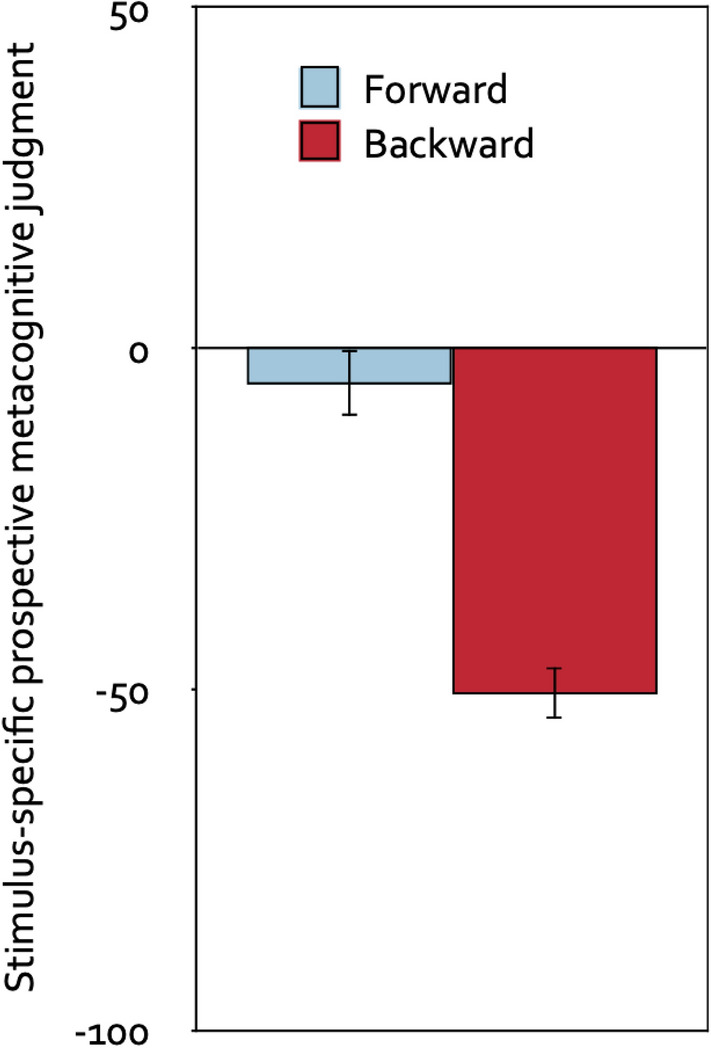
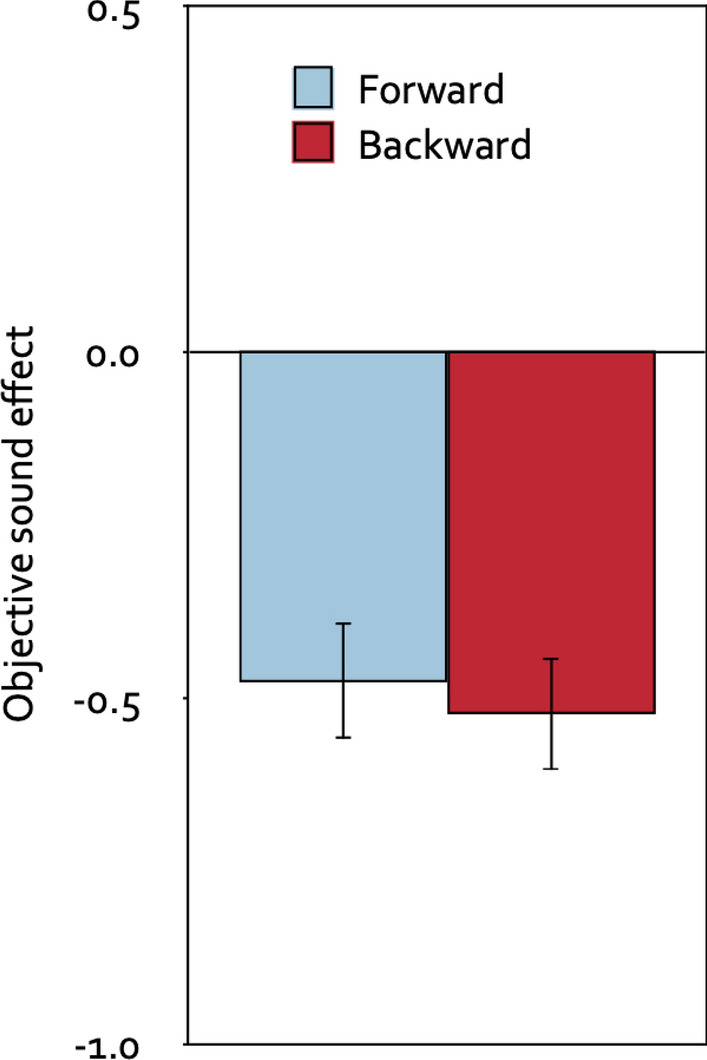
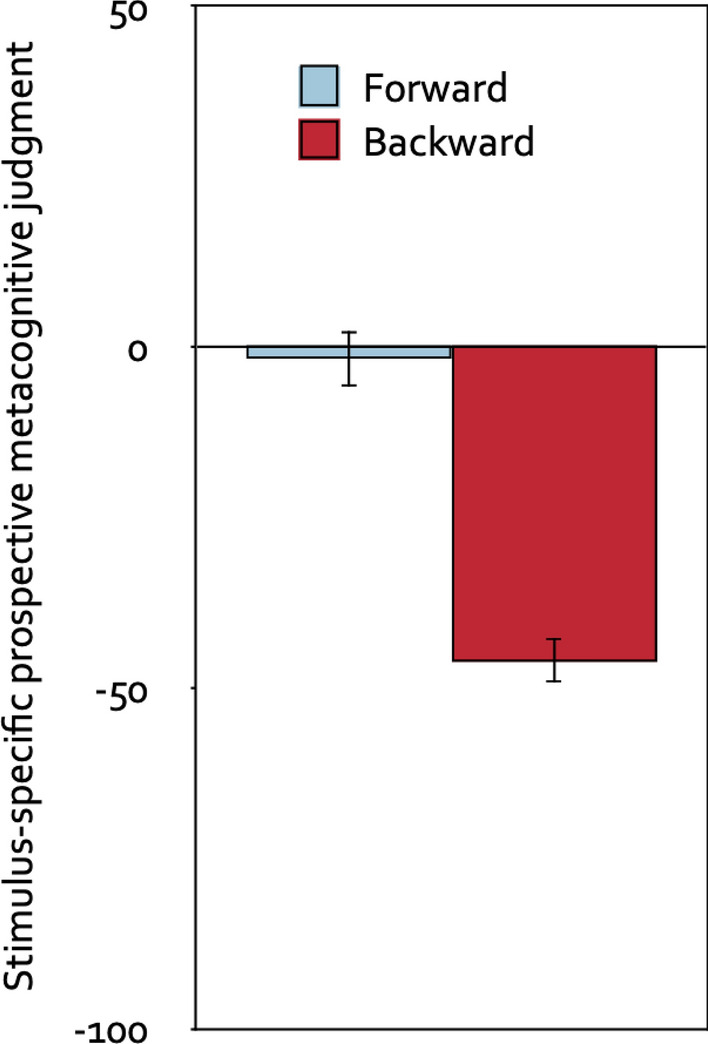
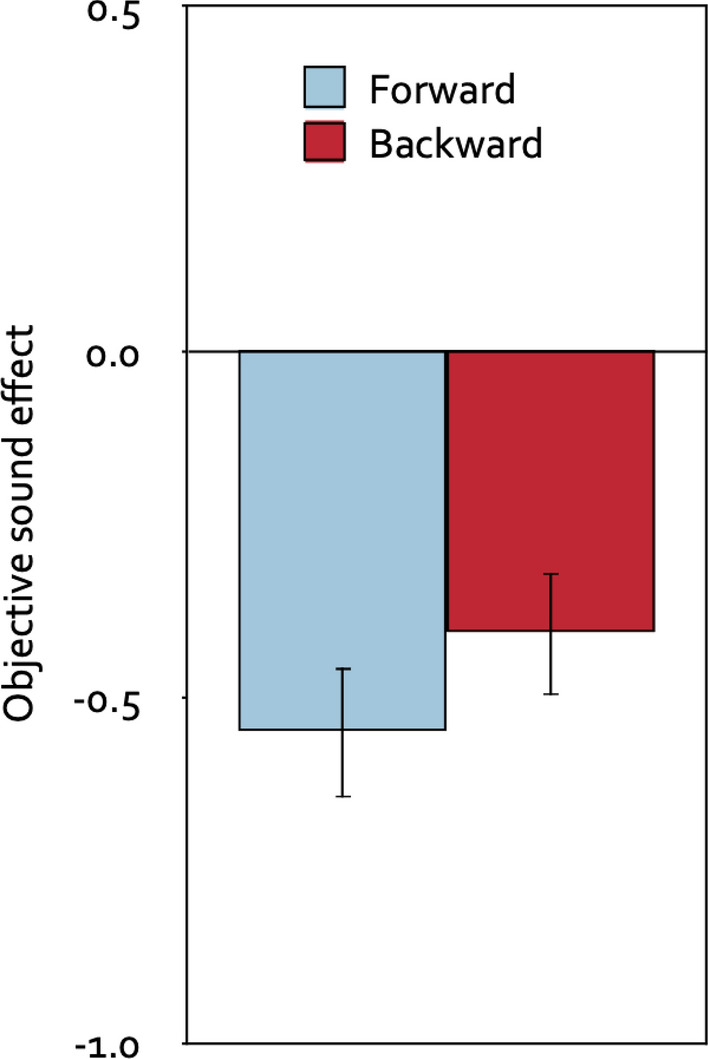
- In Experiment 1, forward and backward piano melodies did not differ objectively in serial-recall disruption, \(F(1,120)=0.46, p=0.498, \eta_p^2<0.01\), and both were distracting relative to quiet, \(t(121)=-5.59\) and \(t(121)=-6.51\), both \(p<0.001\). Yet stimulus-specific prospective judgments rated backward melodies as more distracting than forward melodies, \(F(1,61)=102.00, p<0.001, \eta_p^2=0.63\); forward melodies were judged neither helpful nor distracting, \(t(61)=-1.09, p=0.282\), while backward melodies were judged distracting, \(t(61)=-13.78, p<0.001, \eta_p^2=0.76\).
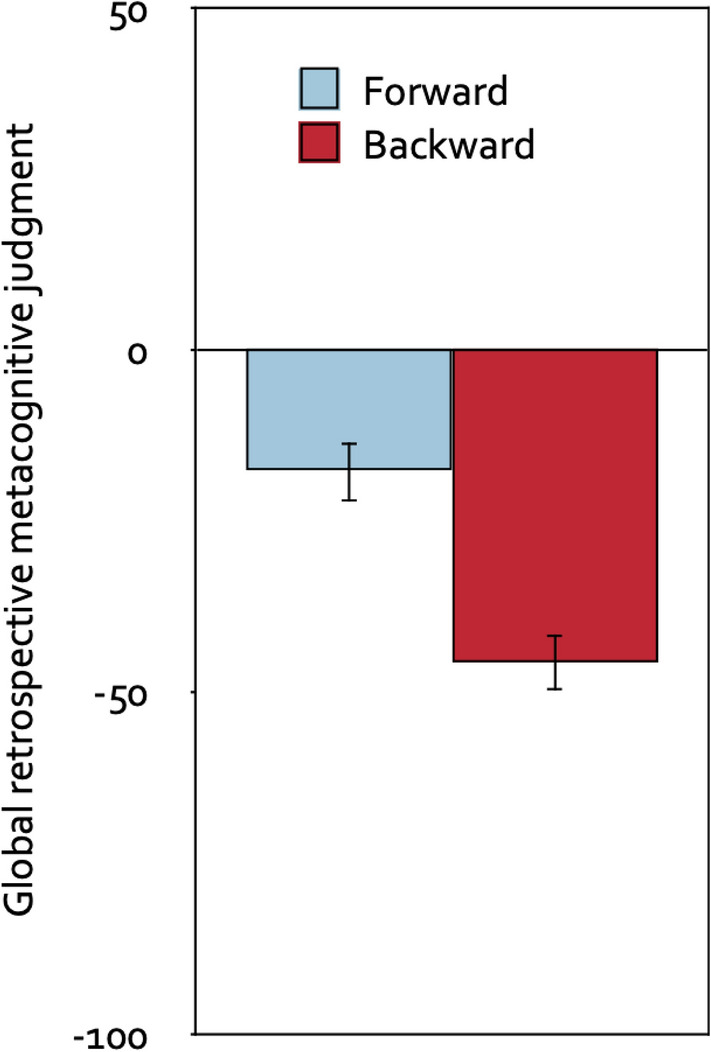
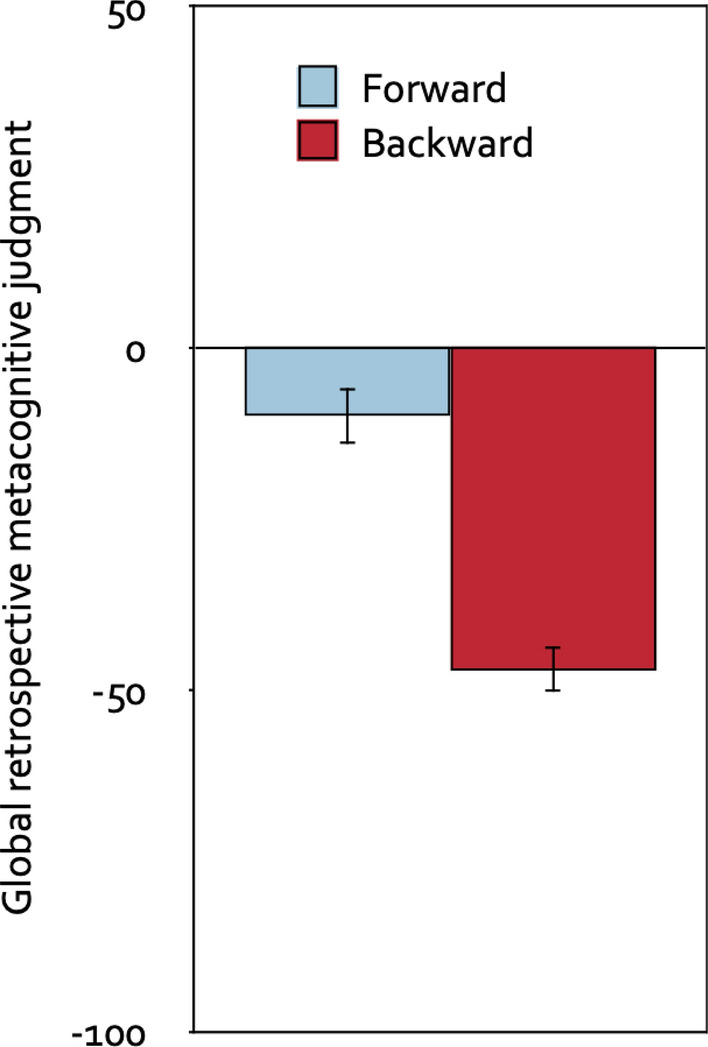
- Global retrospective judgments in Experiment 1 still showed backward melodies as more distracting than forward melodies, \(F(1,120)=37.82, p<0.001, \eta_p^2=0.24\), though both were judged to have been distracting.
- Experiment 2 replicated the pattern with Mozart K. 448 segments: objective disruption did not differ by direction, \(F(1,99)=1.99, p=0.161, \eta_p^2=0.02\); prospective judgments rated backward segments as more distracting, \(F(1,50)=133.53, p<0.001, \eta_p^2=0.73\), with forward segments judged neither helpful nor distracting, \(t(50)=-0.47, p=0.641\), and backward segments judged distracting, \(t(50)=-14.75, p<0.001, \eta_p^2=0.81\). Global retrospective judgments again rated backward segments as more distracting, \(F(1,99)=82.48, p<0.001, \eta_p^2=0.45\).
- Norming studies confirmed the fluency manipulation: backward piano melodies were rated less easy to process than forward melodies (\(M=26\) vs. \(M=75\)), \(F(1,14)=592.54, p<0.001, \eta_p^2=0.98\); backward Mozart segments were rated less easy than forward segments (\(M=13\) vs. \(M=74\)), \(F(1,14)=224.31, p<0.001, \eta_p^2=0.94\).
Methods
- Two experiments used a serial-recall task with visually presented digits and task-irrelevant music played forward or reversed. Experiment 1 used eight simple piano melodies; Experiment 2 used eight 8-s segments of Mozart’s sonata K. 448.
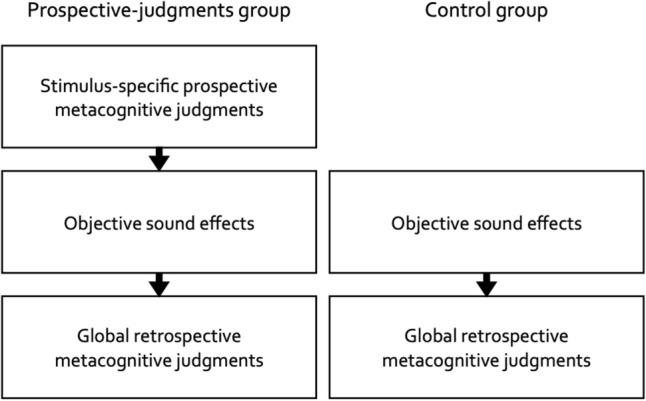
- In each experiment, participants were assigned to a prospective-judgments group or a control group. The prospective group made stimulus-specific prospective metacognitive judgments about each music stimulus before serial recall; all participants then completed serial-recall trials with quiet, forward-music, and backward-music conditions, followed by global retrospective metacognitive judgments and liking judgments.
- Main analyses were mixed analyses of variance comparing forward vs. backward music on objective distraction, prospective judgments, and retrospective judgments. Experiment 1 analyzed 122 participants (83 women, 39 men; mean age 22, \(SD=4\)) after excluding 39 Psychology students; Experiment 2 analyzed 101 participants (65 women, 36 men; mean age 23, \(SD=4\)) after excluding 75 Psychology students.
Limitations
- The paper states that it deliberately focused on a case in which relying on the processing-fluency heuristic causes an illusion, and notes this is likely the exception rather than the rule; future studies are needed to test other sound categories and how these judgments translate into decisions to avoid or seek out sounds.
- The paper states that the potential contribution of the affective quality of task-irrelevant sounds to processing-fluency effects on metacognitive judgments was not directly addressed.
- Evident from the text: the main samples were mostly university students, Psychology students were excluded from the main analyses, and the task used short laboratory music segments and a serial-recall paradigm, so generalization to real-world study or work settings is not directly established.
Model-written summary. Check it against the paper before relying on it.
Integrity signals
Registry
Cites
Statistics
Figures

Verification
Claims the paper makes
3 Valid · 0 Not valid · 19 Not checked · 79 Own results and interpretations
Every source the paper cites for this claim was checked and supports it.
In the paper
“In the study of Bell et al.11, both the stimulus-specific prospective as well as the global retrospective metacognitive judgments correctly captured the objective sound effects on performance.”
§ Evidence of a metacognitive illusion in judgments about the effects of music on cognitive performance > Introduction
What the sources say
- Supportedcites [11] Bell R Mieth L Röer JP Buchner A The metacognition of auditory distraction: Judgments about the effects of deviating and changing auditory distractors on cognitive performance Mem. Cogn. 2022 50 160 173 10.3758/s13421-021-01200-2 PMC8763777 34255305 source
The Method (Prospective and retrospective metacognitive judgments, p. ~) shows the prospective judgments were stimulus-specific (each of the 30 individual word sequences rated) while the retrospective judgments were global (one rating per sound type, covering all sequences experienced). The Experiment's Discussion (p. ~) states that 'the subjective metacognitive judgments mapped well onto the objective performance pattern', and the General Discussion (p. ~) states explicitly that 'both the prospective and the retrospective judgments accurately reflected the effects of the sound sequences that were objectively measured'. The exploratory correlations (r's < .07) concern individual differences within conditions, not the mean-level correspondence the claim describes. (LLM, conf=0.90)
plainstates an association- Asserted: passes — The authors put it forward as true.
- Checkable: passes — It can be checked against evidence.
- Load-bearing: passes — The paper’s conclusions depend on it.
- Based: passes — The paper gives a reason why it holds.
- Supported
Every source the paper cites for this claim was checked and supports it.
In the paper
“The direct-access account thus has some prima facie plausibility for explaining why metacognitive judgments and objective sound effects were closely aligned in the study of Bell et al.11.”
§ Evidence of a metacognitive illusion in judgments about the effects of music on cognitive performance > Introduction
What the sources say
- Supportedcites [11] Bell R Mieth L Röer JP Buchner A The metacognition of auditory distraction: Judgments about the effects of deviating and changing auditory distractors on cognitive performance Mem. Cogn. 2022 50 160 173 10.3758/s13421-021-01200-2 PMC8763777 34255305 source
The General discussion of Bell et al. (2022) states that 'both the prospective and the retrospective judgments accurately reflected the effects of the sound sequences that were objectively measured, one may be tempted to conclude that people have a direct access to the processes that are responsible for the performance decrement,' and concedes it 'does, indeed, seem possible that people have direct access' — exactly the prima facie plausibility of the direct-access account the citing sentence attributes. The Prospective/retrospective Discussion confirms the alignment itself ('the subjective metacognitive judgments mapped well onto the objective performance pattern displayed in Fig. 4'), supported by the Results showing retrospective judgments tracked the objective deviant and changing-state effects. The hedged wording of the citing sentence ('prima facie plausibility') matches the source's own tentativeness, so no overstatement; the only caveat is that the alignment held at the group/condition level, since the exploratory correlations between individual judgments and objective effects were near zero (all r's < .07). (LLM, conf=0.88)
hedgedstates a possible cause- Asserted: passes — The authors put it forward as true.
- Checkable: passes — It can be checked against evidence.
- Load-bearing: unclear — It is unclear whether the paper’s conclusions depend on it.
- Based: passes — The paper gives a reason why it holds.
- Supported
Every source the paper cites for this claim was checked and supports it.
In the paper
“This single-item processing-fluency scale was used because its validity is supported by findings showing that a single-item scale ranging from difficult to easy reflects various processing-fluency manipulations such as typicality, symmetry, repetition, contrast and pronounceability just as sensitively as a multiple-item scale37.”
§ Evidence of a metacognitive illusion in judgments about the effects of music on cognitive performance > Experiment 1 > Methods
What the sources say
- Supportedcites [37] Graf LKM Mayer S Landwehr JR Measuring processing fluency: One versus five items J. Consumer Psychol. 2018 28 393 411 10.1002/jcpy.1021 source
Split into 2 atoms — 2 confirmed, 0 partially supported, 0 disputed, 0 misattributed, 0 unverifiable. Expand the claim to see per-atom verdicts.
plainstates an association- Asserted: passes — The authors put it forward as true.
- Checkable: passes — It can be checked against evidence.
- Load-bearing: passes — The paper’s conclusions depend on it.
- Based: passes — The paper gives a reason why it holds.
- Supported
A result the paper reports from its own data — it cites no other source for it, so there is none to check. The quote shows it is in the paper.
In the paper
“whereas backward segments were judged negatively, (M = − 25, SE = 4), t(100) = − 5.67, p < 0.001, ηp2 = 0.24.”
§ Evidence of a metacognitive illusion in judgments about the effects of music on cognitive performance > Experiment 2 > Results
plain- Asserted: passes — The authors put it forward as true.
- Checkable: passes — It can be checked against evidence.
- Load-bearing: unclear — It is unclear whether the paper’s conclusions depend on it.
- Based: passes — The paper gives a reason why it holds.
A result the paper reports from its own data — it cites no other source for it, so there is none to check. The quote shows it is in the paper.
In the paper
“Participants who had listened to the segments of Mozart’s sonata K. 448 to make stimulus-specific prospective metacognitive judgments on average liked the segments less than participants who had heard the segments only when they were trying to ignore them during the serial-recall task, F(1, 99) = 7.44, p = 0.008, ηp2 = 0.07.”
§ Evidence of a metacognitive illusion in judgments about the effects of music on cognitive performance > Experiment 2 > Results
plain- Asserted: passes — The authors put it forward as true.
- Checkable: passes — It can be checked against evidence.
- Load-bearing: passes — The paper’s conclusions depend on it.
- Based: passes — The paper gives a reason why it holds.
68 more claims
Create a free account to see all 101 claims and to verify the 34 references still open.
- It may state two separate claims as one. 14
- Probably not a substantial claim. 15
- The quote only partly states this claim. 1
Statistics recomputed
Every reported test result, recomputed from its test statistic and degrees of freedom. A result shows as not adding up only once an independent check has confirmed it.
- ConsistentF(1, 14) = 592.54reported p < .001 · recomputed p < .001
“F(1, 14) = 592.54, p < .001”
- ConsistentF(1, 61) = 102reported p < .001 · recomputed p < .001
“F(1, 61) = 102.00, p < .001”
- Consistentt(61) = -1.09reported p = .282 · recomputed p = .280
“t(61) = − 1.09, p = .282”
- Consistentt(61) = -13.78reported p < .001 · recomputed p < .001
“t(61) = − 13.78, p < .001”
- ConsistentF(1, 120) = 0.46reported p = .498 · recomputed p = .499
“F(1, 120) = 0.46, p = .498”
33 more recomputed tests
Create a free account to see every test the Stats check recomputed.
Self-check
Percentages, sums and reported differences re-computed from the paper’s own numbers.
Self-check results appear here once an independent check has confirmed them.
Citations
Cites
Faul, F., Erdfelder, E., Lang, A.-G., & Buchner, A. (2007) · Behavior Research Methods · doi:10.3758/bf03193146 · Cited by 65,971
Self-citationEstimating the reproducibility of psychological science
Open Science Collaboration (2015) · Science · doi:10.1126/science.aac4716 · Cited by 8,515 · cited 2×
“Given that it is problematic to draw conclusions based on the results of a single study 40 , the main purpose of Experiment 2 was to serve as a close replication of Experiment 1.”
BackgroundUniting the Tribes of Fluency to Form a Metacognitive Nation
Alter, A. L., & Oppenheimer, D. M. (2009) · Personality and Social Psychology Review · doi:10.1177/1088868309341564 · Cited by 1,995
Attention and memory: an integrated framework
(1995) · Choice Reviews Online · doi:10.5860/choice.33-2415 · Cited by 1,656
An Embedded-Processes Model of Working Memory
Cowan, N. (1999) · Models of Working Memory · doi:10.1017/cbo9781139174909.006 · Cited by 1,480
Monitoring one’s own knowledge during study: A cue-utilization approach to judgments of learning
Koriat, A. (1997) · Journal of Experimental Psychology: General · doi:10.1037/0096-3445.126.4.349 · Cited by 1,363
Effects of Perceptual Fluency on Affective Judgments
Reber, R., Winkielman, P., & Schwarz, N. (1998) · Psychological Science · doi:10.1111/1467-9280.00008 · Cited by 1,320
Winkielman, P., & Cacioppo, J. T. (2001) · Journal of Personality and Social Psychology · doi:10.1037//0022-3514.81.6.989 · Cited by 931
The Value of Direct Replication
Simons, D. J. (2014) · Perspectives on Psychological Science · doi:10.1177/1745691613514755 · Cited by 630 · cited 1×
“Against the background of the discussion about the robustness of psychological findings 40 , a rigorous test of reproducibility is an essential step for establishing novel findings 45,46 .”
BackgroundMemory predictions are influenced by perceptual information: Evidence for metacognitive illusions.
Rhodes, M. G., & Castel, A. D. (2008) · Journal of Experimental Psychology: General · doi:10.1037/a0013684 · Cited by 459
Research works printed but not linked: 2
- Herzog S Hertwig R Unkelbach C Greifeneder R The ecological validity of fluency How the Fluency of Mental Processes Influences Cognition and Behavior 2013 Psychology Press 190 219
- Winkielman P Schwarz N Fazendeiro TA Reber R Musch J Klauer KC The hedonic marking of processing fluency: Implications for evaluative judgment The Psychology of Evaluation: Affective Processes in Cognition and Emotion 2003 Lawrence Erlbaum Associates Publishers 189 217
Cited by
Sun, Y. (2025) · Behavioral Sciences · doi:10.3390/bs15040416 · Cited by 15
Marsh, J. E., Bell, R., Röer, J. P., & Hodgetts, H. M. (2024) · Journal of Cognitive Psychology · doi:10.1080/20445911.2024.2314974 · Cited by 7
Self-citationKomar, G. F., Buchner, A., Mieth, L., van de Vijver, R., & Bell, R. (2024) · Scientific Reports · doi:10.1038/s41598-024-74719-4 · Cited by 6
Self-citationAtienzar, T., Pilgrim, L. K., Sio, U. N., & Marsh, J. E. (2024) · Journal of Cognitive Psychology · doi:10.1080/20445911.2024.2319268 · Cited by 5
An integrative cognitive model for multisensory design: benefits and risks of AI-personalization
Bartoletti, R. L., & Corveleyn, X. (2025) · Frontiers in Computer Science · doi:10.3389/fcomp.2025.1652537 · Cited by 4
Metadata
- Authors
- Bell, R., Komar, G. F., Mieth, L., & Buchner, A.
- Affiliations
- Heinrich Heine University Düsseldorf (DE)
- Corresponding author
- Bell, Raoul
- Venue
- Scientific Reports
- Published
- 2023-10-31
- Volume
- 13
- Issue
- 1
- Pages
- 18750-18750
- ISSN
- 2045-2322 (ISSN-L)
- PMC
- PMC10618565
- OpenAlex
- W4388042018
- Semantic Scholar
- 453429e9e2718b21fca47586a866a513c51c9a52
- Cited by
- 16
- References
- 49
- Citations by year
- 2026: 7 · 2025: 5 · 2024: 4
- FWCI
- 1.63
- Type
- journal article
- Language
- en
- Open access
- gold
- doi.org
- Licence
- cc-by
- creativecommons.org/licenses/by/4.0 (tdm)
- creativecommons.org/licenses/by/4.0 (vor)
- Locations
- Scientific Reports (publishedVersion, cc-by)
- PubMed Central (publishedVersion, cc-by)
- PubMed (publishedVersion)
- DOAJ (DOAJ: Directory of Open Access Journals) (submittedVersion, cc-by-sa)
- Univ. Duesseldorf: Duesseldorfer Dokumenten- und Publikationsserver (submittedVersion, cc-by)
- Funders
- Deutsche Forschungsgemeinschaft,Germany (BE 4311/6-1)
- Heinrich-Heine-Universität Düsseldorf
- Topics
- Life Sciences › Neuroscience › Cognitive Neuroscience › Neuroscience and Music Perception
- Physical Sciences › Physics and Astronomy › Acoustics and Ultrasonics › Noise Effects and Management
- Life Sciences › Neuroscience › Cognitive Neuroscience › Memory Processes and Influences
- Keywords
- metacognitive judgments, auditory distraction, processing fluency, serial recall, task-irrelevant sounds
- MeSH terms
- Metacognition, Acoustic Stimulation, Auditory Perception, Humans, Illusions, Judgment, Music, Prospective Studies, Retrospective Studies
About these checks
Registry, retraction, Cites and statistics results are computed, not judged, with one exception: a printed reference that no index lists is read once by a model before it counts as a citation error. Claims are extracted by a model and kept only when their quote appears verbatim in the text; each cited source is then checked, with a model’s help, for whether it says what the claim relies on. Those verdicts can be wrong — read the claim’s quote and the cited source before relying on one.
A language model drew the claims from the paper on 2026-11-18, under version 3 of the claim definition (model deepseek-v4.1-flash, prompt extract-v3).
A second model labelled each claim on 2026-11-18 (model jev-1.13-20260917, definition revision gold-guideline-v0.2).
Cited sources are checked with a language model’s help (qwen3.8-omni-flash).
Statistics and arithmetic are recomputed, not judged.
Confidence bands are shown only for fields calibrated on our annotated test set. None is calibrated yet, so no band is shown.
What counts as a claim ›How we measure confidence ›How we check this ›
Are you an author, or do you see a problem with this page? Request a review
Data sources
Bibliographic data: Semantic Scholar, OpenAlex, Crossref.
Contains information from the Semantic Scholar Academic Graph Datasets, made available under the ODC Attribution License (ODC-BY 1.0).
Semantic Scholar’s data is described in: Kinney, R., et al. (2023). The Semantic Scholar Open Data Platform. arXiv:2301.10140.
