

Removal of chromium from tannery industry wastewater using iron-based electrocoagulation process: experimental; kinetics; isotherm and economical studies
Open accessThe DOI matches its Crossref record; 57 of the 57 references it cites were found in a registry or an index.
Abstract
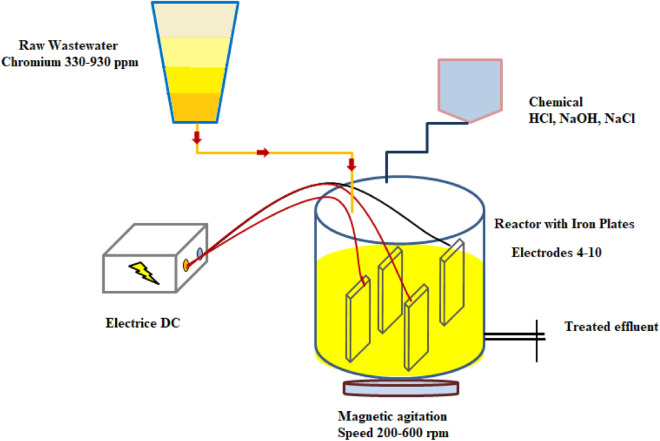
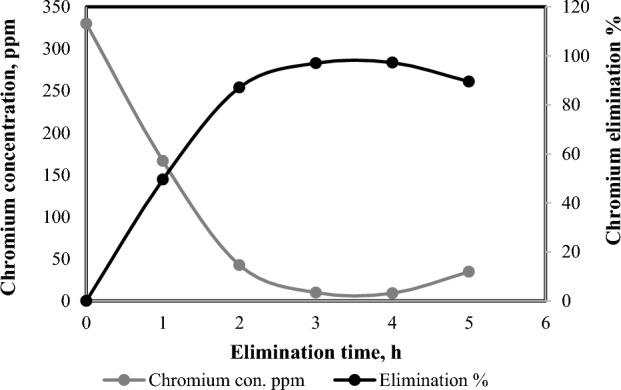
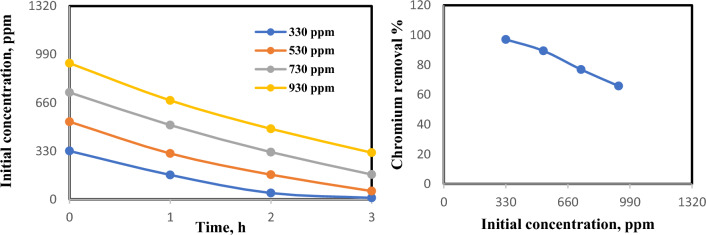
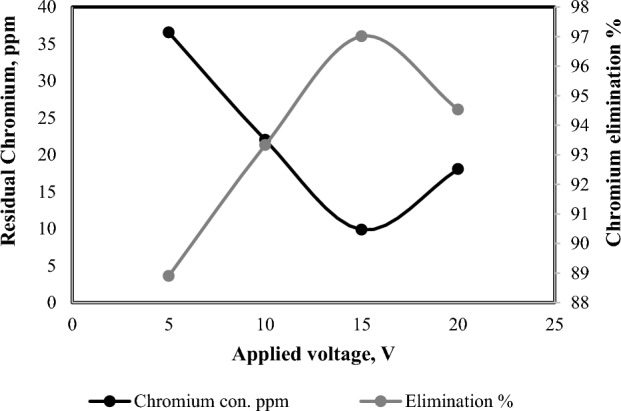
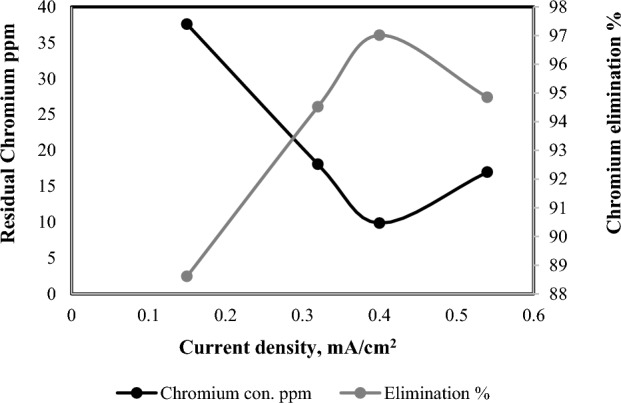
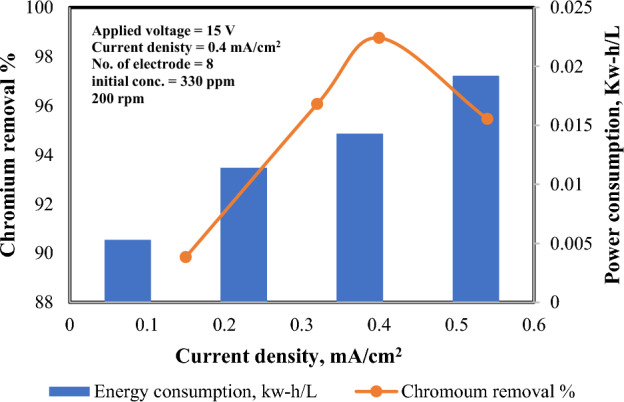
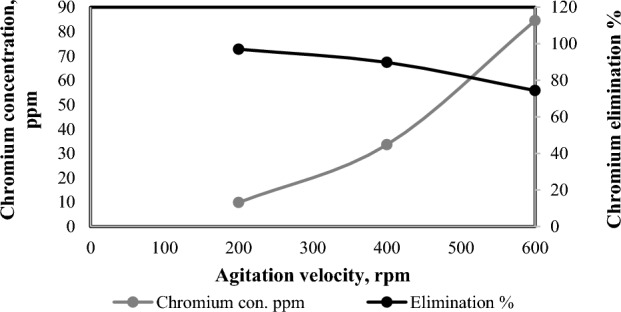
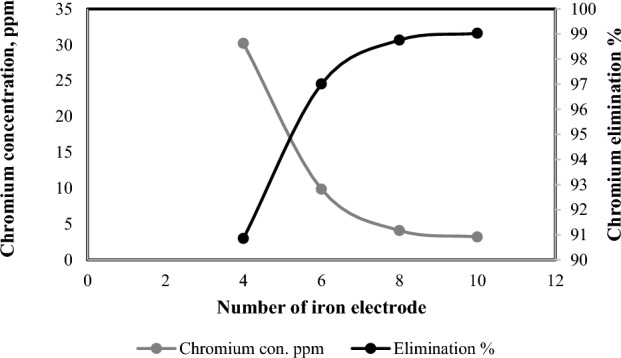
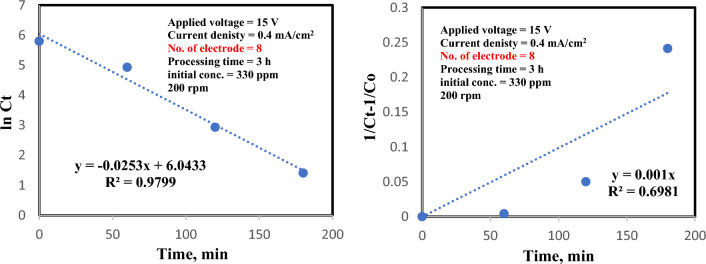
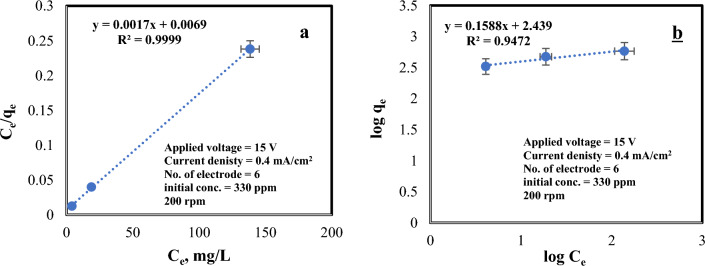
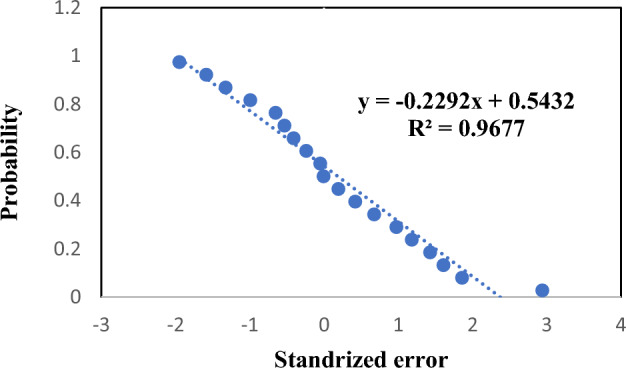
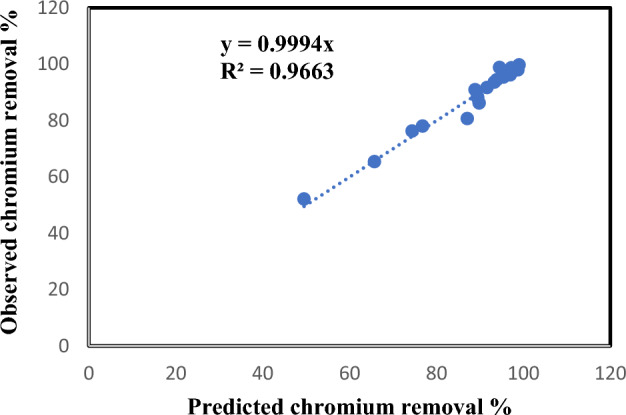
Chromium is a hazardous compound from industrial processes, known for its toxicity, mutagenicity, teratogenicity, and carcinogenicity. Chemical methods are efficient but cost-effective alternatives with reduced sludge are sought. Electro-coagulation, utilizing low-cost iron plate electrodes, was explored for factual tannery wastewater treatment in this manuscript. Operating parameters such as initial chromium concentration, voltage, electrode number, operating time, agitation speed and current density has been studied to evaluate the treatment effeciency. Under optimal conditions (15 V, 0.4 mA/cm 2, 200 rpm, 330 ppm chromium, 8 iron electrodes with a total surface area of 0.1188 m 2, 3 h), chromium elimination was 98.76%. Iron anode consumption, power use, and operating cost were 0.99 gm/L, 0.0143 kW-h/L, and 160 EGP/kg of chromium eliminated, respectively. Kinetics studies were pursued first-order reaction (97.99% correlation), and Langmuir isotherms exhibited strong conformity (Langmuir R 2: 99.99%). A predictive correlation for chromium elimination (R 2: 97.97%) was developed via statistical regression. At HARBY TANNERY factory in Egypt, industrial sewage treatment achieved a final chromium disposal rate of 98.8% under optimized conditions.
Overview
The claims and statistics of this paper haven’t been checked yet.
Free: it reads the open-access text and checks the first 5 claims that cite a source we can check. Create a free account to check every claim.
Integrity signals
Registry
Cites
Statistics
Figures
Verification
Claims the paper makes
The claims and statistics of this paper haven’t been checked yet.
Free: it reads the open-access text and checks the first 5 claims that cite a source we can check. Create a free account to check every claim.
Self-check
Percentages, sums and reported differences re-computed from the paper’s own numbers.
The self-check needs the paper’s full text.
Citations
Cites
Treatment of organic pollution in industrial saline wastewater: A literature review
Lefebvre, O., & Moletta, R. (2006) · Water Research · doi:10.1016/j.watres.2006.08.027 · Cited by 1,289
A comprehensive review of electrocoagulation for water treatment: Potentials and challenges
Moussa, D. T., El-Naas, M. H., Nasser, M., & Al-Marri, M. J. (2017) · Journal of Environmental Management · doi:10.1016/j.jenvman.2016.10.032 · Cited by 963
Treatment of electroplating wastewater containing Cu2+, Zn2+ and Cr(VI) by electrocoagulation
ADHOUM, N., MONSER, L., BELLAKHAL, N., & BELGAIED, J. (2004) · Journal of Hazardous Materials · doi:10.1016/j.jhazmat.2004.04.018 · Cited by 569
Copper, chromium and nickel removal from metal plating wastewater by electrocoagulation
Akbal, F., & Camcı, S. (2011) · Desalination · doi:10.1016/j.desal.2010.11.001 · Cited by 504
Treatment of dairy wastewaters by electrocoagulation using mild steel electrodes
Şengil, İ. A., & özacar, M. (2006) · Journal of Hazardous Materials · doi:10.1016/j.jhazmat.2006.04.009 · Cited by 268
Koushkbaghi, S., Zakialamdari, A., Pishnamazi, M., Ramandi, H. F., Aliabadi, M., & Irani, M. (2018) · Chemical Engineering Journal · doi:10.1016/j.cej.2017.12.075 · Cited by 212
Elabbas, S., Ouazzani, N., Mandi, L., Berrekhis, F., Perdicakis, M., Pontvianne, S., Pons, M.-N., Lapicque, F., & Leclerc, J.-P. (2016) · Journal of Hazardous Materials · doi:10.1016/j.jhazmat.2015.12.067 · Cited by 211
Aber, S., Amani-Ghadim, A. R., & Mirzajani, V. (2009) · Journal of Hazardous Materials · doi:10.1016/j.jhazmat.2009.06.025 · Cited by 210
Kumar, D., Singh, J., & Baleanu, D. (2018) · Nonlinear Dynamics · doi:10.1007/s11071-017-3870-x · Cited by 163
Moradi, M., Vasseghian, Y., Arabzade, H., & Khaneghah, A. M. (2020) · Chemosphere · doi:10.1016/j.chemosphere.2020.128314 · Cited by 154
Research works printed but not linked: 7
- Castiblanco Y Perilla A Arbelaez O Velásquez P Santis A Effect of the pH and the catalyst concentration on the removal of hexavalent chromium (Cr (VI)) during photocatalysis of wastewater from plating on plastics industry Chem. Eng. Trans. 2021 86 679 684
- Gonzalez-Delgado A Tejada-Tovar C Villabona-Ortiz A Computer-aided modeling and evaluation of a packed bed for chromium (vi) removal using residual biomass of Theobroma Cacao L Chem. Eng. Trans. 2022 92 517 522
- Aboutaleb E Kamel G Hellal M Investigation of effective treatment techniques for olive mill wastewater Egypt. J. Chem. 2018 61 415 422
- Villabona-Ortíz, Á., Tejada-Tovar, C. & Contreras-Amaya, R. Electrocoagulación como alternativa para eliminación de cromo (VI) en solución. Rev. Tecnura25, NA-NA (2021). · DOI
- Patel SR Parikh SP Chromium removal from industrial effluent by electrocoagulation: Operating cost and kinetic analysis J. Environ. Treat. Tech. 2021 9 621 628
- Dermentzis K Christoforidis A Valsamidou E Lazaridou A Kokkinos N Removal of hexavalent chromium from electroplating wastewater by electrocoagulation with iron electrodes Glob. Nest J 2011 13 412 418
- Nouri J Mahvi AH Bazrafshan E Application of electrocoagulation process in removal of zinc and copper from aqueous solutions by aluminum electrodes Int. J. Environ. Res. 2010 4 201 208
Cited by
Phu, T. K. C., Nguyen, P. L., & Phung, T. V. B. (2025) · iScience · doi:10.1016/j.isci.2025.111965 · Cited by 113
Kumari, A., Nithya, K., Selvaraj, R., & Rasana, N. (2025) · Environmental Monitoring and Assessment · doi:10.1007/s10661-025-13904-y · Cited by 36
Aqueous Phase Textile Dye Degradation by Microbes and Nanoparticles: A Review
Khongthaw, B., Chauhan, P. K., Chishty, N., Kumar, D., Velmurugan, A., Singh, A., Bhtoya, R., Devi, N., Nene, A., Sadeghzade, S., et al. (2024) · Advances in Materials Science and Engineering · doi:10.1155/2024/8845873 · Cited by 31
“Teir efuents contain both biodegradable and nonbiodegradable materials such as dyes, dispersants, methanol, leveling agents, and chromium [1, 2].”
Meena, S. K., Meena, S. O., Sangal, V. K., & Dehariya, N. K. (2025) · Journal of Water Process Engineering · doi:10.1016/j.jwpe.2025.108314 · Cited by 22
Jimoh, A. A., Azeez, S. O., & Wasiu, J. (2026) · Discover Chemistry. · doi:10.1007/s44371-026-00721-6 · Cited by 17
Muñoz-Martinez, M. X., Macías-Quiroga, I. F., & González, N. R. S. (2024) · Gels · doi:10.3390/gels10120779 · Cited by 13
“Through an XRD analysis of the hydrogel beads, it was confirmed that the structure of the organobentonite was preserved after its encapsulation in the alginate matrix.”
Using a novel bio-based cationic flocculant for food industry wastewater treatment
Ahmed, G. E., Hassan, G. K., Gomaa, E. H., Aly, S. A., Salem, S. Y., Badr, E. E., Aboelghait, K. M., & fify, A. A. (2024) · Scientific Reports · doi:10.1038/s41598-024-69558-2 · Cited by 12
Self-citationEl-Sadaawy, M. M., El‐Said, G. F., Khedawy, M., & Moneer, A. A. (2025) · Discover Applied Sciences · doi:10.1007/s42452-025-07987-y · Cited by 13
Modified coconut shell biochars (MCSBCs): Fabrication and their adsorptions for Pb(II)
Chen, J., Duan, Q., Ji, C., Liu, J., Wang, Z., Song, J., Li, W., & Zhang, C. (2024) · Heliyon · doi:10.1016/j.heliyon.2024.e32422 · Cited by 11
“O kinetic model, i.e., such an adsorption process belonged to a physical manner and ion exchange was the rate-controlling stage, rather than a chemisorption style [37,38].”
BackgroundDoumbi, R. T., Kowe, J. O., Domga, Djonga, W. G., & Noumi, G. B. (2024) · Cleaner Water · doi:10.1016/j.clwat.2024.100032 · Cited by 9
Abdelwahab, M. A., Mustafa, H. M. M., Gouda, Z., Mokhtar, M., Ahmed, M. H., Ghareb, M., Adham, E., Omar, S., Mohamed, R. M., & .El-Hadidy, S. (2024) · Egyptian Journal of Chemistry · doi:10.21608/ejchem.2024.257668.9040 · Cited by 8
Self-citationCostigan, E. M., Wu, S., Eckelman, M. J., Fernandez, L. A., Mueller, A. V., Alshawabkeh, A. N., & Larese‐Casanova, P. (2024) · Separation and Purification Technology · doi:10.1016/j.seppur.2024.129353 · Cited by 7
Utilizing Cement Kiln Dust as an Efficient Adsorbent for Heavy Metal Removal in Wastewater Treatment
Elmaadawy, K., Hamed, M. A. R., Al-Hazmi, H. E., & Hassan, G. K. (2024) · Water · doi:10.3390/w17010040 · Cited by 7
“Heavy metals, considered widespread pollutants, have been found in a significant volume of wastewater produced by various industries worldwide [1,2].”
Self-citationAsaithambi, P., Ezzat, A. O., Abd-Elkader, O. H., Al‐Lohedan, H. A., & Vigneshwaran, S. (2025) · Scientific Reports · doi:10.1038/s41598-025-13716-7 · Cited by 6
“The performance of EC is significantly influenced by the electrode materials, with Al and Fe being the most frequently employed 63 .”
Xu, X., Chen, K., Dai, Y., Xing, X., & Sun, L. N. (2025) · Water Air & Soil Pollution · doi:10.1007/s11270-025-07774-w · Cited by 6
“The removal capacity of the adsorption method is limited, and the recovery of adsorbent is complicated (El-Gawad et al., 2023).”
Kalabarige, L. R., Krishna, D. M., Potnuru, U. K., Mishra, M., Alharthi, S. S., & Koutavarapu, R. (2024) · Water · doi:10.3390/w16152175 · Cited by 6
Zourif, A., Kouniba, S., Hamidallah, K., Nouj, N., Elsenety, M. M., & Guendouzi, M. E. (2025) · Sustainable Chemistry and Pharmacy · doi:10.1016/j.scp.2025.102168 · Cited by 11
Albukhari, S. M. (2024) · Journal of Molecular Liquids · doi:10.1016/j.molliq.2024.124248 · Cited by 5
Electrocoagulation in Water Treatment: Targeted Contaminant Removal and Laboratory Best Practices
Yamazaki, E. R., Yuan, Y., He, X., Verma, A., Jang, G. G., Giammar, D. E., Chellam, S., Jassby, D., Tsouris, C., & Hatzell, M. C. (2026) · ACS ES&T Water · doi:10.1021/acsestwater.5c01550 · Cited by 5
Meena, S. K., Meena, S. O., & Sangal, V. K. (2026) · Journal of environmental chemical engineering · doi:10.1016/j.jece.2026.124359 · Cited by 4
Wibowo, Y. G., Anwar, D., Safitri, H., Setiawan, A., Sudibyo, S., Yuliansyah, A. T., & Petrus, H. T. B. M. (2025) · Colloids and Surfaces C Environmental Aspects · doi:10.1016/j.colsuc.2025.100066 · Cited by 3
Monica, M., & Uppuluri, K. B. (2025) · Process Safety and Environmental Protection · doi:10.1016/j.psep.2025.107527 · Cited by 3
Elsayd, H. M., Hassan, G. K., Affy, A. A., Hanafy, M., & Ahmed, T. S. (2025) · Environmental Sciences Europe · doi:10.1186/s12302-025-01175-w · Cited by 4
“All reagents were obtained from El-Gomhouria Company for Trading Chemicals and Medical Appliances located at greater Cairo in Egypt as used before [19].”
Self-citationAdvanced pre-treatment strategies to control membrane fouling in tannery wastewater treatment
Jha, S., Sonal, S., & Mishra, B. K. (2025) · Applied Water Science · doi:10.1007/s13201-025-02558-3 · Cited by 3
“This result aligns with other studies, such as El-Gawad et al. (2023), who reported 98.76% chromium removal, Varank et al. (2014), who achieved over 82% COD removal, and Genawi et al. (2020), who demonstrated complete chromium removal at optimized conditions of 13 mA/ cm 2 current density and pH 7…”
InfluentialJoshi, S., Saxena, N., Tipre, D. R., & Goyal, N. R. (2026) · Bioresource Technology Reports · doi:10.1016/j.biteb.2025.102542 · Cited by 3
Electrochemical treatment for tannery wastewater: emerging trends, and future perspectives
Meena, S. K., Meena, S. O., & Sangal, V. K. (2026) · Indian Chemical Engineer · doi:10.1080/00194506.2026.2656395 · Cited by 3
Ramisha, F. A., Mim, S., & Uddin, M. E. (2026) · Results in Surfaces and Interfaces · doi:10.1016/j.rsurfi.2026.100861 · Cited by 3
Optimizing Operating Conditions for Maximum Biodiesel Production from Salmon Fish Oil
Mohamed, R. F., Mustafa, H. M. M., Shehata, W. M., Afify, A., Hassan, G. K., & Shoaib, A. M. (2024) · Egyptian Journal of Chemistry · doi:10.21608/ejchem.2024.257532.9031 · Cited by 3
Self-citationHassan, G. K., Ghaly, M. Y., Ahmed, G. E., Mohamed, R. M., El-Gawad, H. A., Kowal, P., Al-Hazmi, H. E., & Afify, A. A. (2024) · Water · doi:10.3390/w16101327 · Cited by 3
Self-citationPinus radiata forest residue: A bio-adsorbent of choice for Cr (VI) removal from aqueous solution
Mancilla, H. D. B., Moreyra, J. D. P., Rosas, J. J. B., Marcelo, A. R. B., Tejada-Tovar, C., Jindal, M. K., Kumar, D., Sillanpää, M. E. T., & Ghernaout, D. (2025) · Environmental Nanotechnology Monitoring & Management · doi:10.1016/j.enmm.2025.101042 · Cited by 3
Photocatalytic reduction of Cr (VI) ions using eggshells/graphitic carbon nitride composite
Ambigadevi, J., Kumar, P. S., Chitra, B., & Rangasamy, G. (2025) · International Journal of Environmental Science and Technology · doi:10.1007/s13762-025-06556-5 · Cited by 2
Solvent-free biorefinery of leather fleshing waste into FAMEs and nitrogen-rich co-products
Deroncelé, V., Sorolla, S., & Dalmases, A. B. (2025) · Cleaner Engineering and Technology · doi:10.1016/j.clet.2025.101065 · Cited by 2
Somasundaram, G., Chinnasamy, P., & Thangavelu, S. (2025) · Journal of environmental chemical engineering · doi:10.1016/j.jece.2025.119579 · Cited by 2
Zakaria, M., Matta, M. E., & Safwat, S. M. (2026) · Process Safety and Environmental Protection · doi:10.1016/j.psep.2026.108468 · Cited by 2
Sagar, S. K., Sorlini, S., Devrajani, S. K., & Tolkou, A. K. (2026) · Urban Science · doi:10.3390/urbansci10050262 · Cited by 2
Hibakhadeeja, M. P., Thakur, A., Mathews, A. A., Dutta, J. R., & Ganesan, R. (2025) · International Journal of Biological Macromolecules · doi:10.1016/j.ijbiomac.2025.139915 · Cited by 2
Khudier, A. S., Mawat, M. J., & Dawood, A. S. (2025) · IOP Conference Series Earth and Environmental Science · doi:10.1088/1755-1315/1567/1/012049 · Cited by 1
“The subsequent precipitation of Cr(OH)₃ and Fe(OH)₃ is also highly efficient in this pH range [26].”
Natarajan, T. S., Ukendrakumar, T., Chockalingam, M., Shanmugavijayakumar, V., Niranjan, J. S., Sugandan, R., & Karmegam, P. M. (2026) · Journal of Chemical Technology & Biotechnology · doi:10.1002/jctb.70142 · Cited by 1
Al‐Essa, K., Habib, M. A., & Al-Essa, E. M. (2026) · Arabian Journal of Chemistry · doi:10.25259/ajc_440_2025 · Cited by 1
Janani, T., Palanisamy, P. N., & Karthikeyan, M. (2025) · Russian Journal of Electrochemistry · doi:10.1134/s1023193525600075 · Cited by 1
Kefale, G. Y., & Tesfaye, T. (2026) · Journal of Chemistry · doi:10.1155/joch/2002613 · Cited by 1
Recovery of valuable material from tannery wastewater
Bresolin, B.-M., Nogarole, M., Florio, C., & Cassano, A. (2025) · Elsevier eBooks · doi:10.1016/b978-0-443-13844-7.00006-6 · Cited by 1
Removal of Chromium Ions Using Radiation Graft Polymerization
Her, J., Kim, H., & Pyo, K. (2025) · Korean Society of Hazard Mitigation · doi:10.9798/kosham.2025.25.5.261
Nagi, M., & Bakry, A. N. (2025) · Environmental Monitoring and Assessment · doi:10.1007/s10661-025-14790-0
“(1234567890) Risks associated with Cr and Cr (VI) hexavalent High Cr levels endanger both aquatic life and human health (El-Gawad et al., 2023).”
Sustainable Cr (VI) removal using Ragi Husk: A data-driven metaheuristic optimization approach
Kalabarige, L. R., Krishna, D. M., Potnuru, U. K., & Holla, M. R. (2026) · Journal of Engineering Research · doi:10.1016/j.jer.2026.03.015
Saeedikia, H., Emamshoushtari, M. M., Helchi, S., Harasek, M., Tavakoli, O., Lesage, G., Héran, M., & Shariati, F. P. (2026) · Environmental Monitoring and Contaminants Research · doi:10.5985/emcr.20250035 · Cited by 2
Lorenzetti, G., Barsanti, L. A., Birindelli, L., Campanella, B., Gualtieri, P., & Legnaioli, S. (2026) · Applied Sciences · doi:10.3390/app16126078
Asri, M., Ouafi, R., & Ghachtouli, N. E. (2026) · Water Air & Soil Pollution · doi:10.1007/s11270-026-09692-x
Valarmathy, C., & Sudhaparimala, S. (2026) · RASAYAN Journal of Chemistry · doi:10.31788/rjc.2026.1939587
Parveen, G. R., & Selvasembian, R. (2026) · Bioresource Technology Reports · doi:10.1016/j.biteb.2026.102946
Cr(VI) elimination from solution by electrocoagulation: kinetic and optimization studies
Karabacakoğlu, B., & Muftu, E. O. (2026) · Journal of Applied Electrochemistry · doi:10.1007/s10800-026-02551-x
“Recent studies have investigated Cr(VI) removal by focusing on process performance and operating costs, utilising different electrode configurations and opti - mization approaches [19 –22 ].”
Hossain, M. N., Hasan, M. N. B., Nayak, R. K., Rahaman, A., Fahad, M. A., Hossain, M. S., Hasan, M., Milon, M. A. H., & Khatun, N. (2026) · Research Square · doi:10.21203/rs.3.rs-10689412/v1
Sunardi, Sumardiyono, & Afghohani, A. (2026) · Desalination and Water Treatment · doi:10.1016/j.dwt.2026.101978
Metadata
- Authors
- El-Gawad, H. A., Hassan, G. K., Aboelghait, K. M., Mahmoud, W. H., Mohamed, R. M., & Afify, A. A.
- Affiliations
- El Shorouk Academy (EG)
- National Research Centre (EG)
- Cairo University (EG)
- Suez Canal University (EG)
- Corresponding author
- Aboelghait, Karim M.
- Venue
- Scientific Reports
- Published
- 2023-11-10
- Volume
- 13
- Issue
- 1
- Pages
- 19597-19597
- ISSN
- 2045-2322 (ISSN-L)
- PMC
- PMC10638374
- OpenAlex
- W4388567725
- Semantic Scholar
- 40dad5b4a4b3dff2f6958bac9de2ea785a3cf1f5
- Cited by
- 50
- References
- 57
- Citations by year
- 2026: 17 · 2025: 21 · 2024: 12
- FWCI
- 3.99
- Type
- journal article
- Language
- en
- Open access
- gold
- doi.org
- Licence
- cc-by
- creativecommons.org/licenses/by/4.0 (tdm)
- creativecommons.org/licenses/by/4.0 (vor)
- Locations
- Scientific Reports (publishedVersion, cc-by)
- PubMed Central (publishedVersion, cc-by)
- PubMed (publishedVersion)
- DOAJ (DOAJ: Directory of Open Access Journals) (submittedVersion, cc-by-sa)
- Greater South Information System
- Funders
- National Research Centre Egypt
- Topics
- Physical Sciences › Environmental Science › Water Science and Technology › Coagulation and Flocculation Studies
- Physical Sciences › Environmental Science › Health, Toxicology and Mutagenesis › Chromium effects and bioremediation
- Physical Sciences › Environmental Science › Environmental Engineering › Environmental remediation with nanomaterials
- Keywords
- chromium removal, tannery wastewater, electrocoagulation, iron electrodes, heavy metal removal, first-order kinetics, Langmuir isotherm, operating costs, current density, wastewater treatment
About these checks
Registry, retraction, Cites and statistics results are computed, not judged, with one exception: a printed reference that no index lists is read once by a model before it counts as a citation error. Claims are extracted by a model and kept only when their quote appears verbatim in the text; each cited source is then checked, with a model’s help, for whether it says what the claim relies on. Those verdicts can be wrong — read the claim’s quote and the cited source before relying on one.
Statistics and arithmetic are recomputed, not judged.
Confidence bands are shown only for fields calibrated on our annotated test set. None is calibrated yet, so no band is shown.
What counts as a claim ›How we measure confidence ›How we check this ›
Are you an author, or do you see a problem with this page? Request a review
Data sources
Bibliographic data: Semantic Scholar, OpenAlex, Crossref.
Contains information from the Semantic Scholar Academic Graph Datasets, made available under the ODC Attribution License (ODC-BY 1.0).
Semantic Scholar’s data is described in: Kinney, R., et al. (2023). The Semantic Scholar Open Data Platform. arXiv:2301.10140.
