

The DOI matches its Crossref record; 66 of the 67 references it cites were found in a registry or an index; 20 of the 34 sources its claims cite were checked for support.
Text classification models for assessing the completeness of randomized controlled trial publications based on CONSORT reporting guidelines
Open accessPublished version of a preprint
Abstract
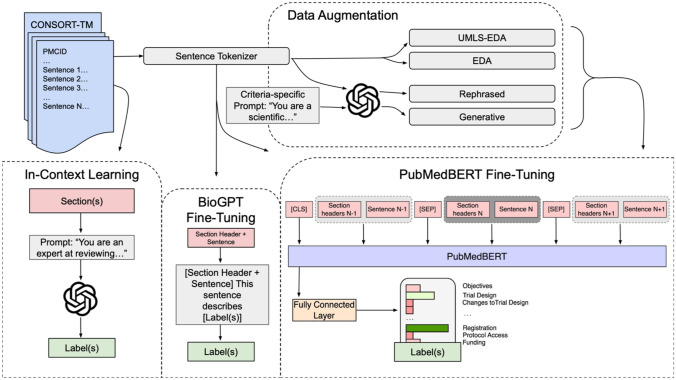
Complete and transparent reporting of randomized controlled trial publications (RCTs) is essential for assessing their credibility. We aimed to develop text classification models for determining whether RCT publications report CONSORT checklist items. Using a corpus annotated with 37 fine-grained CONSORT items, we trained sentence classification models (PubMedBERT fine-tuning, BioGPT fine-tuning, and in-context learning with GPT-4) and compared their performance. We assessed the impact of data augmentation methods (Easy Data Augmentation (EDA), UMLS-EDA, text generation and rephrasing with GPT-4) on model performance. We also fine-tuned section-specific PubMedBERT models (e.g., Methods) to evaluate whether they could improve performance compared to the single full model. We performed 5-fold cross-validation and report precision, recall, F 1 score, and area under curve (AUC). Fine-tuned PubMedBERT model that uses the sentence along with the surrounding sentences and section headers yielded the best overall performance (sentence level: 0.71 micro-F 1 , 0.67 macro-F 1 ; article-level: 0.90 micro-F 1 , 0.84 macro-F 1 ). Data augmentation had limited positive effect. BioGPT fine-tuning and GPT-4 in-context learning exhibited suboptimal results. Methods-specific model improved recognition of methodology items, other section-specific models did not have significant impact. Most CONSORT checklist items can be recognized reasonably well with the fine-tuned PubMedBERT model but there is room for improvement. Improved models can underpin the journal editorial workflows and CONSORT adherence checks.
Overview
CoChat Summary
TL;DR
This study develops and evaluates text classification models to recognize all CONSORT checklist items in randomized controlled trial publications. A fine-tuned PubMedBERT model using surrounding sentences and section headers performed best, while data augmentation and generative models gave limited benefit.
Key findings
- The best PubMedBERT model achieved sentence-level 0.71 micro-F1 and 0.67 macro-F1, with balanced precision and recall (0.72 and 0.71, respectively).
- At article level, the same model reached 0.92 micro-F1 and 0.87 macro-F1 under article (ANY) evaluation, and 0.90 micro-F1 and 0.84 macro-F1 under the stricter article (1+) evaluation.
- Data augmentation had limited positive effect: for the best-performing model, F1 remained 0.71 across original and augmented settings, and differences were not statistically significant.
- BioGPT fine-tuning and GPT-4 in-context learning underperformed the best PubMedBERT model; GPT-4 zero-shot scored 0.51 F1, one-shot 0.48 F1, and five-shot 0.46 F1. Methods-specific training improved recognition of methodology items (0.79 F1 vs. 0.75 F1 for the full model), but other section-specific models had limited impact.
Methods
- Used the CONSORT-TM corpus of 50 RCT publications, containing 10,709 sentences, 4,845 annotated sentences, and 5,246 labels across 37 fine-grained CONSORT items; excluded Background (2a) and focused on 36 items, with items 1a and 1b handled by simple rules.
- Trained sentence classification models via PubMedBERT fine-tuning, BioGPT fine-tuning, and GPT-4 in-context learning; tested input representations including section headers, surrounding sentences, and sentence position, plus data augmentation with EDA, UMLS-EDA, and GPT-4.
- Evaluated with group 5-fold cross-validation, reporting precision, recall, F1, macro-F1, and AUC; GPT-4 in-context learning was evaluated on a randomly sampled test set of 10 articles.
Limitations
- The paper states the dataset is small, consists of XML articles from PubMed Central that may not fully represent RCT literature, and contains limited data for infrequently reported CONSORT items; data augmentation had minimal effect.
- The paper states generative model exploration was limited and calls for more systematic prompting strategies; it also notes the work only recognizes sentences reporting CONSORT items, not whether reporting is adequate or adherent.
- Evident from the text: GPT-4 in-context learning was tested on only 10 articles due to cost, BioGPT fine-tuning used only the target sentence, and section-specific model comparisons were inconclusive, with label confusion between closely related items such as 17a/17b/18 and 12a/12b.
Model-written summary. Check it against the paper before relying on it.
Integrity signals
Registry
Cites
Statistics
Figures

Verification
Claims the paper makes
14 Valid · 2 Not valid · 9 Not checked · 81 Own results and interpretations
The cited sources support only part of this claim — read each source’s verdict below.
In the paper
“A BioBERT-based model44 outperformed rule-based and traditional machine learning approaches.”
§ Text classification models for assessing the completeness of randomized controlled trial publications based on CONSORT reporting guidelines > Related work > Text classification in RCT articles
What the sources say
- Partly supportedcites [44] Lee, J. et al. BioBERT: A pre-trained biomedical language representation model for biomedical text mining. Bioinformatics. 36(4), 1234–1240 (2020). sourceExperimental — accuracy not yet measured
Section 4.3 reports that BioBERT outperformed previous state-of-the-art models on several biomedical named-entity recognition datasets. It does not report recognizing CONSORT methodology items or a comparison with rule-based approaches; those specifics are not supported by this paper. (LLM, conf=0.86)
plainstates a cause- Asserted: passes — The authors put it forward as true.
- Checkable: passes — It can be checked against evidence.
- Load-bearing: passes — The paper’s conclusions depend on it.
- Based: passes — The paper gives a reason why it holds.
- Partly supported
The cited sources support only part of this claim — read each source’s verdict below.
In the paper
“CONSORT implementation, where RCT submissions are scrutinized by journal editors for compliance before peer review, has been shown to improve reporting quality16,17.”
§ Text classification models for assessing the completeness of randomized controlled trial publications based on CONSORT reporting guidelines > Introduction
What the sources say
- Partly supportedcites [16] Hopewell, S., Ravaud, P., Baron, G. & Boutron, I. Effect of editors’ implementation of CONSORT guidelines on the reporting of abstracts in high impact medical journals: Interrupted time series analysis. BMJ. 344, 4178 (2012). sourceExperimental — accuracy not yet measured
The Discussion reports improved reporting of randomized-trial abstracts in journals that actively implemented CONSORT for Abstracts. But the Methods (Interventions) describes emails asking authors to revise abstracts at the manuscript revision stage, or assistant-editor changes near the end of the editorial process—not editor scrutiny of submissions before peer review. (LLM, conf=0.90)
- Not checked — no full text of the sourcecites [17] Pandis, N., Shamseer, L., Kokich, V. G., Fleming, P. S. & Moher, D. Active implementation strategy of CONSORT adherence by a dental specialty journal improved randomized clinical trial reporting. J. Clin. Epidemiol. 67(9), 1044–1048 (2014). source
plainstates a cause- Asserted: passes — The authors put it forward as true.
- Checkable: passes — It can be checked against evidence.
- Load-bearing: passes — The paper’s conclusions depend on it.
- Based: passes — The paper gives a reason why it holds.
- Partly supported
The sources with a verdict support this claim; the rest weren’t checked yet, have no full text we could read, or their verdicts aren’t rated yet.
In the paper
“While they have been endorsed by many high impact journals10, adherence to reporting guidelines remains inadequate2,11,12.”
§ Text classification models for assessing the completeness of randomized controlled trial publications based on CONSORT reporting guidelines > Introduction
What the sources say
- Supportedcites [10] Shamseer, L., Hopewell, S., Altman, D. G., Moher, D. & Schulz, K. F. Update on the endorsement of CONSORT by high impact factor journals: A survey of journal “instructions to authors” in 2014. Trials. 17(1), 301 (2016). source
Citation 10 is attached to the statement that many high-impact journals endorse reporting guidelines, not to the subsequent claim about inadequate adherence, which has separate citations. The Discussion reports that 13 of 15 general medical journals in the high-impact sample endorse CONSORT, and the Conclusions state that many journals now endorse it. (LLM, conf=0.93)
- Not checked — no full text of the sourcecites [2] Glasziou, P. et al. Reducing waste from incomplete or unusable reports of biomedical research. The Lancet. 383(9913), 267–276 (2014). source
- Not checked — no full text of the sourcecites [11] Samaan, Z. et al. A systematic scoping review of adherence to reporting guidelines in health care literature. J. Multidisciplinary Healthcare. 6, 169-88 (2013).
- Supportedcites [12] Jin, Y. et al. Does the medical literature remain inadequately described despite having reporting guidelines for 21 years?–A systematic review of reviews: An update. J. Multidiscip. Healthc. 11, 495–510 (2018). source
The paper’s Conclusion states that current adherence to reporting guidelines in the medical literature is suboptimal. In the citing sentence, the endorsement claim is attached to citation 10; this source is cited for the inadequate-adherence claim. (LLM, conf=0.94)
plain- Asserted: passes — The authors put it forward as true.
- Checkable: passes — It can be checked against evidence.
- Load-bearing: passes — The paper’s conclusions depend on it.
- Based: passes — The paper gives a reason why it holds.
- Supported
The cited sources support only part of this claim — read each source’s verdict below.
In the paper
“systematic studies of current practices show poor reporting even in well-conducted RCTs12–14.”
§ Text classification models for assessing the completeness of randomized controlled trial publications based on CONSORT reporting guidelines > Introduction
What the sources say
- Partly supportedcites [12] Jin, Y. et al. Does the medical literature remain inadequately described despite having reporting guidelines for 21 years?–A systematic review of reviews: An update. J. Multidiscip. Healthc. 11, 495–510 (2018). sourceExperimental — accuracy not yet measured
The Results and Conclusion (pages not provided) report that adherence to reporting guidelines in the medical literature remains suboptimal, supporting the poor-reporting point. The paper discusses RCT reporting, but our copy does not establish that the poorly reported RCTs were well conducted; that qualification is unsupported. (LLM, conf=0.82)
- Partly supportedcites [13] Moher, D. et al. Explanation and Elaboration: Updated guidelines for reporting parallel group randomised trials. BMJ. 2010, 340 (2010). sourceExperimental — accuracy not yet measured
The “Incomplete and inaccurate reporting” section cites multiple reviews and gives examples of poor RCT reporting. It does not establish that the poorly reported trials were well conducted, so that qualification is unsupported. (LLM, conf=0.84)
- Partly supportedcites [14] Turner L, Shamseer L, Altman D, Weeks L, Peters J, Kober T, et al. Consolidated standards of reporting trials (CONSORT) and the completeness of reporting of randomised controlled trials (RCTs) published in medical journals. Cochrane Database Syst. Rev. 2012; (11). sourceExperimental — accuracy not yet measured
The Background states that evidence of suboptimal RCT reporting has accumulated, and the Results report that completeness of reporting was not optimal. The paper does not establish that the poorly reported RCTs were well conducted; the Results caution that reporting may not reflect actual conduct. The indexed passages provide section labels but no page numbers. (LLM, conf=0.86)
plain- Asserted: passes — The authors put it forward as true.
- Checkable: passes — It can be checked against evidence.
- Load-bearing: passes — The paper’s conclusions depend on it.
- Based: passes — The paper gives a reason why it holds.
- Partly supported
The cited sources support only part of this claim — read each source’s verdict below.
In the paper
“The effect of data augmentation on PubMedBERT fine-tuning was minimal, which is consistent with our previous findings22.”
§ Text classification models for assessing the completeness of randomized controlled trial publications based on CONSORT reporting guidelines > Discussion > Data augmentation
What the sources say
- Partly supportedcites [22] Hoang L, Jiang L, Kilicoglu H. Investigating the impact of weakly supervised data on text mining models of publication transparency: a case study on randomized controlled trials. In: AMIA Annual Symposium Proceedings. vol. 2022. American Medical Informatics Association; 2022. p. 254. sourceExperimental — accuracy not yet measured
The Classification results (p. 6) report that UMLS-EDA data augmentation produced only a small performance gain. However, the Introduction (p. 2) identifies the model as BioBERT-based, not PubMedBERT; the source therefore does not establish the claimed result for PubMedBERT fine-tuning. (LLM, conf=0.88)
plain- Asserted: passes — The authors put it forward as true.
- Checkable: passes — It can be checked against evidence.
- Load-bearing: unclear — It is unclear whether the paper’s conclusions depend on it.
- Based: passes — The paper gives a reason why it holds.
- Partly supported
43 more claims
Create a free account to see all 106 claims and every source verdict.
- Probably not a substantial claim. 31
- It may state two separate claims as one. 32
- The quote only partly states this claim. 1
Claims other papers make about this one
Each is checked against this paper’s own text: does it say what the citing paper says it does?
The source backs part of the claim, not all of it — or backs it for a different population, condition or comparison.
In the citing paper
“Although used more frequently in the past, the 15 publications published between 2017 and now that use this approach alongside other architectures such as LLM, 148 Transformer, 33,37 -39,148,156,174 conditional random fields (CRF), 40,156 use it with SVM 41 or other binary classifiers.”
From Data extraction methods for systematic review (semi)automation: Update of a living systematic review (2025) · cites this paper as [148]
Experimental — accuracy not yet measuredThe check wasn’t confident either way, so it gives no verdict — never disputed.
In the citing paper
“but fine-tuning was used less frequently than zero-shot prompting with 13 papers or k-shot prompting in two.”
From Data extraction methods for systematic review (semi)automation: Update of a living systematic review (2025) · cites this paper as [148]
Experimental — accuracy not yet measured
Self-check
Percentages, sums and reported differences re-computed from the paper’s own numbers.
Each contradiction between two passages listed here was confirmed by an independent check.
Rated minor: it would not touch a result — a value no result rests on, a p-value that stays on the same side of the significance level, or a conflict that is clerical, resolved elsewhere in the paper, or outside its own findings.
In the paper
§ Text classification models for assessing the completeness of randomized controlled trial publications based on CONSORT reporting guidelines > Discussion > Error analysis
“The labels shown are Outcomes (6a), Outcome Results (17a), Binary Outcome Results (17b), and Ancillary Analyses (18).”
§ Text classification models for assessing the completeness of randomized controlled trial publications based on CONSORT reporting guidelines > Discussion > Error analysis
“| Some CONSORT items are missed | Patients were directed to fix the adhesive ring with the hole over the verruca and to squeeze a little ointment into the hole and directly on to the verruca | [‘11a’, ‘6a’] | [‘6a’] |”
Citations
Cites
Vaswani, A., Shazeer, N., Parmar, N., Uszkoreit, J., Jones, L., Gomez, A. N., Kaiser, L., & Polosukhin, I. (2017) · arXiv · doi:10.48550/arxiv.1706.03762 · Cited by 120,404
The PRISMA 2020 statement: An updated guideline for reporting systematic reviews
Page, M. J., McKenzie, J. E., Bossuyt, P. M., Boutron, I., Hoffmann, T. C., Mulrow, C. D., Shamseer, L., Tetzlaff, J. M., Akl, E. A., Brennan, S. E., et al. (2021) · BMJ · doi:10.1136/bmj.n71 · Cited by 108,283
BERT: Pre-training of Deep Bidirectional Transformers for Language Understanding
Devlin, J., Chang, M.-W., Lee, K., & Toutanova, K. (2018) · arXiv · doi:10.48550/arxiv.1810.04805 · Cited by 73,173
BERT: Pre-training of Deep Bidirectional Transformers for Language Understanding
Devlin, J., Chang, M.-W., Lee, K., & Toutanova, K. (2019) · Proceedings of the 2019 Conference of the North American Chapter of the Association for Computational Linguistics: Human Language Technologies, Volume 1 (Long and Short Papers) · doi:10.18653/v1/n19-1423 · Cited by 54,325
Language Models are Few-Shot Learners
Brown, T. B., Mann, B., Ryder, N., Subbiah, M., Kaplan, J., Dhariwal, P., Neelakantan, A., Shyam, P., Sastry, G., Askell, A., et al. (2020) · arXiv · doi:10.48550/arxiv.2005.14165 · Cited by 23,372 · cited 1×
“Generative large language models (LLMs) based on Transformer architecture 45 (e.g., GPT family 46,47 , PaLM 48 , LLaMA 49 ) have shown remarkable language generation capabilities and are increasingly applied to NLP tasks in the general domain 50 and in the biomedical domain 51,52 .”
MethodCONSORT 2010 Statement: updated guidelines for reporting parallel group randomised trials
the CONSORT Group, Schulz, K. F., Altman, D. G., & Moher, D. (2010) · BMC Medicine · doi:10.1186/1741-7015-8-18 · Cited by 13,371
CONSORT 2010 Statement: updated guidelines for reporting parallel group randomised trials
Schulz, K. F., Altman, D. G., Moher, D., & for the CONSORT Group (2010) · BMJ · doi:10.1136/bmj.c332 · Cited by 9,329
Moher, D., Hopewell, S., Schulz, K. F., Montori, V., Gotzsche, P. C., Devereaux, P. J., Elbourne, D., Egger, M., & Altman, D. G. (2010) · BMJ · doi:10.1136/bmj.c869 · Cited by 8,883 · cited 1×
“Item descriptions used for the generative prompt were adapted from Moher et al. 13 .”
MethodSPIRIT 2013 Statement: Defining Standard Protocol Items for Clinical Trials
Chan, A.-W., Tetzlaff, J. M., Altman, D. G., Laupacis, A., Gøtzsche, P. C., Krleža-Jerić, K., Hróbjartsson, A., Mann, H., Dickersin, K., Berlin, J. A., et al. (2013) · Annals of Internal Medicine · doi:10.7326/0003-4819-158-3-201302050-00583 · Cited by 7,363
BioBERT: a pre-trained biomedical language representation model for biomedical text mining
Lee, J., Yoon, W., Kim, S., Kim, D., Kim, S., So, C. H., & Kang, J. (2020) · Bioinformatics · doi:10.1093/bioinformatics/btz682 · Cited by 7,218 · cited 2×
“In prior work on CONSORT methodology reporting 21,22 , we fine-tuned the BioBERT model 44 .”
Method
Research works printed but not linked: 8
- Radford, A. et al. Language models are unsupervised multitask learners. OpenAI blog. 1(8), 9 (2019).
- Chowdhery A, Narang S, Devlin J, Bosma M, Mishra G, Roberts A, et al. PaLM: Scaling language modeling with pathways. arXiv preprint arXiv:220402311. 2022.
- Touvron H, Lavril T, Izacard G, Martinet X, Lachaux MA, Lacroix T, et al. LLaMA: Open and efficient foundation language models. arXiv preprint arXiv:230213971. 2023.
- Zhao WX, Zhou K, Li J, Tang T, Wang X, Hou Y, et al. A survey of large language models. arXiv preprint arXiv:230318223. 2023.
- Chen Q, Du J, Hu Y, Keloth VK, Peng X, Raja K, et al. Large language models in biomedical natural language processing: benchmarks, baselines, and recommendations. arXiv preprint arXiv:230516326. 2023.
- Dai H, Liu Z, Liao W, Huang X, Cao Y, Wu Z, et al. AugGPT: Leveraging ChatGPT for text data augmentation. arXiv preprint arXiv:230213007. 2023.
- Wu C, Zhang X, Zhang Y, Wang Y, Xie W. PMC-LLaMA: Further finetuning LLaMA on medical papers. arXiv preprint arXiv:230414454. 2023.
- Tang R, Han X, Jiang X, Hu X. Does synthetic data generation of LLMs help clinical text mining? arXiv preprint arXiv:230304360. 2023.
Cited by
Data extraction methods for systematic review (semi)automation: a living systematic review
Schmidt, L., Olorisade, B. K., McGuinness, L. A., Thomas, J., & Higgins, J. P. T. (2021) · F1000Research · doi:10.12688/f1000research.51117.1 · Cited by 106
Data extraction methods for systematic review (semi)automation: Update of a living systematic review
Schmidt, L., Finnerty Mutlu, A. N., Elmore, R., Olorisade, B. K., Thomas, J., & Higgins, J. P. T. (2025) · F1000Research · doi:10.12688/f1000research.51117.3 · Cited by 27
Srinivasan, A., Berkowitz, J. S., Friedrich, N. A., Kivelson, S., & Tatonetti, N. P. (2025) · JAMA Network Open · doi:10.1001/jamanetworkopen.2025.29418 · Cited by 37
Schmidt, L., Campbell, F., Craig, D., Walker, V. R., Rooney, A. A., Schmitt, C., Härtung, T., & Thomas, J. (2025) · Evidence-Based Toxicology · doi:10.1080/2833373x.2025.2546791 · Cited by 12
Navigating blinding challenges in complex intervention trials: insights from a UK researcher survey
Yonis, A., Dean, S. G., Warren, F. C., Taylor, R. S., Levack, W., & Hay‐Smith, J. (2025) · Trials · doi:10.1186/s13063-025-09223-9 · Cited by 15
“While blinding is widely recognised as a methodological challenge across RCTs of all intervention types, the particular multi-component features of complex interventions present substantial barriers for researchers [16–18].”
Metadata
- Authors
- Jiang, L., Lan, M., Menke, J. D., Vorland, C. J., & Kilicoglu, H.
- Affiliations
- University of Illinois Urbana-Champaign (US)
- Indiana University Bloomington (US)
- Venue
- Scientific Reports
- Published
- 2024-09-17
- Volume
- 14
- Issue
- 1
- Pages
- 21721-21721
- ISSN
- 2045-2322 (ISSN-L)
- PMC
- PMC11408668
- OpenAlex
- W4402620497
- Semantic Scholar
- ab96116d5cfe04a9f17620b522fde647a084c238
- Cited by
- 18
- References
- 67
- Citations by year
- 2026: 2 · 2025: 16
- FWCI
- 5.01
- Type
- journal article
- Language
- en
- Open access
- gold
- doi.org
- Licence
- cc-by
- creativecommons.org/licenses/by/4.0 (tdm)
- creativecommons.org/licenses/by/4.0 (vor)
- Locations
- Scientific Reports (publishedVersion, cc-by)
- medRxiv (acceptedVersion, cc-by-nc)
- PubMed Central (publishedVersion, cc-by)
- PubMed (publishedVersion)
- PubMed Central (submittedVersion, cc-by-nc)
- DOAJ (DOAJ: Directory of Open Access Journals) (submittedVersion)
- Funders
- National Institutes of Health (R01LM014079)
- Topics
- Social Sciences › Decision Sciences › Statistics, Probability and Uncertainty › Meta-analysis and systematic reviews
- Physical Sciences › Computer Science › Artificial Intelligence › Topic Modeling
- Health Sciences › Medicine › Health Informatics › Biomedical Text Mining and Ontologies
- Keywords
- randomized controlled trials, text classification, reporting completeness, PubMedBERT, BioGPT, data augmentation, trial reporting quality, journal editorial workflow
About these checks
Registry, retraction, Cites and statistics results are computed, not judged, with one exception: a printed reference that no index lists is read once by a model before it counts as a citation error. Claims are extracted by a model and kept only when their quote appears verbatim in the text; each cited source is then checked, with a model’s help, for whether it says what the claim relies on. Those verdicts can be wrong — read the claim’s quote and the cited source before relying on one.
The claim verdicts this report counts are experimental: their accuracy is not yet measured.
A language model drew the claims from the paper on 2026-10-02, under version 3 of the claim definition (model deepseek-v4.1-flash, prompt extract-v3).
A second model labelled each claim on 2026-10-02 (model jev-1.13-20260917, definition revision gold-guideline-v0.2).
Cited sources are checked with a language model’s help (gpt-6-sol).
Statistics and arithmetic are recomputed, not judged.
Confidence bands are shown only for fields calibrated on our annotated test set. None is calibrated yet, so no band is shown.
What counts as a claim ›How we measure confidence ›How we check this ›
Are you an author, or do you see a problem with this page? Request a review
How to cite
Cite CoChat for the checks on this page, and the paper for its own findings.
- This page
- CoChat. (2026). Citation check: Text classification models for assessing the completeness of randomized controlled trial publications based on CONSORT reporting guidelines. https://app.cochat.ai/papers/10.1038/s41598-024-72130-7
- The paper
- Jiang, L., Lan, M., Menke, J. D., Vorland, C. J., & Kilicoglu, H. (2024). Text classification models for assessing the completeness of randomized controlled trial publications based on CONSORT reporting guidelines. Scientific Reports. https://doi.org/10.1038/s41598-024-72130-7
Data sources
Bibliographic data: Semantic Scholar, OpenAlex, Crossref.
Contains information from the Semantic Scholar Academic Graph Datasets, made available under the ODC Attribution License (ODC-BY 1.0).
Semantic Scholar’s data is described in: Kinney, R., et al. (2023). The Semantic Scholar Open Data Platform. arXiv:2301.10140.
