

The DOI matches its Crossref record; 1 of the 1 references it cites were found in a registry or an index.
Negative feedback loop in the activation of non-homologous end joining DNA repair pathway in Helicobacter pylori infected patients with gastritis
Open accessPublished version of a preprint
Abstract
This study aimed to investigate the activation of error-prone DNA repair pathway in response to Helicobacter pylori infection. Relative changes in the expression levels of genes involved in the non-homologous end-joining pathway (NHEJ) in H. pylori-infected (Cases) and non-infected patients (Controls) with chronic gastritis were measured. A significant increase in the relative expression level of TP53, and significant decrease in the relative transcription of lncRNA LINP1 and XRCC5 were detected in the case group. The transcription of Lig4 and XRCC6 was increased in the case group, which was not statistically significant. The Spearman's Correlation Coefficient analysis showed a significant positive-correlation between the transcriptional levels of LINP1 and XRCC4/XRCC5/Lig4, and between XRCC5 and TP53/Lig4 both in the case and control groups. Moreover, a significant positive correlation between LinP1 and XRCC6 in the case, and a significant positive correlation between XRCC4 and Lig4, and a negative correlation between TP53 and LinP1/XRCC4/XRCC5 in the control group was detected. Although a relative difference was detected in transcriptional levels of the NHEJ gene mediators, downregulation of LinP1 in H. pylori-infected patients proposed the activation of a negative feedback loop, which may interfere with the NHEJ activity at the early stages of gastritis.
Overview
The claims and statistics of this paper haven’t been checked yet.
Run the check — free, no account needed. It reads the open-access text and checks the sources it cites.
Integrity signals
Registry
Cites
Statistics
Figures
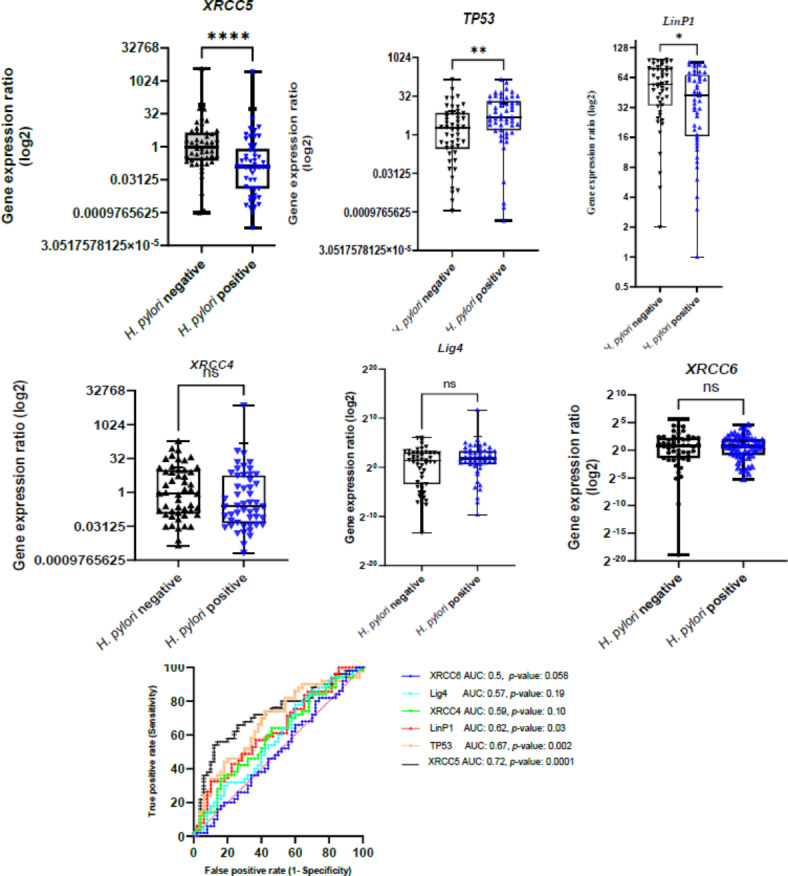
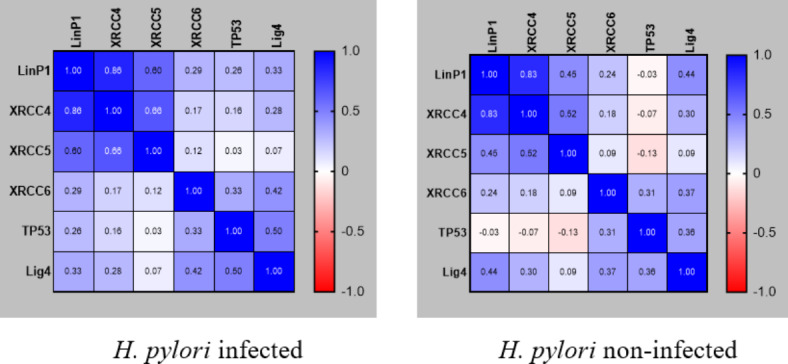
Verification
Claims the paper makes
The claims and statistics of this paper haven’t been checked yet.
Run the check — free, no account needed. It reads the open-access text and checks the sources it cites.
Claims other papers make about this one
Each is checked against this paper’s own text: does it say what the citing paper says it does?
The source backs part of the claim, not all of it — or backs it for a different population, condition or comparison.
In the citing paper
“It is commonly known that miRNAs interfere with target genes, signaling molecules, and pathways within the context of the BM microenvironment, hence contributing to the pathogenesis of MM [167–169].”
From Mesenchymal stromal cells in bone marrow niche of patients with multiple myeloma: a double-edged sword (2025) · cites this paper as [169]
Experimental — accuracy not yet measured
Self-check
Percentages, sums and reported differences re-computed from the paper’s own numbers.
The self-check needs the paper’s full text.
Citations
Cites
p53 in recombination and repair
Gatz, S. A., & Wiesmüller, L. (2006) · Cell Death & Differentiation · doi:10.1038/sj.cdd.4401903 · Cited by 242
Research works printed but not linked: 32
- Liu, Y. et al. Global burden and risk factors of gastritis and duodenitis: An observational trend study from 1990 to 2019. Sci. Rep. 14, 2697 (2024). · DOI
- Sipponen, P. & Price, A. B. The Sydney system for classification of gastritis 20 years ago. J. Gastroenterol. Hepatol. 26, 31–34 (2011). · DOI
- D’souza, S., Lau, K. C., Coffin, C. S. & Patel, T. R. Molecular mechanisms of viral hepatitis induced hepatocellular carcinoma. World J. Gastroenterol. 26, 5759–5783 (2020). · DOI
- Alexander, S. M. et al. Helicobacter pylori in human stomach: The inconsistencies in clinical outcomes and the probable causes. Front. Microbiol. 12, 713955 (2021). · DOI
- Mirbagheri, S. Z. et al. Transcriptional alteration of genes linked to gastritis concerning Helicobacter pylori infection status and its virulence factors. Mol. Biol. Rep. 48, 6481–6489 (2021). · DOI
- Scully, R., Panday, A., Elango, R. & Willis, N. A. DNA double-strand break repair-pathway choice in somatic mammalian cells. Nat. Rev. Mol. Cell Biol. 20, 698–714 (2019). · DOI
- Helicobacter and Cancer Collaborative Group. Gastric cancer and Helicobacter pylori: A combined analysis of 12 case control studies nested within prospective cohorts. Gut 49, 347–353 (2001). · DOI
- Tsuyuki, S. et al. Comparable genetic alteration profiles between gastric cancers with current and past Helicobacter pylori infection. Sci. Rep. 1, 23443 (2021). · DOI
- Jackson, S. P. & Bartek, J. The DNA-damage response in human biology and disease. Nature 461, 1071–1078 (2009). · DOI · Paper page
- Mehta, A. & Haber, J. E. Sources of DNA double-strand breaks and models of recombinational DNA repair. Cold Spring Harb Perspect. Biol. 6, a016428–a016428 (2014). · DOI
- Chang, H. H. Y., Pannunzio, N. R., Adachi, N. & Lieber, M. R. Non-homologous DNA end joining and alternative pathways to double-strand break repair. Nat. Rev. Mol. Cell Biol. 18, 495–506 (2017). · DOI · Paper page
- Li, L. & Robert, C. V. F. The role of error-prone alternative non-homologous end-joining in genomic instability in cancer. In DNA Repair and Human Health (InTech, 2011). · DOI
- Uszczynska-Ratajczak, B., Lagarde, J., Frankish, A., Guigó, R. & Johnson, R. Towards a complete map of the human long non-coding RNA transcriptome. Nat. Rev. Genet. 19, 535–548 (2018). · DOI
- Jiang, M. C., Ni, J. J., Cui, W. Y., Wang, B. Y. & Zhuo, W. Emerging roles of lncRNA in cancer and therapeutic opportunities. Am. J. Cancer Res. 9, 1354–1366 (2019).
- Sakthianandeswaren, A., Liu, S. & Sieber, O. Long noncoding RNA LINP1: Scaffolding non-homologous end joining. Cell Death Discov. 2, 16059 (2016). · DOI
- Ghanbarian, M. et al. Transcriptional alteration of NF-κB-associated long noncoding RNAs in the stomach of Helicobacter pylori-infected and non-infected patients. J. Infect. Dev. Ctries. 17, 1556–1565 (2023). · DOI
- Hanada, K. et al. Helicobacter pylori infection introduces DNA double-strand breaks in host cells. Infect. Immun. 82, 4182–4189 (2014). · DOI
- Hartung, M. L. et al. H. pylori-InducestrandSbreaksBarekintroducedoduced by Nucleotide Excision Rendonucleasesleasepromoteromote targetTgenetexpressionession. Cell. Rep. 13, 70–79 (2015). · DOI
- Morales-Fuentes, G. A. et al. p53 expression in the gastric mucosa of patients infected with Helicobacter pylori. Rev. Gastroenterol. Mex. 78, 12–20 (2013).
- Li, N., Xie, C. & Lu, N. H. p53, a potential predictor of Helicobacter pylori infection-associated gastric carcinogenesis? Oncotarget 7, 66276–66286 (2016). · DOI
- Capaccia, C., Diverio, S., Zampini, D. & Guelfi, G. The Complex Interaction between P53 and miRNAs joins new awareness in physiological stress responses. Cells 11, 1631 (2022). · DOI
- Dahm-Daphi, J. et al. Nonhomologous end-joining of site-specific but not of radiation-induced DNA double-strand breaks is reduced in the presence of wild-type p53. Oncogene 24, 1663–1672 (2005). · DOI
- Rajaei, A. et al. Activation of the DNA damage response pathway in the infected gastric tissue with Helicobacter pylori: A case-control study. J. Infect. Dev. Ctries. 17, 1125–1129 (2023). · DOI
- Mahmoudzadeh Sagheb, H., Heidari, Z., Jahantigh, M. & Narouei, M. Immunohistochemical expression of p53 and Ki-67 genes in gastric Cancer and precancerous lesions in the patients with Helicobacter pylori Infection. Gene Cell Tissue 3, e41341 (2016). · DOI
- Grupp, K. et al. Expression of DNA ligase IV is linked to poor prognosis and characterizes a subset of prostate cancers harboring TMPRSS2: ERG fusion and PTEN deletion. Oncol. Rep. 34, 1211–1220 (2015). · DOI
- Zhao, P. et al. Genetic polymorphisms of DNA double-strand break repair pathway genes and glioma susceptibility. BMC Cancer 13, 234 (2013). · DOI
- Zhang, Y. et al. Long noncoding RNA LINP1 regulates repair of DNA double-strand breaks in triple-negative breast cancer. Nat. Struct. Mol. Biol. 23, 522–530 (2016). · DOI
- Liang, Y. et al. Long noncoding RNA LINP1 acts as an oncogene and promotes chemoresistance in breast cancer. Cancer Biol. Ther. 19, 120–131 (2018). · DOI
- Lu, T. et al. Downregulation of long non-coding RNA LINP1 inhibits the malignant progression of esophageal squamous cell carcinoma. Ann. Transl. Med. 8, 675–675 (2020). · DOI
- Chen, B. et al. A regulatory circuitry comprising TP53, miR-29 family, and SETDB1 in non-small cell lung cancer. Biosci. Rep. 38, BSR20180678 (2018). · DOI
- Ugalde, A. P. et al. Aging and chronic DNA damage response activate a regulatory pathway involving miR-29 and p53. EMBO J. 30, 2219–2232 (2011). · DOI
- Moureau, S., Luessing, J., Harte, E. C., Voisin, M. & Lowndes, N. F. A role for the p53 tumour suppressor in regulating the balance between homologous recombination and non-homologous end joining. Open Biol. 6, 160225 (2016). · DOI
Cited by
Sorted by citations
Kamrani, S., Naseramini, R., Khani, P., Razavi, Z. S., Afkhami, H., Atashzar, M. R., Nasri, F., Alavimanesh, S., Saeidi, F., & Ronaghi, H. (2025) · Cancer Cell International · doi:10.1186/s12935-025-03741-x · Cited by 27
Metadata
- Authors
- Amirnorouzi, M., Karimi, A., Daryani, N. E., Rajaei, A., Hashemi, M., & Alebouyeh, M.
- Affiliations
- Islamic Azad University, Tehran (IR)
- Shahid Beheshti University (IR)
- Imam Khomeini Hospital (IR)
- University of South Florida (US)
- Corresponding author
- Alebouyeh, Masoud
- Venue
- Scientific Reports
- Published
- 2024-10-07
- Volume
- 14
- Issue
- 1
- Pages
- 23363-23363
- ISSN
- 2045-2322 (ISSN-L)
- PMC
- PMC11458588
- OpenAlex
- W4403177453
- Cited by
- 4
- References
- 1
- Citations by year
- 2026: 2 · 2025: 2
- FWCI
- 1.68
- Type
- journal article
- Language
- en
- Open access
- gold
- doi.org
- Licence
- Locations
- Scientific Reports (publishedVersion, cc-by-nc-nd)
- Research Square (acceptedVersion, cc-by)
- PubMed Central (publishedVersion, cc-by-nc-nd)
- PubMed (publishedVersion)
- DOAJ (DOAJ: Directory of Open Access Journals) (submittedVersion, cc-by-sa)
- Funders
- Pediatric Infections Research Center, Research Institute for Children’s Health, Shahid Beheshti University of Medical Sciences, Tehran, Iran (32897)
- Topics
- Health Sciences › Medicine › Gastroenterology › Helicobacter pylori-related gastroenterology studies
- Life Sciences › Biochemistry, Genetics and Molecular Biology › Molecular Biology › DNA Repair Mechanisms
- Health Sciences › Medicine › Pathology and Forensic Medicine › Genetic factors in colorectal cancer
- Keywords
- Helicobacter pylori infection, chronic gastritis, non-homologous end joining, DNA repair, negative feedback loop, TP53, long non-coding RNA, Ku80, XRCC4, Ku70, LIG4, gene expression
- MeSH terms
- Ku Autoantigen, DNA Ligase ATP, Adult, DNA-Binding Proteins, Female, Gastritis, Humans, Male, Middle Aged, Tumor Suppressor Protein p53, Helicobacter pylori, Helicobacter Infections, Feedback, Physiological, DNA End-Joining Repair, RNA, Long Noncoding
About these checks
Registry, retraction, Cites and statistics results are computed, not judged, with one exception: a printed reference that no index lists is read once by a model before it counts as a citation error. Claims are extracted by a model and kept only when their quote appears verbatim in the text; each cited source is then checked, with a model’s help, for whether it says what the claim relies on. Those verdicts can be wrong — read the claim’s quote and the cited source before relying on one.
Statistics and arithmetic are recomputed, not judged.
Confidence bands are shown only for fields calibrated on our annotated test set. None is calibrated yet, so no band is shown.
What counts as a claim ›How we measure confidence ›How we check this ›
Are you an author, or do you see a problem with this page? Request a review
