

Research on digital twin diagnosis model for the thermal-electric field of high-voltage switchgears
Open accessPublished version of a preprint
The DOI matches its Crossref record; 29 of the 29 references it cites were found in a registry or an index; none of the 10 sources its claims cite is checked for support yet.
Abstract
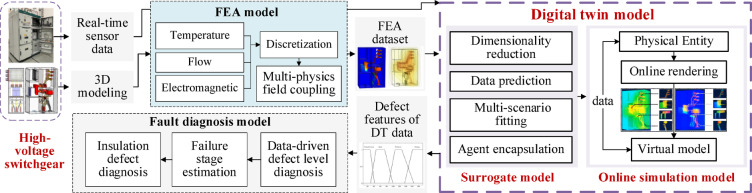
High-voltage switchgear is a critical component in modern power systems, yet it remains vulnerable to insulation degradation and other faults under complex operating conditions. To address these challenges, a digital twin-based online fault diagnosis method is proposed for high-voltage switchgear, integrating thermal and electric field analysis. A three-dimensional model of the KYN28-12(Z) switchgear is first established, incorporating multi-physics simulations to identify key monitoring regions. Building on this, a digital twin surrogate and information model are developed to enable real-time reconstruction and online characterization of coupled thermal-electric fields. For fault feature extraction, optimized classification tree (OCT) and random forest algorithms are employed, while an enhanced adaptive neural-fuzzy inference system (ANFIS) is constructed for intelligent fault diagnosis. Ultimately, the diagnosis model is trained using a combination of finite element simulation data, experimental acquisition data, and on-site operational historical data, ensuring comprehensive learning of switchgear behaviors under various conditions. And the diagnosis relies on data from the digital twin model to achieve accurate virtual-real mapping of switchgear states, providing theoretical support for intelligent operation and maintenance. Experimental results demonstrate a fault recognition rate of 93.4%, with only a 2.3% accuracy drop under 30% noise, verifying the robustness and reliability of the proposed method.
Overview
CoChat Summary
TL;DR
The paper proposes a digital twin-based online fault diagnosis model for high-voltage switchgear, coupling thermal-electric field simulation with a reduced-order surrogate and ANFIS-OCT diagnosis. It reports 93.4% fault recognition and only a 2.3% accuracy drop under 30% noise.
Key findings
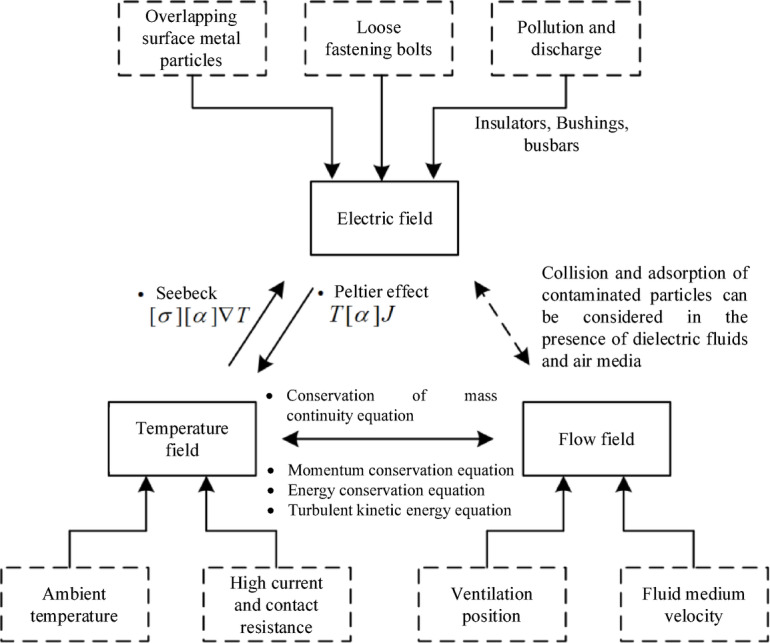
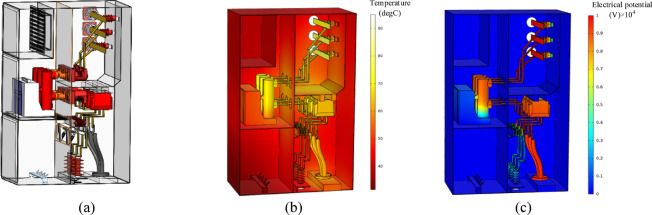
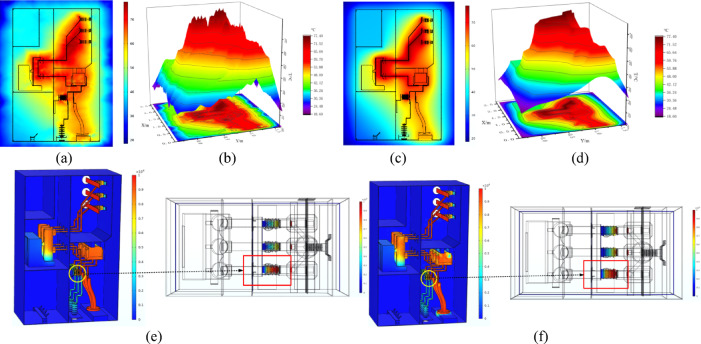
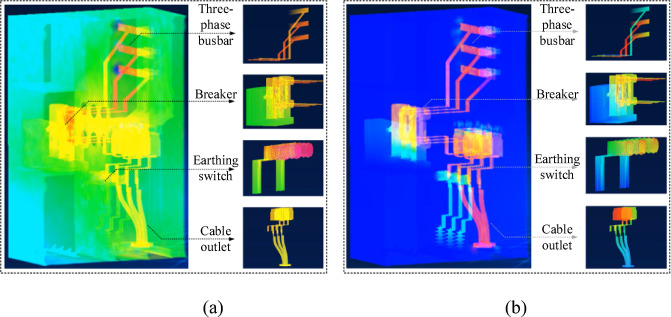
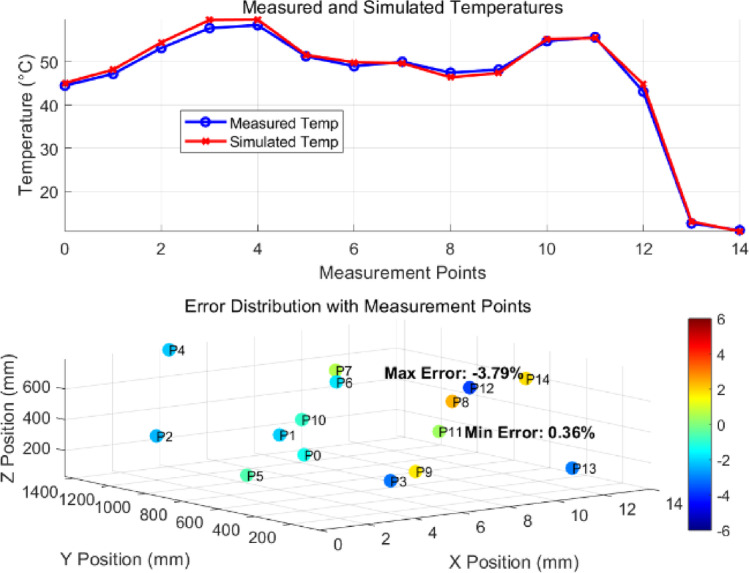
- The KYN28-12(Z) thermal-electric-flow FEA model identified internal risk zones; thermal field simulation error was less than 8% versus test data in the conclusions, with a maximum error of −3.79% in the thermal verification comparison.
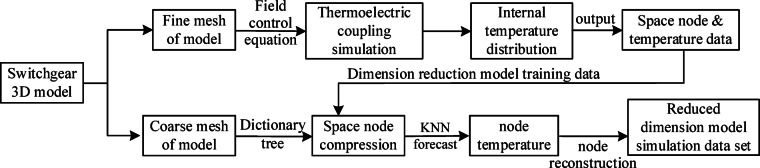
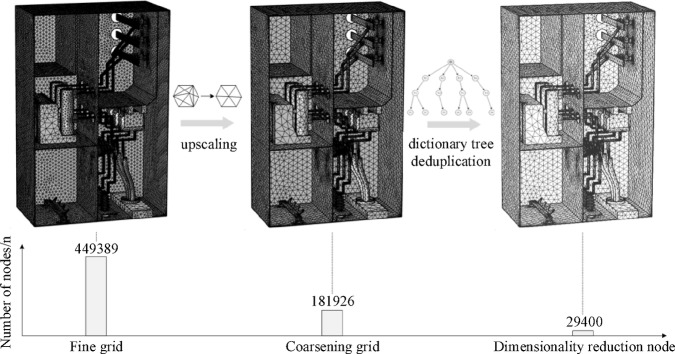
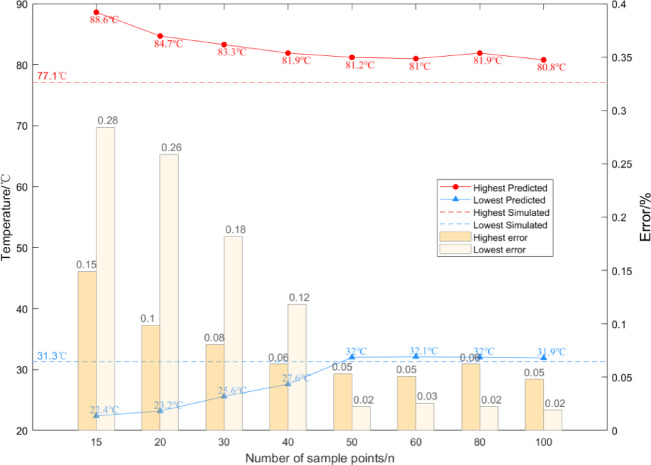
- Dimensionality reduction cut nodes from 449,389 to 181,926 by mesh coarsening (59.5% reduction), then to 29,400 by dictionary tree deduplication (6.5% of original); the paper reports a 90% node reduction while maintaining field extreme value errors below 5%, with K = 50 KNN, temperature M1 = 0.9273 and M2 = 0.9362, electric-field M1 = 0.9141 and M2 = 0.9197, and total response time 0.32 s.
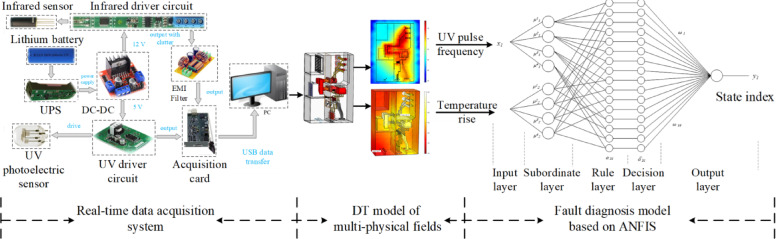
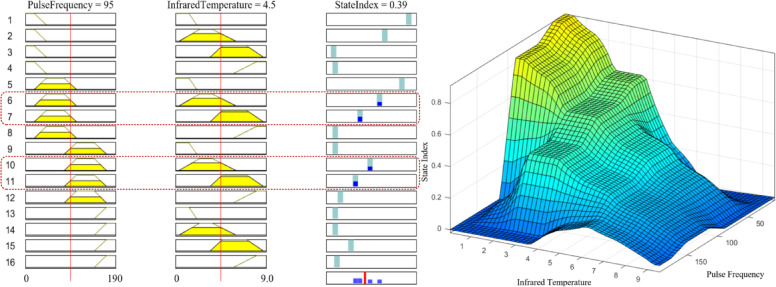
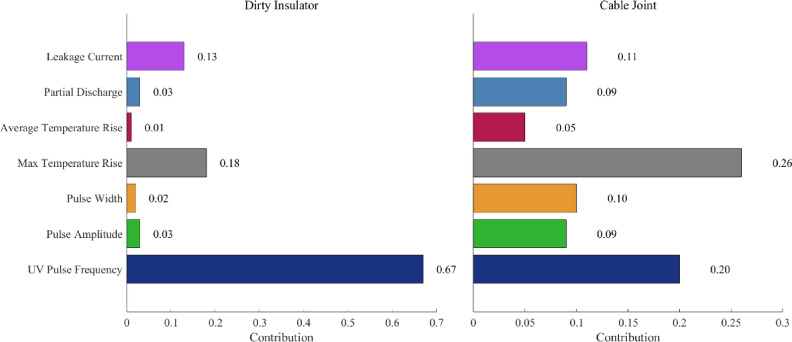
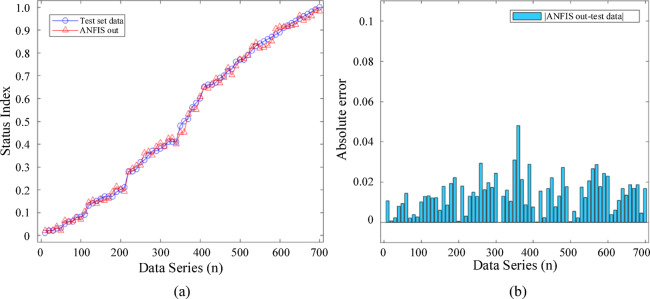
- The ANFIS-OCT hybrid using UV pulse frequency and maximum temperature rise achieved 93.4% accuracy, 93.2% precision, 92.1% recall, 92.6% F1-score, 8.7 s computation time, only 2.3% accuracy reduction under 30% noise, and 2.1% cross-validation accuracy variance.
- ANFIS error propagation analysis showed final output error of ±3.3% from ±5% input error, with amplification factors all below 1 and final output error 34% lower than input error.
Methods
- A 3D KYN28-12(Z) switchgear model was built with coupled thermal-electric-flow FEA; simulations covered ambient temperatures from 10 °C to 40 °C and insulator wet-zone conditions from 0% to 100%, using finite element simulation data, experimental measurements, and historical operational records.
- The surrogate model used mesh coarsening, dictionary tree deduplication, KNN, and RBF interpolation for 29,400 reduced nodes across six ambient-temperature and six fault-temperature datasets; models were serialized as PKL files and transmitted via TCP local loopback to Unity 3D for visualization.
- Fault diagnosis combined OCT and random forest for feature importance with a Takagi-Sugeno ANFIS using four trapezoidal membership functions per input, two inputs (UV pulse frequency and maximum temperature rise), and 16 fuzzy rules; 2,700 data sets were extracted, with 2,000 used for training and 700 for testing (150 Level I, 150 Level II, 400 Level III).
Limitations
- The paper states future work will focus on optimizing sensor deployment, conducting economic analysis for digital twin implementation in 10 kV switchgears, and evaluating dynamic response performance under transient conditions.
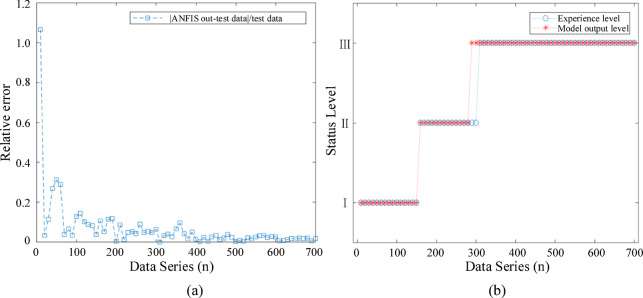
- Evident from the text: validation is limited to a single KYN28-12(Z) model and specific fault types such as insulator contamination and cable joint partial discharge; relative error can reach 106% for low state indices when using only the state index; misclassifications occur at the Level II/III boundary; and the KNN surrogate shows patterned artifacts in planar regions.
Model-written summary. Check it against the paper before relying on it.
Integrity signals
Registry
Cites
Statistics
Figures
Verification
Claims the paper makes
0 Valid · 2 Not valid · 6 Not checked · 80 Own results and interpretations
A result the paper reports from its own data — it cites no other source for it, so there is none to check. The quote shows it is in the paper.
In the paper
“The lowest temperatures (11.1 ~ 12.2 °C) appear on the outer shell.”
§ Research on digital twin diagnosis model for the thermal-electric field of high-voltage switchgears > Results > Construction of the switchgear field simulation dataset
hedged- Asserted: passes — The authors put it forward as true.
- Checkable: passes — It can be checked against evidence.
- Load-bearing: unclear — It is unclear whether the paper’s conclusions depend on it.
- Based: passes — The paper gives a reason why it holds.
A result the paper reports from its own data — it cites no other source for it, so there is none to check. The quote shows it is in the paper.
In the paper
“For dry pollution scenarios, fine-mesh finite element simulations were performed across ambient temperatures ranging from 10 °C to 35 °C, yielding results consistent with the rated conditions of the KYN28 switchgear.”
§ Research on digital twin diagnosis model for the thermal-electric field of high-voltage switchgears > Results > Construction of the switchgear field simulation dataset
plain- Asserted: passes — The authors put it forward as true.
- Checkable: passes — It can be checked against evidence.
- Load-bearing: passes — The paper’s conclusions depend on it.
- Based: passes — The paper gives a reason why it holds.
A result the paper states — it cites no source for it, so there is none to check. The quote shows it is in the paper.
In the paper
“Regarding real-time feasibility, the optimization of spatial nodes by both methods significantly reduces proxy model response time, far exceeding the speed of traditional finite element analysis.”
§ Research on digital twin diagnosis model for the thermal-electric field of high-voltage switchgears > Introduction > Dimensionality reduction of 3D nodes and construction of reduced-dimensionality dataset
boostedstates a cause- Asserted: passes — The authors put it forward as true.
- Checkable: passes — It can be checked against evidence.
- Load-bearing: passes — The paper’s conclusions depend on it.
- Based: passes — The paper gives a reason why it holds.
A result the paper reports from its own data — it cites no other source for it, so there is none to check. The quote shows it is in the paper.
In the paper
“for small K values, the model’s predictions are heavily influenced by a few nearest neighbors, leading to an uneven cloud map and significant deviations in predicted values.”
§ Research on digital twin diagnosis model for the thermal-electric field of high-voltage switchgears > Results > Analysis of the switchgear digital twin surrogate model
plainstates a cause- Asserted: passes — The authors put it forward as true.
- Checkable: passes — It can be checked against evidence.
- Load-bearing: passes — The paper’s conclusions depend on it.
- Based: passes — The paper gives a reason why it holds.
A result the paper reports from its own data — it cites no other source for it, so there is none to check. The quote shows it is in the paper.
In the paper
“The ANFIS architecture does not exhibit the “layer-by-layer amplification” effect.”
§ Research on digital twin diagnosis model for the thermal-electric field of high-voltage switchgears > Results > Discussion: multisource feature data fusion and diagnostic analysis
plain- Asserted: passes — The authors put it forward as true.
- Checkable: passes — It can be checked against evidence.
- Load-bearing: passes — The paper’s conclusions depend on it.
- Based: passes — The paper gives a reason why it holds.
25 more claims
Create a free account to see all 88 claims and to verify the 10 references still open.
- It may state two separate claims as one. 49
- The quote only partly states this claim. 1
- Probably not a substantial claim. 13
Claims other papers make about this one
Each is checked against this paper’s own text: does it say what the citing paper says it does?
In the citing paper
“Within the high-voltage apparatus community, accelerated temperature-field surrogates have been reported for power transformers18, bushings19, cable lines20, and GIS21,22.”
From Uncertainty-aware temperature field reconstruction from sparse samples and sensing via latent-space enhancement for GIS digital twin applications (2026) · cites this paper as [22]
Self-check
Percentages, sums and reported differences re-computed from the paper’s own numbers.
Each contradiction between two passages listed here was confirmed by an independent check.
Rated minor: it would not touch a result — a value no result rests on, a p-value that stays on the same side of the significance level, or a conflict that is clerical, resolved elsewhere in the paper, or outside its own findings.
In the paper
§ Research on digital twin diagnosis model for the thermal-electric field of high-voltage switchgears > Introduction > Fault diagnosis model construction and training process for switchgear
“extracts the maximum temperature rise per unit time and the UV pulse frequency as input variables x1 and x2 for the Takagi-Sugeno model.”
§ Research on digital twin diagnosis model for the thermal-electric field of high-voltage switchgears > Introduction > Fault diagnosis model construction and training process for switchgear
“the input pulse frequency x1 and infrared temperature rise x2 are included in the membership function domain”
Rated minor: it would not touch a result — a value no result rests on, a p-value that stays on the same side of the significance level, or a conflict that is clerical, resolved elsewhere in the paper, or outside its own findings.
In the paper
§ Research on digital twin diagnosis model for the thermal-electric field of high-voltage switchgears > Results > Analysis of the switchgear digital twin surrogate model
“When K ≤ 50, the temperature cloud map shows a clear upward shift in overall temperature, indicating a rise in the average temperature within the switchgear. The predicted maximum and minimum temperatures deviate from finite element results by 14.9% and 28.4%, respectively”
§ Research on digital twin diagnosis model for the thermal-electric field of high-voltage switchgears > Results > Analysis of the switchgear digital twin surrogate model
“At K ≥ 50, the temperature map becomes more uniform and closely aligns with the finite element simulation, with errors in maximum and minimum temperatures reduced to below 5% and 2%, respectively.”
Rated minor: it would not touch a result — a value no result rests on, a p-value that stays on the same side of the significance level, or a conflict that is clerical, resolved elsewhere in the paper, or outside its own findings.
In the paper
§ Research on digital twin diagnosis model for the thermal-electric field of high-voltage switchgears > Introduction > Digital twin data information model and communication scheme
“Each triangle initially includes six vertices, but shared vertices are deduplicated, leaving only unique vertices (e.g., a, b, c, d).”
§ Research on digital twin diagnosis model for the thermal-electric field of high-voltage switchgears > Introduction > Digital twin data information model and communication scheme
“For instance, triangles A (a, b, c) and B (b, c, d) share vertices b and c, resulting in duplicate data.”
Citations
Cites
Wang, P., & Luo, M. (2021) · Journal of Manufacturing Systems · doi:10.1016/j.jmsy.2020.11.012 · Cited by 181
Ling, J. Y. X., Chan, Y. J., Chen, J. W., Chong, D. J. S., Tan, A. L. L., Arumugasamy, S. K., & Lau, P. L. (2024) · Environmental Science and Pollution Research · doi:10.1007/s11356-024-32435-6 · Cited by 100 · cited 1×
“Virtual sensors using adaptive inference reduce localization errors, though single-sensor adaptability is limited by data dimensionality 23 .”
Elevator fault diagnosis based on digital twin and PINNs-e-RGCN
Wang, Q., Chen, L., Xiao, G., Wang, P., Gu, Y., & Lu, J. (2024) · Scientific Reports · doi:10.1038/s41598-024-78784-7 · Cited by 88 · cited 1×
“Real-time protocols support fault detection in vertical transport systems 26,27 , and novel sensors such as capacitive-coupling temperature devices extend condition monitoring capabilities 28 .”
A novel digital-twin approach based on transformer for photovoltaic power prediction
Zhao, X. (2024) · Scientific Reports · doi:10.1038/s41598-024-76711-4 · Cited by 73
Hu, K., Zhou, Y., Sitaraman, S. K., & Tentzeris, M. M. (2023) · Scientific Reports · doi:10.1038/s41598-023-39476-w · Cited by 63
Traffic flow digital twin generation for highway scenario based on radar-camera paired fusion
Li, Y., & Zhang, W. (2023) · Scientific Reports · doi:10.1038/s41598-023-27696-z · Cited by 60
Nguyen, V. H., Tran, Q. T., Bésanger, Y., Jung, M., & Nguyen, T. L. (2021) · Electrical Engineering · doi:10.1007/s00202-021-01246-0 · Cited by 53
Design and application of virtual simulation teaching platform for intelligent manufacturing
Zheng, P., Yang, J., Lou, J., & Wang, B. (2024) · Scientific Reports · doi:10.1038/s41598-024-62072-5 · Cited by 47
Digital twin of a Fresnel solar collector for solar cooling
Machado, D. O., Chicaiza, W. D., Escaño, J. M., Gallego, A. J., de Andrade, G. A., Normey‐Rico, J. E., Bordons, C., & Camacho, E. F. (2023) · Applied Energy · doi:10.1016/j.apenergy.2023.120944 · Cited by 46
A digital twin based forecasting framework for power flow management in DC microgrids
Sado, K., Peskar, J., Downey, A., Khan, J., & Booth, K. (2025) · Scientific Reports · doi:10.1038/s41598-025-91074-0 · Cited by 41
Research works printed but not linked: 4
- Yang, F. et al. Application and implementation method of digital twin in electric equipment. High. Voltage Eng. 47 (5), 1505–1521 (2021).
- Yan, X. et al. Framework design and application prospect for digital twin virtual power plant system. Proc. CSEE. 43 (2), 604–618 (2023).
- Gao, Y., He, X. & Ai, Q. Multi agent coordinated optimal control strategy for smart microgrid based on digital twin drive. Power Syst. Technol. 45 (7), 2483–2491 (2021).
- Liu, L., Ma, S. & Rui, L. Evaluation method for manifold dimensionality reduction effect based on trustworthiness and continuity. Appl. Res. Comput. 35 (06), 1707–1711 (2018).
Cited by
Satpathy, P. R., & Ramachandaramurthy, V. K. (2026) · Applied Energy · doi:10.1016/j.apenergy.2026.128129 · Cited by 13
Chi, W., Wang, T., Zhang, J., Wang, Z., & Zhang, C. (2025) · Energies · doi:10.3390/en18236343 · Cited by 10
Wang, J., Zhou, Z., Chen, W., Liu, B., Su, S., Ding, J., Peng, Z., & Gao, W. (2026) · Scientific Reports · doi:10.1038/s41598-026-52842-8 · Cited by 2
Chen, H., 李明辉, Tian, Y., Li, J., & Liu, P. X. (2026) · Engineering Applications of Artificial Intelligence · doi:10.1016/j.engappai.2026.115586 · Cited by 2
Jin, L., Zuo, P., Wang, J., & Yuan, Z. (2026) · Engineering Research Express · doi:10.1088/2631-8695/ae4c1d · Cited by 1
Metadata
- Authors
- Ding, F., Ma, Y., Li, X., Huang, J., & Kang, J.
- Affiliations
- Tongji University (CN)
- Zhejiang University (CN)
- Corresponding author
- Ma, Yongji
- Venue
- Scientific Reports
- Published
- 2025-10-01
- Volume
- 15
- Issue
- 1
- Pages
- 34303-34303
- ISSN
- 2045-2322 (ISSN-L)
- PMC
- PMC12488926
- OpenAlex
- W4414700983
- Cited by
- 15
- References
- 29
- Citations by year
- 2026: 13 · 2025: 2
- FWCI
- 3.27
- Type
- journal article
- Language
- en
- Open access
- gold
- doi.org
- Licence
- cc-by
- creativecommons.org/licenses/by/4.0 (tdm)
- creativecommons.org/licenses/by/4.0 (vor)
- Locations
- Scientific Reports (publishedVersion, cc-by)
- Research Square (submittedVersion, cc-by)
- Europe PMC (PubMed Central) (publishedVersion, cc-by)
- PubMed Central (publishedVersion, cc-by)
- PubMed (publishedVersion)
- DOAJ (DOAJ: Directory of Open Access Journals) (submittedVersion)
- Topics
- Physical Sciences › Engineering › Control and Systems Engineering › Power Systems Fault Detection
- Physical Sciences › Engineering › Electrical and Electronic Engineering › High voltage insulation and dielectric phenomena
- Physical Sciences › Engineering › Electrical and Electronic Engineering › Power Transformer Diagnostics and Insulation
- Keywords
- high-voltage switchgear, digital twin, real-time fault diagnosis, insulation degradation, multiphysics simulation, surrogate models, information model, random forest, adaptive neuro-fuzzy inference system, fault feature extraction, operation and maintenance
About these checks
Registry, retraction, Cites and statistics results are computed, not judged, with one exception: a printed reference that no index lists is read once by a model before it counts as a citation error. Claims are extracted by a model and kept only when their quote appears verbatim in the text; each cited source is then checked, with a model’s help, for whether it says what the claim relies on. Those verdicts can be wrong — read the claim’s quote and the cited source before relying on one.
A language model drew the claims from the paper on 2026-11-29, under version 3 of the claim definition (model deepseek-v4.1-flash, prompt extract-v3).
A second model labelled each claim on 2026-11-29 (model jev-1.13-20260917, definition revision gold-guideline-v0.2).
Statistics and arithmetic are recomputed, not judged.
Confidence bands are shown only for fields calibrated on our annotated test set. None is calibrated yet, so no band is shown.
What counts as a claim ›How we measure confidence ›How we check this ›
Are you an author, or do you see a problem with this page? Request a review
Data sources
Bibliographic data: Semantic Scholar, OpenAlex, Crossref.
Contains information from the Semantic Scholar Academic Graph Datasets, made available under the ODC Attribution License (ODC-BY 1.0).
Semantic Scholar’s data is described in: Kinney, R., et al. (2023). The Semantic Scholar Open Data Platform. arXiv:2301.10140.
