

Multi-label machine learning for power forecasting of a grid-connected photovoltaic solar plant over multiple time horizons
Open accessThe DOI matches its Crossref record; 50 of the 50 references it cites were found in a registry or an index; none of the 3 sources its claims cite is checked for support yet.
Abstract
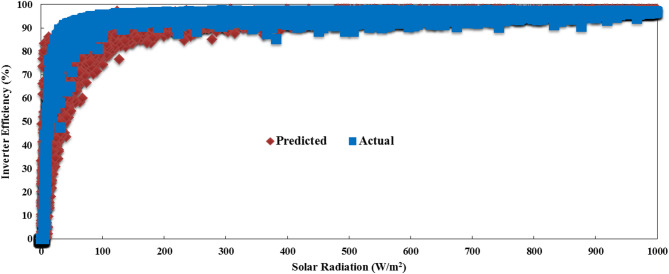
Because of solar power’s inherent intermittency and stochastic nature, accurate photovoltaic (PV) generation forecasting is critical for the planning and operation of PV-integrated power systems. Thus, accurate power forecasting becomes vital for maintaining good power dispatch efficiency and power grid operational security. Several PV forecasting methods based on machine learning algorithms (MLAs) have recently emerged. This paper presents machine learning methods for multi-label forecasting of PV and AC power delivered to the grid of a building-applied PV plant. Various algorithms representing multiple groups are evaluated, including linear regression (LR), polynomial regression (PR), neural networks (NN), deep learning (DL), gradient-boosted trees (GBT), random forests (RF), decision trees (DT), k-nearest neighbor (k-NN), and support vector machines (SVM). The models use real-time collected data from sensors over one year for solar irradiance, ambient temperature, wind speed, and cell temperature to predict PV and AC power outputs. Forecast performance over multiple time horizons is validated using four datasets: 24 h, one week, one month, and sudden variations. Models are evaluated based on performance metrics such as absolute error (AE), root mean square error (RMSE), normalized absolute error (NAE), relative error (RE), relative root square error (RRSE), and correlation coefficient (R). Results show that RF, DT, and DL consistently achieved the highest accuracy (R ≈ 99.8–100%) with minimal errors (RMSE within 0.014–0.022, AE within 0.008–0.015) across various forecasting scenarios. These models demonstrated strong adaptability and predictive reliability across short-term, medium-term, and long-term forecasts, making them the most effective choices for PV and AC power prediction. The accurate forecasts generated in this study have the potential to aid grid operators in forecasting PV power output variability and planning for integrating intermittent PV power into the grid. Understanding how PV generation will fluctuate given different meteorological conditions allows operators to ensure the consistent integration of this weather-dependent power source. Moreover, multi-label prediction of DC and AC power enables inverter efficiency optimization and grid integration analysis. The average actual and predicted efficiencies of the inverter are 0.96688 and 0.9638, providing valuable insights.
Overview
CoChat Summary
TL;DR
This paper develops multi-label machine-learning models to forecast PV array and AC power for a 30.26 kW grid-connected BAPV plant in Cairo, Egypt, using one year of 5-minute meteorological and power data. Across 24-h, one-week, one-month, and sudden-variation horizons, RF, DT, and DL were generally most accurate, while PR and GBT were unstable.
Key findings
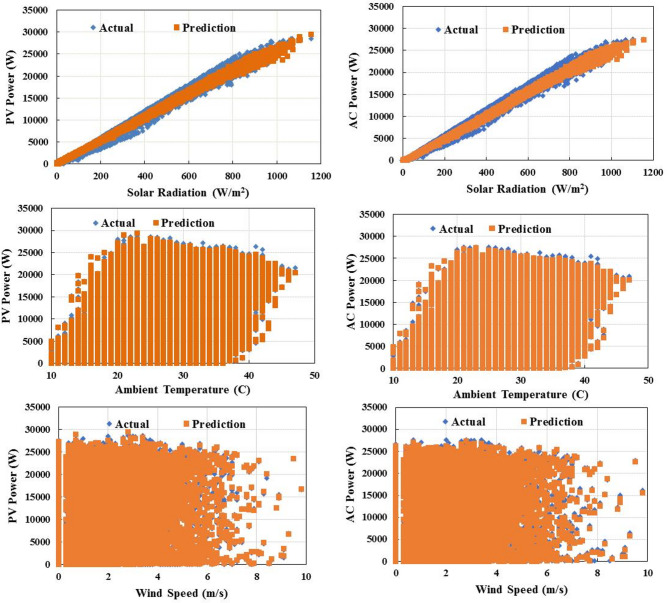
- Overall test performance: RF, DT, and DL were top models with RMSE 0.022–0.023, AE 0.015–0.016, and R = 99.7%; DT had the fastest execution time (1 s) and lowest RE (6.04%), while PR performed worst (RMSE 0.238, RE 797.23%, R = 75.1%) and GBT had RE 665.77%.
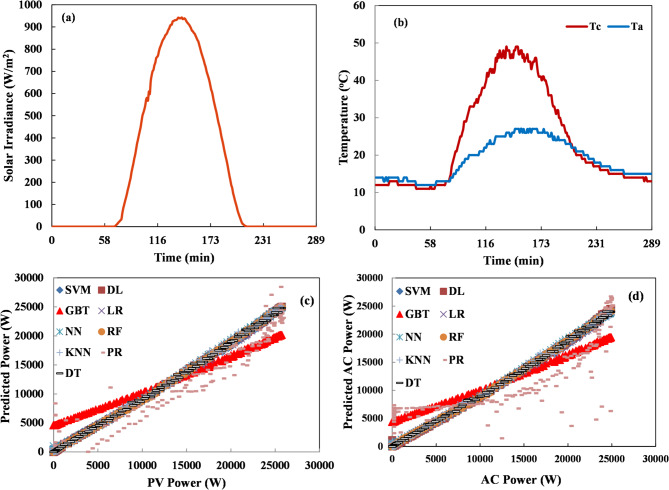
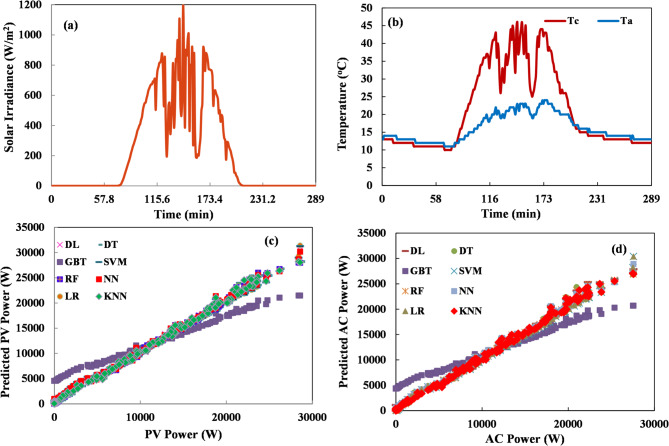
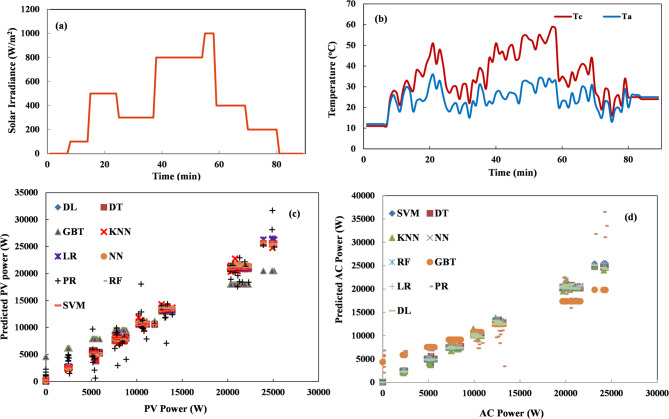
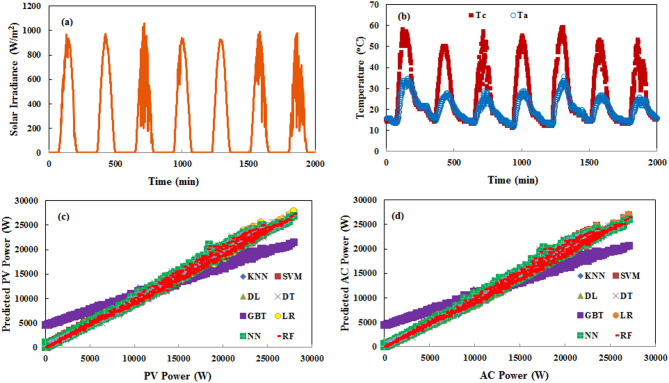
- Short-term horizons: on a sunny day, RF achieved RMSE 0.023 and AE 0.015, K-NN had the lowest RE (5.39%), and DT had RE 8.91%; on a cloudy day, LR and DT had the lowest RMSE (0.016 and 0.018) and AE (0.009), with DT RE 11.27% and RF RE 17.08%; under sudden irradiance variation, LR had RE 3.79%, NN 3.61%, and RF RMSE 0.017 with AE 0.012.
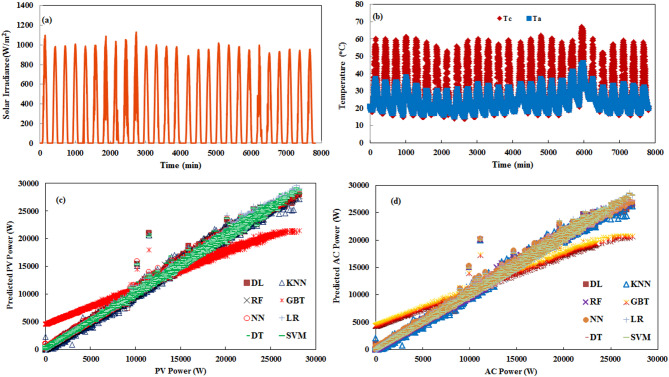
- Medium- and long-term horizons: for one week, DT had the lowest RE (7.79%) at 1 s, while RF had RMSE 0.018 and AE 0.011; for one month, DT had the lowest RE (5.75%) at 1 s, RF and DL had AE 0.008 and RMSE 0.014, and SVM had RE 7.87% but required 193 s.
- Inverter efficiency: the average actual and predicted inverter efficiencies were 0.96688 and 0.9638, respectively; multi-label prediction of DC and AC power is presented as useful for inverter efficiency optimization and grid integration analysis.
Methods
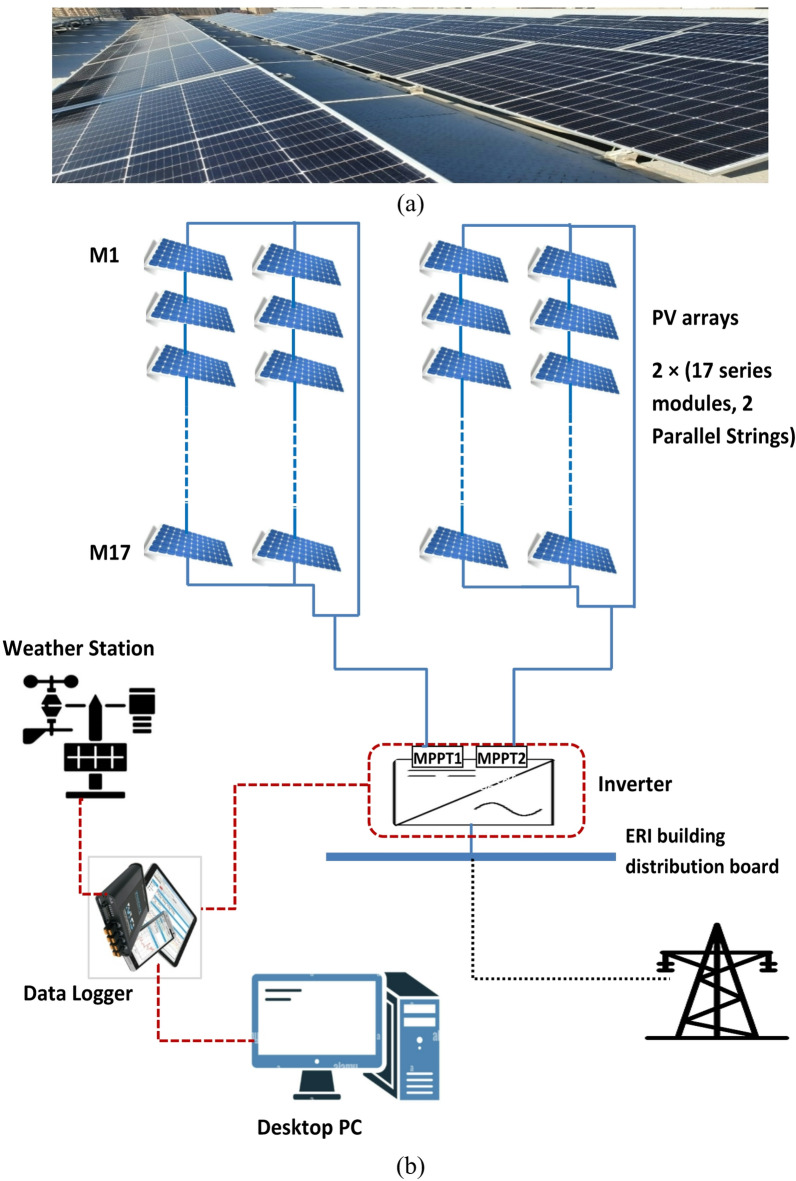
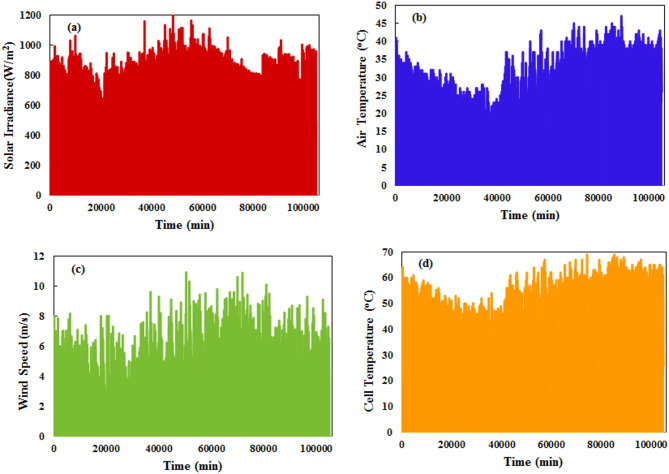
- Data: a grid-connected BAPV plant in New Nozha, Cairo, Egypt, with 30.26 kW total capacity, two 15.13 kW sub-arrays, 445 W mono-crystalline modules, and an ABB 27.6 kW three-phase inverter; on-site weather station and Solar-Log Base 100 logger recorded 5-minute data from October 2022 to September 2023, comprising more than 105 K samples per parameter. Inputs were solar irradiance (Srad), ambient temperature (Tamb), wind speed (Ws), and cell temperature (Tcell); labels were PV array power (PPV) and AC power (PAC).
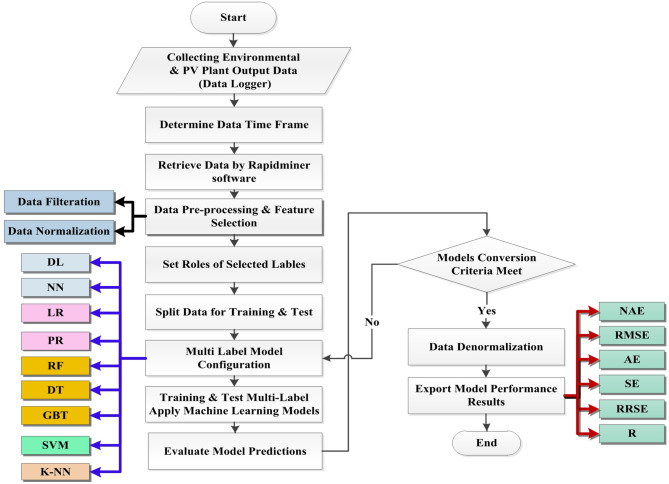
- Modeling: RapidMiner Studio 10.1 Educational was used to implement LR, PR, NN, DL, GBT, RF, DT, k-NN, and SVM; pre-processing included outlier filtration and normalization (min-max for all models except SVM, which used z-score), feature selection used Pearson correlation, and data were split 70:30 for training/testing with hyper-parameter tuning on validation data.
- Validation: models were tested for 24 h (sunny and cloudy days, 288 samples/parameter), one week (2016 samples/parameter), one month (7823 samples/parameter), and sudden variations (90 records); metrics were AE, RMSE, NAE, RE, RRSE, and R. For 2024 horizons, each model received actual measured weather inputs for the target periods, which were excluded from training, and predicted PV output solely from unseen meteorological data.
Limitations
- Stated: future work should incorporate additional variables and real-time data to enhance model robustness and create a generalized model effective under various weather conditions.
- Evident from the text: the study uses one BAPV plant in Cairo and one year of training data; the 2024 horizon validations provide actual measured weather inputs for target periods, so the evaluation does not include errors from forecasting future weather.
- Evident from the text: SVM modeling was restricted to a linear kernel in the mySVM Java implementation, and PR and GBT repeatedly showed extreme instability with very high relative errors, limiting their reliability for PV power forecasting.
Model-written summary. Check it against the paper before relying on it.
Integrity signals
Registry
Cites
Statistics
Figures
Verification
Claims the paper makes
0 Valid · 4 Not valid · 3 Not checked · 98 Own results and interpretations
A result the paper reports from its own data — it cites no other source for it, so there is none to check. The quote shows it is in the paper.
In the paper
“our analysis reveals that the top-performing MLAs consist of RF, DL, and DT”
§ Multi-label machine learning for power forecasting of a grid-connected photovoltaic solar plant over multiple time horizons > Results and discussion > Models train and test
plain- Asserted: passes — The authors put it forward as true.
- Checkable: passes — It can be checked against evidence.
- Load-bearing: passes — The paper’s conclusions depend on it.
- Based: passes — The paper gives a reason why it holds.
A result the paper reports from its own data — it cites no other source for it, so there is none to check. The quote shows it is in the paper.
In the paper
“PR is particularly underperforming across all metrics.”
§ Multi-label machine learning for power forecasting of a grid-connected photovoltaic solar plant over multiple time horizons > Results and discussion > Models train and test
plain- Asserted: passes — The authors put it forward as true.
- Checkable: passes — It can be checked against evidence.
- Load-bearing: unclear — It is unclear whether the paper’s conclusions depend on it.
- Based: passes — The paper gives a reason why it holds.
A result the paper reports from its own data — it cites no other source for it, so there is none to check. The quote shows it is in the paper.
In the paper
“The RF model provided the best results.”
§ Multi-label machine learning for power forecasting of a grid-connected photovoltaic solar plant over multiple time horizons > Results and discussion > Multiple forecasting horizons validation
plain- Asserted: passes — The authors put it forward as true.
- Checkable: passes — It can be checked against evidence.
- Load-bearing: unclear — It is unclear whether the paper’s conclusions depend on it.
- Based: passes — The paper gives a reason why it holds.
A result the paper reports from its own data — it cites no other source for it, so there is none to check. The quote shows it is in the paper.
In the paper
“NN and RF models demonstrated the best prediction accuracy.”
§ Multi-label machine learning for power forecasting of a grid-connected photovoltaic solar plant over multiple time horizons > Results and discussion > Multiple forecasting horizons validation
boostedstates an association- Asserted: passes — The authors put it forward as true.
- Checkable: passes — It can be checked against evidence.
- Load-bearing: unclear — It is unclear whether the paper’s conclusions depend on it.
- Based: passes — The paper gives a reason why it holds.
A result the paper reports from its own data — it cites no other source for it, so there is none to check. The quote shows it is in the paper.
In the paper
“Even more impressive is K-NN, which achieves the lowest RE at 5.39%.”
§ Multi-label machine learning for power forecasting of a grid-connected photovoltaic solar plant over multiple time horizons > Results and discussion > Multiple forecasting horizons validation
plain- Asserted: passes — The authors put it forward as true.
- Checkable: passes — It can be checked against evidence.
- Load-bearing: unclear — It is unclear whether the paper’s conclusions depend on it.
- Based: passes — The paper gives a reason why it holds.
34 more claims
Create a free account to see all 105 claims and to verify the 3 references still open.
- It may state two separate claims as one. 47
- The quote only partly states this claim. 6
- Probably not a substantial claim. 22
Self-check
Percentages, sums and reported differences re-computed from the paper’s own numbers.
Each contradiction between two passages listed here was confirmed by an independent check.
Rated major: it would touch a result — a value a result rests on, reported and recomputed p-values on opposite sides of the significance level, two passages that conflict with no sign which is right, or a cited work retracted before this paper was published.
In the paper
§ Multi-label machine learning for power forecasting of a grid-connected photovoltaic solar plant over multiple time horizons > Methodology > Data pre-processing
“The range normalization is used for all models tested in this study except support vector machines.”
§ Multi-label machine learning for power forecasting of a grid-connected photovoltaic solar plant over multiple time horizons > Methodology > Machine learning algorithms
“To suit the range expected by the sigmoid function, all input attributes were normalized to scale between − 1 and 1 using a normalization preprocessing step.”
Rated minor: it would not touch a result — a value no result rests on, a p-value that stays on the same side of the significance level, or a conflict that is clerical, resolved elsewhere in the paper, or outside its own findings.
In the paper
§ Multi-label machine learning for power forecasting of a grid-connected photovoltaic solar plant over multiple time horizons > Results and discussion > Multiple forecasting horizons validation
“LR demonstrates strong performance during sudden variations, achieving an RMSE of 0.018 and an AE of 0.012, with the lowest relative error among all algorithms at just 3.79%.”
§ Multi-label machine learning for power forecasting of a grid-connected photovoltaic solar plant over multiple time horizons > Results and discussion > Multiple forecasting horizons validation
“| NN | 5 | 0.017 | 0.012 | 3.61 | 0.061 | 0.055 | 99.8 |”
Rated minor: it would not touch a result — a value no result rests on, a p-value that stays on the same side of the significance level, or a conflict that is clerical, resolved elsewhere in the paper, or outside its own findings.
In the paper
§ Multi-label machine learning for power forecasting of a grid-connected photovoltaic solar plant over multiple time horizons > Abstract
“These models demonstrated strong adaptability and predictive reliability across short-term, medium-term, and long-term forecasts, making them the most effective choices for PV and AC power prediction.”
§ Multi-label machine learning for power forecasting of a grid-connected photovoltaic solar plant over multiple time horizons > Results and discussion > Multiple forecasting horizons validation
“| DL | 17 | 0.026 | 0.018 | 42.62 | 0.07 | 0.051 | 99.9 |”
Citations
Cites
Ahmed, R., Sreeram, V., Mishra, Y., & Arif, M. D. (2020) · Renewable and Sustainable Energy Reviews · doi:10.1016/j.rser.2020.109792 · Cited by 1,259 · cited 1×
“It depends on factors such as forecasting horizons, forecast model inputs, and performance estimation 20 .”
Forecasting of photovoltaic power generation and model optimization: a review
Das, U. K., Tey, K. S., Seyedmahmoudian, M., Mekhilef, S., Idris, M. Y. I., Van Deventer, W., Horan, B., & Stojcevski, A. (2018) · Renewable and Sustainable Energy Reviews · doi:10.1016/j.rser.2017.08.017 · Cited by 1,211
Deep learning based forecasting of photovoltaic power generation by incorporating domain knowledge
Luo, X., Zhang, D., & Zhu, X. (2021) · Energy · doi:10.1016/j.energy.2021.120240 · Cited by 312
Ahmad, M. W., Mourshed, M., & Rezgui, Y. (2018) · Energy · doi:10.1016/j.energy.2018.08.207 · Cited by 306
Niu, D., Wang, K., Sun, L., Wu, J., & Xu, X. (2020) · Applied Soft Computing · doi:10.1016/j.asoc.2020.106389 · Cited by 270
Quantifying rooftop photovoltaic solar energy potential: A machine learning approach
Assouline, D., Mohajeri, N., & Scartezzini, J.-L. (2017) · Solar Energy · doi:10.1016/j.solener.2016.11.045 · Cited by 253
Prediction of home energy consumption based on gradient boosting regression tree
Nie, P., Roccotelli, M., Fanti, M. P., Ming, Z., & Li, Z. (2021) · Energy Reports · doi:10.1016/j.egyr.2021.02.006 · Cited by 209
Alizamir, M., Kim, S., Kişi, Ö., & Zounemat‐Kermani, M. (2020) · Energy · doi:10.1016/j.energy.2020.117239 · Cited by 158
Electrical load forecasting: A deep learning approach based on K-nearest neighbors
Dong, Y., Ma, X., & Fu, T. (2020) · Applied Soft Computing · doi:10.1016/j.asoc.2020.106900 · Cited by 153
Jumin, E., Zaini, N., Ahmed, A. N., Abdullah, S., Ismail, M., Sherif, M. M., Sefelnasr, A., & El‐Shafie, A. (2020) · Engineering Applications of Computational Fluid Mechanics · doi:10.1080/19942060.2020.1758792 · Cited by 139
Cited by
YILDIRIM, R. S. (2026) · Turkish Journal of Electrical Power and Energy Systems · doi:10.5152/tepes.2026.25039 · Cited by 2
Renewable Energy Systems of Smart Grids and DL scheme
Sathio, A. A., Hingora, T., Vavekanand, R., & Ali, S. (2026) · Journal of Innovation in Applied Natural Science · doi:10.58723/jinas.v2i1.153 · Cited by 2
Boudouaoui, Y., Seghiour, A., Tadjeddine, A. A., Mekri, A., Kaddour, F., Mostefaoui, I. M., Chouder, A., & Rabhi, A. (2026) · Electronics · doi:10.3390/electronics15112430 · Cited by 2
Photovoltaic power forecasting: A comprehensive review and taxonomy of forecasting methods
Jonuška, J., Damaševičius, R., Belova-Plonienė, D., Katkevičius, A., Plonis, D., Rusen, V., Sledević, T., & Maskeliūnas, R. (2026) · International Journal of Green Energy · doi:10.1080/15435075.2026.2730629 · Cited by 1
Nemakonde, P., Ratshitanga, M., & Nemangwele, F. (2026) · IET Blockchain · doi:10.1049/blc2.70051
Metadata
- Authors
- Hassan, A. A., Atia, D. M., El-Madany, H. T., & ElGhannam, F.
- Affiliations
- Electronics Research Institute (EG)
- Corresponding author
- Hassan, Amal A.
- Venue
- Scientific Reports
- Published
- 2025-09-23
- Volume
- 15
- Issue
- 1
- Pages
- 32676-32676
- ISSN
- 2045-2322 (ISSN-L)
- PMC
- PMC12457606
- OpenAlex
- W4414431312
- Cited by
- 15
- References
- 50
- Citations by year
- 2026: 15
- FWCI
- 1.76
- Type
- journal article
- Language
- en
- Open access
- gold
- doi.org
- Licence
- cc-by
- creativecommons.org/licenses/by/4.0 (tdm)
- creativecommons.org/licenses/by/4.0 (vor)
- Locations
- Scientific Reports (publishedVersion, cc-by)
- Europe PMC (PubMed Central) (publishedVersion, cc-by)
- PubMed Central (publishedVersion, cc-by)
- PubMed (publishedVersion)
- DOAJ (DOAJ: Directory of Open Access Journals) (submittedVersion)
- Funders
- Electronics Research Institute
- Topics
- Physical Sciences › Energy › Renewable Energy, Sustainability and the Environment › Solar Radiation and Photovoltaics
- Physical Sciences › Engineering › Electrical and Electronic Engineering › Energy Load and Power Forecasting
- Physical Sciences › Energy › Renewable Energy, Sustainability and the Environment › Photovoltaic System Optimization Techniques
- Keywords
- photovoltaic power forecasting, building-integrated photovoltaics, short-term and long-term forecasting, solar irradiance, ambient temperature, wind speed, cell temperature, random forest, decision tree, deep learning, gradient boosting decision tree, inverter efficiency
About these checks
Registry, retraction, Cites and statistics results are computed, not judged, with one exception: a printed reference that no index lists is read once by a model before it counts as a citation error. Claims are extracted by a model and kept only when their quote appears verbatim in the text; each cited source is then checked, with a model’s help, for whether it says what the claim relies on. Those verdicts can be wrong — read the claim’s quote and the cited source before relying on one.
A language model drew the claims from the paper on 2026-11-24, under version 3 of the claim definition (model deepseek-v4.1-flash, prompt extract-v3).
A second model labelled each claim on 2026-11-24 (model jev-1.13-20260917, definition revision gold-guideline-v0.2).
Statistics and arithmetic are recomputed, not judged.
Confidence bands are shown only for fields calibrated on our annotated test set. None is calibrated yet, so no band is shown.
What counts as a claim ›How we measure confidence ›How we check this ›
Are you an author, or do you see a problem with this page? Request a review
How to cite
Cite CoChat for the checks on this page, and the paper for its own findings.
- This page
- CoChat. (2026). Citation check: Multi-label machine learning for power forecasting of a grid-connected photovoltaic solar plant over multiple time horizons. https://app.cochat.ai/papers/10.1038/s41598-025-20251-y
- The paper
- Hassan, A. A., Atia, D. M., El-Madany, H. T., & ElGhannam, F. (2025). Multi-label machine learning for power forecasting of a grid-connected photovoltaic solar plant over multiple time horizons. Scientific Reports. https://doi.org/10.1038/s41598-025-20251-y
Data sources
Bibliographic data: Semantic Scholar, OpenAlex, Crossref.
Contains information from the Semantic Scholar Academic Graph Datasets, made available under the ODC Attribution License (ODC-BY 1.0).
Semantic Scholar’s data is described in: Kinney, R., et al. (2023). The Semantic Scholar Open Data Platform. arXiv:2301.10140.
