

The DOI matches its Crossref record; 39 of the 39 references it cites were found in a registry or an index; 2 of the 20 sources its claims cite were checked for support.
Blockchain-based secure MEC model for VANETs using hybrid networks
Open accessAbstract
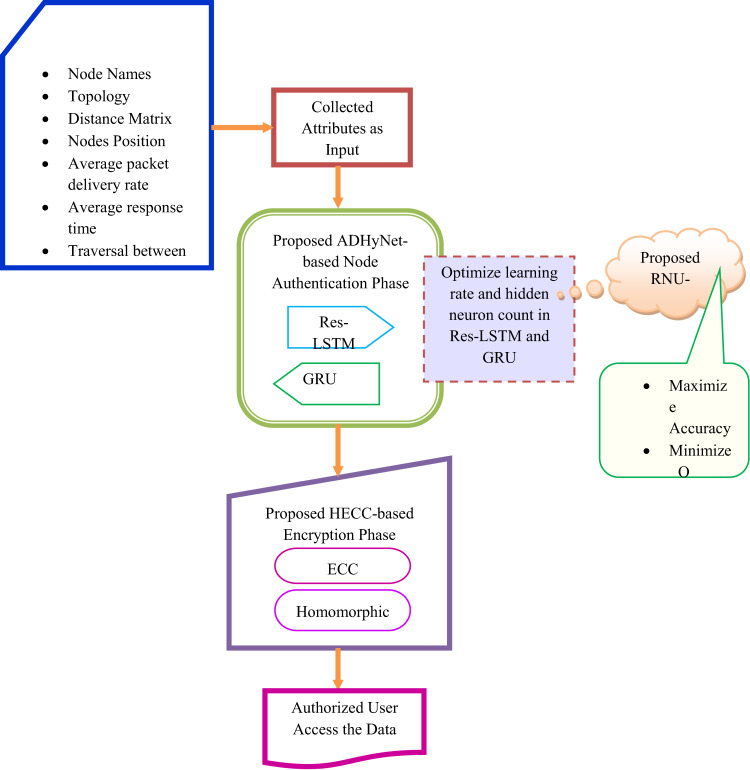
Vehicular Ad-hoc Networks (VANETs) are a type of mobile ad-hoc network that enables vehicles to interact with one another and roadside infrastructure. Multi-Access Edge Computing (MEC) provides a promising solution by positioning storage and computation resources closer to the network edge. This helps to reduce the latency and improve performance. The combination of MEC and blockchain enhances data processing and security. This integration improves privacy safeguards, prevents fraud, and supports trusted communication within VANETs. Consequently, this proposed model aims to develop an innovative approach that leverages these technologies. The main objective of the implemented technique is to create a blockchain architecture powered by deep learning, which ensures the safety of VANETs. The network architecture consists of three layers: perception, edge computing, and services. The main goal of the initial layer is to protect the privacy of VANET data through blockchain activities. The perception layer processes data using edge computing and cloud services. The service layer ensures data protection by through the blockchain technology and storing information in a public cloud. The last layer focuses on addressing user demands for throughput and Quality of Service (QoS). The proposed framework is good for assessing the dependability of vehicle nodes stored on the blockchain. To accomplish node authentication, an Adaptive and Dilated Hybrid Network (ADHyNet) is used. In this approach, the Residual Long Short-Term Memory (Res-LSTM) with Gated Recurrent Unit (GRU) forms the ADHyNet, where the Random Number Updated Skill Optimization Algorithm (RNU-SOA) is used to optimize the hyperparameters. Finally, the encryption process is carried out using Homomorphic Encryption combined with Elliptic Curve Cryptography (HECC) to secure data. This process ensures that confidential user information is protected against unauthorized access. The functionality of the system is thoroughly assessed and simulated. The suggested technique outperforms well than other approaches in terms of data security in VANET.
Overview
CoChat Summary
TL;DR
The paper proposes a blockchain-assisted MEC security model for VANETs that combines ADHyNet node authentication (Res-LSTM + GRU tuned by RNU-SOA) with HECC encryption. It reports high authentication accuracy, reduced cryptographic attack rates, and lower computational time than several baselines, while acknowledging energy, storage, latency, and dynamic-connectivity limitations.
Key findings
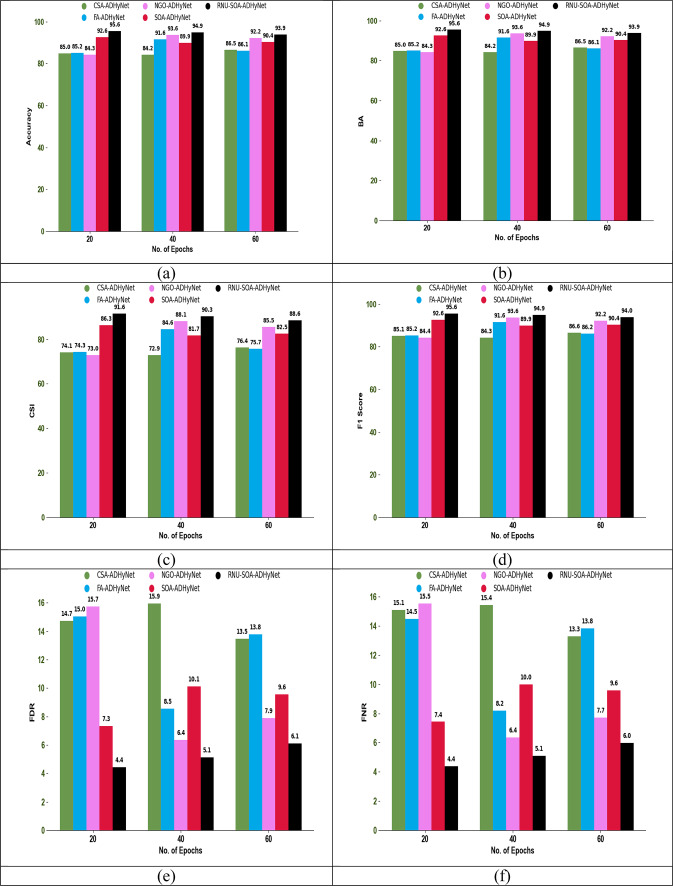
- The RNU-SOA-ADHyNet authentication model reached 95.6% accuracy at 20 epochs, reported as 12.4% higher than CSA-ADHyNet and 12.2% higher than FA-ADHyNet; it was also 20.4%, 13.5%, 11.6%, and 2.2% better than AD-GRU, Res-LSTM, GRU, and DHyNet, respectively.
- At K-fold value 1, accuracy was 90.6%, reported as 21.05% better than CSA-ADHyNet, 12.7% better than FA-ADHyNet, 5.8% better than NGO-ADHyNet, and 4.8% better than SOA-ADHyNet; the conclusion repeats 90.6% with improvements of 13.9%, 10.9%, 3.9%, and 2.3% over AD-GRU, Res-LSTM, GRU, and DHyNet.
- HECC reduced the CPA attack rate by 5.7%, 18.3%, 30%, and 2% compared with DES, AES, homomorphic encryption, and ECC for case 1, and its computational complexity was 53.3%, 26.3%, 57.5%, and 22.2% lower than DES, AES, homomorphic encryption, and ECC.
- Against “today’s best algorithms,” the model reported 98.4% node-authentication accuracy, 85 ms end-to-end latency, 12 ms model inference time, and 97.98% average accuracy in K-fold cross-validation; mean values were minimized by 26.1% vs CSA-ADHyNet, 30.7% vs FA-ADHyNet, 21.2% vs NGO-ADHyNet, and 26.2% vs SOA-ADHyNet.
Methods
- Design: a three-layer blockchain-powered VANET/MEC architecture (perception, edge computing/cloud service, service layers) using permissioned blockchain, ADHyNet for trusted-node authentication, RNU-SOA for hyperparameter tuning, and HECC (homomorphic encryption + ECC) for secure data storage/encryption.
- Data/sample: the Dataset-of-vehicular-communications-traces from GitHub, generated with NS-3.29 and SUMO using OpenStreetMap traffic regions up to 25 km, with nearly 300 vehicles and 15 malicious vehicles; 1000 samples were split into 750 training and 250 testing samples, with 5-fold cross-validation.
- Analysis: implemented in Python 3.11 on Windows 11 Pro with Intel Core i3-1005G1 CPU, 16 GB RAM; evaluated with accuracy, CSI, FDR, FNR, FOR, precision, sensitivity, specificity, computational time, CPA/KPA, scalability, real-time feasibility, and comparisons against CSA, FA, NGO, SOA, AD-GRU, Res-LSTM, GRU, DHyNet, DES, AES, homomorphic encryption, ECC, PKI+ECC, and BiLSTM.
Limitations
- The paper states that the model must address response time and performance when many vehicles connect, energy consumption from fusing deep learning with blockchain under limited vehicular energy, storage issues with enormous data, latency from complex blockchain operations, and difficulty maintaining flexibility/reliability when vehicles lose connections to edge nodes; future work includes energy-efficient resource management and privacy-preserving data sharing.
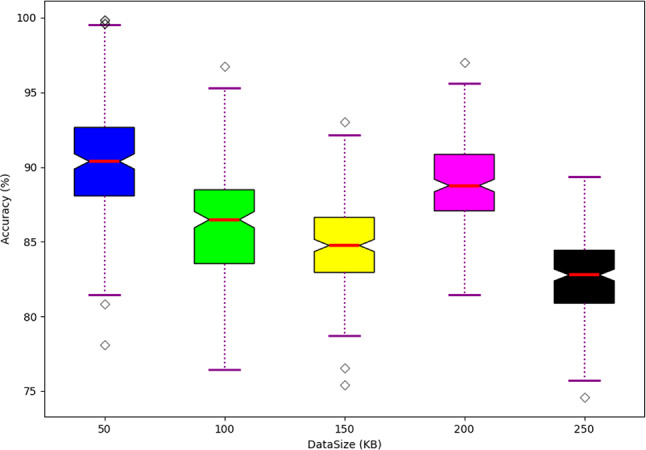
- Evident from the text: the reported authentication accuracies vary across sections (95.6%, 90.6%, 98.4%, and 97.98%) without full reconciliation, and many results refer to figures/tables not included in the provided text.
- Evident from the text: the node trustworthiness score was “synthetically generated” from selected attributes and mapped to dataset features, which may limit claims about real-world trust evaluation.
Model-written summary. Check it against the paper before relying on it.
Integrity signals
Registry
Cites
Statistics
Figures




Verification
Claims the paper makes
0 Valid · 5 Not valid · 17 Not checked · 95 Own results and interpretations
The paper states this without a source or data behind it here, so there is nothing to check it against. The quote shows it is in the paper.
In the paper
“The suggested technique outperforms well than other approaches in terms of data security in VANET.”
§ Blockchain-based secure MEC model for VANETs using hybrid networks > Abstract
boostedstates a cause- Asserted: passes — The authors put it forward as true.
- Checkable: passes — It can be checked against evidence.
- Load-bearing: passes — The paper’s conclusions depend on it.
- Based: unclear — It is unclear why the paper says it holds.
A result the paper reports from its own data — it cites no other source for it, so there is none to check. The quote shows it is in the paper.
In the paper
“The results confirm that the average accuracy of the implemented work is 97.98%, proving that the user authentication of vehicles is accurately performed using the proposed RNU-SOA-ADHyNet method.”
§ Blockchain-based secure MEC model for VANETs using hybrid networks > Results and discussion > K-fold cross validation of the implemented model using various measures
boosted- Asserted: passes — The authors put it forward as true.
- Checkable: passes — It can be checked against evidence.
- Load-bearing: passes — The paper’s conclusions depend on it.
- Based: passes — The paper gives a reason why it holds.
A result the paper reports from its own data — it cites no other source for it, so there is none to check. The quote shows it is in the paper.
In the paper
“The end-to-end latency of our approach is 85 ms, and the model inference time is 12 ms, which demonstrates the real-time effectiveness of the proposed approach.”
§ Blockchain-based secure MEC model for VANETs using hybrid networks > Results and discussion > Performance evaluation of proposed model comparable with today’s best algorithms
plain- Asserted: passes — The authors put it forward as true.
- Checkable: passes — It can be checked against evidence.
- Load-bearing: passes — The paper’s conclusions depend on it.
- Based: passes — The paper gives a reason why it holds.
A result the paper reports from its own data — it cites no other source for it, so there is none to check. The quote shows it is in the paper.
In the paper
“While analyzing the transaction throughput, the developed technique accomplished higher performance and also maintained the reliability by handling heavy traffic scenarios.”
§ Blockchain-based secure MEC model for VANETs using hybrid networks > Results and discussion > Real-time feasibility analysis
plainstates a cause- Asserted: passes — The authors put it forward as true.
- Checkable: passes — It can be checked against evidence.
- Load-bearing: passes — The paper’s conclusions depend on it.
- Based: passes — The paper gives a reason why it holds.
A result the paper reports from its own data — it cites no other source for it, so there is none to check. The quote shows it is in the paper.
In the paper
“The end-to-end latency of our approach is 85 ms, and the model inference time is 12 ms, which demonstrates the real-time effectiveness of the proposed approach.”
§ Blockchain-based secure MEC model for VANETs using hybrid networks > Results and discussion > Performance evaluation of proposed model comparable with today’s best algorithms
plain- Asserted: passes — The authors put it forward as true.
- Checkable: passes — It can be checked against evidence.
- Load-bearing: passes — The paper’s conclusions depend on it.
- Based: passes — The paper gives a reason why it holds.
39 more claims
Create a free account to see all 117 claims and to verify the 4 references still open.
- It may state two separate claims as one. 41
- Probably not a substantial claim. 51
Self-check
Percentages, sums and reported differences re-computed from the paper’s own numbers.
Each contradiction between two passages listed here was confirmed by an independent check.
Rated minor: it would not touch a result — a value no result rests on, a p-value that stays on the same side of the significance level, or a conflict that is clerical, resolved elsewhere in the paper, or outside its own findings.
In the paper
§ Blockchain-based secure MEC model for VANETs using hybrid networks > Results and discussion > Numerical evaluation of authentication performance
“At the K-fold value of 1, the accuracy of the implemented RNU-SOA-ADHyNet network is 90.6%, which is 21.05% better than CSA-ADHyNet, 12.7% better than FA-ADHyNet, 5.8% better than NGO-ADHyNet, and 4.8% better than SOA-ADHyNet (as shown in Table 3).”
§ Blockchain-based secure MEC model for VANETs using hybrid networks > Blockchain-based secure data storage using encryption algorithms in MEC > Blockchain-based data storage for security
“The blockchain consensus details are listed in Table 3.”
Rated minor: it would not touch a result — a value no result rests on, a p-value that stays on the same side of the significance level, or a conflict that is clerical, resolved elsewhere in the paper, or outside its own findings.
In the paper
§ Blockchain-based secure MEC model for VANETs using hybrid networks > Implemented secured MEC model in VANET using blockchain-assisted deep learning: structural description > Proposed secured MEC model in VANET: structural preview
“In HECC, the authorized node data undergoes Homomorphic Encryption. This first level of encryption, referred to as half-enc, allows certain operations on the data without decryption, preserving data confidentiality while enabling limited computations. The partially encrypted data from Homomorphic Encryption is further protected using ECC.”
§ Blockchain-based secure MEC model for VANETs using hybrid networks > Blockchain-based secure data storage using encryption algorithms in MEC > Data encryption using HECC
“Here, the ECC is employed to maintain robustness with better key generation at the initial encryption phase, and then homomorphic encryption is carried out in the ciphertext.”
Citations
Cites
Northern Goshawk Optimization: A New Swarm-Based Algorithm for Solving Optimization Problems
Dehghani, M., Hubalovsky, S., & Trojovsky, P. (2021) · IEEE Access · doi:10.1109/access.2021.3133286 · Cited by 574
Report on the development of the Advanced Encryption Standard (AES)
Nechvatal, J., Barker, E., Bassham, L., Burr, W., Dworkin, M., Foti, J., & Roback, E. (2001) · Journal of Research of the National Institute of Standards and Technology · doi:10.6028/jres.106.023 · Cited by 475
Privacy-Preserving Federated Learning Using Homomorphic Encryption
Park, J., & Lim, H. (2022) · Applied Sciences · doi:10.3390/app12020734 · Cited by 223
Crystal Structure Algorithm (CryStAl): A Metaheuristic Optimization Method
Talatahari, S., Azizi, M., Tolouei, M., Talatahari, B., & Sareh, P. (2021) · IEEE Access · doi:10.1109/access.2021.3079161 · Cited by 184
Resource Allocation in Multi-access Edge Computing for 5G-and-beyond networks
Sarah, A., Nencioni, G., & Khan, M. I. (2023) · Computer Networks · doi:10.1016/j.comnet.2023.109720 · Cited by 128
Skill Optimization Algorithm: A New Human-Based Metaheuristic Technique
Givi, H., & Hubálovská, M. (2022) · Computers, materials & continua/Computers, materials & continua (Print) · doi:10.32604/cmc.2023.030379 · Cited by 115
Zhang, C., Zhou, G., Li, J., Chang, F., Ding, K., & Ma, D. (2022) · Journal of Manufacturing Systems · doi:10.1016/j.jmsy.2022.11.015 · Cited by 108
M., P., Bourouis, S., Ahmed, A. N., M., V., K.G.S., V., Alhakami, W., & Hamdi, M. (2022) · Computer Communications · doi:10.1016/j.comcom.2022.05.014 · Cited by 108
Fireworks algorithm applied to constrained portfolio optimization problem
Bačanin, N., & Tuba, M. (2015) · IEEE Congress on Evolutionary Computation (CEC) · doi:10.1109/cec.2015.7257031 · Cited by 70
Fatima, N., Saxena, P., & Gupta, M. (2022) · Physical Communication · doi:10.1016/j.phycom.2022.101641 · Cited by 51
Research works printed but not linked: 2
- Khaliq, Z., Hussein, A.R. Raft distributed system for multi-access edge computing sharing resources, pp. 2412–16774 (2024).
- Park, J. & Lim, H. Privacy-preserving federated learning using homomorphic encryption. Appl. Sci. 12(2), 734 (2022). · DOI · Paper page
Cited by
Salam, M. A. (2026) · Technologies · doi:10.3390/technologies14100611
Vanet security reinvented: hierarchical stacked CNNS and attention-driven BILSTM optimization
Saudagar, S. I., Jagnade, G. A., Narang, G., Maske, R., & Tirth, S. (2026) · Cluster Computing · doi:10.1007/s10586-026-06129-2
Varanasi, K., & Rao, A. P. (2026) · International Conference on Research Methodologies in Knowledge Management, Artificial Intelligence and Telecommunication Engineering (RMKMATE) · doi:10.1109/rmkmate69073.2026.11518828
Metadata
- Authors
- Goud, G. V., Arunachalam, R., Shukla, S. K., Saranya, K., Venugopal, S., & Palanisamy, P.
- Affiliations
- Saveetha University (IN)
- Amity University (IN)
- Koneru Lakshmaiah Education Foundation (IN)
- Manipal Academy of Higher Education (IN)
- Chitkara University (IN)
- Corresponding author
- Arunachalam, Rajesh
- Venugopal, Sumanth
- Venue
- Scientific Reports
- Published
- 2025-12-16
- Volume
- 15
- Issue
- 1
- Pages
- 43912-43912
- ISSN
- 2045-2322 (ISSN-L)
- PMC
- PMC12708641
- OpenAlex
- W4417360293
- Semantic Scholar
- 67dca96a00bb858d5f14a995901a4f6d45c89d4b
- Cited by
- 8
- References
- 35
- Citations by year
- 2026: 8
- FWCI
- 1.78
- Type
- journal article
- Language
- en
- Open access
- gold
- doi.org
- Licence
- cc-by
- creativecommons.org/licenses/by/4.0 (tdm)
- creativecommons.org/licenses/by/4.0 (vor)
- Locations
- Scientific Reports (publishedVersion, cc-by)
- PubMed (publishedVersion)
- PubMed Central (publishedVersion, cc-by)
- DOAJ (DOAJ: Directory of Open Access Journals) (submittedVersion, cc-by-sa)
- Funders
- Manipal Academy of Higher Education, Manipal
- Topics
- Physical Sciences › Engineering › Electrical and Electronic Engineering › Vehicular Ad Hoc Networks (VANETs)
- Physical Sciences › Computer Science › Information Systems › Blockchain Technology Applications and Security
- Physical Sciences › Computer Science › Computer Networks and Communications › IoT and Edge/Fog Computing
- Keywords
- vehicular ad hoc networks, mobile edge computing, blockchain, VANET security, node authentication, gated recurrent unit, hyperparameter optimization, homomorphic encryption, elliptic curve cryptography, data privacy, quality of service, hybrid network architecture
About these checks
Registry, retraction, Cites and statistics results are computed, not judged, with one exception: a printed reference that no index lists is read once by a model before it counts as a citation error. Claims are extracted by a model and kept only when their quote appears verbatim in the text; each cited source is then checked, with a model’s help, for whether it says what the claim relies on. Those verdicts can be wrong — read the claim’s quote and the cited source before relying on one.
The claim verdicts this report counts are experimental: their accuracy is not yet measured.
A language model drew the claims from the paper on 2026-10-10, under version 3 of the claim definition (model deepseek-v4.1-flash, prompt extract-v3).
A second model labelled each claim on 2026-10-10 (model jev-1.13-20260917, definition revision gold-guideline-v0.2).
Statistics and arithmetic are recomputed, not judged.
Confidence bands are shown only for fields calibrated on our annotated test set. None is calibrated yet, so no band is shown.
What counts as a claim ›How we measure confidence ›How we check this ›
Are you an author, or do you see a problem with this page? Request a review
How to cite
Cite CoChat for the checks on this page, and the paper for its own findings.
- This page
- CoChat. (2026). Citation check: Blockchain-based secure MEC model for VANETs using hybrid networks. https://app.cochat.ai/papers/10.1038/s41598-025-27682-7
- The paper
- Goud, G. V., Arunachalam, R., Shukla, S. K., Saranya, K., Venugopal, S., & Palanisamy, P. (2025). Blockchain-based secure MEC model for VANETs using hybrid networks. Scientific Reports. https://doi.org/10.1038/s41598-025-27682-7
Data sources
Bibliographic data: Semantic Scholar, OpenAlex, Crossref.
Contains information from the Semantic Scholar Academic Graph Datasets, made available under the ODC Attribution License (ODC-BY 1.0).
Semantic Scholar’s data is described in: Kinney, R., et al. (2023). The Semantic Scholar Open Data Platform. arXiv:2301.10140.
