

Advanced customer churn prediction for a music streaming digital marketing service using attention graph-based deep learning approach
Open accessThe DOI matches its Crossref record; 31 of the 33 references it cites were found in a registry or an index.
Abstract
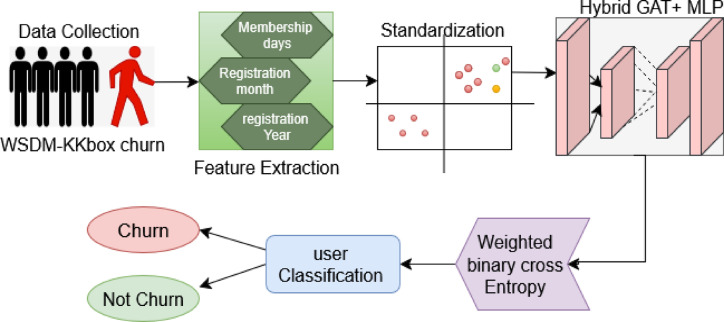
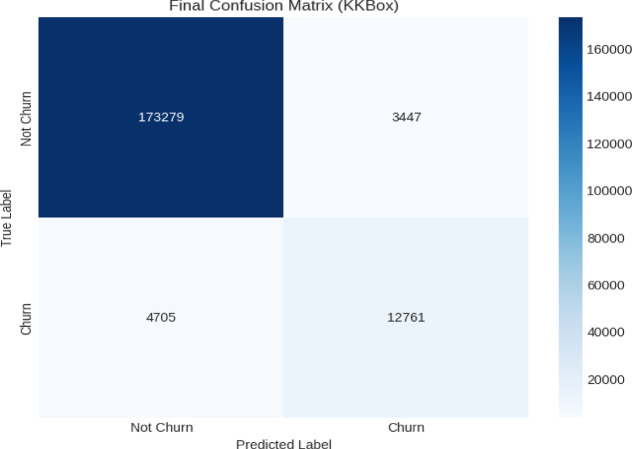
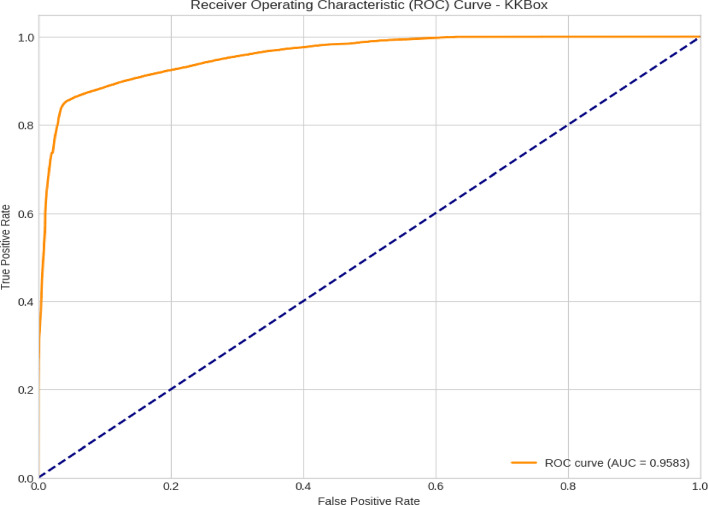
Customer churn poses a persistent threat to the sustainability of music streaming platforms, where user disengagement often occurs unpredictably. Most existing churn prediction methods fail to integrate relational dependencies among users or address the limitations of static, tabular models in imbalanced datasets. In this research, we propose a Hybrid Graph Attention Network (Hybrid GAT + MLP (Multi Layered Perceptron)) that efficiently combines graph-based learning with deep tabular feature modelling, allowing the capture of both individual behaviour and peer-influenced churn patterns. The use of a synthetic similarity graph enables the model to learn from neighbourhood context, while a weighted loss function ensures robustness against class imbalance without altering data distribution. The model was evaluated on the KKBox dataset, achieving an accuracy of 95.8% with an AUC score of 0.9626, indicating high discriminative power. Additional metrics, such as F1-score, confusion matrix, and ROC analysis, ensure the system’s ability to generalize across both churn and non-churn classes. These results validate the applicability of our approach to large-scale, real-world scenarios involving churn detection. All code and the curated dataset for customer churn prediction for music steaming is available at the https://github.com/haiyanchenas/Advanced-Customer-Churn-Prediction-for-a-Music-Streaming-Digital-Marketing-Service/tree/main enabling reproducibility of our findings.
Overview
The claims and statistics of this paper haven’t been checked yet.
Free: it reads the open-access text and checks the first 5 claims that cite a source we can check. Create a free account to check every claim.
Integrity signals
Registry
Cites
Statistics
Figures
Verification
Claims the paper makes
The claims and statistics of this paper haven’t been checked yet.
Free: it reads the open-access text and checks the first 5 claims that cite a source we can check. Create a free account to check every claim.
Self-check
Percentages, sums and reported differences re-computed from the paper’s own numbers.
The self-check needs the paper’s full text.
Citations
Cites
Manzoor, A., Qureshi, M. A., Kidney, E., & Longo, L. (2024) · IEEE Access · doi:10.1109/access.2024.3402092 · Cited by 233
Meng, T., Shou, Y., Ai, W., Du, J., Liu, H., & Li, K. (2023) · Neurocomputing · doi:10.1016/j.neucom.2023.127109 · Cited by 175 · cited 1×
“In the case of panel data analysis, the estimation of latent group structures is done to identify and understand hidden subgroup variances which allows better and more relaxed modeling of complex and heterogeneous data 28,29 .”
Functional-Coefficient Quantile Regression for Panel Data with Latent Group Structure
Yang, X., Jia, C., Li, D., & Li, R. (2023) · Journal of Business and Economic Statistics · doi:10.1080/07350015.2023.2277172 · Cited by 128 · cited 1×
“In the case of panel data analysis, the estimation of latent group structures is done to identify and understand hidden subgroup variances which allows better and more relaxed modeling of complex and heterogeneous data 28,29 .”
A Brief Survey of Machine Learning and Deep Learning Techniques for E-Commerce Research
Zhang, X., Guo, F., Chen, T., Pan, L., Beliakov, G., & Wu, J. (2023) · Journal of Theoretical and Applied Electronic Commerce Research · doi:10.3390/jtaer18040110 · Cited by 121
Razzaq, K., & Shah, M. (2025) · Computers · doi:10.3390/computers14030093 · Cited by 119
BiCHAT: BiLSTM with deep CNN and hierarchical attention for hate speech detection
Khan, S., Fazil, M., Sejwal, V. K., Alshara, M. A., Alotaibi, R. M., Kamal, A., & Baig, A. R. (2022) · Journal of King Saud University - Computer and Information Sciences · doi:10.1016/j.jksuci.2022.05.006 · Cited by 115 · cited 1×
“Next, the problem of class imbalance 35 was addressed by the weighted loss method 36 , but other techniques such as resampling, or even generating synthetic data, which are likely to produce different distribution, were not considered.”
Time for a change! Uprooting users embedded in the status quo from habitual decision-making
Sun, X., Guo, B., Yang, Y., & Pan, Y. (2024) · Decision Support Systems · doi:10.1016/j.dss.2024.114371 · Cited by 112 · cited 1×
“In the context of mobile shopping, social crowding can induce anxiety and cause distractions, and consequently, diminishes the ability of shoppers to easily process the information on their mobile devices 24,25 .”
A survey on machine learning methods for churn prediction
Geiler, L., Affeldt, S., & Nadif, M. (2022) · International Journal of Data Science and Analytics · doi:10.1007/s41060-022-00312-5 · Cited by 105
Khan, S., Kamal, A., Fazil, M., Alshara, M. A., Sejwal, V. K., Alotaibi, R. M., Baig, A. R., & Alqahtani, S. (2022) · IEEE Access · doi:10.1109/access.2022.3143799 · Cited by 98 · cited 1×
“Next, the problem of class imbalance 35 was addressed by the weighted loss method 36 , but other techniques such as resampling, or even generating synthetic data, which are likely to produce different distribution, were not considered.”
Jing, L., Fan, X., Feng, D., Lu, C., & Jiang, S. (2024) · Applied Soft Computing · doi:10.1016/j.asoc.2024.111492 · Cited by 73 · cited 1×
“The model generalizes better across varied situations by removing irrelevant information and noise specific to a domain 26,27 .”
Liu, R., Ali, S., Bilal, S. F., Sakhawat, Z., Imran, A., Almuhaimeed, A., Alzahrani, A., & Sun, G. (2022) · Applied Sciences · doi:10.3390/app12189355 · Cited by 70 · cited 1×
“Clustering (K-means, hierarchical) with classification (Gradient Boosting, SVM, RF) 10 is proposed to first group similar customers, then apply tailored classifiers, thus improving adaptability and prediction accuracy.”
Kamal, A., & Abulaish, M. (2021) · Cognitive Computation · doi:10.1007/s12559-021-09821-0 · Cited by 64 · cited 1×
“Explainable interpretability is not obtained for this model 37 .”
Artificial intelligence in customer retention: a bibliometric analysis and future research framework
Singh, C., Dash, M. K., Sahu, R., & Kumar, A. (2023) · Kybernetes · doi:10.1108/k-02-2023-0245 · Cited by 57
Deep Learning as a Vector Embedding Model for Customer Churn
Cenggoro, T. W., Wirastari, R. A., Rudianto, E., Mohadi, M. I., Ratj, D., & Pardamean, B. (2021) · Procedia Computer Science · doi:10.1016/j.procs.2021.01.048 · Cited by 49
BiCapsHate: Attention to the Linguistic Context of Hate via Bidirectional Capsules and Hatebase
Kamal, A., Anwar, T., Sejwal, V. K., & Fazil, M. (2023) · IEEE Transactions on Computational Social Systems · doi:10.1109/tcss.2023.3236527 · Cited by 40 · cited 1×
“Next, feature engineering is performed to derive static, temporal, and behavioural features from multi-source inputs 31 .”
Jiang, H., Chen, X., Miao, D., Zhang, H., Qin, X., Gu, X., Lu, P., & Li, X. (2025) · Applied Intelligence · doi:10.1007/s10489-025-06313-8 · Cited by 34 · cited 1×
“In the same fashion, the prediction-aware network in sentiment analysis around which a model is built you constantly modifies itself based on in-between outcomes thereby increasing the precision of the interlinks of aspects, opinions and sentiments within the text 30 .”
IBPL: Information Bottleneck-based Prompt Learning for graph out-of-distribution detection
Cao, Y., Shi, F., Yu, Q., Lin, X., Zhou, C. D., Zou, L., Zhang, P., Li, Z., & Yin, D. (2025) · Neural Networks · doi:10.1016/j.neunet.2025.107381 · Cited by 31 · cited 1×
“The model generalizes better across varied situations by removing irrelevant information and noise specific to a domain 26,27 .”
An analysis on classification models for customer churn prediction
Mouli, K. C., Raghavendran, C. V., Bharadwaj, V. Y., Vybhavi, G. Y., Sravani, C., Vafaeva, K. M., Deorari, R., & Alzubaidi, L. H. J. (2024) · Cogent Engineering · doi:10.1080/23311916.2024.2378877 · Cited by 26
Hasumoto, K., & Goto, M. (2022) · Neural Computing and Applications · doi:10.1007/s00521-022-07418-8 · Cited by 24
How social crowding impacts mobile shopping: A perspective from information processing
Jin, J. K., Liu, Q., Yang, Y., Ma, B., & Pan, Y. (2025) · Information & Management · doi:10.1016/j.im.2025.104197 · Cited by 23
Mengash, H. A., Alruwais, N. M., Kouki, F., Singla, C., Elhameed, E. S. A., & Mahmud, A. (2023) · Biomimetics · doi:10.3390/biomimetics9010001 · Cited by 22 · cited 2×
“Archimedes Optimisation Algorithm (AOA) 11 for feature selection, followed by CNN-Autoencoder deep models for churn prediction.”
Methodologies used for Customer Churn Detection in Customer Relationship Management
Jajam, N., & Vijaya, J. (2021) · International Conference on Technological Advancements and Innovations (ICTAI) · doi:10.1109/ictai53825.2021.9673382 · Cited by 15
Mishra, R., Tripathi, P., & Kumar, N. (2024) · Advances in business information systems and analytics book series · doi:10.4018/979-8-3693-1598-9.ch003 · Cited by 15
Talaat, F. M., & Aljadani, A. (2025) · Neural Computing and Applications · doi:10.1007/s00521-025-11027-6 · Cited by 12 · cited 1×
“Adaptive Profit-Centric Churn Prediction Engine built on ensemble methods (XGBoost, Random Forest, Gradient Boosting) 4 , tightly integrated with economic measures such as profit and Customer Lifetime Value.”
Saleh, M. E., & Abd-Alsabour, N. (2024) · International Journal of Advanced Computer Science and Applications · doi:10.14569/ijacsa.2024.0151268 · Cited by 11 · cited 2×
“Decision Tree, Random Forest, and XGBoost 12 were integrated via hyperparameter tuning (grid search) for feature selection in telecom churn prediction.”
Financial Fact-Check Via Multi-modal Embedded Representation and Attention-Fused Network
Mohankumar, P., Singh, V. K., & Kamal, A. (2025) · Lecture notes in networks and systems · doi:10.1007/978-981-96-3372-2_3 · Cited by 9
Churn Prediction and Customer Retention
Karwa, S., Shetty, N., & Nakkella, B. (2024) · Chapman & Hall/CRC eBooks · doi:10.1201/9781003472544-9 · Cited by 5
Li, Y., Tao, Y., Zhu, M., Chen, Z., Wen, Z., & Zhu, B. (2025) · IEEE Transactions on Consumer Electronics · doi:10.1109/tce.2025.3563905 · Cited by 5 · cited 1×
“This dataset is nor preferred widely like telecom, bank etc. TBformer 33 and Entropy 34 shows standard result which is nearer to our proposed model.”
An Improved Convolutional Neural Network for Churn Analysis
Gopal, P., & MohdNawi, N. B. (2023) · International Journal of Advanced Computer Science and Applications · doi:10.14569/ijacsa.2023.0140921 · Cited by 4 · cited 3×
“However, the model requires significant computational resources, and tuning both the VAE and CNN adds additional overhead.”
InfluentialDhariya, S. (2023) · International Conference on Innovative Mechanisms for Industry Applications · doi:10.1109/icimia60377.2023.10426097 · Cited by 4
Evaluation Study of Churn Prediction Models for Business Intelligence
Banday, S. A., & Khan, S. (2021) · Auerbach Publications eBooks · doi:10.1201/9781003175711-11 · Cited by 3
Telco Customer Churn Prediction Using Composite Deep Learning Technique
Ramanayake, C., Liyanage, D., Dhananjaya, P., Kumara, C. T., & Fernando, T. G. I. (2024) · International Conference on Advancements in Computing (ICAC) · doi:10.1109/icac64487.2024.10851050 · Cited by 3
Zhao, Y. (2025) · Informatica · doi:10.31449/inf.v49i32.9086 · Cited by 2 · cited 2×
“This dataset is nor preferred widely like telecom, bank etc. TBformer 33 and Entropy 34 shows standard result which is nearer to our proposed model.”
Research works printed but not linked: 3
- Joy, U.G., Hoque, K.E., Uddin, M.N., Chowdhury, L. and Park, S.B., 2024. A big data- driven hybrid model for enhancing streaming service customer retention through churn prediction integrated with explainable AI. IEEE access.
- Fujo, S.W., Subramanian, S. and Khder, M.A., 2022. Customer churn prediction in telecommunication industry using deep learning. Information Sciences Letters, 11(1), p.24.
- Panimalar, S.A. and Krishnakumar, A., 2023. A review of churn prediction models using different machine learning and deep learning approaches in cloud environment. Journal of Current Science and Technology, 13(1), pp.136-161.
Cited by
Hossain, D., Mehedi, M., Ahmed, K. R., Mahmud, M. R., Khan, M. I., & Jamee, S. S. (2026) · Computers · doi:10.3390/computers15080502 · Cited by 1
Lu, Z., Ali, K. S., Zhang, Y., & Zhao, X. (2026) · IEEE Access · doi:10.1109/access.2026.3703967
“Decades of research have produced increasingly accurate churn prediction models, from logistic regression [3] and gradient boosting [4], [5] to deep learning [6], [7] and graph neural networks (GNNs) [8], [9], [10].”
Hybrid Learning for Automated E-commerce Churn Prediction with XGBoost and SHAP
Henry, A. A., Arribathi, A. H., & Henderi, H. (2026) · MALCOM Indonesian Journal of Machine Learning and Computer Science · doi:10.57152/malcom.v6i3.2833
Taufan, Y., Prabowo, G. M., & Rini, I. T. C. (2026) · International Journal of Education Vocational and Social Science · doi:10.63922/ijevss.v5i04.6432
Binjach, C., & Szénási, S. (2026) · IEEE International Symposium on Intelligent Systems and Informatics (SISY) · doi:10.1109/sisy71351.2026.11738475
“Dynamic graph and graph-attention studies show the value of interaction data in games and streaming services [9], [10].”
Influential
Metadata
- Authors
- Cheng, H., & He, J.
- Affiliations
- Nanchang University (CN)
- Corresponding author
- Cheng, Haiyan
- Venue
- Scientific Reports
- Published
- 2025-12-20
- Volume
- 15
- Issue
- 1
- Pages
- 45028-45028
- ISSN
- 2045-2322 (ISSN-L)
- PMC
- PMC12749653
- OpenAlex
- W4417522567
- Cited by
- 1
- References
- 31
- Citations by year
- 2026: 1
- FWCI
- 1.74
- Type
- journal article
- Language
- en
- Open access
- gold
- doi.org
- Licence
- cc-by-nc-nd
- creativecommons.org/licenses/by-nc-nd/4.0 (tdm)
- creativecommons.org/licenses/by-nc-nd/4.0 (vor, 9 d)
- Locations
- Scientific Reports (publishedVersion, cc-by-nc-nd)
- PubMed (publishedVersion)
- PubMed Central (publishedVersion, cc-by-nc-nd)
- DOAJ (DOAJ: Directory of Open Access Journals) (submittedVersion, cc-by-sa)
- Topics
- Social Sciences › Business, Management and Accounting › Marketing › Customer churn and segmentation
- Social Sciences › Business, Management and Accounting › Marketing › Customer Service Quality and Loyalty
- Social Sciences › Business, Management and Accounting › Organizational Behavior and Human Resource Management › AI and HR Technologies
- Keywords
- customer churn prediction, music streaming platforms, graph attention networks, multilayer perceptron, class imbalance, weighted loss function, peer influence, user disengagement, digital marketing
About these checks
Registry, retraction, Cites and statistics results are computed, not judged, with one exception: a printed reference that no index lists is read once by a model before it counts as a citation error. Claims are extracted by a model and kept only when their quote appears verbatim in the text; each cited source is then checked, with a model’s help, for whether it says what the claim relies on. Those verdicts can be wrong — read the claim’s quote and the cited source before relying on one.
Statistics and arithmetic are recomputed, not judged.
Confidence bands are shown only for fields calibrated on our annotated test set. None is calibrated yet, so no band is shown.
What counts as a claim ›How we measure confidence ›How we check this ›
Are you an author, or do you see a problem with this page? Request a review
Data sources
Bibliographic data: Semantic Scholar, OpenAlex, Crossref.
Contains information from the Semantic Scholar Academic Graph Datasets, made available under the ODC Attribution License (ODC-BY 1.0).
Semantic Scholar’s data is described in: Kinney, R., et al. (2023). The Semantic Scholar Open Data Platform. arXiv:2301.10140.
