

The DOI matches its Crossref record; 2 of the 2 references it cites were found in a registry or an index.
The necessity of multimodal feedback for learning effective pedagogical policies with reinforcement learning
Open accessAbstract
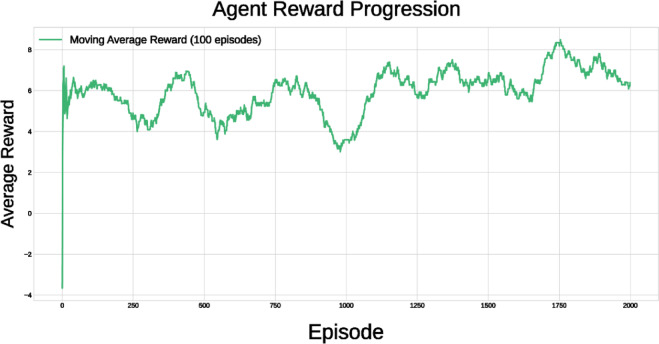
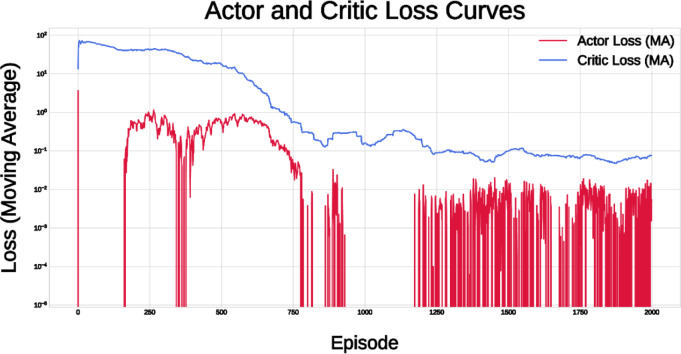
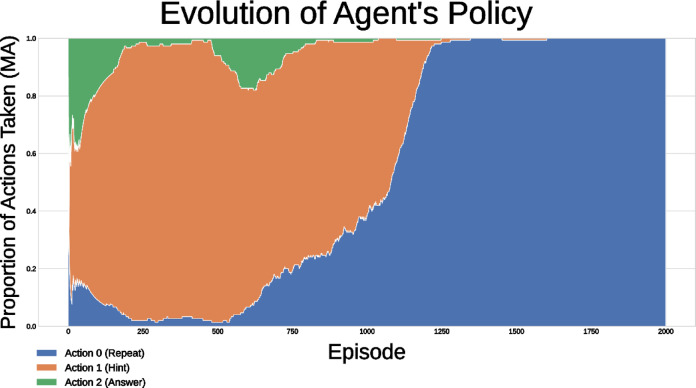
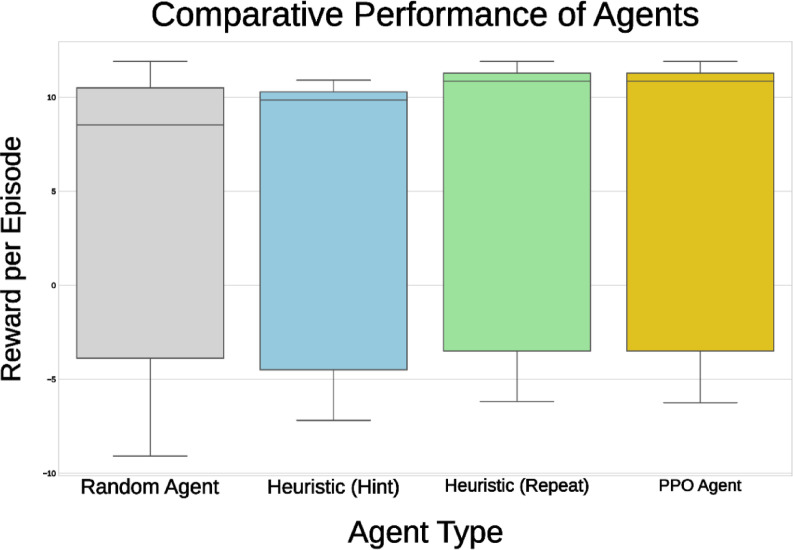
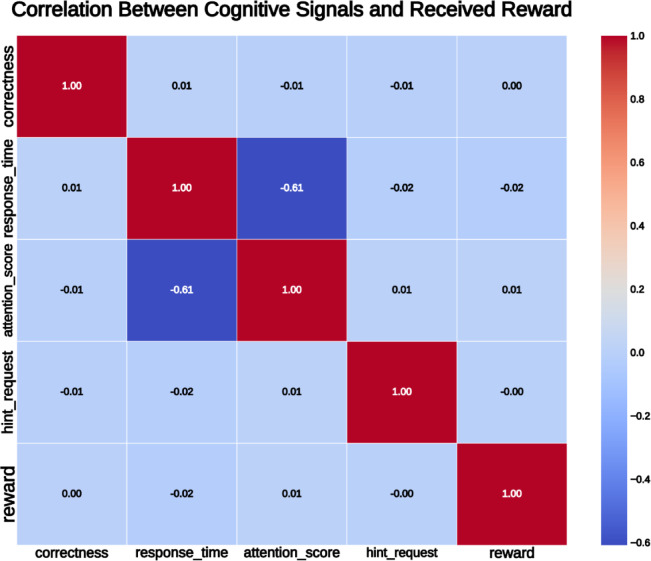
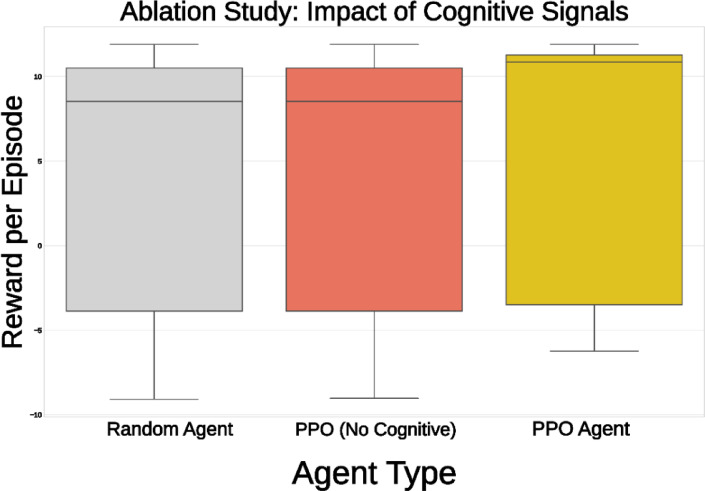
Traditional teaching evaluation methods are often retrospective and coarse-grained, lacking the continuous, moment-to-moment feedback required for real-time pedagogical adaptation in language training. Existing intelligent tutoring systems frequently fail to address this, underutilizing multimodal behavioral signals and leaving a critical gap in understanding whether such signals are essential for learning effective policies. This paper introduces a Reinforcement Learning (RL) framework to solve this problem. We propose a hybrid cognitive-linguistic model using a Proximal Policy Optimization (PPO) actor-critic agent, which operates on a novel 516-dimensional state vector that fuses a 512-dimensional semantic embedding from a pre-trained T5 model with a 4-dimensional vector of simulated cognitive-behavioral signals (correctness, response time, attention, hint request). Tested in a simulated learner environment built on the Tatoeba corpus, our agent autonomously discovers a highly effective policy, achieving a mean episodic reward of 6.563, on par with the optimal heuristic baseline. The identified policy, albeit optimal in the simulation, embodies a counterintuitive method that significantly prioritized task repetition by the learner. Our hypothesis is confirmed by a critical ablation experiment: an agent that is deprived of the cognitive-behavioral signals does not learn, and they are as good as a random baseline (mean reward 5.213). The present work gives conclusive evidence that multimodal cognitive-behavioral cues are not only supplementary but are an inevitable part of learning by adaptive pedagogical agents. We mainly provide validation of a hybrid state representation that allows an RL agent to learn effective teaching strategies, making way for more useful and customized educational technologies.
Overview
The claims and statistics of this paper haven’t been checked yet.
Run the check — free, no account needed. It reads the open-access text and checks the sources it cites.
Integrity signals
Registry
Cites
Statistics
Figures
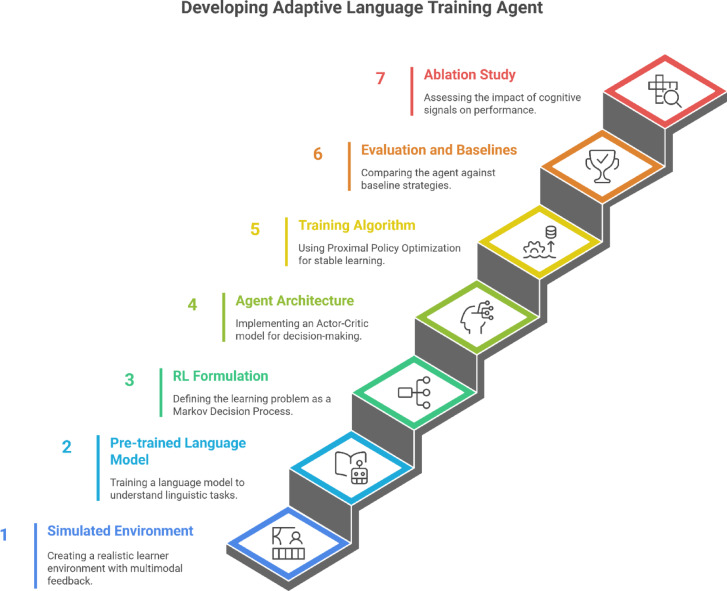
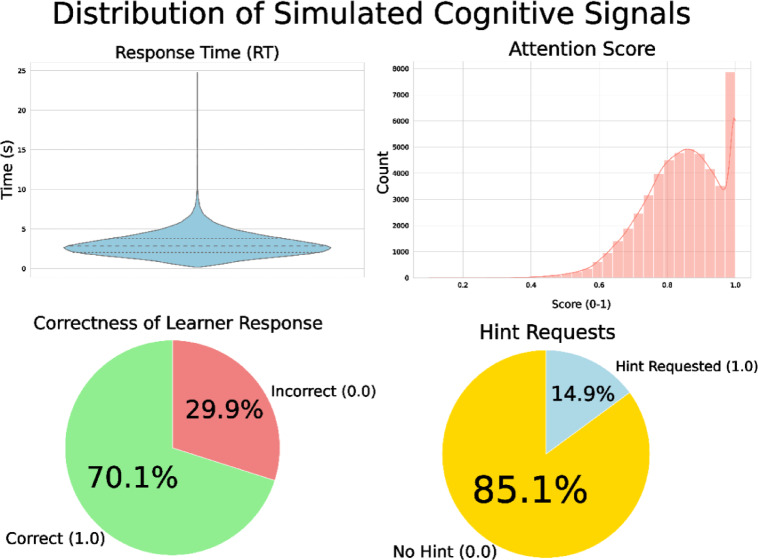
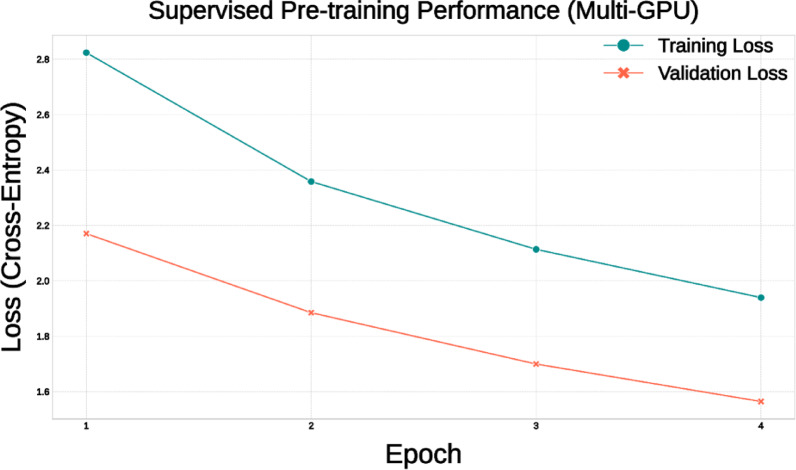
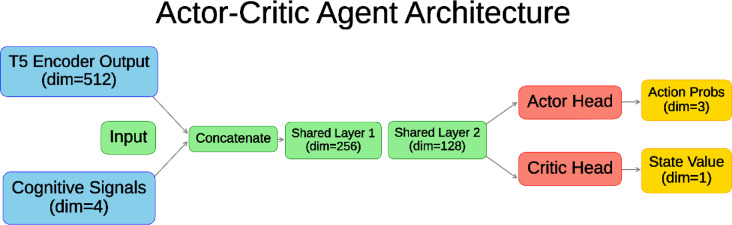
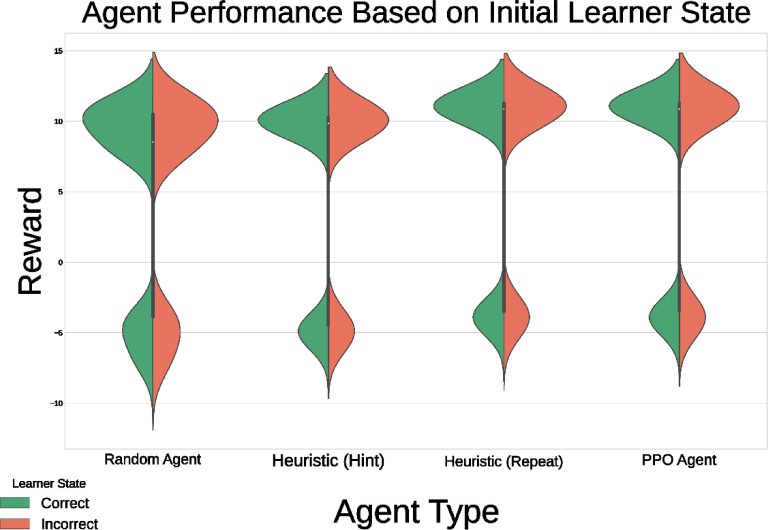
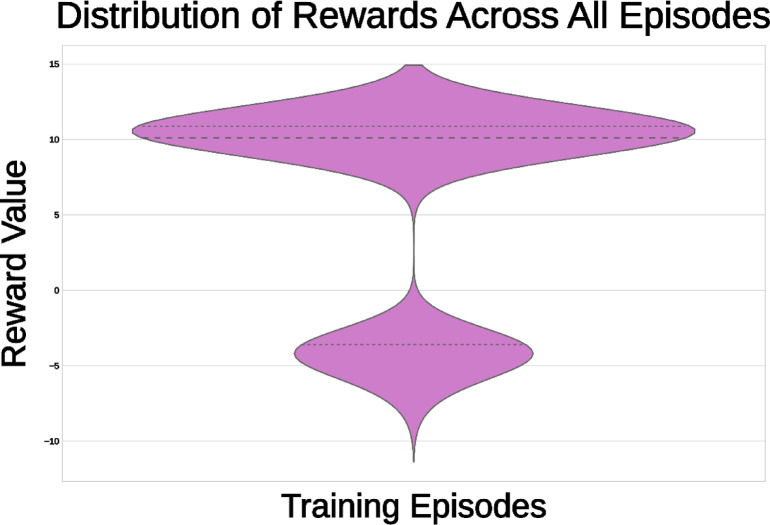
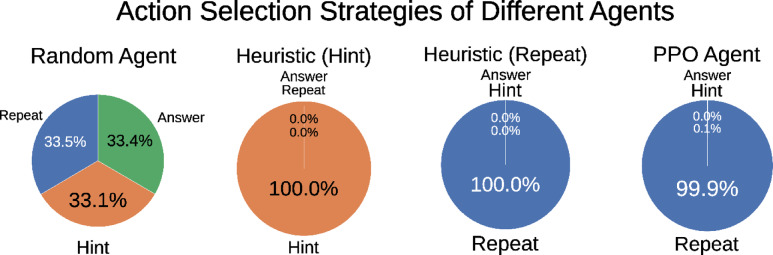
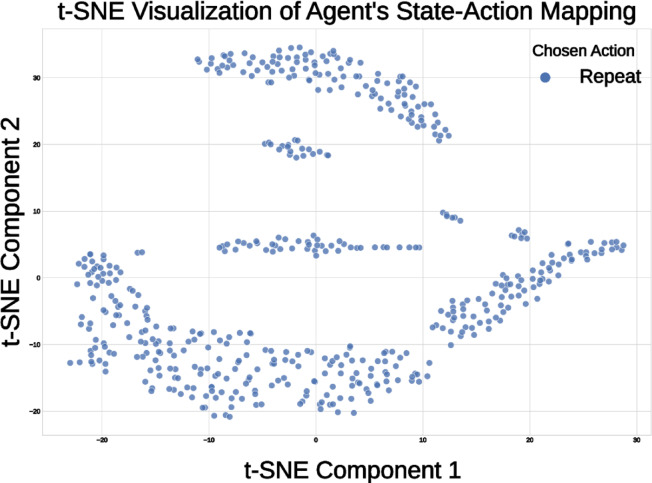
Verification
Claims the paper makes
The claims and statistics of this paper haven’t been checked yet.
Run the check — free, no account needed. It reads the open-access text and checks the sources it cites.
Claims other papers make about this one
Each is checked against this paper’s own text: does it say what the citing paper says it does?
The source backs part of the claim, not all of it — or backs it for a different population, condition or comparison.
In the citing paper
“AI tools promise efficiency and security (Che et al., 2025; Islam et al., 2025), yet the reality is that they, particularly AI detection tools, generate false certainty, obscure human judgment, and normalize constant monitoring as the default mode of educational interaction.”
From Harms and Ethical Risks of AI Detection Tools in Education: False Positives, Bias, Surveillance, and Student Rights (2026) · cites this paper as Che et al., 2025
Experimental — accuracy not yet measured
Self-check
Percentages, sums and reported differences re-computed from the paper’s own numbers.
The self-check needs the paper’s full text.
Citations
Cites
Naseer, F., Tariq, R., Alshahrani, H. M., Alruwais, N., & Al-Wesabi, F. N. (2025) · Scientific Reports · doi:10.1038/s41598-025-10385-4 · Cited by 169 · cited 1×
“Other educational frameworks, including project-based learning, have been examined for their efficacy in student preparation, frequently without the adaptive mechanisms integral to our research 44 .”
System design for using multimodal trace data in modeling self-regulated learning
Cloude, E. B., Azevedo, R., Winne, P. H., Biswas, G., & Jang, E. E. (2022) · Frontiers in Education · doi:10.3389/feduc.2022.928632 · Cited by 23
Research works printed but not linked: 45
- Harrison, R. et al. Evaluating and enhancing quality in higher education teaching practice: A meta-review. Stud. High. Educ. 47(1), 80–96 (2022). · DOI
- Jafari, N. et al. Design strategies to foster improved experiences for patients in rehabilitation. HERD Health Environ. Res. Des. J. 18, 111–124 (2025).
- Flake, S. M. & Gabriel, K. F. Teaching Unprepared Students: Strategies for Promoting Success and Retention in Higher Education (Routledge, 2023).
- Shahrokhi Kahnooj, H., Dadgar, H. & Saberi, H. Validity and reliability of the Persian version of the WH-Question comprehension test in children with autism. Appl. Neuropsychol. Child 13(2), 146–151 (2024). · DOI
- Hilliger, I., Celis, S. & Perez-Sanagustin, M. Engaged versus disengaged teaching staff: A case study of continuous curriculum improvement in higher education. High Educ. Pol. 35(1), 81–101 (2022). · DOI
- Martin, F., Chen, Y., Moore, R. L. & Westine, C. D. Systematic review of adaptive learning research designs, context, strategies, and technologies from 2009 to 2018. Educ. Technol. Res. Dev. 68(4), 1903–1929 (2020). · DOI · Paper page
- Koujel, N. K. & Major, J. C. An exploration of the intersectional distribution of physical, social, and emotional resources in engineering. In 2024 IEEE Frontiers in Education Conference (FIE), 1–9 (IEEE, 2024). · DOI
- Koujel, N. K. & Major, J. C. An examination of the gender gap among Middle Eastern students in Engineering: A systematized review. In 2025 Collaborative Network for Engineering & Computing Diversity (CoNECD) (2025).
- Tisza, G., Sharma, K., Papavlasopoulou, S., Markopoulos, P. & Giannakos, M. Understanding fun in learning to code: A multi-modal data approach. In Proceedings of the 21st Annual ACM Interaction Design and Children Conference, 274–287 (2022). · DOI
- Sibley, L. et al. Adaptive teaching with technology enhances lasting learning. Learn. Instr. 99, 1 (2025). · DOI
- Al-Zahrani, A. M. & Alasmari, T. Learning analytics for data-driven decision making: Enhancing instructional personalization and student engagement in online higher education. Int. J. Online Pedagogy Course Des. (IJOPCD) 13(1), 1–18 (2023). · DOI
- Liang, J. et al. Student modeling and analysis in adaptive instructional systems. IEEE Access 10, 59359–59372 (2022). · DOI
- Deldadehasl, M., Karahroodi, H. H. & Haddadian Nekah, P. Customer clustering and marketing optimization in hospitality: A hybrid data mining and decision-making approach from an emerging economy. Tour. Hosp. 6(2), 80 (2025).
- Khadem-Reza, Z. K., Lashaki, R. A., Shahram, M. A. & Zare, H. Automatic diagnosis of autism spectrum disorders in children through resting-state functional magnetic resonance imaging with machine vision. Quant. Imaging Med. Surg. 15(6), 4935 (2025). · DOI
- Jeong, J., Lee, J. H., Karahroodi, H. H. & Jeong, I. Uncivil customers and work-family spillover: examining the buffering role of ethical leadership. BMC Psychol. 13(1), 723 (2025). · DOI
- Sun, D. et al. A university student performance prediction model and experiment based on multi-feature fusion and attention mechanism. IEEE Access 11, 112307–112319 (2023). · DOI
- Sedghi, M., Zolfaghari, M., Mohseni, A. & Nosratian-Ahour, J. Real-time transient stability estimation of power system considering nonlinear limiters of excitation system using deep machine learning: An actual case study in Iran. Eng. Appl. Artif. Intell. 127, 107254 (2024). · DOI
- Mohseni, A., Doroudi, A. & Karrari, M. Data mining based excitation system parameters estimation considering DCS and PMU measurements using cubature Kalman filter. Int. Trans. Electr. Energy Syst. 30(11), e12619 (2020). · DOI
- Wang, X., Yu, X., Guo, L., Liu, F. & Xu, L. Student performance prediction with short-term sequential campus behaviors. Information 11(4), 201 (2020). · DOI
- Luo, Z. et al. A method for prediction and analysis of student performance that combines multi-dimensional features of time and space. Mathematics 12(22), 3597 (2024). · DOI
- Daneshfar, F., Dolati, M. & Sulaimany, S. Graph clustering techniques for community detection in social networks, 81–100 (2025). · DOI
- Daneshfar, F., Dolati, M. & Sulaimany, S. Semi-supervised and deep learning approaches to social network community analysis, 101–120 (2025). · DOI
- Riedmann, A., Schaper, P. & Lugrin, B. Reinforcement learning in education: A systematic literature review. Int. J. Artif. Intell. Educ. https://doi.org/10.1007/s40593-025-00494-6 (2025). · DOI
- Mohseni, A., Doroudi, A. & Karrari, M. Robust Kalman filter-based method for excitation system parameters identification using real measured data. J. Energy Manag. Technol. 4(2), 39–48 (2020).
- Mohseni, A., Doroudi, A. & Karrari, M. Excitation system parameters Estimation by different input signals and various Kalman filters. Electromech. Energy Convers. Syst. 2(2), 40–51 (2022).
- Bassen, J. et al. Reinforcement learning for the adaptive scheduling of educational activities. In Proceedings of the 2020 CHI Conference on Human Factors in Computing Systems, 1–12 (2020). · DOI
- Nikzat, P. & Hosseinzade, S. A practical model to measure E-service quality and E-customer satisfaction of crypto wallets. Open J. Bus. Manag. 13(3), 1634–1660 (2025). · DOI
- Raeisi, Z. et al. Enhanced classification of tinnitus patients using EEG microstates and deep learning techniques. Sci. Rep. 15(1), 15959 (2025). · DOI
- Forney, A. & Mueller, S. Causal inference in AI education: A primer. J. Causal Inference 10(1), 141–173 (2022). · DOI
- Ghasemi, M. A., Mohseni, A. & Parniani, M. Enhanced scheme for allocation of primary frequency control reserve based on grid characteristics. Tabriz J. Electr. Eng. 51(2), 221–231 (2021).
- Mohseni, A., Sedghi, M., Ravanji, M. H. & Lesani, H. Multiobjective retuning the power system stabilizer (PSS) of a real power plant in Iran grid (2020). · DOI
- Wen, J. et al. Federated offline reinforcement learning with multimodal data. IEEE Trans. Consum. Electron. 70(1), 4266–4276 (2023). · DOI
- Raeisi, Z., Mehrnia, M., Ahmadi Lashaki, R. & Abedi Lomer, F. Enhancing schizophrenia diagnosis through deep learning: A resting-state fMRI approach. Neural Comput. Appl. 37, 15277–15309 (2025). · DOI
- Zhu, Q., Lee, Y.-C. & Wang, H.-C. ActionaBot: Structuring metacognitive conversations towards in-situ awareness in how-to instruction following. In Proceedings of the 7th ACM Conference on Conversational User Interfaces, 1–20 (2025). · DOI
- Lashaki, R. A. et al. EEG microstate analysis in trigeminal neuralgia: Identifying potential biomarkers for enhanced diagnostic accuracy. Acta Neurologica Belgica 125, 1025–1045 (2025). · DOI
- Li, X. & Mahmoud, M. Interpretable concept-based deep learning framework for multimodal human behavior modeling. arXiv preprint http://arxiv.org/abs/2502.10145 (2025). · DOI
- Raeisi, Z. et al. EEG microstate biomarkers for schizophrenia: a novel approach using deep neural networks. Cogn. Neurodyn. 19(1), 1–26 (2025). · DOI
- Zerkouk, M., Mihoubi, M. & Chikhaoui, B. A comprehensive review of AI-based intelligent tutoring systems: Applications and challenges. arXiv preprint http://arxiv.org/abs/2507.18882 (2025). · arXiv
- Tariq, R., Aponte Babines, B. M., Ramirez, J., Alvarez-Icaza, I. & Naseer, F. Computational thinking in STEM education: Current state-of-the-art and future research directions. Front. Comput. Sci. 6, 1480404 (2025). · DOI
- Zhu, B., Chau, K. T. & Mokmin, N. A. M. Optimizing cognitive load and learning adaptability with adaptive microlearning for in-service personnel. Sci. Rep. 14(1), 25960. https://doi.org/10.1038/s41598-024-77122-1 (2024). · DOI
- Tong, C. & Ren, C. Deep knowledge tracing and cognitive load estimation for personalized learning path generation using neural network architecture. Sci. Rep. 15(1), 24925. https://doi.org/10.1038/s41598-025-10497-x (2025). · DOI
- Naseer, F., Khan, M. N., Addas, A., Awais, Q. & Ayub, N. Game mechanics and artificial intelligence personalization: A framework for adaptive learning systems. Educ. Sci. 15(3), 301 (2025). · DOI
- Schmucker, R., Pachapurkar, N., Bala, S., Shah, M. & Mitchell, T. Learning to optimize feedback for one million students: Insights from multi-armed and contextual bandits in large-scale online tutoring. arXiv preprint http://arxiv.org/abs/2508.00270 (2025). · arXiv
- Scarlatos, A., Liu, N., Lee, J., Baraniuk, R. & Lan, A. Training LLM-based tutors to improve student learning outcomes in dialogues. In International Conference on Artificial Intelligence in Education, 251–266 (Springer, 2025). · DOI
- Sharma, P. & Li, Q. Designing simulated students to emulate learner activity data in an open-ended learning environment. In Proceedings of the 17th International Conference on Educational Data Mining, 986–989 (2024).
Cited by
Sorted by citations
GİRAY, L., CANER, H. N., & AMOOZEGAR, A. (2026) · Journal of Narrative and Language Studies · doi:10.59045/nalans.2026.109
Metadata
- Authors
- Che, L., Guo, P., Isleem, H. F., & Wang, Z.
- Affiliations
- INTI International University (MY)
- Philippine Christian University (PH)
- University of York (GB)
- Corresponding author
- Guo, Pu
- Venue
- Scientific Reports
- Published
- 2025-12-02
- Volume
- 16
- Issue
- 1
- Pages
- 454-454
- ISSN
- 2045-2322 (ISSN-L)
- PMC
- PMC12774889
- OpenAlex
- W4416912685
- Cited by
- 3
- References
- 2
- Citations by year
- 2026: 3
- FWCI
- 1.20
- Type
- journal article
- Language
- en
- Open access
- gold
- doi.org
- Licence
- Locations
- Scientific Reports (publishedVersion, cc-by-nc-nd)
- PubMed (publishedVersion)
- PubMed Central (publishedVersion, cc-by-nc-nd)
- DOAJ (DOAJ: Directory of Open Access Journals) (submittedVersion, cc-by-sa)
- Topics
- Physical Sciences › Computer Science › Artificial Intelligence › Intelligent Tutoring Systems and Adaptive Learning
- Social Sciences › Education › Artificial Intelligence in Education
- Physical Sciences › Computer Science › Artificial Intelligence › Reinforcement Learning in Robotics
- Keywords
- multimodal feedback, intelligent tutoring systems, proximal policy optimization, language learning, task repetition
- MeSH terms
- Feedback, Humans, Learning, Reinforcement, Psychology, Teaching
About these checks
Registry, retraction, Cites and statistics results are computed, not judged, with one exception: a printed reference that no index lists is read once by a model before it counts as a citation error. Claims are extracted by a model and kept only when their quote appears verbatim in the text; each cited source is then checked, with a model’s help, for whether it says what the claim relies on. Those verdicts can be wrong — read the claim’s quote and the cited source before relying on one.
Statistics and arithmetic are recomputed, not judged.
Confidence bands are shown only for fields calibrated on our annotated test set. None is calibrated yet, so no band is shown.
What counts as a claim ›How we measure confidence ›How we check this ›
Are you an author, or do you see a problem with this page? Request a review
