

Project based learning framework integrating industry collaboration to enhance student future readiness in higher education
Open accessThe DOI matches its Crossref record; 48 of the 49 references it cites were found in a registry or an index, and 1 are not checked yet; 26 of the 53 sources its claims cite were checked for support.
Abstract
In the 21st-century, it is vital to prepare university students with the required skills to pursue them for future career success. The research presents a framework of project-based learning enriched by industry collaboration to increase students’ future readiness.
Verified 2026-11-19 · 1 reference not checked yet
Overview
CoChat Summary
## TL;DR
This quasi-experimental mixed-methods study found that an industry-enriched project-based learning (I-PBL) curriculum improved STEM undergraduates’ self-reported employability and career readiness compared with a standard curriculum. The strongest effects were tied to sustained industry mentorship and workplace visits, with large gains reported in communication, problem-solving, teamwork, and job-search confidence.
## Key findings
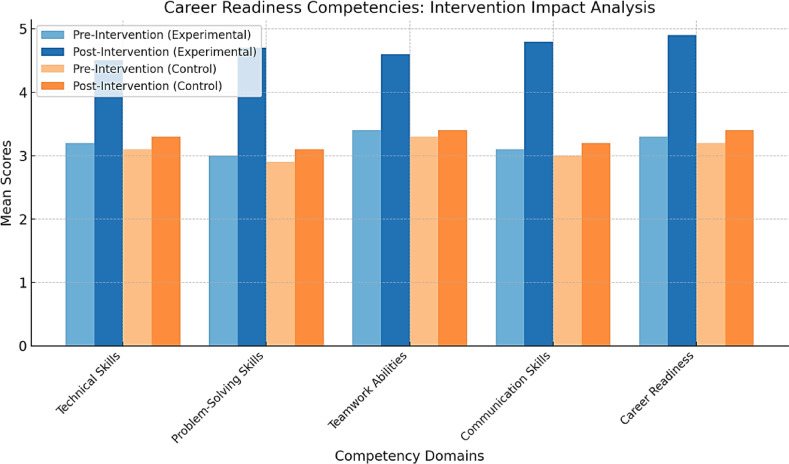
- The I-PBL group showed 25–40% improvements in employability skills, compared with 4–7% gains in the control group; the paper highlights especially large gains in career decision-making, strategic work behaviors, and interpersonal rapport.
- Specific self-reported gains included 30% in problem-solving, 28% in technical skills, 32% in teamwork, and 31% in communication; career-related outcomes rose as well, including 40% for job-search confidence, 38% for strategic work behaviors, and 35% for networking effectiveness.
- Engagement improved over the 12-week course: attendance increased by 7%, milestone completion by 15%, and experience ratings from 3.5 to 4.5.
- Industry interaction mode mattered: industry mentorship had the highest perceived utility (4.86/5.0), followed by immersive workplace visits (4.62/5.0); the strongest engagement gains were in pitch presentation sessions (3.0 to 4.6) and workplace visits (3.0 to 4.2).
- The Pearson correlation between curriculum engagement and competency development was 0.76, indicating a strong positive association.
## Methods
- Design: Quasi-experimental, non-equivalent pretest-posttest design with an experimental I-PBL group and a control group using the standard curriculum; the study also used mixed methods with surveys, engagement metrics, and interviews.
- Sample/data: 340 STEM undergraduates from a single metropolitan university, with 280 in the experimental group and 60 in the control group; data were collected over a 12-week course.
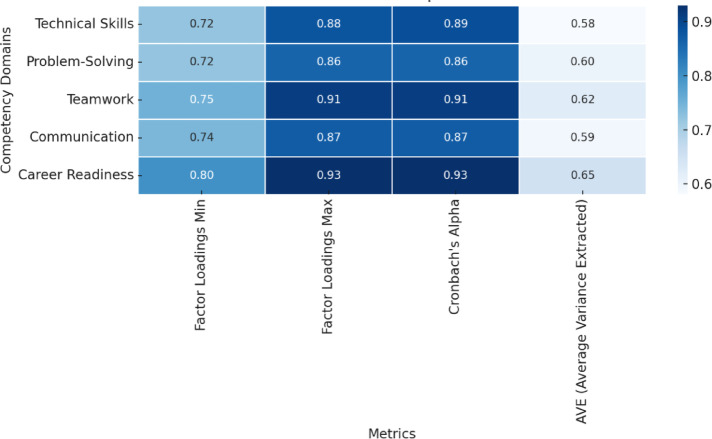
- Analysis: The paper reports CFA for measurement validation, ANCOVA to compare adjusted post-test outcomes, paired t-tests, Pearson correlations, multiple linear regression, two-way mixed ANOVA, chi-square tests for demographic comparability, and thematic analysis of interviews using NVivo 12.
## Limitations
- The authors explicitly note a single-institution scope, self-selected participation, and reliance on student self-reports, which threaten generalizability and validity.
- They also state that the absence of behavioral competency measures and participant tracking limits conclusions about whether improved career readiness translated into actual workplace performance, retention, or leadership advancement.
- Evident from the text: the groups were imbalanced (280 experimental vs 60 control), and the paper notes the control group was smaller than planned; this could reduce power for between-group comparisons.
Model-written summary. Check it against the paper before relying on it.
Integrity signals
Registry
Cites
Statistics
Figures



Verification
Claims the paper makes
15 Valid · 4 Not valid · 20 Not checked · 71 Own results and interpretations
The cited sources that could be checked couldn’t confirm or dispute this claim.
In the paper
“Similarly, analytical case projects co-designed sequentially with external partners over two years enriched student commercial awareness, ethical judgment, and decision-making expertise markedly more than single interactions31,32.”
§ Project based learning framework integrating industry collaboration to enhance student future readiness in higher education > Literature review > Industry-education partnerships and engagement models
What the sources say
- Not checked — no full text of the sourcecites [31] Shaked, H. & Glanz, J. New Explorations for Instructional Leaders: How Principals Can Promote Teaching and Learning Effectively (Rowman & Littlefield, 2022). source
- Could not verifycites [32] Benedek, A. New paths to online Teaching – How can we manage knowledge transfer and make the learning more enjoyable?? Central Eur. J. Educ. Res. 3 (3), 55–62. 10.37441/cejer/2021/3/3/10015 (2021). sourceExperimental — accuracy not yet measured
The ‘From theory to practice’ passages describe vocational teacher students collaboratively developing online learning resources, not analytical case projects with external partners. A search for commercial awareness, ethical judgment, decision-making, and a comparison with single interactions found no passage addressing those outcomes or that comparison. Page numbers were not available in our copy. (LLM, conf=0.77)
boostedstates a cause- Asserted: passes — The authors put it forward as true.
- Checkable: passes — It can be checked against evidence.
- Load-bearing: unclear — It is unclear whether the paper’s conclusions depend on it.
- Based: passes — The paper gives a reason why it holds.
The cited sources support only part of this claim — read each source’s verdict below.
In the paper
“Immersive innovation engagements also reshape learners’ meaning-making towards creative entrepreneurial perspectives rather than purely disciplinary technical frames33–35.”
§ Project based learning framework integrating industry collaboration to enhance student future readiness in higher education > Literature review > Industry-education partnerships and engagement models
What the sources say
- Could not verifycites [33] Cavanaugh, G. et al. Immersive learning and participatory engagement. Int. J. Distance Educ. Technol. 21 (1), 1–19. 10.4018/ijdet.317364 (2023). sourceExperimental — accuracy not yet measured
The Theoretical Framework (page unavailable) discusses learners constructing new meanings in VR, while the Discussion (page unavailable) reports learning and engagement in a virtual classroom. Neither addresses a shift toward creative entrepreneurial perspectives rather than disciplinary technical frames; searches for entrepreneurial innovation and meaning-making found no supporting passage. (LLM, conf=0.75)
- Partly supportedcites [34] Davydova, D., Gil’vanov, R., Kukushkina, Y. & Romanova, I. Immersive technologies in higher education. Proc. Petersbg Transp. Univ. 20 (1), 120–132. 10.20295/1815-588x-2023-1-120-132 (2023). sourceExperimental — accuracy not yet measured
The introduction (page unavailable) says immersive technologies help learners form a representation of the environment in which they will act, and the mixed-reality section says they can improve understanding and engagement. Neither passage says learners shift toward creative entrepreneurial perspectives rather than disciplinary technical frames. (LLM, conf=0.82)
- Partly supportedcites [35] Artyukhov, A., Volk, I., Dluhopolskyi, O., Mieszajkina, E. & Myśliwiecka, A. Immersive university model: A tool to increase higher education competitiveness. Sustainability 15 (10), 7771. 10.3390/su15107771 (2023). sourceExperimental — accuracy not yet measured
Theoretical Background links immersive learning to creativity, innovation, and skills employers need; Section 3 describes active learning practices intended to develop creativity. The paper does not establish that these engagements reshape learners’ meaning-making toward entrepreneurial perspectives or away from disciplinary technical frames. The passages in our copy have no page numbers. (LLM, conf=0.83)
plainstates a cause- Asserted: passes — The authors put it forward as true.
- Checkable: passes — It can be checked against evidence.
- Load-bearing: unclear — It is unclear whether the paper’s conclusions depend on it.
- Based: passes — The paper gives a reason why it holds.
- Could not verify
The cited sources support only part of this claim — read each source’s verdict below.
In the paper
“Qualitative themes show participants adopting new meaning-making habits oriented to critical questioning, metacognitive self-assessment, and reflective practice vital for their field17,18.”
§ Project based learning framework integrating industry collaboration to enhance student future readiness in higher education > Literature review > The 21 st century skills imperative in higher education
What the sources say
- Not checked — no full text of the sourcecites [17] Ssemugenyi, F. Teaching and learning methods compared: A pedagogical evaluation of Problem-Based learning (PBL) and lecture methods in developing learners’ cognitive abilities. Cogent Educ.10 (1). 10.1080/2331186x.2023.2187943 (2023). source
- Partly supportedcites [18] Bahri, A. & Corebima, A. D. Improving PBL in empowering Meta cognitive skill of students. Indian J. Sci. Technol. 12 (17), 1–9. 10.17485/ijst/2019/v12i17/69226 (2019). sourceExperimental — accuracy not yet measured
The Results and Discussion (pp. 5–7) describe PBL-RQA students raising questions, assessing their understanding, and reflecting on their learning. But the Method (p. 3) describes a quasi-experiment, and the Results (pp. 3–4) report test scores rather than qualitative themes showing participants adopting new meaning-making habits. The paper also does not establish that these habits are vital for their field. (LLM, conf=0.87)
plainstates a cause- Asserted: passes — The authors put it forward as true.
- Checkable: passes — It can be checked against evidence.
- Load-bearing: unclear — It is unclear whether the paper’s conclusions depend on it.
- Based: passes — The paper gives a reason why it holds.
A result the paper reports from its own data — it cites no other source for it, so there is none to check. The quote shows it is in the paper.
In the paper
“Implementing the I-PBL significantly increased student engagement by 30% and satisfaction by 35%, demonstrating the approach’s effectiveness.”
§ Project based learning framework integrating industry collaboration to enhance student future readiness in higher education > Abstract In the 21st -century, it is vital to prepare university students with the required skills to pursue them for future career success. The research presents a framework of project-based learning (PBL) enriched by the industry to increase students’ future readiness. The framework comprises collaboration with industry partners, solving real-world problems as projects, and interdisciplinary approaches intended to build specific critical skills like teamwork, problem-solving, and adaptability. The study investigates the impact of I-PBL methodologies and framework on higher education curricula to enhance the readiness of students for the future. The study focuses on two key parameters— (1) the percentage of the curriculum devoted to PBL and (2) the rate of industry engagement activities. The study examines how these educational methods prepare students for today’s workforce challenges. The study bridges quantitative outcomes, revealing how I-PBL enriched with industry engagement significantly enhance STEM students’ skills and readiness for the workforce. The quasi-experimental study quantitatively assessed the curriculum to determine the proportion of PBL at 40%, and the frequency of industry engagement activities averaged at five distinct interactions per academic session. The pre-and post- surveys assessed students’ employability skills, while feedback and participation metrics measured their engagement and satisfaction. The findings reveal a significant improvement in student employability skills, with an average increase of 25% in self-reported competencies in job-related skills. Implementing the I-PBL significantly increased student engagement by 30% and satisfaction by 35%, demonstrating the approach’s effectiveness. It is the first to bring industry-enriched PBL systematically into higher education. Based on these results, the endorsed new insights and enhancement strategies for student employability skills, as discussed in this book, will help bridge the gap between academic preparation and workforce demands. The study addresses the gap in current educational practices by presenting a detailed, empirically validated framework that educators and policymakers can implement to prepare students for the evolving demands of the workforce.
boostedstates a cause- Asserted: passes — The authors put it forward as true.
- Checkable: passes — It can be checked against evidence.
- Load-bearing: passes — The paper’s conclusions depend on it.
- Based: passes — The paper gives a reason why it holds.
A result the paper reports from its own data — it cites no other source for it, so there is none to check. The quote shows it is in the paper.
In the paper
“The quasi-experimental study quantitatively assessed the curriculum to determine the proportion of PBL at 40%, and the frequency of industry engagement activities averaged at five distinct interactions per academic session.”
§ Project based learning framework integrating industry collaboration to enhance student future readiness in higher education > Abstract In the 21st -century, it is vital to prepare university students with the required skills to pursue them for future career success. The research presents a framework of project-based learning (PBL) enriched by the industry to increase students’ future readiness. The framework comprises collaboration with industry partners, solving real-world problems as projects, and interdisciplinary approaches intended to build specific critical skills like teamwork, problem-solving, and adaptability. The study investigates the impact of I-PBL methodologies and framework on higher education curricula to enhance the readiness of students for the future. The study focuses on two key parameters— (1) the percentage of the curriculum devoted to PBL and (2) the rate of industry engagement activities. The study examines how these educational methods prepare students for today’s workforce challenges. The study bridges quantitative outcomes, revealing how I-PBL enriched with industry engagement significantly enhance STEM students’ skills and readiness for the workforce. The quasi-experimental study quantitatively assessed the curriculum to determine the proportion of PBL at 40%, and the frequency of industry engagement activities averaged at five distinct interactions per academic session. The pre-and post- surveys assessed students’ employability skills, while feedback and participation metrics measured their engagement and satisfaction. The findings reveal a significant improvement in student employability skills, with an average increase of 25% in self-reported competencies in job-related skills. Implementing the I-PBL significantly increased student engagement by 30% and satisfaction by 35%, demonstrating the approach’s effectiveness. It is the first to bring industry-enriched PBL systematically into higher education. Based on these results, the endorsed new insights and enhancement strategies for student employability skills, as discussed in this book, will help bridge the gap between academic preparation and workforce demands. The study addresses the gap in current educational practices by presenting a detailed, empirically validated framework that educators and policymakers can implement to prepare students for the evolving demands of the workforce.
plain- Asserted: passes — The authors put it forward as true.
- Checkable: passes — It can be checked against evidence.
- Load-bearing: unclear — It is unclear whether the paper’s conclusions depend on it.
- Based: passes — The paper gives a reason why it holds.
41 more claims
Create a free account to see all 110 claims and every source verdict.
- It may state two separate claims as one. 34
- Probably not a substantial claim. 39
- The quote only partly states this claim. 1
Statistics recomputed
Every reported test result, recomputed from its test statistic and degrees of freedom. A result shows as not adding up only once an independent check has confirmed it.
- Consistentt(338) = 12.85reported p < .001 · recomputed p < .001
“t(338) = 12.85, p < .001”
- Consistentt(338) = 11.95reported p < .001 · recomputed p < .001
“t(338) = 11.95, p < .001”
- Consistentt(338) = 10.92reported p < .001 · recomputed p < .001
“t(338) = 10.92, p < .001”
Self-check
Percentages, sums and reported differences re-computed from the paper’s own numbers.
Each contradiction between two passages listed here was confirmed by an independent check.
Rated minor: it would not touch a result — a value no result rests on, a p-value that stays on the same side of the significance level, or a conflict that is clerical, resolved elsewhere in the paper, or outside its own findings.
In the paper
§ Project based learning framework integrating industry collaboration to enhance student future readiness in higher education > Methodology > Participants
“The sample consisted of 320 undergraduate students enrolled in STEM programs such as Computer Science, Engineering, and Information Systems.”
§ Project based learning framework integrating industry collaboration to enhance student future readiness in higher education > Results > Participant overview
“The sample encompassed 340 students from STEM majors undertaking either the redesigned I-PBL curriculum (n = 280) or standard equivalent module (n = 60).”
Citations
Cites
Thornhill-Miller, B., Camarda, A., Mercier, M., Burkhardt, J.-M., Morisseau, T., Bourgeois-Bougrine, S., Vinchon, F., El Hayek, S., Augereau-Landais, M., Mourey, F., et al. (2023) · Journal of Intelligence · doi:10.3390/jintelligence11030054 · Cited by 768 · cited 3×
“Thornhill-Miller et al. (2023) 9 Assessment of 21st-century skills for future work and education.”
InfluentialEmployability skill development in work-integrated learning: Barriers and best practice
Jackson, D. (2015) · Studies in Higher Education · doi:10.1080/03075079.2013.842221 · Cited by 762 · cited 2×
“According to Jackson, career readiness involves the development of transferable skills, proactive career management, and integrating academic knowledge into practical applications 26 .”
Learning 21st-Century Skills Requires 21st-Century Teaching
Saavedra, A. R., & Opfer, V. D. (2012) · Phi Delta Kappan · doi:10.1177/003172171209400203 · Cited by 640 · cited 2×
“Saavedra & Opfer (2012) 4 21st-century skills require updated teaching methodologies such as project-based learning (PBL).”
Jackson, D., & Wilton, N. (2017) · Higher Education Research & Development · doi:10.1080/07294360.2016.1229270 · Cited by 263
Does Project-Based Learning (PBL) Promote Student Learning? A Performance Evaluation
Ngereja, B. J., Hussein, B., & Andersen, B. S. (2020) · Education Sciences · doi:10.3390/educsci10110330 · Cited by 209 · cited 1×
“The statistic increases in decision effectiveness, cultural rapport, self-regulation, and career navigation measures support previous work on constructivist methods that make potent contributions to capacity development that can be compared to inert knowledge transmission 46 .”
Project-based learning as a contributing factor to graduates’ work readiness
Jollands, M., Jolly, L., & Molyneaux, T. (2012) · European Journal of Engineering Education · doi:10.1080/03043797.2012.665848 · Cited by 162 · cited 1×
“Jollands et al. 15 , performed a survey across graduated cohorts that showed dramatically higher employment and workplace readiness rates among past PBL students, with 80% in full-time positions utilizing their qualifications compared to just 28% of traditionally schooled peers.”
The problem of projects: understanding the theoretical underpinnings of project-led PBL
Hanney, R., & Savin-Baden, M. (2013) · London Review of Education · doi:10.1080/14748460.2012.761816 · Cited by 81 · cited 1×
“Hanney & Savin-Baden (2013) 6 PBL fosters critical thinking and problem-solving skills but needs clear theoretical underpinnings.”
Improving Student Engagement With Project-Based Learning: A Case Study in Software Engineering
Morais, P., Ferreira, M. J., & Veloso, B. (2021) · IEEE Revista Iberoamericana de Tecnologias del Aprendizaje · doi:10.1109/rita.2021.3052677 · Cited by 79 · cited 1×
“Morais et al. 16 randomized the trial quantified PBL learning value through elicitation technique calculating revealed willingness-to-pay, with students considerably overvaluing PBL courses reflecting enhanced competencies gained.”
Jackson, D., & Wilton, N. (2017) · Journal of Education and Work · doi:10.1080/13639080.2016.1255314 · Cited by 61
Ssemugenyi, F. (2023) · Cogent Education · doi:10.1080/2331186x.2023.2187943 · Cited by 56 · cited 1×
“Qualitative themes show participants adopting new meaning-making habits oriented to critical questioning, metacognitive self-assessment, and reflective practice vital for their field 17,18 .”
Cited by
Vlachopoulos, D., & Tsitiridou, O. P. (2026) · Education sciences · doi:10.3390/educsci16030426 · Cited by 24
Petropoulou, A., Antonopoulou, H., Vlachou, A. A., Gkintoni, E., & Halkiopoulos, C. (2025) · Children · doi:10.3390/children12121647 · Cited by 11
“Cross-cultural replications could identify whether strong norm alignment (r = 0.80) reflects Greek collectivist culture or universal developmental patterns, clarifying culturally specific versus universal mechanisms [123].”
InfluentialArtificial intelligence applications and pedagogical challenges in music education
Mazlan, C. A. N., Hanafi, H. F., Sarifin, M. R., Noor, A. R. M., Sadykova, S., Hidayatullah, R., & Jamnongsarn, S. (2026) · Discover Education · doi:10.1007/s44217-026-01127-3 · Cited by 24
“Drawing from advancements in healthcare AI, [83, 84, 86] proposed a robust GAN-IoT framework that significantly improves predictive accuracy and privacy, offering a transferable model for ethical AI integration in educational contexts.”
Wira, I. B. G., Sudatha, I. G. W., Warpala, I. W. S., Parwati, N. N., & Suartama, I. K. (2026) · JKTP: Jurnal Kajian Teknologi Pendidikan · doi:10.17977/um038v9i12026p010-021 · Cited by 4
Guaya, D. E., Romero-Benavides, J. C., Jaramillo, N. D. C. F., & Jiménez, L. (2025) · Sustainability · doi:10.3390/su17198820 · Cited by 9
“Similarly, Naseer et al. (2025) pro-pose industry-enriched PBL frameworks to improve employability and professional readiness [44].”
Metadata
- Authors
- Naseer, F., Tariq, R., Alshahrani, H. M., Alruwais, N., & Al-Wesabi, F. N.
- Affiliations
- Tecnológico de Monterrey (MX)
- Princess Nourah bint Abdulrahman University (SA)
- King Saud University (SA)
- Corresponding author
- Naseer, Fawad
- Tariq, Rasikh
- Venue
- Scientific Reports
- Published
- 2025-07-10
- Volume
- 15
- Issue
- 1
- Pages
- 24985-24985
- ISSN
- 2045-2322 (ISSN-L)
- PMC
- PMC12246200
- OpenAlex
- W4412166965
- Semantic Scholar
- d8b28e5e8187038a5c8271170f446a9892f529de
- Cited by
- 169
- References
- 48
- Citations by year
- 2026: 129 · 2025: 40
- FWCI
- 140.03
- Type
- journal article
- Language
- en
- Open access
- gold
- doi.org
- Licence
- cc-by-nc-nd
- creativecommons.org/licenses/by-nc-nd/4.0 (tdm)
- creativecommons.org/licenses/by-nc-nd/4.0 (vor)
- Locations
- Scientific Reports (publishedVersion, cc-by-nc-nd)
- PubMed Central (publishedVersion, cc-by-nc-nd)
- PubMed (publishedVersion)
- DOAJ (DOAJ: Directory of Open Access Journals) (submittedVersion, cc-by-sa)
- Funders
- King Saud University
- Princess Nourah Bint Abdulrahman University
- Instituto Tecnológico y de Estudios Superiores de Monterrey (IJXT070-23EG99001)
- King Khalid University (RGP2/199/46)
- Topics
- Social Sciences › Education › Problem and Project Based Learning
- Social Sciences › Education › Higher Education and Employability
- Social Sciences › Education › Vocational and Entrepreneurial Education
- Keywords
- project-based learning, industry partnerships, student employability, future readiness, higher education curriculum, STEM students, employability skills, student engagement, student satisfaction, interdisciplinary learning, real-world problem solving
- MeSH terms
- Cooperative Behavior, Curriculum, Humans, Industry, Students, Universities, Problem-Based Learning
About these checks
Registry, retraction, Cites and statistics results are computed, not judged, with one exception: a printed reference that no index lists is read once by a model before it counts as a citation error. Claims are extracted by a model and kept only when their quote appears verbatim in the text; each cited source is then checked, with a model’s help, for whether it says what the claim relies on. Those verdicts can be wrong — read the claim’s quote and the cited source before relying on one.
The claim verdicts this report counts are experimental: their accuracy is not yet measured.
A language model drew the claims from the paper on 2026-10-10, under version 3 of the claim definition (model deepseek-v4.1-flash, prompt extract-v3).
A second model labelled each claim on 2026-10-10 (model jev-1.13-20260917, definition revision gold-guideline-v0.2).
Cited sources are checked with a language model’s help (gpt-6-sol).
Statistics and arithmetic are recomputed, not judged.
Confidence bands are shown only for fields calibrated on our annotated test set. None is calibrated yet, so no band is shown.
What counts as a claim ›How we measure confidence ›How we check this ›
Are you an author, or do you see a problem with this page? Request a review
How to cite
Cite CoChat for the checks on this page, and the paper for its own findings.
- This page
- CoChat. (2026). Citation check: Project based learning framework integrating industry collaboration to enhance student future readiness in higher education. https://app.cochat.ai/papers/10.1038/s41598-025-10385-4
- The paper
- Naseer, F., Tariq, R., Alshahrani, H. M., Alruwais, N., & Al-Wesabi, F. N. (2025). Project based learning framework integrating industry collaboration to enhance student future readiness in higher education. Scientific Reports. https://doi.org/10.1038/s41598-025-10385-4
Data sources
Bibliographic data: Semantic Scholar, OpenAlex, Crossref.
Contains information from the Semantic Scholar Academic Graph Datasets, made available under the ODC Attribution License (ODC-BY 1.0).
Semantic Scholar’s data is described in: Kinney, R., et al. (2023). The Semantic Scholar Open Data Platform. arXiv:2301.10140.
