

Waking rest during retention facilitates memory consolidation, but so does social media use
Open accessThe DOI matches its Crossref record; 49 of the 49 references it cites were found in a registry or an index; none of the 36 sources its claims cite is checked for support yet.
Abstract
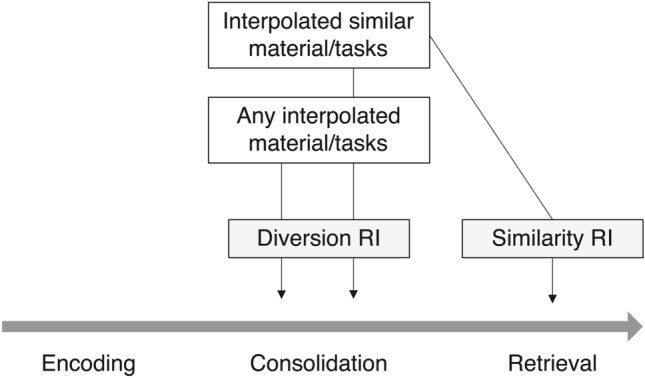
A short period of post-encoding waking rest has been shown to benefit subsequent memory performance. For example, past research suggests that waking rest after learning Icelandic-German word pairs boosts subsequent recall relative to an equally long period of social media use. Such findings are typically interpreted as evidence in favor of diversion retroactive interference. According to this account, non-specific cognitive processing inhibits consolidation and thus impairs storage of information encoded previously. However, the effect might alternatively be explained by similarity retroactive interference according to which retrieval is hampered by information processed during retention. Here, we report two experiments that shed light on the mechanisms underlying the waking rest effect. In both experiments, participants either wakefully rested, used social media, or engaged in additional Norwegian-German vocabulary learning after the original learning phase. We performed multinomial processing tree (MPT) analyses to disentangle latent storage and retrieval contributions to cued recall and recognition performance. We did not find any memory differences between the waking rest and social media conditions in either experiment. Moreover, storage, but not retrieval, was reliably impaired in the vocabulary condition. Thereby, the present research provides direct behavioral evidence for a dominant role of consolidation in the waking rest effect.
Overview
CoChat Summary
TL;DR
Across two preregistered experiments, post-encoding waking rest did not improve memory relative to social media use, but both differed from an additional vocabulary-learning condition. MPT modeling indicated that the vocabulary condition impaired storage/consolidation rather than retrieval, providing direct behavioral evidence for a consolidation contribution to waking rest effects.
Key findings
- No memory differences emerged between waking rest and social media in either experiment: Exp 1 cued recall retention, t(151) = 0.71, p = 0.238, d = 0.14; recognition, t(151) = −0.33, p = 0.627, d = −0.06; Exp 2 retention, t(154) = −0.09, p = 0.534, d = −0.02; recognition, t(154) = −0.20, p = 0.579, d = −0.04.
- Waking rest outperformed the vocabulary condition on cued recall retention and recognition: Exp 1 retention, t(151) = 2.55, p = 0.006, d = 0.50; recognition, t(151) = 3.15, p = 0.001, d = 0.62; Exp 2 retention, t(154) = 2.70, p = 0.004, d = 0.53; recognition, t(154) = 2.23, p = 0.014, d = 0.43.
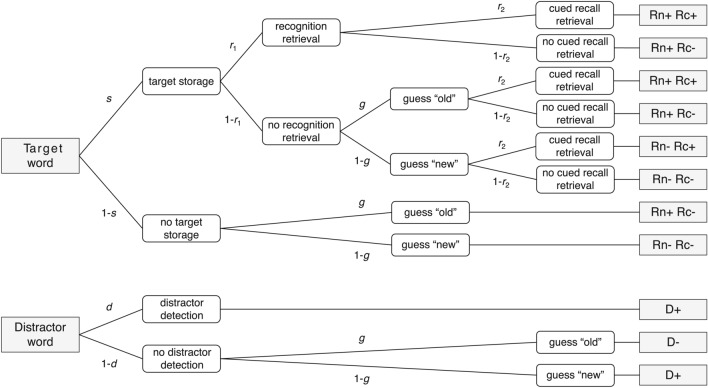
- MPT storage probabilities (s) were lower in the vocabulary condition than in waking rest and social media: Exp 1 aggregated s = 0.91, 0.92, 0.87 for waking rest, social media, vocabulary; waking rest vs. vocabulary z = 2.99, p = 0.001; social media vs. vocabulary ΔG²(1) = 13.40, p < 0.001. Exp 2 aggregated s = 0.92, 0.92, 0.89; waking rest vs. vocabulary z = 2.25, p = 0.012; social media vs. vocabulary ΔG²(1) = 5.83, p = 0.016.
- Cued recall retrieval probabilities (r2) were not reliably impaired in the vocabulary condition in Exp 2; Exp 1 was mixed: aggregated waking rest vs. vocabulary z = 2.21, p = 0.014, and social media vs. vocabulary z = 2.03, p = 0.021, but individual-data Bayesian p = 0.096 and 0.082. Guessing probabilities (g) showed mixed evidence across experiments.
Methods
- Two preregistered lab experiments used a between-participants 8-min post-encoding activity manipulation: waking rest, social media use (Instagram), or vocabulary learning (additional Norwegian-German word pairs). Exp 1 collected N = 159; after outlier exclusions, Session 1 N = 154 and Session 2 N = 141. Exp 2 collected N = 177; final N = 157 after exclusions. Participants were German-fluent, 18–32 years old, knew no Icelandic or Norwegian, and had Instagram on a smartphone.
- Participants learned Icelandic-German word pairs, completed immediate cued recall with a 35% learning criterion, then delayed memory tests. Exp 1 used recognition-then-cued-recall across two sessions about 24 hr apart; Exp 2 used cued-recall-then-recognition in a single session.
- Analyses used one-factorial between-participants ANOVA and planned contrasts, plus a storage-retrieval multinomial processing tree (MPT) model to separate storage (s) and retrieval (r2) contributions, estimated with ML on aggregated data and Bayesian hierarchical latent-trait modeling on individual data.
Limitations
- The authors state their procedure cannot discriminate whether waking rest actively facilitates consolidation or passively protects new memory traces from diversion retroactive interference.
- The authors note procedural differences from Martini et al.: word pairs were presented for 12 sec instead of 5 sec, and a 35% learning criterion was added, yielding higher immediate recall (M = 10.96–12.00) than in the original study (M = 7.64 waking rest, M = 7.21 social media). They cannot rule out that the social media effect would replicate for weaker initial learning, but say the effect disappears with stronger initial learning as used here.
- The authors state their testing procedure did not involve free recall, so retrieval differences might have been more pronounced with free recall. They also note Exp 1 mean cued recall retention scores above 1 suggest benefit from the preceding recognition test, whereas Exp 2’s reversed procedure reduced retention and may be more trustworthy; Exp 1 also deviated from the preregistered analysis plan by excluding outliers.
Model-written summary. Check it against the paper before relying on it.
Integrity signals
Registry
Cites
Statistics
Figures
Verification
Claims the paper makes
0 Valid · 0 Not valid · 27 Not checked · 116 Own results and interpretations
A result the paper reports from its own data — it cites no other source for it, so there is none to check. The quote shows it is in the paper.
In the paper
“However, this was not the case when the waking rest condition was compared against the social media condition, t(151) = 0.71, p = 0.238, Cohen’s d = 0.14.”
§ Waking rest during retention facilitates memory consolidation, but so does social media use > Experiment 1 > Results
plain- Asserted: passes — The authors put it forward as true.
- Checkable: passes — It can be checked against evidence.
- Load-bearing: passes — The paper’s conclusions depend on it.
- Based: passes — The paper gives a reason why it holds.
A result the paper reports from its own data — it cites no other source for it, so there is none to check. The quote shows it is in the paper.
In the paper
“Indeed, guessing probabilities did differ significantly between the waking rest and the vocabulary condition, ΔG²(1) = 10.65, p = 0.001.”
§ Waking rest during retention facilitates memory consolidation, but so does social media use > Experiment 1 > Results
plainstates an association- Asserted: passes — The authors put it forward as true.
- Checkable: passes — It can be checked against evidence.
- Load-bearing: unclear — It is unclear whether the paper’s conclusions depend on it.
- Based: passes — The paper gives a reason why it holds.
A result the paper reports from its own data — it cites no other source for it, so there is none to check. The quote shows it is in the paper.
In the paper
“Somewhat surprisingly, the number of correct responses in the delayed cued recall did not differ significantly between conditions, F(2, 154) = 1.17, p = 0.313, η² = 0.01.”
§ Waking rest during retention facilitates memory consolidation, but so does social media use > Experiment 2 > Results
plain- Asserted: passes — The authors put it forward as true.
- Checkable: passes — It can be checked against evidence.
- Load-bearing: passes — The paper’s conclusions depend on it.
- Based: passes — The paper gives a reason why it holds.
A result the paper reports from its own data — it cites no other source for it, so there is none to check. The quote shows it is in the paper.
In the paper
“In line with the pattern for cued recall retention, this overall effect could be attributed to significantly lower recognition performances in the vocabulary than in the waking rest condition, t(154) = 2.23, p = 0.014, Cohen’s d = 0.43, whereas recognition performances in the social media condition did not differ significantly from those in the waking rest condition, t(154) = -0.20, p = 0.579, Co”
§ Waking rest during retention facilitates memory consolidation, but so does social media use > Experiment 2 > Results
plain- Asserted: passes — The authors put it forward as true.
- Checkable: passes — It can be checked against evidence.
- Load-bearing: passes — The paper’s conclusions depend on it.
- Based: passes — The paper gives a reason why it holds.
A result the paper reports from its own data — it cites no other source for it, so there is none to check. The quote shows it is in the paper.
In the paper
“Our preregistered MPT model specification included an equality constraint on guessing parameter g across conditions for the aggregated data. However, this model version did not fit the data, neither for Session 1, G2(2) = 11.34, p = 0.003, nor for Session 2, G²(2) = 12.11, p = 0.002.”
§ Waking rest during retention facilitates memory consolidation, but so does social media use > Experiment 1 > Results
plain- Asserted: passes — The authors put it forward as true.
- Checkable: passes — It can be checked against evidence.
- Load-bearing: unclear — It is unclear whether the paper’s conclusions depend on it.
- Based: passes — The paper gives a reason why it holds.
77 more claims
Create a free account to see all 143 claims and to verify the 34 references still open.
- Probably not a substantial claim. 56
- It may state two separate claims as one. 15
Statistics recomputed
Every reported test result, recomputed from its test statistic and degrees of freedom. A result shows as not adding up only once an independent check has confirmed it.
- ConsistentF(2, 151) = 0.52reported p = .593 · recomputed p = .596
“F(2, 151) = 0.52, p = .593”
- ConsistentF(2, 151) = 1.42reported p = .245 · recomputed p = .245
“F(2, 151) = 1.42, p = .245”
- ConsistentF(2, 151) = 3.71reported p = .027 · recomputed p = .027
“F(2, 151) = 3.71, p = .027”
- ConsistentF(2, 151) = 3.48reported p = .033 · recomputed p = .033
“F(2, 151) = 3.48, p = .033”
- Consistentt(151) = 2.55reported p = .006 · recomputed p = .012
“t(151) = 2.55, p = .006”
The paper states a one-tailed test
41 more recomputed tests
Create a free account to see every test the Stats check recomputed.
Self-check
Percentages, sums and reported differences re-computed from the paper’s own numbers.
Self-check results appear here once an independent check has confirmed them.
Citations
Cites
Faul, F., Erdfelder, E., Lang, A.-G., & Buchner, A. (2007) · Behavior Research Methods · doi:10.3758/bf03193146 · Cited by 65,971
Self-citationInference from iterative simulation using multiple sequences
Gelman, A., & Rubin, D. B. (1992) · Statistical Science · doi:10.1214/ss/1177011136 · Cited by 16,627
Leys, C., Ley, C., Klein, O., Bernard, P., & Licata, L. (2013) · Journal of Experimental Social Psychology · doi:10.1016/j.jesp.2013.03.013 · Cited by 4,147
Why people use social media: a uses and gratifications approach
Whiting, A., & Williams, D. (2013) · Qualitative Market Research: An International Journal · doi:10.1108/qmr-06-2013-0041 · Cited by 1,810
Rethinking interference theory: Executive control and the mechanisms of forgetting.
Anderson, M. (2003) · Journal of Memory and Language · doi:10.1016/j.jml.2003.08.006 · Cited by 918 · cited 1×
“Apparently, the similarities between Icelandic-German and unrelated Norwegian-German word pairs were insufficient to result in significant retrieval competition 49 or indistinctiveness 45,48 during the delayed memory tests.”
Sensory-processing sensitivity and its relation to introversion and emotionality.
Aron, E. N., & Aron, A. (1997) · Journal of Personality and Social Psychology · doi:10.1037/0022-3514.73.2.345 · Cited by 889
A temporal ratio model of memory
Brown, G. D. A., Neath, I., & Chater, N. (2007) · Psychological Review · doi:10.1037/0033-295x.114.3.539 · Cited by 798 · cited 2×
“Apparently, the similarities between Icelandic-German and unrelated Norwegian-German word pairs were insufficient to result in significant retrieval competition 49 or indistinctiveness 45,48 during the delayed memory tests.”
Decay happens: the role of active forgetting in memory
Hardt, O., Nader, K., & Nadel, L. (2013) · Trends in Cognitive Sciences · doi:10.1016/j.tics.2013.01.001 · Cited by 416 · cited 1×
“Thus, the main focus of this research was on item rather than associative memory 20,21 , although cued recall performances may be assumed to be indicative of associative memory to some extent as well.”
multiTree: A computer program for the analysis of multinomial processing tree models
Moshagen, M. (2010) · Behavior Research Methods · doi:10.3758/brm.42.1.42 · Cited by 375
Multinomial Processing Tree Models: A Review of the Literature
Erdfelder, E., Auer, T.-S., Hilbig, B. E., Aßfalg, A., Moshagen, M., & Nadarevic, L. (2009) · Zeitschrift für Psychologie / Journal of Psychology · doi:10.1027/0044-3409.217.3.108 · Cited by 336
Self-citation
Cited by
Resting after learning or repeating the learned?
Martini, M., Mercer, T., Gutmann, L., Dahm, S. F., Marhenke, R., & Sachse, P. (2025) · Psychonomic Bulletin & Review · doi:10.3758/s13423-025-02820-4 · Cited by 2
Knowles, B. P., & Craig, M. (2026) · Applied Cognitive Psychology · doi:10.1002/acp.70252
Lam, N. (2025) · White Rose eTheses Online (University of Leeds, The University of Sheffield, University of York)
Metadata
- Authors
- Quevedo Pütter, J., & Erdfelder, E.
- Affiliations
- University of Mannheim (DE)
- ORCID
- Erdfelder, Edgar
- Venue
- Scientific Reports
- Published
- 2025-02-18
- Volume
- 15
- Issue
- 1
- Pages
- 5884-5884
- ISSN
- 2045-2322 (ISSN-L)
- PMC
- PMC11836141
- OpenAlex
- W4407719903
- Cited by
- 3
- References
- 47
- Citations by year
- 2026: 1 · 2025: 2
- FWCI
- 0.94
- Type
- journal article
- Language
- en
- Open access
- gold
- doi.org
- Licence
- cc-by
- creativecommons.org/licenses/by/4.0 (tdm)
- creativecommons.org/licenses/by/4.0 (vor)
- Locations
- Scientific Reports (publishedVersion, cc-by)
- PubMed Central (publishedVersion, cc-by)
- PubMed (publishedVersion)
- MADOC (University of Mannheim) (submittedVersion, cc-by)
- DOAJ (DOAJ: Directory of Open Access Journals) (submittedVersion)
- Funders
- Universität Mannheim
- Topics
- Life Sciences › Neuroscience › Cognitive Neuroscience › Memory Processes and Influences
- Life Sciences › Neuroscience › Cognitive Neuroscience › Sleep and Wakefulness Research
- Life Sciences › Neuroscience › Cognitive Neuroscience › Memory and Neural Mechanisms
- Keywords
- memory consolidation, social media use, retroactive interference, vocabulary acquisition, cued recall, recognition memory
- MeSH terms
- Memory Consolidation, Adult, Female, Humans, Learning, Male, Mental Recall, Rest, Retention, Psychology, Wakefulness, Young Adult, Social Media
About these checks
Registry, retraction, Cites and statistics results are computed, not judged, with one exception: a printed reference that no index lists is read once by a model before it counts as a citation error. Claims are extracted by a model and kept only when their quote appears verbatim in the text; each cited source is then checked, with a model’s help, for whether it says what the claim relies on. Those verdicts can be wrong — read the claim’s quote and the cited source before relying on one.
A language model drew the claims from the paper on 2026-11-24, under version 3 of the claim definition (model deepseek-v4.1-flash, prompt extract-v3).
A second model labelled each claim on 2026-11-24 (model jev-1.13-20260917, definition revision gold-guideline-v0.2).
Statistics and arithmetic are recomputed, not judged.
Confidence bands are shown only for fields calibrated on our annotated test set. None is calibrated yet, so no band is shown.
What counts as a claim ›How we measure confidence ›How we check this ›
Are you an author, or do you see a problem with this page? Request a review
How to cite
Cite CoChat for the checks on this page, and the paper for its own findings.
- This page
- CoChat. (2026). Citation check: Waking rest during retention facilitates memory consolidation, but so does social media use. https://app.cochat.ai/papers/10.1038/s41598-025-88363-z
- The paper
- Quevedo Pütter, J., & Erdfelder, E. (2025). Waking rest during retention facilitates memory consolidation, but so does social media use. Scientific Reports. https://doi.org/10.1038/s41598-025-88363-z
Data sources
Bibliographic data: Semantic Scholar, OpenAlex, Crossref.
Contains information from the Semantic Scholar Academic Graph Datasets, made available under the ODC Attribution License (ODC-BY 1.0).
Semantic Scholar’s data is described in: Kinney, R., et al. (2023). The Semantic Scholar Open Data Platform. arXiv:2301.10140.
