

The DOI matches its Crossref record; 74 of the 74 references it cites were found in a registry or an index.
Cognitive performance classification of older patients using machine learning and electronic medical records
Open accessPublished version of a preprint
Abstract
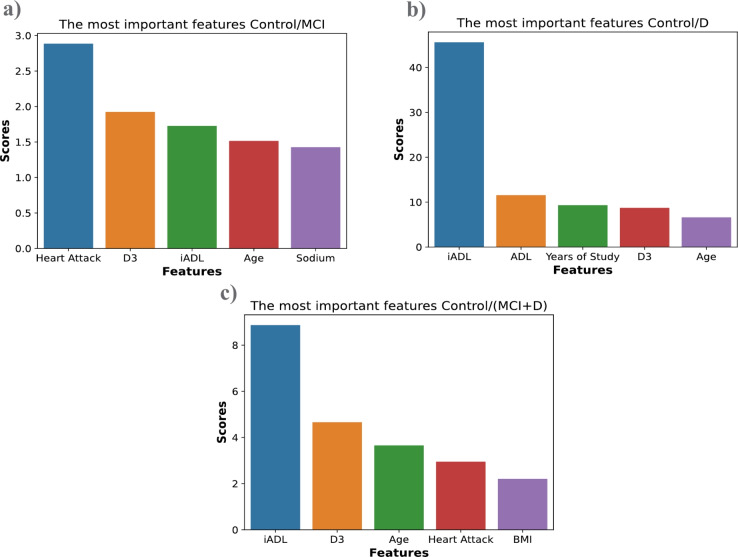
Dementia rates are projected to increase significantly by 2050, posing considerable challenges for healthcare systems worldwide. Developing efficient diagnostic tools is critical, and machine learning (ML) algorithms have shown potential for improving the accuracy of cognitive impairment classification. This study aims to address challenges in current systems by leveraging readily available electronic medical record (EMR) data to simplify and enhance the classification of cognitive impairment. The analysis includes 283 older adults, categorized into three groups: 144 individuals with mild cognitive impairment (MCI), 38 with dementia, and 101 healthy controls. Various ML techniques are evaluated to classify cognitive performance levels based on input features such as sociodemographic variables, lab results, comorbidities, Body Mass Index (BMI), and functional scales. Key predictors for distinguishing healthy controls from individuals with MCI are identified. These are history of myocardial infarction, vitamin D3 levels, the Instrumental Activities of Daily Living (IADL) scale, age, and sodium levels. The nonlinear Support Vector Machine (SVM) with a Radial Basis Function (RBF) kernel achieve the best performance for MCI classification, with an accuracy of 69%, an AUC of 0.75, and a Matthews Correlation Coefficient (MCC) of 0.43. For distinguishing healthy controls from those with dementia, the most influential factors include the IADL scale, the Activities of Daily Living (ADL) scale, education, vitamin D3 levels, and age. Here, the Random Forest algorithm demonstrates superior performance, achieving 84% accuracy, an AUC of 0.96, and an MCC of 0.71. These two models consistently outperform other ML techniques, such as K-Nearest Neighbors, Multi-Layer Perceptron, linear SVM, Naive Bayes, Quadratic Discriminant Analysis, Linear Discriminant Analysis, AdaBoost, and Gaussian Process Classifiers. The findings suggest that EMR data can be an effective resource for the initial classification of cognitive impairments. Integrating these ML-driven approaches into primary care settings may facilitate the early identification of older patients who could benefit from further cognitive assessments.
Overview
The claims and statistics of this paper haven’t been checked yet.
Free: it reads the open-access text and checks the first 5 claims that cite a source we can check. Create a free account to check every claim.
Integrity signals
Registry
Cites
Statistics
Figures

Verification
Claims the paper makes
The claims and statistics of this paper haven’t been checked yet.
Free: it reads the open-access text and checks the first 5 claims that cite a source we can check. Create a free account to check every claim.
Claims other papers make about this one
Each is checked against this paper’s own text: does it say what the citing paper says it does?
The check wasn’t confident either way, so it gives no verdict — never disputed.
In the citing paper
“For example, changes in physical activity and movement patterns, driving behavior, sleep patterns, everyday speech, eye tracking, facial expressions, technology use, writing, texting, and keyboard typing dynamics have all been shown to differentiate those with and without neurodegenerative disease.111–119”
From Review of Artificial Intelligence for Clinical Use in Alzheimer's Disease and Related Dementias (2026) · cites this paper as [112]
Experimental — accuracy not yet measured
Self-check
Percentages, sums and reported differences re-computed from the paper’s own numbers.
The self-check needs the paper’s full text.
Citations
Cites
1 retracted
Dementia prevention, intervention, and care: 2020 report of the Lancet Commission
Livingston, G., Huntley, J., Sommerlad, A., Ames, D., Ballard, C., Banerjee, S., Brayne, C., Burns, A., Cohen-Mansfield, J., Cooper, C., et al. (2020) · The Lancet · doi:10.1016/s0140-6736(20)30367-6 · Cited by 10,430 · cited 2×
“1, 2 and 3.”
RetractedFolstein, M. F., Folstein, S. E., & McHugh, P. R. (1975) · Journal of Psychiatric Research · doi:10.1016/0022-3956(75)90026-6 · Cited by 88,282
Scikit-learn: Machine Learning in Python
Pedregosa, F., Varoquaux, G., Gramfort, A., Michel, V., Thirion, B., Grisel, O., Blondel, M., Müller, A., Nothman, J., Louppe, G., et al. (2012) · arXiv · doi:10.48550/arxiv.1201.0490 · Cited by 71,016
SMOTE synthetic minority over-sampling technique
Chawla, N. V., Bowyer, K. W., Hall, L. O., & Kegelmeyer, W. P. (2002) · Journal of Artificial Intelligence Research · doi:10.1613/jair.953 · Cited by 32,865
The Montreal Cognitive Assessment, MoCA: a brief screening tool for mild cognitive impairment
Nasreddine, Z. S., Phillips, N. A., Bédirian, V., Charbonneau, S., Whitehead, V., Collin, I., Cummings, J. L., & Chertkow, H. (2005) · Journal of the American Geriatrics Society · doi:10.1111/j.1532-5415.2005.53221.x · Cited by 25,553 · cited 1×
“Cognitive assessments, including the Mini-Mental State Examination (MMSE) 66 , Montreal Cognitive Assessment (MoCA) 67 , and the Clock Drawing Test (CDT), were conducted by a psychologist.”
Hirono, N., Mori, E., Ikejiri, Y., Imamura, T., Shimomura, T., Hashimoto, M., Yamashita, H., & Ikeda, M. (1997) · Brain and nerve · Cited by 21,038
Kok, J. S., Berg, I. J., & Scherder, E. J. A. (2013) · Dementia and Geriatric Cognitive Disorders Extra · doi:10.1159/000353441 · Cited by 20,589
Older Adults' Reasons for Using Technology while Aging in Place
Peek, S. T. M., Luijkx, K. G., Rijnaard, M. D., Nieboer, M. E., van der Voort, C. S., Aarts, S., van Hoof, J., Vrijhoef, H. J. M., & Wouters, E. J. M. (2016) · Gerontology · doi:10.1159/000430949 · Cited by 19,690
Sensitivity and False Alarm Rate of a Fall Sensor in Long-Term Fall Detection in the Elderly
Kangas, M., Korpelainen, R., Vikman, I., Nyberg, L., & Jämsä, T. (2015) · Gerontology · doi:10.1159/000362720 · Cited by 18,909
Assessment of Older People: Self-Maintaining and Instrumental Activities of Daily Living
Lawton, M. P., & Brody, E. M. (1969) · The Gerontologist · doi:10.1093/geront/9.3_part_1.179 · Cited by 18,540
Research works printed but not linked: 3
- Prince, M., Albanese, E., Guerchet, M. & Prina, M. World Alzheimer Report 2014. Dementia and Risk Reduction: An analysis of protective and modifiable risk factors. Ph.D. thesis, schoolAlzheimer’s Disease International (2014).
- Gauthier, S., Rosa-Neto, P., Morais, J. A. & Webster, C. World Alzheimer report 2021: Journey through the diagnosis of dementia. Alzheimer’s Dis. Int. 2022, 30 (2021).
- Fernández-Delgado, M., Cernadas, E., Barro, S. & Amorim, D. Do we need hundreds of classifiers to solve real world classification problems?. J. Mach. Learn. Res. 15, 3133–3181 (2014).
Cited by
Gkintoni, E., Vassilopoulos, S. P., Νικολάου, Γ., & Vantarakis, A. (2025) · Brain Sciences · doi:10.3390/brainsci15060582 · Cited by 42
Review of Artificial Intelligence for Clinical Use in Alzheimer's Disease and Related Dementias
Breithaupt, A. G., Tang, A., Paolillo, E. W., Bibars, M., Johnson, E. C. B., Saloner, R., Possin, K. L., Windon, C. C., Hill-Jarrett, T. G., Giorgio, J., et al. (2026) · Seminars in Neurology · doi:10.1055/a-2744-9871 · Cited by 6
Ye, T., & Peng, J. (2026) · Frontiers in Neurology · doi:10.3389/fneur.2026.1718791 · Cited by 4
“Richter-Laskowska et al. used EMR features (demographics, labs, comorbidities) to distinguish MCI patients from healthy controls, achieving AUC ≈ 0.75 (23).”
InfluentialBednorz, A., Trybek, P., Lundberg, C., Richter‐Laskowska, M., Kananen, L., & Religa, D. (2025) · Journal of Neuropsychology · doi:10.1111/jnp.70022 · Cited by 3
Self-citationMMSE-Based Dementia Prediction: Deep vs. Traditional Models
Jung, Y., Park, Y., Jo, J.-H., & Jeong, J.-H. (2025) · Life · doi:10.3390/life15101544 · Cited by 2
“Interestingly, while the deep learning model achieved the highest accuracy, the literature has also reported that traditional machine learning models, such as random forests and SVMs, can also perform well in cognitive impairment classification [10].”
Metadata
- Authors
- Richter-Laskowska, M., Sobotnicka, E., & Bednorz, A.
- Affiliations
- Lukasiewicz Research Network - Krakow Institute of Technology (PL)
- Humanitas University in Sosnowiec (PL)
- Corresponding author
- Richter-Laskowska, Monika
- Bednorz, Adam
- ORCID
- Sobotnicka, Ewelina
- Venue
- Scientific Reports
- Published
- 2025-02-24
- Volume
- 15
- Issue
- 1
- Pages
- 6564-6564
- ISSN
- 2045-2322 (ISSN-L)
- PMC
- PMC11850844
- OpenAlex
- W4407884340
- Cited by
- 16
- References
- 73
- Citations by year
- 2026: 9 · 2025: 7
- FWCI
- 10.77
- Type
- journal article
- Language
- en
- Open access
- gold
- doi.org
- Licence
- cc-by-nc-nd
- creativecommons.org/licenses/by-nc-nd/4.0 (tdm)
- creativecommons.org/licenses/by-nc-nd/4.0 (vor)
- Locations
- Scientific Reports (publishedVersion, cc-by-nc-nd)
- Research Square (acceptedVersion, cc-by)
- PubMed Central (publishedVersion, cc-by-nc-nd)
- PubMed (publishedVersion)
- DOAJ (DOAJ: Directory of Open Access Journals) (submittedVersion)
- Topics
- Health Sciences › Medicine › Psychiatry and Mental health › Dementia and Cognitive Impairment Research
- Health Sciences › Health Professions › Health Information Management › Artificial Intelligence in Healthcare
- Physical Sciences › Computer Science › Artificial Intelligence › Machine Learning in Healthcare
- Keywords
- cognitive impairment classification, mild cognitive impairment, dementia, older adults, electronic health records, support vector machine, random forest, vitamin D3, instrumental activities of daily living, activities of daily living, comorbidities, early diagnosis of dementia, primary care
- MeSH terms
- Machine Learning, Activities of Daily Living, Aged, Aged, 80 and over, Algorithms, Cognition, Dementia, Female, Humans, Male, Case-Control Studies, Electronic Health Records, Support Vector Machine, Cognitive Dysfunction
About these checks
Registry, retraction, Cites and statistics results are computed, not judged, with one exception: a printed reference that no index lists is read once by a model before it counts as a citation error. Claims are extracted by a model and kept only when their quote appears verbatim in the text; each cited source is then checked, with a model’s help, for whether it says what the claim relies on. Those verdicts can be wrong — read the claim’s quote and the cited source before relying on one.
Statistics and arithmetic are recomputed, not judged.
Confidence bands are shown only for fields calibrated on our annotated test set. None is calibrated yet, so no band is shown.
What counts as a claim ›How we measure confidence ›How we check this ›
Are you an author, or do you see a problem with this page? Request a review
How to cite
Cite CoChat for the checks on this page, and the paper for its own findings.
- This page
- CoChat. (2026). Citation check: Cognitive performance classification of older patients using machine learning and electronic medical records. https://app.cochat.ai/papers/10.1038/s41598-025-90460-y
- The paper
- Richter-Laskowska, M., Sobotnicka, E., & Bednorz, A. (2025). Cognitive performance classification of older patients using machine learning and electronic medical records. Scientific Reports. https://doi.org/10.1038/s41598-025-90460-y
Data sources
Bibliographic data: Semantic Scholar, OpenAlex, Crossref.
Contains information from the Semantic Scholar Academic Graph Datasets, made available under the ODC Attribution License (ODC-BY 1.0).
Semantic Scholar’s data is described in: Kinney, R., et al. (2023). The Semantic Scholar Open Data Platform. arXiv:2301.10140.
