

Effect of combined and intensive rehabilitation on cognitive function in patients with Alzheimer’s disease evaluated through a randomized controlled trial
Open accessThe DOI matches its Crossref record; 37 of the 39 references it cites were found in a registry or an index; none of the 21 sources its claims cite is checked for support yet.
Abstract
This study investigates the impact of combined special education and occupational therapy intervention on cognitive functions in Alzheimer’s patients. Specifically, it evaluates changes measured by the Addenbrooke’s Cognitive Examination (ACE-R) after six months compared to a control group receiving standard care. A longitudinal, controlled experiment was conducted with random assignment to experimental and control groups. The experimental group underwent three weekly interventions of 45–50 min over eight months in 2021. Cognitive functions were periodically assessed using ACE-R. Power analysis determined a sample size of 128 participants for adequate statistical power; the study included 60 participants (30 per group). Data were analyzed using non-parametric methods due to non-normal data distribution. The experimental group showed significant improvement in ACE-R scores compared to the control group. The mean difference in scores was 10.27 points (SD = 2.83) for the experimental group, indicating improved cognitive function, while the control group showed a mean decrease of 5.67 points (SD = 2.06). Statistical analysis confirmed significant differences between groups at both interim and final assessments (p < 0.001). The combined special education and occupational therapy intervention led to significant cognitive improvements in Alzheimer’s patients compared to standard care. The study supports the efficacy of such interventions in enhancing cognitive functions, as evidenced by the substantial score increases in the experimental group.
Overview
CoChat Summary
TL;DR
In a randomized controlled trial of 60 Alzheimer’s patients, a combined special education and occupational therapy intervention added to standard care improved ACE-R cognitive scores over six months, while control participants declined. Between-group differences were statistically significant at interim and final assessments (p < 0.001).
Key findings
- The experimental group’s ACE-R score increased by a mean of 10.27 points (SD = 2.83; range +5 to +17), whereas the control group decreased by a mean of 5.67 points (SD = 2.06; range −9 to −2); between-group differences were significant at control and final testing (p < 0.001).
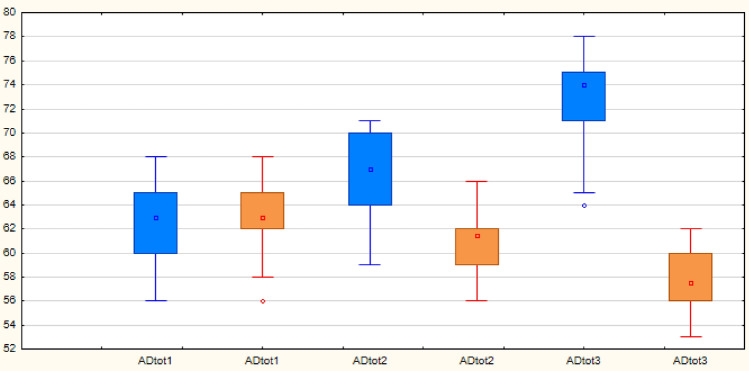
- Initial ACE-R scores were comparable: experimental mean 62.633 (median 63.000) vs control mean 63.133 (median 63.000); final means were 72.900 vs 57.467.
- Repeated-measures ANOVA showed significant within-group changes: experimental F(2,58) = 276.76, p < 0.001, η² = 0.6; control F(2,58) = 136.12, p < 0.001, η² = 0.43.
- The paper also reports use of the Barthel Index and slight improvements in daily activities, but gives no numeric results for that measure.
Methods
- Longitudinal controlled experiment with random assignment; quota/stratified random sampling; 60 analyzed participants (30 experimental, 30 control), aged over 65, at least 4 years since Alzheimer’s diagnosis, more than 1 year in a care facility, and voluntary consent; exclusions included MMSE below 18 and comorbid conditions affecting cognition.
- Experimental group received combined special education and occupational therapy three times weekly for 45–50 min plus facility activities; control group received standard facility care/activities. ACE-R was the primary cognitive outcome, with Barthel Index for functional independence; assessments occurred at initial, control, and final time points.
- Analysis used Shapiro–Wilk normality testing, repeated-measures ANOVA, unpaired t-tests, p-values, post-hoc analysis, and effect sizes; the Abstract states non-parametric methods were used due to non-normal distribution, while the Methods/Results describe parametric tests.
Limitations
- Stated: sample size was 60 vs the power-analysis recommendation of 128, risking reduced power/Type II error; limited duration and follow-up; relatively homogeneous sample limits generalizability; natural disease progression; reliance on ACE-R as the main cognitive measure; possible environmental influences; no cross-over design; and budget/time constraints.
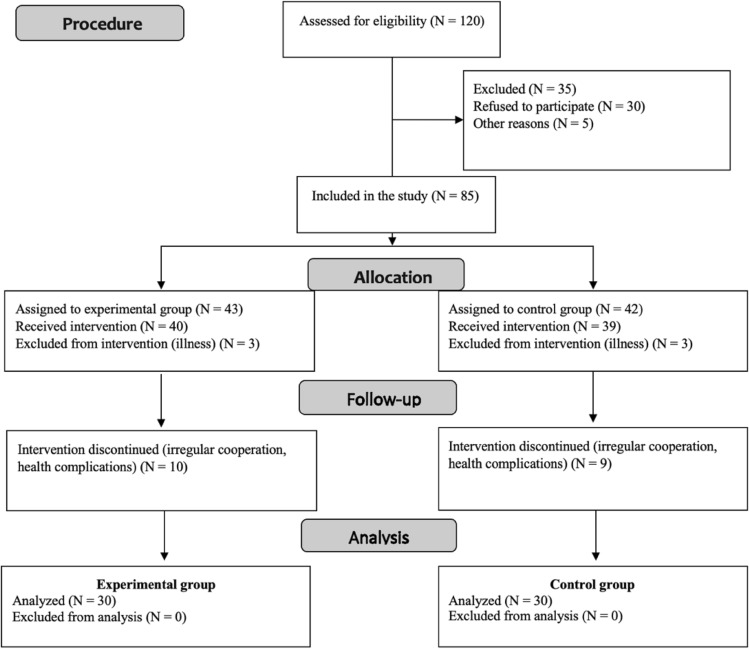
- Evident in the text: timeline/duration inconsistencies (Abstract says eight months; Methods says 6 months; initial testing is dated February 2023 while interventions are dated 2021), sample-flow inconsistencies (120 selected, 43/42 randomized, 40/39 after exclusions, 30/30 analyzed; Table 1 percentages appear based on 40/39), and a mismatch between the Abstract’s non-parametric claim and the parametric R-M ANOVA reported in Results.
Model-written summary. Check it against the paper before relying on it.
Integrity signals
Registry
Cites
Statistics
Figures
Verification
Claims the paper makes
0 Valid · 0 Not valid · 12 Not checked · 85 Own results and interpretations
A result the paper reports from its own data — it cites no other source for it, so there is none to check. The quote shows it is in the paper.
In the paper
“Significant differences are evident in all cases except for the initial assessment.”
§ Effect of combined and intensive rehabilitation on cognitive function in patients with Alzheimer’s disease evaluated through a randomized controlled trial > Results > Hypothesis testing
plain- Asserted: passes — The authors put it forward as true.
- Checkable: passes — It can be checked against evidence.
- Load-bearing: passes — The paper’s conclusions depend on it.
- Based: passes — The paper gives a reason why it holds.
A result the paper reports from its own data — it cites no other source for it, so there is none to check. The quote shows it is in the paper.
In the paper
“Statistical analysis confirmed significant differences between groups at both interim and final assessments (p < 0.001).”
§ Effect of combined and intensive rehabilitation on cognitive function in patients with Alzheimer’s disease evaluated through a randomized controlled trial > Abstract
plainstates an associationn = 60 ·- Asserted: passes — The authors put it forward as true.
- Checkable: passes — It can be checked against evidence.
- Load-bearing: passes — The paper’s conclusions depend on it.
- Based: passes — The paper gives a reason why it holds.
A result the paper reports from its own data — it cites no other source for it, so there is none to check. The quote shows it is in the paper.
In the paper
“The presented results of the cognitive test show a noticeable difference between the experimental and control groups in the final testing.”
- Also stated in: § Hypothesis testing · boosted
“This difference was also confirmed in the final testing (p-level < 0.001).”
§ Effect of combined and intensive rehabilitation on cognitive function in patients with Alzheimer’s disease evaluated through a randomized controlled trial > Results > Hypothesis testing
boostedstates an association- Asserted: passes — The authors put it forward as true.
- Checkable: passes — It can be checked against evidence.
- Load-bearing: passes — The paper’s conclusions depend on it.
- Based: passes — The paper gives a reason why it holds.
- Also stated in: § Hypothesis testing · boosted
A result the paper reports from its own data — it cites no other source for it, so there is none to check. The quote shows it is in the paper.
In the paper
“Differences between the two groups emerge only during the second (ADtot2) and third (ADtot3) testing.”
§ Effect of combined and intensive rehabilitation on cognitive function in patients with Alzheimer’s disease evaluated through a randomized controlled trial > Results > Descriptive statistics
plain- Asserted: passes — The authors put it forward as true.
- Checkable: passes — It can be checked against evidence.
- Load-bearing: passes — The paper’s conclusions depend on it.
- Based: passes — The paper gives a reason why it holds.
A result the paper reports from its own data — it cites no other source for it, so there is none to check. The quote shows it is in the paper.
In the paper
“while the control group showed a mean decrease of 5.67 points (SD = 2.06).”
§ Effect of combined and intensive rehabilitation on cognitive function in patients with Alzheimer’s disease evaluated through a randomized controlled trial > Abstract
plainn = 60- Asserted: passes — The authors put it forward as true.
- Checkable: passes — It can be checked against evidence.
- Load-bearing: passes — The paper’s conclusions depend on it.
- Based: passes — The paper gives a reason why it holds.
29 more claims
Create a free account to see all 97 claims and to verify the 19 references still open.
- It may state two separate claims as one. 35
- Probably not a substantial claim. 43
Statistics recomputed
Every reported test result, recomputed from its test statistic and degrees of freedom. A result shows as not adding up only once an independent check has confirmed it.
- Consistentχ²(2) = 4.981reported p = .083 · recomputed p = .083
“χ2(2) = 4.981, p = .083”
- Consistentχ²(2) = 1.077reported p = .584 · recomputed p = .584
“χ2(2) = 1.077, p = .584”
- ConsistentF(2, 58) = 276.76reported p < .001 · recomputed p < .001
“F(2, 58) = 276.76, p < .001”
- ConsistentF(2, 58) = 136.12reported p < .001 · recomputed p < .001
“F(2, 58) = 136.12, p < .001”
Self-check
Percentages, sums and reported differences re-computed from the paper’s own numbers.
Each contradiction between two passages listed here was confirmed by an independent check.
Rated major: it would touch a result — a value a result rests on, reported and recomputed p-values on opposite sides of the significance level, two passages that conflict with no sign which is right, or a cited work retracted before this paper was published.
In the paper
“The study began with 120 participants, who were selected using quota sampling and then randomly assigned to the experimental (43) and control group (42).”
§ Effect of combined and intensive rehabilitation on cognitive function in patients with Alzheimer’s disease evaluated through a randomized controlled trial > Methodology > Research sample
Reported 120 · recomputed 85
Rated major: it would touch a result — a value a result rests on, reported and recomputed p-values on opposite sides of the significance level, two passages that conflict with no sign which is right, or a cited work retracted before this paper was published.
In the paper
§ Effect of combined and intensive rehabilitation on cognitive function in patients with Alzheimer’s disease evaluated through a randomized controlled trial > Abstract
“Data were analyzed using non-parametric methods due to non-normal data distribution.”
§ Effect of combined and intensive rehabilitation on cognitive function in patients with Alzheimer’s disease evaluated through a randomized controlled trial > Results > Hypothesis testing
“For subsequent analyses, parametric statistical methods will be used, primarily because these tests are appropriate due to their higher statistical power.”
Rated major: it would touch a result — a value a result rests on, reported and recomputed p-values on opposite sides of the significance level, two passages that conflict with no sign which is right, or a cited work retracted before this paper was published.
In the paper
§ Effect of combined and intensive rehabilitation on cognitive function in patients with Alzheimer’s disease evaluated through a randomized controlled trial > Methodology > Research sample
“The final analysis included 30 participants from each group.”
§ Effect of combined and intensive rehabilitation on cognitive function in patients with Alzheimer’s disease evaluated through a randomized controlled trial > Methodology > Research sample
“| Women | 37 (93.0) | 37 (95.0) |”
Rated minor: it would not touch a result — a value no result rests on, a p-value that stays on the same side of the significance level, or a conflict that is clerical, resolved elsewhere in the paper, or outside its own findings.
In the paper
§ Effect of combined and intensive rehabilitation on cognitive function in patients with Alzheimer’s disease evaluated through a randomized controlled trial > Results > Descriptive statistics
“The same conclusion would be reached using the mean values (Meanexp = 63.133, Meancon = 63.133).”
§ Effect of combined and intensive rehabilitation on cognitive function in patients with Alzheimer’s disease evaluated through a randomized controlled trial > Results
“| ADtot1 | 30 | 62,633 | 63,000 | 56,000 | 68,000 | 3,337 |”
Rated minor: it would not touch a result — a value no result rests on, a p-value that stays on the same side of the significance level, or a conflict that is clerical, resolved elsewhere in the paper, or outside its own findings.
In the paper
§ Effect of combined and intensive rehabilitation on cognitive function in patients with Alzheimer’s disease evaluated through a randomized controlled trial > Results
“The highest score, 17 points, was achieved by one participant. Fifteen other participants improved their scores by more than 10 points.”
§ Effect of combined and intensive rehabilitation on cognitive function in patients with Alzheimer’s disease evaluated through a randomized controlled trial > Results
“| ADdif ─ experiment | 30 | 10,267 | 10,000 | 5,000 | 17,000 | 2,828 |”
6 more findings
Create a free account to see every finding of this check.
Citations
Cites
The Montreal Cognitive Assessment, MoCA: a brief screening tool for mild cognitive impairment
Nasreddine, Z. S., Phillips, N. A., Bédirian, V., Charbonneau, S., Whitehead, V., Collin, I., Cummings, J. L., & Chertkow, H. (2005) · Journal of the American Geriatrics Society · doi:10.1111/j.1532-5415.2005.53221.x · Cited by 25,553
Mioshi, E., Dawson, K., Mitchell, J., Arnold, R., & Hodges, J. R. (2006) · International Journal of Geriatric Psychiatry · doi:10.1002/gps.1610 · Cited by 2,016
Dementia: a public health priority
Acosta, D. M., Krishnamoorthy, E. S., Wortmann, M., Prince, M. J., & Saxena, S. (2012) · Cited by 1,955
Clare, L., & Woods, B. (2003) · Cochrane Database of Systematic Reviews · doi:10.1002/14651858.cd003260 · Cited by 576
Influence of combined physical and cognitive training on cognition: a systematic review
Lauenroth, A., Ioannidis, A. E., & Teichmann, B. (2016) · BMC Geriatrics · doi:10.1186/s12877-016-0315-1 · Cited by 345
Sherman, D. S., Mauser, J., Nuno, M., & Sherzai, D. (2017) · Neuropsychology Review · doi:10.1007/s11065-017-9363-3 · Cited by 281
Lindberg, B., Nilsson, C., Zotterman, D., Söderberg, S., & Skär, L. (2013) · International Journal of Telemedicine and Applications · doi:10.1155/2013/461829 · Cited by 235
Music and the wellbeing of people with dementia
Sixsmith, A. J., & Gibson, G. (2006) · Ageing and Society · doi:10.1017/s0144686x06005228 · Cited by 196 · cited 2×
“Cognitive functions are weakened by the disease, leading gradually to immobility and permanent bed confinement with 24 care by others.”
The incidence of mild cognitive impairment: A systematic review and data synthesis
Gillis, C., Mirzaei, F., Potashman, M., Ikram, M. A., & Maserejian, N. (2019) · Alzheimer's & Dementia: Diagnosis, Assessment & Disease Monitoring · doi:10.1016/j.dadm.2019.01.004 · Cited by 191
Cited by
Vostrý, M., Binter, J., Kovářová, K., Posel, Z., Kubová, N., Cmorej, P. C., & Kroufek, R. (2026) · Scientific Reports · doi:10.1038/s41598-026-60446-5
Self-citation
Metadata
- Authors
- Vostrý, M., Chytrý, V., Cmorej, P. C., Fleischmann, O., & Kubová, N.
- Affiliations
- Jan Evangelista Purkyně University in Ústí nad Labem (CZ)
- Corresponding author
- Vostrý, Michal
- Venue
- Scientific Reports
- Published
- 2025-03-08
- Volume
- 15
- Issue
- 1
- Pages
- 8110-8110
- ISSN
- 2045-2322 (ISSN-L)
- PMC
- PMC11890615
- OpenAlex
- W4408257123
- Semantic Scholar
- b07fa22a4552dedc12fd3204338d8711c3d48adc
- Cited by
- 1
- References
- 39
- Citations by year
- 2026: 1
- FWCI
- 0.40
- Type
- journal article
- Language
- en
- Open access
- gold
- doi.org
- Licence
- cc-by
- creativecommons.org/licenses/by/4.0 (tdm)
- creativecommons.org/licenses/by/4.0 (vor)
- Locations
- Scientific Reports (publishedVersion, cc-by)
- PubMed Central (publishedVersion, cc-by)
- Europe PMC (PubMed Central) (publishedVersion, cc-by)
- PubMed (publishedVersion)
- DOAJ (DOAJ: Directory of Open Access Journals) (submittedVersion)
- Funders
- Jan Evangelista Purkyně University in Ústí nad Labem, Faculty of Health Studies, Czech Republic (2023/19.10.1358)
- Topics
- Health Sciences › Medicine › Psychiatry and Mental health › Dementia and Cognitive Impairment Research
- Health Sciences › Health Professions › Occupational Therapy › Occupational Therapy Practice and Research
- Social Sciences › Psychology › Experimental and Cognitive Psychology › Cognitive Functions and Memory
- Keywords
- Alzheimer's disease, cognitive rehabilitation, special education, occupational therapy, cognitive function, Addenbrooke's Cognitive Examination-Revised, dementia care
- MeSH terms
- Aged, Aged, 80 and over, Alzheimer Disease, Cognition, Female, Humans, Longitudinal Studies, Male, Middle Aged, Occupational Therapy, Treatment Outcome
About these checks
Registry, retraction, Cites and statistics results are computed, not judged, with one exception: a printed reference that no index lists is read once by a model before it counts as a citation error. Claims are extracted by a model and kept only when their quote appears verbatim in the text; each cited source is then checked, with a model’s help, for whether it says what the claim relies on. Those verdicts can be wrong — read the claim’s quote and the cited source before relying on one.
A language model drew the claims from the paper on 2026-11-27, under version 3 of the claim definition (model deepseek-v4.1-flash, prompt extract-v3).
A second model labelled each claim on 2026-11-27 (model jev-1.13-20260917, definition revision gold-guideline-v0.2).
Statistics and arithmetic are recomputed, not judged.
Confidence bands are shown only for fields calibrated on our annotated test set. None is calibrated yet, so no band is shown.
What counts as a claim ›How we measure confidence ›How we check this ›
Are you an author, or do you see a problem with this page? Request a review
Data sources
Bibliographic data: Semantic Scholar, OpenAlex, Crossref.
Contains information from the Semantic Scholar Academic Graph Datasets, made available under the ODC Attribution License (ODC-BY 1.0).
Semantic Scholar’s data is described in: Kinney, R., et al. (2023). The Semantic Scholar Open Data Platform. arXiv:2301.10140.
