

The DOI matches its Crossref record; 54 of the 54 references it cites were found in a registry or an index; none of the 39 sources its claims cite is checked for support yet.
Association between long-term exercise with different osteogenic index, dietary patterns, body composition, biological factors, and bone mineral density in female elite masters athletes
Open accessAbstract
This study evaluated the association between long-term exercise with different osteogenic index, dietary patterns, body composition, biological factors, and bone mineral density (BMD) in 199 female elite masters athletes endurance athletes (EA), speed-power athletes (SPA), and throwing athletes (TA). Bone parameters in the distal (dis) and proximal (prox) parts of the forearm were measured by densitometry. Body compositions were analyzed using bioelectrical impedance analysis. Biological factors and lifetime bone fracture status were rated via face-to-face interviews. Dietary patterns and usual dietary intake were assessed using a semiquantitative NHANES Food Frequency Questionnaire. In female elite masters athletes the main parameters affecting BMD dis were age at menopause (small effect: η² = 0.03), number of fractures (small effect: η² = 0.05), number of dairy products per day (small effect: η² = 0.05), type of dietary pattern (small effect: η² = 0.04) and sport competition, type by OI (small effect: η² = 0.03). BMD prox was affected by age at menarche (medium effect: η² = 0.096), age at menopause (large effect: η² = 0.12), past fractures (small effect: η² = 0.02), dairy product (large effect: η² = 0.13), type of dietary pattern (small effect: η² = 0.04) and sports competition (medium effect: η² = 0.06). In both groups of women, EA and SPA dietary pattern with high intake of fruit, vegetables, dairy products, whole grains, poultry, fish, nuts, and legumes had a greater mean BMD. In contrast, in the TA group dietary pattern with lactose-free, and gluten-free determined higher mean BMD. Late menarche determined higher mean BMD in all groups of women, especially in TA. Physical activity helps maintain bone mineralization during aging. The long-term effects of athletic training, especially exercises such as throwing, have been confirmed in these studies. It is therefore worth considering popularizing these exercises for healthy aging.
Overview
CoChat Summary
TL;DR
This cross-sectional study of 199 female elite masters athletes found that forearm bone mineral density and content differed by sport type, with throwing athletes showing higher bone parameters than endurance and speed-power athletes. Biological factors, dairy intake, dietary pattern, fractures, and sport category were associated with forearm BMD, with dietary pattern interactions differing between athlete groups.
Key findings
- Throwing athletes (TA) had significantly greater bone parameters than endurance athletes (EA) and speed-power athletes (SPA): BMD distal was 0.371 ± 0.09 vs 0.302 ± 0.06 and 0.305 ± 0.07 g/cm²; BMD proximal was 0.746 ± 0.14 vs 0.685 ± 0.12 and 0.682 ± 0.11 g/cm².
- In ANCOVA, BMD proximal was affected by age at menarche (medium effect: η² = 0.096), age at menopause (large effect: η² = 0.12), past fractures (small effect: η² = 0.02), dairy product intake (large effect: η² = 0.13), dietary pattern type (small effect: η² = 0.04), and sport competition type by osteogenic index (medium effect: η² = 0.06); BMD distal was affected by age at menopause (η² = 0.03), fractures (η² = 0.05), dairy products per day (η² = 0.05), dietary pattern (η² = 0.04), and sport competition (η² = 0.03).
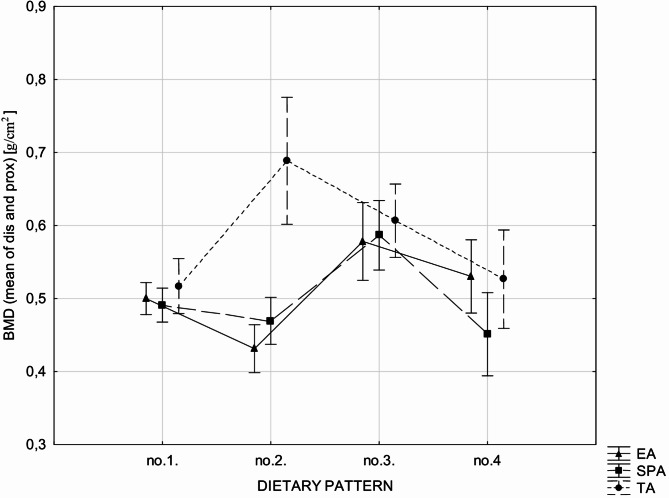
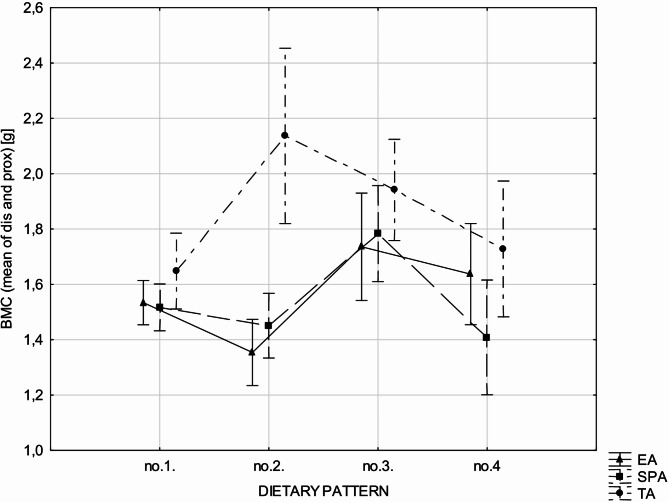
- In EA and SPA, dietary pattern no. 3 (high intake of fruit, vegetables, dairy products, whole grains, poultry, fish, nuts, and legumes) had greater mean BMD and BMC; in TA, dietary pattern no. 2 (lactose-free, gluten-free) determined higher mean BMD and BMC. Late menarche determined higher mean BMD in all groups, especially TA.
- The desired proximal forearm BMD value (T-score −1.0 or above) occurred significantly more often in TA than in EA by 22.3% and SPA by 30.4%.
Methods
- Cross-sectional study of 199 women aged 57.6 ± 11.2 years, elite masters athletes at the World Masters Athletics Indoor Championships (Torun 2023) and European Masters Athletics Championships Indoor (Torun 2024), divided into endurance athletes (EA), speed-power athletes (SPA), and throwing athletes (TA).
- Forearm BMC, BMD, and T-score were measured by dual-energy X-ray absorptiometry at distal and proximal regions of interest; body composition was analyzed by bioelectrical impedance analysis; biological factors and lifetime fracture status were collected by face-to-face interviews; dietary intake and patterns were assessed using a semiquantitative NHANES Food Frequency Questionnaire and factor/cluster analysis into four dietary patterns.
- Analyses included ANOVA with Bonferroni post hoc tests, chi-square tests, ANCOVA with age as a continuous variable, and two-way ANOVA; effect sizes were calculated as eta-squared (η²), with VIF, White, and Durbin-Watson tests also reported; statistical significance was set at α < 0.01 and α < 0.001.
Limitations
- The paper states a relatively small number of female athletes studied after participating in sports competition, notes that BMD accounts for almost 70% of bone strength with bone quality accounting for the remaining 30%, and says the study’s homogeneity (Caucasian, European origin) limits applicability to broader populations; exclusion criteria may also restrict results to specific athlete groups.
- Evident from the text: the cross-sectional design cannot establish causality, dietary and biological data relied on self-reported interviews/FFQ, and bone outcomes were measured only at the forearm rather than other skeletal sites.
Model-written summary. Check it against the paper before relying on it.
Integrity signals
Registry
Cites
Statistics
Figures
Verification
Claims the paper makes
0 Valid · 4 Not valid · 21 Not checked · 89 Own results and interpretations
A result the paper reports from its own data — it cites no other source for it, so there is none to check. The quote shows it is in the paper.
In the paper
“This study had significant interactions of sport competition category and type of dietary pattern with BMD and BMC.”
§ Association between long-term exercise with different osteogenic index, dietary patterns, body composition, biological factors, and bone mineral density in female elite masters athletes > Discussion > Interactions of sport competition category and type of dietary pattern with BMD and BMC
plainstates an association- Asserted: passes — The authors put it forward as true.
- Checkable: passes — It can be checked against evidence.
- Load-bearing: passes — The paper’s conclusions depend on it.
- Based: passes — The paper gives a reason why it holds.
A result the paper reports from its own data — it cites no other source for it, so there is none to check. The quote shows it is in the paper.
In the paper
“The results of the covariance analyses between BMC dis and selected parameters indicated that in the case of masters athletes women, the main parameters affecting BMC dis were age at menarche (small effect: η² = 0.04), age at menopause (small effect: η² = 0.05), past fractures (small effect: η² = 0.05), dairy product (medium effect: η² = 0.06), type of dietary pattern (small effect: η² = 0.04) and”
§ Association between long-term exercise with different osteogenic index, dietary patterns, body composition, biological factors, and bone mineral density in female elite masters athletes > Results > Relationships between BMD, BMC and exercise with different OI, dietary patterns, body compositions, and biological factors
hedgedstates a cause- Asserted: passes — The authors put it forward as true.
- Checkable: passes — It can be checked against evidence.
- Load-bearing: passes — The paper’s conclusions depend on it.
- Based: passes — The paper gives a reason why it holds.
A result the paper reports from its own data — it cites no other source for it, so there is none to check. The quote shows it is in the paper.
In the paper
“In contrast, in the TA group dietary pattern with lactose-free, and gluten-free determined higher mean BMD.”
§ Association between long-term exercise with different osteogenic index, dietary patterns, body composition, biological factors, and bone mineral density in female elite masters athletes > Abstract
plainstates an association- Asserted: passes — The authors put it forward as true.
- Checkable: passes — It can be checked against evidence.
- Load-bearing: passes — The paper’s conclusions depend on it.
- Based: passes — The paper gives a reason why it holds.
A result the paper reports from its own data — it cites no other source for it, so there is none to check. The quote shows it is in the paper.
In the paper
“The TA group had significantly greater body mass (large effect; η2 = 0.50), body height (medium effect; η2 = 0.10), BMI (large effect; η2 = 0.42), FM (large effect; η2 = 0.51), PBF (large effect; η2 = 0.34) and FFM (large effect; η2 = 0.31) than did the EA and SPA groups.”
§ Association between long-term exercise with different osteogenic index, dietary patterns, body composition, biological factors, and bone mineral density in female elite masters athletes > Results > Comparison of somatic, bone, and biological characteristics between EA, SPA and TA
plainstates an association- Asserted: passes — The authors put it forward as true.
- Checkable: passes — It can be checked against evidence.
- Load-bearing: unclear — It is unclear whether the paper’s conclusions depend on it.
- Based: passes — The paper gives a reason why it holds.
A result the paper reports from its own data — it cites no other source for it, so there is none to check. The quote shows it is in the paper.
In the paper
“The results of the covariance analyses between BMC dis and selected parameters indicated that in the case of masters athletes women, the main parameters affecting BMC dis were age at menarche (small effect: η² = 0.04), age at menopause (small effect: η² = 0.05), past fractures (small effect: η² = 0.05), dairy product (medium effect: η² = 0.06), type of dietary pattern (small effect: η² = 0.04) and”
§ Association between long-term exercise with different osteogenic index, dietary patterns, body composition, biological factors, and bone mineral density in female elite masters athletes > Results > Relationships between BMD, BMC and exercise with different OI, dietary patterns, body compositions, and biological factors
plainstates an association- Asserted: passes — The authors put it forward as true.
- Checkable: passes — It can be checked against evidence.
- Load-bearing: unclear — It is unclear whether the paper’s conclusions depend on it.
- Based: passes — The paper gives a reason why it holds.
63 more claims
Create a free account to see all 114 claims and to verify the 37 references still open.
- It may state two separate claims as one. 15
- The quote only partly states this claim. 1
- Probably not a substantial claim. 38
Self-check
Percentages, sums and reported differences re-computed from the paper’s own numbers.
Each contradiction between two passages listed here was confirmed by an independent check.
Rated major: it would touch a result — a value a result rests on, reported and recomputed p-values on opposite sides of the significance level, two passages that conflict with no sign which is right, or a cited work retracted before this paper was published.
In the paper
§ Association between long-term exercise with different osteogenic index, dietary patterns, body composition, biological factors, and bone mineral density in female elite masters athletes > Results > Relationships of sport competition category and age at menarche category with BMD and BMC
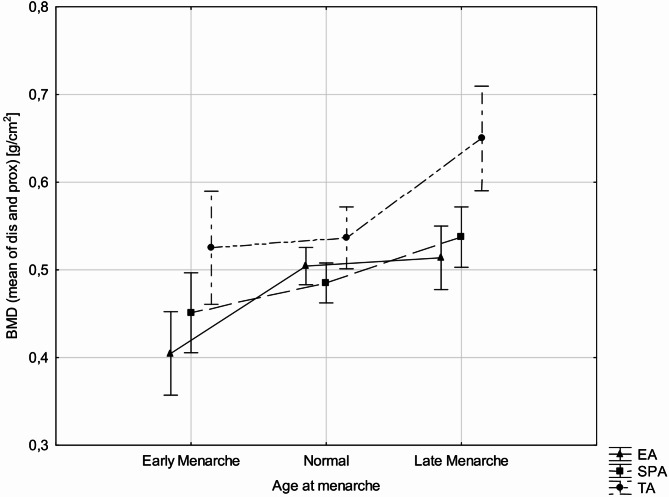
“Figure 3 presents the relationships between the sports competition category and age at menarche category and BMD (mean dis and prox), (two-way ANOVA results) of the women studied. There were clear significant interactions between the variables studied.”
§ Association between long-term exercise with different osteogenic index, dietary patterns, body composition, biological factors, and bone mineral density in female elite masters athletes > Results > Relationships of sport competition category and age at menarche category with BMD and BMC
“Figure: Fig. 3 Relationships of sport competition category and age at menarche category with BMD (mean dis and prox), (results two-way ANOVA; F = 2.4106; p = 0.0506; η2 = 0.05; vertical lines − 0.95 CI - confidence intervals).”
Rated minor: it would not touch a result — a value no result rests on, a p-value that stays on the same side of the significance level, or a conflict that is clerical, resolved elsewhere in the paper, or outside its own findings.
In the paper
§ Association between long-term exercise with different osteogenic index, dietary patterns, body composition, biological factors, and bone mineral density in female elite masters athletes > Results > Relationships between BMD, BMC and exercise with different OI, dietary patterns, body compositions, and biological factors
“sport competition (medium effect: η² = 0.03)”
§ Association between long-term exercise with different osteogenic index, dietary patterns, body composition, biological factors, and bone mineral density in female elite masters athletes > Methods > Statistical analysis
“small effect: <0.06; medium effect: 0.06–0.14; large effect: >0.14”
Rated minor: it would not touch a result — a value no result rests on, a p-value that stays on the same side of the significance level, or a conflict that is clerical, resolved elsewhere in the paper, or outside its own findings.
In the paper
§ Association between long-term exercise with different osteogenic index, dietary patterns, body composition, biological factors, and bone mineral density in female elite masters athletes > Results > Relationships between BMD, BMC and exercise with different OI, dietary patterns, body compositions, and biological factors
“| Age at menopause (year) | 6.590 (0.011)**0.034”
§ Association between long-term exercise with different osteogenic index, dietary patterns, body composition, biological factors, and bone mineral density in female elite masters athletes > Results > Relationships between BMD, BMC and exercise with different OI, dietary patterns, body compositions, and biological factors
“Significant differences: *p ≤ 0.05, **p ≤ 0.01 and ***p ≤ 0.001.”
Rated minor: it would not touch a result — a value no result rests on, a p-value that stays on the same side of the significance level, or a conflict that is clerical, resolved elsewhere in the paper, or outside its own findings.
In the paper
§ Association between long-term exercise with different osteogenic index, dietary patterns, body composition, biological factors, and bone mineral density in female elite masters athletes > Results > Comparison of somatic, bone, and biological characteristics between EA, SPA and TA
“TA significantly increased the BMD dis (medium effect; η2 = 0.42), BMC dis (medium effect; η2 = 0.06), T-score dis (small effect; η2 = 0.03)”
§ Association between long-term exercise with different osteogenic index, dietary patterns, body composition, biological factors, and bone mineral density in female elite masters athletes > Results > Comparison of somatic, bone, and biological characteristics between EA, SPA and TA
“| T-score dis R + U | -0.788 ± 0.94 | -0.789 ± 1.06 | -0.308 ± 0.85 | 1v3, 2v3 | 3.34 (0.037)0.03 |”
Rated minor: it would not touch a result — a value no result rests on, a p-value that stays on the same side of the significance level, or a conflict that is clerical, resolved elsewhere in the paper, or outside its own findings.
In the paper
§ Association between long-term exercise with different osteogenic index, dietary patterns, body composition, biological factors, and bone mineral density in female elite masters athletes > Results > Relationships of sport competition category and age at menarche category with BMD and BMC
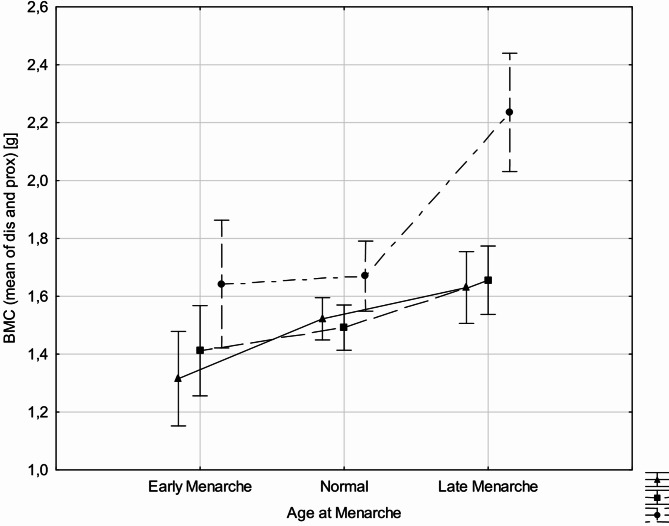
“In all groups of women TA, EA and SPA late menarche determined higher mean BMD, especially in TA (Fig. 4).”
§ Association between long-term exercise with different osteogenic index, dietary patterns, body composition, biological factors, and bone mineral density in female elite masters athletes > Results > Relationships of sport competition category and age at menarche category with BMD and BMC
“Figure: Fig. 4 Relationships of sport competition category and age at menarche category with BMC (mean dis and prox)”
3 more findings
Create a free account to see every finding of this check.
Citations
Cites
Food synergy: an operational concept for understanding nutrition
Jacobs, D. R., Gross, M. D., & Tapsell, L. C. (2009) · The American Journal of Clinical Nutrition · doi:10.3945/ajcn.2009.26736b · Cited by 660
Grissom, R. J., & Kim, J. J. (2012) · doi:10.4324/9780203803233 · Cited by 470
Pinheiro, M. B., Oliveira, J., Bauman, A., Fairhall, N., Kwok, W., & Sherrington, C. (2020) · International Journal of Behavioral Nutrition and Physical Activity · doi:10.1186/s12966-020-01040-4 · Cited by 431
The Effectiveness of Physical Exercise on Bone Density in Osteoporotic Patients
Benedetti, M. G., Furlini, G., Zati, A., & Letizia Mauro, G. (2018) · BioMed Research International · doi:10.1155/2018/4840531 · Cited by 395
Effects of Training on Bone Mass in Older Adults: A Systematic Review
Gómez-Cabello, A., Ara, I., González-Agüero, A., Casajús, J. A., & Vicente-Rodríguez, G. (2012) · Sports Medicine · doi:10.2165/11597670-000000000-00000 · Cited by 336
Lewiecki, E. M., Binkley, N., Morgan, S. L., Shuhart, C. R., Camargos, B. M., Carey, J. J., Gordon, C. M., Jankowski, L. G., Lee, J.-K., & Leslie, W. D. (2016) · Journal of Clinical Densitometry · doi:10.1016/j.jocd.2016.03.003 · Cited by 334
Bone mineral density and dietary patterns in older adults: the Framingham Osteoporosis Study,,
Tucker, K. L., Chen, H., Hannan, M. T., Cupples, L. A., Wilson, P. W., Felson, D., & Kiel, D. P. (2002) · The American Journal of Clinical Nutrition · doi:10.1093/ajcn/76.1.245 · Cited by 279
Nutrients and Dietary Patterns Related to Osteoporosis
Muñoz-Garach, A., García-Fontana, B., & Muñoz-Torres, M. (2020) · Nutrients · doi:10.3390/nu12071986 · Cited by 260
Interactions between Muscle and Bone—Where Physics Meets Biology
Herrmann, M., Engelke, K., Ebert, R., Müller-Deubert, S., Rudert, M., Ziouti, F., Jundt, F., Felsenberg, D., & Jakob, F. (2020) · Biomolecules · doi:10.3390/biom10030432 · Cited by 197
Daly, R. M., Rosengren, B. E., Alwis, G., Ahlborg, H. G., Sernbo, I., & Karlsson, M. K. (2013) · BMC Geriatrics · doi:10.1186/1471-2318-13-71 · Cited by 192
Research works printed but not linked: 2
- Kopiczko, A. Factors affecting bone mineral density in young athletes of different disciplines: a cross-sectional study. Arch. Budo Sci. Martial Art Extreme Sport 19, 75–84 (2023).
- Hall, J. G., Allanson, J. E., Gripp, K. W. & Slavotinek, A. M. Handbook of Physical Measurements (Oxford University Press, 2007).
Cited by
Dietary Patterns and Nutritional Status of Polish Elite Athletes
Tyrała, F., & Frączek, B. (2025) · Nutrients · doi:10.3390/nu17162685 · Cited by 4
Pinheiro, J. C. D. S. M., Costa, A., Pedrosa, P., & Marques-Vieira, C. M. A. (2026) · International Journal of Orthopaedic and Trauma Nursing · doi:10.1016/j.ijotn.2026.101258 · Cited by 3
Zhang, Y., Huang, L., Li, M., Yang, P., Cheng, L., Yang, H., Lu, S., & Zhang, J. (2025) · Regenerative medicine reports . · doi:10.4103/regenmed.regenmed-d-25-00016 · Cited by 2
Dovgan, R. R., & Масна, З. З. (2025) · Morphologia · doi:10.26641/1997-9665.2025.3.65-72
Адамович, О. О., Довган, Р. Р., Согуйко, Р. Р., Рудницька, Х. І., Орел, М. Г., & Масна, З. З. (2025) · Bulletin of Problems Biology and Medicine · doi:10.29254/2523-4110-2025-4-179/addition-15-17
Farinatti, P. A. D. A., Sousa, C., Zacca, R., Ávila-Carvalho, L., Mota, J. A. P. S., Monteiro, I., Carvalho, J., da Silva, N. S. L., & Farinatti, P. (2026) · International Journal of Environmental Research and Public Health · doi:10.3390/ijerph23020159
Metadata
- Authors
- Kopiczko, A., Bałdyka, J., Adamczyk, J. G., Nyrć, M., & Gryko, K.
- Affiliations
- Józef Piłsudski University of Physical Education in Warsaw (PL)
- Corresponding author
- Kopiczko, Anna
- Venue
- Scientific Reports
- Published
- 2025-03-17
- Volume
- 15
- Issue
- 1
- Pages
- 9167-9167
- ISSN
- 2045-2322 (ISSN-L)
- PMC
- PMC11914273
- OpenAlex
- W4408524584
- Semantic Scholar
- 7dab508587b844cc5b5baaa9d9f2e75c4302882d
- Cited by
- 6
- References
- 54
- Citations by year
- 2026: 2 · 2025: 4
- FWCI
- 4.22
- Type
- journal article
- Language
- en
- Open access
- gold
- doi.org
- Licence
- cc-by-nc-nd
- creativecommons.org/licenses/by-nc-nd/4.0 (tdm)
- creativecommons.org/licenses/by-nc-nd/4.0 (vor)
- Locations
- Scientific Reports (publishedVersion, cc-by-nc-nd)
- PubMed Central (publishedVersion, cc-by-nc-nd)
- PubMed (publishedVersion)
- DOAJ (DOAJ: Directory of Open Access Journals) (submittedVersion, cc-by-sa)
- Topics
- Health Sciences › Medicine › Orthopedics and Sports Medicine › Bone health and osteoporosis research
- Health Sciences › Medicine › Public Health, Environmental and Occupational Health › Physical Activity and Health
- Health Sciences › Medicine › Orthopedics and Sports Medicine › Sports Performance and Training
- Keywords
- bone mineral density, endurance athletes, throwing athletes, dietary habits, dairy consumption, age at menarche, age at menopause, bone fractures, body composition, forearm bones, healthy aging
- MeSH terms
- Adult, Body Composition, Diet, Female, Humans, Middle Aged, Osteogenesis, Exercise, Bone Density, Athletes
About these checks
Registry, retraction, Cites and statistics results are computed, not judged, with one exception: a printed reference that no index lists is read once by a model before it counts as a citation error. Claims are extracted by a model and kept only when their quote appears verbatim in the text; each cited source is then checked, with a model’s help, for whether it says what the claim relies on. Those verdicts can be wrong — read the claim’s quote and the cited source before relying on one.
A language model drew the claims from the paper on 2026-11-14, under version 3 of the claim definition (model deepseek-v4.1-flash, prompt extract-v3).
A second model labelled each claim on 2026-11-14 (model jev-1.13-20260917, definition revision gold-guideline-v0.2).
Statistics and arithmetic are recomputed, not judged.
Confidence bands are shown only for fields calibrated on our annotated test set. None is calibrated yet, so no band is shown.
What counts as a claim ›How we measure confidence ›How we check this ›
Are you an author, or do you see a problem with this page? Request a review
Data sources
Bibliographic data: Semantic Scholar, OpenAlex, Crossref.
Contains information from the Semantic Scholar Academic Graph Datasets, made available under the ODC Attribution License (ODC-BY 1.0).
Semantic Scholar’s data is described in: Kinney, R., et al. (2023). The Semantic Scholar Open Data Platform. arXiv:2301.10140.
