

Accelerated global burden of depressive disorders during the COVID-19 pandemic from 2019 to 2021
Open accessThe DOI matches its Crossref record; 42 of the 42 references it cites were found in a registry or an index.
Abstract
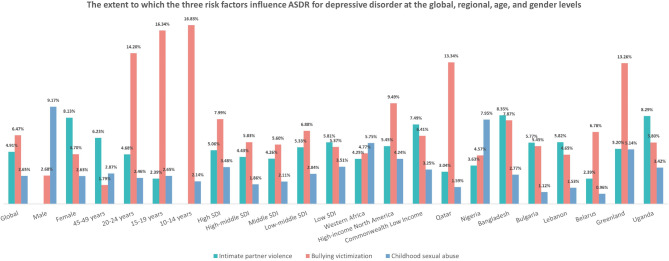
A thorough and current analysis of the burden and evolving trends in depressive disorders during the COVID-19 pandemic from 2019 to 2021 remains unavailable. Employing the Global Burden of Disease (GBD) 2021 database, we evaluated the burden of depressive disorders at the global, regional, and national levels, stratifying the analysis by age, gender, and socio-demographic index (SDI). To examine trends in depressive disorders during the epidemic, we calculated the estimated annual percentage change (EAPC) in age-standardized incidence rates (ASIR), age-standardized prevalence rates (ASPR), and age-standardized DALYs rates (ASDR) across all levels from 2019 to 2021. Furthermore, we performed a frontier analysis of depressive disorders across various countries, incorporating risk factor analyses at multiple levels. In 2021, the global incidence of depressive disorders stood at 357.43 million, while the prevalence was recorded at 332.41 million, accompanied by 56.33 million disability-adjusted life years (DALYs). Throughout the COVID-19 pandemic, there was a notable upward trend in ASIR (EAPC = 8.33 [-0.46 to 17.9]), ASPR (EAPC = 6.02 [0.28 to 12.09]), and ASDR (EAPC = 7.13 [-0.18 to 14.97]) for depressive disorders on a global scale. The burden of depressive disorders is most pronounced among females and individuals aged 60 to 64 within their respective subgroups. From 1990 to 2021, the burden of depressive disorders consistently remained highest in the low SDI region; however, it experienced the most significant increase in the high SDI region during the COVID-19 pandemic from 2019 to 2021. In 2021, the burden of depressive disorders was highest in central sub-Saharan Africa, Greenland, and Uganda, while the Andean region of Latin America, along with Bulgaria and Belarus, experienced the most significant increase in depressive disorders during the COVID-19 pandemic. Globally, bullying victimization, intimate partner violence, and childhood sexual abuse contributed to 6.47%, 4.91%, and 2.65% of the ASDR for depressive disorders, respectively. The global burden of depressive disorders has markedly increased during the COVID-19 pandemic, gradually shifting from low to high SDI regions, particularly in North America and Europe.
Overview
The claims and statistics of this paper haven’t been checked yet.
Free: it reads the open-access text and checks the first 5 claims that cite a source we can check. Create a free account to check every claim.
Integrity signals
Registry
Cites
Statistics
Figures
Verification
Claims the paper makes
The claims and statistics of this paper haven’t been checked yet.
Free: it reads the open-access text and checks the first 5 claims that cite a source we can check. Create a free account to check every claim.
Self-check
Percentages, sums and reported differences re-computed from the paper’s own numbers.
The self-check needs the paper’s full text.
Citations
Cites
Murray, C. J. L., Aravkin, A. Y., Zheng, P., Abbafati, C., Abbas, K. M., Abbasi-Kangevari, M., Abd-Allah, F., Abdelalim, A., Abdollahi, M., Abdollahpour, I., et al. (2020) · The Lancet · doi:10.1016/s0140-6736(20)30752-2 · Cited by 9,854 · cited 1×
“Additionally, the GBD 2021 study employed the Bayesian meta-regression tool, DisMod-MR 2.1, as the principal methodology, ensuring consistency in the incidence, prevalence, and DALYs across all diseases 11,12 .”
InfluentialSelf-citationSantomauro, D. F., Mantilla Herrera, A. M., Shadid, J., Zheng, P., Ashbaugh, C., Pigott, D. M., Abbafati, C., Adolph, C., Amlag, J. O., Aravkin, A. Y., et al. (2021) · The Lancet · doi:10.1016/s0140-6736(21)02143-7 · Cited by 5,444
Ferrari, A. J., Santomauro, D. F., Aali, A., Abate, Y. H., Abbafati, C., Abbastabar, H., Abd ElHafeez, S., Abdelmasseh, M., Abd-Elsalam, S., Abdollahi, A., et al. (2024) · The Lancet · doi:10.1016/s0140-6736(24)00757-8 · Cited by 5,112
Self-citationMalhi, G. S., & Mann, J. J. (2018) · The Lancet · doi:10.1016/s0140-6736(18)31948-2 · Cited by 4,099
Age of onset of mental disorders: a review of recent literature
Kessler, R. C., Amminger, G. P., Aguilar-Gaxiola, S., Alonso, J., Lee, S., & ??st??n, T. B. (2007) · Current Opinion in Psychiatry · doi:10.1097/yco.0b013e32816ebc8c · Cited by 3,457
The Epidemiology of Depression Across Cultures
Kessler, R. C., & Bromet, E. J. (2013) · Annual Review of Public Health · doi:10.1146/annurev-publhealth-031912-114409 · Cited by 2,657
Why is depression more common among women than among men?
Kuehner, C. (2017) · The Lancet Psychiatry · doi:10.1016/s2215-0366(16)30263-2 · Cited by 1,752
Depression and cardiovascular disease: a clinical review
Hare, D. L., Toukhsati, S. R., Johansson, P., & Jaarsma, T. (2014) · European Heart Journal · doi:10.1093/eurheartj/eht462 · Cited by 1,362
Estrogen Actions in the Central Nervous System1
McEwen, B. S., & Alves, S. E. (1999) · Endocrine Reviews · doi:10.1210/edrv.20.3.0365 · Cited by 1,358 · cited 1×
“In female physiology, estrogen plays a crucial role in mood regulation by modulating neurotransmitter turnover and enhancing serotonergic activity 21 .”
Avenevoli, S., Swendsen, J., He, J.-P., Burstein, M., & Merikangas, K. R. (2015) · Journal of the American Academy of Child & Adolescent Psychiatry · doi:10.1016/j.jaac.2014.10.010 · Cited by 1,202
Mental health: a world of depression
Smith, K. (2014) · Nature · doi:10.1038/515180a · Cited by 1,148
Findings from the Global Burden of Disease Study 2021
Murray, C. J. L. (2024) · The Lancet · doi:10.1016/s0140-6736(24)00769-4 · Cited by 1,057
Lei, L., Huang, X., Zhang, S., Yang, J., Yang, L., & Xu, M. (2020) · Medical Science Monitor · doi:10.12659/msm.924609 · Cited by 871 · cited 2×
“Additionally, reduced interpersonal contact and disrupted information flow during isolation made individuals more susceptible to feelings of loneliness, which in turn contributed to an increase in depressive disorders 9 .”
Bhattacharjee, N. V., Schumacher, A. E., Aali, A., Abate, Y. H., Abbasgholizadeh, R., Abbasian, M., Abbasi-Kangevari, M., Abbastabar, H., Abd ElHafeez, S., Abd-Elsalam, S., et al. (2024) · The Lancet · doi:10.1016/s0140-6736(24)00550-6 · Cited by 629 · cited 1×
“These results should be interpreted with caution, as they are primarily driven by the sharp decline in the total number of children aged 5 years, which is largely attributable to the global total fertility rate dropping by more than half between 1950 and 2021 26 .”
Self-citationCost-of-illness studies of depression
Luppa, M., Heinrich, S., Angermeyer, M. C., König, H.-H., & Riedel-Heller, S. G. (2007) · Journal of Affective Disorders · doi:10.1016/j.jad.2006.07.017 · Cited by 353
Perinatal Depression: Challenges and Opportunities
Dagher, R. K., Bruckheim, H. E., Colpe, L. J., Edwards, E., & White, D. B. (2021) · Journal of Women's Health · doi:10.1089/jwh.2020.8862 · Cited by 285
Piao, J., Huang, Y., Han, C., Li, Y., Xu, Y., Liu, Y., & He, X. (2022) · European Child & Adolescent Psychiatry · doi:10.1007/s00787-022-02040-4 · Cited by 264 · cited 1×
“Based on the SDI index, the GBD 2021 database classifies the world into five categories: low (0-0.45), low-middle (0.45– 0.61), middle (0.61–0.69), high-middle (0.69–0.81), and high SDI (0.81-1) 14 .”
InfluentialHertz-Palmor, N., Moore, T. M., Gothelf, D., DiDomenico, G. E., Dekel, I., Greenberg, D. M., Brown, L. A., Matalon, N., Visoki, E., White, L. K., et al. (2021) · Journal of Affective Disorders · doi:10.1016/j.jad.2021.04.054 · Cited by 220 · cited 1×
“Therefore, a thorough evaluation of all depressive disorders throughout the entire course of the COVID-19 pandemic would provide a more accurate understanding of its near-term impact on the mental health of the population 8,9 .”
Pan, H., Zhao, Z., Deng, Y., Zheng, Z., Huang, Y., Huang, S., & Chi, P. (2022) · BMC Public Health · doi:10.1186/s12889-022-14274-7 · Cited by 178 · cited 1×
“The effective difference for each country or region is then calculated based on its SDI and corresponding ASRs, allowing for the measurement of the gap between actual and achievable health outcomes 17 .”
Global, Regional, and National Epidemiology of Diabetes in Children From 1990 to 2019
Zhang, K., Kan, C., Han, F., Zhang, J., Ding, C., Guo, Z., Huang, N., Zhang, Y., Hou, N., & Sun, X. (2023) · JAMA Pediatrics · doi:10.1001/jamapediatrics.2023.2029 · Cited by 173 · cited 8×
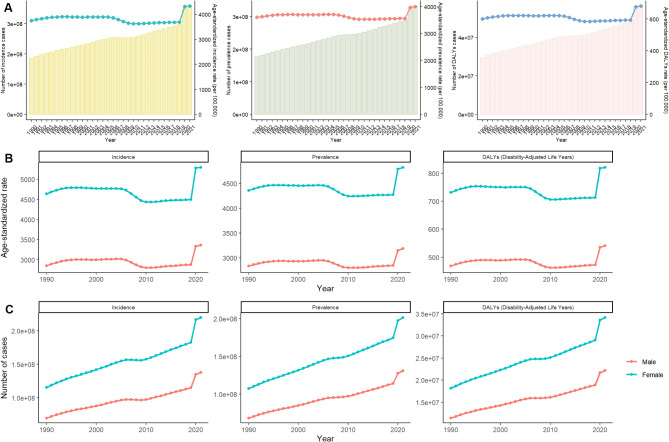
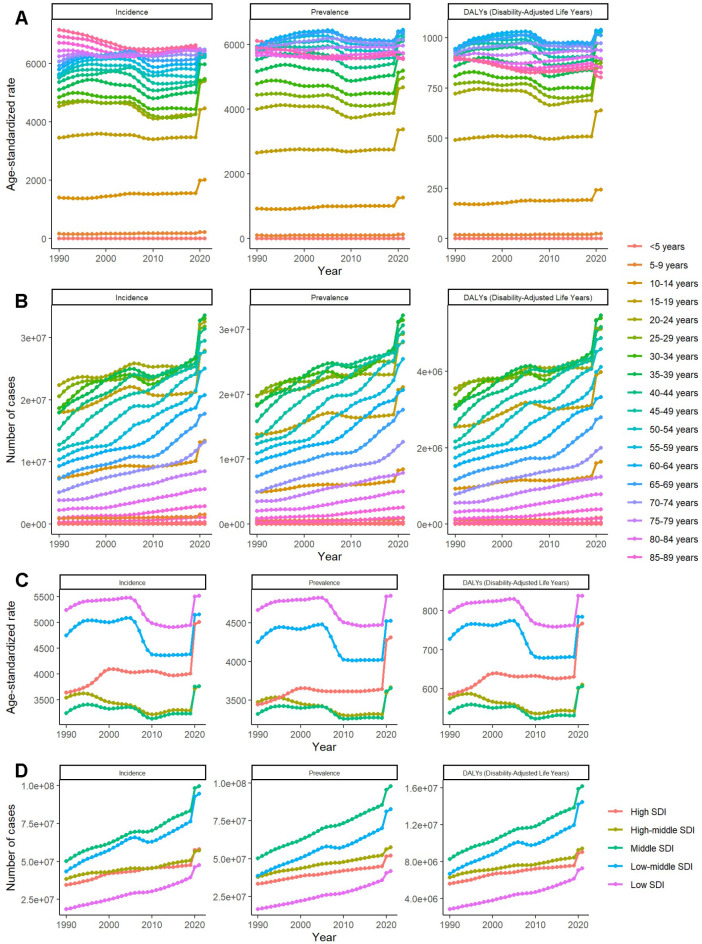
“Figures 1 and 2 reveal a marked upward trend in all ASRs for depressive disorders between 2019 and 2021.”
InfluentialSelf-citationDickerson, L. M., Mazyck, P. J., & Hunter, M. H. (2003) · PubMed · Cited by 172
The explanatory models of depression in low income countries: listening to women in India
Pereira, B., Andrew, G., Pednekar, S., Pai, R., Pelto, P., & Patel, V. (2007) · Journal of Affective Disorders · doi:10.1016/j.jad.2006.09.025 · Cited by 166
Liu, J., Liu, Y., Ma, W., Tong, Y., & Zheng, J. (2024) · Scientific Reports · doi:10.1038/s41598-024-62381-9 · Cited by 160 · cited 3×
“This population is experiencing a significant shift from an outward focus on external matters to an inward focus on their own bodies, a transition marked by heightened loneliness and declining cognitive function, which contributes to emotional instability 13 .”
InfluentialBrinda, E. M., Rajkumar, A. P., Attermann, J., Gerdtham, U., Enemark, U., & Jacob, K. S. (2016) · American Journal of Geriatric Psychiatry · doi:10.1016/j.jagp.2016.07.016 · Cited by 129 · cited 1×
“…by entrenched poverty, economic disparity, limited access to education, structural violence, discrimination, political repression, and social marginalization, among other critical risk factors, all of which contribute to the onset, intensification, and persistence of depressive disorders 27–29 .”
Gender Disparity In Prevalence Of Depression Among Patient Population: A Systematic Review
Abate, K. (2013) · Ethiopian Journal of Health Sciences · doi:10.4314/ejhs.v23i3.11 · Cited by 113 · cited 1×
“This disparity is largely attributable to females being more prone to experiencing adverse events and emotions, such as perinatal and menopausal mood fluctuations, domestic violence, sexual abuse, and discrimination, as well as confronting internalized psychological barriers 18–20 .”
Chhibber, A., Woody, S. K., Karim Rumi, M. A., Soares, M. J., & Zhao, L. (2017) · Psychoneuroendocrinology · doi:10.1016/j.psyneuen.2017.05.016 · Cited by 107 · cited 2×
“Furthermore, Anindit discovered that estrogen disruption in menopausal mice induces dysregulation of BDNF-5-HT2A signaling and impairs synaptic plasticity, thereby heightening the brain’s vulnerability to depressive disorders 20 .”
Hong, C., Liu, Z., Gao, L., Jin, Y., Shi, J., Liang, R., Maimaitiming, M., Ning, X., & Luo, Y. (2022) · Epidemiology and Psychiatric Sciences · doi:10.1017/s2045796022000683 · Cited by 92 · cited 1×
“Additionally, the GBD 2021 study employed the Bayesian meta-regression tool, DisMod-MR 2.1, as the principal methodology, ensuring consistency in the incidence, prevalence, and DALYs across all diseases 11,12 .”
InfluentialAbe, Y., Fujise, N., Fukunaga, R., Nakagawa, Y., & Ikeda, M. (2012) · International Psychogeriatrics · doi:10.1017/s1041610212000099 · Cited by 81 · cited 1×
“Additionally, logistic regression analyses revealed that depressive disorders in older adults was significantly associated with factors such as living alone, unemployment, chronic illness, sleep disorders, suicidal ideation, financial stress, and inadequate social support 25 .”
Li, D., Han, Y., He, Y.-S., Wen, Y., Liu, Y., Fu, Z., Pan, H., & Cao, F. (2023) · Autoimmunity Reviews · doi:10.1016/j.autrev.2023.103407 · Cited by 76 · cited 1×
“Conversely, a decrease in the ASR was indicated if both the EAPC value and the upper bound of the 95% CI were less than 0 16 .”
Suicides in the midnight sun—a study of seasonality in suicides in West Greenland
Björkstén, K. S., Bjerregaard, P., & Kripke, D. F. (2005) · Psychiatry Research · doi:10.1016/j.psychres.2004.12.002 · Cited by 72 · cited 1×
“Furthermore, the pronounced seasonal variations in light and darkness prevalent in Greenland, which contribute to sleep deprivation, coupled with communication barriers in sparsely populated regions and the extreme cold climate, play a crucial role in the onset of depressive disorders 35 .”
Seffren, V., Familiar, I., Murray, S. M., Augustinavicius, J., Boivin, M. J., Nakasujja, N., Opoka, R. O., & Bass, J. (2018) · AIDS Care · doi:10.1080/09540121.2018.1441969 · Cited by 67 · cited 1×
“A substantial body of literature now confirms the high prevalence of depressive disorders among individuals living with HIV in Uganda, highlighting their strong association with inadequate social support, food insecurity, and HIV-related neurocognitive disorders 32,33 .”
Hormonal therapy and depression: Are we overlooking an important therapeutic alternative?
Ancelin, M., Scali, J., & Ritchie, K. A. (2007) · Journal of Psychosomatic Research · doi:10.1016/j.jpsychores.2006.12.019 · Cited by 56
Uganda as a Role Model for Pandemic Containment in Africa
Sarki, A. M., Ezeh, A., & Stranges, S. (2020) · American Journal of Public Health · doi:10.2105/ajph.2020.305948 · Cited by 55 · cited 7×
“A substantial body of literature now confirms the high prevalence of depressive disorders among individuals living with HIV in Uganda, highlighting their strong association with inadequate social support, food insecurity, and HIV-related neurocognitive disorders 32,33 .”
InfluentialHua, Z., Wang, S., & Yuan, X. (2024) · Journal of Affective Disorders · doi:10.1016/j.jad.2024.01.009 · Cited by 55 · cited 10×
“Among the three risk factors, the burden of depressive disorders associated with bullying victimization was the most severe, exhibiting the highest prevalence among individuals aged 10–24 years and in high-income countries, including North America, Qatar, and Greenland; the burden of depressive disorders stemming from…”
InfluentialRuiz, J. M., Sbarra, D. A., & Steffen, P. R. (2018) · International Journal of Psychophysiology · doi:10.1016/j.ijpsycho.2018.04.001 · Cited by 46
Genetics of metabolic traits in Greenlanders: lessons from an isolated population
Andersen, M. K., & Hansen, T. F. (2018) · Journal of Internal Medicine · doi:10.1111/joim.12814 · Cited by 27 · cited 1×
“Genetically, the distinctive genetic backgrounds, coupled with the shift towards a Westernized diet, have fostered a rapid increase in susceptibility to cardiovascular and metabolic diseases, thereby contributing to the emergence of depressive disorders 36,37 .”
Namagga, J. K., Rukundo, G. Z., Niyonzima, V., & Voss, J. G. (2021) · BMC Psychiatry · doi:10.1186/s12888-021-03316-w · Cited by 23 · cited 1×
“A substantial body of literature now confirms the high prevalence of depressive disorders among individuals living with HIV in Uganda, highlighting their strong association with inadequate social support, food insecurity, and HIV-related neurocognitive disorders 32,33 .”
Dirlikov, E., Kamoga, J., Alamo, S., Namusobya, J., Kasozi, D. E., Akao, J. N., Birabwa, E., Ward, J. A., Elur, B., Shiraishi, R. W., et al. (2023) · MMWR Morbidity and Mortality Weekly Report · doi:10.15585/mmwr.mm7204a2 · Cited by 21
Abu-Ras, W. M., Almoayad, F. A., Bakry, H., Alammari, D., Kelly, P. J., & Aboul-Enein, B. H. (2024) · International Journal of Social Psychiatry · doi:10.1177/00207640241259995 · Cited by 17 · cited 1×
“Palestine has borne the profound consequences of the ongoing conflict, particularly the extensive devastation wrought by the protracted Israeli-Palestinian war; Political unrest and economic turmoil characterized the period in Lesotho during the COVID-19 pandemic 39 .”
Noahsen, P., Faber, L. L., Isidor, S., Fonager, J., Rasmussen, M., & Hansen, H. L. (2023) · Eurosurveillance · doi:10.2807/1560-7917.es.2023.28.29.2200767 · Cited by 15
To Grow or Not to Grow: Belarus and Lithuania
Gylfason, Þ., & Hochreiter, E. H. (2022) · Comparative Economic Studies · doi:10.1057/s41294-022-00188-1 · Cited by 5
Depression, Palliative Care, and Hematologic Malignancies: The Paradox in Low-Income Countries
Tazi, I., Nafil, H., & Mahmal, L. (2012) · Journal of Palliative Medicine · doi:10.1089/jpm.2011.0352 · Cited by 1 · cited 1×
“…by entrenched poverty, economic disparity, limited access to education, structural violence, discrimination, political repression, and social marginalization, among other critical risk factors, all of which contribute to the onset, intensification, and persistence of depressive disorders 27–29 .”
Cited by
Zhang, Z., Chen, X., Wu, S., Chen, X., Wang, X., Liu, C., Zeng, N., Liu, Y., Huo, T., Liu, X., et al. (2025) · Journal of Affective Disorders · doi:10.1016/j.jad.2025.120299 · Cited by 120
Bochenska, N., Tomczak, J., & Lisek, M. (2025) · Antioxidants · doi:10.3390/antiox14121464 · Cited by 19
“The impact of depressive disorders is greatest among females and people aged 60 to 64 within their respective demographic groups [1].”
InfluentialLisowska, K. A. (2025) · International Journal of Molecular Sciences · doi:10.3390/ijms262010092 · Cited by 15
“Major depressive disorder (MDD) is a highly prevalent and disabling psychiatric condition, affecting more than 300 million people globally [1].”
Advances in the prevalence and treatment of depression for adolescents: a review
Yin, C., Xu, M., & Zong, Z. (2025) · Frontiers in Pharmacology · doi:10.3389/fphar.2025.1574574 · Cited by 17
Hanifa, H., Alzoubi, M., Khallouf, E. S., Alzoubi, L., Hamesh, F., Qashqash, M. E., Albaroudi, F. H., Al-Baroudy, M., Mahouk, M. A. M., Al-Mashaqbah, Y. M., et al. (2025) · BMC Psychology · doi:10.1186/s40359-025-03879-3 · Cited by 5
“In 2014, over 300 million people worldwide suffered from depression [6].”
Metadata
- Authors
- Zhou, J., Zhang, Y., He, S., Xu, S., Sun, Q., Zhao, T., & Dai, Y.
- Affiliations
- Zhejiang Provincial People's Hospital (CN)
- Zhejiang Chinese Medical University (CN)
- Corresponding author
- Zhao, Tingxiao
- Dai, Yaqin
- Venue
- Scientific Reports
- Published
- 2025-03-19
- Volume
- 15
- Issue
- 1
- Pages
- 9529-9529
- ISSN
- 2045-2322 (ISSN-L)
- PMC
- PMC11923300
- OpenAlex
- W4408611311
- Cited by
- 20
- References
- 38
- Citations by year
- 2026: 12 · 2025: 8
- FWCI
- 23.63
- Type
- journal article
- Language
- en
- Open access
- gold
- doi.org
- Licence
- cc-by-nc-nd
- creativecommons.org/licenses/by-nc-nd/4.0 (tdm)
- creativecommons.org/licenses/by-nc-nd/4.0 (vor)
- Locations
- Scientific Reports (publishedVersion, cc-by-nc-nd)
- PubMed Central (publishedVersion, cc-by-nc-nd)
- PubMed (publishedVersion)
- DOAJ (DOAJ: Directory of Open Access Journals) (submittedVersion, cc-by-sa)
- Topics
- Social Sciences › Psychology › Clinical Psychology › COVID-19 and Mental Health
- Health Sciences › Medicine › Psychiatry and Mental health › Mental Health Treatment and Access
- Health Sciences › Medicine › Public Health, Environmental and Occupational Health › Maternal Mental Health During Pregnancy and Postpartum
- Keywords
- depressive disorders, COVID-19 pandemic, global burden of disease, disability-adjusted life years, incidence and prevalence trends, socio-demographic index, sex differences, age differences, bullying victimization, intimate partner violence, child sexual abuse, risk factors, mental health burden, sub-Saharan Africa, Latin America, Eastern Europe, Pacific Islands, Middle East and North Africa, South Asia, North America
- MeSH terms
- Global Burden of Disease, COVID-19, SARS-CoV-2, Disability-Adjusted Life Years, Adolescent, Adult, Aged, Depressive Disorder, Female, Humans, Male, Middle Aged, Risk Factors, Global Health, Incidence, Prevalence, Cost of Illness, Young Adult, Pandemics
About these checks
Registry, retraction, Cites and statistics results are computed, not judged, with one exception: a printed reference that no index lists is read once by a model before it counts as a citation error. Claims are extracted by a model and kept only when their quote appears verbatim in the text; each cited source is then checked, with a model’s help, for whether it says what the claim relies on. Those verdicts can be wrong — read the claim’s quote and the cited source before relying on one.
Statistics and arithmetic are recomputed, not judged.
Confidence bands are shown only for fields calibrated on our annotated test set. None is calibrated yet, so no band is shown.
What counts as a claim ›How we measure confidence ›How we check this ›
Are you an author, or do you see a problem with this page? Request a review
Data sources
Bibliographic data: Semantic Scholar, OpenAlex, Crossref.
Contains information from the Semantic Scholar Academic Graph Datasets, made available under the ODC Attribution License (ODC-BY 1.0).
Semantic Scholar’s data is described in: Kinney, R., et al. (2023). The Semantic Scholar Open Data Platform. arXiv:2301.10140.
