

The DOI matches its Crossref record; 3 of the 3 references it cites were found in a registry or an index.
A zero-trust digital twin framework for privacy-preserving multi-dataset intrusion detection in industrial IoT with lightweight blockchain auditing
Open accessAbstract
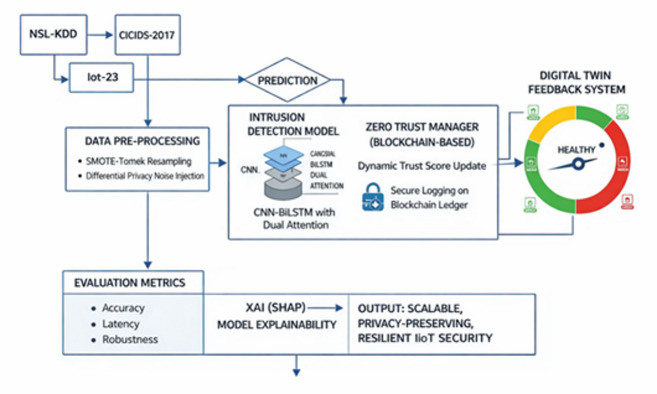
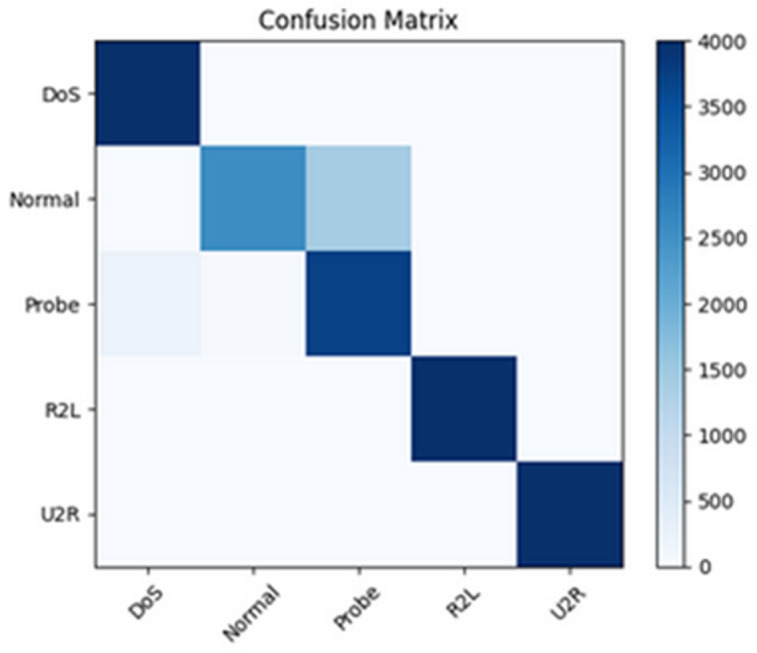
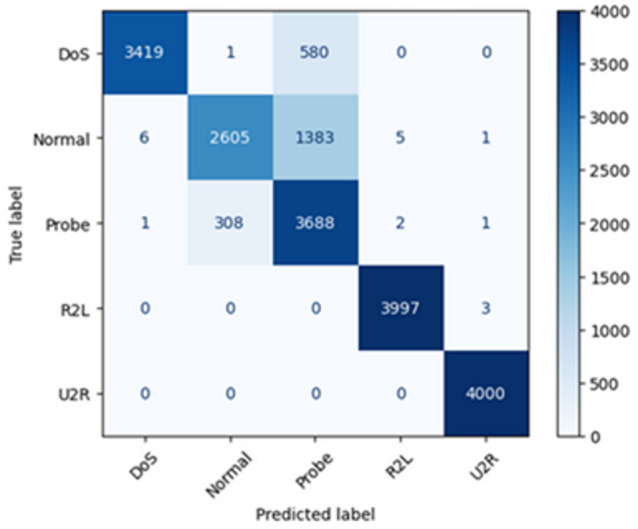
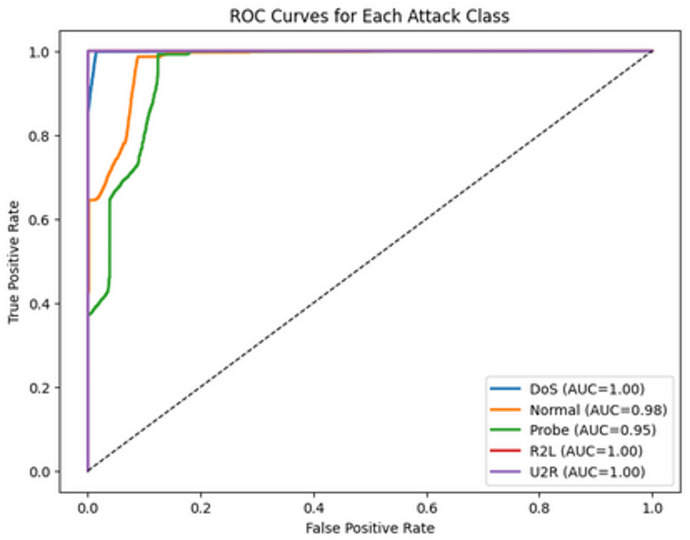
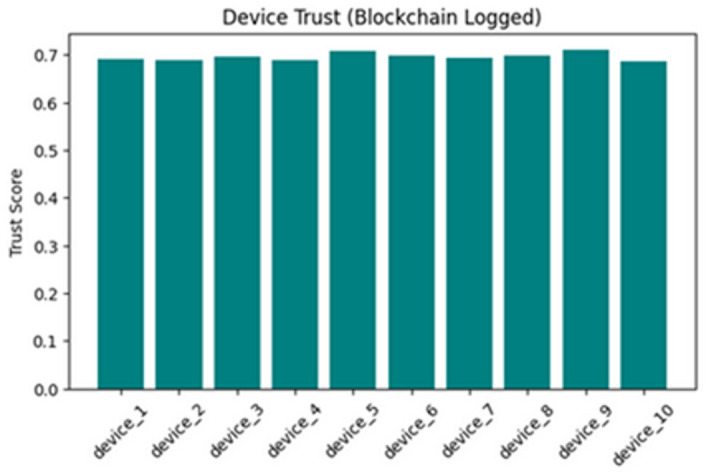
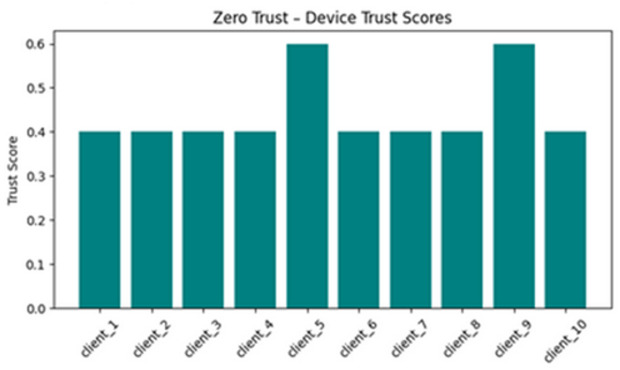
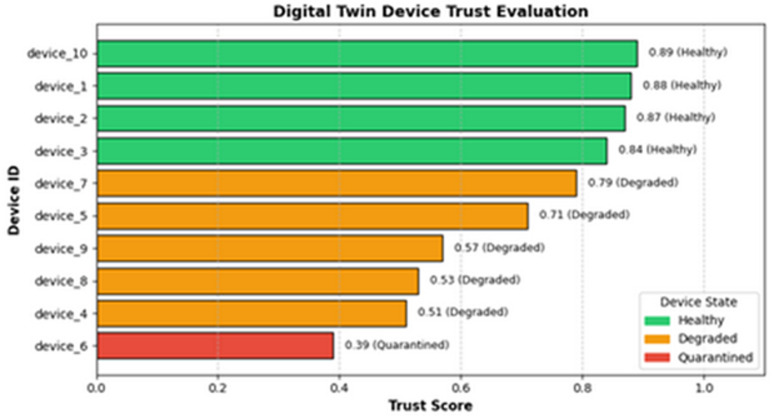
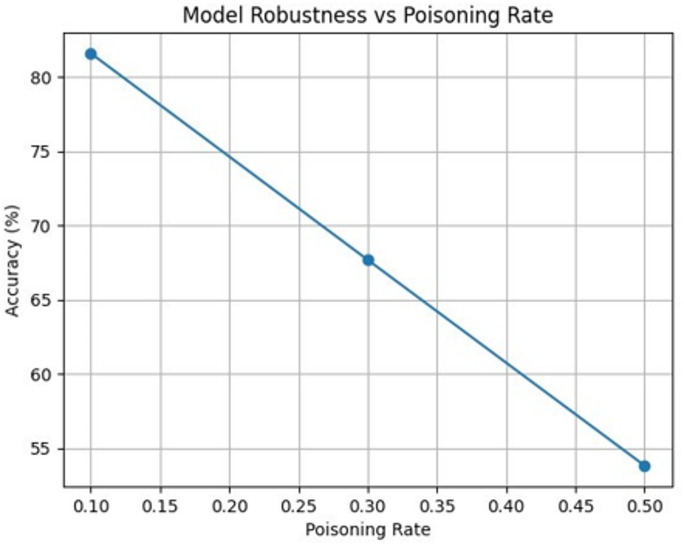
Industrial IoT (IIoT) environments face growing cyber threats due to device heterogeneity and cyber-physical integration. This study proposes a Zero Trust-enhanced intrusion detection framework integrating deep learning anomaly detection, differential privacy, lightweight blockchain-inspired hash-chained ledger and Digital Twin-based situational awareness and visualization of device trust states, designed for low-latency inference suitable for near-real-time IIoT monitoring .A unified dataset was constructed by merging NSL-KDD, CICIDS-2017, and IoT-23 (2,513,419 raw samples unified to 143 features, balanced to 100,000 samples across Normal, DoS, Probe, R2L, U2R classes using SMOTE). Mutual information-based feature selection reduced features to 25. Optimized Multilayer Perceptron (MLP) and CNN–BiLSTM models achieved 89–91% accuracy and 0.89–0.91 macro F1-score, with near-perfect rare-attack detection (F1 ≈ 1.00 for R2L/U2R). Differential privacy (Laplace, ε = 25) reduced accuracy to ~ 78%, quantifying the privacy-utility trade-off. The decoupled Zero-Trust Manager dynamically updates trust scores based on prediction confidence, with tamper-evident SHA-256 hash-chained logging adding negligible latency (~ 1.04–1.06 s for 500 samples). This lightweight, centralized design offers strong cross-domain generalization and deployability for resource-constrained IIoT.
Overview
The claims and statistics of this paper haven’t been checked yet.
Run the check — free, no account needed. It reads the open-access text and checks the sources it cites.
Integrity signals
Registry
Cites
Statistics
Figures
Verification
Claims the paper makes
The claims and statistics of this paper haven’t been checked yet.
Run the check — free, no account needed. It reads the open-access text and checks the sources it cites.
Claims other papers make about this one
Each is checked against this paper’s own text: does it say what the citing paper says it does?
The cited source doesn’t support the claim as written.
In the citing paper
“Recent work has demonstrated that DTs can host real-time anomaly detection [25], support process-residual-based intrusion detection with F1 scores above 96% on water-treatment SCADA testbeds [25], and provide situational awareness of device trust states in industrial IoT [27].”
From Crypto-Agile Zero Trust Architecture for IT-OT Convergence in Industrial Control Systems: A Digital Twin-Driven Framework over 5G/TSN with Post-Quantum Cryptography (2026) · cites this paper as [27]
Checked by a reasoning model — may be wrong.
Experimental — accuracy not yet measuredThe source backs part of the claim, not all of it — or backs it for a different population, condition or comparison.
In the citing paper
“The DT concept has matured from manufacturing-optimization research into a candidate cybersecurity primitive over the past five years [25], [26], [27], [54], [55], [56].”
From Crypto-Agile Zero Trust Architecture for IT-OT Convergence in Industrial Control Systems: A Digital Twin-Driven Framework over 5G/TSN with Post-Quantum Cryptography (2026) · cites this paper as [27]
Experimental — accuracy not yet measuredThe cited source says what the claim attributes to it.
In the citing paper
“Prasad et al. [27] in Scientific Reports (2026) propose a zero-trust digital twin framework that combines deep-learning anomaly detection, differential privacy, blockchain-inspired hash-chained auditing, and DT-based situational awareness in IIoT. With 8991% accuracy on a unified NSL-KDD/CICIDS-2017/IoT-23 dataset, the work is the closest existing analogue to our proposed framework.”
The check wasn’t confident either way, so it gives no verdict — never disputed.
In the citing paper
“The next closest from the OT side is Prasad et al. [27], which combines ZT and DT for IIoT but treats transport as a given and uses classical cryptography.”
From Crypto-Agile Zero Trust Architecture for IT-OT Convergence in Industrial Control Systems: A Digital Twin-Driven Framework over 5G/TSN with Post-Quantum Cryptography (2026) · cites this paper as [27]
Experimental — accuracy not yet measured
Self-check
Percentages, sums and reported differences re-computed from the paper’s own numbers.
The self-check needs the paper’s full text.
Citations
Cites
A Zero-Trust Architecture for Remote Access in Industrial IoT Infrastructures
Federici, F., Martintoni, D., & Senni, V. (2023) · Electronics · doi:10.3390/electronics12030566 · Cited by 74 · cited 8×
“The proposed ZTA integration aims to counter these weaknesses by using dynamic verification and behavior-based access control.”
InfluentialZero-Trust Model for Smart Manufacturing Industry
Paul, B., & Rao, M. (2022) · Applied Sciences · doi:10.3390/app13010221 · Cited by 53
Lv, F., Wang, H., Pan, Z., Sun, R., Si, S., Zhang, W., Lv, S., & Sun, L. (2025) · Computer Networks · doi:10.1016/j.comnet.2025.111459 · Cited by 12
Research works printed but not linked: 29
- Ullah, Z., Al-Turjman, F., Mostarda, L. & Gagliardi, R. Applications of artificial intelligence and machine learning in smart cities. Comput. Commun. 154, 313–323 (2020). · DOI · Paper page
- Torkura, K. A., Sukmana, M. I., Cheng, F. & Meinel, C. Continuous auditing and threat detection in multi-cloud infrastructure. Comput. Secur. 102, 102124 (2021). · DOI
- Fatema, K. et al. Federated XAI IDS: An explainable and safeguarding privacy approach to detect intrusion combining federated learning and SHAP. Future Internet. 17 (6), 234 (2025). · DOI
- Neto, E. C. et al. CICIoT2023: A real-time dataset and benchmark for large-scale attacks in IoT environment. Sensors 23 (13), 5941 (2023). · DOI
- Harbi, Y., Medani, K., Gherbi, C., Aliouat, Z. & Harous, S. Roadmap of adversarial machine learning in Internet of Things-enabled security systems. Sensors 24(16), 5150 (2024). · DOI
- Laghari, A. A. et al. A novel and secure artificial intelligence enabled zero trust intrusion detection in industrial internet of things architecture. Sci. Rep. 15 (1), 26843 (2025). · DOI · Paper page
- Onwubiko, A., Singh, R., Awan, S., Pervez, Z. & Ramzan, N. Enabling trust and security in digital twin management: A blockchain-based approach with Ethereum and IPFS. Sensors 23(14), 6641 (2023). · DOI
- Mishra, S. & Sharma, S. K. Advanced contribution of IoT in agricultural production for the development of smart livestock environments. Internet Things 22(1), 100724 (2023). · DOI
- Zanasi, C., Russo, S. & Colajanni, M. Flexible zero trust architecture for the cybersecurity of industrial IoT infrastructures. Ad Hoc Netw. 156(1), 103414 (2024). · DOI · Paper page
- Lilhore, U. K. et al. SmartTrust: a hybrid deep learning framework for real-time threat detection in cloud environments using zero-trust architecture. J. Cloud Comput. 14(1), 35 (2025). · DOI
- Ali, S., Li, Q. & Yousafzai, A. Blockchain and federated learning-based intrusion detection approaches for edge-enabled industrial IoT networks: A survey. Ad Hoc Netw. 152(1), 103320 (2024). · DOI
- Huma, Z. E., Jan, S. U., Ahmad, J., Buchanan, W. & Pitropakis, N. Adversarial machine learning in IoT security: A comprehensive survey. ACM Comput. Surv. (2025). · DOI
- Benjamin Franklin, I., Paul Arokiadass Jerald, M. & Bhuvaneswari, R. Machine learning-based trust management in cloud using blockchain technology. SN Comput. Sci. 3 (6), 429 (2022). · DOI
- .Hong, Y., Wu, J. & Morello, R. LLM-Twin: mini-giant model-driven beyond 5G digital twin networking framework with semantic secure communication and computation. Sci. Rep. 14 (1), 19065 (2024). · DOI
- Siraparapu, S. R. & Azad, S. M. Securing the IoT landscape: A comprehensive review of secure systems in the digital era. e-Prime-Adv. Electr. Eng. Electron. Energy 10(1), 100798 (2024). · DOI
- Chen, X., Feng, W., Ge, N. & Zhang, Y. Zero trust architecture for 6G security. IEEE Netw. 38 (4), 224–232 (2023). · DOI
- Prasad, K. S. et al. A two-tier optimization strategy for feature selection in robust adversarial attack mitigation on internet of things network security. Sci. Rep. 15 (1), 2235 (2025). · DOI
- Sarhan, M., Lo, W. W., Layeghy, S. & Portmann, M. HBFL: A hierarchical blockchain-based federated learning framework for collaborative IoT intrusion detection. Comput. Electr. Eng. 103, 108379 (2022). · DOI
- Sundar, K., Sasikumar, S. & Jayakumar, C. Enhanced cloud security model using QKDP (ECSM-QKDP) for advanced data security over cloud. Quantum Inf. Process. 21 (3), 115 (2022). · DOI
- Javeed, D., Saeed, M. S., Adil, M., Kumar, P. & Jolfaei, A. A federated learning-based zero trust intrusion detection system for Internet of Things. Ad Hoc Netw. 162, 103540 (2024). · DOI
- Puviarasu, A. & Sudha, V. K. Enhanced IoT security: privacy-preserving federated learning model for accurate, real-time intrusion detection across devices. Ain Shams Eng. J. 17 (1), 103866 (2026). · DOI
- Nawshin, F., Unal, D., Hammoudeh, M. & Suganthan, P. N. AI-powered malware detection with Differential Privacy for zero trust security in Internet of Things networks. Ad Hoc Netw. 161, 103523 (2024). · DOI
- Jamiri, H. & Zyane, A. Adversarial attacks in IoT: A performance assessment of ML and DL models. Eng. Proc. 112(1), 14–15 (2025).
- Sharafaldin, I., Lashkari, A. H. & Ghorbani, A. A. Toward generating a new intrusion detection dataset and intrusion traffic characterization. Proc. Int. Conf. Inf. Syst. Secur. Priv. (ICISSP). 108–116 (accessed Sept 10 2025). https://doi.org/10.5220/0006639801080116 (2018). · DOI · Paper page
- Tavallaee, M., Bagheri, E., Lu, W. & Ghorbani, A. A. accessed Sept. 10, NSL-KDD dataset, University of New Brunswick (2009). (accessed 10 Sept 2025). https://www.unb.ca/cic/datasets/nsl.html
- Kathole, A. B. et al. Enhanced security mechanism in vehicular networks using ensemble machine learning to detect malicious activity in VANETs. J. Discrete Math. Sci. Cryptogr. 27(7), 2005–2014 (2024). · DOI
- Kathole, A. B. et al. A novel approach to IoT security for intrusion detection system using ensemble network and heuristic-assisted feature fusion. J. Discrete Math. Sci. Cryptogr. 27(7), 2207–2217 (2024). · DOI
- Kathole, A. B., Jadhav, D., Vhatkar, K. N., Swapnaja, A. & Gandhewar, N. Solar energy prediction in IoT system based on optimized complex-valued spatio-temporal graph convolutional neural network. Knowledge Based Syst. 304, 112400 (2024). · DOI
- Kathole, A. B. et al. Secure federated cloud storage protection strategy using hybrid heuristic attribute-based encryption with permissioned blockchain. IEEE Access 12, 117154–117169 (2024). · DOI
Cited by
Sorted by citations
Qadri, S. M. (2026) · Frontiers in Computer Science and Artificial Intelligence · doi:10.32996/fcsai.2026.5.9.2
“The DT concept has matured from manufacturing-optimization research into a candidate cybersecurity primitive over the past five years [25], [26], [27], [54], [55], [56].”
Influential
Metadata
- Authors
- Mishra, S., Aldafas, T. S. M., & Alshammari, N. S.
- Affiliations
- Majmaah University (SA)
- Corresponding author
- Mishra, Shailendra
- Alshammari, Naif S.
- ORCID
- Alshammari, Naif S.
- Venue
- Scientific Reports
- Published
- 2026-03-31
- Volume
- 16
- Issue
- 1
- ISSN
- 2045-2322 (ISSN-L)
- PMC
- PMC13181063
- OpenAlex
- W7147213917
- Cited by
- 4
- References
- 3
- Citations by year
- 2026: 4
- FWCI
- 15.06
- Type
- journal article
- Language
- en
- Open access
- gold
- doi.org
- Licence
- Locations
- Scientific Reports (publishedVersion, cc-by-nc-nd)
- PubMed (publishedVersion)
- PubMed Central (publishedVersion, cc-by-nc-nd)
- DOAJ (DOAJ: Directory of Open Access Journals) (submittedVersion, cc-by-sa)
- Funders
- Majmaah University (R-2026-X( number X issued after acceptance))
- Topics
- Physical Sciences › Computer Science › Computer Networks and Communications › Network Security and Intrusion Detection
- Physical Sciences › Computer Science › Information Systems › Internet of Things and AI
- Physical Sciences › Computer Science › Artificial Intelligence › Internet Traffic Analysis and Secure E-voting
- Keywords
- zero-trust architecture, digital twin, intrusion detection, Industrial Internet of Things, differential privacy, blockchain auditing, privacy-utility trade-off, anomaly detection, multilayer perceptron, CNN-BiLSTM, rare attack detection, trust evaluation, CICIDS2017, NSL-KDD dataset, SMOTE, feature selection, resource-constrained devices
About these checks
Registry, retraction, Cites and statistics results are computed, not judged, with one exception: a printed reference that no index lists is read once by a model before it counts as a citation error. Claims are extracted by a model and kept only when their quote appears verbatim in the text; each cited source is then checked, with a model’s help, for whether it says what the claim relies on. Those verdicts can be wrong — read the claim’s quote and the cited source before relying on one.
Statistics and arithmetic are recomputed, not judged.
Confidence bands are shown only for fields calibrated on our annotated test set. None is calibrated yet, so no band is shown.
What counts as a claim ›How we measure confidence ›How we check this ›
Are you an author, or do you see a problem with this page? Request a review
