

Hybrid generative–ensemble approach for predicting recycled aggregate concrete strength properties
Open accessThe DOI matches its Crossref record; 75 of the 75 references it cites were found in a registry or an index; none of the 34 sources its claims cite is checked for support yet.
Abstract
This study proposes a hybrid generative-ensemble framework to predict key mechanical properties of recycled aggregate concrete from mix proportions. An established database of 112 mixes was used to model compressive strength, split tensile strength, flexural strength, and elastic modulus. To mitigate data scarcity, a conditional variational autoencoder was trained on the training data only and used to generate additional physically plausible input samples, after which seven supervised learning algorithms were trained and compared using cross-validation. Gradient boosting and support vector regression achieved the most accurate and stable predictions across all targets, outperforming baseline linear models and commonly used empirical correlations. Feature-attribution analysis was used to identify the dominant drivers of each property, showing that binder-related variables primarily govern strength, while aggregate-related variables dominate stiffness. The results support practical, data-driven screening of recycled aggregate concrete mixes and provide interpretable guidance for sustainable mix design.
Overview
CoChat Summary
TL;DR
This study proposes a leakage-safe hybrid CVAE–ensemble workflow to predict compressive strength, split tensile strength, flexural strength, and elastic modulus of recycled aggregate concrete from mix proportions. Gradient boosting and support vector regression generally gave the most accurate predictions, while SHAP showed binder variables dominate strength and aggregate variables dominate stiffness.
Key findings
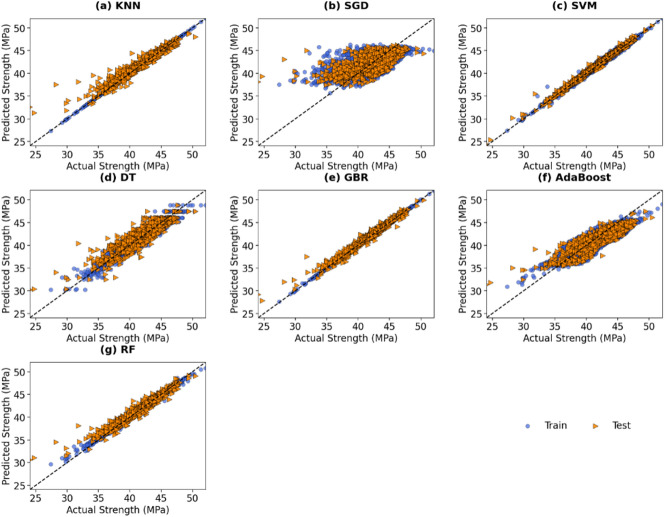
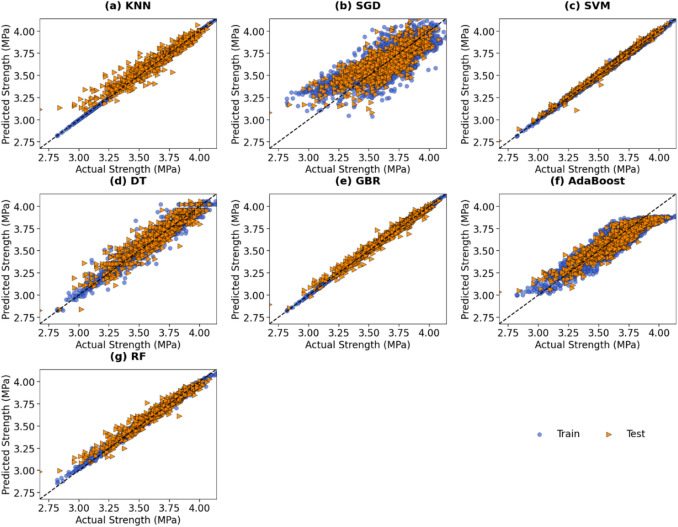
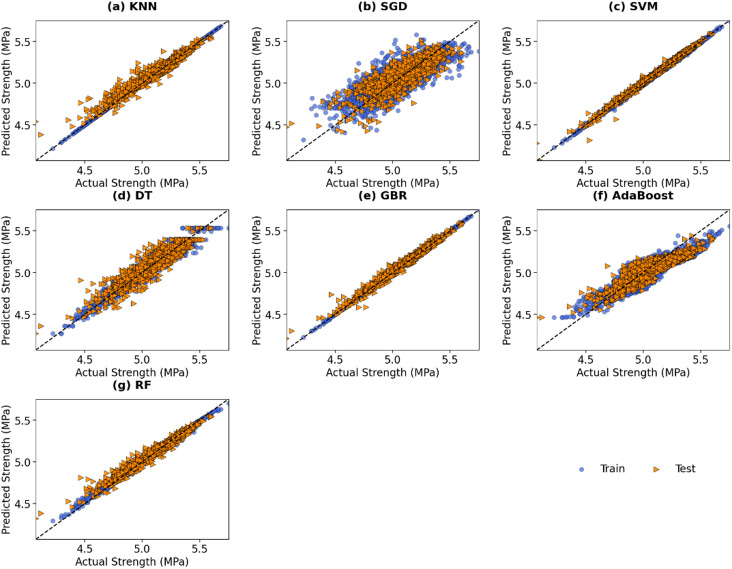
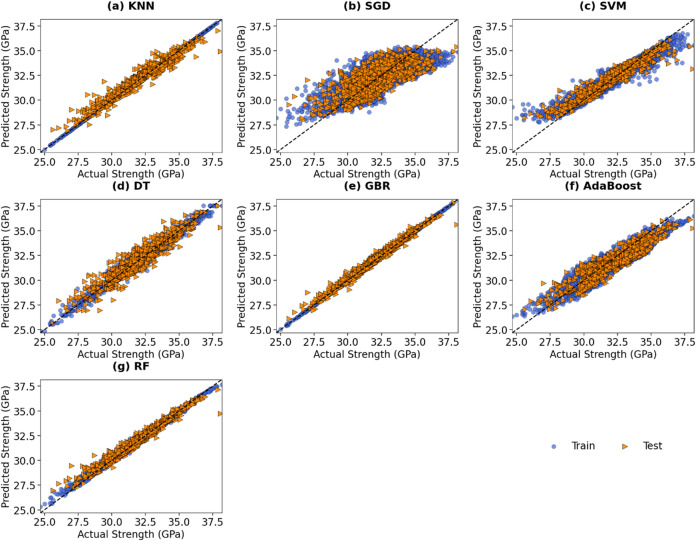
- GBR and SVM were the strongest models across most targets: compressive strength GBR \(R^2_{\text{test}}=0.972\), RMSE \(=0.529\) MPa; SVM \(R^2_{\text{test}}=0.990\), RMSE \(=0.312\) MPa; split tensile GBR \(R^2=0.978\), RMSE \(=0.030\) MPa; flexural GBR \(R^2=0.979\), RMSE \(=0.031\) MPa; modulus GBR \(R^2=0.981\), RMSE \(=236.842\) MPa. Linear SGD was weakest (e.g., compressive \(R^2=0.448\); modulus \(R^2=0.525\)).
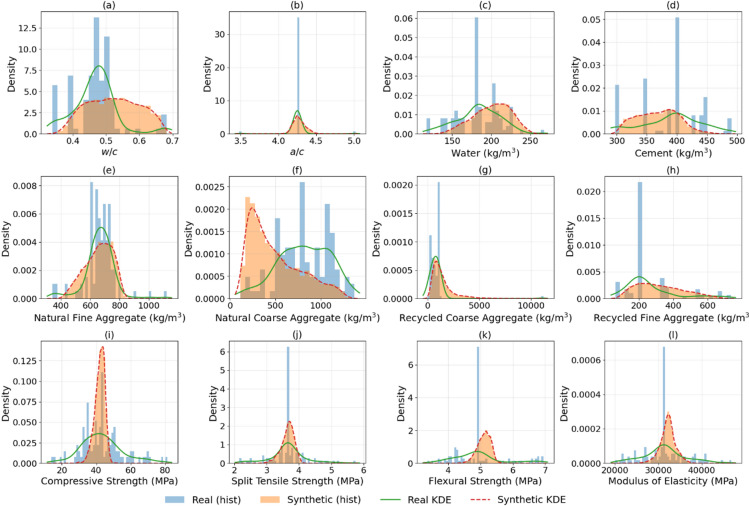
- The CVAE generated 5,000 synthetic mixes from training folds only; reported diagnostics included FID\(_{\text{inputs standardized}}\approx4.23\), FID\(_{\text{targets standardized}}\approx2.30\), and mean KL (real→synthetic) \(\approx1.81\) for inputs and \(\approx6.17\) for targets.
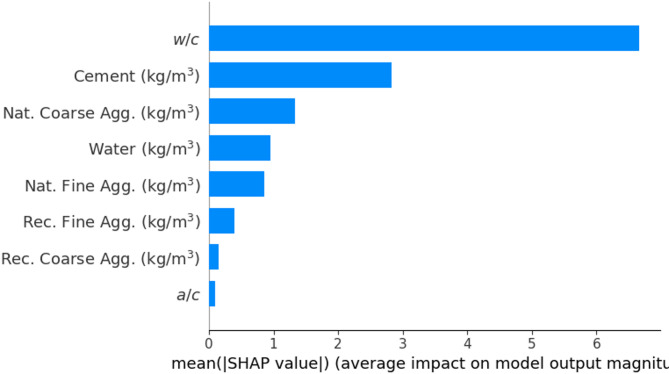
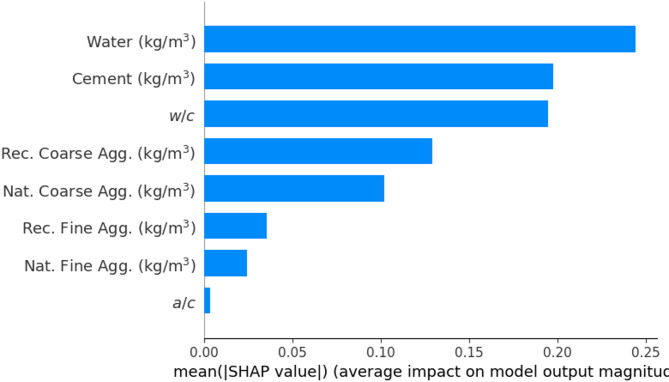
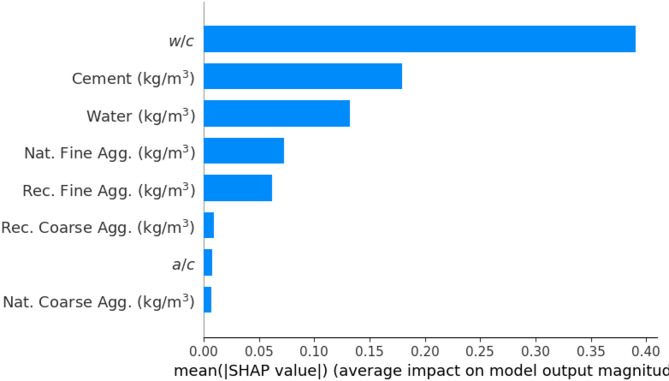
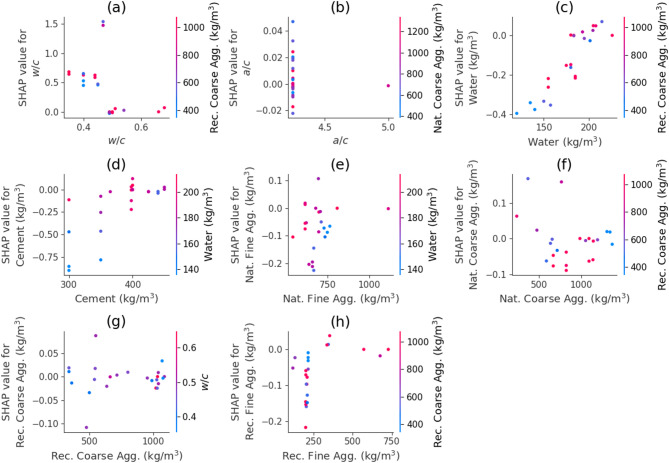
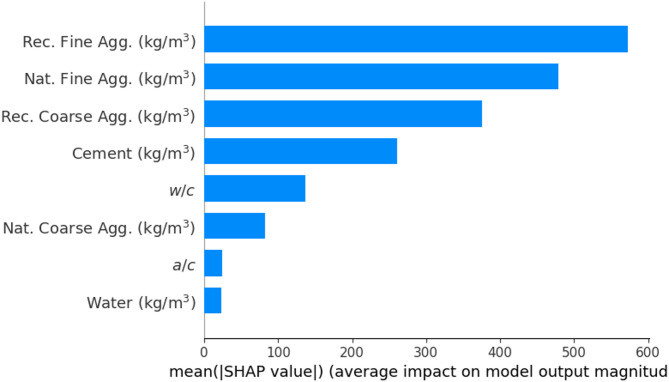
- SHAP indicated binder-related variables primarily govern strength: w/c and cement content for compressive strength; water, cement, and w/c for split tensile strength; w/c, cement, and water for flexural strength. For elastic modulus, recycled fine aggregate had the highest mean SHAP value, followed by natural fine aggregate, recycled coarse aggregate, and cement.
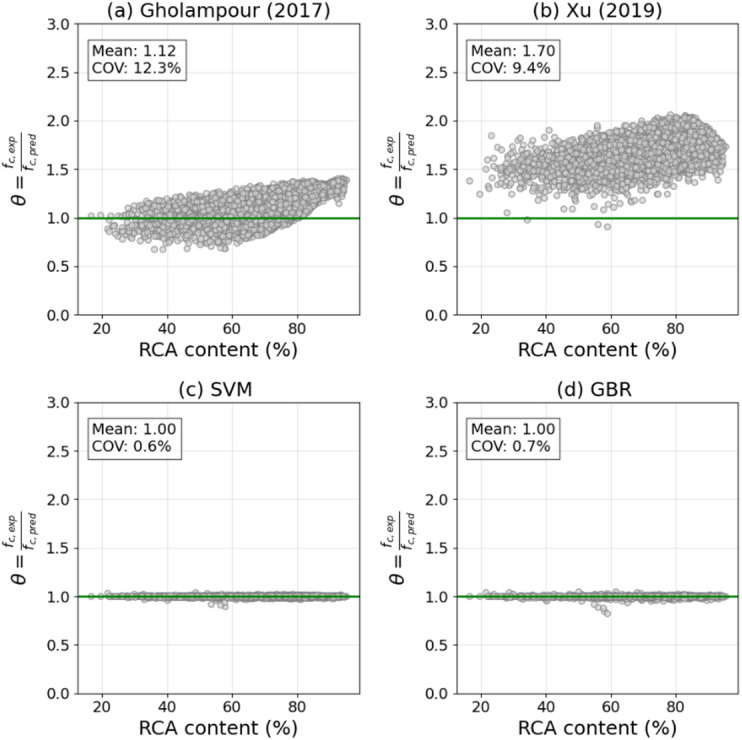
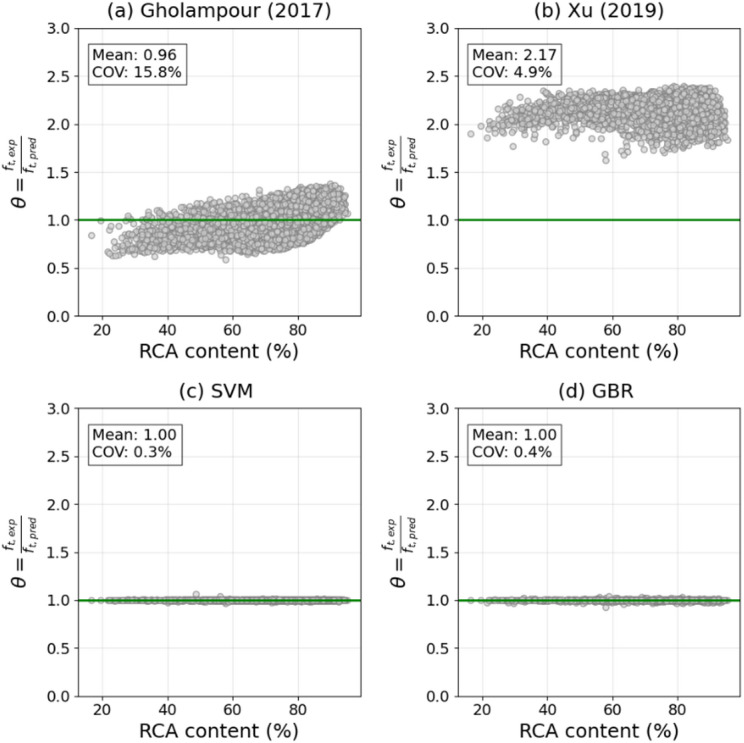
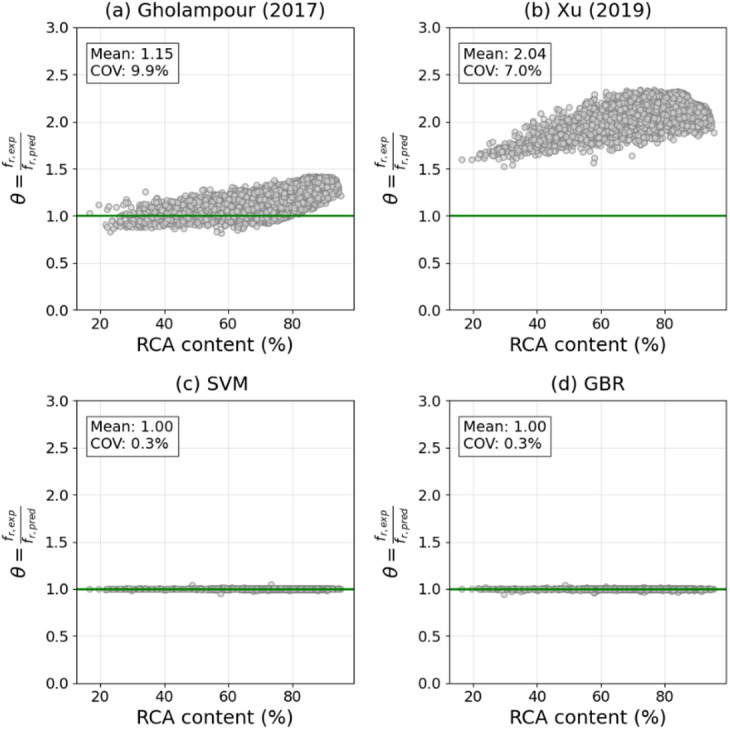
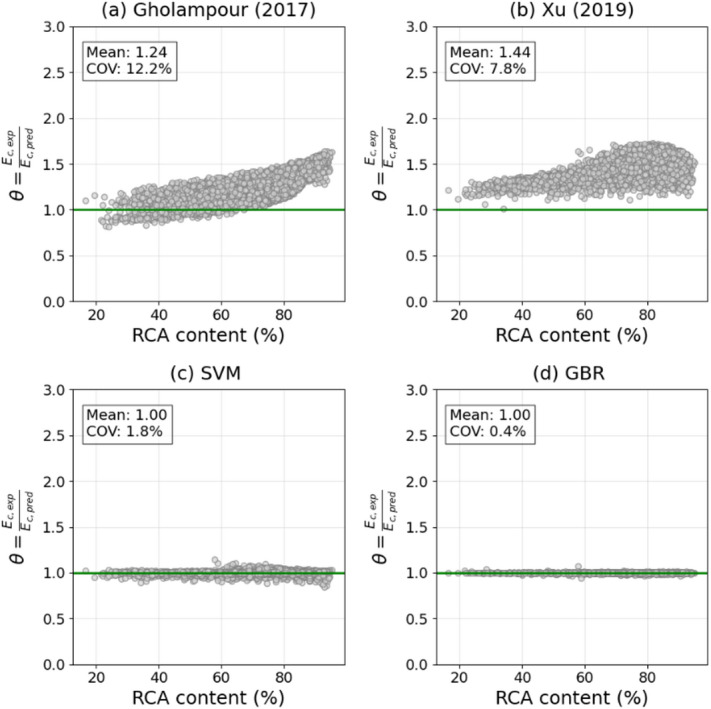
- Benchmarking against empirical equations showed systematic bias: for compressive strength, mean prediction ratio \(\theta=1.12\) (COV \(=12.3\%\)) for Gholampour et al. and \(\theta=1.70\) (COV \(=9.4\%\)) for Xu et al., while SVM and GBR remained centered near unity with COV \(<1\%\).
Methods
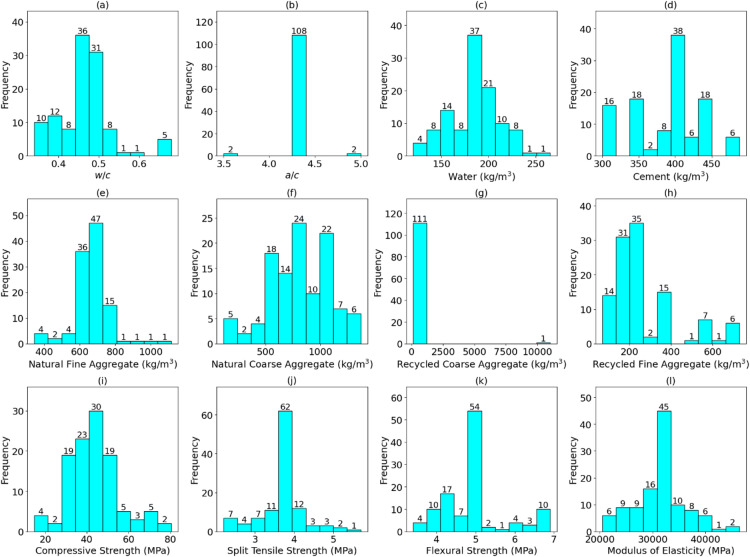
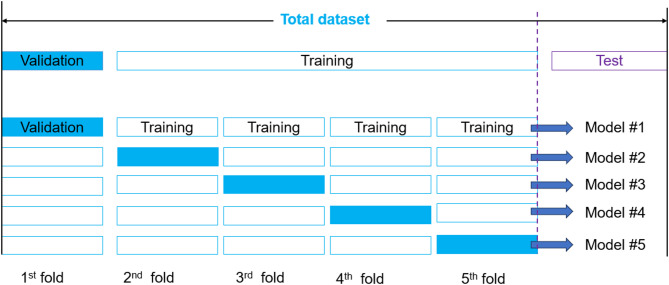
- A dataset of 112 concrete mix designs was compiled from published RAC studies, with eight input features (w/c, a/c, water, cement, natural fine aggregate, natural coarse aggregate, recycled coarse aggregate, recycled fine aggregate) and four targets (compressive, split tensile, flexural strength, elastic modulus). The data were split into a locked 20% real-only test set and an 80% development set; 5-fold cross-validation was used for tuning and model selection.
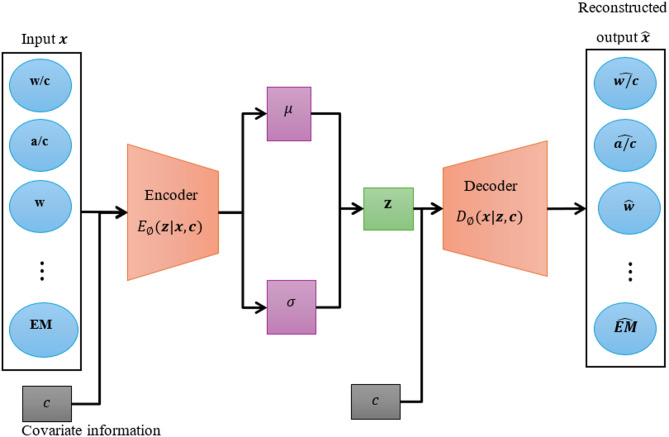
- A conditional variational autoencoder was trained only on training folds to generate 5,000 synthetic input samples; augmentation was restricted to the input space, and evaluation targets remained real measurements.
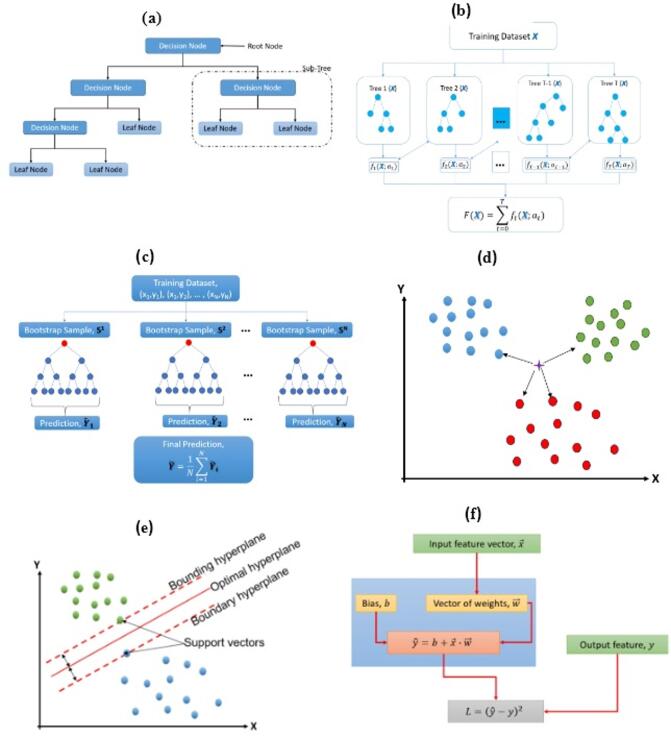
- Seven supervised algorithms were compared: DT, RF, GBR, AdaBoost, KNN, SVM, and SGD. Hyperparameters were tuned with Bayesian optimization using Optuna/TPE for 1,000 trials per target–model combination; performance was assessed with \(R^2\), RMSE, MAE, and MAPE, and SHAP was computed on held-out data.
Limitations
- The paper states that the main limitation is the small dataset size and coverage, which restricts generalization outside the observed mix-design space; it also states that model accuracy is primarily limited by data coverage and that future work should add uncertainty quantification and durability indicators.
- Evident from the text: the dataset description reports 112 mix designs but also says it covers “56 experimental mixes,” an inconsistency that is not resolved.
- Evident from the text: synthetic augmentation was used only for inputs and reported as an auxiliary robustness check, while empirical benchmarking was applied to the full augmented dataset (synthetic plus real) without sub-sampling, unlike the real-only locked test used for ML evaluation.
Model-written summary. Check it against the paper before relying on it.
Integrity signals
Registry
Cites
Statistics
Figures
Verification
Claims the paper makes
0 Valid · 0 Not valid · 26 Not checked · 113 Own results and interpretations
A result the paper reports from its own data — it cites no other source for it, so there is none to check. The quote shows it is in the paper.
In the paper
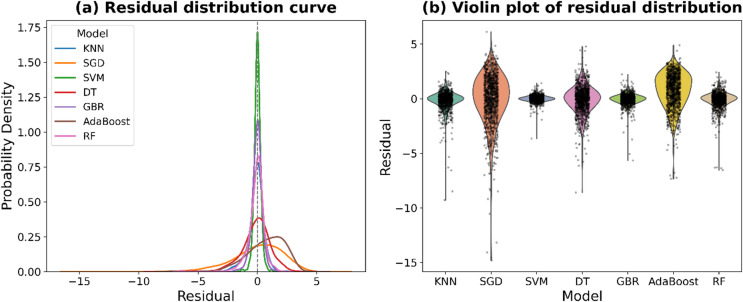
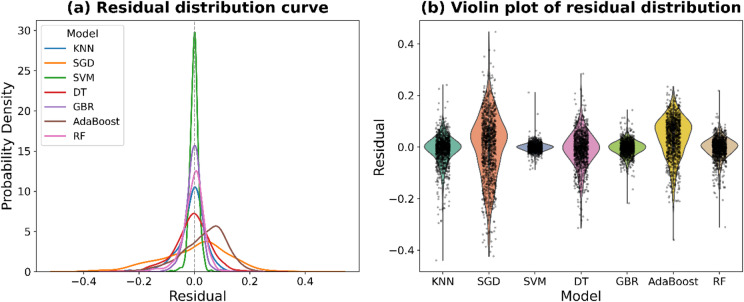
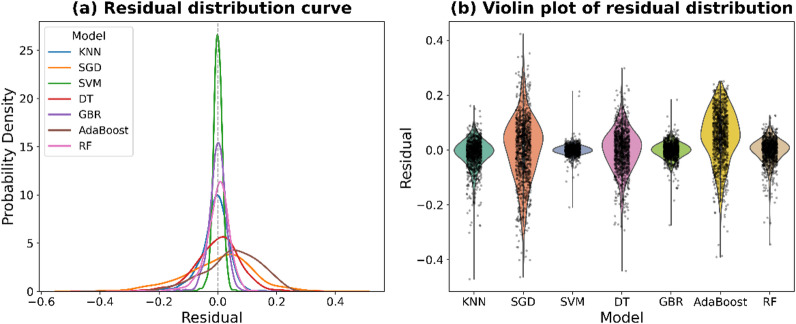
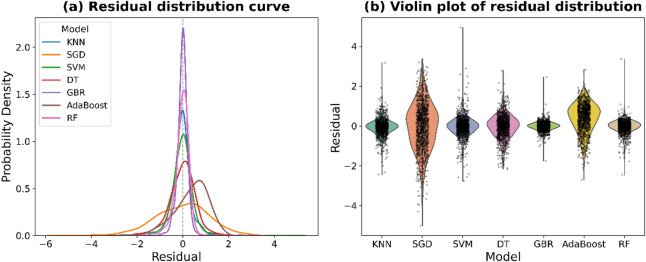
“Residual plots in Fig. 14 confirm that GBR, RF, and AdaBoost yield tightly clustered, symmetric residuals centered near zero, indicating minimal bias and strong predictive reliability.”
§ Hybrid generative–ensemble approach for predicting recycled aggregate concrete strength properties > Results analysis and discussion > Predicting performances of the proposed ML models
boostedstates an association- Asserted: passes — The authors put it forward as true.
- Checkable: passes — It can be checked against evidence.
- Load-bearing: passes — The paper’s conclusions depend on it.
- Based: passes — The paper gives a reason why it holds.
- Rests on an assumption not shown here.
A result the paper reports from its own data — it cites no other source for it, so there is none to check. The quote shows it is in the paper.
In the paper
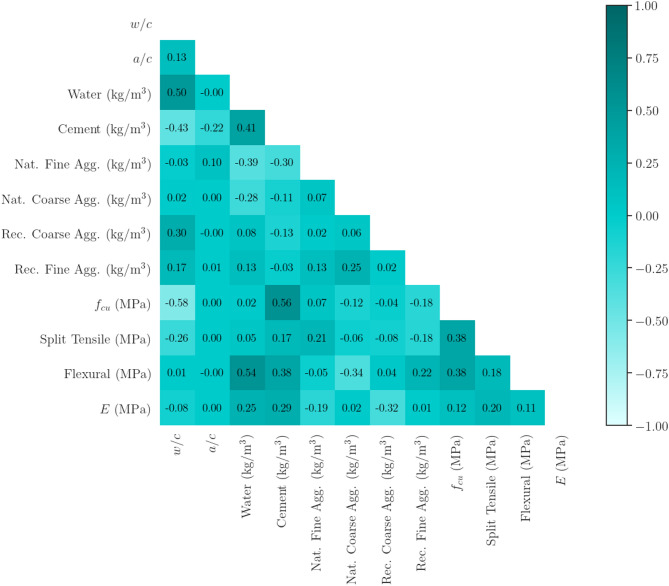
“Recycled aggregate contents showed weaker but notable correlations, reflecting their complex and quality-dependent influence on mechanical performance.”
§ Hybrid generative–ensemble approach for predicting recycled aggregate concrete strength properties > Dataset description > Correlation analysis and research questions
plainstates an association- Asserted: passes — The authors put it forward as true.
- Checkable: passes — It can be checked against evidence.
- Load-bearing: unclear — It is unclear whether the paper’s conclusions depend on it.
- Based: passes — The paper gives a reason why it holds.
A result the paper reports from its own data — it cites no other source for it, so there is none to check. The quote shows it is in the paper.
In the paper
“binder-related variables primarily govern strength”
§ Hybrid generative–ensemble approach for predicting recycled aggregate concrete strength properties > Abstract
plainstates a cause- Asserted: passes — The authors put it forward as true.
- Checkable: passes — It can be checked against evidence.
- Load-bearing: passes — The paper’s conclusions depend on it.
- Based: passes — The paper gives a reason why it holds.
A result the paper states — it cites no source for it, so there is none to check. The quote shows it is in the paper.
In the paper
“The weak correlation between compressive strength and elastic modulus (ρ = 0.12)”
§ Hybrid generative–ensemble approach for predicting recycled aggregate concrete strength properties > Dataset description > Correlation analysis and research questions
plainstates an association- Asserted: passes — The authors put it forward as true.
- Checkable: passes — It can be checked against evidence.
- Load-bearing: passes — The paper’s conclusions depend on it.
- Based: passes — The paper gives a reason why it holds.
A result the paper reports from its own data — it cites no other source for it, so there is none to check. The quote shows it is in the paper.
In the paper
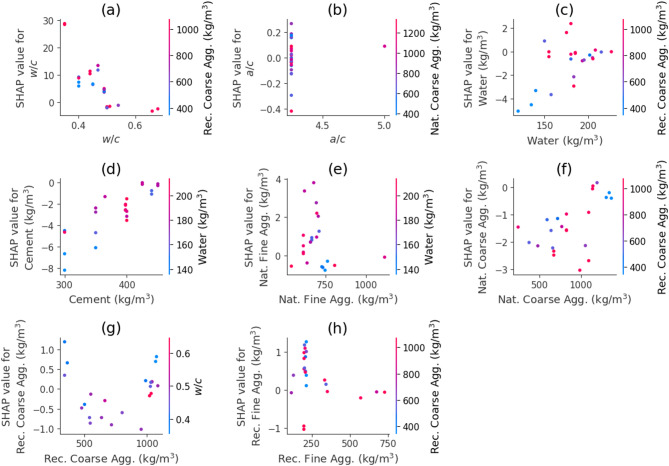
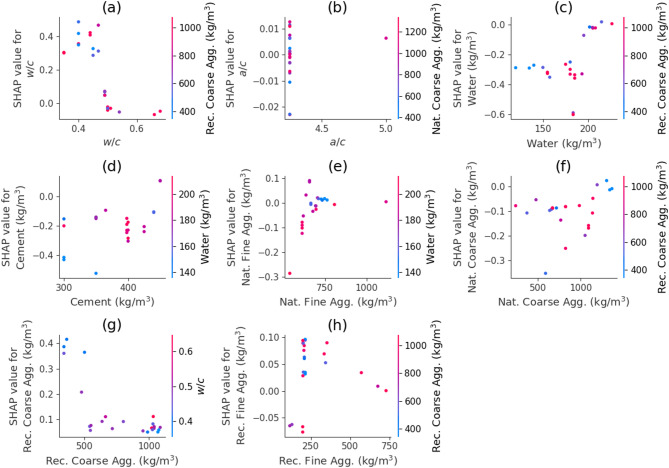
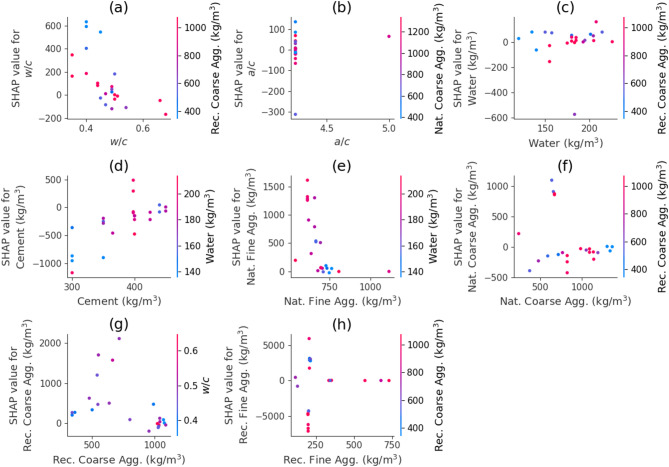
“the aggregate-to-cement (a/c) ratio in particular has SHAP values near zero across its range, indicating minimal relevance to compressive strength predictions.”
§ Hybrid generative–ensemble approach for predicting recycled aggregate concrete strength properties > Results analysis and discussion > Analysis of relative influence and sensitivity analysis
hedged- Asserted: passes — The authors put it forward as true.
- Checkable: passes — It can be checked against evidence.
- Load-bearing: unclear — It is unclear whether the paper’s conclusions depend on it.
- Based: passes — The paper gives a reason why it holds.
- Rests on 2 assumptions not shown here.
66 more claims
Create a free account to see all 139 claims and to verify the 26 references still open.
- It may state two separate claims as one. 52
- The quote only partly states this claim. 1
- Probably not a substantial claim. 23
Self-check
Percentages, sums and reported differences re-computed from the paper’s own numbers.
Each contradiction between two passages listed here was confirmed by an independent check.
Rated major: it would touch a result — a value a result rests on, reported and recomputed p-values on opposite sides of the significance level, two passages that conflict with no sign which is right, or a cited work retracted before this paper was published.
In the paper
§ Hybrid generative–ensemble approach for predicting recycled aggregate concrete strength properties > Results analysis and discussion > Predicting performances of the proposed ML models
“The GBR achieves the highest accuracy ({R}_{\mathrm{test}}^{2}=0.98, RMSE = 0.03 MPa, MAPE = 0.61%), followed by SVM ({R}_{\mathrm{test}}^{2}=0.99)”
§ Hybrid generative–ensemble approach for predicting recycled aggregate concrete strength properties > Results analysis and discussion > Predicting performances of the proposed ML models
“| SVM | 0.993 | 0.997 | 0.017 | 0.010 | 0.012 | 0.008 | 0.327 | 0.215 |”
Rated minor: it would not touch a result — a value no result rests on, a p-value that stays on the same side of the significance level, or a conflict that is clerical, resolved elsewhere in the paper, or outside its own findings.
In the paper
§ Hybrid generative–ensemble approach for predicting recycled aggregate concrete strength properties > Benchmarking with empirical and ML models
“Table: Table 7 Empirical equations proposed by Gholampour et al.26 and Xu et al.74 for mechanical properties of recycled aggregate concrete”
§ Hybrid generative–ensemble approach for predicting recycled aggregate concrete strength properties > Benchmarking with empirical and ML models
“| Compressive strength | Gholampour et al74.”
Rated minor: it would not touch a result — a value no result rests on, a p-value that stays on the same side of the significance level, or a conflict that is clerical, resolved elsewhere in the paper, or outside its own findings.
In the paper
§ Hybrid generative–ensemble approach for predicting recycled aggregate concrete strength properties > Results analysis and discussion > Analysis of relative influence and sensitivity analysis
“For consistency, SHAP was applied to GBR for all targets because it was among the best-performing models and enables stable, efficient SHAP computation for tree-based ensembles.”
§ Hybrid generative–ensemble approach for predicting recycled aggregate concrete strength properties > Results analysis and discussion > Analysis of relative influence and sensitivity analysis
“Figure: Fig. 15 Mean absolute SHAP values for each input feature used in the compressive strength prediction AdaBoost model”
Rated minor: it would not touch a result — a value no result rests on, a p-value that stays on the same side of the significance level, or a conflict that is clerical, resolved elsewhere in the paper, or outside its own findings.
In the paper
§ Hybrid generative–ensemble approach for predicting recycled aggregate concrete strength properties > Benchmarking with empirical and ML models
“Table: Table 7 Empirical equations proposed by Gholampour et al.26 and Xu et al.74 for mechanical properties of recycled aggregate concrete”
§ Hybrid generative–ensemble approach for predicting recycled aggregate concrete strength properties > Benchmarking with empirical and ML models
“| | Xu et al75. |”
Rated minor: it would not touch a result — a value no result rests on, a p-value that stays on the same side of the significance level, or a conflict that is clerical, resolved elsewhere in the paper, or outside its own findings.
In the paper
§ Hybrid generative–ensemble approach for predicting recycled aggregate concrete strength properties > Methodology > Data augmentation module
“n=\mathrm{5,000}synthetic mixes were conditionally sampled around the dataset’s mean target vector.”
§ Hybrid generative–ensemble approach for predicting recycled aggregate concrete strength properties > Methodology > Data augmentation module
“Conditional targets were sampled to maintain coverage across the full target range rather than being concentrated at the mean, and tail behaviour was checked explicitly.”
Citations
Cites
A tutorial on support vector regression
Smola, A. J., & Schölkopf, B. (2004) · Statistics and Computing · doi:10.1023/b:stco.0000035301.49549.88 · Cited by 13,387
Dormann, C. F., Elith, J., Bacher, S., Buchmann, C., Carl, G., Carré, G., Marquéz, J. R. G., Gruber, B., Lafourcade, B., Leitão, P. J., et al. (2013) · Ecography · doi:10.1111/j.1600-0587.2012.07348.x · Cited by 9,998
Larian Studios Dev Team (2024) · doi:10.1145/3292500.3330701 · Cited by 8,618 · cited 2×
“Due to space limitations, the full Optuna search spaces and tuning scripts for all model–target combinations are provided in the project’s GitHub repository (see Data/Code Availability).”
Strategies for mitigation of climate change: a review
Fawzy, S., Osman, A. I., Doran, J., & Rooney, D. W. (2020) · Environmental Chemistry Letters · doi:10.1007/s10311-020-01059-w · Cited by 1,522
A Comprehensive Review on Recycled Aggregate and Recycled Aggregate Concrete
Wang, B., Yan, L., Fu, Q., & Kasal, B. (2021) · Resources, Conservation and Recycling · doi:10.1016/j.resconrec.2021.105565 · Cited by 999
Comparative environmental assessment of natural and recycled aggregate concrete
Marinković, S., Radonjanin, V., Malešev, M., & Ignjatović, I. (2010) · Waste Management · doi:10.1016/j.wasman.2010.04.012 · Cited by 818
Ghaffar, S. H., Burman, M., & Braimah, N. (2020) · Journal of Cleaner Production · doi:10.1016/j.jclepro.2019.118710 · Cited by 531
Khan, A. A., Chaudhari, O., & Chandra, R. (2024) · Expert Systems with Applications · doi:10.1016/j.eswa.2023.122778 · Cited by 530
Use of fine recycled concrete aggregates in concrete: A critical review
Nedeljković, M., Visser, J., Šavija, B., Valcke, S., & Schlangen, E. (2021) · Journal of Building Engineering · doi:10.1016/j.jobe.2021.102196 · Cited by 485
Issues, Impacts, and Mitigations of Carbon Dioxide Emissions in the Building Sector
Ahmed Ali, K., Ahmad, M. I., & Yusup, Y. (2020) · Sustainability · doi:10.3390/su12187427 · Cited by 437
Research works printed but not linked: 1
- Liu, Y. & Zhao, Q. Ensemble learning, in Handbook On Computer Learning And Intelligence, vol. 2–2, pp. 635–660. (2022). 10.1142/9789811247323_0016 · doi:10.1142/9789811247323_0016
Cited by
Kojic, N. S., & Milošević, B. (2026) · Technologies · doi:10.3390/technologies14080474 · Cited by 4
Moradi, R., Alazam, R., Alaaraje, H. M., Owaid, A. M., & Jabbar, N. F. (2026) · Journal of Building Pathology and Rehabilitation · doi:10.1007/s41024-026-00820-y · Cited by 2
Physics-guided interpretable machine learning for predicting recycled aggregate concrete strength
Hassan, A., Imjai, T., Saleh, Z., Sukontasukkul, P., & Zhang, C. (2026) · Results in Engineering · doi:10.1016/j.rineng.2026.112641 · Cited by 1
Yuan, Q., Yin, J., Gao, P., & Dai, X. (2026) · Buildings · doi:10.3390/buildings16163270 · Cited by 1
Kapavarapu, J., Rao, G. P., & Rao, B. K. (2026) · Materials Today Communications · doi:10.1016/j.mtcomm.2026.116080 · Cited by 1
Milošević, B., Kojic, N. S., & Kragović, M. (2026) · Journal of Composites Science · doi:10.3390/jcs10080379
Sui, P., Yang, M., Shao, C., & Li, S. (2026) · Buildings · doi:10.3390/buildings16152935
Structural performance and optimization strategies of hempcrete composites: a comprehensive review
Gebremedhin, M. D., Eryürük, K., & Madenci, E. (2026) · European Journal of Environmental and Civil engineering · doi:10.1080/19648189.2026.2709090
Kafiah, F. M., Omar, O. K., & Alkhatib, H. (2026) · Journal of Industrial Textiles · doi:10.1177/15280837261488147
Yang, P., Zhao, Q., Zhang, B., Zhou, D., & Lv, L. (2026) · Buildings · doi:10.3390/buildings16101916
Xenon light sources for spectroscopy-based fruit quality assessment: a preliminary analysis
Phan-Thi, H.-C., Lam, V.-L., Nguyen, V.-L., Tran, N.-T., Fukuzawa, M., Danh, L. V. Q., & Nguyen, C.-N. (2026) · Measurement Science and Technology · doi:10.1088/1361-6501/ae532a
Khalil, E. K., Gomaa, M. S., & Azzam, E. O. A. (2026) · Journal of Building Pathology and Rehabilitation · doi:10.1007/s41024-026-00822-w
Sharhan, Z. S., & Rad, M. M. (2026) · Buildings · doi:10.3390/buildings16101981
Self-citationŞenkaya, M., Jadallah, M., Almustafa, M. K., Doğangün, A., & Nehdi, M. L. (2026) · Journal of Building Pathology and Rehabilitation · doi:10.1007/s41024-026-00867-x
Al-Jazairy, N. A., & Numan, H. A. (2026) · Journal of Building Pathology and Rehabilitation · doi:10.1007/s41024-026-00882-y
Yallampalli, T., & Kumar, A. G. (2026) · Matéria (Rio de Janeiro) · doi:10.1590/1517-7076-rmat-2026-0194
Mechanical and durability properties of self-compacting concrete with modified recycled aggregates
Raman, J. V. M., Kathiravan, R., Balamurugan, M., & Balamurthi, B. (2026) · Innovative Infrastructure Solutions · doi:10.1007/s41062-026-02937-y
Ismail, R., Alim, N. I. A. B. N., Halim, M. A. I. A., Zakwan, F. A. A., & Dee, G. L. (2026) · Journal of Building Pathology and Rehabilitation · doi:10.1007/s41024-026-00919-2
Revilla‐Cuesta, V., Hurtado‐Alonso, N., Hernando-Revenga, M., & Manso‐Morato, J. (2026) · Wear · doi:10.1016/j.wear.2026.207190
Zhang, Y., Zhang, J., Zhang, X., Zhang, X., & Xia, Y. (2026) · Buildings · doi:10.3390/buildings16224637
Metadata
- Authors
- Awoyera, P. O., Simwanda, L., Vasić, M. V., Mydin, M. A. O., Imoh, U. U., Fadugba, O. G., Asiz, A., & Rad, M. M.
- Affiliations
- Prince Mohammad bin Fahd University (SA)
- Czech Technical University in Prague (CZ)
- Universiti Sains Malaysia (MY)
- Széchenyi István University (HU)
- Federal University of Technology (NG)
- Corresponding author
- Awoyera, Paul O.
- Fadugba, Olaolu George
- ORCID
- Venue
- Scientific Reports
- Published
- 2026-03-06
- Volume
- 16
- Issue
- 1
- Pages
- 15205
- ISSN
- 2045-2322 (ISSN-L)
- PMC
- PMC13183995
- OpenAlex
- W7133941776
- Cited by
- 20
- References
- 75
- Citations by year
- 2026: 20
- FWCI
- 34.74
- Type
- journal article
- Language
- en
- Open access
- gold
- doi.org
- Licence
- cc-by-nc-nd
- creativecommons.org/licenses/by-nc-nd/4.0 (tdm)
- creativecommons.org/licenses/by-nc-nd/4.0 (vor, 70 d)
- Locations
- Scientific Reports (publishedVersion, cc-by-nc-nd)
- PubMed Central (publishedVersion, cc-by-nc-nd)
- PubMed (publishedVersion)
- DOAJ (DOAJ: Directory of Open Access Journals) (submittedVersion)
- Funders
- České Vysoké Učení Technické v Praze (24-10892S)
- Topics
- Physical Sciences › Engineering › Building and Construction › Recycled Aggregate Concrete Performance
- Physical Sciences › Engineering › Civil and Structural Engineering › Innovative concrete reinforcement materials
- Physical Sciences › Engineering › Building and Construction › Structural Behavior of Reinforced Concrete
- Keywords
- recycled aggregate concrete, compressive strength prediction, splitting tensile strength, flexural strength, elastic modulus, conditional variational autoencoder, synthetic data generation, ensemble learning, gradient boosting, support vector regression, feature attribution, binder content, aggregate properties, data scarcity
About these checks
Registry, retraction, Cites and statistics results are computed, not judged, with one exception: a printed reference that no index lists is read once by a model before it counts as a citation error. Claims are extracted by a model and kept only when their quote appears verbatim in the text; each cited source is then checked, with a model’s help, for whether it says what the claim relies on. Those verdicts can be wrong — read the claim’s quote and the cited source before relying on one.
A language model drew the claims from the paper on 2026-11-27, under version 3 of the claim definition (model deepseek-v4.1-flash, prompt extract-v3).
A second model labelled each claim on 2026-11-27 (model jev-1.13-20260917, definition revision gold-guideline-v0.2).
Statistics and arithmetic are recomputed, not judged.
Confidence bands are shown only for fields calibrated on our annotated test set. None is calibrated yet, so no band is shown.
What counts as a claim ›How we measure confidence ›How we check this ›
Are you an author, or do you see a problem with this page? Request a review
Data sources
Bibliographic data: Semantic Scholar, OpenAlex, Crossref.
Contains information from the Semantic Scholar Academic Graph Datasets, made available under the ODC Attribution License (ODC-BY 1.0).
Semantic Scholar’s data is described in: Kinney, R., et al. (2023). The Semantic Scholar Open Data Platform. arXiv:2301.10140.
