

Hydrophobic deep eutectic solvent-based DLLME for simultaneous determination of triazole fungicides in grain and water samples
Open accessThe DOI matches its Crossref record; 43 of the 44 references it cites were found in a registry or an index; 3 of the 17 sources its claims cite were checked for support.
Abstract
This study aims to develop a dispersive liquid-liquid micro-extraction (DLLME) method for simultaneous determination of triazole fungicides (TFs). A hydrophobic molecular deep eutectic solvent (DES), composed of diphenylamine (DPA) and benzophenone (BZP) in a 1:1 molar ratio, was prepared as an extraction solvent for the adsorption of TFs. The rapid injection of a dispersion solvent containing the extraction solvent (DES) facilitated the extraction process, and phase separation was further accelerated through centrifugation. Under the optimal conditions, the proposed method provided a correlation coefficient greater than 0.993, with intra-day and inter-day RSDs ranging from 2.5% to 4.8% and 5.5% to 7.1%, respectively. The limits of detection and quantitation were found to be in the range of 0.5-1.0 ng mL − 1 and 1.6–3.3 ng mL − 1 , respectively. Enrichment factors ranged from 593 to 1380. Ultimately, the proposed extraction method successfully detected residual TFs, achieving relative recoveries between 84.6% and 109.6% in water, wheat, and rice samples. Furthermore, this study provides comparative insights into the presence of TFs in bran compared to hulled wheat samples. The findings demonstrate that the proposed DLLME method, based on a tailored hydrophobic DPA–BZP-1:1 DES, provides a simple, low-solvent, and selective sample preparation strategy, offering an effective methodological alternative for the routine monitoring of triazole fungicide residues in agricultural products and environmental samples.
Overview
CoChat Summary
TL;DR
This study developed a hydrophobic deep eutectic solvent (DPA:BZP 1:1) dispersive liquid-liquid microextraction method coupled to GC-FID for simultaneous determination of six triazole fungicides in water, wheat, and rice. Under optimized conditions it achieved low detection limits, high enrichment factors, and acceptable recoveries, and compared bran versus hulled wheat for fungicide presence.
Key findings
- The method gave correlation coefficients of 0.993–0.996, intra-day RSDs of 2.5–4.8%, inter-day RSDs of 5.5–7.1%, LODs of 0.5–1.0 ng mL−1, LOQs of 1.6–3.3 ng mL−1, and enrichment factors of 593–1380.
- Relative recoveries in spiked water, wheat, and rice samples were 84.6–109.6%.
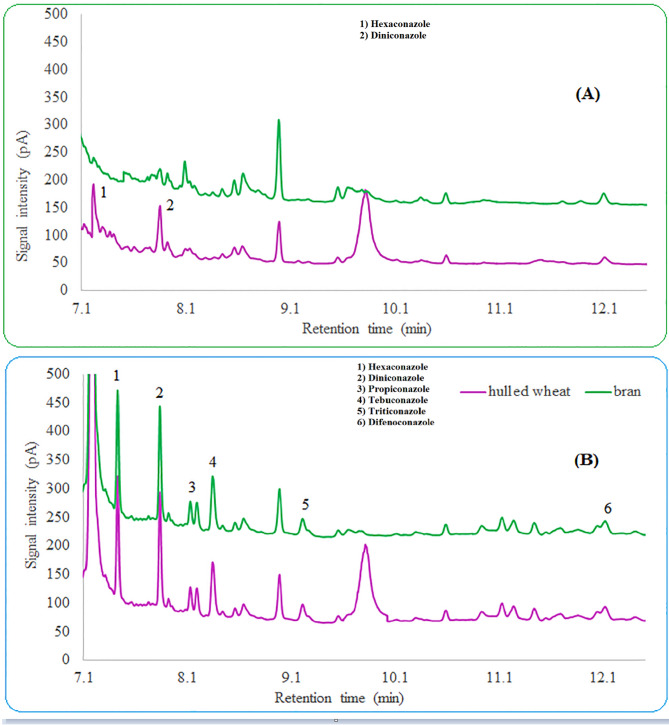
- In wheat, hexaconazole and diniconazole passed through the bran and remained in hulled wheat; the bran-versus-hulled-wheat comparison is reported as a first.
- The AGREE greenness score was 0.56; the method uses 25 µL DES plus 1.5 mL methanol, reported as a 90–98% reduction in solvent consumption versus classical LLE.
Methods
- The DES was prepared by mixing diphenylamine and benzophenone in a 1:1 molar ratio, then ultrasonicating at 35 °C for 1 min until a homogeneous yellow eutectic liquid formed.
- DLLME used 50 mL aqueous sample at pH 3.0; 1500 µL methanol containing 25 µL DES was injected rapidly, shaken manually for 1 min, centrifuged at 5000 rpm for 5 min, and 1 µL of the sedimented DES droplet was injected into GC-FID.
- Rice and wheat were obtained from random stores in Tehran, and river water was collected from three Jajrood River locations and combined; wheat bran was removed and hulled wheat analyzed separately, with samples spiked at 20, 100, and 200 ng mL−1. Validation covered linearity from 1.6 to 1000 ng mL−1, LOD/LOQ, RSDs, enrichment factors, and relative recovery.
Limitations
- Stated: the extraction solvent is not recyclable, and direct injection of DES into the GC system limits solvent recyclability; future immobilization on magnetic nanoparticles could improve greenness.
- Stated: the AGREE score of 0.56 is acceptable but not optimal, and greenness could be improved in future studies.
- Evident: validation and application are limited to six triazole fungicides and wheat, rice, and river water samples; no mass-spectrometric confirmation or broader matrix/analyte coverage is reported in the text.
Model-written summary. Check it against the paper before relying on it.
Integrity signals
Registry
Cites
Statistics
Figures
Verification
Claims the paper makes
1 Valid · 1 Not valid · 3 Not checked · 43 Own results and interpretations
At least one cited source doesn’t support this claim or points to a different paper, and none confirmed it — see the verdicts below.
In the paper
“Hence, 1500 µL methanol (25 µL DES) was selected as the optimal dispersion solvent31.”
§ Hydrophobic deep eutectic solvent-based DLLME for simultaneous determination of triazole fungicides in grain and water samples > Results and discussion > Optimization of the extraction process
What the sources say
- Disputedcites [31] Kachangoon, R., Vichapong, J., Santaladchaiyakit, Y. & Teshima, N. Trace-Level Determination of Triazole Fungicides Using Effervescence-Assisted Liquid–Liquid Microextraction Based on Ternary Deep Eutectic Solvent Prior to High-Performance Liquid Chromatography. ACS Omega. 8, 21332–21340 (2023). 37323407 PMC10268287 sourceExperimental — accuracy not yet measured
The Results and Discussion section on extraction-condition optimization selects 100 μL of TDES as the extracting solvent, not 25 μL of DES. Its solvent optimization selects acetonitrile rather than methanol; the Experimental Section says dispersion was produced by carbon dioxide bubbles, not by 1500 μL of methanol. No page numbers are available in our copy. (LLM, conf=0.88)
Checked by a reasoning model — may be wrong.
plain- Asserted: passes — The authors put it forward as true.
- Checkable: passes — It can be checked against evidence.
- Load-bearing: passes — The paper’s conclusions depend on it.
- Based: passes — The paper gives a reason why it holds.
- Disputed
The cited sources support only part of this claim — read each source’s verdict below.
In the paper
“However, the present method indicates superior performance regarding EFs compared to most reported methods16,30,31,37–43.”
§ Hydrophobic deep eutectic solvent-based DLLME for simultaneous determination of triazole fungicides in grain and water samples > Results and discussion > Analysis of the wheat, rice and river water samples
What the sources say
- Not checked — no full text of the sourcecites [16] Jing, X. et al. Evaporation-assisted dispersive liquid–liquid microextraction based on the solidification of floating organic droplets for the determination of triazole fungicides in water samples by high-performance liquid chromatography. J. Chromatogr. A. 1597, 46–53 (2019). 30926256 source
- Partly supportedcites [30] Bosco, C., Mariani, F. & Gentili, A. Hydrophobic Eutectic Solvent-Based Dispersive Liquid-Liquid Microextraction Applied to the Analysis of Pesticides in Wine. Molecules 27, 908 (2022). 35164176 PMC8839483 sourceExperimental — accuracy not yet measured
Section 2.3 (page unavailable) reports enrichment factors of 43–86 for the cited paper’s method, providing a benchmark for comparison. Section 2.4 compares other performance measures with a few methods, but does not establish that the citing paper’s “present method” has superior EFs to most reported methods. (LLM, conf=0.78)
- Partly supportedcites [31] Kachangoon, R., Vichapong, J., Santaladchaiyakit, Y. & Teshima, N. Trace-Level Determination of Triazole Fungicides Using Effervescence-Assisted Liquid–Liquid Microextraction Based on Ternary Deep Eutectic Solvent Prior to High-Performance Liquid Chromatography. ACS Omega. 8, 21332–21340 (2023). 37323407 PMC10268287 sourceExperimental — accuracy not yet measured
Analytical Performance and Method Validation (page unavailable) reports enrichment factors of 112–142 for the cited method. The Comparison of the Proposed Method with Other Previously Reported Methods section calls its EF high, but Table 3 gives no EFs for the other methods. This source therefore supplies a reported EF for comparison, not evidence that the citing paper’s method outperforms most reported methods on EF. (LLM, conf=0.78)
- Not checked — no full text of the sourcecites [37] Farajzadeh, M. A., Djozan, D. & Khorram, P. Development of a new dispersive liquid-liquid microextraction method in a narrow-bore tube for preconcentration of triazole pesticides from aqueous samples. Anal. Chim. Acta. 713, 70–78 (2012). 22200310 source
- Not checked — no full text of the sourcecites [38] Zhang, Y., Zhang, Y., Zhao, Q., Chen, W. & Jiao, B. Vortex-Assisted Ionic Liquid Dispersive Liquid-Liquid Microextraction Coupled with High-Performance Liquid Chromatography for the Determination of Triazole Fungicides in Fruit Juices. Food Anal. Methods. 9, 596–604 (2016). source
- Not checked — no full text of the sourcecites [39] Wang, H. et al. Detection of triazole pesticides in environmental water and juice samples using dispersive liquid-liquid microextraction with solidified sedimentary ionic liquids. New. J. Chem. 40, 4696–4704 (2016). source
- Not checked — no full text of the sourcecites [40] Kadivar, M. & Aliakbar, A. A new composite based on graphene oxide-poly 3-aminophenol for solid- phase microextraction of four triazole fungicides in water and fruit juices prior to high-performance liquid chromatography analysis. Food Chem. 299, 125127 (2019). 31301528 source
- Not checked — no full text of the sourcecites [41] Aladaghlo, Z., Fakhari, A. R., Alavioon, S. I. & Dabiri, M. Ultrasound assisted dispersive solid phase extraction of triazole fungicides by using an N-heterocyclic carbene copper complex supported on ionic liquid-modified graphene oxide as a sorbent. Microchim Acta186, (2019). 30826862 source
- Not checked — no full text of the sourcecites [42] Aladaghlo, Z., Javanbakht, S., Sahragard, A., Reza Fakhari, A. & Shaabani, A. Cellulose-based nanocomposite for ultrasonic assisted dispersive solid phase microextraction of triazole fungicides from water, fruits, and vegetables samples. Food Chem. 403, 134273 (2023). 36174345 source
- Not checked — no full text of the sourcecites [43] Wei, Q. et al. Tablet-effervescence-assisted dissolved carbon flotation for the extraction of four triazole fungicides in water by gas chromatography with mass spectrometry. J. Sep. Sci. 39, 4603–4609 (2016). 27734583 source
hedged- Asserted: passes — The authors put it forward as true.
- Checkable: passes — It can be checked against evidence.
- Load-bearing: passes — The paper’s conclusions depend on it.
- Based: passes — The paper gives a reason why it holds.
A result the paper reports from its own data — it cites no other source for it, so there is none to check. The quote shows it is in the paper.
In the paper
“Investigating the effects on TFs extraction efficiencies from pH 2.0 to 8.0 indicated that efficiencies increased with rising pH from 2.0 to 3.0 (Fig. S1).”
§ Hydrophobic deep eutectic solvent-based DLLME for simultaneous determination of triazole fungicides in grain and water samples > Results and discussion > Optimization of the extraction process
hedgedstates a cause- Asserted: passes — The authors put it forward as true.
- Checkable: passes — It can be checked against evidence.
- Load-bearing: unclear — It is unclear whether the paper’s conclusions depend on it.
- Based: passes — The paper gives a reason why it holds.
A result the paper reports from its own data — it cites no other source for it, so there is none to check. The quote shows it is in the paper.
In the paper
“Notably, the developed method shows LODs and RSDs similar to those of previous studies.”
§ Hydrophobic deep eutectic solvent-based DLLME for simultaneous determination of triazole fungicides in grain and water samples > Results and discussion > Analysis of the wheat, rice and river water samples
plain- Asserted: passes — The authors put it forward as true.
- Checkable: passes — It can be checked against evidence.
- Load-bearing: unclear — It is unclear whether the paper’s conclusions depend on it.
- Based: passes — The paper gives a reason why it holds.
A result the paper reports from its own data — it cites no other source for it, so there is none to check. The quote shows it is in the paper.
In the paper
“Limits of quantitation (LOQs), calculated at the S/N = 10, were in the range of 1.6 to 3.3 ng mL− 1.”
§ Hydrophobic deep eutectic solvent-based DLLME for simultaneous determination of triazole fungicides in grain and water samples > Results and discussion > Method validation
plain- Asserted: passes — The authors put it forward as true.
- Checkable: passes — It can be checked against evidence.
- Load-bearing: passes — The paper’s conclusions depend on it.
- Based: passes — The paper gives a reason why it holds.
24 more claims
Create a free account to see all 48 claims and every source verdict.
- It may state two separate claims as one. 16
- Probably not a substantial claim. 5
Self-check
Percentages, sums and reported differences re-computed from the paper’s own numbers.
Each contradiction between two passages listed here was confirmed by an independent check.
Rated minor: it would not touch a result — a value no result rests on, a p-value that stays on the same side of the significance level, or a conflict that is clerical, resolved elsewhere in the paper, or outside its own findings.
In the paper
§ Hydrophobic deep eutectic solvent-based DLLME for simultaneous determination of triazole fungicides in grain and water samples > Introduction
“eliminating the need for dispersers or auxiliary devices”
§ Hydrophobic deep eutectic solvent-based DLLME for simultaneous determination of triazole fungicides in grain and water samples > Experimental > DES-DLLME procedure
“1500 µL of dispersion solvent (methanol) containing 25 µL of extraction solvent (DES) was injected quickly”
Rated minor: it would not touch a result — a value no result rests on, a p-value that stays on the same side of the significance level, or a conflict that is clerical, resolved elsewhere in the paper, or outside its own findings.
In the paper
§ Hydrophobic deep eutectic solvent-based DLLME for simultaneous determination of triazole fungicides in grain and water samples > Conclusion
“relatively low RSDs (< 7.1%)”
§ Hydrophobic deep eutectic solvent-based DLLME for simultaneous determination of triazole fungicides in grain and water samples > Results and discussion > Method validation
“5.5 to 7.1% for inter-day (n = 5 × 3 days)”
Citations
Cites
AGREE—Analytical GREEnness Metric Approach and Software
Pena-Pereira, F., Wojnowski, W., & Tobiszewski, M. (2020) · Analytical Chemistry · doi:10.1021/acs.analchem.0c01887 · Cited by 3,983
Physicochemical properties of deep eutectic solvents: A review
Omar, K. A., & Sadeghi, R. (2022) · Journal of Molecular Liquids · doi:10.1016/j.molliq.2022.119524 · Cited by 521 · cited 1×
“Consequently, extraction efficiency decreases above the optimal pH 35,36 .”
Assessing the toxicity and biodegradability of deep eutectic solvents
Wen, Q., Chen, J.-X., Tang, Y.-L., Wang, J., & Yang, Z. (2015) · Chemosphere · doi:10.1016/j.chemosphere.2015.02.061 · Cited by 480 · cited 2×
“Compared to other tested pesticide classes, these interactions were found to be more pronounced for triazole compounds, resulting in rapid and efficient partitioning of the target analytes into the DES phase, even at a low extraction solvent volume 28,29,32 .”
Ilharco, L. M., Garcia, A. R., Lopes da Silva, J., & Vieira Ferreira, L. F. (1997) · Langmuir · doi:10.1021/la962138u · Cited by 137 · cited 1×
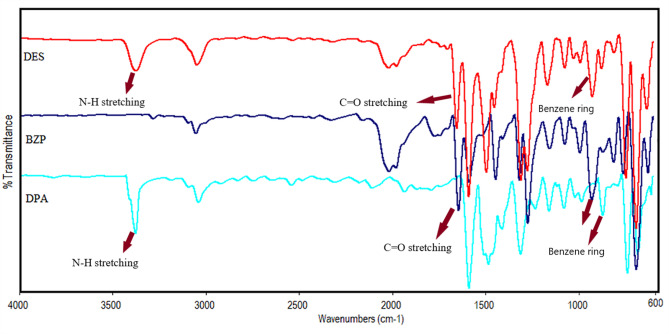
“Importantly, these spectral changes fully agree with the interaction patterns previously reported for this DES system in the literature 29,34 , confirming that the DES synthesized in this work exhibits the same hydrogen-bonding and non-covalent assembly characteristics.”
Chen, Y., & Yu, Z. (2023) · Green Chemical Engineering · doi:10.1016/j.gce.2023.11.001 · Cited by 134
Airouyuwa, J. O., Sivapragasam, N., Redha, A. A., & Maqsood, S. (2024) · Food Chemistry · doi:10.1016/j.foodchem.2024.139061 · Cited by 132 · cited 2×
“A different class of solvents called deep eutectic solvents (DESs), are formed by harmonious blends of two solids acting as hydrogen bond donor (HBD) and acceptor (HBA) 21,22 .”
Farajzadeh, M. A., Djozan, D., & Khorram, P. (2012) · Analytica Chimica Acta · doi:10.1016/j.aca.2011.11.030 · Cited by 89 · cited 1×
“However, the present method indicates superior performance regarding EFs compared to most reported methods 16,30,31,37–43 .”
Liu, G., Tian, M., Lu, M., Shi, W., Li, L., Gao, Y., Li, T., & Xu, D. (2021) · Journal of Chromatography B · doi:10.1016/j.jchromb.2020.122500 · Cited by 89
Jalbani, N. B., & Soylak, M. (2014) · Food Chemistry · doi:10.1016/j.foodchem.2014.07.015 · Cited by 80 · cited 1×
“Extensive attention has been attributed to ionic liquids (ILs) as a versatile solvent class, which includes advantageous features like low melting points, exceptionally low vapor pressures, high thermal stability, and customizable molecular properties 19,20 .”
Tüzen, M., Uluözlü, Ö. D., Mendil, D., Soylak, M., Machado, L. O. R., dos Santos, W. N. L., & Ferreira, S. L. C. (2017) · Food Chemistry · doi:10.1016/j.foodchem.2017.10.115 · Cited by 67 · cited 1×
“Extensive attention has been attributed to ionic liquids (ILs) as a versatile solvent class, which includes advantageous features like low melting points, exceptionally low vapor pressures, high thermal stability, and customizable molecular properties 19,20 .”
Han, X., Chen, J., Li, Z., Quan, K., & Qiu, H. (2020) · Analytica Chimica Acta · doi:10.1016/j.aca.2020.06.077 · Cited by 66
Senosy, I. A., Zhang, X., Lu, Z.-H., Guan, X., Yang, Z., Li, J., Guo, H., Abdelrahman, T. M., Mmby, M., & Gbiliy, A. S. F. (2021) · Microchimica Acta · doi:10.1007/s00604-020-04648-2 · Cited by 61
Aladaghlo, Z., Javanbakht, S., Sahragard, A., Reza Fakhari, A., & Shaabani, A. (2023) · Food Chemistry · doi:10.1016/j.foodchem.2022.134273 · Cited by 54
Self-citationZhang, Y., Zhang, Y., Zhao, Q., Chen, W., & Jiao, B. (2016) · Food Analytical Methods · doi:10.1007/s12161-015-0223-6 · Cited by 54
Pang, J., Mei, M., Yuan, D., & Huang, X. (2018) · Talanta · doi:10.1016/j.talanta.2018.03.005 · Cited by 52
Jing, X., Huang, X., Zhang, Y., Wang, M., Xue, H., Wang, X., & Jia, L. (2021) · Food Chemistry · doi:10.1016/j.foodchem.2021.130664 · Cited by 49
Shahsavani, A., Aladaghlo, Z., & Fakhari, A. R. (2023) · Microchimica Acta · doi:10.1007/s00604-023-05948-z · Cited by 44
Self-citationJing, X., Yang, L., Zhao, W., Wang, F., Chen, Z., Ma, L., Jia, L., & Wang, X. (2019) · Journal of Chromatography A · doi:10.1016/j.chroma.2019.03.040 · Cited by 44 · cited 2×
“However, the present method indicates superior performance regarding EFs compared to most reported methods 16,30,31,37–43 .”
Jing, X., Xue, H., Sang, X., Wang, X., & Jia, L. (2022) · Food Chemistry · doi:10.1016/j.foodchem.2022.133220 · Cited by 44 · cited 2×
“Cost-effectiveness, higher biodegradability, and simplified preparation are particular characteristics of a DES that can be considered as additional superiorities over ILs 23–26 .”
Seetha, B. S., Ganneru, S., Thati, R., & Mudiam, M. K. R. (2023) · Food Chemistry · doi:10.1016/j.foodchem.2022.134778 · Cited by 44 · cited 2×
“In the context of DLLME, hydrophobic DESs have shown great promise as an appropriate candidate due to their preferential affinity for organic compounds and excellent extraction capabilities 28,29 .”
Kadivar, M., & Aliakbar, A. (2019) · Food Chemistry · doi:10.1016/j.foodchem.2019.125127 · Cited by 43
Aladaghlo, Z., Fakhari, A. R., Alavioon, S. I., & Dabiri, M. (2019) · Microchimica Acta · doi:10.1007/s00604-019-3276-1 · Cited by 42
Self-citationZhang, K., Wang, J., Guo, R., Nie, Q., & Zhu, G. (2024) · Food Chemistry · doi:10.1016/j.foodchem.2024.138425 · Cited by 40 · cited 1×
“Consequently, small droplets are separated manually by centrifugation 16–18 .”
Wang, H., Yang, X., Hu, L., Gao, H., Lu, R., Zhang, S., & Zhou, W. (2016) · New Journal of Chemistry · doi:10.1039/c5nj03376d · Cited by 40
Seebunrueng, K., Tamuang, S., Ruangchai, S., Sansuk, S., & Srijaranai, S. (2021) · Microchemical Journal · doi:10.1016/j.microc.2021.106396 · Cited by 40 · cited 2×
“The first one involves employing an adsorbent, with extraction methods such as solid-phase extraction (SPE) 7 and solid-phase microextraction (SPME) 8 and sustainable sorptive extractions such as fabric phase sorptive extraction (FPSE) 9 , cationic paper sorptive extraction (CPSE) 10 , and disposable in-tip cellulose…”
Yang, M., Gu, Y., Wu, X., Xi, X., Yang, X., Zhou, W., Zeng, H., Zhang, S., Lu, R., Gao, H., et al. (2017) · Food Chemistry · doi:10.1016/j.foodchem.2017.06.080 · Cited by 39 · cited 2×
“The first one involves employing an adsorbent, with extraction methods such as solid-phase extraction (SPE) 7 and solid-phase microextraction (SPME) 8 and sustainable sorptive extractions such as fabric phase sorptive extraction (FPSE) 9 , cationic paper sorptive extraction (CPSE) 10 , and disposable in-tip cellulose…”
Farisi, P., Mogaddam, M. R. A., Farajzadeh, M. A., & Nemati, M. (2022) · Journal of Food Composition and Analysis · doi:10.1016/j.jfca.2022.105107 · Cited by 39 · cited 1×
“A different class of solvents called deep eutectic solvents (DESs), are formed by harmonious blends of two solids acting as hydrogen bond donor (HBD) and acceptor (HBA) 21,22 .”
Chen, L., Liao, S., Yu, D., Li, L., Mu, T., & Xue, Z. (2023) · Separation and Purification Technology · doi:10.1016/j.seppur.2022.122903 · Cited by 35 · cited 4×
“In the context of DLLME, hydrophobic DESs have shown great promise as an appropriate candidate due to their preferential affinity for organic compounds and excellent extraction capabilities 28,29 .”
InfluentialWei, Q., Song, Z., Nie, J., Xia, H., Chen, F., Li, Z., & Lee, M. (2016) · Journal of Separation Science · doi:10.1002/jssc.201600619 · Cited by 33 · cited 1×
“However, the present method indicates superior performance regarding EFs compared to most reported methods 16,30,31,37–43 .”
Chu, S.-P., Tseng, W.-C., Kong, P.-H., Huang, C.-K., Chen, J.-H., Chen, P.-S., & Huang, S.-D. (2015) · Food Chemistry · doi:10.1016/j.foodchem.2015.04.015 · Cited by 31 · cited 1×
“By employing a low volume of a simply synthesized aryl-based hydrophobic DES and eliminating the need for dispersers or auxiliary devices, the proposed approach significantly reduces solvent consumption and operational cost while enhancing extraction efficiency toward triazole fungicides 33 .”
Zhang, Y., Ren, T., Fu, R., Lu, Q., Guo, X., & Di, X. (2023) · Journal of Chromatography A · doi:10.1016/j.chroma.2023.464149 · Cited by 30 · cited 1×
“The second category of pesticides extraction methods is solvent-based and includes techniques such as liquid-liquid extraction (LLE) 12,13 , liquid phase microextraction (LPME) 14 , and dispersive liquid-liquid microextraction (DLLME) 15 .”
Dal Bosco, C., Mariani, F., & Gentili, A. (2022) · Molecules · doi:10.3390/molecules27030908 · Cited by 28 · cited 2×
“The adsorption of TFs using hydrophobic DESs based on fatty acids, phenols and terpenoids has been documented in environmental water and wine samples 30,31 .”
Monajjemzadeh, F., Mohebbi, A., Farajzadeh, M. A., Nemati, M., & Mogaddam, M. R. A. (2020) · Journal of Food Composition and Analysis · doi:10.1016/j.jfca.2020.103696 · Cited by 26 · cited 13×
“In conventional DLLME-based methods, solubility-related limitations often arise from partial dissolution of the extraction solvent in the aqueous phase or insufficient affinity between the extractant and target analytes, leading to reduced enrichment factors and compromised extraction efficiency.”
InfluentialMakoś‐Chełstowska, P., Kucharska, K., Słupek, E., Gębicki, J., & de la Guárdia, M. (2023) · Journal of Molecular Liquids · doi:10.1016/j.molliq.2023.122945 · Cited by 25
Kachangoon, R., Vichapong, J., Santaladchaiyakit, Y., & Teshima, N. (2023) · ACS Omega · doi:10.1021/acsomega.3c02919 · Cited by 25 · cited 3×
“Hence, 1500 µL methanol (25 µL DES) was selected as the optimal dispersion solvent 31 .”
Ganneru, S., Seetha, B. S., & Mudiam, M. K. R. (2023) · Journal of Chromatography A · doi:10.1016/j.chroma.2023.464338 · Cited by 20 · cited 1×
“Consequently, extraction efficiency decreases above the optimal pH 35,36 .”
Jain, R., Singh, M., Ali, N., Khan, M. R., Bajaj, A., & Mudiam, M. K. R. (2024) · Journal of Chromatography B · doi:10.1016/j.jchromb.2024.124268 · Cited by 19
Zhang, K., Guo, R. W., Wang, Y., Nie, Q., & Zhu, G. (2022) · Food Chemistry · doi:10.1016/j.foodchem.2022.132414 · Cited by 19
Yue, Y., Wang, M., Qi, Y., Han, J., Yang, Y., Li, J., Qin, S., & Jing, X. (2024) · Journal of Food Composition and Analysis · doi:10.1016/j.jfca.2024.106796 · Cited by 17 · cited 1×
“Cost-effectiveness, higher biodegradability, and simplified preparation are particular characteristics of a DES that can be considered as additional superiorities over ILs 23–26 .”
Liu, J., Nie, Y., Niu, Y., Li, L., & Jing, X. (2024) · Food Chemistry · doi:10.1016/j.foodchem.2024.140407 · Cited by 14 · cited 1×
“The second category of pesticides extraction methods is solvent-based and includes techniques such as liquid-liquid extraction (LLE) 12,13 , liquid phase microextraction (LPME) 14 , and dispersive liquid-liquid microextraction (DLLME) 15 .”
Pedraza-Soto, A. M., Lucena, R., & Cárdenas, S. (2024) · Sustainable Chemistry and Pharmacy · doi:10.1016/j.scp.2024.101723 · Cited by 14 · cited 2×
“The first one involves employing an adsorbent, with extraction methods such as solid-phase extraction (SPE) 7 and solid-phase microextraction (SPME) 8 and sustainable sorptive extractions such as fabric phase sorptive extraction (FPSE) 9 , cationic paper sorptive extraction (CPSE) 10 , and disposable in-tip cellulose…”
Fatemi, F. S., Shahsavani, A., & Fakhari, A. R. (2025) · Microchemical Journal · doi:10.1016/j.microc.2025.113302 · Cited by 7 · cited 1×
“By carefully selecting precursors, researchers have successfully created hydrophobic DESs with unique characteristics that give them an advantage over their hydrophilic counterparts 27 .”
Self-citationWang, L. P., Hou, J., Chen, Y. J., Tseng, B. C., & Babel, S. (2024) · Minerals Engineering · doi:10.1016/j.mineng.2024.108572 · Cited by 3 · cited 2×
“The second category of pesticides extraction methods is solvent-based and includes techniques such as liquid-liquid extraction (LLE) 12,13 , liquid phase microextraction (LPME) 14 , and dispersive liquid-liquid microextraction (DLLME) 15 .”
Influentialmrls @ ec.europa.eu. at https://ec.europa.eu/food/plant/pesticides/eu-pesticides-database/start/screen/mrls
(n.d.)
Unresolved
Cited by
Samanpong, N., Rattakham, K., Wongsaipun, S., Dubey, M., & Chaiyasith, W. C. (2026) · Food Analytical Methods · doi:10.1007/s12161-026-03282-7
“Recent developments in dispersive liquid–liquid microextraction, including hydrophobic deep eutectic solvent systems, further demonstrate the potential of liquid-phase dispersion for rapid and low-solvent sample preparation (Fatemi et al. 2026).”
Samanpong, N., Putkham, A. I., Wongsaipun, S., Janrungroatsakul, W., Sirikulkajorn, A., Dubey, M., & Chaiyasith, W. C. (2026) · Food Analytical Methods · doi:10.1007/s12161-026-03313-3
“(Fatemi et al. 2026).”
Metadata
- Authors
- Fatemi, F. S., Shahsavani, A., Aladaghlo, Z., & Fakhari, A. R.
- Affiliations
- Shahid Beheshti University (IR)
- University of Tehran (IR)
- Corresponding author
- Fakhari, Ali Reza
- Venue
- Scientific Reports
- Published
- 2026-05-06
- Volume
- 16
- Issue
- 1
- ISSN
- 2045-2322 (ISSN-L)
- PMC
- PMC13338161
- OpenAlex
- W7160372687
- Cited by
- 2
- References
- 44
- Citations by year
- 2026: 2
- FWCI
- 3.36
- Type
- journal article
- Language
- en
- Open access
- gold
- doi.org
- Licence
- cc-by-nc-nd
- creativecommons.org/licenses/by-nc-nd/4.0 (tdm)
- creativecommons.org/licenses/by-nc-nd/4.0 (vor, 62 d)
- Locations
- Scientific Reports (publishedVersion, cc-by-nc-nd)
- PubMed (publishedVersion)
- PubMed Central (publishedVersion, cc-by-nc-nd)
- DOAJ (DOAJ: Directory of Open Access Journals) (submittedVersion)
- Topics
- Physical Sciences › Chemistry › Analytical Chemistry › Analytical chemistry methods development
- Life Sciences › Agricultural and Biological Sciences › Food Science › Pesticide Residue Analysis and Safety
- Physical Sciences › Chemistry › Physical and Theoretical Chemistry › Ionic liquids properties and applications
- Keywords
- triazole fungicides, deep eutectic solvents, dispersive liquid-liquid microextraction, pesticide residues, grain contamination, wheat, rice, water samples, diphenylamine, benzophenone, residue monitoring, sample preparation
- MeSH terms
- Deep Eutectic Solvents, Edible Grain, Fungicides, Industrial, Oryza, Solvents, Triazoles, Water, Water Pollutants, Chemical, Triticum, Hydrophobic and Hydrophilic Interactions, Liquid Phase Microextraction
About these checks
Registry, retraction, Cites and statistics results are computed, not judged, with one exception: a printed reference that no index lists is read once by a model before it counts as a citation error. Claims are extracted by a model and kept only when their quote appears verbatim in the text; each cited source is then checked, with a model’s help, for whether it says what the claim relies on. Those verdicts can be wrong — read the claim’s quote and the cited source before relying on one.
The claim verdicts this report counts are experimental: their accuracy is not yet measured.
A language model drew the claims from the paper on 2026-09-29, under version 3 of the claim definition (model deepseek-v4.1-flash, prompt extract-v3).
A second model labelled each claim on 2026-09-29 (model jev-1.13-20260917, definition revision gold-guideline-v0.2).
Cited sources are checked with a language model’s help (gpt-6-sol).
Statistics and arithmetic are recomputed, not judged.
Confidence bands are shown only for fields calibrated on our annotated test set. None is calibrated yet, so no band is shown.
What counts as a claim ›How we measure confidence ›How we check this ›
Are you an author, or do you see a problem with this page? Request a review
Data sources
Bibliographic data: Semantic Scholar, OpenAlex, Crossref.
Contains information from the Semantic Scholar Academic Graph Datasets, made available under the ODC Attribution License (ODC-BY 1.0).
Semantic Scholar’s data is described in: Kinney, R., et al. (2023). The Semantic Scholar Open Data Platform. arXiv:2301.10140.
