

The DOI matches its Crossref record; 30 of the 30 references it cites were found in a registry or an index.
Hydrophobic Eutectic Solvent-Based Dispersive Liquid-Liquid Microextraction Applied to the Analysis of Pesticides in Wine
Open accessAbstract
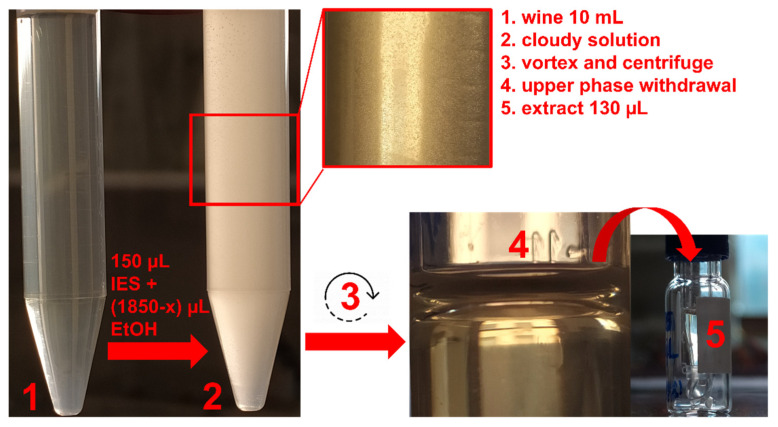
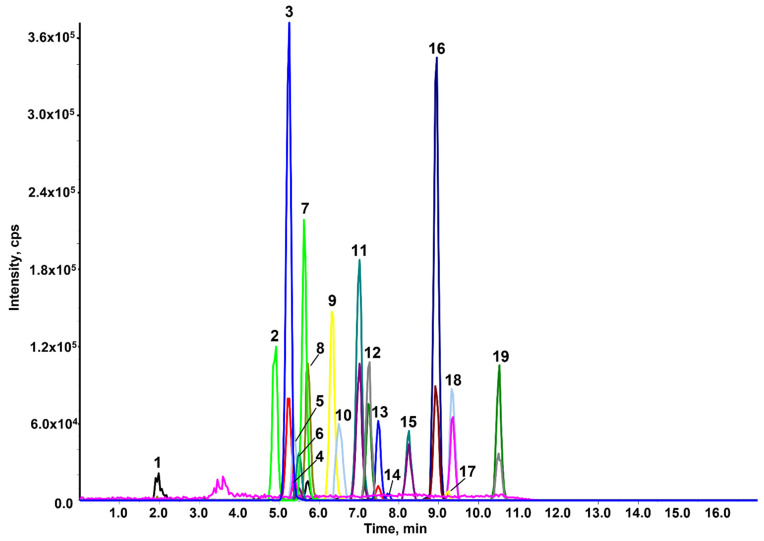
A green solvent-based DLLME/HPLC-MS method for the determination of 19 pesticides in wine samples has been developed. The extractant solvent is a hydrophobic eutectic mixture composed of L-menthol and butylated hydroxytoluene in a molar ratio of 3:1. The endogenous ethanol of wine has been used as dispersive solvent, in order to avoid the solidification of the extracts under 19 °C. The mobile phase composition, the elution gradient and the sample injection volume were optimized in order to make this hydrophobic mixture compatible with conventional reversed phase chromatography and electrospray ionization. The method was validated in matrix, using a wine free from the target compounds. Average recovery as high as 80%, precision between 3 and 14%, and limits of detection and quantification much lower than the maximum residue levels (MRLs) for grapes and wines fixed by the EU regulation, make this multiresidue method fitted for the purpose, with the further advantages of being quick, cheap and in compliance with the green analytical chemistry. From the analysis of 11 commercial wines it was found that just in a bio sample the target compounds were not detectable or lower than quantification limit; as for the other samples, the most widespread and abundant pesticides were methoxyfenozide and boscalid, but their levels were much lower than the relative MRLs.
Overview
The claims and statistics of this paper haven’t been checked yet.
Free: it reads the open-access text and checks the first 5 claims that cite a source we can check. Create a free account to check every claim.
Integrity signals
Registry
Cites
Statistics
Figures
Verification
Claims the paper makes
The claims and statistics of this paper haven’t been checked yet.
Free: it reads the open-access text and checks the first 5 claims that cite a source we can check. Create a free account to check every claim.
Claims other papers make about this one
Each is checked against this paper’s own text: does it say what the citing paper says it does?
The source backs part of the claim, not all of it — or backs it for a different population, condition or comparison.
In the citing paper
“However, the present method indicates superior performance regarding EFs compared to most reported methods16,30,31,37–43.”
From Hydrophobic deep eutectic solvent-based DLLME for simultaneous determination of triazole fungicides in grain and water samples (2026) · cites this paper as [30]
Experimental — accuracy not yet measuredThe cited source says what the claim attributes to it.
In the citing paper
“Among these, DLLME-based methods are still widely adopted due to their fast extraction kinetics, reduced solvent usage, simple sample handling, and high preconcentration capability [46,47,57,63,66,67,71,81,83,85,87,89,90].”
From Eco-Friendly Deep Eutectic Solvent-Based Extraction Technologies: A Comprehensive Review of Principles, Applications, and Comparative Insights (2026) · cites this paper as [66]
Self-check
Percentages, sums and reported differences re-computed from the paper’s own numbers.
The self-check needs the paper’s full text.
Citations
Cites
Anastassiades, M., Lehotay, S. J., Štajnbaher, D., & Schenck, F. J. (2003) · Journal of AOAC INTERNATIONAL · doi:10.1093/jaoac/86.2.412 · Cited by 5,670 · cited 1×
“[7], its success is due to the microscale extraction, which reduces the organic solvent consumption, and to the simple and fast procedure.”
BackgroundDetermination of organic compounds in water using dispersive liquid–liquid microextraction
Rezaee, M., Assadi, Y., Milani Hosseini, M.-R., Aghaee, E., Ahmadi, F., & Berijani, S. (2006) · Journal of Chromatography A · doi:10.1016/j.chroma.2006.03.007 · Cited by 3,402 · cited 1×
“, in 2006 [9], is recognized for its simplicity, low cost, and high ER.”
BackgroundNarenderan, S. T., Meyyanathan, S. N., & Babu, B. (2020) · Food Research International · doi:10.1016/j.foodres.2020.109141 · Cited by 413
Pesticide Residues in Grapes, Wine, and Their Processing Products
Cabras, P., & Angioni, A. (2000) · Journal of Agricultural and Food Chemistry · doi:10.1021/jf990727a · Cited by 372
Rykowska, I., Ziemblińska, J., & Nowak, I. (2018) · Journal of Molecular Liquids · doi:10.1016/j.molliq.2018.03.043 · Cited by 353
Cortese, M., Gigliobianco, M. R., Magnoni, F., Censi, R., & Di Martino, P. (2020) · Molecules · doi:10.3390/molecules25133047 · Cited by 280
Utilization of deep eutectic solvents in dispersive liquid-liquid micro-extraction
Li, G., & Row, K. H. (2019) · TrAC Trends in Analytical Chemistry · doi:10.1016/j.trac.2019.115651 · Cited by 186
Jia, L., Huang, X., Zhao, W., Wang, H., & Jing, X. (2020) · Food Chemistry · doi:10.1016/j.foodchem.2020.126424 · Cited by 96 · cited 1×
“As far as this last category is concerned, to the best of our knowledge, only four methods applied the DLLME by using a green extraction solvent, such as 1-undecanol [14] and 1-octanol [15], or 1-dodecanol [16] and a hydrophobic eutectic solvent based on thymol and octanoic acid [17].”
MethodCampone, L., Piccinelli, A. L., & Rastrelli, L. (2010) · Analytical and Bioanalytical Chemistry · doi:10.1007/s00216-010-4347-7 · Cited by 89
Zhang, Y., Zhang, X., & Jiao, B. (2014) · Food Chemistry · doi:10.1016/j.foodchem.2014.03.028 · Cited by 79
Research works printed but not linked: 1
- WHO (2003, January 15–24). Pesticide residues in food—Report 2003. Proceedings of the Joint Meeting of the FAO Panel of Experts on Pesticide Residues in Food and the Environment and the WHO Core Assessment Group on Pesticide Residues, Geneva, Switzerland.
Cited by
Sportiello, L., Favati, F., Condelli, N., Di Cairano, M., Caruso, M. C., Simonato, B., Tolve, R., & Galgano, F. (2023) · Food Chemistry · doi:10.1016/j.foodchem.2022.134703 · Cited by 87
Fatemi, F. S., Shahsavani, A., Aladaghlo, Z., & Fakhari, A. R. (2026) · Scientific Reports · doi:10.1038/s41598-026-51500-3 · Cited by 2
“The adsorption of TFs using hydrophobic DESs based on fatty acids, phenols and terpenoids has been documented in environmental water and wine samples 30,31 .”
Alahmadi, S. M., & Abu-Dief, A. M. (2026) · Sustainable Chemistry · doi:10.3390/suschem7030033 · Cited by 1
“Among these, DLLME-based methods are still widely adopted due to their fast extraction kinetics, reduced solvent usage, simple sample handling, and high preconcentration capability [46,47,57,63,66,67,71,81,83,85,87,89,90].”
Metadata
- Authors
- Dal Bosco, C., Mariani, F., & Gentili, A.
- Affiliations
- Department of Chemistry, Sapienza University of Rome, 00185 Rome, Italy
- Sapienza University of Rome (IT)
- ORCID
- Gentili, Alessandra
- Venue
- Molecules
- Publisher
- MDPI AG
- Published
- 2022-01-28
- Volume
- 27
- Issue
- 3
- Pages
- 908
- ISSN
- 1420-3049 (ISSN-L)
- PMC
- PMC8839483
- OpenAlex
- W4213136993
- Cited by
- 28
- References
- 30
- Citations by year
- 2026: 2 · 2025: 10 · 2024: 5 · 2023: 6 · 2022: 5
- FWCI
- 2.96
- Type
- journal article
- Language
- en
- Open access
- gold
- doi.org
- Licence
- Locations
- Molecules (publishedVersion, cc-by)
- PubMed Central (publishedVersion, cc-by)
- PubMed (publishedVersion)
- IRIS Research product catalog (Sapienza University of Rome) (submittedVersion, cc-by)
- DOAJ (DOAJ: Directory of Open Access Journals) (submittedVersion, cc-by-sa)
- Funders
- Sapienza University of Rome (RG11916B6451D44A)
- Topics
- Physical Sciences › Chemistry › Analytical Chemistry › Analytical chemistry methods development
- Life Sciences › Agricultural and Biological Sciences › Food Science › Pesticide Residue Analysis and Safety
- Physical Sciences › Chemistry › Analytical Chemistry › Analytical Chemistry and Chromatography
- Keywords
- dispersive liquid-liquid microextraction, hydrophobic eutectic solvents, L-menthol, butylated hydroxytoluene, multiresidue analysis, green analytical chemistry, HPLC-MS, maximum residue limits, methoxyfenozide, boscalid
About these checks
Registry, retraction, Cites and statistics results are computed, not judged, with one exception: a printed reference that no index lists is read once by a model before it counts as a citation error. Claims are extracted by a model and kept only when their quote appears verbatim in the text; each cited source is then checked, with a model’s help, for whether it says what the claim relies on. Those verdicts can be wrong — read the claim’s quote and the cited source before relying on one.
Statistics and arithmetic are recomputed, not judged.
Confidence bands are shown only for fields calibrated on our annotated test set. None is calibrated yet, so no band is shown.
What counts as a claim ›How we measure confidence ›How we check this ›
Are you an author, or do you see a problem with this page? Request a review
How to cite
Cite CoChat for the checks on this page, and the paper for its own findings.
- This page
- CoChat. (2026). Citation check: Hydrophobic Eutectic Solvent-Based Dispersive Liquid-Liquid Microextraction Applied to the Analysis of Pesticides in Wine. https://app.cochat.ai/papers/10.3390/molecules27030908
- The paper
- Dal Bosco, C., Mariani, F., & Gentili, A. (2022). Hydrophobic Eutectic Solvent-Based Dispersive Liquid-Liquid Microextraction Applied to the Analysis of Pesticides in Wine. Molecules. https://doi.org/10.3390/molecules27030908
Data sources
Bibliographic data: Semantic Scholar, OpenAlex, Crossref.
Contains information from the Semantic Scholar Academic Graph Datasets, made available under the ODC Attribution License (ODC-BY 1.0).
Semantic Scholar’s data is described in: Kinney, R., et al. (2023). The Semantic Scholar Open Data Platform. arXiv:2301.10140.
