

The DOI matches its Crossref record; 102 of the 102 references it cites were found in a registry or an index.
Photoplethysmography based atrial fibrillation detection: a review
Open accessAbstract
Atrial fibrillation (AF) is a cardiac rhythm disorder associated with increased morbidity and mortality. It is the leading risk factor for cardioembolic stroke and its early detection is crucial in both primary and secondary stroke prevention. Continuous monitoring of cardiac rhythm is today possible thanks to consumer-grade wearable devices, enabling transformative diagnostic and patient management tools. Such monitoring is possible using low-cost easy-to-implement optical sensors that today equip the majority of wearables. These sensors record blood volume variations—a technology known as photoplethysmography (PPG)—from which the heart rate and other physiological parameters can be extracted to inform about user activity, fitness, sleep, and health. Recently, new wearable devices were introduced as being capable of AF detection, evidenced by large prospective trials in some cases. Such devices would allow for early screening of AF and initiation of therapy to prevent stroke. This review is a summary of a body of work on AF detection using PPG. A thorough account of the signal processing, machine learning, and deep learning approaches used in these studies is presented, followed by a discussion of their limitations and challenges towards clinical applications.
Overview
The claims and statistics of this paper haven’t been checked yet.
Run the check — free, no account needed. It reads the open-access text and checks the sources it cites.
Integrity signals
Registry
Cites
Statistics
Figures
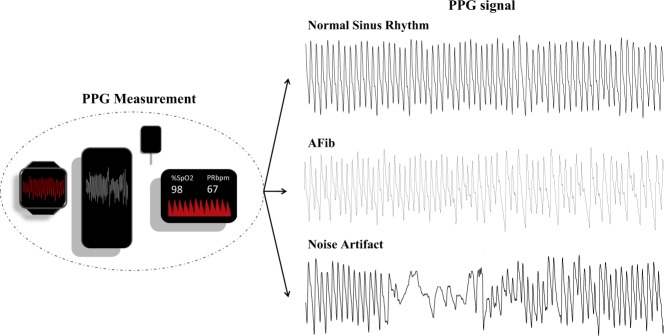
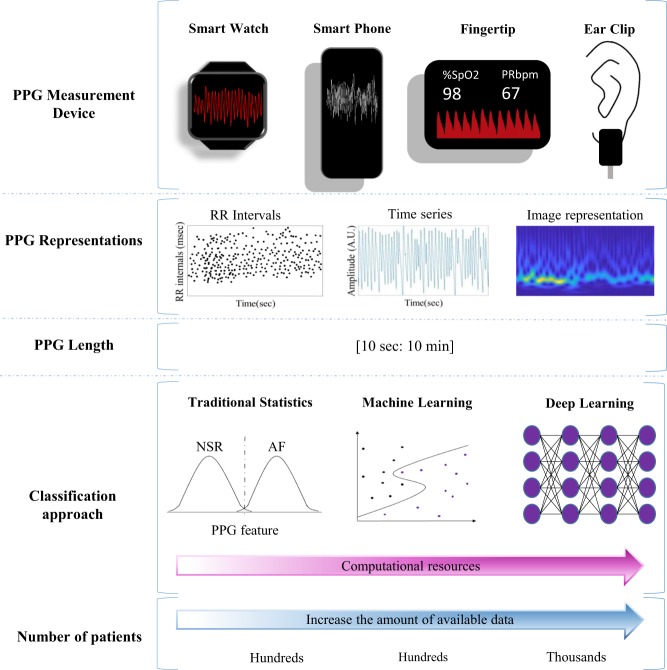
Verification
Claims the paper makes
The claims and statistics of this paper haven’t been checked yet.
Run the check — free, no account needed. It reads the open-access text and checks the sources it cites.
Claims other papers make about this one
Each is checked against this paper’s own text: does it say what the citing paper says it does?
In the citing paper
“atrial fibrillation (AF), which can be identified from pulse wave signals due to the irregular heart rhythm produced by AF”
From Wearable Photoplethysmography for Cardiovascular Monitoring (2022) · cites this paper as [27]
In the citing paper
“Several techniques have been proposed to assess the irregularity of IBIs and the shape of pulse waves in order to detect AF from the PPG”
From Wearable Photoplethysmography for Cardiovascular Monitoring (2022) · cites this paper as [27]
Self-check
Percentages, sums and reported differences re-computed from the paper’s own numbers.
The self-check needs the paper’s full text.
Citations
Cites
Deep Residual Learning for Image Recognition
He, K., Zhang, X., Ren, S., & Sun, J. (2016) · 2016 IEEE Conference on Computer Vision and Pattern Recognition (CVPR) · doi:10.1109/cvpr.2016.90 · Cited by 235,474
Rethinking the Inception Architecture for Computer Vision
Szegedy, C., Vanhoucke, V., Ioffe, S., Shlens, J., & Wojna, Z. (2016) · 2016 IEEE Conference on Computer Vision and Pattern Recognition (CVPR) · doi:10.1109/cvpr.2016.308 · Cited by 32,138
Ror2 signaling regulates Golgi structure and transport through IFT20 for tumor invasiveness
Nishita, M., Park, S.-Y., Nishio, T., Kamizaki, K., Wang, Z., Tamada, K., Takumi, T., Hashimoto, R., Otani, H., Pazour, G. J., et al. (2017) · Scientific Reports · doi:10.1038/s41598-016-0028-x · Cited by 15,947
Goldberger, A. L., Amaral, L. A. N., Glass, L., Hausdorff, J. M., Ivanov, P. C., Mark, R. G., Mietus, J. E., Moody, G. B., Peng, C.-K., & Stanley, H. E. (2000) · Circulation · doi:10.1161/01.cir.101.23.e215 · Cited by 14,809
Zhang, Q., Wang, C., Zheng, M., Li, Y., Li, J., Zhang, L., Shang, X., & Yan, C. (2014) · Cerebrovascular Diseases · doi:10.1159/000369778 · Cited by 11,609
2016 ESC Guidelines for the management of atrial fibrillation developed in collaboration with EACTS
Kirchhof, P. F., Benussi, S., Kotecha, D., Ahlsson, A., Atar, D., Casadei, B., Castellà, M., Diener, H., Heidbüchel, H., Hendriks, J., et al. (2016) · EP Europace · doi:10.1093/europace/euw295 · Cited by 6,438
2016 ESC Guidelines for the management of atrial fibrillation developed in collaboration with EACTS
Kirchhof, P., Benussi, S., Kotecha, D., Ahlsson, A., Atar, D., Casadei, B., Castella, M., Diener, H.-C., Heidbuchel, H., Hendriks, J., et al. (2016) · European Heart Journal · doi:10.1093/eurheartj/ehw210 · Cited by 6,418
Saito, T., & Rehmsmeier, M. (2015) · PLOS ONE · doi:10.1371/journal.pone.0118432 · Cited by 5,309
Kernan, W. N., Ovbiagele, B., Black, H. R., Bravata, D. M., Chimowitz, M. I., Ezekowitz, M. D., Fang, M. C., Fisher, M., Furie, K. L., Heck, D. V., et al. (2014) · Stroke · doi:10.1161/str.0000000000000024 · Cited by 5,170
The impact of the MIT-BIH Arrhythmia Database
Moody, G. B., & Mark, R. G. (2001) · IEEE Engineering in Medicine and Biology Magazine · doi:10.1109/51.932724 · Cited by 4,834
Research works printed but not linked: 5
- Singh, D. et al. Worldwide epidemiology of atrial fibrillation. Circulation 129, 837–847 (2013).
- Tripathi, S., San, U. C., Zachary, D., Lipton, C. & Nguyen, T. Q. Correction by projection: denoising images with generative adversarial networks. Preprint at http://arXiv.org/1803.04477v1 (2018).
- Rolnick, D., Veit, A., Belongie, S. & Shavit, N. Deep learning is robust to massive label noise. Preprint at http://arXiv.org/1705.10694 [cs.LG] (2017).
- Xu, M., Qian, F. & Pushp, S. Enabling cooperative inference of deep learning on wearables and smartphones. Preprint at http://arXiv.org/1712.03073, 1–21 (2017).
- Schack, T., Harb, Y. S., Muma, M. & Zoubir, A. M. Computationally Efficient Algorithm for Photoplethysmography-Based Atrial Fibrillation Detection Using Smartphones. In 38th Annual International Conference of the IEEE Engineering in Medicine and Biology Society. 104–108 (2017). · DOI
Cited by
Sorted by citations
Brundel, B. J. J. M., Ai, X., Hills, M. T., Kuipers, M. F., Lip, G. Y. H., & de Groot, N. M. S. (2022) · Nature Reviews Disease Primers · doi:10.1038/s41572-022-00347-9 · Cited by 545
Photoplethysmogram Analysis and Applications: An Integrative Review
Park, J., Seok, H. S., Kim, S.-S., & Shin, H. (2022) · Frontiers in Physiology · doi:10.3389/fphys.2021.808451 · Cited by 514
Wearable Photoplethysmography for Cardiovascular Monitoring
Charlton, P. H., Kyriacou, P. A., Mant, J., Marozas, V., Chowienczyk, P., & Alastruey, J. (2022) · Proceedings of the IEEE · doi:10.1109/jproc.2022.3149785 · Cited by 250
Krittanawong, C., Rogers, A. J., Johnson, K. W., Wang, Z., Turakhia, M. P., Halperin, J. L., & Narayan, S. M. (2020) · Nature Reviews Cardiology · doi:10.1038/s41569-020-00445-9 · Cited by 248
The 2023 wearable photoplethysmography roadmap
Charlton, P. H., Allen, J., Bailón, R., Baker, S., Behar, J. A., Chen, F., Clifford, G. D., Clifton, D. A., Davies, H. J., Ding, C., et al. (2023) · Physiological Measurement · doi:10.1088/1361-6579/acead2 · Cited by 233
Self-citation
Metadata
- Authors
- Pereira, T., Tran, N., Gadhoumi, K., Pelter, M. M., Do, D. H., Lee, R. J., Colorado, R., Meisel, K., & Hu, X.
- Affiliations
- University of California, San Francisco (US)
- University of California, Los Angeles (US)
- Venue
- npj Digital Medicine
- Published
- 2020-01-10
- Volume
- 3
- Issue
- 1
- Pages
- 3-3
- ISSN
- 2398-6352 (ISSN-L)
- PMC
- PMC6954115
- OpenAlex
- W2999926771
- Cited by
- 300
- References
- 102
- Citations by year
- 2026: 34 · 2025: 47 · 2024: 57 · 2023: 51 · 2022: 40 · 2021: 50 · 2020: 18
- FWCI
- 3.32
- Type
- journal article
- Language
- en
- Open access
- gold
- doi.org
- Locations
- npj Digital Medicine (publishedVersion, cc-by)
- PubMed Central (publishedVersion, cc-by)
- PubMed (publishedVersion)
- DOAJ (DOAJ: Directory of Open Access Journals) (submittedVersion, cc-by-sa)
- DOAJ (DOAJ: Directory of Open Access Journals) (submittedVersion)
- eScholarship (California Digital Library) (submittedVersion)
- eScholarship (California Digital Library) (submittedVersion, cc-by)
- Funders
- National Institutes of Health (R01NHLBI128679)
- National Heart, Lung, and Blood Institute (R01NHLBI128679, R01HL128679)
- Topics
- Physical Sciences › Engineering › Biomedical Engineering › Non-Invasive Vital Sign Monitoring
- Health Sciences › Medicine › Cardiology and Cardiovascular Medicine › ECG Monitoring and Analysis
- Health Sciences › Medicine › Cardiology and Cardiovascular Medicine › Heart Rate Variability and Autonomic Control
- Keywords
- atrial fibrillation detection, photoplethysmography, wearable devices, optical sensors, cardioembolic stroke prevention, signal processing, machine learning, deep learning, early screening
About these checks
Registry, retraction, Cites and statistics results are computed, not judged, with one exception: a printed reference that no index lists is read once by a model before it counts as a citation error. Claims are extracted by a model and kept only when their quote appears verbatim in the text; each cited source is then checked, with a model’s help, for whether it says what the claim relies on. Those verdicts can be wrong — read the claim’s quote and the cited source before relying on one.
Statistics and arithmetic are recomputed, not judged.
Confidence bands are shown only for fields calibrated on our annotated test set. None is calibrated yet, so no band is shown.
What counts as a claim ›How we measure confidence ›How we check this ›
Are you an author, or do you see a problem with this page? Request a review
