

Seeing other perspectives: evaluating the use of virtual and augmented reality to simulate visual impairments (OpenVisSim)
Open accessThe DOI matches its Crossref record; 59 of the 59 references it cites were found in a registry or an index.
Abstract
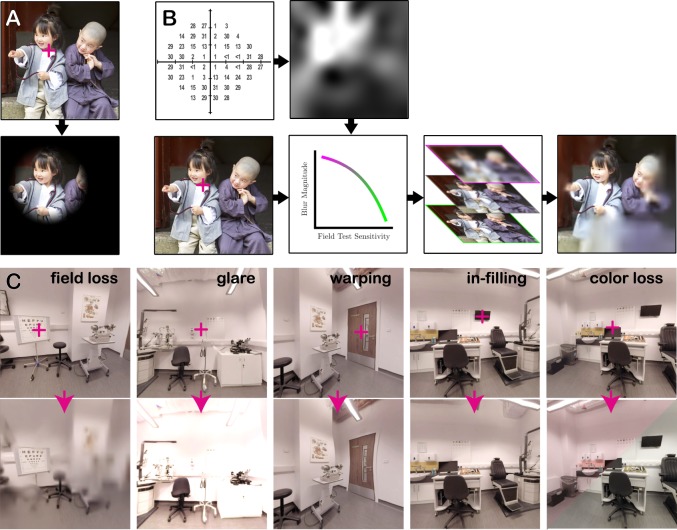
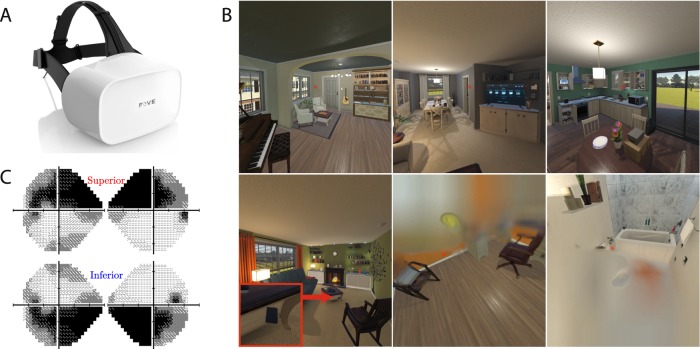
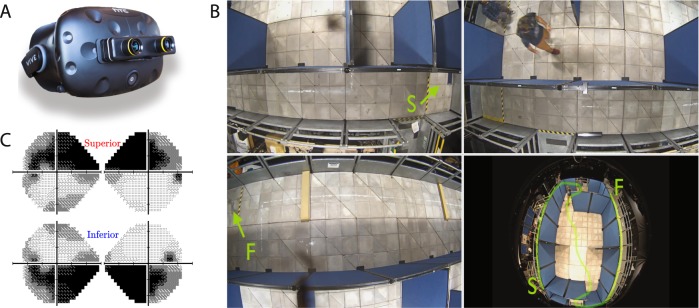
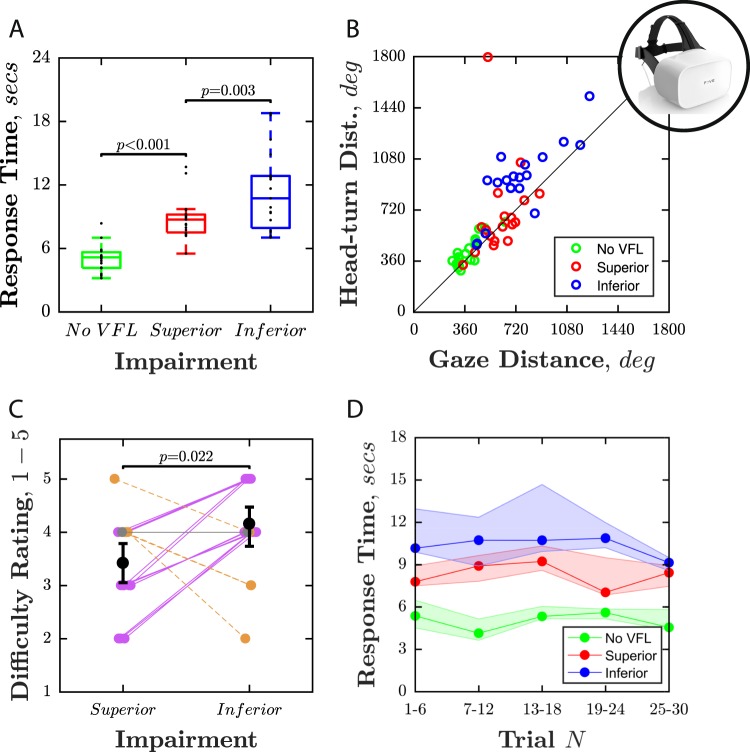
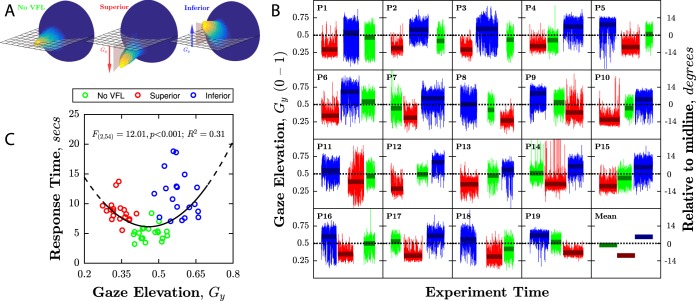
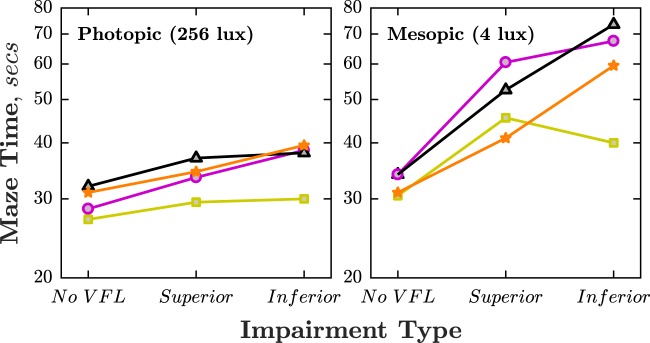
Simulations of visual impairment are used to educate and inform the public. However, evidence regarding their accuracy remains lacking. Here we evaluated the effectiveness of modern digital technologies to simulate the everyday difficulties caused by glaucoma. 23 normally sighted adults performed two everyday tasks that glaucoma patients often report difficulties with: a visual search task in which participants attempted to locate a mobile phone in virtual domestic environments (virtual reality (VR)), and a visual mobility task in which participants navigated a physical, room-scale environment, while impairments were overlaid using augmented reality (AR). On some trials, a gaze-contingent simulated scotoma—generated using perimetric data from a real patient with advanced glaucoma—was presented in either the superior or inferior hemifield. The main outcome measure was task completion time. Eye and head movements were also tracked and used to assess individual differences in looking behaviors. The results showed that the simulated impairments substantially impaired performance in both the VR (visual search) and AR (visual mobility) tasks (both P < 0.001). Furthermore, and in line with previous patient data: impairments were greatest when the simulated Visual Field Loss (VFL) was inferior versus superior (P < 0.001), participants made more eye and head movements in the inferior VFL condition (P < 0.001), and participants rated the inferior VFL condition as more difficult (P < 0.001). Notably, the difference in performance between the inferior and superior conditions was almost as great as the difference between a superior VFL and no impairment at all (VR: 71%; AR: 70%). We conclude that modern digital simulators are able to replicate and objectively quantify some of the key everyday difficulties associated with visual impairments. Advantages, limitations, and possible applications of current technologies are discussed. Instructions are also given for how to freely obtain the software described (OpenVisSim).
Overview
The claims and statistics of this paper haven’t been checked yet.
Free: it reads the open-access text and checks the first 5 claims that cite a source we can check. Create a free account to check every claim.
Integrity signals
Registry
Cites
Statistics
Figures
Verification
Claims the paper makes
The claims and statistics of this paper haven’t been checked yet.
Free: it reads the open-access text and checks the first 5 claims that cite a source we can check. Create a free account to check every claim.
Claims other papers make about this one
Each is checked against this paper’s own text: does it say what the citing paper says it does?
The cited source says what the claim attributes to it.
In the citing paper
“Naturally, trying to fully comprehend the experience of a person with vision problems is hard, even with the use of advanced simulation techniques [95].”
From A Review of Design and Evaluation Practices in Mobile Text Entry for Visually Impaired and Blind Persons (2023) · cites this paper as [95]
Self-check
Percentages, sums and reported differences re-computed from the paper’s own numbers.
The self-check needs the paper’s full text.
Citations
Cites
Flaxman, S. R., Bourne, R. R. A., Resnikoff, S., Ackland, P., Braithwaite, T., Cicinelli, M. V., Das, A., Jonas, J. B., Keeffe, J., Kempen, J. H., et al. (2017) · The Lancet Global Health · doi:10.1016/s2214-109x(17)30393-5 · Cited by 3,477
Development of the 25-list-item National Eye Institute Visual Function Questionnaire
Mangione, C. M. (2001) · Archives of Ophthalmology · doi:10.1001/archopht.119.7.1050 · Cited by 2,230
Factors for Glaucoma Progression and the Effect of Treatment: The Early Manifest Glaucoma Trial
Leske, M. C. (2003) · Archives of Ophthalmology · doi:10.1001/archopht.121.1.48 · Cited by 2,030
Effect of gene therapy on visual function in Leber’s congenital amaurosis
Bainbridge, J. W. B., Smith, A. J., Barker, S. S., Robbie, S., Henderson, R., Balaggan, K., Viswanathan, A., Holder, G. E., Stockman, A., Tyler, N., et al. (2008) · New England Journal of Medicine · doi:10.1056/nejmoa0802268 · Cited by 1,924 · cited 1×
“See Bainbridge et al. 59 for further details. c The simulated VFL conditions were the same as in the main experiment (Fig.”
Cost-Effectiveness in Health and Medicine
(2016) · doi:10.1093/acprof:oso/9780190492939.001.0001 · Cited by 1,552
2005 IEEE Engineering in Medicine and Biology 27th Annual Conference
(2005) · doi:10.1109/embc9043.2006 · Cited by 423
Quality of Life in Glaucoma and Its Relationship with Visual Function
Nelson, P., Aspinall, P., Papasouliotis, O., Worton, B., & O'Brien, C. (2003) · Journal of Glaucoma · doi:10.1097/00061198-200304000-00009 · Cited by 387 · cited 2×
“For example, tasks could be implemented that map onto each of the categories of behavior de fi ned in the NEI-VFQ-25 34 or GQL-15 35 (e.g., near-vision, distance-vision, driving, etc.).”
BackgroundMethodFitting the Mind to the WorldAdaptation and After-Effects in High-Level Vision
Clifford, C. W. G., & Rhodes, G. (2005) · Oxford University Press eBooks · doi:10.1093/acprof:oso/9780198529699.001.0001 · Cited by 262
The relationship between visual field loss in glaucoma and health-related quality-of-life
van Gestel, A., Webers, C. A. B., Beckers, H. J. M., van Dongen, M. C. J. M., Severens, J. L., Hendrikse, F., & Schouten, J. S. A. G. (2010) · Eye · doi:10.1038/eye.2010.133 · Cited by 197
Optimizing virtual reality for all users through gaze-contingent and adaptive focus displays
Padmanaban, N., Konrad, R., Stramer, T., Cooper, E. A., & Wetzstein, G. (2017) · Proceedings of the National Academy of Sciences · doi:10.1073/pnas.1617251114 · Cited by 189 · cited 1×
“However, direct application of VR/AR to patients will only be appropriate once headsets are developed that are more comfortable and lightweight, and once they routinely support effective refractive correction 57,58 .”
Background
Research works printed but not linked: 2
- 46. Geisler, W. S. & Perry, J. S. in Proceedings of the 2002 symposium on Eye tracking research & applications. 83-87 (2002).
- 59. Peli, E. in Visual Instrumentation: Optical Design And Engineering Principles (ed. Mouroulis, P.) 205-276 (McGraw-Hill New York, 1999).
Cited by
Dudley, J., Yin, L., Garaj, V., & Kristensson, P. O. (2023) · Virtual Reality · doi:10.1007/s10055-023-00850-8 · Cited by 221
“Several studies have developed VR based simulations of various visual impairments (Ates et al. 2015; Jones et al. 2020) including temporary visual impairments experienced with migraines (Misztal et al. 2020).”
BackgroundMetaverse and Virtual Health Care in Ophthalmology: Opportunities and Challenges
Tan, T. F., Li, Y., Lim, J. S., Gunasekeran, D. V., Teo, Z. L., Ng, W. Y., & Ting, D. S. (2022) · Asia-Pacific Journal of Ophthalmology · doi:10.1097/apo.0000000000000537 · Cited by 208
“Both AR and VR can help patients understand how vision loss affects function, 70 including assessing the effect of glaucoma on daily living, 71 identifying vision-related disability, 72 and evaluating the effect of visual field loss on functional vision.”
BackgroundJdaitawi, M. T., & Kan’an, A. F. (2021) · Contemporary Educational Technology · doi:10.30935/cedtech/11369 · Cited by 98
“Studies showed that technology-supported activities were reported to influence the cognitive, behavioral, mental and physical development of students with disabilities (e.g., Cakir & Korkmaz, 2019; Jones et al., 2020; McMahon et al., 2015).”
BackgroundApplications of Extended Reality in Ophthalmology: Systematic Review
Ong, C. W., Tan, M. C. J., Lam, M., & Koh, V. (2021) · Journal of Medical Internet Research · doi:10.2196/24152 · Cited by 91
“Jones et al [86] evaluated the use of a head-mounted display to simulate visual impairment in glaucoma using virtual reality and augmented reality and found it able to replicate and objectively quantify functional impairments associated with visual impairments.”
Virtual Reality and Augmented Reality in Ophthalmology: A Contemporary Prospective
Iskander, M., Ogunsola, T., Ramachandran, R., McGowan, R., & Al‐Aswad, L. A. (2021) · Asia-Pacific Journal of Ophthalmology · doi:10.1097/apo.0000000000000409 · Cited by 76
“Another study used AR to gain insight into how ophthalmic diseases affect functional vision.(44) The authors used AR to simulate everyday difficulties caused by glaucoma, and found that participants with ARsimulated visual field loss had increased difficulties with visual mobility (P< 0.”
MethodA systematic review of extended reality (XR) for understanding and augmenting vision loss
Kasowski, J., Johnson, B. A., Neydavood, R., Akkaraju, A., & Beyeler, M. (2023) · Journal of Vision · doi:10.1167/jov.23.5.5 · Cited by 71
“Scotomas can lead to changes in visual function such as visual field loss, which may affect perceptual or behavioral performance (Jones et al., 2020; Pollmann et al., 2020).”
InfluentialA Postphenomenological Framework for Studying User Experience of Immersive Virtual Reality
Vindenes, J., & Wasson, B. (2021) · Frontiers in Virtual Reality · doi:10.3389/frvir.2021.656423 · Cited by 70
“Other examples of simulated subjectivity include simulations of various visual impairments in VR (Ahn et al., 2013; Ates et al., 2015; Jones et al., 2020) as well as strokes (Maxhall et al., 2004) and schizophrenic episodes (Nyre and Vindenes, 2020).”
BackgroundGaze During Locomotion in Virtual Reality and the Real World
Drewes, J., Feder, S., & Einhäuser, W. (2021) · Frontiers in Neuroscience · doi:10.3389/fnins.2021.656913 · Cited by 51
“…education and training (Bernardo, 2017; Izard et al., 2018), simulation, diagnosis and rehabilitation of visual impairments (Baheux et al., 2005; Jones et al., 2020)] and psychotherapy (e.g., autism therapy: Georgescu et al., 2014; Lahiri et al., 2015, fear and anxiety disorders: Hong et al.,…”
BackgroundApplications of augmented reality in ophthalmology [Invited]
Aydındoğan, G., Kavaklı, K., Şahin, A., Artal, P., & Ürey, H. (2020) · Biomedical Optics Express · doi:10.1364/boe.405026 · Cited by 58
“[67] FOVE Virtual Reality Yes OLED HTC Vive Augmented Reality (Video see-through)”
MethodChow-Wing-Bom, H. T., Dekker, T. M., & Jones, P. R. (2020) · Vision Research · doi:10.1016/j.visres.2019.10.012 · Cited by 42
“These would be non-trivial undertakings, but the code for the present simulations has been made freely available online for anybody interested in pursuing this line of inquiry Jones et al. (2020).”
Self-citationAlemán, T. S., Miller, A. J., Maguire, K. H., Aleman, E. M., Serrano, L. W., O’Connor, K., Bedoukian, E. C., Leroy, B. P., Maguire, A. M., & Bennett, J. (2021) · Clinical ophthalmology · doi:10.2147/opth.s292527 · Cited by 34
Augmented Reality in Ophthalmology: Applications and Challenges
Li, T., Li, C., Zhang, X., Liang, W., Chen, Y., Ye, Y., & Lin, H. (2021) · Frontiers in Medicine · doi:10.3389/fmed.2021.733241 · Cited by 32
“Although a few of research have held evaluation, the problems with insufficient sample size and selective bias still exist (42, 62).”
BackgroundMethodVirtual reality as a means to explore assistive technologies for the visually impaired
Ricci, F. S., Boldini, A., Ma, X., Beheshti, M., Geruschat, D. R., Seiple, W., Rizzo, J., & Porfiri, M. (2023) · PLOS Digital Health · doi:10.1371/journal.pdig.0000275 · Cited by 31
“Despite the presence of studies that show simulation software ability to accurately replicate symptomps associated with VIs [45, 48, 49], the simulations described in the present work were only intended as an approximation of vision loss due to the three most widespread VIs.”
BackgroundOdden, J. L., Mihailović, A., Boland, M. V., Friedman, D. S., West, S. K., & Ramulu, P. Y. (2020) · Investigative Ophthalmology & Visual Science · doi:10.1167/iovs.61.13.23 · Cited by 27
Ricci, F. S., Liguori, L., Palermo, E., Rizzo, J., & Porfiri, M. (2024) · JMIR Rehabilitation and Assistive Technologies · doi:10.2196/55776 · Cited by 30
Krabben, K. J., Mann, D. L., Lojanica, M. B., Mueller, D., Dominici, N., van der Kamp, J., & Savelsbergh, G. J. P. (2021) · Journal of Sports Sciences · doi:10.1080/02640414.2021.1987721 · Cited by 27
“Recent advances in augmented reality may offer a promising means of simulating visual field loss while performing in-situ tasks (Jones et al., 2020).”
BackgroundZaman, N., Ong, J., Waisberg, E., Masalkhi, M., Lee, A. G., Tavakkoli, A., & Zuckerbrod, S. L. (2023) · Annals of Biomedical Engineering · doi:10.1007/s10439-023-03379-8 · Cited by 30
“…51 Wu et al. [172] NVis SX60 HMD ✓ 36 Krosl et al. [69] HTC Vive Unreal Engine 4 X 30 Krosl et al. [71] HTC Vive Unreal Engine 4 ✓ 21 Jones et al. [62] FOVE0HTC Vive Unity ✓ 23 Lam et al. [228] HTC Vive Unity X 148 Zavlanou and Lanitis [229] Oculus Rift X 23 Accessibility Zhao et al. [176] HTC…”
InfluentialEvoking empathy with visually impaired people through an augmented reality embodiment experience
Guarese, R., Pretty, E. J., Fayek, H. M., Zambetta, F., & van Schyndel, R. (2023) · IEEE Conference on Virtual Reality and 3D User Interfaces (VR) · doi:10.1109/vr55154.2023.00034 · Cited by 25
“Other works have studied AR/VR simulation of specific visual impairment conditions regarding their visual accuracy, such as glaucoma [24] or cataracts [27], which fall out of the scope of the current study.”
BackgroundInclusion and adaptation beyond disability: Using virtual reality to foster empathy
Coelho, L. P., Laska-Leśniewicz, A., Pereira, E. T., & Sztobryn-Giercuszkiewicz, J. (2023) · Medycyna Pracy · doi:10.13075/mp.5893.01386 · Cited by 25
“For example, the use of VR and augmented reality (AR) to simulate visual impairments can be explored with the OpenVisSim software [4].”
Neugebauer, A., Castner, N., Severitt, B., Štingl, K., Ivanov, I. V., & Wahl, S. (2024) · Virtual Reality · doi:10.1007/s10055-024-00987-0 · Cited by 22
“Different previous studies have shown that the applied approaches to simulate visual field impairments have the desired effects on visually healthy participants in that they reduce their performance in visual tasks (Jones et al., 2020, Kr¨osl et al., 2019, V¨ayrynen et al., 2016).”
Simulating Macular Degeneration to Investigate Activities of Daily Living: A Systematic Review
Macnamara, A., Chen, C., Schinazi, V. R., Saredakis, D., & Loetscher, T. (2021) · Frontiers in Neuroscience · doi:10.3389/fnins.2021.663062 · Cited by 22
Komninos, A., Stefanis, V., & Garofalakis, J. (2023) · Multimodal Technologies and Interaction · doi:10.3390/mti7020022 · Cited by 16
Simulation of visual impairment in persons with normal vision for scientific research
Abraham, C. H., Sakyi‐Badu, G., Boadi‐Kusi, S. B., Morny, E. K. A., Darko‐Takyi, C., Ocansey, S., Hope, P. K. F., Dadzie, A. K., Aboagye-MacCarthy, A., Osei‐Frimpong, K., et al. (2024) · Ophthalmic and Physiological Optics · doi:10.1111/opo.13268 · Cited by 16
Biebl, B., Arcidiacono, E., Kacianka, S., Rieger, J. W., & Bengler, K. J. (2022) · Frontiers in Neuroergonomics · doi:10.3389/fnrgo.2022.916169 · Cited by 14
“However, it should be pointed out that, while currently available, simulation methods can provide valuable insights, they cannot replace the interaction with, and investigation of, persons exhibiting actual deficits during research and product development (Jones et al., 2020; Macnamara et al., 2021).”
BackgroundYao, T., Yoo, S., & Parker, C. (2021) · Australian Conference on Human-Computer Interaction (OzCHI) · doi:10.1145/3520495.3520519 · Cited by 15
“[21] evaluated the use of VR and augmented reality (AR) to simulate the two everyday difficulties, object searching and visual mobility task, often encountered by glaucoma (peripheral vision loss) patients.”
MethodExtended reality: opportunities, success stories and challenges (health, education) : final report
Directorate-General for Communications Networks, C. A. T. (. C., Analytics, V., Consult, I., Boel, C., Dekeyser, K., Depaepe, F., Quintero, L., Daele, T. V., & Wiederhold, B. (2023) · Lirias (KU Leuven) · doi:10.2759/121671 · Cited by 19
Simulating Visibility and Reading Performance in Low Vision
Xiong, Y.-Z., Lei, Q., Calabrèse, A., & Legge, G. E. (2021) · Frontiers in Neuroscience · doi:10.3389/fnins.2021.671121 · Cited by 13
“Low-vision simulations, such as diffusive filters, optical defocus and digital blur, have been utilized for research or education purposes (Peli, 1990; Dickinson and Rabbitt, 1991; Bowers and Reid, 1997; Thompson et al., 2017; Jones and Ometto, 2018; Jones et al., 2020).”
MethodBarbieri, M., Albanese, G. A., Merello, A., Crepaldi, M., Setti, W., Gori, M., Canessa, A., Sabatini, S. P., Facchini, V., & Sandini, G. (2024) · Frontiers in Bioengineering and Biotechnology · doi:10.3389/fbioe.2024.1285107 · Cited by 12
Visual impairments simulation in virtual reality as an empathy booster
Zwoliński, G., Kamińska, D., Coelho, L. P., Haamer, R. E., Raposo, R., & Vairinhos, M. (2025) · Virtual Reality · doi:10.1007/s10055-025-01150-z · Cited by 17
“However, contact lens-induced symptoms are also not representative of visual impairment (Jones et al. 2020).”
InfluentialNeugebauer, A., Štingl, K., Ivanov, I. V., & Wahl, S. (2021) · Brain Sciences · doi:10.3390/brainsci11020223 · Cited by 11
“Although the simulation of visual impairments in visually healthy participants was shown to induce similar behavior as their real counterparts [41], there are multiple aspects due to which results could vary if the experiment were to be repeated with real patients.”
BackgroundThe effects of simulated central and peripheral vision loss on naturalistic search
Veerkamp, K., Müller, D., Pechler, G. A., Mann, D. L., & Olivers, C. N. L. (2025) · Journal of Vision · doi:10.1167/jov.25.8.6 · Cited by 9
“Even though the behavior between VR and real-life behavior differs, this does not mean that the effects of vision impairment would not go in the same direction for both cases (Jones et al., 2020; Neugebauer et al., 2024).”
Virtual reality and augmented reality in ophthalmology: A recent update
Bibak-Bejandi, Z., Razavi, A., Niktinat, H., Yucel, Z. J., Sebhat, A. M., Bibak-Bejandi, R., Arabpour, Z., Khandaker, A. N., Sanchez, J., Nusair, O., et al. (2025) · Digital Health · doi:10.1177/20552076251387047 · Cited by 9
“78 In a more recent advancement, the VisioPainter project introduced 2D authoring software that enables users to create various visual impairments by applying different brush types to simulate distinct views, thereby portraying a range of visual dysfunctions.”
Krösl, K., Medeiros, M. L., Huber, M., Feiner, S., & Elvezio, C. (2023) · Multimodal Technologies and Interaction · doi:10.3390/mti7070070 · Cited by 8
Realter: An Immersive Simulator to Support Low-Vision Rehabilitation
Barbieri, M., Albanese, G. A., Capris, E., Canessa, A., Sabatini, S. P., & Sandini, G. (2023) · Lecture notes in computer science · doi:10.1007/978-3-031-43404-4_27 · Cited by 8
DiVRsity: Design and Development of Group Role-Play VR Platform for Disability Awareness Education
Jin, Y., Lee, S. H., Kim, S. H., Seo, J. A., Jung, K., Lim, H., & Lee, J. (2023) · Designing Interactive Systems Conference · doi:10.1145/3563657.3596047 · Cited by 7
“Similarly, for the evaluation of a vision disability simulation application, participants were required to perform everyday tasks, such as fnding a smartphone with blurred vision in a VR environment [19].”
BackgroundBarbieri, M., Pennazio, V., Sabatini, S. P., & Gori, M. (2025) · Frontiers in Education · doi:10.3389/feduc.2025.1634253 · Cited by 6
VIP-Sim: A User-Centered Approach to Vision Impairment Simulation for Accessible Design
Rädler, M., Colley, M., & Rukzio, E. (2025) · ACM Symposium on User Interface Software and Technology (UIST) · doi:10.1145/3746059.3747704 · Cited by 7
“We discuss their capabilities, limitations, and the challenges identified.”
InfluentialWork-In-Progress-Exploring VR Conference Navigation Employing Audio Cues
Robern, G., Uribe-Quevedo, Á., Sukhai, M. A., Coppin, P., Lee, T., & Ingino, R. (2021) · International Conference of the Immersive Learning Research Network (iLRN) · doi:10.23919/ilrn52045.2021.9459330 · Cited by 8
The Invisibility of Scotomas I: The Carving Hypothesis
Peli, E., Goldstein, R. B., & Jung, J. (2023) · Optometry and Vision Science · doi:10.1097/opx.0000000000002048 · Cited by 6
Exercise programming for individuals with vision loss
Esatbeyoğlu, F., Karaçoban, L., Akın, Ş., & Dönmez, G. (2022) · Turkish Journal of Sports Medicine · doi:10.47447/tjsm.0690 · Cited by 10
Intraoperative Augmented Reality for Vitreoretinal Surgery Using Edge Computing
Ye, R. Z., & Iezzi, R. (2025) · Journal of Personalized Medicine · doi:10.3390/jpm15010020 · Cited by 4
Metaverse in Ophthalmology: The Convergence of Virtual and Physical Space in Eye Care
Benet, D., & Pellicer-Valero, Ó. J. (2022) · Digital Medicine and Healthcare Technology · doi:10.5772/dmht.10 · Cited by 4
Applications of the Metaverse as Disruptive Innovation
Isa, N. N. A. H. (2023) · Advances in e-business research series · doi:10.4018/978-1-6684-6097-9.ch011 · Cited by 4
Simulating Cataracts in Virtual Reality
Krösl, K. (2021) · Human-computer interaction series · doi:10.1007/978-3-030-61905-3_14 · Cited by 3
Real-time Low Vision Simulation in Mixed Reality
Acevedo, V., Colantoni, P., Dinet, É., & Trémeau, A. (2022) · International Conference on Signal-Image Technology & Internet-Based Systems (SITIS) · doi:10.1109/sitis57111.2022.00060 · Cited by 3
“In OpenVisSim, Jones et al. [9] used a Head-Mounted Display with integrated eye-tracking to perform gaze-contingent digital manipulations in virtual or augmented reality, where each symptom can be parametrically manipulated, but this research was only focused on glaucoma pathology.”
Dong, J., & Karmann, C. (2024) · IOP Conference Series Earth and Environmental Science · doi:10.1088/1755-1315/1320/1/012022 · Cited by 3
The interactive use of augmented reality for educating the elderly on common age-related eye disease
Hung, Y. Y., Chu, W. Y., Jiang, J., Yeung, W. Y., Yan, W. H., Kwok, T. T.-O., & Chan, Y. K. (2025) · BMC Geriatrics · doi:10.1186/s12877-024-05658-y · Cited by 5
Hierarchical cortical plasticity in congenital sight impairmentPreprint
Maimon-Mor, R. O., Farahbakhsh, M., Hedger, N., Rider, A. T., Anderson, E. J., Rees, G. E., Knapen, T. H. J., Michaelides, M., & Dekker, T. M. (2024) · eLife · doi:10.7554/elife.100404.1 · Cited by 3
The relationship between a simulated glaucoma impairment and postural threat on quiet stance
Lavalle, L. K., Pourhashemi, N., & Cleworth, T. W. (2025) · Virtual Reality · doi:10.1007/s10055-024-01082-0 · Cited by 2
“Recently, VR has been successfully used to simulate disorders affect - ing the visual field (Jones and Ometto 2018 ; Jones et al. 2020 ); this allows for the functional impact of these visual disorders to be studied in a controlled environment.”
Nonis, F., Toska, R., Vezzetti, E., Marcolin, F., & Celeghin, A. (2025) · Lecture notes in computer science · doi:10.1007/978-3-031-97781-7_10 · Cited by 2
“Although some sight-loss simulators have been made free and available to the research community, e.g., OpenVisSim [ 18] and VARID [ 9], we simulated the gaze-contingent central vision loss disease ourselves through AR to better suit our needs.”
InfluentialCheng, M., & Chukoskie, L. (2026) · Frontiers in Virtual Reality · doi:10.3389/frvir.2026.1757251 · Cited by 3
Higgins, B. E., Crabb, D. P., Jones, P. R., & Gardiner, S. K. (2026) · Optometry and Vision Science · doi:10.1002/ovs2.70055 · Cited by 2
Self-citationPostuma, E. M. J. L., de Haan, G. A., Heutink, J., & Cornelissen, F. W. (2025) · Journal of Vision · doi:10.1167/jov.25.11.1 · Cited by 2
Malheiros, O. (2021) · Advances in medical education, research, and ethics (AMERE) book series · doi:10.4018/978-1-7998-8824-6.ch017 · Cited by 5
Furthering Visual Accessibility with Extended Reality (XR): A Systematic Review.Preprint
Kasowski, J., Johnson, B. A., Neydavood, R., Akkaraju, A., & Beyeler, M. (2021) · arXiv (Cornell University) · Cited by 5
Virtual Reality and Eye-Tracking Based Vision Screening – A Bibliometric Study
Dæhlen, A., Heldal, I., Ali, Q., Katona, J., & Kővári, A. (2024) · World Congress on Medical Physics and Biomedical Engineering, September 7 - 12, 2009, Munich, Germany · doi:10.1007/978-3-031-62502-2_90 · Cited by 1
The Effects of AMD Severities on Eye Movements in Virtual Environments
Grootjen, J. W., Yadla, S., & Mayer, S. (2025) · Mensch und Computer (MuC) · doi:10.1145/3743049.3748561 · Cited by 1
Huang, Y., Lebreton, P., Bruckert, A., & Callet, P. L. (2025) · European Workshop on Visual Information Processing · doi:10.1109/euvip66349.2025.11238437 · Cited by 1
“For example, simulated scotomas have been applied to a user’s viewport to study navigation and search task performance under visual distortion [12].”
The Effects of Simulated Low Vision on Perceived Action Capabilities in Virtual Reality
Orthy, M. T., Stefanucci, J. K., Bodenheimer, B., & Creem-Regehr, S. H. (2026) · IEEE Conference on Virtual Reality and 3D User Interfaces (VR) · doi:10.1109/vr67842.2026.00028 · Cited by 1
“These virtual low-vision simulators have been used to study performance in tasks such as visual search, face perception, and reading [1, 33, 35].”
Longitudinal Visual Field and Quality-of-Life Change in the Treatment for Advanced Glaucoma Study
Montesano, G., Ometto, G., Cheloni, R., Garway‐Heath, D. F., Higgins, B. E., Crabb, D. P., King, A. J., King, A., Agrawal, P., Broadway, D. C., et al. (2026) · Ophthalmology · doi:10.1016/j.ophtha.2026.04.020 · Cited by 1
Self-citationde Oliveira, M. A. (2021) · Digital Library of Theses and Dissertations (Universidade de São Paulo) · doi:10.11606/d.17.2021.tde-10052021-143844
Dental Health in a Group of Workers from Timisoara
Păuncu, E.-A., Jebereanu, L., & Gavrilă-Ardelean, L. (2008)
Virtual Reality and Augmented Reality for Industrial and Business Intelligence
Desai, K., Kumar, M. D., Khairi, M. O., Govindarajo, N. S., & Sharma, V. (2024) · Advances in hospitality, tourism and the services industry (AHTSI) book series · doi:10.4018/979-8-3693-1103-5.ch004
Hierarchical cortical plasticity in congenital sight impairmentPreprint
Maimon-Mor, R. O., Farahbakhsh, M., Hedger, N., Rider, A. T., Anderson, E. J., Rees, G. E., Knapen, T. H. J., Michaelides, M., & Dekker, T. M. (2024) · eLife · doi:10.1101/2024.07.04.602138
Hierarchical cortical plasticity in congenital sight impairmentPreprint
Maimon-Mor, R. O., Farahbakhsh, M., Hedger, N., Rider, A. T., Anderson, E. J., Rees, G. E., Knapen, T. H. J., Michaelides, M., & Dekker, T. M. (2024) · eLife · doi:10.7554/elife.100404
Greci, L., Bosco, F., Corsano, L., & Croce, V. (2024) · IFAC-PapersOnLine · doi:10.1016/j.ifacol.2024.09.273 · Cited by 1
Metaverse‐Based Digital Twins in Ophthalmology
Malviya, R., & Rajput, S. (2025) · Wiley eBooks · doi:10.1002/9781394315680.ch6
Jin, H., & Yang, J. (2025) · Journal of Computational Methods in Sciences and Engineering · doi:10.1177/14727978251337891
“Jones et al. 14 introduced a generative neural network consisting of an encoder and a decoder.”
Application Perspectives of Digital Twin in Healthcare Using Metaverse
Singh, B. K., & Vyas, A. K. (2025) · Wiley eBooks · doi:10.1002/9781394305292.ch18
1. Recent Trends of Visual Display Technology Using Head Mounted Displays
Kiyokawa, K. (2022) · The Journal of The Institute of Image Information and Television Engineers · doi:10.3169/itej.76.304
Understanding the Impact of Glaucoma Severities Through Virtual Reality Simulations
Grootjen, J. W., Yadla, S., & Mayer, S. (2025) · Mensch und Computer (MuC) · doi:10.1145/3743049.3743084
OpticalAging: Real-time Presbyopia Simulation for Inclusive Design via Tunable Lenses
Zhang, Q., Su, Z., KONDOH, Y., Asada, K., Starner, T. E., Kunze, K., Itoh, Y., & Rekimoto, J. (2026) · Augmented Humans International Conference (AHs) · doi:10.1145/3795011.3795035
“Filters to Optical See-Through Simulation techniques range from low-fidelity static filters [3, 6, 17] and full-body aging suits to Virtual Reality (VR) environments [26, 31].”
Leung, W. L., Runswick, O. R., Heard, C. L., & Rakow, T. (2025) · Research Square · doi:10.21203/rs.3.rs-7957115/v1
Do You See What I See? Vocal Cues to Visual Acuity Discrepancies in VR-Based Stargazing
Iida, S., & Nakamura, S. (2025) · Lecture notes in computer science · doi:10.1007/978-3-032-10156-3_9
Through the Eye: Virtual Reality Simulation of Retinal Diseases for Educational Purposes
Hassan, R., Mostafa, S., Nagy, M., Fouad, S., Youssef, R., & Al‐Atabany, W. (2025) · Novel Intelligent and Leading Emerging Sciences Conference (NILES) · doi:10.1109/niles68063.2025.11232445
Grootjen, J. W., Weiß, Y., Daniel, T. J., Kahman, F., & Mayer, S. (2025) · International Conference on Mobile and Ubiquitous Multimedia (MUM) · doi:10.1145/3771882.3771884
“Visualsearch tasks have been employed widely to investigate visual impairments both on patients with visual impairments [12, 39] as well as in simulations of visual impairments [13, 23, 29].”
Framework to Simulate Perceived Images Affected by Human Visual System Disorders
Jaén-Lorites, J. M., Vila-Tomás, J., Moratal, D., & Laparra, V. (2025) · Annual International Conference of the IEEE Engineering in Medicine and Biology Society (EMBC) · doi:10.1109/embc58623.2025.11251890
“Usually, the most studied diseases are those related with the early parts of the HVS such as the eye and the retina, since they are the most studied parts, and there are also many computational models [2], [5], [6].”
Biebl, B. L., Bengler, K., & München, T. U. (2025)
Källstrand, J. (2026) · Signals and communication technology · doi:10.1007/978-3-031-91550-5_13
Takebayashi, H., & Wada, Y. (2026) · Research Square · doi:10.21203/rs.3.rs-8754299/v1
Revealing the benefit of eye motion for acuity under emulated cone loss
Doyle, H. K., Fong, J., Ng, R., & Roorda, A. (2026) · eLife · doi:10.7554/elife.111289.3
Revealing the benefit of eye motion for acuity under emulated cone lossPreprint
Doyle, H. K., Fong, J., Ng, R., & Roorda, A. (2026) · eLife · doi:10.7554/elife.111289
“…using eye tracking ( Crane and Kelly, 1983 ; Fine and Rubin, 1999 ; Kwon et al., 2012 ; McIlreavy et al., 2012 ) and more recently using extended reality technologies in head-mounted displays ( Jones et al., 2020 ; Chow- Wing-Bom et al., 2020 ; Sipatchin et al., 2021 ; Barbieri et al., 2024 ).”
Revealing the benefit of eye motion for acuity under emulated cone lossPreprint
Doyle, H. K., Fong, J., Ng, R., & Roorda, A. (2026) · eLife · doi:10.7554/elife.111289.1
Leung, W. L., Runswick, O. R., Heard, C. L., & Rakow, T. (2026) · International Journal of Human-Computer Interaction · doi:10.1080/10447318.2026.2664698
Haritas, H. K., Darshan, Meeradevi, Vishal, R. K., & Sadarangani, V. H. (2026) · Lecture notes in networks and systems · doi:10.1007/978-3-032-27154-9_24
Author response: Revealing the benefit of eye motion for acuity under emulated cone loss
Doyle, H. K., Fong, J., Ng, R., & Roorda, A. (2026) · eLife · doi:10.7554/elife.111289.2.sa0
Perceptual characteristics of scotomas modulate visual performance under simulated prosthetic vision
Kim, D. E., Kim, M., & Im, M. (2026) · Journal of Neural Engineering · doi:10.1088/1741-2552/aea36b
“To achieve this, we employed a HMD-based VR platform [36– 39] that fully occludes ambient visual input, ensuring that participants’ visual experience was determined entirely by the rendered environment, which is a prerequisite for isolating the effect of sco-toma appearance from residual natural…”
Sharma, V., Vishwakarma, H., Singh, A., Mahadev, T., & Biswas, P. (2026) · International Journal of Social Robotics · doi:10.1007/s12369-026-01426-7
“AR can be used to provide visual aids for individuals with visual impairments [25 ].”
A Multimodal Behavioural, Eye-Tracking, and EEG Study Under Simulated Hemianopia in Virtual Reality
Nonis, F., Olivetti, E. C., Vezzetti, E., Marcolin, F., & Celeghin, A. (2026) · Lecture notes in computer science · doi:10.1007/978-3-032-33506-7_19
Metadata
- Authors
- Jones, P. R., Somoskeöy, T., Chow-Wing-Bom, H., & Crabb, D. P.
- Affiliations
- University of London (GB)
- NIHR Moorfields Biomedical Research Centre (GB)
- Corresponding author
- Jones, Pete R.
- Venue
- npj Digital Medicine
- Published
- 2020-03-10
- Volume
- 3
- Issue
- 1
- Pages
- 32-32
- ISSN
- 2398-6352 (ISSN-L)
- PMC
- PMC7064490
- OpenAlex
- W3010216189
- Semantic Scholar
- a7e4f39b0979e2609010945e40d53a7a6ae9509e
- Cited by
- 79
- References
- 59
- Citations by year
- 2026: 8 · 2025: 21 · 2024: 11 · 2023: 12 · 2022: 6 · 2021: 17 · 2020: 3
- FWCI
- 7.53
- Type
- journal article
- Language
- en
- Open access
- gold
- doi.org
- Licence
- cc-by
- creativecommons.org/licenses/by/4.0 (tdm)
- creativecommons.org/licenses/by/4.0 (vor)
- Locations
- npj Digital Medicine (publishedVersion, cc-by)
- Europe PMC (PubMed Central) (publishedVersion, cc-by)
- PubMed Central (publishedVersion, cc-by)
- PubMed (publishedVersion)
- City Research Online (City University London) (acceptedVersion)
- DOAJ (DOAJ: Directory of Open Access Journals) (submittedVersion, cc-by-sa)
- UCL Discovery (University College London) (submittedVersion)
- Funders
- Fight for Sight UK (1854/1855)
- Topics
- Health Sciences › Medicine › Ophthalmology › Glaucoma and retinal disorders
- Physical Sciences › Computer Science › Human-Computer Interaction › Virtual Reality Applications and Impacts
- Health Sciences › Medicine › Ophthalmology › Ophthalmology and Visual Impairment Studies
- Keywords
- glaucoma, visual impairment simulation, virtual reality, augmented reality, visual field defects, visual search, eye movements, head movement, accessibility education
About these checks
Registry, retraction, Cites and statistics results are computed, not judged, with one exception: a printed reference that no index lists is read once by a model before it counts as a citation error. Claims are extracted by a model and kept only when their quote appears verbatim in the text; each cited source is then checked, with a model’s help, for whether it says what the claim relies on. Those verdicts can be wrong — read the claim’s quote and the cited source before relying on one.
Statistics and arithmetic are recomputed, not judged.
Confidence bands are shown only for fields calibrated on our annotated test set. None is calibrated yet, so no band is shown.
What counts as a claim ›How we measure confidence ›How we check this ›
Are you an author, or do you see a problem with this page? Request a review
Data sources
Bibliographic data: Semantic Scholar, OpenAlex, Crossref.
Contains information from the Semantic Scholar Academic Graph Datasets, made available under the ODC Attribution License (ODC-BY 1.0).
Semantic Scholar’s data is described in: Kinney, R., et al. (2023). The Semantic Scholar Open Data Platform. arXiv:2301.10140.
