

Seeing other perspectives: evaluating the use of virtual and augmented reality to simulate visual impairments (OpenVisSim)
Open accessThe DOI matches its Crossref record; 59 of the 59 references it cites were found in a registry or an index.
Abstract
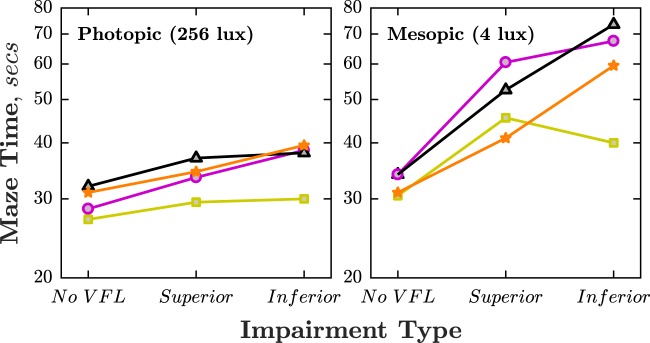
Simulations of visual impairment are used to educate and inform the public. However, evidence regarding their accuracy remains lacking. Here we evaluated the effectiveness of modern digital technologies to simulate the everyday difficulties caused by glaucoma. 23 normally sighted adults performed two everyday tasks that glaucoma patients often report difficulties with: a visual search task in which participants attempted to locate a mobile phone in virtual domestic environments (virtual reality (VR)), and a visual mobility task in which participants navigated a physical, room-scale environment, while impairments were overlaid using augmented reality (AR). On some trials, a gaze-contingent simulated scotoma—generated using perimetric data from a real patient with advanced glaucoma—was presented in either the superior or inferior hemifield. The main outcome measure was task completion time. Eye and head movements were also tracked and used to assess individual differences in looking behaviors. The results showed that the simulated impairments substantially impaired performance in both the VR (visual search) and AR (visual mobility) tasks (both P < 0.001). Furthermore, and in line with previous patient data: impairments were greatest when the simulated Visual Field Loss (VFL) was inferior versus superior (P < 0.001), participants made more eye and head movements in the inferior VFL condition (P < 0.001), and participants rated the inferior VFL condition as more difficult (P < 0.001). Notably, the difference in performance between the inferior and superior conditions was almost as great as the difference between a superior VFL and no impairment at all (VR: 71%; AR: 70%). We conclude that modern digital simulators are able to replicate and objectively quantify some of the key everyday difficulties associated with visual impairments. Advantages, limitations, and possible applications of current technologies are discussed. Instructions are also given for how to freely obtain the software described (OpenVisSim).
Overview
The claims and statistics of this paper haven’t been checked yet.
Free: it reads the open-access text and checks the first 5 claims that cite a source we can check. Create a free account to check every claim.
Integrity signals
Registry
Cites
Statistics
Figures
Verification
Claims the paper makes
The claims and statistics of this paper haven’t been checked yet.
Free: it reads the open-access text and checks the first 5 claims that cite a source we can check. Create a free account to check every claim.
Claims other papers make about this one
Each is checked against this paper’s own text: does it say what the citing paper says it does?
The cited source says what the claim attributes to it.
In the citing paper
“Naturally, trying to fully comprehend the experience of a person with vision problems is hard, even with the use of advanced simulation techniques [95].”
From A Review of Design and Evaluation Practices in Mobile Text Entry for Visually Impaired and Blind Persons (2023) · cites this paper as [95]
Self-check
Percentages, sums and reported differences re-computed from the paper’s own numbers.
The self-check needs the paper’s full text.
Citations
Cites
Flaxman, S. R., Bourne, R. R. A., Resnikoff, S., Ackland, P., Braithwaite, T., Cicinelli, M. V., Das, A., Jonas, J. B., Keeffe, J., Kempen, J. H., et al. (2017) · The Lancet Global Health · doi:10.1016/s2214-109x(17)30393-5 · Cited by 3,477
Development of the 25-list-item National Eye Institute Visual Function Questionnaire
Mangione, C. M. (2001) · Archives of Ophthalmology · doi:10.1001/archopht.119.7.1050 · Cited by 2,230
Factors for Glaucoma Progression and the Effect of Treatment: The Early Manifest Glaucoma Trial
Leske, M. C. (2003) · Archives of Ophthalmology · doi:10.1001/archopht.121.1.48 · Cited by 2,030
Effect of gene therapy on visual function in Leber’s congenital amaurosis
Bainbridge, J. W. B., Smith, A. J., Barker, S. S., Robbie, S., Henderson, R., Balaggan, K., Viswanathan, A., Holder, G. E., Stockman, A., Tyler, N., et al. (2008) · New England Journal of Medicine · doi:10.1056/nejmoa0802268 · Cited by 1,924 · cited 1×
“See Bainbridge et al. 59 for further details. c The simulated VFL conditions were the same as in the main experiment (Fig.”
Cost-Effectiveness in Health and Medicine
(2016) · doi:10.1093/acprof:oso/9780190492939.001.0001 · Cited by 1,552
2005 IEEE Engineering in Medicine and Biology 27th Annual Conference
(2005) · doi:10.1109/embc9043.2006 · Cited by 423
Quality of Life in Glaucoma and Its Relationship with Visual Function
Nelson, P., Aspinall, P., Papasouliotis, O., Worton, B., & O'Brien, C. (2003) · Journal of Glaucoma · doi:10.1097/00061198-200304000-00009 · Cited by 387 · cited 2×
“For example, tasks could be implemented that map onto each of the categories of behavior de fi ned in the NEI-VFQ-25 34 or GQL-15 35 (e.g., near-vision, distance-vision, driving, etc.).”
BackgroundMethodFitting the Mind to the WorldAdaptation and After-Effects in High-Level Vision
Clifford, C. W. G., & Rhodes, G. (2005) · Oxford University Press eBooks · doi:10.1093/acprof:oso/9780198529699.001.0001 · Cited by 262
The relationship between visual field loss in glaucoma and health-related quality-of-life
van Gestel, A., Webers, C. A. B., Beckers, H. J. M., van Dongen, M. C. J. M., Severens, J. L., Hendrikse, F., & Schouten, J. S. A. G. (2010) · Eye · doi:10.1038/eye.2010.133 · Cited by 197
Optimizing virtual reality for all users through gaze-contingent and adaptive focus displays
Padmanaban, N., Konrad, R., Stramer, T., Cooper, E. A., & Wetzstein, G. (2017) · Proceedings of the National Academy of Sciences · doi:10.1073/pnas.1617251114 · Cited by 189 · cited 1×
“However, direct application of VR/AR to patients will only be appropriate once headsets are developed that are more comfortable and lightweight, and once they routinely support effective refractive correction 57,58 .”
BackgroundZheng, Y., Wu, X., Lin, X., & Lin, H. (2017) · Scientific Reports · doi:10.1038/srep46453 · Cited by 180 · cited 1×
“For example, elevated levels of depression and physical inactivity are common among the visually impaired 25 , and in extreme cases can lead to individuals being afraid to leave their own homes 17 .”
BackgroundCrabb, D. P., Smith, N. D., Glen, F. C., Burton, R., & Garway-Heath, D. F. (2013) · Ophthalmology · doi:10.1016/j.ophtha.2012.11.043 · Cited by 177 · cited 1×
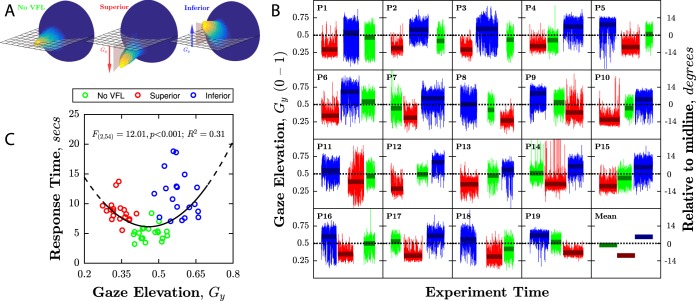
“However, those observers who modified their gaze least, and continued to fixate more centrally in all conditions, performed faster in the impairment conditions (Quadratic regression; F(2,54)= 12.”
Self-citationAbe, R. Y., Diniz-Filho, A., Costa, V. P., Gracitelli, C. P. B., Baig, S., & Medeiros, F. A. (2016) · Ophthalmology · doi:10.1016/j.ophtha.2015.10.046 · Cited by 170
Kumpik, D. P., Kacelnik, O., & King, A. J. (2010) · Journal of Neuroscience · doi:10.1523/jneurosci.5488-09.2010 · Cited by 163 · cited 1×
“It would be particularly interesting to examine, for example, whether the human visual system is able to recover from chronically altered signals, in a similar way as has been reported previously in audition 42 , and in vision using prisms 43 .”
ResultVisual Field Defects and the Risk of Motor Vehicle Collisions among Patients with Glaucoma
McGwin, G., Xie, A., Mays, A., Joiner, W., DeCarlo, D. K., Hall, T. A., & Owsley, C. (2005) · Investigative Opthalmology & Visual Science · doi:10.1167/iovs.05-0750 · Cited by 159
Real-World Assessment of Physical Activity in Glaucoma Using an Accelerometer
Ramulu, P. Y., Maul, E. J., Hochberg, C. H., Chan, E. S., Ferrucci, L., & Friedman, D. S. (2012) · Ophthalmology · doi:10.1016/j.ophtha.2012.01.013 · Cited by 151 · cited 3×
“In brief, individuals with glaucoma often report particular dif fi culty locating objects in cluttered visual scenes 18 , and also exhibit reduced mobility 17 and increased risk of falls 15 .”
BackgroundLongitudinal Prevalence of Major Eye Diseases
Lee, P. P. (2003) · Archives of Ophthalmology · doi:10.1001/archopht.121.9.1303 · Cited by 138 · cited 1×
“It would also be desirable to explore the usability and acceptability of the technology in older adults, since the prevalence of eye-disease increases greatly with age 40 .”
BackgroundLau, J. T. F. (2002) · British Journal of Ophthalmology · doi:10.1136/bjo.86.10.1080 · Cited by 122
Identifying Areas of the Visual Field Important for Quality of Life in Patients with Glaucoma
Murata, H., Hirasawa, H., Aoyama, Y., Sugisaki, K., Araie, M., Mayama, C., Aihara, M., & Asaoka, R. (2013) · PLoS ONE · doi:10.1371/journal.pone.0058695 · Cited by 117
Awareness of glaucoma, and health beliefs of patients suffering primary acute angle closure
Saw, S. (2003) · British Journal of Ophthalmology · doi:10.1136/bjo.87.4.446 · Cited by 90 · cited 3×
“The dif fi culty, is that the public generally has poor comprehension of what life with a visual impairment is really like 10 – 14 , leading to decisions that may fail to maximize societal health bene fi ts 53 .”
BackgroundMethodKnowledge about glaucoma and barriers to follow-up care in a community glaucoma screening program
Altangerel, U., Nallamshetty, H. S., Uhler, T. A., Fontanarosa, J., Steinmann, W. C., Almodin, J., Chen, B. H., & Henderer, J. D. (2009) · Canadian Journal of Ophthalmology · doi:10.3129/i08-175 · Cited by 89 · cited 3×
“The dif fi culty, is that the public generally has poor comprehension of what life with a visual impairment is really like 10 – 14 , leading to decisions that may fail to maximize societal health bene fi ts 53 .”
BackgroundMethodValuing Condition-Specific Health States Using Simulation Contact Lenses
Czoski‐Murray, C., Carlton, J., Brazier, J. E., Young, T. A., Papo, N. L., & Kang, H. K. (2009) · Value in Health · doi:10.1111/j.1524-4733.2009.00527.x · Cited by 88
Cheng, H., Guo, C., Chen, M.-J., Ko, Y., Huang, N., & Liu, C. J.-L. (2014) · JAMA Ophthalmology · doi:10.1001/jamaophthalmol.2014.4908 · Cited by 82
An exploratory study of visual search performance in glaucoma
Smith, N. D., Crabb, D. P., & Garway‐Heath, D. F. (2011) · Ophthalmic and Physiological Optics · doi:10.1111/j.1475-1313.2011.00836.x · Cited by 79 · cited 1×
“In brief, individuals with glaucoma often report particular dif fi culty locating objects in cluttered visual scenes 18 , and also exhibit reduced mobility 17 and increased risk of falls 15 .”
BackgroundSelf-citationSun, Y., Lin, C., Waisbourd, M., Ekici, F., Erdem, E., Wizov, S. S., Hark, L. A., & Spaeth, G. L. (2015) · American Journal of Ophthalmology · doi:10.1016/j.ajo.2015.12.006 · Cited by 77
Assessment of the Vision-specific Quality of Life Using Clustered Visual Field in Glaucoma Patients
Sawada, H., Yoshino, T., Fukuchi, T., & Abe, H. (2012) · Journal of Glaucoma · doi:10.1097/ijg.0b013e318265bbdc · Cited by 69
Negotiating the reality of visual impairment: Hope, coping, and functional ability
Jackson, W. T., Taylor, R. E., Palmatier, A. D., Elliott, T. R., & Elliott, J. L. (1998) · Journal of Clinical Psychology in Medical Settings · doi:10.1023/a:1026259115029 · Cited by 68 · cited 1×
“This supports the intuition that some individuals are better at coping with same level of sight loss, and shows that this re fl ects not just differences in psychology 28,29 or lifestyle 30 , but also represents genuine differences in capability.”
BackgroundMansouri, K., Orgül, S., Meier-Gibbons, F., & Mermoud, A. (2006) · Ophthalmologica · doi:10.1159/000090574 · Cited by 66
Knowledge and awareness of age related eye diseases: a population-based survey.
Katibeh, M., Ziaei, H., Panah, E., Moein, H.-R., Hosseini, S., Kalantarion, M., Eskandari, A., & Yaseri, M. (2014) · PubMed Central · Cited by 65
Measuring Disability in Glaucoma
Sotimehin, A. E., & Ramulu, P. Y. (2018) · Journal of Glaucoma · doi:10.1097/ijg.0000000000001068 · Cited by 64 · cited 1×
“In this sense, VR/AR — as has been recently noted recently by others 54 — can be seen as the logical extension of traditional ‘ performance based ’ assessments 55 such as the Assessment of Visual Disability Related to Vision (ADREV) 56 .”
BackgroundWhy don't older adults in E ngland go to have their eyes examined?
Shickle, D., & Griffin, M. B. (2013) · Ophthalmic and Physiological Optics · doi:10.1111/opo.12100 · Cited by 59
Taylor, D. J., Edwards, L. A., Binns, A. M., & Crabb, D. P. (2017) · Ophthalmic and Physiological Optics · doi:10.1111/opo.12419 · Cited by 59 · cited 1×
“Such depictions are generally regarded as crude and unrealistic by patients, however 2,7 .”
BackgroundSelf-citationImpaired Saccadic Eye Movement in Primary Open-angle Glaucoma
Lamirel, C., Miléa, D., Cochereau, I., Duong, M.-H., & Lorenceau, J. (2012) · Journal of Glaucoma · doi:10.1097/ijg.0b013e31825c10dc · Cited by 57 · cited 1×
“Likewise, AR could be used to explore whether prolonged simulated sight-loss leads to subtle changes in the ‘ microstructure ’ of eye-movements (e.g., rate of corrective saccades), as have been shown previously to occur following glaucoma 21,44 .”
BackgroundEnoch, J., Jones, L., Taylor, D. J., Bronze, C., Kirwan, J., Jones, P. R., & Crabb, D. P. (2019) · Eye · doi:10.1038/s41433-019-0679-5 · Cited by 57 · cited 1×
“Thus, it has been observed that some glaucoma patients exhibit a greater loss of vision under home-lighting, than when assessed in a well-lit eye clinic 37,38 .”
BackgroundSelf-citationEffect of glaucoma on eye movement patterns and laboratory-based hazard detection ability
Lee, S. S., Black, A. A., & Wood, J. M. (2017) · PLoS ONE · doi:10.1371/journal.pone.0178876 · Cited by 56
Lorenzana, L. L., Lankaranian, D., Dugar, J., Mayer, J. R., Palejwala, N. V., Kulkarni, K., Warrian, K., Boghara, Z., Richman, J., Wizov, S., et al. (2009) · Ophthalmic Epidemiology · doi:10.1080/09286580902738142 · Cited by 51 · cited 1×
“In this sense, VR/AR — as has been recently noted recently by others 54 — can be seen as the logical extension of traditional ‘ performance based ’ assessments 55 such as the Assessment of Visual Disability Related to Vision (ADREV) 56 .”
BackgroundGarnefski, N., Kraaij, V., De Graaf, M., & Karels, L. (2010) · Disability and Rehabilitation · doi:10.3109/09638280903071859 · Cited by 45 · cited 1×
“This supports the intuition that some individuals are better at coping with same level of sight loss, and shows that this re fl ects not just differences in psychology 28,29 or lifestyle 30 , but also represents genuine differences in capability.”
BackgroundDegraded Reality: Using VR/AR to simulate visual impairments
Jones, P. R., & Ometto, G. (2018) · doi:10.1109/var4good.2018.8576885 · Cited by 45
Self-citationHead mounted display design tool for simulating visual disabilities
Väyrynen, J., Colley, A., & Häkkilä, J. (2016) · International Conference on Mobile and Ubiquitous Multimedia (MUM) · doi:10.1145/3012709.3012714 · Cited by 44
Does Glaucoma Alter Eye Movements When Viewing Images of Natural Scenes? A Between-Eye Study
Asfaw, D. S., Jones, P. R., Mönter, V. M., Smith, N. D., & Crabb, D. P. (2018) · Investigative Ophthalmology & Visual Science · doi:10.1167/iovs.18-23779 · Cited by 43 · cited 3×
“It has also been shown that individuals with glaucoma tend to make more eye-and head-movements, to compensate for their restricted fi eld of view 21 – 23 .”
BackgroundSelf-citationChow-Wing-Bom, H. T., Dekker, T. M., & Jones, P. R. (2020) · Vision Research · doi:10.1016/j.visres.2019.10.012 · Cited by 42 · cited 1×
“However, we are also using the same paradigm to explore, for example, how a purely unilateral de fi cit effects everyday vision-related tasks 36 .”
MethodSelf-citationDive, S., Rouland, J. F., Lenoble, Q., Szaffarczyk, S., McKendrick, A. M., & Boucart, M. (2016) · Journal of Glaucoma · doi:10.1097/ijg.0000000000000402 · Cited by 41
In Their Own Words: Strategies Developed by Visually Impaired Elders to Cope with Vision Loss
Brennan‐Ing, M., Horowitz, A., Reinhardt, J. P., Cimarolli, V. R., Benn, D., & Leonard, R. (2001) · Journal of Gerontological Social Work · doi:10.1300/j083v35n01_08 · Cited by 39 · cited 1×
“This supports the intuition that some individuals are better at coping with same level of sight loss, and shows that this re fl ects not just differences in psychology 28,29 or lifestyle 30 , but also represents genuine differences in capability.”
BackgroundKrösl, K., Bauer, D., Schwärzler, M., Fuchs, H., Suter, G., & Wimmer, M. H. (2018) · The Visual Computer · doi:10.1007/s00371-018-1517-7 · Cited by 39 · cited 3×
“…single, functioning system, and it is the fi rst to be shown capable of eliciting plausible impairments on the sorts of typical, ‘ real world ’ tasks of daily living that patients really value (i.e., rather than purely perceptual changes in the user ’ s ability to recognize words or letters 39,46 ).”
BackgroundRamulu, P. Y., Mihailović, A., West, S. K., Friedman, D. S., & Gitlin, L. N. (2018) · Journal of the American Geriatrics Society · doi:10.1111/jgs.15609 · Cited by 36
Bhorade, A. M., Perlmutter, M. S., Wilson, B., Kambarian, J., Chang, S. T., Pekmezci, M., & Gordon, M. O. (2013) · JAMA Ophthalmology · doi:10.1001/jamaophthalmol.2013.4995 · Cited by 35 · cited 1×
“Thus, it has been observed that some glaucoma patients exhibit a greater loss of vision under home-lighting, than when assessed in a well-lit eye clinic 37,38 .”
BackgroundGoh, R. L. Z., Kong, Y. X. G., McAlinden, C., Liu, J., Crowston, J. G., & Skalicky, S. E. (2018) · Translational Vision Science & Technology · doi:10.1167/tvst.7.1.10 · Cited by 33 · cited 1×
“In this sense, VR/AR — as has been recently noted recently by others 54 — can be seen as the logical extension of traditional ‘ performance based ’ assessments 55 such as the Assessment of Visual Disability Related to Vision (ADREV) 56 .”
Background‘I didn't see that coming’: simulated visual fields and driving hazard perception test performance
Glen, F. C., Smith, N. D., Jones, L., & Crabb, D. P. (2016) · Clinical and Experimental Optometry · doi:10.1111/cxo.12435 · Cited by 33
Self-citationSimulation of Eye Disease in Virtual Reality
Jin, B., Ai, Z., & Rasmussen, M. (2005) · Annual International Conference of the IEEE Engineering in Medicine and Biology Society (EMBC) · doi:10.1109/iembs.2005.1615631 · Cited by 32 · cited 1×
“And many people have developed VR/AR sight-loss simulators 46 – 49 of varying technical sophistication.”
BackgroundElicitation of Informed General Population Health State Utility Values: A Review of the Literature
McTaggart-Cowan, H. M. (2011) · Value in Health · doi:10.1016/j.jval.2011.05.046 · Cited by 30 · cited 1×
“The dif fi culty, is that the public generally has poor comprehension of what life with a visual impairment is really like 10 – 14 , leading to decisions that may fail to maximize societal health bene fi ts 53 .”
BackgroundThe effect of simulated visual impairment on speech‐reading ability
Dickinson, C., & Taylor, J. J. (2011) · Ophthalmic and Physiological Optics · doi:10.1111/j.1475-1313.2010.00810.x · Cited by 27
Simulating visibility under reduced acuity and contrast sensitivity
Thompson, W. B., Legge, G. E., Kersten, D., Shakespeare, R. A., & Lei, Q. (2017) · Journal of the Optical Society of America A · doi:10.1364/josaa.34.000583 · Cited by 26 · cited 3×
“…case with changes in contrast sensitivity — a common complaint of many VI patients 35 , but one that is computationally challenging to depict accurately, as it requires the simulator to effectively model an ascending hierarchy of increasing receptive fi elds, as exist within the visual system 39 .”
BackgroundMethodTaylor, D. J., Smith, N. D., Jones, P. R., Binns, A. M., & Crabb, D. P. (2019) · British Journal of Ophthalmology · doi:10.1136/bjophthalmol-2019-313864 · Cited by 25 · cited 1×
“Interestingly, “ climbing stairs ” is also a regular source of anxiety for many people with severe vision loss 24 , and these ‘ psychological ’ aspects of visual impairment can also have a substantial impact on wellbeing.”
BackgroundSelf-citationActivity Limitation in Glaucoma: Objective Assessment by the Cambridge Glaucoma Visual Function Test
Skalicky, S. E., McAlinden, C., Khatib, T. Z., Anthony, L. M., Sim, S. Y., Martin, K. R. G., Goldberg, I., & McCluskey, P. (2016) · Investigative Ophthalmology & Visual Science · doi:10.1167/iovs.16-19458 · Cited by 24
Butt, T., Crossland, M. D., West, P. A., Orr, S. W., & Rubin, G. S. (2014) · British Journal of Ophthalmology · doi:10.1136/bjophthalmol-2014-305802 · Cited by 23 · cited 3×
“However, the symptoms elicited by contact lenses also remain unrepresentative of real VIs: even a small region of opacity results in a diffuse shadow cast over the whole retina, rather than the localized degradations of form or spatial detail typically reported by patients 4 .”
BackgroundInfluentialGoodman-Deane, J., Waller, S., Bradley, M. D., Yoxall, A., Wiggins, D., & Clarkson, P. J. (2016) · Elsevier eBooks · doi:10.1016/b978-0-08-100356-5.00003-6 · Cited by 18
Inclusive Design and Pedagogy: An Outline of Three Innovations
Scott, I., McLachlan, F., & Brookfield, K. (2018) · Built Environment · doi:10.2148/benv.44.1.9 · Cited by 16 · cited 2×
“While in engineering, an effective simulator would aid in the design and assessment of more accessible products 5 and built environments 6 .”
BackgroundRealistic simulation of progressive vision diseases in virtual reality
Stock, S., Erler, C., & Stork, W. (2018) · ACM Symposium on Virtual Reality Software and Technology (VRST) · doi:10.1145/3281505.3283395 · Cited by 15
Accommodating the Past: A Selective History of Adaptation
Wade, N. J., & Verstraten, F. A. J. (2005) · Oxford University Press eBooks · doi:10.1093/acprof:oso/9780198529699.003.0004 · Cited by 14
Research works printed but not linked: 2
- 46. Geisler, W. S. & Perry, J. S. in Proceedings of the 2002 symposium on Eye tracking research & applications. 83-87 (2002).
- 59. Peli, E. in Visual Instrumentation: Optical Design And Engineering Principles (ed. Mouroulis, P.) 205-276 (McGraw-Hill New York, 1999).
Cited by
Dudley, J., Yin, L., Garaj, V., & Kristensson, P. O. (2023) · Virtual Reality · doi:10.1007/s10055-023-00850-8 · Cited by 221
“Several studies have developed VR based simulations of various visual impairments (Ates et al. 2015; Jones et al. 2020) including temporary visual impairments experienced with migraines (Misztal et al. 2020).”
BackgroundMetaverse and Virtual Health Care in Ophthalmology: Opportunities and Challenges
Tan, T. F., Li, Y., Lim, J. S., Gunasekeran, D. V., Teo, Z. L., Ng, W. Y., & Ting, D. S. (2022) · Asia-Pacific Journal of Ophthalmology · doi:10.1097/apo.0000000000000537 · Cited by 208
“Both AR and VR can help patients understand how vision loss affects function, 70 including assessing the effect of glaucoma on daily living, 71 identifying vision-related disability, 72 and evaluating the effect of visual field loss on functional vision.”
BackgroundJdaitawi, M. T., & Kan’an, A. F. (2021) · Contemporary Educational Technology · doi:10.30935/cedtech/11369 · Cited by 98
“Studies showed that technology-supported activities were reported to influence the cognitive, behavioral, mental and physical development of students with disabilities (e.g., Cakir & Korkmaz, 2019; Jones et al., 2020; McMahon et al., 2015).”
BackgroundApplications of Extended Reality in Ophthalmology: Systematic Review
Ong, C. W., Tan, M. C. J., Lam, M., & Koh, V. (2021) · Journal of Medical Internet Research · doi:10.2196/24152 · Cited by 82
“Jones et al [86] evaluated the use of a head-mounted display to simulate visual impairment in glaucoma using virtual reality and augmented reality and found it able to replicate and objectively quantify functional impairments associated with visual impairments.”
Virtual Reality and Augmented Reality in Ophthalmology: A Contemporary Prospective
Iskander, M., Ogunsola, T., Ramachandran, R., McGowan, R., & Al‐Aswad, L. A. (2021) · Asia-Pacific Journal of Ophthalmology · doi:10.1097/apo.0000000000000409 · Cited by 76
“Another study used AR to gain insight into how ophthalmic diseases affect functional vision.(44) The authors used AR to simulate everyday difficulties caused by glaucoma, and found that participants with ARsimulated visual field loss had increased difficulties with visual mobility (P< 0.”
Method
Metadata
- Authors
- Jones, P. R., Somoskeöy, T., Chow-Wing-Bom, H., & Crabb, D. P.
- Affiliations
- University of London (GB)
- NIHR Moorfields Biomedical Research Centre (GB)
- Corresponding author
- Jones, Pete R.
- Venue
- npj Digital Medicine
- Published
- 2020-03-10
- Volume
- 3
- Issue
- 1
- Pages
- 32-32
- ISSN
- 2398-6352 (ISSN-L)
- PMC
- PMC7064490
- OpenAlex
- W3010216189
- Cited by
- 79
- References
- 59
- Citations by year
- 2026: 8 · 2025: 21 · 2024: 11 · 2023: 12 · 2022: 6 · 2021: 17 · 2020: 3
- FWCI
- 7.53
- Type
- journal article
- Language
- en
- Open access
- gold
- doi.org
- Licence
- cc-by
- creativecommons.org/licenses/by/4.0 (tdm)
- creativecommons.org/licenses/by/4.0 (vor)
- Locations
- npj Digital Medicine (publishedVersion, cc-by)
- Europe PMC (PubMed Central) (publishedVersion, cc-by)
- PubMed Central (publishedVersion, cc-by)
- PubMed (publishedVersion)
- City Research Online (City University London) (acceptedVersion)
- DOAJ (DOAJ: Directory of Open Access Journals) (submittedVersion, cc-by-sa)
- UCL Discovery (University College London) (submittedVersion)
- Funders
- Fight for Sight UK (1854/1855)
- Topics
- Health Sciences › Medicine › Ophthalmology › Glaucoma and retinal disorders
- Physical Sciences › Computer Science › Human-Computer Interaction › Virtual Reality Applications and Impacts
- Health Sciences › Medicine › Ophthalmology › Ophthalmology and Visual Impairment Studies
- Keywords
- glaucoma, visual impairment simulation, virtual reality, augmented reality, visual field defects, visual search, eye movements, head movement, accessibility education
About these checks
Registry, retraction, Cites and statistics results are computed, not judged, with one exception: a printed reference that no index lists is read once by a model before it counts as a citation error. Claims are extracted by a model and kept only when their quote appears verbatim in the text; each cited source is then checked, with a model’s help, for whether it says what the claim relies on. Those verdicts can be wrong — read the claim’s quote and the cited source before relying on one.
Statistics and arithmetic are recomputed, not judged.
Confidence bands are shown only for fields calibrated on our annotated test set. None is calibrated yet, so no band is shown.
What counts as a claim ›How we measure confidence ›How we check this ›
Are you an author, or do you see a problem with this page? Request a review
Data sources
Bibliographic data: Semantic Scholar, OpenAlex, Crossref.
Contains information from the Semantic Scholar Academic Graph Datasets, made available under the ODC Attribution License (ODC-BY 1.0).
Semantic Scholar’s data is described in: Kinney, R., et al. (2023). The Semantic Scholar Open Data Platform. arXiv:2301.10140.
