

The DOI matches its Crossref record; 40 of the 42 references it cites were found in a registry or an index.
A framework for digital health equity
Open accessAbstract
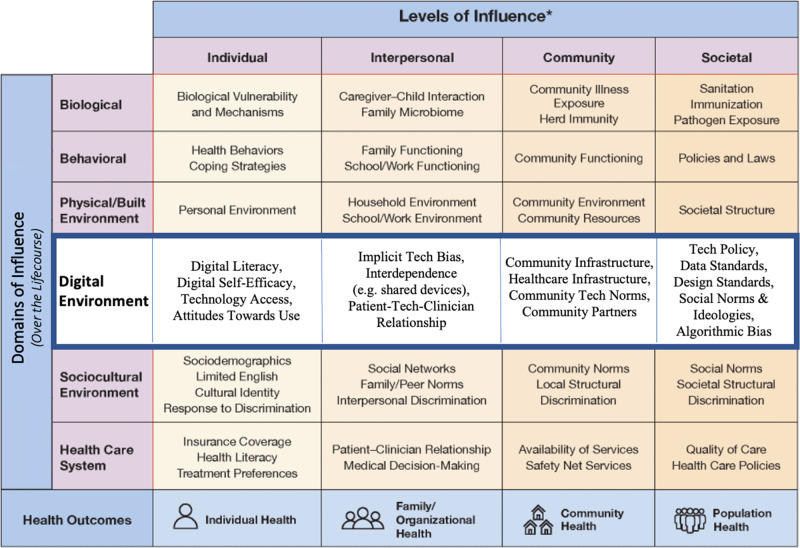
We present a comprehensive Framework for Digital Health Equity, detailing key digital determinants of health (DDoH), to support the work of digital health tool creators in industry, health systems operations, and academia. The rapid digitization of healthcare may widen health disparities if solutions are not developed with these determinants in mind. Our framework builds on the leading health disparities framework, incorporating a digital environment domain. We examine DDoHs at the individual, interpersonal, community, and societal levels, discuss the importance of a root cause, multi-level approach, and offer a pragmatic case study that applies our framework.
Overview
The claims and statistics of this paper haven’t been checked yet.
Run the check — free, no account needed. It reads the open-access text and checks the sources it cites.
Integrity signals
Registry
Cites
Statistics
Figures
Verification
Claims the paper makes
The claims and statistics of this paper haven’t been checked yet.
Run the check — free, no account needed. It reads the open-access text and checks the sources it cites.
Claims other papers make about this one
Each is checked against this paper’s own text: does it say what the citing paper says it does?
The cited source doesn’t support the claim as written.
In the citing paper
“Two recently published digital health frameworks for medical students outlined 27 artificial intelligence-specific competencies 47 and 40 digital health topics, 48 respectively.”
From The Digital Health Competencies in Medical Education Framework (2025) · cites this paper as [47]
Checked by a reasoning model — may be wrong.
Experimental — accuracy not yet measuredThe source backs part of the claim, not all of it — or backs it for a different population, condition or comparison.
In the citing paper
“We recognize, however, that social determinants of health are important factors influencing care delivery, symptom management, and supportive care needs and also play an important role in the adoption and access to digital health solutions.41”
From Implementation of a remote symptom monitoring pathway in oncology care: analysis of real-world experience across 33 cancer centres in France and Belgium (2024) · cites this paper as [41]
Experimental — accuracy not yet measuredThe cited source says what the claim attributes to it.
In the citing paper
“Based on the Digital Health Equity Framework (Richardson et al., 2022), digital determinants of health (DDoHs) and social determinants of health (SDoHs) are intertwined factors that influence an individual’s ability and opportunity to engage with digital health tools.”
From Sociodemographics and Digital Health Literacy in Using Wearables for Health Promotion and Disease Prevention: Cross-Sectional Nationwide Survey in Germany (2025) · cites this paper as Richardson et al., 2022
The check wasn’t confident either way, so it gives no verdict — never disputed.
In the citing paper
“Because this study examined U.S.-based physicians using major commercial EHR platforms, the findings should be interpreted within this context40.”
From When better data meets better design: How EHR data usability and system usability shape physicians' cognitive load (2026) · cites this paper as [40]
Experimental — accuracy not yet measuredThe check wasn’t confident either way, so it gives no verdict — never disputed.
In the citing paper
“Nevertheless, these 2 frameworks involved experts from a single country in their development, which may limit their wider use.”
From The Digital Health Competencies in Medical Education Framework (2025) · cites this paper as [47]
Experimental — accuracy not yet measured
Self-check
Percentages, sums and reported differences re-computed from the paper’s own numbers.
The self-check needs the paper’s full text.
Citations
Cites
Self-efficacy: Toward a unifying theory of behavioral change
Bandura, A. (1977) · Psychological Review · doi:10.1037/0033-295x.84.2.191 · Cited by 43,925
Self-efficacy mechanism in human agency
Bandura, A. (1982) · American Psychologist · doi:10.1037/0003-066x.37.2.122 · Cited by 15,975
Levels of racism: a theoretic framework and a gardener's tale
(2000) · American Journal of Public Health · doi:10.2105/ajph.90.8.1212 · Cited by 2,626
Braveman, P., & Gruskin, S. (2003) · Journal of Epidemiology & Community Health · doi:10.1136/jech.57.4.254 · Cited by 1,949
Hidden in Plain Sight — Reconsidering the Use of Race Correction in Clinical Algorithms
Vyas, D. A., Eisenstein, L. G., & Jones, D. S. (2020) · New England Journal of Medicine · doi:10.1056/nejmms2004740 · Cited by 1,731
What types of interventions generate inequalities? Evidence from systematic reviews
Lorenc, T., Petticrew, M., Welch, V., & Tugwell, P. (2013) · Journal of Epidemiology and Community Health · doi:10.1136/jech-2012-201257 · Cited by 927
LaVeist, T. A., Nickerson, K. J., & Bowie, J. V. (2000) · Medical Care Research and Review · doi:10.1177/1077558700057001s07 · Cited by 918
Agarwal, R., Sambamurthy, V., & Stair, R. M. (2000) · Information Systems Research · doi:10.1287/isre.11.4.418.11876 · Cited by 834
Diffusion Of Innovations Theory, Principles, And Practice
Dearing, J. W., & Cox, J. G. (2018) · Health Affairs · doi:10.1377/hlthaff.2017.1104 · Cited by 757
The National Institute on Minority Health and Health Disparities Research Framework
Alvidrez, J., Castille, D. M., Laude-Sharp, M., Rosario, A. M., & Tabor, D. C. (2019) · American Journal of Public Health · doi:10.2105/ajph.2018.304883 · Cited by 740
Research works printed but not linked: 3
- Davis, F. Technology Acceptance Model For Empirically Testing New End-user Information Systems: Theory and Result. PhD thesis, Massachusetts Institute of Technology. (1986).
- Caldwell, B. et al. Web content accessibility guidelines (WCAG) 2.0. WWW Consort. (W3C) 290, 1–34 (2008).
- White, M., Adams, J. & Heywood, P. How and why do interventions that increase health overall widen inequalities within populations. Soc. Inequal. Public Health 65, 82 (2009).
Cited by
Sorted by citations
Items 601–604 of 604
Guney-Coskun, M., Weech, M., Fallaize, R., Hwang, F., Lovegrove, J. A., & Kalkan, İ. (2026) · Journal of Nutrition · doi:10.1016/j.tjnut.2026.101897
Aadam, A. A., Daahiye, M. A., Mohamed, A. A., Ali, A. D., & Khalif, I. A. (2026) · Frontiers in Public Health · doi:10.3389/fpubh.2026.1942140
A community health worker pilot intervention to increase patient portal use among people with HIV
Whitney, E., Devlin, S. A., Friedman, E. E., Mason, J. A., Vilas, S. P., Kagarmanova, A., Clark, N., Laiteerapong, N., Pagkas-Bather, J., Brewer, R., et al. (2026) · PLOS Digital Health · doi:10.1371/journal.pdig.0001782
Braimah, A. W., Darko, P., & Yakubu, R. (2026) · Research Square · doi:10.21203/rs.3.rs-11536250/v1
Metadata
- Authors
- Richardson, S., Lawrence, K., Schoenthaler, A. M., & Mann, D.
- Affiliations
- New York University (US)
- Corresponding author
- Richardson, Safiya
- Venue
- npj Digital Medicine
- Published
- 2022-08-18
- Volume
- 5
- Issue
- 1
- Pages
- 119-119
- ISSN
- 2398-6352 (ISSN-L)
- PMC
- PMC9387425
- OpenAlex
- W4292202284
- Cited by
- 607
- References
- 42
- Citations by year
- 2026: 193 · 2025: 183 · 2024: 149 · 2023: 71 · 2022: 9
- FWCI
- 14.32
- Type
- journal article
- Language
- en
- Open access
- gold
- doi.org
- Locations
- npj Digital Medicine (publishedVersion, cc-by)
- PubMed Central (publishedVersion, cc-by)
- PubMed (publishedVersion)
- DOAJ (DOAJ: Directory of Open Access Journals) (submittedVersion, cc-by-sa)
- Funders
- Agency for Healthcare Research and Quality (R01 HS026522)
- National Heart, Lung, and Blood Institute (K23HL145114)
- Topics
- Social Sciences › Health › Health disparities and outcomes
- Social Sciences › Health › Public Health and Social Inequalities
- Health Sciences › Health Professions › General Health Professions › Health Literacy and Information Accessibility
- Keywords
- digital health equity, digital determinants of health, health disparities, digital health tools, multilevel approach, root cause analysis, digital environment, health equity frameworks
About these checks
Registry, retraction, Cites and statistics results are computed, not judged, with one exception: a printed reference that no index lists is read once by a model before it counts as a citation error. Claims are extracted by a model and kept only when their quote appears verbatim in the text; each cited source is then checked, with a model’s help, for whether it says what the claim relies on. Those verdicts can be wrong — read the claim’s quote and the cited source before relying on one.
Statistics and arithmetic are recomputed, not judged.
Confidence bands are shown only for fields calibrated on our annotated test set. None is calibrated yet, so no band is shown.
What counts as a claim ›How we measure confidence ›How we check this ›
Are you an author, or do you see a problem with this page? Request a review
