

The DOI matches its Crossref record; 64 of the 64 references it cites were found in a registry or an index; 16 of the 46 sources its claims cite were checked for support.
When better data meets better design: How EHR data usability and system usability shape physicians' cognitive load
Open accessAbstract
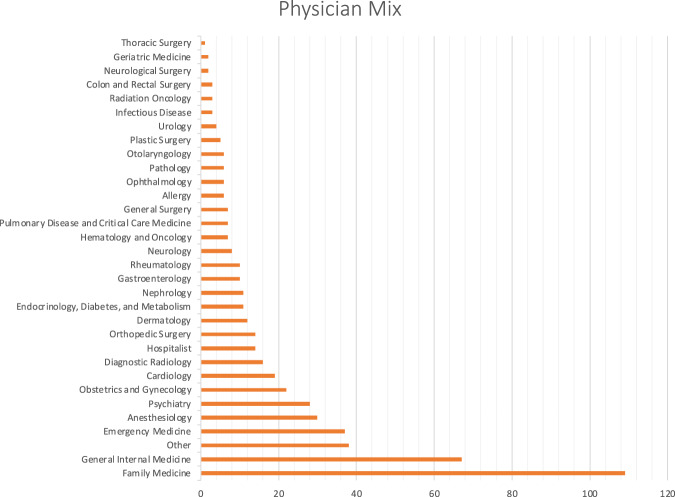
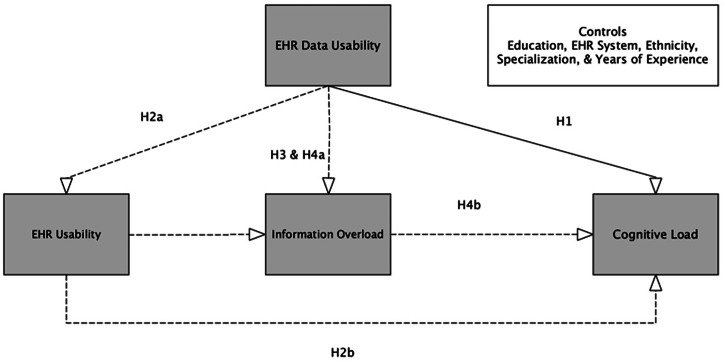
Electronic health record (EHR) systems were designed to enhance clinical decision-making, yet the way data is organized and displayed can create significant cognitive demands for physicians. This study examines how EHR data usability (data quality, data completeness, and data-driven use) and system usability jointly shape physicians' cognitive load. Using survey responses from 564 physicians across 32 specialties, we tested a mediated model with covariance-based structural equation modeling. Reliability and validity were assessed through standard psychometric criteria. Findings show that stronger data usability increases germane cognitive load, promoting deeper engagement with clinically meaningful information. In contrast, higher system usability reduces extraneous cognitive load by aligning interface design with clinical workflow and minimizing navigation-related effort. Information overload partially mediated these effects, suggesting that better data usability helps physicians better filter irrelevant data and stay focused on diagnostically relevant cues. Overall, the results highlight two levers for improving cognitive performance: enhancing system usability lowers unnecessary cognitive effort and documentation-related errors, while improving data usability supports reasoning-intensive diagnostic work. Optimizing both fosters balanced cognitive load and more sustainable, error-resilient clinical decision-making.
Overview
CoChat Summary
## TL;DR
This cross-sectional survey of 564 U.S. physicians found that EHR data usability and EHR system usability affect physicians’ cognitive load in different ways. Better data usability increased cognitive load and reduced information overload, while better system usability reduced cognitive load by lowering interface-related effort.
## Key findings
- Survey data from 564 physicians across 32 specialties were analyzed; the largest EHR platform group used Epic (51.6%), followed by Cerner (12.2%), Allscripts (6.6%), and Meditech (5.7%).
- The final structural model fit well (χ2 = 15.993, df = 10, CFI = 0.995, TLI = 0.979, RMSEA = 0.048, SRMR = 0.036), and it explained 34.1% of the variance in cognitive load.
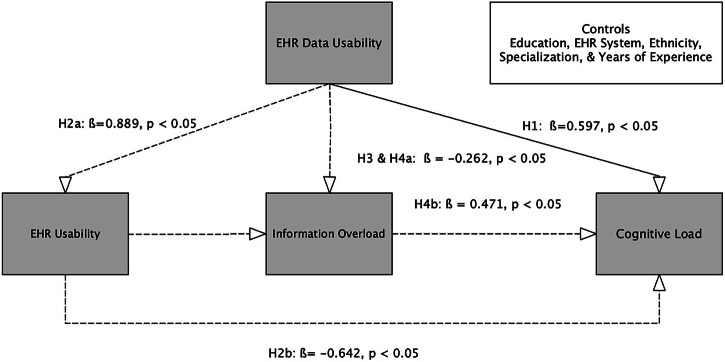
- EHR data usability had a strong direct positive effect on cognitive load (β = 0.597, p = 0.000*).
- EHR system usability partially and negatively mediated the data usability–cognitive load relationship (indirect β = −0.571, p = 0.019*), and also directly reduced information overload (β = −0.262, p = 0.000*). Information overload also mediated the data usability–cognitive load link (β = −0.137, p = 0.014*).
- Among controls, only years of experience was significant, with more experienced physicians reporting lower cognitive load (β = −0.145, p = 0.005).
## Methods
- Design: Cross-sectional online survey; hypotheses tested with covariance-based structural equation modeling (SEM).
- Sample/data: 564 practicing physicians in the United States, recruited through SBH Global, surveyed between February and May 2022; eligibility required active EHR use and at least 4.84 years of EHR experience.
- Analysis: Exploratory factor analysis, confirmatory factor analysis, mediation testing with bootstrapping (5,000 resamples, 95% CIs), and SEM in Mplus; common method bias and multicollinearity were also checked.
## Limitations
- The paper explicitly says the findings should be interpreted in the context of U.S.-based physicians using major commercial EHR platforms, and notes that international systems may differ.
- The final model explained 34.1% of cognitive load, which the paper states indicates additional antecedents were not captured.
- The paper states it could not account for dynamic variation in cognitive load by patient complexity, data density, or situational factors, nor examine how cognitive load fluctuations affect clinical performance.
Model-written summary. Check it against the paper before relying on it.
Integrity signals
Registry
Cites
Statistics
Figures
Verification
Claims the paper makes
6 Valid · 4 Not valid · 15 Not checked · 59 Own results and interpretations
The cited sources support only part of this claim — read each source’s verdict below.
In the paper
“Emerging evidence shows that these activities introduce substantial cognitive load, particularly after nurse intake and the initial patient-physician encounter for established patients3,4.”
§ When better data meets better design: How EHR data usability and system usability shape physicians’ cognitive load > Introduction
What the sources say
- Partly supportedcites [3] Pollack, A. H. & Pratt, W. Association of health record visualizations with physicians’ cognitive load when prioritizing hospitalized patients. JAMA Netw. Open 3, e1919301 (2020). sourceExperimental — accuracy not yet measured
The Introduction (page not provided) says searching and synthesizing information across EHR sections increases physicians’ cognitive workload. The paper examines prioritization of hospitalized patients; it does not establish that workload is particularly high after nurse intake or an initial patient–physician encounter for established patients. (LLM, conf=0.89)
- Partly supportedcites [4] Mazur, L. M., Mosaly, P. R., Moore, C. & Marks, L. Association of the usability of electronic health records with cognitive workload and performance levels among physicians. JAMA Netw. Open 2, e191709 (2019). sourceExperimental — accuracy not yet measured
The Results (Perceived and Physiological Workload; page unavailable) report higher cognitive workload with the baseline EHR than with the enhanced EHR in simulated abnormal-test-result tasks. The paper does not locate that workload particularly after nurse intake or an initial patient-physician encounter for established patients. (LLM, conf=0.86)
plainstates a cause- Asserted: passes — The authors put it forward as true.
- Checkable: passes — It can be checked against evidence.
- Load-bearing: passes — The paper’s conclusions depend on it.
- Based: passes — The paper gives a reason why it holds.
- Partly supported
The cited sources support only part of this claim — read each source’s verdict below.
In the paper
“Generally, because EHRs have higher data usability prompts, they encourage physicians to engage more deeply with patient information3,4,44,49,54.”
§ When better data meets better design: How EHR data usability and system usability shape physicians’ cognitive load > Methods
What the sources say
- Partly supportedcites [3] Pollack, A. H. & Pratt, W. Association of health record visualizations with physicians’ cognitive load when prioritizing hospitalized patients. JAMA Netw. Open 3, e1919301 (2020). sourceExperimental — accuracy not yet measured
The Discussion reports that a visualization with high usability scores helped physicians recognize and process meaningful patterns in patient data. It does not report that EHRs generally have higher data-usability prompts or that such prompts cause physicians to engage more deeply with patient information; the Introduction instead describes shortcomings of conventional EHRs. (LLM, conf=0.83)
- Partly supportedcites [4] Mazur, L. M., Mosaly, P. R., Moore, C. & Marks, L. Association of the usability of electronic health records with cognitive workload and performance levels among physicians. JAMA Netw. Open 2, e191709 (2019). sourceExperimental — accuracy not yet measured
The Methods (Intervention) describe an enhanced EHR that prominently displayed patient status and instructions for next steps. The Discussion reports that its users were more likely to contact patients and schedulers about missed follow-up, but the study did not establish that physicians engaged more deeply with patient information generally. (LLM, conf=0.84)
- Not checked yetcites [44] Collins, R. Clinician cognitive overload and its implications for nurse leaders. Nurse Lead. 18, 44–47 (2020). source
Checked before — its earlier verdict is held back until a new check runs.
- Not checked — no full text of the sourcecites [49] Deck, C. & Jahedi, S. The effect of cognitive load on economic decision making: a survey and new experiments. Eur. Econ. Rev. 78, 97–119 (2015). source
- Not matchedcites [54] Harmon, C. S., Adams, S. A. & Davis, J. E. Nursing cognitive-overload and electronic documentation burden: a literature review. J. Inform. Nurs. 5, 16–30 (2020).
Couldn’t be matched to a paper in Crossref, so it can’t be checked.
plainstates a cause- Asserted: passes — The authors put it forward as true.
- Checkable: passes — It can be checked against evidence.
- Load-bearing: passes — The paper’s conclusions depend on it.
- Based: passes — The paper gives a reason why it holds.
- Partly supported
The cited sources that could be checked couldn’t confirm or dispute this claim.
In the paper
“Importantly, information overload decreases when physicians encounter highly usable patient data, as they are better able to focus more on task-relevant cues and filter out noise47.”
§ When better data meets better design: How EHR data usability and system usability shape physicians’ cognitive load > Discussion
What the sources say
- Could not verifycites [47] Rieke, N. et al. The future of digital health with federated learning. npj Digit. Med. 3, 119 (2020). sourceExperimental — accuracy not yet measured
The 'Impact on stakeholders—Clinicians' passage discusses ML-assisted diagnosis and presenting information in a commonly understood format, not whether usable patient data reduces physicians’ information overload. Searches for task-relevant cues, filtering noise, and reduced cognitive load found no passage addressing that claim. Page numbers were not available in our copy. (LLM, conf=0.76)
plainstates a cause- Asserted: passes — The authors put it forward as true.
- Checkable: passes — It can be checked against evidence.
- Load-bearing: passes — The paper’s conclusions depend on it.
- Based: passes — The paper gives a reason why it holds.
- Could not verify
The cited sources that could be checked couldn’t confirm or dispute this claim.
In the paper
“In this view, enhanced data usability mitigates overload not by limiting information volume, but by structuring and contextualizing data to reduce extraneous cognitive effort47.”
§ When better data meets better design: How EHR data usability and system usability shape physicians’ cognitive load > Methods
What the sources say
- Could not verifycites [47] Rieke, N. et al. The future of digital health with federated learning. npj Digit. Med. 3, 119 (2020). sourceExperimental — accuracy not yet measured
The 'Impact on stakeholders' section discusses using a common format to present information to collaborators, while 'The reliance on data' concerns data quality and availability; page numbers are unavailable in our copy. Neither addresses whether structuring and contextualizing data reduces information overload or extraneous cognitive effort. Searches for those terms and for clinician cognitive load found no supporting passage. (LLM, conf=0.75)
plainstates a cause- Asserted: passes — The authors put it forward as true.
- Checkable: passes — It can be checked against evidence.
- Load-bearing: passes — The paper’s conclusions depend on it.
- Based: passes — The paper gives a reason why it holds.
- Could not verify
A result the paper reports from its own data — it cites no other source for it, so there is none to check. The quote shows it is in the paper.
In the paper
“Information overload partially mediated these effects, suggesting that better data usability helps physicians better filter irrelevant data and stay focused on diagnostically relevant cues.”
§ When better data meets better design: How EHR data usability and system usability shape physicians’ cognitive load > Abstract
hedgedstates a cause- Asserted: passes — The authors put it forward as true.
- Checkable: passes — It can be checked against evidence.
- Load-bearing: passes — The paper’s conclusions depend on it.
- Based: passes — The paper gives a reason why it holds.
- Rests on an assumption not shown here.
25 more claims
Create a free account to see all 84 claims and to verify the 7 references still open.
- It may state two separate claims as one. 34
- Probably not a substantial claim. 31
Self-check
Percentages, sums and reported differences re-computed from the paper’s own numbers.
Each contradiction between two passages listed here was confirmed by an independent check.
Rated major: it would touch a result — a value a result rests on, reported and recomputed p-values on opposite sides of the significance level, two passages that conflict with no sign which is right, or a cited work retracted before this paper was published.
In the paper
§ When better data meets better design: How EHR data usability and system usability shape physicians’ cognitive load > Methods > Measures and variables
“Preliminary analysis indicated that none of these variables had significant direct effects on the dependent constructs; therefore, they were excluded from the final structural model to maintain parsimony.”
§ When better data meets better design: How EHR data usability and system usability shape physicians’ cognitive load > Results > Hypothesis testing
“All controls were nonsignificant with one exception: years of experience were negatively associated with cognitive load (β = −0.145, ρ = 0.005**), indicating that more experienced physicians reported lower cognitive load.”
Rated minor: it would not touch a result — a value no result rests on, a p-value that stays on the same side of the significance level, or a conflict that is clerical, resolved elsewhere in the paper, or outside its own findings.
In the paper
§ When better data meets better design: How EHR data usability and system usability shape physicians’ cognitive load > Results > Participant characteristics
“A total of N = 564 physicians representing 32 specialties, from Family Medicine to Thoracic Surgery, completed the survey (see Fig. 2).”
§ When better data meets better design: How EHR data usability and system usability shape physicians’ cognitive load > Results > Participant characteristics
“Overall, the sample included physicians from 35 medical specialties, reference Fig. 1.”
Citations
Cites
Hu, L., & Bentler, P. M. (1999) · Structural Equation Modeling A Multidisciplinary Journal · doi:10.1080/10705519909540118 · Cited by 108,788
Sources of method bias in social science research and recommendations on how to control it
Podsakoff, P. M., MacKenzie, S. B., & Podsakoff, N. P. (2012) · Annual Review of Psychology · doi:10.1146/annurev-psych-120710-100452 · Cited by 15,744
Cognitive Load During Problem Solving: Effects on Learning
Sweller, J. (1988) · Cognitive Science · doi:10.1016/0364-0213(88)90023-7 · Cited by 11,048
Sweller, J., Ayres, P., & Kalyuga, S. (2011) · doi:10.1007/978-1-4419-8126-4 · Cited by 5,531
Cacioppo, J. T., & Petty, R. E. (1982) · Journal of Personality and Social Psychology · doi:10.1037/0022-3514.42.1.116 · Cited by 5,359 · cited 1×
“Cognitive load is essential for interpreting, integrating, and deriving meaning from patient information duringclinical decision-making 42,43 .”
Sweller, J. (2011) · Psychology of Learning and Motivation · doi:10.1016/b978-0-12-387691-1.00002-8 · Cited by 4,856
Sweller, J. (2012) · Encyclopedia of the Sciences of Learning · doi:10.1007/978-1-4419-1428-6_446 · Cited by 4,405
The future of digital health with federated learning
Rieke, N., Hancox, J., Li, W., Milletarì, F., Roth, H. R., Albarqouni, S., Bakas, S., Galtier, M. N., Landman, B. A., Maier-Hein, K., et al. (2020) · npj Digital Medicine · doi:10.1038/s41746-020-00323-1 · Cited by 4,015 · cited 2×
“Importantly, information overload decreases when physicians encounter highly usable patient data, as they are better able to focus more on task-relevant cues and fi lter out noise 47 .”
The Future of Digital Health with Federated Learning
Rieke, N., Hancox, J., Li, W., Milletari, F., Roth, H., Albarqouni, S., Bakas, S., Galtier, M. N., Landman, B., Maier-Hein, K., et al. (2020) · arXiv · doi:10.48550/arxiv.2003.08119 · Cited by 3,495
Barriers and facilitators to utilizing digital health technologies by healthcare professionals
Borges do Nascimento, I. J., Abdulazeem, H., Vasanthan, L. T., Martinez, E. Z., Zucoloto, M. L., Østengaard, L., Azzopardi-Muscat, N., Zapata, T., & Novillo-Ortiz, D. (2023) · npj Digital Medicine · doi:10.1038/s41746-023-00899-4 · Cited by 673 · cited 1×
“EHR usability has long been recognized as a barrier to high-quality patient care 33 .”
Research works printed but not linked: 5
- Drews, S., Thompson, C. & Gerlach, H. Usability of electronic health records by clinicians in acute care: a scoping review. Can. J. Nurs. Inform. 20, 2 (2025).
- Hair, J. F., Black, W. C., Babin, B. J. & Anderson, R. E. Canonical Correlation: A Supplement to Multivariate Data Analysis: A Global Perspective (Pearson Prentice Hall, 2010).
- Harmon, C. S., Adams, S. A. & Davis, J. E. Nursing cognitive-overload and electronic documentation burden: a literature review. J. Inform. Nurs. 5, 16–30 (2020).
- Shultz, S. & Hand, M. Usability optimization of the electronic health record. J. Inform. Nurs. 2, 14–19 (2017).
- Weber, S., Beck, R. & König, W. Instant messaging—blessing or curse for enterprises? In Proc. Int. Conf. Inf. Syst. (ICIS) 2012 (Association for Information Systems, 2012).
Cited by
Less Is More: Radiologists Prefer Brief Narratives in LLM-Generated Clinical History Summaries
Lyo, S. K., Tripathi, S., Tejani, A. S., Vu, D., Dogra, S., Alizai, H., & Cook, T. S. (2026) · Journal of Imaging Informatics in Medicine · doi:10.1007/s10278-026-02229-y
Bajaj, S., Goh, E. C. D., Ng, Y. Y., & Lee, Z. (2026) · Medical Education Online · doi:10.1080/10872981.2026.2726067
Liu, M., Zhang, P., Wu, Y., Pan, L., & Li, L. (2026) · Nursing Open · doi:10.1002/nop2.70855
Chin, A. T., Zhu, N., Vangala, S., Woo, H. E., Wisk, L. E., Kingsley, T., Mafi, J. N., & Lukac, P. J. (2026) · medRxiv · doi:10.64898/2026.08.26.26361496
Berger, M. F., Augustin, T., Kamolz, L., & Lumenta, D. B. (2026) · Frontiers in Digital Health · doi:10.3389/fdgth.2026.1938990
“This combined approach would ensure that systems are not just broadly acceptable but optimized to reduce cognitive load and prevent critical errors in high stakes clinical environments (58, 59).”
Metadata
- Authors
- Merriweather, Lyytinen, K., Aron, D., & Cauley, M. R.
- Affiliations
- Duke University (US)
- Case Western Reserve University (US)
- Vanderbilt University Medical Center (US)
- Corresponding author
- Merriweather,, Curtis A.
- Venue
- npj Digital Medicine
- Published
- 2026-01-14
- Volume
- 9
- Issue
- 1
- Pages
- 104-104
- ISSN
- 2398-6352 (ISSN-L)
- PMC
- PMC12864774
- OpenAlex
- W7123486818
- Semantic Scholar
- 5628fa63b436984698f5655c8c4ed8384fdd6e18
- Cited by
- 9
- References
- 54
- Citations by year
- 2026: 9
- FWCI
- 67.56
- Type
- journal article
- Language
- en
- Open access
- gold
- doi.org
- Licence
- cc-by
- creativecommons.org/licenses/by/4.0 (tdm)
- creativecommons.org/licenses/by/4.0 (vor, 19 d)
- Locations
- npj Digital Medicine (publishedVersion, cc-by)
- Europe PMC (PubMed Central) (publishedVersion, cc-by)
- PubMed (publishedVersion)
- DOAJ (DOAJ: Directory of Open Access Journals) (submittedVersion, cc-by-sa)
- Topics
- Health Sciences › Health Professions › Health Information Management › Electronic Health Records Systems
- Health Sciences › Medicine › Family Practice › Clinical Reasoning and Diagnostic Skills
- Physical Sciences › Computer Science › Human-Computer Interaction › Usability and User Interface Design
- Keywords
- electronic health records, system usability, germane cognitive load, extraneous cognitive load, information overload, clinical decision-making, clinical workflow, documentation errors, data completeness, data quality
About these checks
Registry, retraction, Cites and statistics results are computed, not judged, with one exception: a printed reference that no index lists is read once by a model before it counts as a citation error. Claims are extracted by a model and kept only when their quote appears verbatim in the text; each cited source is then checked, with a model’s help, for whether it says what the claim relies on. Those verdicts can be wrong — read the claim’s quote and the cited source before relying on one.
The claim verdicts this report counts are experimental: their accuracy is not yet measured.
A language model drew the claims from the paper on 2026-10-10, under version 3 of the claim definition (model deepseek-v4.1-flash, prompt extract-v3).
A second model labelled each claim on 2026-10-10 (model jev-1.13-20260917, definition revision gold-guideline-v0.2).
Cited sources are checked with a language model’s help (gpt-6-sol).
Statistics and arithmetic are recomputed, not judged.
Confidence bands are shown only for fields calibrated on our annotated test set. None is calibrated yet, so no band is shown.
What counts as a claim ›How we measure confidence ›How we check this ›
Are you an author, or do you see a problem with this page? Request a review
How to cite
Cite CoChat for the checks on this page, and the paper for its own findings.
- This page
- CoChat. (2026). Citation check: When better data meets better design: How EHR data usability and system usability shape physicians' cognitive load. https://app.cochat.ai/papers/10.1038/s41746-025-02243-4
- The paper
- Merriweather, Lyytinen, K., Aron, D., & Cauley, M. R. (2026). When better data meets better design: How EHR data usability and system usability shape physicians' cognitive load. npj Digital Medicine. https://doi.org/10.1038/s41746-025-02243-4
Data sources
Bibliographic data: Semantic Scholar, OpenAlex, Crossref.
Contains information from the Semantic Scholar Academic Graph Datasets, made available under the ODC Attribution License (ODC-BY 1.0).
Semantic Scholar’s data is described in: Kinney, R., et al. (2023). The Semantic Scholar Open Data Platform. arXiv:2301.10140.
