

The DOI matches its Crossref record; 29 of the 29 references it cites were found in a registry or an index.
Systematic review of deep learning image analyses for the diagnosis and monitoring of skin disease
Open accessAbstract
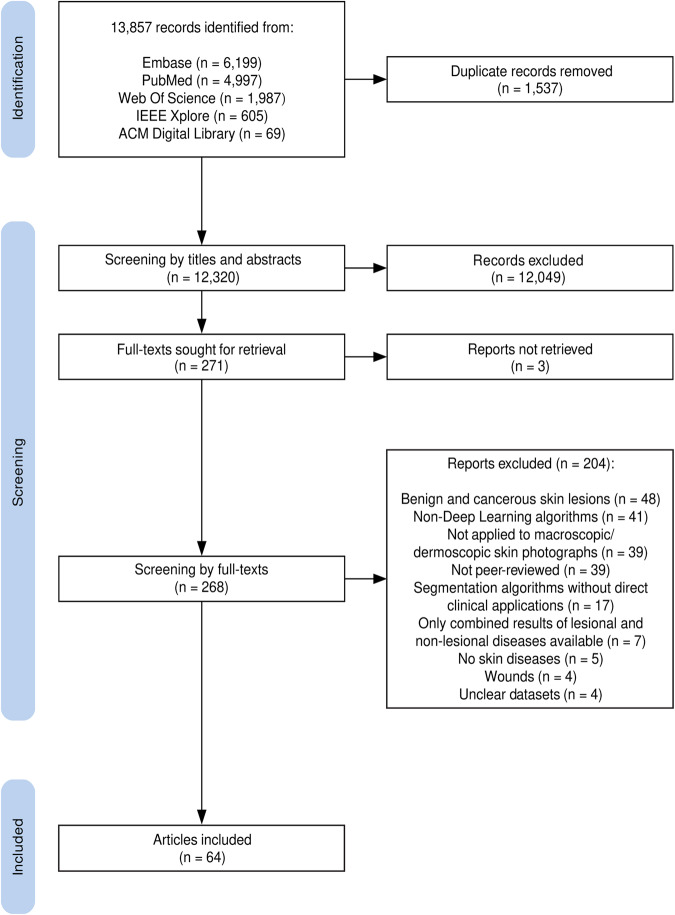
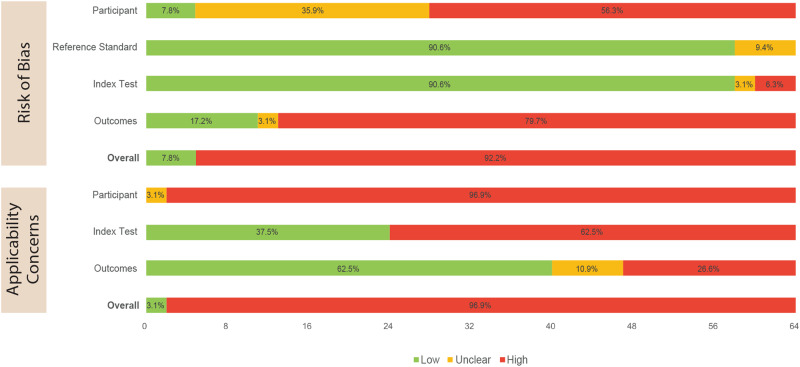
Skin diseases affect one-third of the global population, posing a major healthcare burden. Deep learning may optimise healthcare workflows through processing skin images via neural networks to make predictions. A focus of deep learning research is skin lesion triage to detect cancer, but this may not translate to the wider scope of >2000 other skin diseases. We searched for studies applying deep learning to skin images, excluding benign/malignant lesions (1/1/2000-23/6/2022, PROSPERO CRD42022309935). The primary outcome was accuracy of deep learning algorithms in disease diagnosis or severity assessment. We modified QUADAS-2 for quality assessment. Of 13,857 references identified, 64 were included. The most studied diseases were acne, psoriasis, eczema, rosacea, vitiligo, urticaria. Deep learning algorithms had high specificity and variable sensitivity in diagnosing these conditions. Accuracy of algorithms in diagnosing acne (median 94%, IQR 86-98; n = 11), rosacea (94%, 90-97; n = 4), eczema (93%, 90-99; n = 9) and psoriasis (89%, 78-92; n = 8) was high. Accuracy for grading severity was highest for psoriasis (range 93-100%, n = 2), eczema (88%, n = 1), and acne (67-86%, n = 4). However, 59 (92%) studies had high risk-of-bias judgements and 62 (97%) had high-level applicability concerns. Only 12 (19%) reported participant ethnicity/skin type. Twenty-four (37.5%) evaluated the algorithm in an independent dataset, clinical setting or prospectively. These data indicate potential of deep learning image analysis in diagnosing and monitoring common skin diseases. Current research has important methodological/reporting limitations. Real-world, prospectively-acquired image datasets with external validation/testing will advance deep learning beyond the current experimental phase towards clinically-useful tools to mitigate rising health and cost impacts of skin disease.
Overview
The claims and statistics of this paper haven’t been checked yet.
Run the check — free, no account needed. It reads the open-access text and checks the sources it cites.
Integrity signals
Registry
Cites
Statistics
Figures
Verification
Claims the paper makes
The claims and statistics of this paper haven’t been checked yet.
Run the check — free, no account needed. It reads the open-access text and checks the sources it cites.
Claims other papers make about this one
Each is checked against this paper’s own text: does it say what the citing paper says it does?
The source backs part of the claim, not all of it — or backs it for a different population, condition or comparison.
In the citing paper
“Key technical hurdles include standardizing image quality across photo acquisition methods, addressing confounding factors and artifacts in images, and developing representative datasets that span diverse patient populations (Choy et al, 2023; Daneshjou et al, 2022)”
From Artificial intelligence–enabled precision medicine for inflammatory skin diseases (2026) · cites this paper as Choy et al, 2023
Experimental — accuracy not yet measuredThe source backs part of the claim, not all of it — or backs it for a different population, condition or comparison.
In the citing paper
“The accuracy of deep learning is confirmed to achieve optimal outcomes in skin disease diagnosis [48]”
From Artificial Intelligence in the Histopathological Assessment of Non-Neoplastic Skin Disorders: A Narrative Review with Future Perspectives (2025) · cites this paper as [48]
Experimental — accuracy not yet measuredThe source backs part of the claim, not all of it — or backs it for a different population, condition or comparison.
In the citing paper
“which was consistent with previous findings.14”
From Assessing the performance of artificial intelligence models in evaluating inflammatory skin disease severity: a systematic review and meta-analysis (2025) · cites this paper as [14]
Experimental — accuracy not yet measuredThe cited source says what the claim attributes to it.
In the citing paper
“with a recent review including 64 studies, of which 52 were focused on detection and 12 concentrated on severity assessment.14”
From Assessing the performance of artificial intelligence models in evaluating inflammatory skin disease severity: a systematic review and meta-analysis (2025) · cites this paper as [14]
The cited source says what the claim attributes to it.
In the citing paper
“An earlier review of deep learning image analyses by Choy et al. noted the highest accuracy in psoriasis (93–100%, n = 2) and the lowest in acne (67–86%, n = 4), but lacked a meta-analysis for direct comparisons.14”
From Assessing the performance of artificial intelligence models in evaluating inflammatory skin disease severity: a systematic review and meta-analysis (2025) · cites this paper as [14]
Self-check
Percentages, sums and reported differences re-computed from the paper’s own numbers.
The self-check needs the paper’s full text.
Citations
Cites
ImageNet classification with deep convolutional neural networks
Krizhevsky, A., Sutskever, I., & Hinton, G. E. (2017) · Communications of the ACM · doi:10.1145/3065386 · Cited by 112,155
LeCun, Y., Bengio, Y., & Hinton, G. (2015) · Nature · doi:10.1038/nature14539 · Cited by 84,126
PRISMA-P Group, Moher, D., Shamseer, L., Clarke, M., Ghersi, D., Liberati, A., Petticrew, M., Shekelle, P., & Stewart, L. A. (2015) · Systematic Reviews · doi:10.1186/2046-4053-4-1 · Cited by 26,223 · cited 1×
“This systematic review is reported in accordance with the Preferred Reporting Items for Systematic Reviews and Meta-Analysis (PRISMA) guidelines 33 .”
MethodRayyan-a web and mobile app for systematic reviews.
Ouzzani, M., Hammady, H., Fedorowicz, Z., & Elmagarmid, A. (2016) · Systematic Reviews · doi:10.1186/s13643-016-0384-4 · Cited by 26,092
Dermatologist-level classification of skin cancer with deep neural networks
Esteva, A., Kuprel, B., Novoa, R. A., Ko, J., Swetter, S. M., Blau, H. M., & Thrun, S. (2017) · Nature · doi:10.1038/nature21056 · Cited by 14,362
A guide to deep learning in healthcare
Esteva, A., Robicquet, A., Ramsundar, B., Kuleshov, V., DePristo, M., Chou, K., Cui, C., Corrado, G., Thrun, S., & Dean, J. (2019) · Nature Medicine · doi:10.1038/s41591-018-0316-z · Cited by 5,312
Synthesis without meta-analysis (SWiM) in systematic reviews: reporting guideline
Campbell, M., McKenzie, J. E., Sowden, A., Katikireddi, S. V., Brennan, S. E., Ellis, S., Hartmann-Boyce, J., Ryan, R., Shepperd, S., Thomas, J., et al. (2020) · BMJ · doi:10.1136/bmj.l6890 · Cited by 4,628
Utilization of the PICO framework to improve searching PubMed for clinical questions
Schardt, C., Adams, M. B., Owens, T., Keitz, S., & Fontelo, P. (2007) · BMC Medical Informatics and Decision Making · doi:10.1186/1472-6947-7-16 · Cited by 3,053
PROBAST: A Tool to Assess the Risk of Bias and Applicability of Prediction Model Studies
Wolff, R. F., Moons, K. G. M., Riley, R. D., Whiting, P. F., Westwood, M., Collins, G. S., Reitsma, J. B., Kleijnen, J., Mallett, S., & for the PROBAST Group† (2019) · Annals of Internal Medicine · doi:10.7326/m18-1376 · Cited by 2,984
Liu, X., Faes, L., Kale, A. U., Wagner, S. K., Fu, D. J., Bruynseels, A., Mahendiran, T., Moraes, G., Shamdas, M., Kern, C., et al. (2019) · The Lancet Digital Health · doi:10.1016/s2589-7500(19)30123-2 · Cited by 1,883
Research works printed but not linked: 1
- Page M. J. H. J. & Sterne J. A. C. Chapter 13: Assessing risk of bias due to missing results in a synthesis. in Cochrane Handbook for Systematic Reviews of Interventions version 63 (updated February 2022) Ch. 13 (Cochrane, 2022).
Cited by
Sorted by citations
Large language models for disease diagnosis: a scoping review
Zhou, S., Xu, Z., Zhang, M., Xu, C., Guo, Y., Zhan, Z., Fang, Y., Ding, S., Wang, J., Xu, K., et al. (2025) · npj Artificial Intelligence · doi:10.1038/s44387-025-00011-z · Cited by 188
Smart Dressings and Their Applications in Chronic Wound Management
Li, X., Xue, X., & Xie, P. (2024) · Cell Biochemistry and Biophysics · doi:10.1007/s12013-024-01402-w · Cited by 48
Unraveling the Impact of Class Imbalance on Deep-Learning Models for Medical Image Classification
Hellín, C. J., Olmedo, A., Valledor, A., Gómez, J., López‐Benítez, M., & Tayebi, A. (2024) · Applied Sciences · doi:10.3390/app14083419 · Cited by 43
Deep learning models across the range of skin disease
Venkatesh, K. P., Raza, M. M., Nickel, G., Wang, S., & Kvedar, J. C. (2024) · npj Digital Medicine · doi:10.1038/s41746-024-01033-8 · Cited by 36
Shapiro, J., & Lyakhovitsky, A. (2024) · Clinics in Dermatology · doi:10.1016/j.clindermatol.2024.06.020 · Cited by 26
Metadata
- Authors
- Choy, S. P., Kim, B. J., Paolino, A., Tan, W. R., Lim, S. M. L., Seo, J., Tan, S. P., Francis, L., Tsakok, T., Simpson, M., Barker, J. N. W. N., Lynch, M. D., Corbett, M. S., Smith, C. H., & Mahil, S. K.
- Affiliations
- King's College London (GB)
- St George’s University Hospitals NHS Foundation Trust (GB)
- Maidstone and Tunbridge Wells NHS Trust (GB)
- Imperial College London (GB)
- Barking, Havering And Redbridge University Hospitals NHS Trust (GB)
- University of York (GB)
- Corresponding author
- Mahil, Satveer K.
- ORCID
- Venue
- npj Digital Medicine
- Published
- 2023-09-27
- Volume
- 6
- Issue
- 1
- Pages
- 180-180
- ISSN
- 2398-6352 (ISSN-L)
- PMC
- PMC10533565
- OpenAlex
- W4387104519
- Cited by
- 105
- References
- 29
- Citations by year
- 2026: 35 · 2025: 43 · 2024: 25 · 2023: 2
- FWCI
- 3.40
- Type
- journal article
- Language
- en
- Open access
- gold
- doi.org
- Locations
- npj Digital Medicine (publishedVersion, cc-by)
- PubMed Central (publishedVersion, cc-by)
- PubMed (publishedVersion)
- White Rose Research Online (University of Leeds, The University of Sheffield, University of York) (acceptedVersion, public-domain)
- Research Portal (King's College London) (submittedVersion, cc-by)
- DOAJ (DOAJ: Directory of Open Access Journals) (submittedVersion, cc-by-sa)
- Funders
- DH | National Institute for Health Research (NIHR302258)
- Psoriasis Association (PhD Studentship)
- RCUK | Medical Research Council ([MR/R001839/1])
- Topics
- Health Sciences › Medicine › Oncology › Cutaneous Melanoma Detection and Management
- Health Sciences › Medicine › Dermatology › Dermatology and Skin Diseases
- Health Sciences › Medicine › Health Informatics › Artificial Intelligence in Healthcare and Education
- Keywords
- deep learning, dermatological diagnosis, skin lesion image analysis, acne, psoriasis, atopic dermatitis, rosacea, vitiligo, urticaria, disease severity classification, diagnostic accuracy, risk of bias, external validation, skin type, dermatology
About these checks
Registry, retraction, Cites and statistics results are computed, not judged, with one exception: a printed reference that no index lists is read once by a model before it counts as a citation error. Claims are extracted by a model and kept only when their quote appears verbatim in the text; each cited source is then checked, with a model’s help, for whether it says what the claim relies on. Those verdicts can be wrong — read the claim’s quote and the cited source before relying on one.
Statistics and arithmetic are recomputed, not judged.
Confidence bands are shown only for fields calibrated on our annotated test set. None is calibrated yet, so no band is shown.
What counts as a claim ›How we measure confidence ›How we check this ›
Are you an author, or do you see a problem with this page? Request a review
