

Hidden flaws behind expert-level accuracy of multimodal GPT-4 vision in medicine
Open accessThe DOI matches its Crossref record; 23 of the 23 references it cites were found in a registry or an index.
Abstract
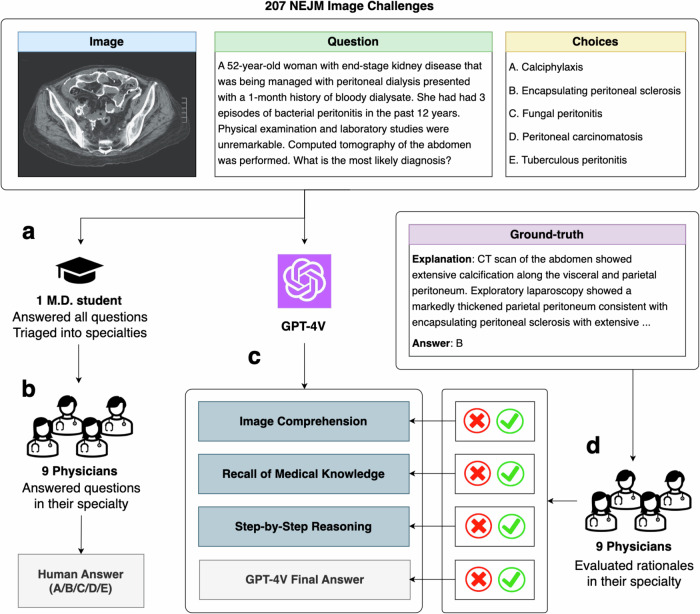
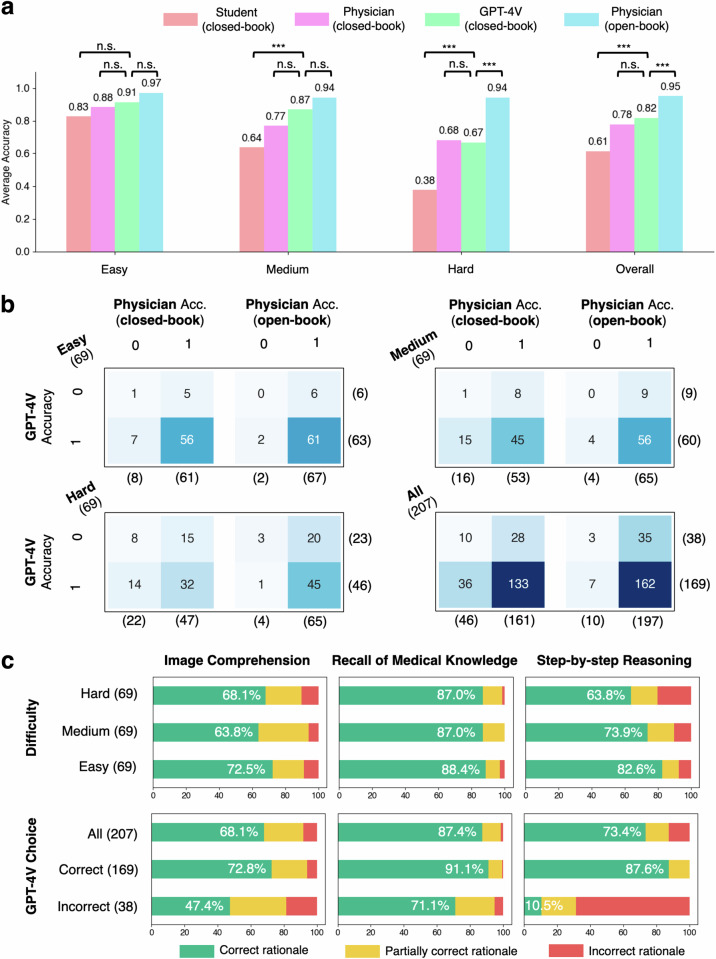
Recent studies indicate that Generative Pre-trained Transformer 4 with Vision (GPT-4V) outperforms human physicians in medical challenge tasks. However, these evaluations primarily focused on the accuracy of multi-choice questions alone. Our study extends the current scope by conducting a comprehensive analysis of GPT-4V’s rationales of image comprehension, recall of medical knowledge, and step-by-step multimodal reasoning when solving New England Journal of Medicine (NEJM) Image Challenges—an imaging quiz designed to test the knowledge and diagnostic capabilities of medical professionals. Evaluation results confirmed that GPT-4V performs comparatively to human physicians regarding multi-choice accuracy (81.6% vs. 77.8%). GPT-4V also performs well in cases where physicians incorrectly answer, with over 78% accuracy. However, we discovered that GPT-4V frequently presents flawed rationales in cases where it makes the correct final choices (35.5%), most prominent in image comprehension (27.2%). Regardless of GPT-4V’s high accuracy in multi-choice questions, our findings emphasize the necessity for further in-depth evaluations of its rationales before integrating such multimodal AI models into clinical workflows.
Overview
The claims and statistics of this paper haven’t been checked yet.
Free: it reads the open-access text and checks the first 5 claims that cite a source we can check. Create a free account to check every claim.
Integrity signals
Registry
Cites
Statistics
Figures
Verification
Claims the paper makes
The claims and statistics of this paper haven’t been checked yet.
Free: it reads the open-access text and checks the first 5 claims that cite a source we can check. Create a free account to check every claim.
Claims other papers make about this one
Each is checked against this paper’s own text: does it say what the citing paper says it does?
The cited source says what the claim attributes to it.
In the citing paper
“Recent studies on GPT-4V’s performance on medical multiple-choice questions demonstrated that despite the impressive results of models on multiple-choice questions, the rationale behind correct answers is flawed in a significant percentage of cases39.”
From Large Language Models lack essential metacognition for reliable medical reasoning (2025) · cites this paper as [39]
The cited source says what the claim attributes to it.
In the citing paper
“However, the current capabilities of LLMs, including advanced models like GPT-4V, remain limited in their understanding and processing of medical images56,57”
From A large language model digital patient system enhances ophthalmology history taking skills (2025) · cites this paper as [56]
The cited source says what the claim attributes to it.
In the citing paper
“AI-powered diagnoses33 are not yet perfected,34 and there is an ongoing discussion as to their use.35–39”
From Clinical AI Scribes in primary care: accuracy, error severity and implications for clinical practice (2025) · cites this paper as [34]
Self-check
Percentages, sums and reported differences re-computed from the paper’s own numbers.
The self-check needs the paper’s full text.
Citations
Cites
Large language models encode clinical knowledge
Singhal, K., Azizi, S., Tu, T., Mahdavi, S. S., Wei, J., Chung, H. W., Scales, N., Tanwani, A., Cole-Lewis, H., Pfohl, S., et al. (2023) · Nature · doi:10.1038/s41586-023-06291-2 · Cited by 4,083 · cited 4×
“These re fl ect the multimodal nature of the task as well as the commonly evaluated capabilities for text-only LLMs 6,8 .”
BackgroundInfluentialLarge Language Models Encode Clinical Knowledge
Singhal, K., Azizi, S., Tu, T., Mahdavi, S. S., Wei, J., Chung, H. W., Scales, N., Tanwani, A., Cole-Lewis, H., Pfohl, S., et al. (2022) · arXiv · doi:10.48550/arxiv.2212.13138 · Cited by 4,083 · cited 4×
“These re fl ect the multimodal nature of the task as well as the commonly evaluated capabilities for text-only LLMs 6,8 .”
BackgroundInfluentialAcosta, J. N., Falcone, G. J., Rajpurkar, P., & Topol, E. J. (2022) · Nature Medicine · doi:10.1038/s41591-022-01981-2 · Cited by 1,365
Capabilities of GPT-4 on Medical Challenge Problems
Nori, H., King, N., McKinney, S. M., Carignan, D., & Horvitz, E. (2023) · arXiv · doi:10.48550/arxiv.2303.13375 · Cited by 509 · cited 1×
“…fi ed by generative pre-trained transformer 4 (GPT-4) 1 have achieved remarkable performance on various biomedical tasks 2 , including summarizing medical evidence 3 , assisting in literature search 4,5 , answering medical examination questions 6 – 9 , andmatchingpatientstoclinicaltrials 10 .”
BackgroundEvaluating large language models on medical evidence summarization
Tang, L., Sun, Z., Idnay, B., Nestor, J. G., Soroush, A., Elias, P. A., Xu, Z., Ding, Y., Durrett, G., Rousseau, J. F., et al. (2023) · npj Digital Medicine · doi:10.1038/s41746-023-00896-7 · Cited by 423
Self-citationEvaluating Large Language Models on Medical Evidence Summarization
Tang, L., Sun, Z., Idnay, B., Nestor, J. G., Soroush, A., Elias, P. A., Xu, Z., Ding, Y., Durrett, G., Rousseau, J., et al. (2023) · doi:10.1101/2023.04.22.23288967 · Cited by 423
Self-citationOpportunities and Challenges for ChatGPT and Large Language Models in Biomedicine and Health
Tian, S., Jin, Q., Yeganova, L., Lai, P.-T., Zhu, Q., Chen, X., Yang, Y., Chen, Q., Kim, W., Comeau, D. C., et al. (2023) · Briefings in Bioinformatics · doi:10.1093/bib/bbad493 · Cited by 359
Self-citationCan large language models reason about medical questions?
Liévin, V., Hother, C. E., Motzfeldt, A. G., & Winther, O. (2024) · Patterns · doi:10.1016/j.patter.2024.100943 · Cited by 343 · cited 1×
“These re fl ect the multimodal nature of the task as well as the commonly evaluated capabilities for text-only LLMs 6,8 .”
BackgroundCan large language models reason about medical questions?
Liévin, V., Hother, C. E., Motzfeldt, A. G., & Winther, O. (2022) · arXiv · doi:10.48550/arxiv.2207.08143 · Cited by 343 · cited 1×
“These re fl ect the multimodal nature of the task as well as the commonly evaluated capabilities for text-only LLMs 6,8 .”
BackgroundMatching Patients to Clinical Trials with Large Language Models
Jin, Q., Wang, Z., Floudas, C. S., Chen, F., Gong, C., Bracken-Clarke, D., Xue, E., Yang, Y., Sun, J., & Lu, Z. (2023) · arXiv · doi:10.48550/arxiv.2307.15051 · Cited by 287 · cited 1×
“…fi ed by generative pre-trained transformer 4 (GPT-4) 1 have achieved remarkable performance on various biomedical tasks 2 , including summarizing medical evidence 3 , assisting in literature search 4,5 , answering medical examination questions 6 – 9 , andmatchingpatientstoclinicaltrials 10 .”
BackgroundSelf-citation
Cited by
Items 101–185 of 185
Feizyab, S., Bonetti, G., Medori, M. C., Micheletti, C., Luca, I. D., Donato, K., Miertuš, J., Dündar, M. S., Vráblová, M., HENEHAN, G. T. M., et al. (2025) · The EuroBiotech Journal · doi:10.2478/ebtj-2025-0019 · Cited by 2
Candito, A., Mun, T. S. H., Holbrey, R., Doran, S., Messiou, C., Koh, D., & Blackledge, M. (2025) · Journal of Imaging Informatics in Medicine · doi:10.1007/s10278-025-01712-2 · Cited by 3
SynthEHR-eviction: enhancing eviction SDoH detection with LLM-augmented synthetic EHR data
Yao, Z., Zhao, Y., Mitra, A., Levy, D. A., Druhl, E., Tsai, J., & Yu, H. (2026) · npj Digital Medicine · doi:10.1038/s41746-026-02473-0 · Cited by 3
“Continual re fi nement of the reasoning templates and collaboration with clinical experts will be needed to close these gaps 49,50 .”
Wang, Z., Ma, T., & Wang, H. (2026) · Die Radiologie · doi:10.1007/s00117-026-01608-4 · Cited by 2
Akhund, S. A., Qazi, S., Mazhar, M. A., Shaikh, A. A., Atif, E., Shaikh, A., Shaibah, H., Musa, M. K., N.Qazi, S., Khan, M. A., et al. (2026) · Medical Education Online · doi:10.1080/10872981.2026.2684837 · Cited by 4
“Evidence from medical imaging and transfer-learning literature suggests reduced robustness under distribution shift when inputs differ from common training distributions [34,35], which is consistent with multimodal error patterns reported in medical visual tasks [33].”
Is it safe to deploy AI in safety-critical systems?
Kolda, T. G. (2026) · Philosophical Transactions of the Royal Society A Mathematical Physical and Engineering Sciences · doi:10.1098/rsta.2025.0123 · Cited by 2
Agentic systems in computational pathology: architectures, evidence, and translational challenges
Lu, X., Li, Q., Gao, Y., Wei, D., Lyu, M., Ma, S., Li, J., Wu, Y., Cai, L., Zhang, T., et al. (2026) · Journal of Translational Medicine · doi:10.1186/s12967-026-08829-0 · Cited by 2
“Because error detection may depend on a clinician’s own diagnostic expertise [172], AI training should complement rather than replace sustained morphological education.”
InfluentialGoričan, T., Terčelj, M., & Peruš, I. (2024) · Applied Sciences · doi:10.3390/app14167015 · Cited by 2
Multimodal artificial intelligence in radiology: Text-dominant reasoning limits image understanding
Duron, L., & Lecler, A. (2025) · Diagnostic and Interventional Imaging · doi:10.1016/j.diii.2025.05.008 · Cited by 2
Increasing Adoptive Capacities of Innovative Health Technologies in the Global Health Care System
Lam, M. L. (2025) · DARNIOS APLINKOS VYSTYMAS · doi:10.52320/dav.v22i1.381 · Cited by 1
“More research is needed to understand how these well-performed AI medical devices available in the market function in different systems (Askin et al., 2024; Jin et al., 2024).”
Wound Care in Blistering Diseases
Suru, A., Mănăilă, M., Fritz, K., & Sălăvăstru, C. (2025) · Springer eBooks · doi:10.1007/978-3-031-84579-6_7 · Cited by 1
Kim, Y., & Lee, S. (2025) · 국토계획 · doi:10.17208/jkpa.2025.06.60.3.65 · Cited by 1
A hybrid deployment model for generative artificial intelligence in hospitals
Griot, M., Hemptinne, C., Vanderdonckt, J. M., & Yüksel, D. (2025) · Machine Learning Health · doi:10.1088/3049-477x/addb51 · Cited by 2
Artificial Intelligence: Its Role in Clinical Medicine?
Li, J. S. Y., & Robertson, H. (2025) · Transplantation · doi:10.1097/tp.0000000000005505 · Cited by 2
Program Directors’ Perspectives on the Transition to the Oral Boards: Results From a National Survey
Smith, E. B., Hossain, R., Resnik, C. S., Sun, K., Kuoy, E., & Golshan-Momeni, M. (2026) · Academic Radiology · doi:10.1016/j.acra.2026.01.048 · Cited by 1
Schmidt, R. D., Balise, R. R., Gonzalez, S. T., Duan, R., Hefner, K. R., Shmueli‐Blumberg, D., Vena, A. A., Tross, S., Feinberg, J., Brandt, L., et al. (2026) · Journal of Substance Use and Addiction Treatment · doi:10.1016/j.josat.2026.209982 · Cited by 1
Comprehensive Evaluation of AI Consent Forms in Otolaryngologic Surgery
Hack, S., Attal, R., Farzad, A., Crew, L. A., Silverstein, S., Karni, J. E., Livneh, N., Alsleibi, S., Saleh, N., Gvili, B., et al. (2026) · World Journal of Otorhinolaryngology - Head and Neck Surgery · doi:10.1002/wjo2.70118 · Cited by 1
“However, these approaches require significant time resources, and continuous updates, making them challenging to sustain in many health-care settings [6, 7].”
Large Language Models for Cholesteatoma Diagnosis: A Pathology-Validated Study
Yenigün, A., Küçük, R. B., Yıldız, Ç., Yurtsever, İ., Şentürk, E., Doğan, R., Eren, S. B., Aksoy, F., & Özturan, O. (2026) · Journal of Craniofacial Surgery · doi:10.1097/scs.0000000000013019 · Cited by 1
Public reactions to hospitals after adverse events involving AI
Choi, J., Kim, Y. J., Lyu, P., Luan, Y. L., & Toh, S. M. (2026) · npj Digital Public Health · doi:10.1038/s44482-026-00021-x · Cited by 2
“For example, diagnostic AI models may rely on spurious patterns 9 or misinterpret images 10 , producing misleading diagnostic outputs that can delay appropriate care and contribute to patient harm.”
Zaman, K. T., Hasan, W. U., Ahmed, N., & Li, J. (2026) · JMIR Formative Research · doi:10.2196/88549 · Cited by 1
“LLMs can exhibit strong performance on medical benchmarks; yet, reliability varies by task and evaluation practice—and human evaluations in health care remain uneven in design rigor [36,37,65, 66].”
Sethi, I., Khan, S., Lyons, P. G., Gao, C. A., Luo, Y., Miltz, D., Tovar, S., ten Lohuis, C., Polly, D. M., Dave, S. B., et al. (2026) · Critical Care Medicine · doi:10.1097/ccm.0000000000007228 · Cited by 2
Wu, P., Han, Y., Zhang, J., Li, Y., Jiang, M., Lu, X., Zhang, H., Xu, D., Hao, M., Wang, L., et al. (2026) · npj Digital Medicine · doi:10.1038/s41746-026-03372-0 · Cited by 1
Self-citationArtificial intelligence in radiology: navigating innovation and ensuring clinical reliability
Herazo, V. D. C., Gutierrez, M. J., Noguera, V., Bermúdez, L. M. O., & Romero, J. A. (2025) · European Radiology · doi:10.1007/s00330-025-11599-w · Cited by 1
Ndoro, S., Edwards, S., & McNally, R. (2026) · British Journal of Healthcare Management · doi:10.12968/bjhc.2025.0145 · Cited by 1
Tamas, P., & Kamminga, L. (2026) · Journal of Information Literacy · doi:10.11645/20.1.847
A critical juncture for the integration of artificial intelligence
Nassehi, D., & Riegler, M. (2024) · Tidsskrift for Den norske legeforening · doi:10.4045/tidsskr.24.0445
What will the future role for large language models (LLMs) be in managing patients with glaucoma?
Tavakoli, K., Hallaj, S., & Baxter, S. L. (2025) · Expert Review of Ophthalmology · doi:10.1080/17469899.2025.2487532
“Ensuring that LLMs are used responsibly, with human over-sight, will be key to their successful integration into clinical practice [10].”
Self-citationAvec l’intelligence artificielle, allons-nous être assistés, augmentés ou… remplacés ?
Démoulins, E., & Martin, L. (2025) · Annales de Dermatologie et de Vénéréologie - FMC · doi:10.1016/j.fander.2025.03.004
SynthEHR-Eviction: Enhancing Eviction SDoH Detection with LLM-Augmented Synthetic EHR DataPreprint
Yao, Z., Zhao, Y., Mitra, A., Levy, D. A., Druhl, E., Tsai, J., & Yu, H. (2025) · medRxiv · doi:10.1101/2025.07.10.25331237 · Cited by 1
“Continual refinement of the reasoning templates and collaboration with clinical experts will be needed to close these gaps 50,51 .”
AI: Stabilizer or Disruptor of Our Livelihood
Lam, M. L., & Wong, K. W. (2025) · Springer eBooks · doi:10.1007/978-3-031-91493-5_9
Arisetijono, E., & Agustin, A. A. (2025) · MNJ (Malang Neurology Journal) · doi:10.21776/ub.mnj.2025.011.02.07
Expanding Horizon of AI: ChatGPT Applications in Healthcare Cybersecurity and Poultry Science
Pendy, B. (2025) · Global Trends in Science and Technology · doi:10.70445/gtst.1.3.2025.244-272
Digitalization Protocol for Histology Image Acquisition
Aizuddin, A. R. M., Loh, B. C. S., & Then, P. (2025) · EAI/Springer Innovations in Communication and Computing · doi:10.1007/978-3-031-96518-0_5
Loson-Kawalec, M., Kowalczyk, A., Szymanski, D., Dadynska, P., Tabor, A., Bartosik, D., Żerek, M., Sitarek, G., Starzynski, B., Keska, A., et al. (2025) · Cureus · doi:10.7759/cureus.96885
King III, K. H. (2024) · VTechWorks (Virginia Tech)
Sussan, T. T., Brawley, R. R., Eckroth, J., Mossell, J., & Weitao, T. (2026) · JMIR Neurotechnology · doi:10.2196/69708
“Jin et al [24] documented “hidden flaws behind expert-level accuracy,” revealing systematic errors obscured by superficially correct outputs.”
InfluentialLi, D., Tang, A., & Chong, J. (2026) · Radiology · doi:10.1148/radiol.252814
Kim, H., Yin, Y., Cao, Z., Liu, C., Li, A., Chen, Z., Ai, X., Chung, Y., Ma, F., Peng, X., et al. (2026) · Research Square · doi:10.21203/rs.3.rs-8819770/v1
“Recent research suggests that these formats may lead to an overestimation of a model’s true capabilities; even when an LLM’s underlying medical knowledge or reasoning is flawed, the model may still identify the most statistically probable answer 109 .”
Self-citationUcdal, M., Celik, M. E., Evik, G., Kuru, S. B., Ozer, S., & Gungor, S. (2026) · JMIR Formative Research · doi:10.2196/88618
“This performance gap is consistent with Jin et al [18], who found that GPT-4V frequently presents flawed rationales despite achieving correct final answers, particularly in image comprehension tasks.”
Zhang, H., & Liu, Y. (2026) · Hemodynamics · doi:10.1097/hd9.0000000000000015
ChatGPT-4’s ability to describe kinematic graphs
Ghazal, A., & Arvidson, A. (2026) · DiVA (Digitala Vetenskapliga Arkivet)
Lam, M. L. (2025) · Institutional Repository of LCC International University
AI facilitates or impedes human flourishing /
Lam, M. L. (2024) · Institutional Repository of LCC International University · Cited by 5
Kim, M. J., Park, J. S., & Kang, S. H. (2026) · Scientific Reports · doi:10.1038/s41598-026-44333-7
Erdem, O., Yılmaz, A., Şahin, A. S., Dağtaş, B. B., Gökyayla, E., Kayıran, M. A., Erdemir, V. A., & Gurel, M. S. (2026) · Scientific Reports · doi:10.1038/s41598-026-68943-3
“Consequently, text-based accuracy alone is an incomplete proxy for multimodal competence and should be interpreted cautiously when evaluating the readiness of VLMs for visually intensive clinical domains such as dermatology 40 .”
Toward Multimodal Conversational Artificial Intelligence for Age-Related Macular Degeneration
Gu, R., Hou, B., Hébert, M., Indurkar, A., Yang, Y., Chew, E. Y., Keenan, T. D. L., & Lu, Z. (2026) · Ophthalmology Retina · doi:10.1016/j.oret.2026.08.010
Self-citationMultimodal Generative AI for Personalized Healthcare and Real-Time Monitoring
Tummuri, S. S. R. (2026) · IEEE International Conference on Emerging Computing and Intelligent Technologies (ICoECIT) · doi:10.1109/icoecit68303.2026.11497204
“Jin et al. [5] revealed cases of overconfidence, spurious correlations, and brittle reasoning by empirically investigating GPT-4 Vision failures of GPT-4 in applying to medical tasks.”
Kristovič, S., & Serrano, P. (2025) · doi:10.33700/21t68m84
Et-Tousy, J., Malek, C., & Zyane, A. (2026) · International Conference on Innovative Research in Applied Science, Engineering and Technology (IRASET) · doi:10.1109/iraset68627.2026.11538732
“It attained an accuracy rate of 81.6% on NEJM Image Challenge, a figure that slightly exceeds the 77.8% accuracy of physicians in a closed-book setting [4].”
InfluentialDAĞCI, M., Özdemir, D., Çekmen, C., Bolat, M., & KOCAAĞA, S. (2026) · Research Square · doi:10.21203/rs.3.rs-9540619/v1
Why high scores do not mean application readiness for health AI
(2026) · Nature Medicine · doi:10.1038/s41591-026-04500-9
Chatbot accuracy in bioinformatics knowledge and coronavirus sequence images
Chen, M.-H., Lau, S.-T., & Woo, P. C. Y. (2026) · Academia molecular biology and genomics. · doi:10.20935/acadmolbiogen8413
Chen, Y., Zheng, J., Wang, Y., Wu, B., Li, L., Liu, M., Xu, L., Wu, Y., Liu, C., Guo, L., et al. (2026) · medRxiv · doi:10.64898/2026.07.11.26357421
Self-citationAgentic systems for breast cancer treatment recommendationsPreprint
de Almeida, V. A., Borges, N. H., Vicenzi, L. F., Kociolek, H., Rocha, S. M. D. C., Gomes, F. N., Ribeiro, J. C. F., & Oliveira, L. E. S. E. (2026) · arXiv (Cornell University) · doi:10.48550/arxiv.2607.12051
“In challenging medical tasks, although some models may outperform physicians in answer accuracy, their reasoning may not align with their final answers, especially in tasks involving image comprehension [47].”
Captioning daily activity images in early childhood education: benchmark and algorithm
Li, S., Gu, Z., Zhang, Z., Pan, W., Li, B., Wang, Y., & Liu, H. (2026) · Multimedia Systems · doi:10.21203/rs.3.rs-10234796/v1
Neto, M., Pinto, R., Reis, J., & Antão, L. (2026) · Computers and Education Artificial Intelligence · doi:10.1016/j.caeai.2026.100654
Requena, L. S., Rizzi, J. S., Ribeiro, Z. M. T., Filho, P. T. H., & Ferretti, R. (2026) · Medical Science Educator · doi:10.1007/s40670-026-02839-9
Bae, S., Moon, I., Park, J., Lim, J., Lee, S., Yoon, Y. E., & Cho, G. (2026) · Journal of Cardiovascular Imaging · doi:10.1186/s44348-026-00085-6
“For example, LLMs can introduce unsupported or fabricated statements when summarizing clinical text [34–36].”
Lin, Y., & Lee, Y.-T. (2026) · American Journal of Geriatric Psychiatry · doi:10.1016/j.jagp.2026.08.016
Song, J., Jeong, W. G., Ko, H., Hwang, E. J., & Lee, T. (2026) · Journal of Imaging Informatics in Medicine · doi:10.1007/s10278-026-02217-2
Dhaimade, P. A., & Henderson, R. (2026) · medRxiv · doi:10.64898/2026.08.21.26360755
Khan, U., Moholkar, S., Kazi, F., & Malik, M. M. U. D. (2026) · Indian journal of radiology and imaging - new series/Indian journal of radiology and imaging/Indian Journal of Radiology & Imaging · doi:10.1055/s-0046-1827821
Pohlkamp, C., & Haferlach, T. (2026) · EClinicalMedicine · doi:10.1016/j.eclinm.2026.104184 · Cited by 1
“28 AI systems have vulnerabilities that differ from, and sometimes exceed, human limitations: they can fail under distribution shift or spectrum bias, perform poorly in under-represented subgroups, be mis-calibrated despite high accuracy, and encode historical biases in their training data.”
Cirkel, L., Knitza, J., Schillings, V., Oksche, A., Becker, J. C., & Kuhn, S. (2026) · npj Digital Medicine · doi:10.1038/s41746-026-03082-7
“This interpretation is consistent with priorworkshowingthathighmultimodal multiple-choiceaccuracy canstill conceal substantial weaknesses in image-grounded reasoning and rationale quality 26 .”
Sannathimmappa, M. B. (2026) · Bulletin of the National Research Centre/Bulletin of the National Research Center · doi:10.1186/s42269-026-01482-z
“Multimodal models reached the right multiple-choice option while justifying it incorrectly in more than a third of cases (Jin et al. 2024).”
InfluentialArtificial Intelligence and Sleep
Schneider, L. D., Hernandez, J., & Heneghan, C. (2026) · Neurologic Clinics · doi:10.1016/j.ncl.2026.07.015
Costa, G., Mendes, R., Teixeira, B., & Ribeiro, L. (2026) · Journal of Artificial Intelligence for Healthcare Systems · doi:10.68159/f858630908
Babu, T., Nair, R. R., Khoh, W. H., Mogan, J. N., & Sindhu, S. (2026) · Computers · doi:10.3390/computers15090598
“Brier score; ECE Brier score [28]; ECE [29] Retains established calibration measures while concept-level supervision through L concept additionally constrains the intermediate clinical representation.”
Cha, J., Zhao, Y., & Zong, H. (2026) · JMIR Medical Education · doi:10.2196/95342
“In this context, accuracy metrics calculated solely on a per-question basis can be systematically overestimated [8].”
Choi, K., Kim, S. J., & Kim, Y. (2026) · Communications in computer and information science · doi:10.1007/978-3-032-28463-1_19
Acevedo-Carrillo, M., & Espejo, S. F. S. (2026) · Journal of Computer Science · doi:10.3844/jcssp.2026.2755.2768
Капустник, В. В. (2026) · Access to Justice in Eastern Europe · doi:10.33327/ajee-18-9.4-a0002009
Hadi, A. A., & Supreethi, K. P. (2026) · Discover Informatics · doi:10.1007/s44564-026-00022-1
Suh, P. S., Shim, W. H., Heo, H., & Suh, C. H. (2026) · Journal of the Korean Society of Radiology · doi:10.3348/jksr.2026.0080
Nemati, A. (2026) · Minds at UW (University of Wisconsin)
NHS staff perceptions of artificial intelligence in healthcare settings
Ndoro, S. (2026) · British Journal of Healthcare Management · doi:10.12968/bjhc.2026.0076
Tabuchi, H., Oshika, T., Akada, M., Toba, Y., & Gomi, F. (2026) · AJO International · doi:10.1016/j.ajoint.2026.100328
Gökçen, E., Kuşdoğan, M., Erkoç, M. F., Albayrak, L., Albayrak, G. S., & Tanrıverdi, D. (2026) · Journal of Clinical Medicine · doi:10.3390/jcm15197716
“The scenario-based reports were internally coherent yet clinically implausible, a pattern consistent with the confabulation phenomenon described in the medical AI literature [11,22].”
Meng, Y., Cui, N., Yao, J., Kong, S., Liu, P., Zhang, Z., & Liang, H. (2026) · Frontiers in Artificial Intelligence · doi:10.3389/frai.2026.1943004
Jun, H. W., Nam, D., Choi, J. Y., & Yoo, T. K. (2026) · Engineering Applications of Artificial Intelligence · doi:10.1016/j.engappai.2026.116609
Xu, K., Yang, Y., Chen, Y., 張心孜, Fu, Y., & Deng, L. (2026) · Pharmaceutical Research · doi:10.1007/s11095-026-04227-9
Xu, J., Han, J., Li, L., & Mu, X. (2026) · Journal of Fungi · doi:10.3390/jof12110813
An Analysis of Large Language Model Performance on Hematology Key Feature Questions
Musick, E., Sutton, D., Josan, H., Dhillon, K., Konopny, A., Sayyad, S., Shams, I., Glover-Takahashi, S., Nayer, M., Leung, F., et al. (2026) · Journal of Cancer Education · doi:10.1007/s13187-026-03025-6
Metadata
- Authors
- Jin, Q., Chen, F., Zhou, Y., Xu, Z., Cheung, J. M., Chen, R., Summers, R. M., Rousseau, J. F., Ni, P., Landsman, M. J., Baxter, S. L., Al’Aref, S. J., Li, Y., Chen, A., Brejt, J. A., Chiang, M. F., Peng, Y., & Lu, Z.
- Affiliations
- National Institutes of Health (US)
- University of Pittsburgh (US)
- Weill Cornell Medicine (US)
- New York University (US)
- Harvard University (US)
- The University of Texas Southwestern Medical Center (US)
- MetroHealth Medical Center (US)
- University of California San Diego (US)
- University of Pittsburgh Medical Center (US)
- Corresponding author
- Peng, Yifan
- Lu, Zhiyong
- ORCID
- Venue
- npj Digital Medicine
- Published
- 2024-07-23
- Volume
- 7
- Issue
- 1
- Pages
- 190-190
- ISSN
- 2398-6352 (ISSN-L)
- PMC
- PMC11266508
- OpenAlex
- W4400921803
- Cited by
- 146
- References
- 18
- Citations by year
- 2026: 67 · 2025: 60 · 2024: 19
- FWCI
- 13.65
- Type
- journal article
- Language
- en
- Open access
- gold
- doi.org
- Licence
- cc-by
- creativecommons.org/licenses/by/4.0 (tdm)
- creativecommons.org/licenses/by/4.0 (vor)
- Locations
- npj Digital Medicine (publishedVersion, cc-by)
- PubMed Central (publishedVersion, cc-by)
- PubMed (publishedVersion)
- arXiv (Cornell University) (submittedVersion, cc-by)
- eScholarship (California Digital Library) (submittedVersion, cc-by)
- PubMed Central (submittedVersion, cc-by)
- DOAJ (DOAJ: Directory of Open Access Journals) (submittedVersion)
- arXiv (Cornell University) (cc-by)
- Funders
- U.S. Department of Health & Human Services | National Institutes of Health
- Topics
- Health Sciences › Medicine › Health Informatics › Artificial Intelligence in Healthcare and Education
- Physical Sciences › Computer Science › Computer Vision and Pattern Recognition › Multimodal Machine Learning Applications
- Physical Sciences › Computer Science › Artificial Intelligence › Explainable Artificial Intelligence (XAI)
- Keywords
- GPT-4V, multimodal large language models, medical image interpretation, diagnostic accuracy, multimodal reasoning, clinical implementation of AI
About these checks
Registry, retraction, Cites and statistics results are computed, not judged, with one exception: a printed reference that no index lists is read once by a model before it counts as a citation error. Claims are extracted by a model and kept only when their quote appears verbatim in the text; each cited source is then checked, with a model’s help, for whether it says what the claim relies on. Those verdicts can be wrong — read the claim’s quote and the cited source before relying on one.
Statistics and arithmetic are recomputed, not judged.
Confidence bands are shown only for fields calibrated on our annotated test set. None is calibrated yet, so no band is shown.
What counts as a claim ›How we measure confidence ›How we check this ›
Are you an author, or do you see a problem with this page? Request a review
Data sources
Bibliographic data: Semantic Scholar, OpenAlex, Crossref.
Contains information from the Semantic Scholar Academic Graph Datasets, made available under the ODC Attribution License (ODC-BY 1.0).
Semantic Scholar’s data is described in: Kinney, R., et al. (2023). The Semantic Scholar Open Data Platform. arXiv:2301.10140.
