

Detecting clinical medication errors with AI enabled wearable cameras
Open accessThe DOI matches its Crossref record; 50 of the 50 references it cites were found in a registry or an index.
Abstract
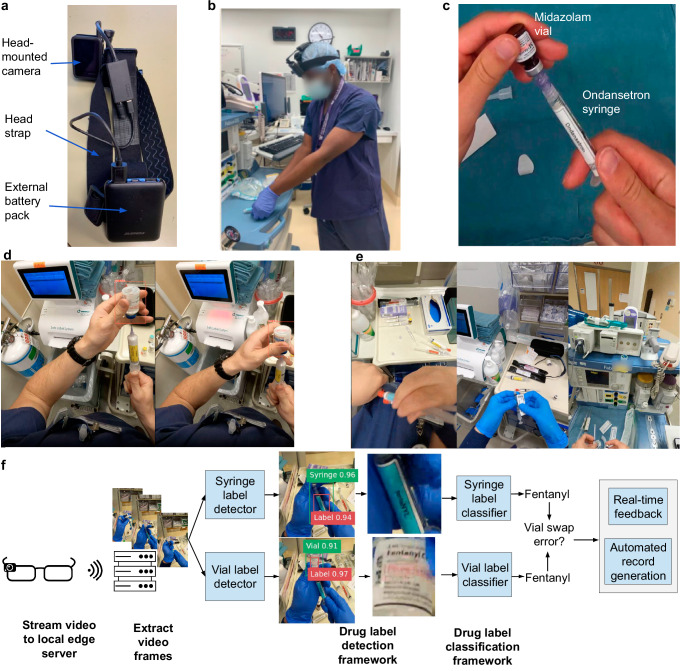
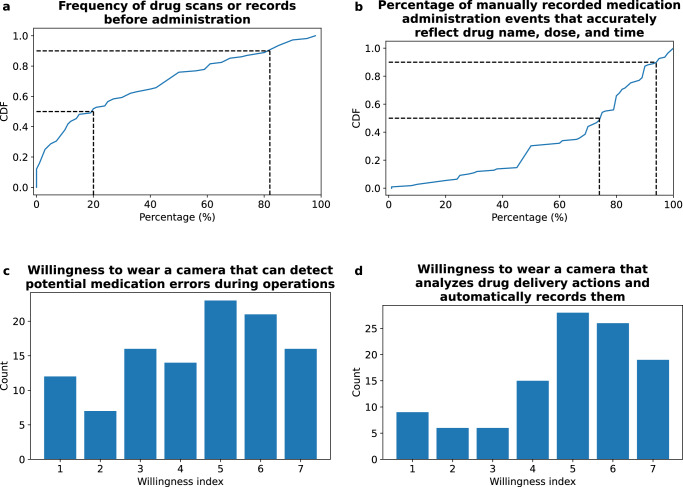
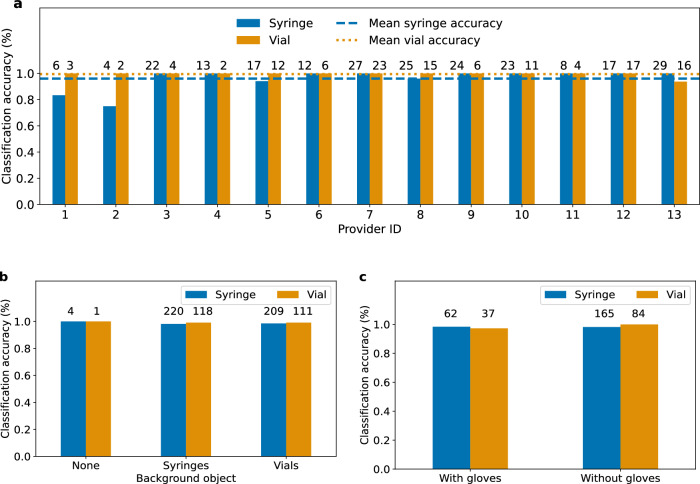
Drug-related errors are a leading cause of preventable patient harm in the clinical setting. We present the first wearable camera system to automatically detect potential errors, prior to medication delivery. We demonstrate that using deep learning algorithms, our system can detect and classify drug labels on syringes and vials in drug preparation events recorded in real-world operating rooms. We created a first-of-its-kind large-scale video dataset from head-mounted cameras comprising 4K footage across 13 anesthesiology providers, 2 hospitals and 17 operating rooms over 55 days. The system was evaluated on 418 drug draw events in routine patient care and a controlled environment and achieved 99.6% sensitivity and 98.8% specificity at detecting vial swap errors. These results suggest that our wearable camera system has the potential to provide a secondary check when a medication is selected for a patient, and a chance to intervene before a potential medical error.
Overview
The claims and statistics of this paper haven’t been checked yet.
Free: it reads the open-access text and checks the first 5 claims that cite a source we can check. Create a free account to check every claim.
Integrity signals
Registry
Cites
Statistics
Figures
Verification
Claims the paper makes
The claims and statistics of this paper haven’t been checked yet.
Free: it reads the open-access text and checks the first 5 claims that cite a source we can check. Create a free account to check every claim.
Claims other papers make about this one
Each is checked against this paper’s own text: does it say what the citing paper says it does?
The cited source doesn’t support the claim as written.
In the citing paper
“AI has moderate accuracy overall but performs better in controlled settings.”
From Artificial Intelligence in Detecting Statistical Errors: Implications for Authors, Reviewers, and Editors (2025) · cites this paper as [28]
Checked by a reasoning model — may be wrong.
Experimental — accuracy not yet measuredThe cited source says what the claim attributes to it.
In the citing paper
“In a study that applied video-assisted operating rooms (OR), AI helped in identifying vial swap errors with a sensitivity and specificity of 99.6% and 98.8%, respectively.28”
From Artificial Intelligence in Detecting Statistical Errors: Implications for Authors, Reviewers, and Editors (2025) · cites this paper as [28]
Self-check
Percentages, sums and reported differences re-computed from the paper’s own numbers.
The self-check needs the paper’s full text.
Citations
Cites
ImageNet: A large-scale hierarchical image database
Deng, J., Dong, W., Socher, R., Li, L.-J., Li, K., & Fei-Fei, L. (2009) · 2009 IEEE Conference on Computer Vision and Pattern Recognition · doi:10.1109/cvpr.2009.5206848 · Cited by 65,333
Learning Transferable Visual Models From Natural Language Supervision
Radford, A., Kim, J. W., Hallacy, C., Ramesh, A., Goh, G., Agarwal, S., Sastry, G., Askell, A., Mishkin, P., Clark, J., et al. (2021) · arXiv · doi:10.48550/arxiv.2103.00020 · Cited by 15,293 · cited 1×
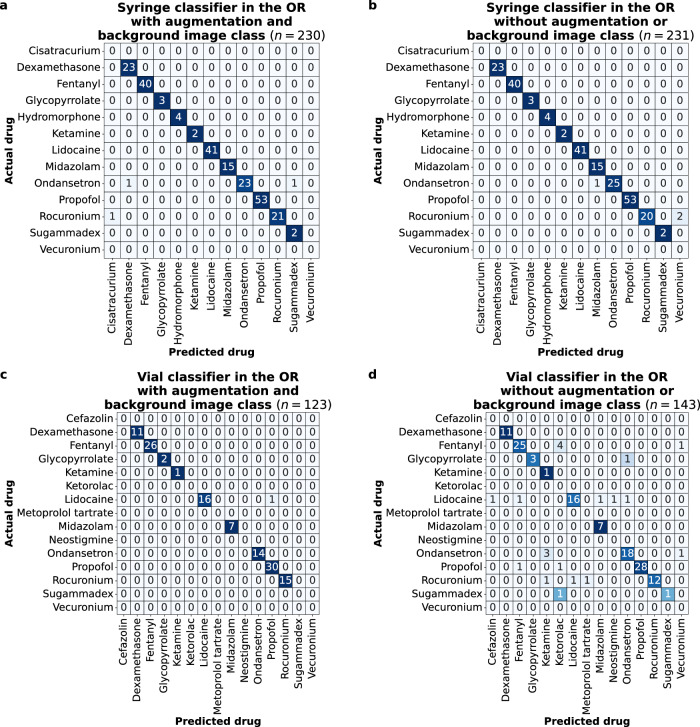
“Ourclassi fi erleveragesthepre-trainedCLIPViT-L/14transformermodel 62 , fi ne-tuned on a training dataset of drug labels.”
(2017) · Cited by 11,625
Multi-column deep neural networks for image classification
Ciresan, D., Meier, U., & Schmidhuber, J. (2012) · 2012 IEEE Conference on Computer Vision and Pattern Recognition · doi:10.1109/cvpr.2012.6248110 · Cited by 3,720
Medical error—the third leading cause of death in the US
Makary, M. A., & Daniel, M. (2016) · BMJ · doi:10.1136/bmj.i2139 · Cited by 3,264 · cited 1×
“Studies estimate that between 140,000 to 440,000 deaths annually in the United States can be attributed to medical errors 2 – 4 with 80% of adverse events occurring in the hospital, and 41% occurring in the operating room 5 .”
Best practices for convolutional neural networks applied to visual document analysis
Simard, P. Y., Steinkraus, D., & Platt, J. C. (2005) · Seventh International Conference on Document Analysis and Recognition, 2003. Proceedings. · doi:10.1109/icdar.2003.1227801 · Cited by 2,741 · cited 1×
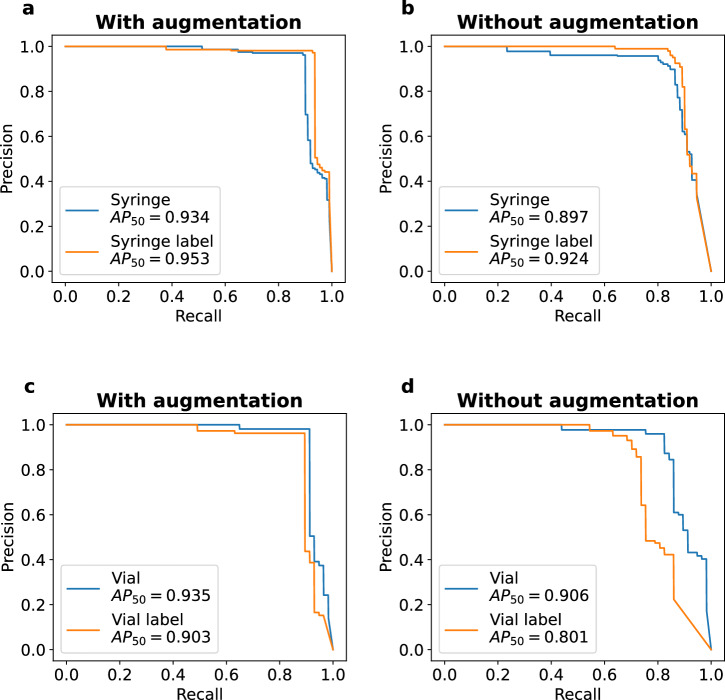
“Further, to increase the accuracy of our system, we augment the dataset using label-preserving image transformations 45,46 (see Methods) and train two separate detectors one to detect syringes and syringelabels,andonetodetectvialsandviallabels.”
Albumentations: fast and flexible image augmentations
Buslaev, A., Iglovikov, V. I., Khvedchenya, E., Parinov, A., Druzhinin, M., & Kalinin, A. A. (2020) · Information · doi:10.3390/info11020125 · Cited by 2,714
Medication Errors and Adverse Drug Events in Pediatric Inpatients
Kaushal, R. (2001) · JAMA · doi:10.1001/jama.285.16.2114 · Cited by 1,917 · cited 1×
“…most prominently in anesthesiology 12,19,20 , medication administration errors have also been shown to occur across various medical settings including pediatrics 23 , the emergency department 16 , rehabilitation unit 24 , radiology 22 , medical and surgicalwards 25 ,andtheprehospitalsetting 18 .”
The incidence and nature of in-hospital adverse events: a systematic review
de Vries, E. N., Ramrattan, M. A., Smorenburg, S. M., Gouma, D. J., & Boermeester, M. A. (2008) · Quality and Safety in Health Care · doi:10.1136/qshc.2007.023622 · Cited by 1,784
A New, Evidence-based Estimate of Patient Harms Associated with Hospital Care
James, J. T. (2013) · Journal of Patient Safety · doi:10.1097/pts.0b013e3182948a69 · Cited by 1,399 · cited 2×
“To address these challenges, we augmented the classi fi er training dataset with drug events that occurred less frequently in the operating room using additional drug events collected in the controlled environment (Supplementary Tables 3, 4).”
Research works printed but not linked: 1
- Grissinger, M. The Five Rights: a destination without a map. Pharm. Ther 35, 542 (2010).
Cited by
Wearable AI to enhance patient safety and clinical decision-making
Mahajan, A., Heydari, K., & Powell, D. (2025) · npj Digital Medicine · doi:10.1038/s41746-025-01554-w · Cited by 82
How AI can help in error detection and prevention in the ICU?
Flint, A. R., Schaller, S. J., & Balzer, F. (2025) · Intensive Care Medicine · doi:10.1007/s00134-024-07775-z · Cited by 14
“For instance, recent work has shown the possibility to detect medication errors by utilizing AI enabled wearable cameras [6].”
Mobile medical systems for equitable healthcare
Chan, J., Goel, M., Gollakota, S., & Nandakumar, R. (2025) · Nature Reviews Bioengineering · doi:10.1038/s44222-025-00330-5 · Cited by 11
“For example, wearable camera systems can detect clinical medication errors by classifying drug labels on syringes and vials and flagging if labels might be mismatched, indicating an error 25 .”
Self-citationArakawa, R., Patidar, P., Page, W., Lehman, J. F., & Goel, M. (2025) · ACM Symposium on User Interface Software and Technology (UIST) · doi:10.1145/3746059.3747700 · Cited by 18
Alnaimat, F., AlSamhori, A. R. F., El Sharu, H., Othman, L., Oralbek, A., & Zimba, O. (2025) · Journal of Korean Medical Science · doi:10.3346/jkms.2025.40.e342 · Cited by 4
“28 In a less controlled setting compared to the OR, the AI error-reduction rate ranged from 40–55%.”
Modeling anesthetic-drug label detection for low-resource operating rooms
Nsumba, S., Ninsiima, F. D., Nampawu, M. J., Nabende, P., & Nabende, J. N. (2025) · BMC Medical Informatics and Decision Making · doi:10.1186/s12911-025-03316-w · Cited by 3
“Unlike prior studies [11] conducted in high-resource settings like the United States, the Ugan-dan clinical environment presented unique challenges— including differences in drug labeling conventions, availability, and operating room configurations.”
InfluentialSelf-citationDiño, M. J. S., Arellano, Y. B., Evangelista, A. G., Esteban, W. C., Feliciano, C. M. G., Quizana, V. C., Sevilla, P. S., Trillana, R. S. C., Malacas, M. K. G., Ortiz, C. G. E., et al. (2025) · Health Science Reports · doi:10.1002/hsr2.71067 · Cited by 7
“AI ‐ powered wearable devices have also been used to detect potential MEs before administration [14].”
Beyond the End of Conservation: Tacit Knowledge and Practical Skills in the Era of AI
Otero, J., & Freixas-Jambert, R. (2025) · Studies in Conservation · doi:10.1080/00393630.2025.2582953 · Cited by 2
“Additionally, in clinical research, AI accelerates drug discovery and clinical trials by analyzing large datasets to identify potential treatments and predict outcomes (Chan et al. 2024).”
Artificial Intelligence in Anesthesiology: Comment
Higgins, K. E., Jalilian, L., Wingert, T., Margolis, R. D., Sinskey, J. L., & Vinson, A. E. (2025) · Anesthesiology · doi:10.1097/aln.0000000000005712 · Cited by 2
Machine learning for medication error detection: a scoping review protocol
Hêche, F., Yazdani, A., Ferdowsi, S., Kabak, R., Mu, G., & Teodoro, D. (2026) · BMJ Open · doi:10.1136/bmjopen-2025-109192 · Cited by 2
Machine learning for medication error detection: a scoping review protocolPreprint
Hêche, F., Yazdani, A., Ferdowsi, S., Kabak, R., Mu, G., & Teodoro, D. (2025) · medRxiv · doi:10.1101/2025.08.06.25333103
“Collectively, these capabilities underscore the promise of ML in the detection of medication errors, a challenge that has already motivated a growing body of research [61, 62, 63, 64, 65].”
Machine learning for medication error detection: a scoping reviewPreprint
Hêche, F., Ferdowsi, S., Yazdani, A., Sansaloni-Pastor, S., & Teodoro, D. (2026) · Research Square · doi:10.21203/rs.3.rs-8919709/v1 · Cited by 1
“Administration errors were addressed in 18.2% of the studies and typically within narrowly defined or specialized clinical settings [61, 62, 51, 63].”
InfluentialExploring AI-assisted cameras to assess use of contact precautions
McLuckey, R. J., Chowdhury, Z., Goodman, K. E., Pineles, L. L., Newman, M., Schrank, G. M., Morgan, D. J., Scarcelli, G., & Harris, A. W. (2026) · Infection Control and Hospital Epidemiology · doi:10.1017/ice.2026.10408
“11,12 Study limitations include persistent double-counting errors where HCP were counted more than once after entering or exiting the red zone once.”
Low-cost head-mounted camera system for medication-error detection
Nsumba, S., Kaitesi, J., Namutosi, D., Mugagga, P. K. B., Nakatumba-Nabende, J., & Nabende, P. (2026) · HardwareX · doi:10.1016/j.ohx.2026.e00812
“Similar trends toward edge-based clinical monitoring have been reported in recent studies on wearable and embedded healthcare systems [11].”
Self-citationInnovations in Surgical Quality Improvement
Kelz, R. R., & Hwang, J. (2026) · Success in academic surgery · doi:10.1007/978-3-032-30411-7_13
Xu, L., Yang, B., Jiang, S., Liu, K., Hou, K., Fan, Y., Chen, H., Yan, Z., & Jiang, X. (2026) · Proceedings of the ACM on Interactive Mobile Wearable and Ubiquitous Technologies · doi:10.1145/3832022 · Cited by 8
Advancing Perioperative Medicine With AI: Current Landscape and Research Priorities
Rohatgi, N., & Mathur, P. (2026) · JMIR Perioperative Medicine · doi:10.2196/107155
“AI is emerging to assist with medication safety checks in the operating room, provide ultrasound guidance during regional blocks, and anticipate transfusion needs [32-34].”
Metadata
- Authors
- Chan, J., Nsumba, S., Wortsman, M., Dave, A., Schmidt, L., Gollakota, S., & Michaelsen, K.
- Affiliations
- University of Washington (US)
- Makerere University (UG)
- Toyota Research Institute (US)
- Corresponding author
- Gollakota, Shyamnath
- Michaelsen, Kelly
- Venue
- npj Digital Medicine
- Published
- 2024-10-22
- Volume
- 7
- Issue
- 1
- Pages
- 287-287
- ISSN
- 2398-6352 (ISSN-L)
- PMC
- PMC11496812
- OpenAlex
- W4403619512
- Cited by
- 18
- References
- 49
- Citations by year
- 2026: 8 · 2025: 10
- FWCI
- 9.94
- Type
- journal article
- Language
- en
- Open access
- gold
- doi.org
- Licence
- cc-by-nc-nd
- creativecommons.org/licenses/by-nc-nd/4.0 (tdm)
- creativecommons.org/licenses/by-nc-nd/4.0 (vor)
- Locations
- npj Digital Medicine (publishedVersion, cc-by-nc-nd)
- PubMed Central (publishedVersion, cc-by-nc-nd)
- PubMed (publishedVersion)
- DOAJ (DOAJ: Directory of Open Access Journals) (submittedVersion, cc-by-sa)
- Funders
- Washington Research Foundation
- Foundation for the National Institutes of Health (K08GM153069)
- Foundation for Anesthesia Education and Research
- Topics
- Health Sciences › Medicine › Public Health, Environmental and Occupational Health › Patient Safety and Medication Errors
- Health Sciences › Medicine › Health Informatics › Artificial Intelligence in Healthcare and Education
- Health Sciences › Medicine › Surgery › Healthcare Technology and Patient Monitoring
- Keywords
- medication errors, wearable cameras, head-mounted camera, drug preparation, operating room, anesthesiology, deep learning, patient safety, error detection
About these checks
Registry, retraction, Cites and statistics results are computed, not judged, with one exception: a printed reference that no index lists is read once by a model before it counts as a citation error. Claims are extracted by a model and kept only when their quote appears verbatim in the text; each cited source is then checked, with a model’s help, for whether it says what the claim relies on. Those verdicts can be wrong — read the claim’s quote and the cited source before relying on one.
Statistics and arithmetic are recomputed, not judged.
Confidence bands are shown only for fields calibrated on our annotated test set. None is calibrated yet, so no band is shown.
What counts as a claim ›How we measure confidence ›How we check this ›
Are you an author, or do you see a problem with this page? Request a review
Data sources
Bibliographic data: Semantic Scholar, OpenAlex, Crossref.
Contains information from the Semantic Scholar Academic Graph Datasets, made available under the ODC Attribution License (ODC-BY 1.0).
Semantic Scholar’s data is described in: Kinney, R., et al. (2023). The Semantic Scholar Open Data Platform. arXiv:2301.10140.
